fbpx

April 4, 2024

Joseph Lieberman’s Legacy: A Courageous Voice for Iranian Democracy

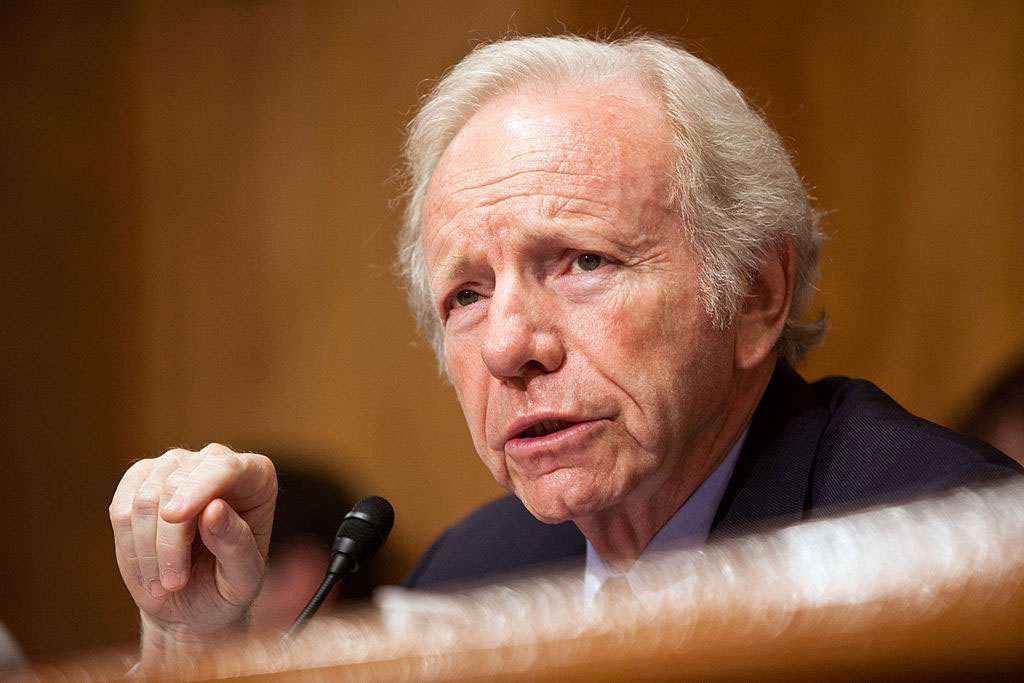
The untimely and shocking passing of former U.S. Senator and vice-presidential candidate Joseph Lieberman at the age of 82 marks a significant loss of principled leadership and patriotism in American politics. Lieberman, who served Connecticut in the Senate for nearly a quarter of a century, leaves behind a legacy of principled leadership, bipartisan collaboration, and unwavering commitment to his beliefs.

His political career was marked by numerous milestones, including his historic nomination as the first Jewish politician to join a major party U.S. presidential ticket in 2000, when Al Gore selected him as his running mate.

Lieberman’s activism transcended domestic politics, reflecting a broader foreign policy vision. His perspective vis-à-vis the Iranian regime distinguished Lieberman from many of his contemporaries. His advocacy for the National Council of Resistance of Iran (NCRI) and the People’s Mojahedin Organization of Iran (PMOI/MEK) went beyond mere rhetoric, demonstrating his broader commitment to global democratic ideals and human rights. Lieberman’s support was rooted in a deep-seated belief in their mission to bring about change in Iran, a stance that earned him respect and recognition among his peers and colleagues.

Furthermore, Lieberman’s engagement with the Iranian resistance movement underscored his understanding of the strategic importance of Iran in Middle Eastern politics and the global fight against religious dictatorship and extremism. By aligning himself with the NCRI and PMOI/MEK, he sent a clear message about the United States’ commitment to supporting democratic movements and opposing oppressive regimes. This alignment also highlighted his foresight in recognizing the potential of the Iranian opposition to play a pivotal role in Iran’s future.  His active engagement involved speaking at international conferences, meeting with opposition members, and using his platform to draw attention to the plight of those fighting for freedom in Iran.

In a political landscape often dominated by short-term interests and regional biases, Lieberman’s steadfast support for the Iranian resistance movement marked him as a principled leader willing to stand up for democratic values, even when it conflicted with official government policy.

In a political landscape often dominated by short-term interests and regional biases, Lieberman’s steadfast support for the Iranian resistance movement marked him as a principled leader willing to stand up for democratic values, even when it conflicted with official government policy.

His speeches, which repeatedly underscored the legitimacy, preparedness, and democratic vision of the NCRI and MEK, aimed to inspire confidence in both Iranian and international audiences that a free and democratic Iran was within reach. While his passing marks the end of an era, his words will continue to resonate with those who share his vision for Iran’s future.

One of the central figures in Lieberman’s support for the Iranian resistance was his endorsement of NCRI President-elect Maryam Rajavi’s 10-point plan for the future of Iran, which envisions a secular, democratic, and non-nuclear republic of Iran.

Lieberman emphasized the existence of a viable alternative to the Iranian regime, praising the NCRI and MEK for their enduring struggle against both the Shah and the Ayatollahs.

In his speech at the Free Iran World Summit 2023, he said, “Is there an alternative to the regime in Iran? Of course, there is. It is the overwhelming majority of the people of Iran who want to be free again and live lives equal to those in the rest of the civilized world. And is there an organization ready to lead the transition to power by the people of Iran? Of course, there is. It’s the NCRI and MEK. There are other opposition organizations to the regime. But I ask you, is there any one of them or gathering of any group of them that could bring together the world leaders who are in this room, the leaders of the parliaments who are just up here? Is there any other organization that has and has had… No, right, for years the Resistance fighters were on the ground in Iran.

“The NCRI and MEK have earned the right through the leadership of Massoud Rajavi to Maryam Rajavi, decades of fighting against the Shah, against the Ayatollahs to lead the transition to freedom. They have earned it, but I will tell you this, they are ready for it. We have talked a lot today, as we should always, about the Ten-Point Plan of Mrs. Rajavi. It’s a great plan, a plan for freedom, equality, and opportunity for the people of Iran. It’s one that every civilized democratic nation in the world should enthusiastically support.

“But the NCRI and Mrs. Rajavi have something else. They have a transition plan. It is out there for everybody to see. And it is a selfless plan that shows that this organization is not about seizing power. It is about making sure that the people of Iran seize power when this regime falls. It’s a plan that begins with a transition to early elections, to have a constituent assembly from the people in Iran that will then adopt the constitution, hopefully very much like the Ten-Point Plan, and will elect leaders of the country.

“I’ve been over this plan. I’ve been over it with Mrs. Rajavi. I will tell you, in my opinion, in the history of uprisings, and rebellions, for freedom in the world against dictatorships, there has never been a group of revolutionaries that are prepared to avoid chaos and provide a smooth and peaceful transition to freedom than this group, NCRI, MEK, and the people of Iran. So, there is an alternative.”

Lieberman’s support for the Iranian resistance indicated his perception of the threat the Iranian regime posed to the region. It seems he had accurately predicted the events we are now witnessing in the Middle East, including the incendiary actions of the Iranian regime. For this reason, he well understood that supporting the people’s resistance to a secular and democratic republic was the flip side of striking at the heart of Tehran’s regime’s octopus of terrorism and warmongering.


Hamid Enayat is a political scientist, a specialist on Iran, and collaborates with the Iranian democratic opposition (NCRI).

Joseph Lieberman’s Legacy: A Courageous Voice for Iranian Democracy Read More »

‘Cooking for a Cause’ Cookbook Supports Leket

After the October 7 attacks in Israel, June Hersh, the author of “Food, Hope and Resilience” and “Iconic New York Jewish Food,” like many others wanted to find a way to help.

In January, she approached the leadership at Leket Israel about her plan to compile a cookbook to benefit their organization. 

“I wanted to do something tangible to support Israel during this crisis and was aware of the remarkable work done by Leket,” Hersh told the Journal. “As the largest food rescue organization in Israel, they have focused their attention on aiding struggling farmers and feeding displaced families.”

Hersh, whose mantra is to “Eat Well-Do Good,” focuses on preserving Jewish food memory through her charitable endeavors. 

Hersh, whose mantra is to “Eat Well-Do Good,” focuses on preserving Jewish food memory through her charitable endeavors. 

“My vehicle to shine a light is food, so this seemed like a natural way for me to express my support,” she said.

Hersh gathered 70+ chefs, who contributed more than 90 recipes for “Cooking for a Cause: Feeding Israel with Love.” The book was released on February 29, and has already raised more than $25,000 for Leket. 
The 196-page digital book can be downloaded when a donation for $36 is made on the site chef.leket.org. According to the website, $36 provides 29 meals for those in need.

The recipes, Hersh explains, are accessible, yet global; familiar and innovative. 

“It is full color with recipes representing Jewish and Israeli cuisine from some of the acclaimed chefs, cookbook authors and restaurateurs including Adeena Sussman, Michael Solomonov, Jake Cohen, Eitan Bernath, Leah Koenig and so many more,” Hersh said. “It also features recipes from outspoken advocates, like Caroline D’Amore and musician Biggah as well as a couple of recipes created at the request of Hersh Goldberg-Polin’s family for some of Hersh’s favorite foods.”

One such recipe is cookbook author Shannon Sarna’s Mac and Cheese Kugel.

“When I learned that Mac and Cheese was one of [hostage] Hersh Goldberg-Polin’s favorite foods, I knew I had to contribute this recipe in his honor,” Sarna says in the book. “Is it just mac and cheese? Is it a kugel? It doesn’t really matter because this American comfort food meets Ashkenazi casserole will be an instant hit for brunches, Yom Kippur breakfast or dinner anytime you need to feed a crowd.”

She adds, “I hope it’s something Hersh adds to his favorite foods just as soon as he returns home.” Sarna’s recipe is below.

To compile the book, Hersh reached out to anyone and everyone she thought would like to contribute. 

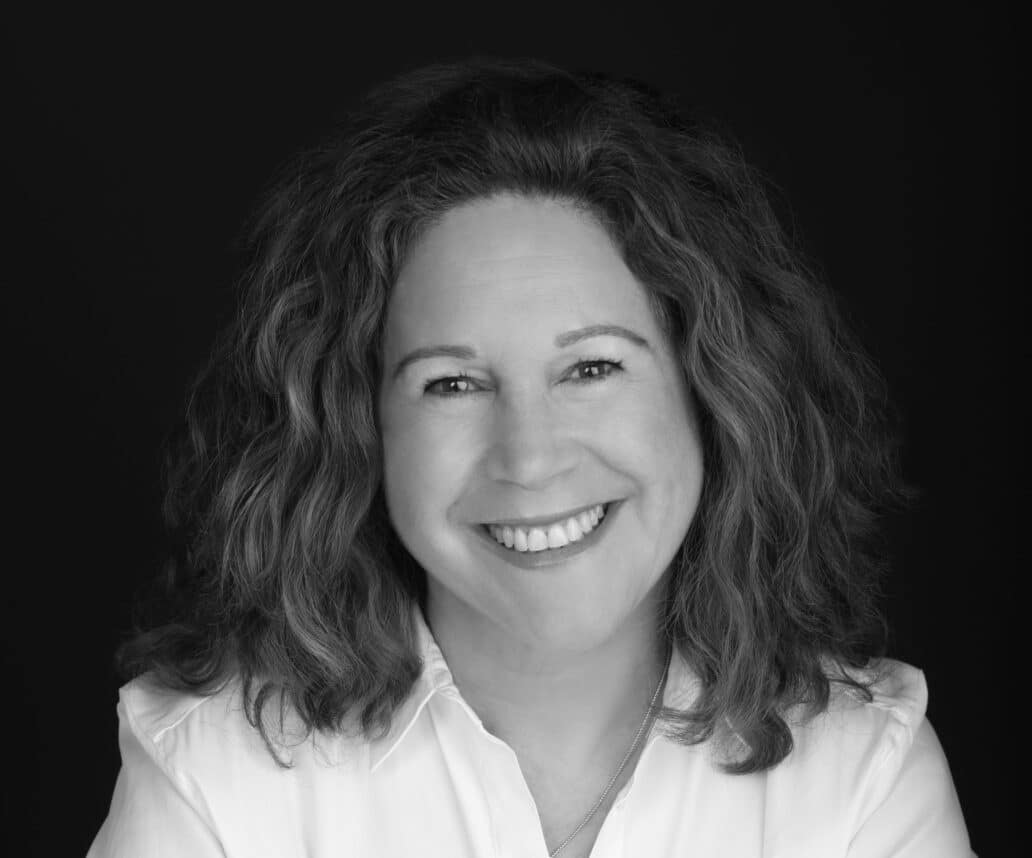
June Hersh

“The response was overwhelmingly positive with chefs from Israel, across the U.S., Europe, Australia and South Africa sending recipes,” she said.  “I then compiled everything I received and designed the book with Leket baker Paula Shoyer and my daughter Jen helping to proofread.”

They turned the project around in a month. 

“As the book title says, we are ‘Cooking for a Cause’ and ‘Feeding Israel with Love,’” Hersh said. “I hope that is felt on every page of the book.

“I hope readers feel the sense of community that is pervasive among the Jewish people, how we rally to support one another, how we can maintain our humanity and spirit, and our unwavering support of the people of Israel.“

“As we scroll through the pages of this cookbook, let us remember the importance of coming together, not only to savor delicious meals but also to uplift those in need,” founder and chairman of Leket Israel Joseph Gitler said. “May our collective efforts continue to make a difference in the lives of others.”

To learn more about the organization, go to Leket.org. To order the digital cookbook and/or donate, go to Chef.Leket.org.

Mac & Cheese Kugel 

This recipe, included in “Cooking for a Cause,” originally appeared in “Modern Jewish Comfort Food” by Shannon Sarna. Sarna is the former editor at large of The Nosher/70 Faces Media and author of “Modern Jewish Baker” and “Modern Jewish Comfort Food.”

For the base kugel
18 oz wide egg noodles
6 large eggs
8 oz mild cheddar cheese, shredded
4 oz Velveeta or American cheese, cubed, shredded or cut into small pieces
4 Tbsp butter
1 cup sour cream

For the topping
1 cup Ritz crackers
1 stick (8 Tbsp) unsalted butter, melted
2 Tbsp Parmesan cheese

1.Preheat oven to 350°F. Grease a 9×13 casserole baking dish with cooking spray.
2. Boil noodles according to directions (around 5 minutes) in a large pot of salted water. Drain noodles.
3. While noodles are cooking, place eggs, cheese, butter, and sour cream in a large bowl and mix. Add hot, drained noodles to the bowl and mix until everything is combined.
4. Pour noodles into the prepared pan.
5. Combine Ritz cracker crumbs, melted butter and Parmesan in a small bowl.
6. Sprinkle top of kugel evenly with cracker mixture.
7. Bake for 35-40 minutes, until golden on top. Allow to cool slightly before cutting into squares for serving.

‘Cooking for a Cause’ Cookbook Supports Leket Read More »

LA Federation Holds Entertainment Event, OC Federation Honors Women Philanthropists, Mensch Foundation Ceremony

24kGoldn performs at the L.A. Federation’s entertainment and media event. Courtesy of Jewish Federation Los Angeles

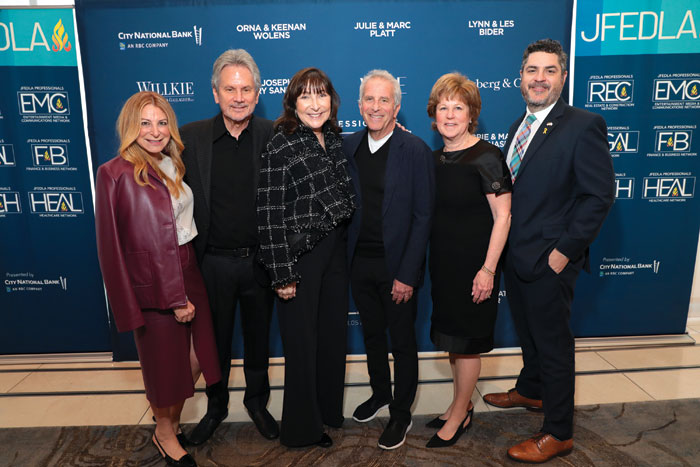
Jewish Federation Los Angeles (JFEDLA) presented the inaugural Entertainment Network Award to Nancy Josephson during its Entertainment, Media & Communications Network Event.

The glitzy March 21 gathering at the Beverly Hilton featured remarks by actress Niecy Nash and a performance by Jewish rapper 24kGoldn while raising more than $800,000 for JFEDLA’s work supporting Jewish Los Angeles.


From left: Rebbitzen Malka and Rabbi Marvin Hier; Mensch Foundation Founder Steven Geiger; and Hungarian deputy consul general Imola Szabo. Photo by Orly Halevy

On March 19, the Mensch Foundation recognized Simon Wiesenthal Center Founder Rabbi Marvin Hier with the Mensch Award, citing his “significant impact on the Jewish community,” reporter Scott Jacobs said in an article on JooTubeTV.

 Held at YULA Boys High School in Pico-Robertson, the ceremony also marked 80 years since the Nazis’ occupation of Hungary, which led to the deportation of more than 500,000 Hungarian Jews to extermination camps across Europe. 

Speakers discussed Hungarian Jewry as well as the rise of antisemitism on college campuses across the country in the aftermath of Oct. 7. They included American Jewish University scholar Michael Berenbaum; Mensch Foundation Director Steven Geiger; UCLA Emeritus Professor Judea Pearl; UCLA psychiatrist Kira Stein; YULA Head of School Rabbi Arye Sufrin; and Deputy Consul General of Hungary in Los Angeles Imola Szabo. 

http://jootube.tv/2024/03/nazis-rose-to-power-on-antisemitic.htmlRead more at jootube.tv/2024/03/nazis-rose-to-power-on-antisemitic.html. 


2024 Woman of the Year Heather Kline and bestselling author and former Special Envoy for Combating Antisemitism Noa Tishby in conversation onstage at the Orange County Jewish Federation’s Women’s VOICES event. Courtesy of Jewish Federation of Orange County

On March 14, Jewish Federation of Orange County held its annual Women’s Voices event to celebrate the impact of women philanthropists in Orange County.

The evening soiree at City National Grove of Anaheim featured bestselling author and former Special Envoy for Combating Antisemitism Noa Tishby as the keynote speaker and honored 2024 Woman of the Year and Immediate Past Chair of Jewish Federation of Orange County’s board and executive committee Heather Kline. Kline has been actively involved in the Orange County Jewish community since 2003.

“It’s incredibly inspiring to witness the power of collective purpose in a room filled with hundreds of women philanthropists,” Tishby said. “Our shared commitment to a vibrant Jewish future matters now more than ever, and the event left me feeling confident that we can build a world in which tolerance triumphs over hatred.”

Women’s Voices was created by the Jewish Federation of Orange County Women’s Philanthropy in alignment with its mission to inspire purposeful and passionate giving. The event highlights the unique Jewish journeys of women working together to amplify Jewish life in Orange County, Israel and around the world. The event also raises critical funds for the Jewish Federation Annual Campaign. 

LA Federation Holds Entertainment Event, OC Federation Honors Women Philanthropists, Mensch Foundation Ceremony Read More »

Complaint: UC Davis Failed to Take Action Against Antisemitism on Campus

The StandWithUs Center for Legal Justice (SCLJ) filed a complaint to the Department of Education’s Office of Civil Rights (OCR) against UC Davis on Monday, alleging that the university has failed to take action against multiple instances of antisemitism on campus following the Oct. 7 massacre and is in violation of Title VI of the Civil Rights Act.

The complaint centers on social media posts from UC Davis students and faculty members “advocating for, justifying, or celebrating killing Jews,” including a purported post from Assistant Professor of American Studies Jemma Decristo about how “we have easy access to … all these Zionist journalists who spread propaganda and misinformation … They have houses [with] addresses, kids in school,” Decristo wrote on X. “[T]hey can fear their bosses, but they should fear us more.” She ended the post with a knife and axe emoji followed by three blood drop emojis. And yet, the university has not “made public the final determination regarding Decristo’s status at the University,” the complaint contends.

The complaint also focuses on social media posts from UC Davis chapter of Students for Justice in Palestine (SJP), alleging that it referred to the Oct. 7 massacre as “Palestinian resistance” and that “we indisputably support the Uprising”; further, the SJP chapter blamed “the Israeli occupation” for the “escalation in violence.” The vice president of the SJP  also referred to the UC system as “a bunch of zio losers”; “Zio,” the complaint explains, “is a slur against Jews and Israelis popularized by David Duke.” In November, the SJP chapter posted that Israel has no right to self-defense “due to its status as an occupier.” And in January, the SJP said at the end of a lengthy post that “Palestinians on the ground lead the movement, we do what they say,” which the complaint interprets as “confirming allegiance to Hamas.”

But the SJP chapter’s alleged behavior goes beyond social media posts; according to a witness quoted in the complaint during a student government meeting shortly after the Oct. 7 massacre, “SJP affiliates mocked Israeli students who recounted the loss of friends and family, interrupted speeches with profanities, and reportedly threw objects at Jewish students who were present.” The complaint further claims that the SJP chapter held multiple demonstrations that violated university policy, including two demonstrations where hundreds of people attended; these would qualify as a “major event” where the organizer is required to request approval a few weeks in advance, provide proof of insurance and cover the costs associated with the event, including any damage caused by the event. They also held a walkout in October with their stated purpose to disrupt classes; during the walkout, the university “egg head” statutes were vandalized and “Nothing but hate for Israel and Zionism” signs were left at the base of the statues, per the complaint.

“UC Davis free speech policies explicitly commit to balancing the free speech rights of students against the rights of all other students to enjoy University functions — such as class — without disruption,” the complaint states. This, in addition to the “major” events held by SJP, has caused the SCLJ to question if “UC Davis has granted SJP privileged exceptions from its free speech policies.”

During an SJP rally in November in which an estimated 300-500 people showed up, the organizers led the crowd to Mrak Hall — where Chancellor Gary May’s office is located––where they issued a series of demands. Five minutes later, the protesters “began violently banging on the doors,” forcing the building to go into lockdown. One masked protester spray-painted ‘F— ADMIN” and “BLOOD ON YOUR HANDS” on the building.

The complaint also alleges that several faculty members have not properly distinguished between “speaking as a private citizen and speaking as an agent of the University.” As an example, the complaint points to the fact that several faculty members participated in an “emergency teach-in” event that was advertised on department websites without any disclaimers; one of the faculty members, English Professor Joshua Clover, allegedly said during the event that “all Israeli residents are legitimate targets” and that “people under occupation have the legitimate right to resist by all means necessary.” “This is a statement outside of personal opinion, utterly unfounded in international law and well outside the expertise of Professor Clover, a poet and professor of English,” the complaint states. “By publishing his personal opinion from the pulpit of a UC Davis event, from UC Davis facilities, as a UC Davis professor without any disclaimer at all, Professor Clover not only acted in violation of applicable policies concerning faculty speech but also directly contributed to the creation of a hostile environment.”

Asked by the Journal to comment on the allegation, Clover replied that he would provide comment “once you assure me that, as a principled supporter of liberation, you believe that Palestine should be free and that Israel must commence an immediate ceasefire as a first step toward withdrawing from all territory it has occupied since the beginning of the Nakba.”

Further, the complaint accuses Hans Wagner, a writing instructor at the university, of pausing class while a Jewish Israeli student was in the process of reading her poem out loud so he could hear pro-Palestinian protesters chanting outside; Wagner then ended the class early so he could attend the rally, which the SCLJ argues is in violation of UC policy. However, Wagner told the Journal in an email that this is “a false allegation.” “I took this up with Academic Affairs when said allegation emerged,” he said. “I take my position as a professor in the English department at UCD seriously. Furthermore, I take classroom equity, diversity, and inclusion to be principal foundations on which I teach. I do not discriminate on any basis regarding race, color, or national origin. I am happy to seek legal assistance, if need be.”

The complaint contends that university affiliated organizations are excluding Zionist students, including a student co-op housing contract agreement stipulating that “any actions of racism… [Z]ionism… will result in removal from the house” and the UC Davis rugby team revoking their invitation to a Jewish student to DJ their event after the student voiced support for Israel on social media following the Oct. 7 massacre.

The complaint also documents an instance in which a student was punched in the face after confronting an individual who was tearing down hostage posters; the complaint claims to be not aware of any response or investigation by the university into the matter.

The complaint concludes by calling for the university to adopt the International Holocaust Remembrance Alliance definition of antisemitism, provide required training on antisemitism and the Jewish identity, and investigate all antisemitic incidents that have been reported on campus. “After such investigation, to the extent warranted under campus policies, revoke SJP’s registration as a student organization, defund it and ban it from campus,” the complaint states.

“UC Davis has neglected and ignored its Jewish and Israeli students’ complaints of rising campus antisemitism,” SCLJ Director Yael Lerman said in a statement. “In doing so, the school has allowed UC Davis to become a hotbed for anti-Jewish bigotry, failing their obligation under Title VI. This complaint details the administration’s indifference to antisemitism and calls on them to remedy the situation by committing to enforce their own policies and disciplining perpetrators of antisemitic conduct. UC Davis must be held accountable and Jewish, Israeli and Zionist students must be protected.”

“UC Davis has neglected and ignored its Jewish and Israeli students’ complaints of rising campus antisemitism … In doing so, the school has allowed UC Davis to become a hotbed for anti-Jewish bigotry, failing their obligation under Title VI.” – SCLJ Director Yael Lerman

Hillel at Davis and Sacramento Board President Barry Klein also said in a statement, “Hillel at Davis and Sacramento has tried to work with the administration to protect Jewish and Israeli students on campus, but harassment and discrimination still run rampant at UC Davis. We hope that this complaint will lead to the administration taking more effective actions to address these issues.”

In a statement to the Journal, the university said, “UC Davis is committed to fostering a climate of equity and justice where all can feel welcome and thrive, free of harassment or discrimination. UC Davis has a comprehensive harassment and discrimination prevention program. When the university receives a complaint of antisemitism or other offensive behavior, it immediately reaches out the affected parties to provide support and resources, and reviews the allegations under the university’s anti-discrimination policy. Chancellor Gary S. May has spoken out forcefully against antisemitism, and has joined with UC President Michael V. Drake and chancellors across the University of California in condemning bigotry and intolerance.” The university added that they are a participant in the Hillel Campus Climate Initiative.

“We take student safety very seriously, and follow up on all reports of students not having an equal opportunity to pursue their education or that may need protection due to lack of safety,” the university’s statement continued. “Students or their supporters can directly report concerns to our Office of Student Support via this webform, and a case manager will review and follow up directly with the impacted student(s). Free speech is strongly protected by university policy and the First Amendment. As a public university, UC Davis cannot discipline individuals for speech protected by the First Amendment. Even when allegations center on protected speech, the university provides resources and explores supportive measures for the affected parties.”

Complaint: UC Davis Failed to Take Action Against Antisemitism on Campus Read More »

The Laws of Creature Eaters – A Poem for Parsha Shemini

These are the creatures that you may eat among all the animals on earth…
~ Leviticus 11:2

I remember what it was like to
eat the creatures of the earth.

The satisfaction of their protein.
The feeling I was really eating something.

Thirty-seven years later, I still complain
if there’s no Tofurky at Thanksgiving.

A grown-up boy needs his meat
even if it’s the faux kind.

I wander through the restaurants of the world
longing for a leaf icon next to

a variety of choices indicating they
had me in mind when they

put their whole thing together.
The uninitiated still tell me

I think they have salads and it
only serves to make me weep.

I just want to be a regular person
in a world of creature eaters.

The only time the text speaks to me on this
is near the beginning when it says

to not eat from the tree of knowledge.
That didn’t go well and now we know too much.

Rest safely oh creatures of the day and night.
Whether you have joints and hop

or cloven feet or chew your cud.
Whether you are forbidden or allowed –

Your flesh will never pass these lips.
This is my promise. This is how I will

observe these laws. Now I’m off to have a salad
and weep.


Rick Lupert, a poet, songleader and graphic designer, is the author of 27 books including “God Wrestler: A Poem for Every Torah Portion.” Find him online at www.JewishPoetry.net

The Laws of Creature Eaters – A Poem for Parsha Shemini Read More »

Umbraphiles and Poets Put into the Shade by their Wifely Shidduch

People who are lovers of the sun’s eclipses

are known as umbraphiles, which doesn’t mean that they

believe that God is an umbrella, although gypsies,

of whose beliefs I know extremely little, may.


Some people used to think eclipses were a portent

of bad things that would happen, by them made afraid.

For those who dream that they’re the sun, it is important

to find a moon so they’ll be put into the shade.


Joseph found such shade in Egypt while exilic,

and let himself be covered by fair Asenath.

Every student of the sun who’s umbraphilic

becomes ecstatic when the moon is in its path,


reflecting thus the way that every hubris hus-

band orbited by his wife becomes ecstatic,

just as this poet shadowed by his shidduch does,

when, down to earth, his tides appear to be erratic.


Shidduch:  a Yiddish word denoting a marital match.

 “Umbraphile”: a person who enjoys observing eclipses of the sun.

Ps.91:1 may be interpreted as implying that all human beings should be umbraphiles:

יֹ֭שֵׁב בְּסֵ֣תֶר עֶלְי֑וֹן בְּצֵ֥ל שַׁ֝דַּ֗י יִתְלוֹנָֽן׃

O you who dwell in the hiding place of the Most High, and abide in the shade of God, whose name is Shaddai.

I dedicated the original version of this poem to the late Jay Pasachoff, a distinguished professorial umbraphile whom Dennis Overbye praised in “A Lifetime Under the Moon’s Shadow,” NYT, 4/2/24.  Unfortunately, Jay has landed in the valley of the shadow of death due of his smoking habit which I regretfully observed four years before his passing.


Gershon Hepner is a poet who has written over 25,000 poems on subjects ranging from music to literature, politics to Torah. He grew up in England and moved to Los Angeles in 1976. Using his varied interests and experiences, he has authored dozens of papers in medical and academic journals, and authored “Legal Friction: Law, Narrative, and Identity Politics in Biblical Israel.” He can be reached at gershonhepner@gmail.com.

Umbraphiles and Poets Put into the Shade by their Wifely Shidduch Read More »

A Bisl Torah – Journey to the Promised Land

Of all the Jewish holidays, Passover requires the longest preparation. We clean our homes, kasher our kitchens, buy an obscene amount of food and design elaborate seder meals. There is an abundance of effort and exhaustion in the process of attaining “freedom.”

Perhaps, this is a minuscule step in understanding the historical journey of our people. Freedom was an effort filled, exhausting process. A mental and physical maze that felt impossible to escape. Imagine a Pharaoh that refused to let our people go, even after giving hints of relenting. Imagine a Jewish people that prayed day and night to live safely in the Promised Land?Imagine preparing for a meal in which you are a main character of the story, seeing yourself as an essential ingredient in the continuity of Jewish living?

An effort filled, exhausting journey that doesn’t feel far from what our people are experiencing today. Today, we pray for a “Pharaoh” to let our people go. We yearn for safety and freedom in our holy land. When we read the Haggadah, this year, it is easier to see ourselves as the ones that are trying to flee the narrowness of Egypt. The ones that urgently open the door for Elijah, anguished with wonder if peace will be achieved in our lifetimes.

But remember, at the end of the seder, we sing “Dayeinu.” A song of gratitude for leaving Egypt. An exultation for receiving the Torah and Shabbat. We cry with joy, “All of this would have been enough!” Because the taste of freedom is beyond glorious.

Although the journey is arduous and long, we too must believe freedom is coming. And when we “cross into the Promised Land”, we will sing. And undoubtedly, we will give thanks.

Shabbat Shalom


Rabbi Nicole Guzik is senior rabbi at Sinai Temple. She can be reached at her Facebook page at Rabbi Nicole Guzik or on Instagram @rabbiguzik. For more writings, visit Rabbi Guzik’s blog section from Sinai Temple’s website.

A Bisl Torah – Journey to the Promised Land Read More »

A Moment in Time: “What is a Reform Jew?”

Dear all,

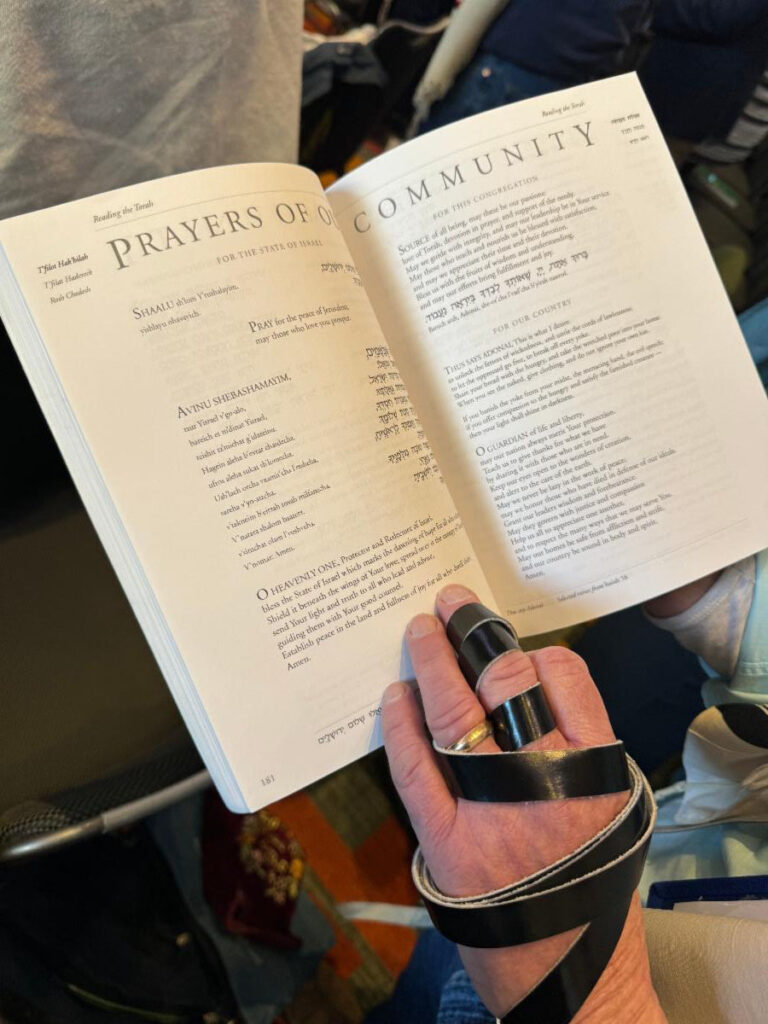
During our worship service at my recent convention of Reform Rabbis, I noticed many things goings on around me. To my left was a colleague wearing no religious symbols. Behind me was a colleague with a tallit. In front of me was a colleague with a kippah. And next to me was a colleague with tefillin (pictured here, as we offer the prayer for the State of Israel).

Many different expressions – all under one umbrella of Judaism. When the movement began in the 19th century, Reform Judaism was about forming a new religious identity as American Jews bound by ancestral ties and ethical laws.

What does it mean to be a Reform Jew in 2024?

At its core, to be a Reform Jew means:

-To accept the responsibility as a member of our tribe.

-To engage with the voices of our people by becoming familiar with Jewish texts and Jewish music.

-To wrestle with those texts (rather than ignore them or walk away from them).

-To be thoughtful about the Jewish choices we make.

-To understand that what happened at Sinai DOESN’T stay at Sinai. (In other words, we have an opportunity to be part of a living story, and we carry the torch into the future.)

-To advocate for those who may feel broken by society.

-To connect with Israel.

-To allow Jewish laws to guide (but not necessarily govern) our lives.

-To realize we are a link in a chain. (Yes, it’s awesome that grandpa was a kosher butcher. But what will my grandchild be because of what I am doing today?)

-To accept that in this moment in time, we have an opportunity to make the world a better place with Jewish values.

Being Reform is not about what we don’t practice. It’s about what we do practice.

And it’s about how we allow ancient traditions to imbue contemporary life with meaning.

With love and shalom.

Rabbi Zach Shapiro

A Moment in Time: “What is a Reform Jew?” Read More »

Print Issue: Prince of Truth | April 5, 2024

CLICK HERE FOR FULLSCREEN VERSION

Print Issue: Prince of Truth | April 5, 2024 Read More »

JFSLA Brings Joy to Holocaust Survivors with Café Europa

Every Tuesday at lunchtime, 106-year-old Holocaust survivor Risa Igelfeld saves a seat for her friend, 92-year-old, Maria Ross. Igelfeld met Ross the first day she came to Jewish Family Service LA’s Café  Europa, a weekly program where Holocaust survivors congregate and socialize. 

The fourteen-year age difference between the two Holocaust survivors is inconsequential. Their shared experience of losing family members during WWII and being forced to flee their homes and start over in America connects them. 

This bond is woven among Café Europa participants, who meet weekly at either JFSLA’s Gunther-Hirsch Family Center or the Valley Storefront Community Resource Center. Social worker Susan Belgrade, JFSLA’s Senior Director of Multipurpose and Senior Centers, oversees the program. 

For Belgrade, it’s not just work, it’s personal. 

Belgrade’s 98-year-old mother, Rose Gross, is a Holocaust survivor who comes to Café Europa every week. Gross gets so excited to come to Café Europa that she picks out her clothes the night before. A wide smile flashes across Belgrade’s face as she watches her mother show off her outfit to the other survivors. 

While participants exchange pleasantries about family and fashion choices, there is a deeper understanding of the shared hardships they have endured. 

“They understand what each other went through during the war, whether they were hidden in the forest, in a camp or on the run,” said Belgrade.

While the survivors sometimes process their shared trauma at Café Europa, the organizers of the program foster an environment marked by joy and celebration. Music and movement are a core part of almost every weekly meeting. For those with memory impairment, song awakens something inside the survivors. 

While the survivors sometimes process their shared trauma at Café Europa, the organizers of the program foster an environment marked by joy and celebration. Music and movement are a core part of almost every weekly meeting. For those with memory impairment, song awakens something inside the survivors. 

“When I see people dancing and singing and smiling and laughing and clapping and forgetting about all the pains and inconveniences in life, it makes me cry tears of joy,” said survivor Ross.  

Ross’ best friend in the program, Igelfeld, will often play piano for the group, harkening back to her days when she was a world-famous touring musician singing in 17 different languages. 

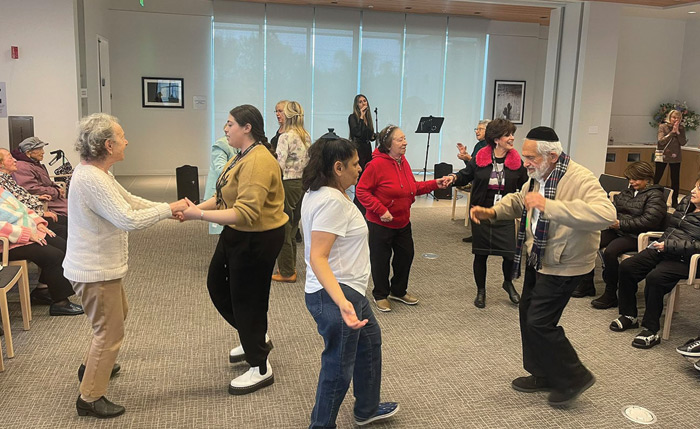
Bands like The Kosher Cowboys will stop by to volunteer their time and play for the seniors at Café Europa. On the upper floor of the newly-remodeled Gunther-Hirsh Family Center at JFSLA, Café Europa participants hold hands and dance in jubilation, many with assistive mobility devices. 

As the population of Holocaust survivors has aged, Café Europa’s programming has adapted. Many participants are accompanied by caregivers and some are brought to the community centers via Lyft vouchers, which are provided by JFSLA.  

Café Europa’s first and longest-serving volunteer, Colette Ament, remembers a time when the participants could get around more easily, but has seen how the unique bonds that connect these survivors have continued to grow. 

Ament, a current JFSLA board member, has witnessed survivors who hadn’t seen each other since the war reconnect through Café Europa. “The sense of continuity this program provides—they never thought they’d see this person again, and yet here they are,” she said. 

The volunteers at Café Europa are stalwarts who have been coming to the weekly gatherings for years. Ament introduced the program to her friend, JFSLA board member Shana Passman, who quickly fell in love. 

“It’s the highlight of my week,” said Passman. “There is just something about being around Café Europa that is uplifting and inspiring. And I have an idea it’s the survivors’ favorite day too.”

Many of the survivors who anchor their week around Café Europa were distraught when COVID hit and in-person gatherings were suspended. Understanding how vital this program is for the mental health and well-being of the seniors, Café Europa volunteers quickly pivoted and got creative. 

Volunteers would socialize with the Café Europa participants from outside their balconies at a safe distance. Nutritious meals were delivered to participants in need of food. 

While some Café Europa participants receive social services from JFSLA, the socioeconomic makeup of the participants is broad. Café Europa serves Holocaust survivors from all walks of life. Some participants are donors to JFSLA, while others are living at the poverty line.  

Despite income differences, the survivors come together to revel in their shared resilience. When asked about her secret to longevity as a spry 106-year-old, Igelfeld said, “I’m a hundred and six and four months. Don’t forget the four months!”

“I lost my two beautiful children and my sweetheart,” she continued. “I just asked myself one question, can I change it? No, I can’t. But what can I do? Count my blessings that they had been in my life.”

The survivors’ fortitude has been tested again in the wake of the October 7th terror attacks. When processing how they feel about living through another mass murder of Jews, some lean into the group discussion, while others prefer to navigate the trauma more independently. 

To provide additional support post-October 7th, JFSLA’s former Executive Vice President, Susie Forer-Dehrey, has been running a group specifically geared toward child survivors of the Holocaust. 

“During the Holocaust, there was no State of Israel yet. There was no place to go. It gives them strength that there’s a homeland they can go to and are connected to,” said Forer-Dehrey. 

The Holocaust survivors of Café Europa were clear about how others should respond in the face of the October 7th attacks.

“Be proud that you’re Jewish. This is number one. No matter what,” said Ross, who was forced to flee her Soviet Union home to the freezing temperatures of Siberia during WWII. 

“We’ve survived the Holocaust and we will survive this too.”

JFSLA Brings Joy to Holocaust Survivors with Café Europa Read More »