

Why a New Jewish Documentary Podcast, ‘The Nightingale of Iran,’ Absolutely Soars
After arriving in America in the 1990s as a little girl from post-revolutionary Iran, I spent a lot of time yelling. I yelled at the radio and the television set. And I yelled at anyone who controlled the radio and television set.
I often yelled the most when the radio, which was always tuned in to our local Persian-language station in Los Angeles, sporadically played Āvāz, a mode of Persian music characterized by unmetered vocals. Āvāz is the closest thing Persian music has to the improvisation of jazz, yet the instruments are not saxophones or drums, but the haunting human voices themselves.
For decades after leaving Iran, I actively avoided listening to Āvāz. It was too heavy, too emotional, and, for some reason, it felt laced with pain and trauma. And it was so unfamiliar to Western ears, including those of my new-found American friends, that I was desperate to leave it in the past. I had arrived in America, and Āvāz had no business following me here.
Several weeks ago, after nearly 30 years of not listening to such powerful Persian singing, I broke down and sobbed cathartically when, in the first few seconds of the extraordinary new audio documentary podcast, “The Nightingale of Iran,” I heard the imitable voice of one of the greatest Āvāz singers in modern Persian history, the man whom my family and I, and tens of thousands of fellow Iranian Jews, have only known by one name: Dardashti.
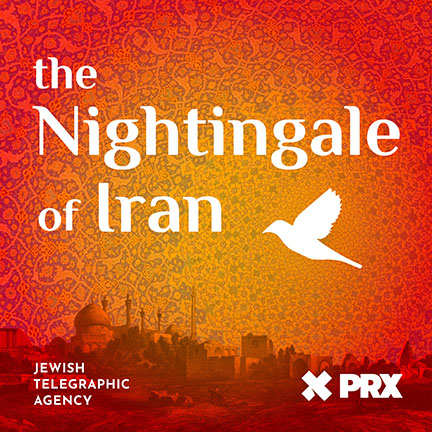 The podcast, which is presented by the Jewish Telegraphic Agency (JTA) and distributed by PRX, is the brainchild of sisters Danielle and Galeet Dardashti. The six-part series offers a master class in storytelling, music and identity as they interview family members and experts, and unearth previously unknown reel-to-reel, cassette and VHS tapes in their parents’ New Rochelle basement, to uncover a secret spanning over six decades.
One of the most endearing aspects of “The Nightingale of Iran” is that listeners themselves are witnesses to the sisters’ own slowly-unfolding, multi-layered uncovering of this secret. The podcast masterfully reveals this secret to listeners as each episode progresses.
That secret focuses on why Danielle and Galeet’s legendary paternal grandfather, Younes Dardashti, as well as their father, Farid Dardashti, suddenly left pre-revolutionary Iran at the height of their fame and success. Beginning in the late 1940s and 1950s, Younes, a religious Jew who was known by Iranians as “the Nightingale” (“bolbol” in Persian) for his astounding vocal range, defied religious boundaries between Jews and Muslims by becoming one of the country’s most famous classical singers, selling out concert halls and even performing for the late Shah Mohammad Reza Pahlavi at the royal palace. After the 1979 Islamic revolution, most of his radio recordings (he never recorded an album) were either lost or destroyed.
Known to Muslim fans as “Ostad” (“Maestro”), Younes, who was raised an orphan in Tehran’s Jewish ghetto at the beginning of the 20th century, enjoyed levels of fame and popularity previously unknown to Jews in modern-day Iran.
In the early 1960s, his son, Farid, became a teen idol, pop star and TV personality. Growing up in America, Galeet and Danielle (and their younger sister, Michelle) never contemplated why their father and grandfather left Iran so many years before the 1979 Islamic revolution, during what was commonly known as a golden age of Iranian Jewry.
But in 2021, Danielle, a documentarian, and Galeet, an anthropologist and gifted musician, found themselves with more time on their hands during the height of the COVID-19 pandemic. The podcast takes listeners through their journey of uncovering the complexities surrounding the Iranian Jewish community itself, and how those complexities affected Younes, Farid and their future generations (Danielle and Galeet’s mother, Sheila, is Ashkenazi and a talented folk singer and songwriter; she and Farid met in the 1960s and also began singing as a duo.)
The podcast is currently the number one Jewish podcast in America, according to Apple’s charts. It also ranks third on Apple charts for music history podcasts (between “A History of Rock Music in 500 Songs” in first place and “Dolly Parton’s America” in third), and ranks seventh in music podcasts overall.
I asked Galeet and Danielle, who live in New York, why they believe “The Nightingale of Iran” is soaring on the charts, alongside shows produced by some of the biggest studios in the world. Few could have imagined that the story of an Iranian Jewish family would captivate listeners from around the world, including many non-Jews who have reached out to the sisters.
“Foremost, what people are reaching out to us to say is that it’s the emotions in the podcast about family stories, about wanting to preserve them and feeling that time is moving really fast,” Danielle told me. “We have heard from people in every walk of life who have identified with those emotions and with our struggle in telling our family’s story.”
Galeet believes that the story is resonating with listeners on different levels, including immigration, assimilation, belonging and remembering. Fans of the podcast span the world, from Norway and Germany to New Zealand and yes, back in Iran. “Hearing from people in Iran and how they really want to tell us their stories has been amazing and overwhelming,” said Galeet.
“The Nightingale of Iran” is crucial in shedding a light on Jewish diversity at precisely a time when millions worldwide are exposed to false narratives about Jews and whiteness, especially in light of the ongoing Israel-Hamas war. “People around the world don’t know there were or are Jews in Iran,” said Galeet. “This is mind-blowing to them.”
The timing of the podcast is also vital given that in the last decade or so, young Sephardic and Mizrahi Jews in North America have also shown greater interest in connecting with their roots. “I know because I’ve been doing this — making Persian and Middle Eastern Jewish music — for a long time,” Galeet said. “People are excited to connect with their own histories.”
In September, Galeet released a personally meaningful album named “Monajat,” in which her vocals intertwined with the voice of her late grandfather, Younes, who passed away in Israel in 1994. Granddaughter and grandfather sang together across time, space and life itself.
Beyond the nearly-perfect timing, the stars seemed to have aligned for Danielle and Galeet, who are the first to acknowledge that they had a “really good team,” including sound and story editors.
Like a warm cup of soothing Persian tea, this story should be savored; never rushed or enjoyed mindlessly.
I won’t give away the secret that Danielle the storyteller, and Galeet the musician and scholar, painstakingly unearthed as they dug deeper into their family’s story. I will only warn listeners that once they begin listening to “The Nightingale of Iran,” it will be difficult to stop. Like a warm cup of soothing Persian tea, this story should be savored; never rushed or enjoyed mindlessly.
As for me, the voice of the Nightingale and the wonderful stories in the podcast brought with them the closure and comfort that had eluded me for decades. In a way, the Dardashti story is my story as well; it flows through anyone who has ever wondered who they are and from where they came.
And though the Dardashti sisters were born in the U.S., Galeet wants to visit Iran “more than anything.” For now, she will still have to wait. “I feel nostalgia for a place we’ve never been,” she said. And then, Galeet made an observation that I will never forget: “Nostalgia is about a rupture.”
In many ways, “The Nightingale of Iran” heals part of that rupture by reminding listeners that one of the greatest ways to offer love for one’s identity and family is to simply ask a few questions, and record the responses. And then, to ask a few more.
Galeet and Danielle Dardashti will speak after Shabbat services and dinner at IKAR on Friday, April 5. Services begin at 6:30 p.m.
For more information about the podcast, visit www.nightingaleofiran.com/ http://www.nightingaleofiran.com
Tabby Refael is an award-winning writer, speaker and weekly columnist for The Jewish Journal of Greater Los Angeles. Follow her on X and Instagram @TabbyRefael
Why a New Jewish Documentary Podcast, ‘The Nightingale of Iran,’ Absolutely Soars Read More »
