fbpx

December 7, 2023

Hanukkah Light: Avoiding Shadows and Illusions

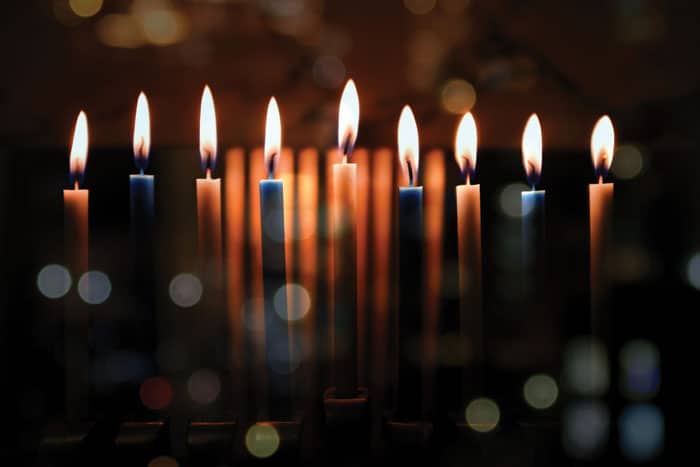
The Talmud (Shabbat 21b) records a famous debate between the Schools of Shammai and Hillel as to how to light the Hanukkah lights.  Bet Shammai rules that we should light 8 lights the first night, and then subtract one light each ensuing night. After all, the original miracle of the oil in the Temple would have entailed the oil diminishing a bit each day.

Bet Hillel rules that we should light one light the first night, and then increase the number of lights night after night. (This is the accepted practice.) A reason is suggested: in matters of holiness, we increase rather than decrease. The miracle of Hanukkah is more beautifully observed with the increasing of lights; it would be anti-climactic to diminish the lights with each passing night.

Increasing lights is an appealing concept, both aesthetically and spiritually. But the increase of light might also be extended to refer to the increase in knowledge. The more we study, the more we are enlightened. When we cast light on a problem, we clarify the issues. We avoid falling into error. The more light we enjoy, the less we succumb to shadows and illusions.

Aesop wisely noted: Beware lest you lose the substance by grasping at the shadow. It is all too easy to make mistaken judgments by chasing shadows rather than realities.

The illusion of validity leads to innumerable errors, to wrong judgments, to unnecessary confrontations. Shedding more light leads to clearer thinking. It enables people to see errors, to cast off shadows and get closer to truth.

Professor Daniel Kahneman, the Israeli Nobel Prize winner in Economics, has coined the phrase “illusion of validity.” He points out that we tend to think that our own opinions and intuitions are correct. We tend to overlook hard data that contradict our worldview and to dismiss arguments that don’t coincide with our own conception of things. We operate under the illusion that our ideas, insights, intuitions are valid; we don’t let facts or opposing views get in our way.

The illusion of validity leads to innumerable errors, to wrong judgments, to unnecessary confrontations. If we could be more open and honest, self-reflective, willing to entertain new ideas and to correct erroneous assumptions — we would find ourselves in a better, happier and more humane world.

In her powerful book, “The March of Folly,” Barbara Tuchman studied the destructive behavior of leaders from antiquity to the Vietnam War. She notes: “A phenomenon noticeable throughout history regardless of place or period is the pursuit by government of policies contrary to their own interests.” She points out: “Government remains the paramount area of folly because it is there that men seek power over others — only to lose it over themselves.”

But why should people with political power succumb to policies that are wrong-headed and dangerous? Tuchman suggests that the lust for power is one ingredient in this folly. Another ingredient is an unwillingness to admit that one has made a misjudgment. Leaders keep pursuing bad policies and bad wars because they do not want to admit to the public that they’ve been wrong. So more people are hurt, and more generations are lost — all because the leaders won’t brook dissent, won’t consider other and better options, won’t yield any of their power, won’t admit that they might be wrong. These leaders are able to march into folly because the public at large allows them to get away with it. Until a vocal and fearless opposition arises, the “leaders” trample on the heads of the public. They are more concerned with their own power politics, than for the needs and wellbeing of their constituents.

The march of folly is not restricted to political power. It is evident in all types of organizational life. The leader or leaders make a decision; the decision is flawed; it causes dissension; it is based on the wrong factors. Yet, when confronted with their mistake, they will not back down. They have invested their own egos in their decision and will not admit that they were wrong. Damage — sometimes irreparable damage — ensues, causing the organization or institution to diminish or to become unfaithful to its original mission. The leader(s) march deeper and deeper into folly; they refuse to see the light.

Bet Hillel taught the importance of increasing light. Shedding more light leads to clearer thinking. It enables people to see errors, to cast off shadows and get closer to truth.

It takes great wisdom and courage to avoid having the illusion of validity. It takes great wisdom and courage to evaluate and reevaluate decisions, to shed honest light on the situation, to be flexible enough to change direction when the light of reason so demands.

The lights of Hanukkah remind us of the importance of increasing the light of holiness and knowledge.

The lights of Hanukkah remind us of the importance of increasing the light of holiness and knowledge. As we learn to increase light, we learn to seek reality and truth — and to avoid grasping at shadows and illusions.


Rabbi Marc D. Angel is Founder and Director of the Institute for Jewish Ideas and Ideals.

Hanukkah Light: Avoiding Shadows and Illusions Read More »

Some Reflections on the Reform Movement at 150 Years

As the URJ (Union for Reform Judaism) prepares to observe its 150th anniversary in Washington D.C. (December 15-17), this affords us an opportunity to assess the impact of our largest denominational movement. We are reminded that this celebratory gathering takes place against the backdrop of events surrounding October 7th. While it may be too soon to project the impact of the Gaza War on American Jewish religious behavior, no doubt this moment, with the onset of increased antisemitism, will likely create a series of ripple effects in our community.

The Reform Movement’s celebration next week coincides with the observance of Chanukah and reminds us that the roots of this holiday speak to a religious revolution, where the Maccabees’ sought to reclaim Jewish tradition, removing the imprint of Greek influence and customs. Viewed from an historical context, Reform Judaism represented a transformational expression introducing a universal response to Jewish thought that might be seen in contemporary terms as challenging the Maccabean notions of a return to traditional practice.

Judaism has always had to endure and acclimate to change. Within the context of the American religious space, the Protestant idea of “denominations” would also define the American Jewish religious framework. From 1873 until the closing decades of the 20th Century, the UAHC (Union of American Hebrew Congregations) as it was historically known, proved successful as a denominational structure serving the needs and aspirations of its more than 800 affiliated congregations. The Movement’s rich history testifies to both its universal prophetic message and its commitment to meld a modern form of Jewish religious expression with the American experience. Through its various auxiliary bodies and denominational resources, Reform Judaism has provided a rich, textured North American connection for millions of Jews.

As we have observed elsewhere, the religious marketplace today is undergoing a series of major transitions. If competition and capitalism described the American religious model of the past, collaboration and partnerships will be the mantra for the emerging religious marketplace. We are living in a different eco-system that celebrates and promotes individualism and social media connectivity. Chanukah may be the perfect case study, as we increasingly observe alternative and creative expressions of how this holiday is observed and practiced.

The success of this enterprise is directly connected with its conscious focus on welcoming non-Jewish partners and Jews by choice, becoming increasingly aware of the need to remove barriers for Jews of Color, while also welcoming the LGBTQ community. No doubt, its controversial decision around patrilineal descent (1983) has afforded opportunities for many families to find a Jewish religious home. The URJ’s 14 camps are seen by some as the centerpiece of the Movement. Designed to “enrich and transform lives by strengthening Jewish identity, teaching Jewish knowledge, instilling Jewish values, exploring campers’ connection to Israel, and cultivating lifelong friendships—all informed and inspired by the traditions and values of living Reform Judaism,” the camps have generated significant interest and support both from inside and outside the Movement.

Since 1985, the “Second American Jewish Revolution” would introduce a boutique model of communal and religious expression, as alternative organizations began to fill specific programmatic niches, while distinctively playing to the changing tastes, interests and expectations of younger American Jews. All of this is happening from the outside in or from the bottom up. The pace and the nature of these emerging structural changes make this moment both unique and challenging for such mainstream legacy systems as the Reform Movement.

Just as we are seeing mergers, the downsizing and even closure of churches, similar patterns are taking place inside the Jewish religious space. The arrival of multi-Judaisms is at hand. The emerging changes in synagogue life in North America will include various organizing schemes. The shift from the contemporary synagogue model to multiple organizing and delivery approaches, from online Judaism to highly individualized or privatized models of personal religious expression.

Just as we are seeing mergers, the downsizing and even closure of churches, similar patterns are taking place inside the Jewish religious space.

In the near term, the operational tasks ahead for synagogues will be managing the “dwellers” (existing members), serving the “seekers” (individuals who are in search of a religious community), even as we encounter a growing number of religious “nones” (those who are opting out of formal religion by checking the box, “none of the above”).

Moving forward, new religious organizing models will be required, with distinctive offerings, appealing to a marketplace of choice and to individualized needs (privatized Judaism). The undoing of institutional boundaries is in play, as partnerships and collaborative relationships will define elements of this new religious economy. The idea of “membership,” the traditional dues model, and the costs associated with “affiliation” all will contribute to an exploration of alternative Jewish organizing schemes. Even beyond the boundaries of institutional religion, Jewish demographics suggest a far more diffuse, assimilated and diverse community than had once defined who Reform Jews were—making it harder for traditional denominational bodies to deliver their product and messages.

Indeed, at the URJ Biennial in Washington in 2011, URJ President Rick Jacobs framed the challenges facing the Movement and more directly the Union. Beyond the financial concerns, in part generated by the 2008 economic recession, synagogues were reporting a decline in memberships, Jacobs noted the efforts by the Union’s primary partners, HUC-JIR and the CCAR to more effectively collaborate in order to address the issues facing the Movement. To be certain these unresolved challenges remain.

How Israel is perceived and supported among Reform leadership and its congregations has drawn particular attention. Here its critics have argued that Reform is not adequately committed to the Israel agenda. As Rabbi Ami Hirsch noted at a conference that he helped to organize, held earlier this year, entitled “Recharging Reform Judaism:  “Whenever Jews abandoned their ideological—or practical—commitment to Am Yisrael, they eventually drifted away.”

As social justice is a centerpiece of the Movement, some of its critics have charged that various positions taken by the Union’s public policy arm, the RAC, are seen as merely an extension of the Democratic Party, failing to reflect more directly Jewish tradition and law.

For some older members, who define themselves as “Classical” Reform Jews, the Movement’s shift to more Hebrew and traditional practices are seen as problematic, while other long term synagogue members regret the constant introduction of new liturgy and music, seeing it as disruptive and unfamiliar.

Others have raised concerns regarding the Union’s decision to close its regional operations, feeling that this has further distance congregants from URJ programs and personnel.

In connection with small congregations, where demographic trends and financial pressures are negatively impacting certain “dying” Jewish communities, these realities reflect the broader operational challenges facing religious institutions across denominations in rethinking their traditional organizing model.

Moving forward, how ought we to understand the future for liberal Judaism? Reform Judaism will have a unique opportunity to build collaborative partnerships, beyond its existing denominational walls, with an array of organizational players. This moment affords the URJ and others an opportunity to build creative networks involving other sectors within the Jewish religious enterprise, and beyond. 

As with the evolution and reinterpretation of Chanukah, the strength of the Reform Movement may well be its capacity to absorb new and innovative ideas and continue to be audacious in engaging contrarian perspectives and introducing new models of practice.


Dr. Steven Windmueller is an Emeritus Professor of Jewish Communal Studies at the Jack H. Skirball Campus of HUC-JIR, Los Angeles. His writings can be found on his website, www.thewindreport.com.

Some Reflections on the Reform Movement at 150 Years Read More »

Debut Novel Shines a Lyrical Light

A gray mouse, a drum-loving Russian house spirit known as Barabashka, the constellation Orion and an émigrée Jewish ballerina from the former Soviet Union are on their way to an oncology appointment in Philadelphia in December 1997. The mouse has slid down Orion’s bowstring smelling “like Leningrad: wet granite, lilac, cabbage soup, the crease of Matthew’s neck, and Babby’s perfume”; Barabashka “is bobbing his head and drumming on his angular knees that are sticking up above his ears.” The first three are, of course, creatures of the ballerina’s mind, there to lend support as she meets the oncologist who will give her the diagnosis. But as she thinks: “What’s the worst that could happen? I die?”

Thus begins “The Light of Seven Days” (Delphinium Books, 2023), a compulsively readable, lyrical first novel by River Adams, a former concert pianist from the former Soviet Union. In the hands of a less talented writer, the subject matter—a seriously ill young ballerina; antisemitism in the Soviet Union; the shadow of Chernobyl; a refugee finding sanctuary in the United States—could be maudlin, didactic or smug. Adams almost entirely avoids these pitfalls by spicing the story with an acerbic eye and determined rejection of pathos. Narrative technique aside, there’s the glorious prose. At risk of fawning, it’s the kind of writing you read for the sheer delight of it.

Mouse, Barabashka and Orion abandon the ballerina—Dinah—soon after she is diagnosed with inoperable lung cancer, as she wanders an unfamiliar town in need of human comfort. She finds it in the form of a young rabbi, and although she feels acutely that as a nonbeliever she’s not a “real Jew,” Simon Levi is the man who holds her as she sobs, then soothes her with the prayer he’s been singing in advance of the next day’s Shabbat service.

From here the story rewinds to Dinah’s childhood in Leningrad in 1971. The cliffhanger might elicit a howl, but as is the case with all artfully wielded cliffhangers, the reader is helpless to do anything but read on. The chapters that follow are so engrossing that it’s only possible to enjoy the detour until the story catches up with 1997 Dinah and her fate is revealed.

Dinah’s childhood and youth are deftly painted. The central figures of Dinah’s life—the grandmother, Babby, who raises her after her parents die in an industrial accident; teachers and friends from the prestigious Vaganova ballet school she attends; Matthew, the almost impossibly wonderful Catholic fellow dancer who rescues her during an antisemitic assault —are depicted delicately and lovingly.

Leningrad itself also emerges as a flawed but beautiful character with a history that inspires Dinah. As someone who has thrilled to Shostakovich’s “Leningrad” symphony more times than I can count, I appreciated passages invoking the suffering of the city’s citizens in World War II. The story is careful to provide balance in describing the antisemitism that drives Dinah to emigrate. Thus, while one Party functionary dismisses Dinah’s concerns insisting “there is no anti-Semitism in the Soviet Union,” another character associated with the Party takes Dinah’s side and punishes the antisemite. A rounded picture of Soviet life emerges, defying caricature. As Dinah snaps at her new American family near the end—after they express astonishment that the Soviet Union had toy stores—they had hot water too, she tells them. Also violins, pillowcases and toilet paper.

As the Soviet Union collapses, the fascistic antisemitic group Memory begins holding huge rallies in the city. After a terrifying violent encounter with two of their members, Dinah decides it’s time to emigrate. She considers Israel, “the only place where there will never, ever be a pogrom” (haunting words today), but can’t abide the thought of a religious state. So America it must be, and soon she is on her way bearing a bunch of Leningrad poplars presented as a parting gift, heartbroken over the dear friends she will never see again.

As a refugee in Philadelphia Dinah is supported by a local synagogue, and although she’s grateful to them, her helplessness is degrading. She’s unable to understand basic English—“a soft, gooey mouthful of porridge”—and humiliated by mishaps such as an unfortunate encounter with her host’s dishwasher. As she adjusts, certain things drive her to distraction about Americans: They ask if you’re okay when you clearly are not; they promise to
call leaving her “waiting for them to call back, stubbornly, stupidly, again and again. Because where I come from, words mean what they mean.” Nothing is as it should be, not even the snobby indifferent American moon. “In the Russian Northwest,” narrator Dinah informs us, “the crescent gazes down on humanity. It cares.”

After a long miserable spell stocking shelves at a Russian grocery store, Dinah decides to find out where they keep ballet in Philadelphia and begins the arduous struggle of returning to what she loves. The new life she builds includes people from varying backgrounds, broadening her views both of American society and what it means to be Jewish. A frail elderly Holocaust survivor she befriends, a choreographer, responds to her questions about God and tells Dinah it doesn’t matter what she says: she is yiddishe maydeleh.

Some heavy-handedness seeps in when the novel explores American race relations. A scene in which Dinah quits a job she desperately needs because the boss is racist against black people should be inspiring but doesn’t quite ring true; the reader senses a well-intentioned sermon. Another jarring scene comes after Dinah protests the oncology office listing her race on a form as white. The medical secretary dutifully follows her instructions to put her down as “Middle Eastern,” but Dinah can see she’s bemused: “Who doesn’t want to be white?” (Some number of guilt-addled white Americans actually—it’s a thing here. See, e.g., Dolezal, Rachel.) But although the novel sometimes veers into didacticism in these sections, they provide much to think about. A critical passage comes near the end when Dinah says she loves America for giving her a home, and she hates America for making her a white person—which she knows, as a Jew who grew up among Russians, doesn’t reflect her true identity.

But my main beef about this book is that it ended. It kept me spellbound, and I hope this writer’s debut novel isn’t her last.


Kathleen Hayes is the author of ”Antisemitism and the Left: A Memoir.”

Debut Novel Shines a Lyrical Light Read More »

Bernard-Henri Lévy Implores Documentarians to Film the Front Lines of War

French philosopher and filmmaker Bernard Henri-Lévy’s new documentary, “Glory to the Heroes,” is a raw collection of the battles and fears on the front lines of the Ukraine-Russia War in the summer of 2023. 

The official summary of the film says that it’s about Lévy’s “fight against fatigued public opinion, the cynicism of chancelleries and, perhaps now more than ever, the weight of silence fallen upon Ukraine.” But it’s more than that. It’s a face-to-face ride-along with Ukrainian soldiers.

Every scene has firsthand accounts from those hurt most by the war: A Russian prisoner-of-war who was drafted out of prison into uniform and then abruptly sold to mercenaries to fight Ukrainians; a Rabbi shares stories about Ukraine’s antisemitic past; a female Ukrainian soldier talks about being taken prisoner and tortured by the Russians, and heartbreaking scenes of injured children rehabilitating in Mariupol. There are moments where Lévy and the Ukrainian troops he’s documenting are mere meters away from being hit by artillery. Lévy and co-director Marc Roussel capture views of front lines from drones, to murky underground bunkers, to several hundred meters atop a wind turbine. It’s hard not to feel the fear and determination shared by those on camera in this 87-minute documentary. 

Still, Lévy had a hard time recalling being frightened at any moment of peril. 

“A big part of the film is shot around the city of Bakhmut — one of the hottest places on the frontline, so when I was there, there were at least two moments when the missiles were not very far,” Lévy told the Journal. “Of course, it’s scary, it is frightening, but generally in this circumstance, you are afraid after, not during, when a shell or a missile falls not too far.”

Lévy told the Journal that “Glory to the Heroes” was “practically edited on the front lines.” He had a team of editors in Paris but gave them his indications in real time. “It is really the war as it is,” Lévy said. It is a follow-up to Lévy’s documentary “Slava Ukraini” (“Glory to Ukraine”), released in May 2023, which chronicled the early days of the war — February and March of 2022. Both documentaries were produced by Cohen Media Group.

Lévy’s latest documentary comes after a long career covering war as it is and the philosophy of those who perpetrate it. 

Lévy’s latest documentary comes after a long career covering war as it is and the philosophy of those who perpetrate it. He has written more than 40 books, including “Who Killed Daniel Pearl?” and “The Genius of Judaism.” “Glory to the Heroes” is his eighth film. 

The faces of war is a topic he has examined for over a half-century. He recalled his first experiences on the front lines of a war and how it’s stayed with him for all these years. “My first experience is 52 years ago, the liberation war of Eastern Pakistan, which liberated itself and called itself Bangladesh,” Lévy said. “I was there, this was my first physical commitment in 1971. From November to Christmas, 1971, I was reporting for a book, which was my first book. So my first experience of a war, of corpses, of misery, of rape, raping, violating women as a tool, a weapon of war … I was 20something, 22, and I saw images on French TV. I felt helpless, hopeless, despaired, full of sorrow for what was happening. The first genocide after the Second World War. And I decided to go, to go maybe to act and at least to show and at least to narrate, to tell, which I did in my first book called ‘Les Indes Rouges,’ I was 23 years old when I did that.” 

Earlier this year, Lévy was awarded the Los Angeles Press Club Daniel Pearl Award for Courage and Integrity in Journalism. “Bernard-Henri Lévy has been at the forefront of the fight against antisemitism, the struggle of the Kurds for National recognition and, more recently, the fight of Ukraine for survival and independence,” Dr. Judea Pearl said when presenting Lévy with the award in June 2023. And on November 23, 2023, Lévy was honored with the Moral Courage Award by U.N. Watch. 

The Journal spoke with Lévy about the experience of filming, his perspectives on the Israel-Hamas War, and his charge to fellow documentarians. The conversation has been edited for length and clarity. 

JEWISH JOURNAL: As a documentarian, do you ever consider the audiences who are told not to believe their eyes and ears by the belligerents waging the wars?

BERNARD-HENRI LÉVY:  You have to bypass that. Of course, one of the most horrible trends of our time is denial of reality. You have that in Israel, the sort of denial of the pogrom every day. We see that in France, I suppose in America too. They say ‘it’s fake news, it’s not true.’ That’s what they pretend. They are antisemites, they are enraged, crazy antisemites, but they just deny. 

JJ: What do you say to filmmakers and journalists who are considering going out to Ukraine, Israel, other conflict areas in the world?

BHL: If you have a platform, if you have the energy, if you have the access, you should do it. The three things you need: Access, energy, and platform. Access because you have to be able to show things, situations which were not shown before.  Energy, because it dries part of you, it dries your energy, it takes sweat from you, really. It’s not an easy task. And you have to have a platform because it takes so many risks, you have to take the risk to release your work on a large scale to a large audience. If you have the combination of those three, don’t think too much — do it. 

JJ: What were particular moments of resilience and courage that really stick with you? 

BHL: The soldiers who hold the line with very little ammunition, very few deliveries from America and from Europe, and nevertheless, they hold the line. This is very impressive. International volunteers — I met them in the city of Kiev. They are British-Australian volunteers, and again, they are in a base which has been completely destroyed once, which was revealed, and I was impressed by their huge resilience. And the Israeli soldiers. There is an important chapter in the movie where you see young veterans from the IDF, who have volunteered since day one in the Ukrainian forces. They are engaged, committed, and enlisted in the Ukrainian forces.

JJ: What do you want people to remember as they have discourse with each other about war when it comes to these conflicts in Ukraine and Israel?

BHL:  It’s even worse than each one going back to each other’s corners. Even worse, the situation is that there are many people in America and in France who say, ‘Okay, Biden is doing that, therefore have to do the opposite.’ This is against any common sense, and it goes against the national interest of the countries of the West. There are some causes, some fights — we are speaking of two of them, Israel and Ukraine — which absolutely should be bipartisan, which should not be engaged and taken hostage in political debate. They’re out of debate. In Ukraine, the national security of America is at stake like in Israel, and it should not be diverted or transformed into a political quarrel. 

JJ: Would you do the same type of documentary in Israel during the current war with Hamas?

BHL:  I want to show as much as possible what I did in Ukraine. I would dream to be able to do it also in Israel, to show the real image, to show the reality behind the propaganda, like from Russia, from Hamas … I convinced the Ukrainian authorities, the Ukrainian army, the Ukrainian political power to let me show the realities of war. That’s what is needed. When you are in front of barbarism, you have to show it as much as you can. 

Lévy will be appearing in-person at a screening of “Glory to the Heroes”  in Los Angeles on Sunday, December 10 at the Landmark Theatre Sunset in West Hollywood. For tickets: https://cohenmedia.net/product/glory-to-the-heroes 

“Glory to the Heroes” is set for streaming release on January 9, 2024. 

Bernard-Henri Lévy Implores Documentarians to Film the Front Lines of War Read More »

It’s Now or Never

“It’s now or never.
Come hold me tight.
Kiss me my darling.
Be mine tonight.
Tomorrow will be too late.
It’s now or never.
My love won’t wait.
“It’s now or never.”

– Songwriters: Wally Gold / Giovanni Capurro / Eduardo Di Capua / Aaron H. Schroeder / Emmanuele Mazzucchi

According to Maimonides, “The highest level of giving, above which there is no greater, is to support a fellow Jew by endowing him with a gift or loan or entering a partnership.” Israel needs our support. It’s now or never. 

My wife is much better at donating money than I am. So are members of her family. Years ago, her brother Bobby and sister-in-law Sandi named a Jewish Community Day School The Eleanor Kolitz Academy in San Antonio after their mother. 

I love donating money and I always feel good after donating it. But as soon as I think about donating, I am attacked by that voice that says, ‘You can’t afford it. Work is slow, blah, blah, blah, blah, blah.”  

For instance, I recently received an email from AIPAC. We love AIPAC. I asked my wife, “Nancy, are we donating to AIPAC?”  She said, “I sent them a check last week.” When I found out how much she sent them, I considered removing all the pens and stamps from the house. It was nice to know she has such confidence in my earning ability.

Since we don’t write on Yom Tov or Shabbat at my synagogue, they hand out cards and ask you to fold back the tab with the amount you want to donate. As a joke, I always fold back the $18,000 tab. One day, I’ll pay the price when my wife accidentally sends in the card with the $18,000 folded down and I must tell the Rabbi I was joking.  I meant $18.

Many organizations have the “check here” box if you want to make a monthly contribution. I am already committed to a monthly contribution with Spectrum so we can watch the L.A. Dodgers.  My monthly Spectrum bill is about Shalom Bayit or peace in the home. It comes way before many worthy causes.  Look, between me and you, if I didn’t have Spectrum, I’d have to talk to my wife and kids, and you know what that means: Lots of fighting, yelling, and disagreeing. Go Dodgers. 

But on Oct. 7th, 2023, everything seemed to change. Israel was savagely attacked by the evil terrorist group Hamas, and the number of dead and wounded and kidnapped started adding up. In Hebrew, Hamas means “violence.” King David used it several times in his psalms. Many causes have come my way over the years, but this rose immediately to the top like bubbles in a champagne glass.

In my seven decades, this is by far the most important donation I’ve ever been asked to make. I now donate money, go to rallies, give blood, post on social media, do extra mitzvahs, hang a mezuzah, be kind, pray, follow the Ten Commandments and more. When people ask what they can do, you can do a lot. Use my ideas and come up with your own.

What we saw on Oct. 7th was a modern-day Zombie movie. Dead souls, thirsty for blood, crossing a border to kill everyone. The ant hill was kicked over, and we’ve been shown a fraction of the vile that lays beneath. Not giving and donating on some level is not an option.  It’s now or never for us. 

Jew hatred is now openly tolerated online, at marches, by ripping down hostage posters, by rape, and by the murder of an elderly Jewish man named Paul Kessler.  As we edge closer to them violently dragging us from our homes, don’t think they don’t want to. It’s now or never for us.

Israel is being asked to donate the ultimate: their mothers, fathers, and children.  We here in America are being asked a lot less. 

Israel is being asked to donate the ultimate: their mothers, fathers, and children.  We here in America are being asked a lot less. 

 “Masters of War…. “Let me ask you one question. Is your money that good? Will it buy you forgiveness, do you think that it could? I think you will find, when your death takes its toll, all the money you made will never buy back your soul.”  – Bob Dylan 1963

It’s now or never.


Mark Schiff is a comedian, actor and writer, and host of the ‘You Don’t Know Schiff’ podcast. His new book is “Why Not? Lessons on Comedy, Courage and Chutzpah.”

It’s Now or Never Read More »

Rosner’s Domain | The Massacre and the Mustache

What happened that led to the catastrophe of Oct. 7th? Israelis are eager to get their answers and there are players that seem eager to provide them with their version of the truth. That’s becoming a problem: Things that ought to be discussed by serious people, whose access to all the necessary information is full, are currently rehashed by, well, politicians, hacks, journalists, activists, spin doctors, pundits and other people for which seriousness is not always a first priority.  

Let’s give an example: Earlier this week, military analyst Roy Sharon aired a juicy piece of news. Just two days before the October 7th massacre, two elite IDF platoons were moved from a base near Gaza to Samaria in the West Bank. This information had the effect of adding fuel to a fire. Why? Because when the war started, many Israelis (on the center-left) bought into a narrative of a neglectful, politically motivated, abandonment of the Gaza border. The IDF was not ready to stop the invasion – so the story goes – because its main forces were sent to defend the settlers in Judea and Samaria. And why were the troops sent to defend the settlers? Because of political pressure of the right-wing government. Case closed: the government is guilty of putting politics before security. 

Supporters of the government and of the settlers (right-wingers) responded with understandable fury to this narrative. They assume that IDF troops were in the West Bank because of operational considerations. And besides, the rumor concerning troops that were transferred from Gaza just days before the attack was fake news. How do we know it was fake news? Because the IDF denied it. Right-wing Israel, backed by the IDF denial, accused the opposition of trying to make the settlers seem guilty for something they had nothing to do with.  

Enters Sharon and his piece of news. And suddenly the IDF confirms that platoons were actually moved. Aha! – opposition activists say – we told you so! Then they add another layer of blame: Why were the troops moved? To defend the far-right Member of Knesset Zvi Sukkot. Following a shooting attack, MK Sukkot decided to set up a sukkah in the Palestinian town of Huwara, south of Nablus. Huwara is a dangerous place, and the IDF was forced to guard the MK. So, case closed: The Gaza border was abandoned because of a protest of a right-wing politician.

True? Not true. The platoons were sent to the West Bank on Thursday morning, Sukkot built his (admittedly idiotic) Sukkah on Thursday evening. But narratives are spreading and are becoming entrenched. This is not really a factual debate. It is a shouting contest of people for whom the facts are merely a tool with which to prove a predetermined story. For the right: The IDF failed without political involvement. For the center-left: the IDF failed because of political involvement. 

Faced with an incessant flow of news, half-news, rumors and leaks, we must remember that what we see is not a picture. We see a selection of pieces from a puzzle. These are pieces chosen by someone. Either by an officer, or a politician, or a parent of a soldier. These leakers of information don’t necessarily mean to manipulate the public, but some of them certainly do, even those who don’t only see, well, their pieces of the puzzle. If the full picture is a cat, there is someone who sees a tail, and someone who sees a left ear, and someone who sees the tip of a mustache. What we – the public – get is exactly that: The tip of a mustache. But an image of a cat is becoming fixed in our minds, when it may be the case that when the full picture is revealed the mustache would belong to a different animal altogether, or there will be a cat, but next to it also a dog and a giraffe. Alas, we have already decided that it is a cat, and convincing us otherwise is going to be hard.

The task of the investigative committee that is expected to be formed after the war will be difficult and complex, and as more details about what happened before the attack are leaked, the more difficult it will be. 

Thus, the task of the investigative committee that is expected to be formed after the war will be difficult and complex, and as more details about what happened before the attack are leaked, the more difficult it will be. It’d be difficult because the members of the committee will come to the table when they have already been exposed to a great deal of unfiltered, incomplete, sometimes manipulative information. It’d be difficult because by this time the public have already developed certain expectations regarding what the committee is supposed to find. 

If the public expects to see a cat, it will have a difficult time with an investigative committee that will come to the conclusion that there is a dog or a monkey in the picture. This means that either the committee will find what the majority of the public wants it to find, or the committee will find itself under a deluge of manipulative leaks of various kinds, and will be exposed to endless claims of bias, political pressure, misjudgment and misunderstanding. 

How can you conclude that settler pressure was the cause of IDF redeployment? How can you conclude that settler pressure was not the cause of IDF redeployment? We already saw the mustache – don’t confuse us with a full picture of facts.

Something I wrote in Hebrew

The leaders of Hamas are probably saying to themselves: Our containment plan is working. We attacked, we murdered, we kidnapped, then we were hit by the IDF, then we had a truce, and from there we will roll into another truce and another one, until Israel no longer has the energy or desire or backing to keep the war going. There is no cure for such calculation other than stubborn determination. Free some hostages — and then continue. Have a truce – and then continue. Negotiate with the world — without ever giving up on the principle that has guided this war from the start: Hamas must fall.

A week’s numbers

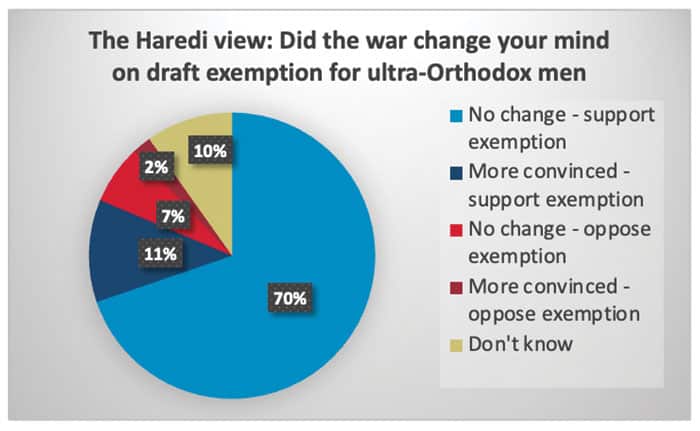
Whether Israelis like it or not (and most of them dislike it), A JPPI survey of ultra-Orthodox Israelis found that most of them still oppose a mandatory military draft for Haredi men – the war didn’t change many Haredi minds. They still want an exemption.

A reader’s response:

A question from Danny: “Do you really think that a religious movement like Hamas can be eliminated by war?” My answer: Israel doesn’t intend to “eliminate Hamas,” it intends to get rid of Hamas rule over Gaza. And yes, that’s possible (if not easy). 


Shmuel Rosner is senior political editor. For more analysis of Israeli and international politics, visit Rosner’s Domain at jewishjournal.com/rosnersdomain.

Rosner’s Domain | The Massacre and the Mustache Read More »

Chicken Soup and Matzah Balls for Hanukkah

Soup is the quintessential comfort food. It’s also a great addition to any holiday meal.

”Chicken soup is one of my favorite things to cook during the colder months, especially around Hanukkah time.”

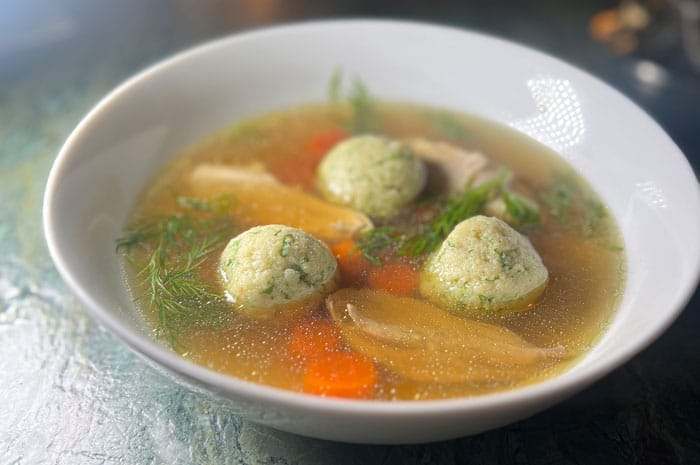
“Chicken soup is one of my favorite things to cook during the colder months, especially around Hanukkah time,” Brad Mahlof, Cook with Brad, told the Journal. “My mom, who is truly an amazing person, makes the best chicken soup, and my recipe is a way to honor her.”

Mahlof is an advocate of homemade chicken stock; it’s worlds better. “Store bought stock tends to be salty and lacks nuance of flavor. The depth and richness of flavor of homemade chicken broth is irreplaceable.”

Brad’s Liquid Gold Chicken Broth

1 (3- to 4-pound) whole chicken (plus additional 1-2 pounds of chicken bones or wings [optional])
2 large onions, unpeeled and quartered
4 carrots, unpeeled and cut in thirds
3 celery stalks with leaves, cut in thirds
1 parsnip, unpeeled and cut in thirds
1 head garlic, unpeeled and cut in half crosswise
20 dill sprigs
1 small bunch of parsley
15 thyme sprigs
2 Tbsp kosher salt
1.5 Tbsp whole black peppercorns
1½ tsp ground turmeric
1 tsp good-quality saffron

Put all the chicken broth ingredients in a large stock pot. Add cold water. Heat on medium flame and bring to a simmer. Once simmering, immediately lower flame, so that the broth is just barely simmering. Skim any fat that emerges to the top of the pot. The key to a crystal clear broth without any cloudiness is avoiding the broth from boiling so make sure to keep an eye and adjust the temp as needed.
Cook for 4 hours. Strain the broth through a fine-mesh strainer and discard the solids.
Note: If using whole chicken and chicken bones, I remove the whole chicken halfway through cooking, let cool slightly and remove the meat and save for serving. Return chicken carcass back to the pot and continue cooking.
Carrots (for serving):
Boil salted water in a separate saucepan and add in sliced carrots. Cook until the carrots are just fork tender (about 15 minutes). Remove them from the boiling water and store them in a bowl with some of the salt water until ready to serve.
To Serve:
Add chicken broth, a few spoonfuls of cooked carrots, chicken pieces (without skin or bones) and fresh sprigs of dill to the bowl and serve. If you made matzah balls, you can also add those.


To celebrate the season, Katz’s Deli shared their “perfected” homemade Matzah ball soup recipe.

“Katz’s Matzah Ball Soup is a tried-and-true recipe that has been passed down our family for generations,” Katz’s owner Jake Dell told the Journal. 

He adds, “A classic dish that tastes like home, we love to call the soup Jewish penicillin, as it’s the perfect pick me up sure to lift everyone’s spirits. Most people will agree it is hard to find something more comforting.”

Katz’s Deli Matzah Ball Soup 

6 eggs
½ teaspoons salt
½ teaspoons pepper
¼ cup seltzer
1/8 cup schmaltz
2 cups matzah meal
Chicken broth

Beat eggs and seasonings together in an incredibly large mixer. Stir in seltzer and schmaltz, then matzah meal.
Store at cold temperature overnight.
Roll the batter into roughly 25 miniature-sized baseballs and drop into boiling water (use an even larger saucepan that is wide rather than deep).
Once the balls start floating, gently stir. Keep boiling until they become softball-sized (almost double).
Add Matzah balls to a traditional chicken broth soup and enjoy.

Chicken Soup and Matzah Balls for Hanukkah Read More »

LA’s Largest, Female-Led Nonprofit Is Jewish—and Is Doing Amazing Things for Israel

In my two decades of being involved with Jewish and pro-Israel organizations, I’ve seldom seen anything like it: No bureaucracy or red tape; until last week, not a single dollar for overhead (because there was previously no paid staff); and a near-instantaneous impact as a result of people simply getting things done. And did I mention it describes itself as the largest, all-female-led, nonprofit organization in Los Angeles?

I’m referring to Maman Nonprofit, founded by Sara Raoof Jacobs, an Iranian American Jewish woman who, with her family, escaped post-revolutionary Iran as an infant and resettled in Los Angeles. Maman, which means “mother” in Persian, became a registered nonprofit in 2022 and has over one thousand volunteers in the United States and Israel. But chances are you may have not heard of it. That’s because Maman does so much behind the scenes. 

Since Oct. 7, the organization has performed miraculous feats, especially for Israelis, whether soldiers or massacre survivors and displaced people — from sending over $700,000 in humanitarian aid funds and over two tons of supplies to Israel within two weeks after the massacre (it was all flown to Israel on boxing legend Floyd Mayweather Jr.’s private jet), to organizing the empty stroller installations in California and New York, including at UCLA and Cornell, which drew attention to the children who have been brutally kidnapped by Hamas.

Maman also worked with Nachman Rosenberg, a well-known expert on philanthropy in Israel who informed the organization about both civilian and soldiers’ immediate needs, including medical equipment. Maman leaders researched how to pack everything so it could bypass shipping headaches. “During the first major shipment, our supplies never sat in a warehouse,” Sara told me. “We were meticulous in how we packed, palletized and shipped things.” 

Yes, a group of mostly young, Iranian American Jewish women was able to organize shipments of medical equipment, such as tourniquets, as well as specifically-requested supplies for the IDF, within less than a week. And sending them on a boxing giant’s private jet was the icing on the cake, though, according to Sara, “It was all G-d.”

What is the secret to Maman’s imitable success in simply getting things done? It’s simple: Sara and other volunteers crowd-source from a pool of thousands of people who want to help in any way they can, and it’s all free. On various private WhatsApp groups, volunteers ask for everything, from finding someone who can immediately offer a ride for a senior citizen in L.A., to anyone who can offer specific supplies, such as cribs and toys, to an Israeli family who survived Oct. 7 and is temporarily displaced in L.A. 

The last time I checked one of Maman’s WhatsApp groups, Jewish Angelenos were volunteering to serve as unofficial tour guides for traumatized teens visiting L.A. from Israel, offering infant car seats to temporarily resettled Israeli families and sending hundreds of supplies to soldiers. A volunteer in Israel shared a video in which a dozen IDF soldiers emerged from a tank sporting protective camouflage gear. As they left the tank, all of them stood together, smiled and shouted, “Thank you, Maman!”

On Friday afternoons, volunteers coordinate driving Shabbat meals to Jewish families in need. As for Hanukkah, which begins this week, Maman volunteers are set to buy hundreds of gifts for local children, including children battling illness, as well as displaced Israeli children and teen survivors of October 7 who are in L.A. without their parents. Maman is also hosting a Hanukkah barbeque for Israeli survivors.

The organization is like the fairy (Jewish) grandmother most people wish they had. Only, there’s no magic. Sometimes, it seems like Maman Nonprofit is the answer for anyone who is moved to ask, “What can I do to help?”

“We think of ourselves as mothering the community,” Sara said, acknowledging that the name is a nod to her beloved late mother, Mahvash, a longtime nurse who passed away from cancer in 2004, when Sara was 23. “We step in as a mother would, whether with foster kids, special needs kids, and now, refugee families from Israel. When I think of the word, ‘Maman,’ it means having someone in your corner; someone who looks one step ahead, to see something you may not even know you need. We’re behind the scenes, making sure things happen.”

Before Oct. 7, Maman volunteers were particularly busy offering help to families dealing with illness. “It takes a toll on everyone,” said Sara. “We’re like a concierge service for the family and try to provide whatever they need.” In one instance, a local mother battling cancer was unable to drive her child to the eye doctor, so a Maman volunteer stepped up as a chauffeur. The organization has thrown bat mitzvah ceremonies for sick children, with everything donated. Maman also helps families with children battling illness address housing issues, moving expenses, finding a new home, and it has hosted countless swabs for children, including in Canada. 

To help two local children, Maman hosted swab events that drew over 5,000 people and resulted in over 40 bone marrow matches. “Forty lives were saved,” Sara said. “Forty people had a second chance at life.” The organization has also hosted platelet drives, especially for kids at Children’s Hospital Los Angeles (CHLA).

Since Oct. 7, Maman has launched Maman 4 Israel, a new initiative. Melody Pirian, who is based in L.A., has been coordinating sending gear and life-saving equipment to IDF soldiers. And volunteers are working around the clock to secure immigration attorneys for displaced Israelis, working with landlords who may offer immediate housing, or identifying therapists who can work pro-bono with Israeli survivors, whether in the U.S. or Israel. 

Working in partnership with the Israeli nonprofit, AMEN: The Land Where Women Heal, Maman is providing trauma therapy to survivors of Kibbutz Be’eri who are currently living at various Dead Sea hotels. “We also make sure the therapists are being supported and have their own therapy, so they don’t burn out,” said Sara.

Maman’s ability to help nearly everyone would not be possible without the amazing kindness of the Jewish community. 

Maman’s ability to help nearly everyone would not be possible without the amazing kindness of the Jewish community. The organization has an advisory board, a board of directors, and a separate board for Israel. “I can’t imagine a larger female-led nonprofit, led entirely by volunteers, and I’m hearing from Israelis that the impact we’re making is much larger than we realized,” Sara said. “We’re setting a precedent.” 

On WhatsApp, various Maman-affiliated groups range from Maman Teen Survivors to Maman Displaced Families to Healing the Kibbutz. In November, Maman hosted a gala for several hundred attendees that raised over $350,000 and was sponsored by local philanthropists Alex and Arezou Tofer. “Maman actually delivers on their goals and promises,” Alex told me. “[And] it is operated by strong independent women who want to help others in need.” 

Sepi Makabi, one of Maman’s newest board members, told me that she has found “a sisterhood that shared similar values and was invested in unity.” Like Sara and Alex, Sepi also understands that the lack of red tape is one of the organization’s most important assets. 

Sara, who majored in psychology and minored in social welfare at UCLA, and who also teaches kabbalah, is the first to know that at Maman, there’s barely time for recognition and plaques, and that kind actions are their own reward. “If you realize that someone else is in pain, there’s a message for you; you undergo a transformation that is needed in you,” she said. “And Maman is 100% a labor of love, a platform that just allows you to give.” 

Naturally, I asked Sara how she and others find the time and bandwidth to volunteer so many hours to help people whom they will most likely never meet. “If I have the capacity and the blessings,” she responded, “why wouldn’t I pay it forward?” 

For more information, visit mamannonprofit.com


Tabby Refael is an award-winning writer, speaker and weekly columnist for The Jewish Journal of Greater Los Angeles. Follow her on X/Twitter and Instagram @TabbyRefael 

LA’s Largest, Female-Led Nonprofit Is Jewish—and Is Doing Amazing Things for Israel Read More »

The Joy of Sweaters

The other day, I finally had good reason to wear one of my pullover sweaters, even around the house. Why, it must have been a frigid 58 degrees outside! It felt cozy and comforting, and none too soon at the end of November. Wearing this soft, warm sweater made me feel that not only was the natural season changing but perhaps the spiritual season as well, and with it, hopes of continuing good news from Israel and continuing the remarkable, nearly miraculous unity among Jews worldwide. 

That’s a lot of responsibility to put on a sweater, even one made from thick wool. But sweaters are, of course, very Jewish. What Jewish mother’s arsenal is complete without calling after her children, husband, or even the plumber, “Don’t forget your sweater!” 

“I don’t need it.” 

“At least carry it. And take an umbrella, it might rain.” 

Not to mention that Jews have been legion in the garment industry, procuring and selling the fabrics to make our toasty warm sweaters. That’s just another thing the rest of the world should thank us for. 

My kids are all grown adults, most in their 30s, but don’t think it stops me from running after them with a jacket when they leave the house any time from the end of September through the end of June. I never have to tell my husband to wear a sweater. His body temperature runs cooler than mine and he likes to bundle up. Maybe I run warmer because I’m always yelling at everyone else to put on another layer before heading out into 66-degree temperatures.  

Since a few of our kids have moved to cities that are far colder in the winter and insanely hotter in the summer, I have been intimidated into staying silent when I’d really like to complain about L.A. weather. If I say, “It’s so hot today, 94 degrees!,” a true statement with no maternal exaggeration, our daughter will respond by taking a screen shot of her local weather in Dallas showing a hellish 108. And if I say, “It’s getting cold here — 55 degrees!” I will be met with a sarcastic laugh by a son who lives in a city where it is currently 28 degrees. I can practically see his eyes rolling even though we are not on FaceTime. Look what I have to suffer after all I’ve done for these kids.  

For several years, I bought my husband a new sweater for Hanukkah. He is a loyal sort, which is excellent news for me, but he is also overly loyal to his “vintage” clothing, which wasn’t vintage when he bought it. Certain that everyone deserves a new sweater every 15 years or so — whether they need it or not — I’d buy him a half-zip pullover — his favorite style— in a color that looks great on him. After we’d light our menorah, he’d open the gift box, look at the new sweater, thank me, and then claim, “I don’t need it.” I doggedly continued this exercise for about eight years before giving up. As a consolation prize, I bought a new sweater for myself.  

As much as I love sweaters, I’m glad to have never been invited to one of those “ugly holiday sweater” parties. My ego is healthy, but not fearless enough to show up in clothing whose sole purpose is to invite ridicule. Looking at pictures of some of those contest winners, you realize they were designed by someone who got totally sloshed at the previous year’s party.

Each year our family takes pictures as we light our Hanukkah menorah. By this point, I have loads of photos that give me a chance to admire, miss, or regret the various sweaters I have worn over the years. 

Each year our family takes pictures as we light our Hanukkah menorah. By this point, I have loads of photos that give me a chance to admire, miss, or regret the various sweaters I have worn over the years. When we still had our beagle, Ken, he’d pose with his Hanukkah bandana, though he never liked his rain trench coat. 

I have many pretty sweaters to choose from, but my choice this year is no contest at all. I’ll wear a simple, solid Wedgewood blue sweater with a white beret: Israel’s colors, the colors of Hanukkah. Our small flames will give off a warm and glorious light, celebrating miracles.


Judy Gruen is the author of several books, including “The Skeptic and the Rabbi: Falling in Love With Faith.” Her next book, “Bylines and Blessings,” will be published in February 2024.

The Joy of Sweaters Read More »

Let’s Talk Latkes

Hanukkah may be the Festival of Lights – but it’s also the Festival of Latkes. Here are some latke recipes for your holiday celebrations.

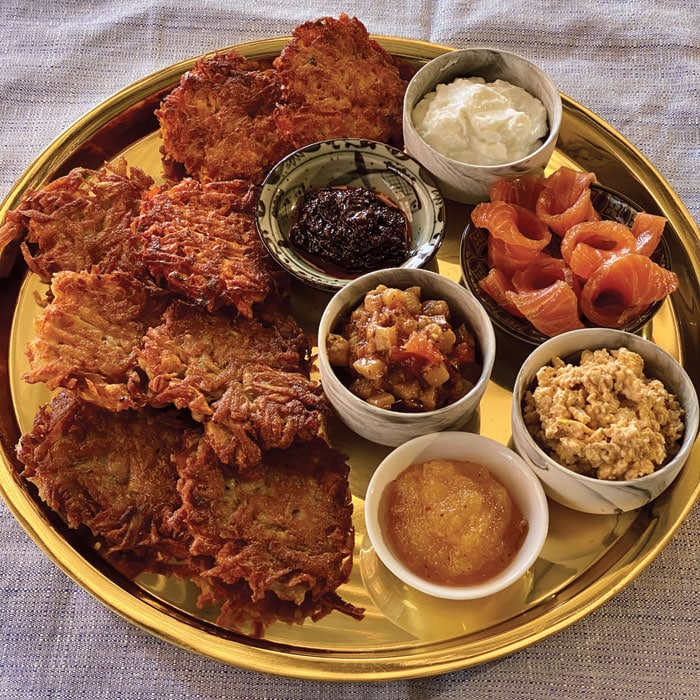
“Lemon zest, freshly grated nutmeg, and lots of scallions really enhance the flavor of latkes,” Alon Shaya told the Journal. 

Shaya is chef-partner of Pomegranate Hospitality and author of “Shaya: An Odyssey of Food, My Journey Back to Israel.”

“For toppings, I like homemade applesauce, made with pomegranate molasses and baharat, and labneh in lieu of sour cream for a thicker, richer texture,” he said. “To finish things off, why not add a scoop of salmon caviar?”

Alon Shaya’s Latkes

3 Yukon gold potatoes, peeled
½ yellow onion
3 eggs, separated
¼ tsp cream of tartar
1 cup cornstarch
1 cup sliced scallions
1 tsp freshly grated nutmeg
Zest and juice from ½ lemon
1 Tbsp kosher salt
1 ½ cups ghee

Grate the potatoes and onion on the coarse side of a box grater. Add to a strainer lined with a clean dish towel and wring it out to remove as much liquid as possible.
Add the egg whites and cream of tartar to a mixing bowl and whisk vigorously until the whites are very frothy and almost make soft peaks when you lift the whisk. Set aside.
Put the grated potatoes and onion in a separate bowl and fold in the cornstarch, scallions, nutmeg, and lemon zest and juice until fully incorporated. Do the same with the yolks and salt.
Add the whisked egg whites and use a spatula or wooden spoon to very gently incorporate.
Warm the ghee in a large skillet over medium heat. Use a ½-cup measure to scoop the latke batter into the pan, making sure not to overcrowd them. Cook until the latkes are deeply golden on both sides, 3 to 4 minutes per side.Transfer to a paper towel-lined plate and repeat with the remaining latkes. Serve with applesauce, labneh or your favorite topping.


Master Latke
Photo courtesy of La Boite

Lior Lev Sercarz’s Master Latke recipe uses the microwave to “set” the starch. “You can make many small crispy batches without them oxidizing,” Chef Lior, who is owner of La Boîte in New York City, co-founder of the Galilee Culinary Institute and author of “ A Middle Eastern Pantry,” told the Journal.

For a sweet potato version, combine one cup of grated potato with two cups of grated sweet potato. For a zucchini version, combine one cup of grated potato with two cups of grated zucchini. Another option: combine one cup each of potato, sweet potato and zucchini.

Lior Lev Sercarz’s Master Latke

Yield: 10 Latkes
Latkes
1 pint grated potato (2 cups)
1 egg
1 Tbsp cornstarch or flour
1 tsp fine sea salt
1 tsp granulated onion
1 tsp baking powder
Oil for frying

Quick Apple Sauce
1/2 cup sugar
2 Tbsp water
4 cups apples, peeled and cut into large chunks
1 Tbsp lemon juice
Pinch of salt
1/2 tsp Sri Lanka blend
1 Tbsp cornstarch mixed with 1 Tbsp water

Latkes
Spread the grated potato onto a flat plate and cover with plastic wrap. I like to use a 9 “-10″ glass pie plate as the sides come in handy.
Microwave on high 2-3. You want the potatoes to be warmed through and still raw but not cooked or clumped.
When ready, mix the potatoes with a fork to fluff, separate, and cool the potatoes. The potatoes should cool to room temperature.
Add the egg, cornstarch, salt, onion powder and baking powder to combine well.
Prepare a tray with a cooling rack or a bed of paper towels.
Heat a heavy bottom skillet with a 1/4” of oil, until shimmering.
Drop the latke mix in ¼ cup piles and press down lightly to form 1/2-inch thick patty shapes. You want even thicknesses with some perfectly imperfect edges. Resist the urge to smash the cake here, and after flipping, as it will make them dense.
Fry the latkes in small batches on low-medium heat. The oil should be gently bubbling around the edges.
Note that when cooked, you can still see and taste the layers of grated potato inside. High five.
Keep cooking latkes until all of the batter is cooked.

Make-Ahead Applesauce
Pulse the apple chunks in a food processor with the lemon juice, pinch of salt and Sri Lanka until finely chopped. The apples can also be grated.
In a small, heavy, bottom sauté pan, cook the sugar and water to an amber caramel.
Add the rest of the ingredients and bring back to a boil. Resist the urge to stir the caramel at this point; it will only stick to your spoon instead of staying in the applesauce.
Once at a boil, simmer for 20 minutes or until the fruit is cooked and the jam is sticky and shiny.
Drizzle in your cornstarch and water mixture and stir to combine well, while still simmering.
Remove from heat and store.


Sweet Potato Latkes
Photo courtesy of Dawn Lerman

Dawn Lerman’s dad always told her that potato pancakes made all the problems in the world melt away.

“It reminded him of the best part of his childhood,” Lerman, nutritionist and author of “My Fat Dad: A Memoir of Food, Love, and Family, With Recipes,” told the Journal.

Lerman agreed, but found a way to make them a little lighter, sweeter and more festive.

“I bake them instead of frying them and use sweet potatoes for a burst of flavor and color,” she said. “All the memories without all the guilt.”

Lerman’s recipe includes traditional frying instructions, as well as a way to bake them in muffin tins. They also freeze well, making them perfect to prepare in advance.

Dawn Lerman’s Sweet Potato Latkes

Yield: 8 pancakes or muffins
2 medium sweet potatoes, peeled and quartered
1/2 medium yellow onion, peeled and quartered
2 large eggs, beaten
3 Tbsp all-purpose flour, or use whole-wheat or almond flour
1 Tbsp fresh lemon juice
1 tsp brown sugar or monk fruit
1 tsp ground cinnamon
1 tsp fine sea salt
Oil for frying or nonstick spray for muffin tins
Applesauce, plain yogurt or sour cream for topping (optional)

Using the fine side of a grater or a food processor, grate the potatoes. Then press out any excess moisture. Transfer the potatoes and the onions to a large bowl, and thoroughly combine with the eggs, flour, lemon juice, sugar, cinnamon and salt. Set aside.

Baking Instructions
Position the rack in the middle and heat the oven to 400°F. Grease the muffin tins with oil or nonstick cooking spray. Using a large spoon, divide the mixture across the muffin cups. Transfer the muffin tin to the oven and bake the latkes for 25 minutes, or until they are golden brown and cooked through. Note: Can also be baked in a baking pan — like a kugel.

Frying Instructions
In a large skillet set over high heat, warm enough oil to cover the bottom of the pan until just before it starts to smoke.
Using a large spoon, add the latke batter to the pan, and using a spatula, shape and flatten the batter into pancakes. Do not overcrowd the pan; you may need to do this in batches.
Immediately decrease the heat to medium and cook the latkes until golden brown on each side, approximately 4 minutes on one side and 3 minutes on the other side.
Flip the latke only when it is halfway cooked through; otherwise it will break apart. Repeat with the remaining batter.
Serve the latkes topped with applesauce, yogurt or sour cream, if desired.

Tip: If the latke batter is too watery, add a bit more flour; if it is too thick, add a bit of the beaten egg yolk.

Let’s Talk Latkes Read More »