fbpx

October 26, 2023

All We Are Saying is Give War a Chance

War is Hell on earth. People die during war. Many of those deaths are innocent civilians, including young children. Many more people are permanently injured, unable to walk, speak, see, hear or smile. Others suffer mental traumas ranging from nightmares to paralyzing hallucinations and delusions. 

At least the deceased see their pain end. For the surviving family members and other loved ones, there is eternal agony. The pain never heals. Parents who bury their children die every day they live. War is truly hell.

For these and many other reasons, singing “Kumbaya” or “Give Peace a Chance” has a powerful allure. Unfortunately, this approach often leads to more war and more deaths. Evil actors see this kindness for weakness, inviting more aggression.

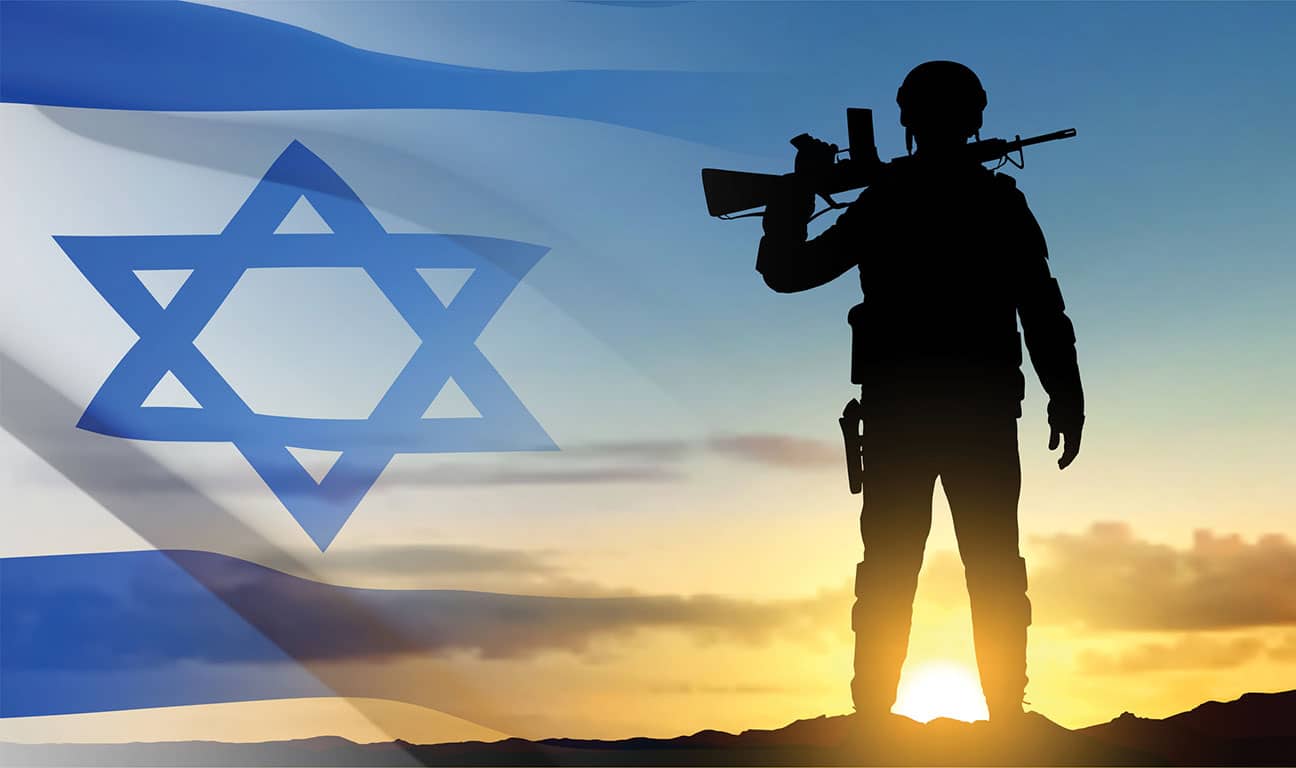
So as Israel prepares for a lengthy, painful war with Hamas and Hezbollah, it is imperative to dismiss calls for an immediate ceasefire. Sometimes war is the answer. In the case of Israel and her enemies, war is the only answer. That comes straight from the Torah.
The Torah does not say “Thou shalt not kill.” It says “Thou shalt not murder.” The Torah also says that a Jew can take any steps necessary to save a life with the three exceptions: Adultery, idolatry and murder.

Judaism is not a religion of surrender. The Jewish holiday of Hanukkah is a celebration of a military victory. The Greeks tried to wipe out the Jews, and the Jews led by the Maccabees forcefully and successfully fought back. 

Judaism is not a religion of surrender. The Jewish holiday of Hanukkah is a celebration of a military victory. The Greeks tried to wipe out the Jews, and the Jews led by the Maccabees forcefully and successfully fought back. During the Holocaust, members of the Warsaw Ghetto fought back. Many Jews died, but some of them were saved. They eliminated many more Nazis than expected.

War freed the slaves. War saved the world from Nazism and fascism. War preserved freedom in South Korea.  

Sometimes there is no peaceful solution. When Pearl Harbor was bombed, FDR was willing to do anything to preserve the American way of life. His successor President Truman’s use of nuclear weapons was so shocking that it ended Japanese involvement in World War II.  JFK was willing to wage war and risk Armageddon during the Cuban Missile crisis. The Russians backed down. After the September 11th attacks, George W. Bush led a Global War on Terror that routed the Taliban and removed Saddam Hussein from earth. Donald Trump kept his word and smashed ISIS to pieces.

Self-defense and defense of others is more than justified to save innocent lives. Saving lives is not just mandatory according to Torah law. Saving lives is Torah law. 

Self-defense and defense of others is more than justified to save innocent lives. Saving lives is not just mandatory according to Torah law. Saving lives is Torah law. That is why if a loved one — God forbid — has a heart attack on Shabbos, the only course of action is to immediately telephone 911 or drive them to the hospital. 

Saving lives sometimes involves ending other lives. Such is the case with terrorists. For humans to survive, civilization must be preserved. Barbarism is contra to civilization. Raping, torturing and decapitating innocent civilians is not compatible with civilization. Israel’s enemies have repeatedly used such brutal barbaric tactics against innocent Jews. The terrorists even thrust barbarism upon their own people. Any society that utilizes suicide bombers is a society that is incompatible with civilization. 

Suicide bombers render diplomacy useless. Wars end or are avoided in one of two circumstances. Either one side realizes victory is hopeless … checkmate … or both sides come to that conclusion that neither can gain a complete victory… stalemate. Death is usually a deterrent. America avoided a “hot war” with Russia, China and even North Korea because none of the people running those governments wanted to die. The Russians wanted blue jeans and Beatles tapes. The Chinese leaders are like J.R. Ewing from “Dallas.” They want to buy everything. 

A culture that encourages suicide bombers is impossible to reason with. People willing to kill themselves while killing others need to be physically stopped before they self-detonate. 

All diplomatic options in Israel have been exhausted because both sides still have hope of victory. Hamas and Hezbollah are unwilling to stop murdering innocent Jews. They can only be stopped by superior firepower. 

This means collateral damage. This means more parents will weep openly as they bury their beloved children. This is awful. This is also necessary. The alternative of endless war and death is far worse.

So to those demanding a ceasefire, only one retort is necessary. If you truly want the closest thing to permanent peace, ignore John Lennon’s advice. Unleash the Israeli Defense Forces. Give war a chance.


Eric Golub is a retired stockbrokerage and oil professional living in Los Angeles.

All We Are Saying is Give War a Chance Read More »

The Loneliness of the Israeli Leftist

The October 7th massacre by Hamas and the ensuing war on Gaza had an unexpected ecological dimension: The Israeli left, already an endangered species, now appears on the brink of extinction. Surprisingly, a significant accelerator of its decline seems to be the American left, which appears to do anything in its power to obliterate the last remaining stronghold of Israelis advocating for Palestinian freedom.

Consider what it’s like being an Israeli leftist these days. The mainstream political discourse has marginalized us for years, ostracizing those advocating for an end to the occupation. We’ve been labeled traitors by politicians who incite the public to unleash violence against those who criticize Israel’s policies in the West Bank and Gaza or express sympathy for Palestinian suffering. And then you wake up one Saturday morning to find that thousands of terrorists from Gaza invaded your families’ towns, brutally murdering more than a thousand children, women and men, burning their houses down and kidnapping hundreds more, including babies and the elderly.

While grappling with profound grief and shock, there’s the added weight of the “I told you so” coming from the right side of the Israeli political map. That is predictable — being asked to excuse violent acts of Palestinians and being blamed for them. Only now it seems to also come from the left side of the map — following the horrific massacre, many on the left seemed to abandon their agendas and “sober-up.” Frankly, it’s hard to blame them. No excuse whatsoever could be given for what happened. The usual suspects — the occupation, the blockade, years of dividing the Palestinians to prevent pragmatic forces from taking the lead — would not suffice and could never justify or explain these acts. It’s understandable that it’s hard to think of Palestinian lives and rights these days. And peace, who can even pronounce that word now? While the responsibility on the Israeli side for the strengthening of Hamas lies on the right-wing Netanyahu governments of the past 14 years, the Israeli left is in the midst of a deep introspection and reckoning. Indeed, October 7th might prove to be a breaking point within the already dwindling Israeli left.

But what truly breaks you is seeing supposed comrades from across the Atlantic revel in the slaughter of your family and friends, driven by a warped, distorted, post-colonial sense of justice.

But what truly breaks you is seeing supposed comrades from across the Atlantic revel in the slaughter of your family and friends, driven by a warped, distorted, post-colonial sense of justice.

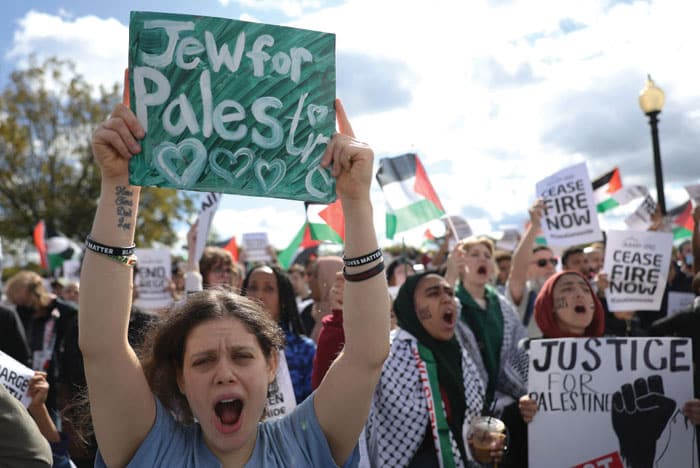
You, who marched and rallied for years alongside Palestinians calling for their liberation from Israeli oppression, now feel isolated. As you mourn the lives of Israeli mothers and babies burned to death and fear the ramifications of another war on Gaza, figures like Tariq Ali laud the “fighting back” against “settler populations.” As you desperately hope your loved ones were only kidnapped and not raped or killed, while also watching with dread as the death toll of Gazan civilians rise, you see videos of American college and high school students marching and chanting, “From the river to the sea, Palestine will be free.”  As you take cover from Hamas rockets aimed at your neighborhood and anguish over innocent Gazan children who lack safe shelters, memes surface celebrating the paragliding terrorists who murdered 260 partygoers as freedom fighters.

It may be that deep down, many on the American and European left are trying to atone for the West’s colonialist past by using Israel as a scapegoat. In doing so, they often view even radical Islamist terrorist groups like Hamas as a kind of ‘noble savage.’

Postmodernist and Postcolonialist studies have seemed to rendered liberal intelligentsia blind to tangible suffering. Naomi Klein remarked at the outset of this grievous chapter of the Palestinian-Israeli conflict that the left should side with the child over the gun every single time, no matter whose gun and no matter whose child. It seems to be lost on many in the American left. For them, postcolonial studies paint Israel as the eternal oppressor and Palestinians as the perennial victims, absolving Palestinians of any accountability for their actions. It may be that deep down, many on the American and European left are trying to atone for the West’s colonialist past by using Israel as a scapegoat. In doing so, they often view even radical Islamist terrorist groups like Hamas as a kind of “noble savage.”

Postmodernist philosophy has left an indelible mark on the American left, one seemingly immune to the cleansing power of real-world suffering. For many, the dominant culture’s language cannot truly depict reality, so the term “terror” doesn’t apply to Palestinian actions. They argue that morality is relative, hence Israelis and Palestinians can’t be held to the same standards. Dogmatic adherence to these concepts permits no humanism, only racism: Palestinians can do no wrong, while Israelis must accept their bloody fate as the logical endpoint of a skewed philosophy of freedom.

But perhaps the most jarring realization is that beneath layers of so-called leftist ideology is an underlying denial of Israel’s right to exist. If the massacred kibbutzim townspeople, who were largely left-wing, are “settlers,” then the issue isn’t just about 1967, but 1948. If the cry is “From the river to the sea, Palestine will be free,” then what becomes of Israelis? The chilling answer lies in the question itself: Into the sea. It’s particularly disheartening to hear American Jews express such views. This is not just because of our shared bloody history and the growing specter of antisemitism, but because it’s easy to hold such beliefs from a comfortable suburban setting, far removed from the threats of terrorist militias.

If the American left wants Israeli allies in the just fight for Palestinian rights, it must free itself from these juvenile fantasies and the naive misreadings of Fanon and Foucault. Regrettably, these days it looks as though they want no allies, for they literally celebrate their killing.


Nadav Neuman is an Israeli writer and Head of Education at Sapienship.

The Loneliness of the Israeli Leftist Read More »

Remembering Rabbi and Spiritual Care Counselor Malka Mittelman

Rabbi Malka Mittelman, a remarkable woman whose light touched the lives of many, passed away on Yom Kippur, September 25, 2023. Family and friends gathered at Burbank Temple Emanu El on Sunday, Oct. 1 to honor and remember a woman whose enduring legacy will forever be cherished.
Malka was born in 1955 in the San Francisco Bay area to Maya Molner and Irwin Mittelman. She earned her BA at UC Berkeley after attending Brandeis University, and her career path initially led her to the entertainment world. As a film editor she contributed to numerous movies, including the original “Teenage Mutant Ninja Turtles” and “Poison Ivy.”

However, her true calling came in 2006 when she realized her dream of becoming a rabbi and enrolled at the Academy of Jewish Religion. That year she also met her second husband, Cantor Danny Chodos.

At the memorial ceremony, Chodos spoke lovingly about the day the two had met. “I met Malka in an adult class I was teaching at Sinai Temple Glendale,” he said. “She sat to my left and flashed that ineluctable smile. Malka? Really? I said, ‘Really,’ she answered.  And then she explained, ‘I’m Gina, but Malka is also on my birth certificate, and I’m becoming a rabbi.’”

He explained that Gina is Regina and it means queen, and Malka means queen in Hebrew; her parents contrived to have both words on the certificate.  

“She wanted me to be sure it wasn’t an affectation, which she knew was why I asked,” Chodos said. “A few months before we were married, Malka calculated our respective gematria (numerology). That’s the numeric value of the letters in a Hebrew words: Daniel and Malka – they’re the same: 95. Our union was bashert – a union predestined in heaven.  Our wedding invitation had the numbers nine and five in a repeat pattern bordering the text.  And it became our private code.”

After they got married 12 years ago, Malka and Danny co-founded B’nei Mishkan, a transdenominational service dedicated to sharing and celebrating Jewish traditions with others. Malka’s profound impact extended to her 18-year tenure as a rabbi and spiritual care counselor at Skirball Hospice, where she provided comfort and guidance to countless individuals facing illness, the end of life, and bereavement. Her life was a testament to kindness, love and boundless compassion.

“Malka was many things. She was, first of all, a dancer,” Chodos told the 150 people who filled Burbank Temple Emanu El. “Her grace of movement matched her beautiful person and her beautiful heart. As a young woman in the Bay Area, she danced with the famous post-modernist Anna Halprin. And all her life, she found solace and expression in movement and breath.  When I had been doing Tai Chi for three years or more, she joined our group one evening, and never before having practiced the form, she picked it up in moments, as if she had been doing it all her life.” Chodos remembered his wife as an artist “with an infallible eye for beauty and truth” who took after her mother, a painter. She practiced yoga, meditation, shamanism, entheogenics and she was certified by Yogi Bhajan to teach Kundalini Yoga. She also underwent training in mindfulness meditation with Tara Brach and Jack Kornfield, and she held qualifications as a chaplain, completing two years of intensive clinical pastoral education.

“Malka was driven by an unshakeable desire to make the world a better place. She worked tirelessly with city agencies to assist the homeless and impoverished, and she championed the Homeroom Project, aiming to intervene in the lives of troubled youth before they could turn to violence, providing them with help and healing.” – Danny Chodos

“Malka was driven by an unshakeable desire to make the world a better place,” Chodos said. “She worked tirelessly with city agencies to assist the homeless and impoverished, and she championed the Homeroom Project, aiming to intervene in the lives of troubled youth before they could turn to violence, providing them with help and healing.”

According to Jewish belief, one who dies on the High Holy Days is considered a “tzadik,” a title given in Judaism to people considered righteous. “Malka showed all the signs,” Chodos said. “A lifelong commitment to good deeds coupled with a nagging self-doubt that only a true tzadik can have. “

Malka is survived by her loving husband Danny, her sons Daniel and Noah Stubblefield, her brother Jonathan Mittelman, her nephews David and Daniel Mittelman, her grandnephew Eugene Mittelman and her grandniece Hannah Mittelman.

Remembering Rabbi and Spiritual Care Counselor Malka Mittelman Read More »

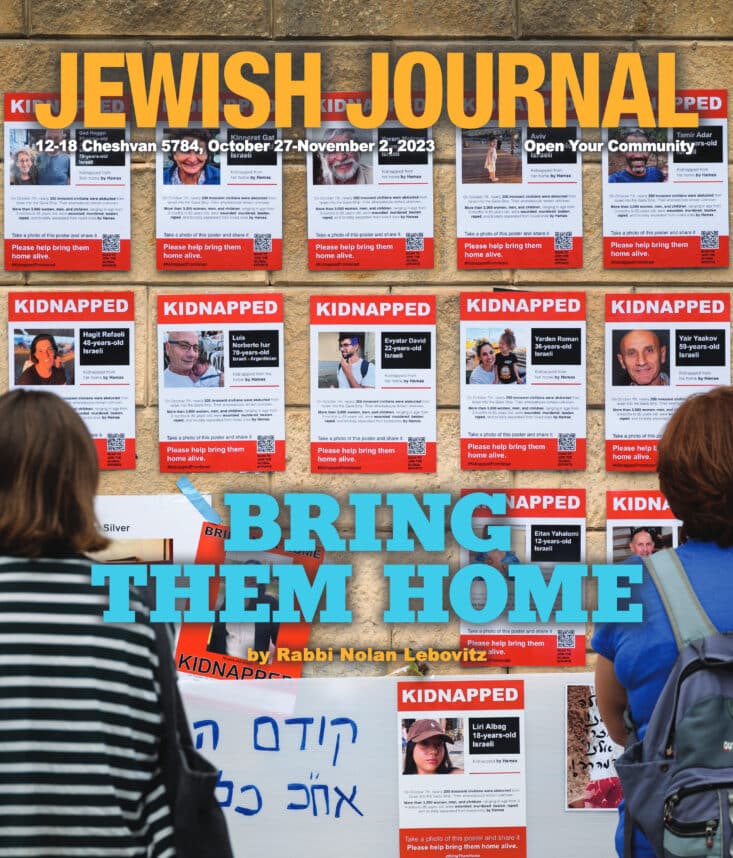
Print Issue: Bring Them Home | Oct 27, 2023

CLICK HERE FOR FULLSCREEN VERSION

Print Issue: Bring Them Home | Oct 27, 2023 Read More »

Humanitarian Has Two Sides

In the first wrenching days after the Simchat Torah Massacre, Israeli Energy Minister Israel Katz made what turned out to be an unkeepable promise: That no humanitarian relief in the form of water, fuel or electricity would be allowed into Gaza until Hamas took the humanitarian step of releasing all Israeli and international hostages. How unfortunate that only one of those commitments has remained in the public eye while the other has been deprioritized, if not forgotten. If not implicitly forgiven.

The selective and intentionally narrow basis on which the term is now comm only used in the context of the current crisis has devalued the term to an almost worthless epithet. 

I consider myself to be a humanitarian. I’m confident that you think of yourself to be one too. But it seems as if that term has now been diminished from a concept of inestimable moral worth into a geopolitical partisan accusation. A humanitarian has historically been defined as one who concerns themselves with human welfare – all human welfare. But the selective and intentionally narrow basis on which the term is now commonly used in the context of the current crisis has devalued the term to an almost worthless epithet. 

On October 21, exactly two weeks after the massacre, the day that the first aid relief began to be transported into Gaza, the United Nations Office for the Coordination of Humanitarian Affairs (OCHA) issued a “flash update” attempting to summarize what they see as the most dire circumstances the region is facing (https://www.ochaopt.org/content/hostilities-gaza-strip-and-israel-flash-update-15). In a 14-page report, there were exactly two passing references to Israel, the first of which noted that there had been no Israeli fatalities that day and the second which briefly mentioned that the U.N. Secretary General has previously called upon Hamas to free the 200-plus hostages and that two U.S. hostages had been released. 

A traditional definition of humanitarianism would certainly include access to food, water and medicine. But it would also contain some reference to the prevention of murder, rape, kidnapping, and slaughter of children, women, seniors and babies. The U.N. report focused almost exclusively on the needs of Gazans, a relevant but incomplete and therefore highly misleading overview of the calamitous situation. But complaining about the United Nations’ innumerable double standards, inherent biases and immoral posturing against Israel has long since ceased to be newsworthy or even especially interesting. So let’s broaden our lens and examine mainstream news coverage of the post-October 7 Middle East.
On the same day that the U.N. report was released and less than 24 hours after two American hostages were freed (of the more than 200 still held captive in Gaza), I entered the terms “Israel,” “Hamas” and “humanitarian” in a Google news search. Twenty-four of the first 25 entries highlight the aid shipments sent into Gaza across the Rafah crossing. One single posting referenced the release of the Chicago mother and her teenage daughter. 

This is not to suggest that the freeing of Judith Ranaan and her 17-year-old daughter Natalie was not widely covered news. It received immense media attention around the world. The Hamas propagandists who released two healthy and mediagenic American women knew full well that their ploy would attract tremendously favorable publicity for their cause. We rejoice their safe return, even while we grieve for the more than 200 hostages still in captivity. But Israel still receives worldwide condemnation for not meeting the “humanitarian” demands of those who attacked them. The attackers, in the meantime, are not challenged for their lack of human decency, even as their victims are imprisoned, buried, and mourned. 

But the global discussion surrounding the need for humanitarian action remains focused almost entirely on the provision of supplies to Gaza with almost no effort whatsoever to pressure the Hamas terrorists into even minimal and belated humanitarian action of their own. The Israeli government’s caution about goods intended for refugees being co-opted for terrorist use has received scant attention in mainstream media, incorrectly implying that the careful deployment of aid is being slowed only for the purpose of ongoing punishment. But beyond the discussion of Gazans’ access to food, medicine and fuel should be another high-profile and necessary conversation about Israelis’ needs — for safety, freedom and life.


Dan Schnur is the U.S. Politics Editor for the Jewish Journal. He teaches courses in politics, communications, and leadership at UC Berkeley, USC and Pepperdine. He hosts the monthly webinar “The Dan Schnur Political Report” for the Los Angeles World Affairs Council & Town Hall. Follow Dan’s work at www.danschnurpolitics.com

Humanitarian Has Two Sides Read More »

American Jews Need to Reexamine their Blinding ‘Conzeptzia Too’

When the war ends and the commissions begin, Israelis will reexamine  the “conceptzia,” the blinding assumptions that failed to prevent October 7. Meanwhile, Diaspora Jewry must stay united too, supporting Israel wholeheartedly, apolitically, until our hostages are returned home, and Israelis’ sense of safety is restored. Still, with memories of the Jew-hating viciousness so fresh, with Israeli soldiers endangered, and the hostages enduring unimaginable abuses daily, it’s time to start re-examining “the conceptzia” that distorted the American Jewish community conversation about Israel for so long.

Israel’s “Black Saturday” was followed by Sobering Sunday for many American Jews. If in the 1980s, you defined a conservative as a liberal who’s been mugged, today’s new liberal liberals are woke liberals who’ve been bombed – or seen innocents slaughtered cruelly by Hamas.

I am less dismayed by the loud, vicious minority that found the bloodshed “exhilarating” and celebrates paragliders used to slaughter 260 concert-goers as some symbol of “resistance.” Exploring how some Jews accepted these inhumane fanatics as allies, as they forged a new form of Jew-hatred through their Zionophobia, is for another time. So, too, is the fascinating ideological and sociological question of how this “social justice” ideology, which cheered the most ungodly, inhumane attacks, so seduced so many American Jews into forgetting that “tikkun olam” – repairing the world – is done “bemalchut shaddai” – under God’s sovereignty.

Far more disturbing were the pale, generic denunciations from more mainstream liberals of “the violence” – as if it were a natural phenomenon, not carefully-planned Palestinian war crimes. Cornell University’s president, Martha Pollack, declared “The loss of human life is always tragic, whether caused by human actions such as terrorism, war or mass shootings, or by natural disasters such as earthquakes, fires or floods.” With donors revolted and revolting, she apologized.

Clearly, grade-grubbing radicals and simpering centrists ignored the facts – just how personal, antisemitic, and barbaric, Hamas’ evil was. Today’s young liberals waking up to the heartless cruelty of these MacBook revolutionaries should realize: you didn’t betray your ideals; you’re supposed allies betrayed your shared ideals – and you, too. 

As well-meaning Americans support Jewish students or “our Jewish friends” in distress — they still fail to get it. These Palestinians and their campus Kapos assaulted civilization, not just Jews.  Few Americans turned their fury against Vladimir Putin’s invasion into an outreach to Ukrainian-Americans. Most of us recognized Russia’s offensive as on assault on the good, threatening us all.

Reeling from good people’s inability to process new facts, in a spirit of education not recrimination, I propose that we reassess some of the communal blindspots we’ve developed when discussing Israel – and the challenges the Jewish state faces.

For decades, too many American Jewish leaders swallowed the Palestinian narrative. Even as polls showed most Jews pro-Israel, a growing number of rabbis, professors, and community activists kept blaming Israel far more than the Palestinians for the conflict. Beyond treating Hamas as “pragmatic” and Palestinians as “victimized” and thus forever blameless, the language of “cycle of violence,” “disproportionate response,” “two-state,” “West Bank,” “occupiers,” “settlers,” “the settlements,” became mainstreamed, even among those who avoided the more delegitimizing language of racism, colonialism, imperialism, and Jewish supremacy. 

Sometimes, historical cataclysms shake-up opinions. To misread politics is human; to refuse to update is diabolical.

Can anyone who has seen these horrific images still believe that this is merely a territorial dispute, that if Israel only had conceded more territory, the Palestinian leadership would make peace? 

Targeting civilians so brutally, along with the Palestinian mob’s sadistic delight in parading hostages and degrading bodies, exposed the kind of enemy Israel faces. We saw their Jew-hatred, their misogyny, their evil. Can anyone who has seen these horrific images still believe that this is merely a territorial dispute, that if Israel only had conceded more territory, the Palestinian leadership would make peace? Can anyone today make a convincing case that Israel should just trust these neighbors to act peacefully?

Some of us didn’t need this traumatic wake-up call. Even before this unhappy Simchat Torah, we recognized Palestinian rejectionism and extremism. I am not foolish enough to claim Israel is perfect. But no one should be blind enough to overlook the consistent rejection in mainstream Palestinian culture of Israel’s existence, let alone genuine peace.

To blame Israel constantly – pressuring it to make more concessions no matter what the outcome – you already had to ignore many facts, before October 7.

You had to ignore Palestinians’ refusal to compromise. It began by repudiating the 1947 U.N. Partition Plan. It continued with Yasser Arafat’s unwillingness to negotiate with Ehud Barak at Camp David in 2000. It was confirmed by the 2005 Gaza withdrawal’s failure to spawn a peaceful neighbor. And it culminated with Mahmoud Abbas’s rejection of Ehud Olmert’s offer of all but 6.3 percent of the West Bank in 2008.

You had to ignore Palestinian political culture’s sexism, homophobia, and hostility to democracy. We judge societies by how they treat their weakest and most vulnerable – why aren’t Palestinians held to such standards? Calling the Palestinian Authority “moderate,” is like calling carbon monoxide “safe” because it takes longer to kill than cyanide. True, the PA is less awful than Hamas, but it remains a dictatorship that abuses its people while crushing dissent. 

You had to ignore Hamas’s antisemitic charter which seeks to destroy Israel. Do any Peace-Nowers doubt that if Hamas ruled, liberals would be the first in line to be shot?  

You had to ignore Palestinians’ culture of negation. While I hope for a solution, and, as a nationalist, respect Palestinians’ desire for national self-determination, “two-state solution” often negates Jews’ ties to the land. Treating the “West Bank” as an organic whole, exclusively belonging to the Palestinians, misses Jews’ deep connection to Hebron, Shiloh and many other places. It overlooks the randomness of the hastily-drawn 1949 armistice border, which became sanctified as THE Green Line defining THE West Bank.

You had to ignore the toxic impact of enabling Palestinian terrorism, which has murdered thousands.  In that silly debate about “which is worse, right-wing antisemitism or left-wing antisemitism,” liberals emphasize that right-winger Jew-haters killed more Jews, especially at Pittsburgh. But the Palestinian-generated death toll dwarfed those numbers – even before October 7. Many terrorists are hopped up on a Jew-hatred unintentionally validated “cycle of violence” talk. 

You also had to ignore the patriotism and survival instincts of liberals’ natural allies on the Israeli left. Oslo’s failure disillusioned many Peace Now types and two-state solution cheerleaders. Once Palestinians turned away from negotiations to terrorism in 2000, many Israelis realized that another slice of territory here or there would never satisfy Palestinian maximalists – who crush Palestinian moderates. Even more Israelis sobered up seven years later, when the Gaza Disengagement delusion disappeared as Hamas brutalized fellow Palestinians to take over Gaza. This debacle turned what could have been the Riviera of the Middle East into a cesspool for dictators, terrorists, sexists, homophobes and theocrats. Watch Israel’s protest leaders – they detest Benjamin Netanyahu and his government, but, despite their threats of refusal, mobilized to defend their home.  

Finally, you had to ignore the Abraham Accords. Admittedly, Donald Trump and Netanyahu have their fingerprints on them. But they prove that Israelis are not anti-Arab, only opposed to those Arabs who target them; they prove that many Israelis and Arabs want to work together; and they prove how toxic the Palestinian boycott is. Boycotting Israel negates the people-to-people and business-to-business ties the Abraham Accords facilitate — and the Saudi agreement would generate. Like Hamas’s actions, they expose the end game, showing how fanatically anti-Israel too many Palestinians continue to be.

Admittedly, from afar, it seems easy: just draw a line in those faraway sands, give everyone something, and peace will prevail. Hmm. Time to approach Israel with solidarity, empathy, understanding, and humility.

This is our defining moment. Western civilization must see this fight against Hamas as a fight for democracy and decency. Our non-Jewish friends must understand that we are all in this together. And we, Jews, from left to right, must reevaluate our now-outdated assumptions, finding new visions and new policies – while upholding our core ideals.


Professor Gil Troy, a Senior Fellow in Zionist Thought at the JPPI, the Global Think Tank of the Jewish People, is an American presidential historian, and, most recently, the editor of the three-volume set, Theodor Herzl: Zionist Writings, the inaugural publication of The Library of the Jewish People. 

American Jews Need to Reexamine their Blinding ‘Conzeptzia Too’ Read More »

Klein Halevi, Wolpe Discuss “Crisis in Israel”

Israeli author Yossi Klein Halevi and Rabbi David Wolpe acknowledged the recent attack by Hamas on Israel was a gamechanger, the ultimate consequences of which remain unclear.
“This is one of those moments that defines a country’s resolve,” Klein Halevi said.

Klein Halevi, a senior fellow at the Jerusalem-based Shalom Hartman Institute and author of the 2019 book, “Letters to my Palestinian Neighbor,” and Wolpe, emeritus rabbi at Sinai Temple and a visiting scholar at Harvard Divinity School, were participating in “Crisis in Israel,” a virtual webinar held Oct. 22.

The discussion was held as the American-Jewish community continues to grapple with the atrocities of October 7 and Israel’s war with Hamas. In Los Angeles, there have been multiple community-wide events showing support for Israel, including a march in Pico-Robertson on Oct. 15 and a pro-Israel event for San Fernando Valley’s Jewish community held Oct. 22.

The expression of American-Jewish solidarity affirms “much of the diaspora has rediscovered its love for Israel,” Klein Halevi said during the webinar. “Sometimes you don’t know how much you love something until it’s threatened.”

This feeling of togetherness has caught on in Israel, which was experiencing deep domestic divisions before Hamas’ Oct. 7 attack on innocent civilians.

Now, the country is witnessing “a peak moment of national unity and purpose,” Klein Halevi said.

During the hourlong discussion, Klein Halevi wondered if Hamas’ ability to strike at and wound Israel was emblematic of deeper existential issues facing the Jewish state. Was the country still the scrappy, fearless nation that had achieved impossible military victories over its enemies throughout its 75-year-history?

Or, he wondered, “Did the tightrope walker look down? Has the country lost its nerve?”

Klein Halevi and Wolpe’s recent discussion was held as part of “Community Conversations,” a series of virtual events co-organized by Jews United for Democracy and Justice (JUDJ) and Community Advocates, Inc. 

Wolpe moderated the conversation, posing his own questions to Klein Halevi along with those submitted beforehand by the audience.

Klein Halevi expressed frustration with those who oppose Israel’s current retaliatory strikes on Hamas in the Gaza Strip because of the humanitarian consequences but offer no insight into what Israel should do.

Klein Halevi expressed frustration with those who oppose Israel’s current retaliatory strikes on Hamas in the Gaza Strip because of the humanitarian consequences but offer no insight into what Israel should do.

“They never, or almost never, offer us an alternative,” Klein Halevi said. 

If Israel doesn’t respond—currently there are approximately 300,000 Israeli ground troops on the Israeli-Gaza border—it will lose its ability to deter future attacks.

“If we don’t respond strongly, we will be inviting aggression from Hezbollah, from Syria – and of course all this is coming from Iran.”

While no one is saying innocent Palestinians deserve to be punished for Hamas’ actions, one can’t ignore that Palestinians in the Gaza Strip elected Hamas in 2006, Klein Halevi said. “The blame for Hamas belongs with the Palestinian people.” 

He also criticized the lack of unequivocal condemnation of Hamas by the international Muslim community. “Right not, I see a colossal moral failure in virtually the entire Muslim world,” he said.

This lack of decisive condemnation of Hamas from the Muslim community has caused much “disappointment [currently] shuddering through the American-left,” Wolpe opined. “It’s been a shock to the system on the progressive-left not to hear that.”

This lack of decisive condemnation of Hamas from the Muslim community has caused much “disappointment [currently] shuddering through the American-left,” Wolpe opined. “It’s been a shock to the system on the progressive-left not to hear that.”

How will recent events impact an Israeli-Saudi normalization agreement, which was in the process of being negotiated before Hamas’ unprecedented attack? Klein Halevi said the Hamas massacre has shattered the perception of Israel’s strength. Saudi Arabia, he explained, was compelled to enter diplomatic relations with Israel because the Jewish State was seen as strong. If Israel’s unable to project regional dominance, however, Arab countries in the Gulf will have less to gain from a relationship with Israel, he said.

On the topic of hostages, Klein Halevi said, “My sense is the determination to go to the end includes all consequences.” In other words, Israel is prepared to do whatever it takes to dismantle Hamas even if it leads to the tragic death of the remaining hostages.

Whatever happens next, “We’re about to experience a nightmare in Gaza.”

Klein Halevi, Wolpe Discuss “Crisis in Israel” Read More »

A Visit to Palisades High School

I have not set foot on a high school campus in many years. I interact often with teenagers at our synagogue. I consult with teens, give them the appropriate resources to combat antisemitism in the classroom and in the halls of their schools, and educate them on the history and the importance of Israel. After they become b’nai mitzvah, complete religious school or graduate Sinai Akiba Academy, we send these young people off to act as Jewish leaders in their high schools, private and public schools alike. If we are lucky, a small majority of teens stay active and deeply connected to synagogue life. It is the reality of the world. 

It was not until last week that I witnessed the uphill battle these teenagers face and the desperate need they have for their synagogues and Jewish communities to support them and their support for Israel.

Everyone is asking, “What can we do?” How do we speak to our co-workers about Israel? How do we speak to our friends? Teens are asking, how do we speak to our peers and to our teachers?

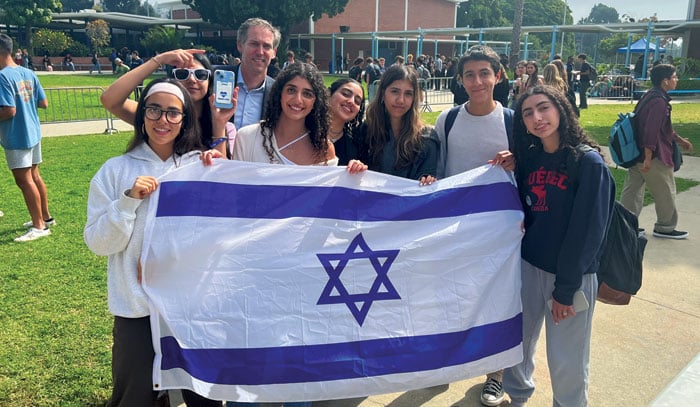
After the Simchat Torah Massacre, a Sinai Temple teenager from our Sinai Temple teen center reached out and asked if I would address the Palisades Charter High School community for a solidarity with Israel program held on the campus quad.

Speaking is what I do for a living. I speak at public rallies, I speak weekly on a bima, and I host a podcast with major sports personalities. Yet, I was never more nervous than the moment I walked into that high school.

The solidarity for Israel program was brief. Israeli music was playing and students wrote cards to IDF soldiers. That morning, I received pictures of excited students hanging Israeli flags on the quad in preparation for the program.

As I entered the school, I was asked to speak to the administration. They asked me, “What message will you be giving the students today? I responded, “The difference between good and evil. I will speak about humanity, but it must be stated that HAMAS is a terrorist organization that not only killed over 1,400 Israelis, and has taken 200 hostages, but continues to hold its own population hostage for the last 20 years!”

As I went to greet the student from Sinai Temple, she was asked, “Solidarity … so that means there will be Israeli flags and other flags too?” The student shyly answered, “No … Israeli flags … like I told you in the email.”

As I went to greet the student from Sinai Temple, she was asked, “Solidarity … so that means there will be Israeli flags and other flags too?” The student shyly answered, “No … Israeli flags … like I told you in the email.”

Based on this conversation, the flags hung up in the morning were taken down, and the only flag allowed was one that a student wore around their shoulders. I thought to myself, “If a Free Palestine program were taking place on this quad, would they ask if ‘other’ flags were going to be included?”

I was told that last week the Jewish Student Union hosted a program with a rabbi and a lawyer speaking about Israel, but since it was in an enclosed area, there was no issue.

What is the message? We can talk about Israel behind closed doors? But once it steps into the public sphere, we must be quiet? 

As we entered the quad, two long tables were set up, with two small signs, barely visible from more than 10 feet away said, “We stand with Israel.”

Hours before I arrived, Israel was wrongly accused by Hamas and the entire world for bombing a Gaza hospital, while evidence clearly showed that Palestinian Islamic Jihad itself was responsible itself for killing its own civilians.

How could Jewish students not stand up in front of their community and publicly say, “We stand with Israel.” More Jews were killed on October 7th in the Simchat Torah Massacre then at any time since the Holocaust. Last Friday, thousands of Jewish children stayed home from school, fearful of the call for a Day of Jihad. 

How can we not stand up and say, “My people were murdered — men, women, and children. It was supposed to be a day of joy, but that day will live in infamy as a day that will change the course of Jewish history.” 

As I stood up on the stage to speak, I looked out at the crowd. Thousands of students were eating their lunch. One hundred students wrote letters to soldiers. I took the microphone and quoted Rabbi Abraham Joshua Heschel in his book, “Israel,” written in 1967 after he visited Jerusalem for the first time. He calls for a “community of concern.” Where a Jew hurts somewhere, he says, a Jew hurts everywhere.

These are the best and the brightest, and now they must ask themselves, “Will I feel safe on the campus where I wish to study?”

I could see the pain on these teenagers faces. Many of those teens are thinking about where to study in college. These are the best and the brightest, and now they must ask themselves, “Will I feel safe on the campus where I wish to study?”

What I learned that morning is that the college campus is too late. What our children learn in our high schools and now even in our middle schools will shape them for life. And what we teach them in our religious schools and in our day schools must prepare them for a journey of pride, strength, and ultimately Jewish leadership.

October 7th will be a moment when the next generation stands up and says, “We are the one that will tell the story of Israel.” Over the last two decades, Gen Z-ers have disconnected from Israel, spent most of their time criticizing its government and not enough time finding the ways in which the land of Israel and the people of Israel bring light to our world.

As we concluded Sukkot on October 7th, we read the book of Ecclesiastes, “There is a time for everything under the sun.” At Palisades High School, with a large population of Jewish students, the time is now. The time to proudly say Am Yisrael Chai, to call out evil and terror when it confronts us, to uplift the Israeli spirit of love. Even more so, it is all of us, the Jewish community, that must support these students. 

I learned one of the greatest lessons of my rabbinate today. Don’t wait for your students to come to you. Go to them, teach them what it means to pray with your feet. Watch them grow and watch them lead.


Erez Sherman is Senior Rabbi at Sinai Temple.

A Visit to Palisades High School Read More »

The Food Behind the Reservist Flight to Israel

What do you do when you need kosher meals for reservists headed to Israel on a Saturday morning flight?

If you are Michael Steuer, you call Yossi Segelman at Our Big Kitchen Los Angeles (OBKLA).

“I’d done a program [at OBKLA], and most people in the community know Yossi,” Steuer, who volunteers with an organization called Israel Friends, told the Journal. 

Israel Friends, which delivers critical and immediate aid to Israel, arranged the first charter flight, sending over gear and reservists on October 14. 

“We helped more than 100 reservists get back to their families and rejoin the fight,” he said.

As he was helping to coordinate arrangements on Friday, October 13, Steuer received a phone call from fellow volunteer Marc Kirshbaum, who told there were at least 50 people on the flight who would like to have kosher food. 

Steuer reached out to several local restaurants, as well as OBKLA. La Brea Bagel and Pizza Mark also donated food for the flight. 

“I asked for meals for 50 people, I got meals for 100 people,” he said. 

Founded by Yossi and Chaya Segelman, OBKLA is a community-focused organization that provides homemade meals to Angelenos in need. Every week, hundreds of volunteers help prepare anywhere from 2,500 and 3,000 kosher meals. People of all ages come through school, synagogue, corporate and community organizations, private celebrations or the open meal-prep sessions held every Sunday.

“We spread light and love one meal at a time,” Segelman told the Journal. “All we can do is bring people together in a safe way and prepare more meals for people that need it.” 

“We spread light and love one meal at a time,” Segelman told the Journal. “All we can do is bring people together in a safe way and prepare more meals for people that need it.” 

For OBKLA, how all the food came together for the flight was divine providence, Segelman said. They had extra dough from a Thursday night challah bake; volunteers braided and baked on Friday, and there were extra cookies and meals in the freezer. 

“We never have extra food,” he said. “All of that was meant to be when we got that call from Israel Friends.” 

The food package also included chicken fajita meals and freshly baked potato bourekas.

“Some of the food that was provided was prepared by students of Milken Community School who came with their school to volunteer on Friday,” Segelman said. “Shabbat Kits provided small bottles of grape juice and kiddush cups so the reservists could make kiddush.”

He added, “That was just a beautiful way of us here in LA at OBK, connecting and giving nourishment for their flight.”

Steuer got access to the kitchen from Segelman, picked up the food and drove it to the airport. The executive director of Temple Beth Am also picked up the donations from La Brea Bagel and Pizza Mark.

On Saturday, October 14, one week after the conflict in Israel began, passengers feasted on kosher meals. 

 “The flight took off this morning successfully with 13 tons of protective gear and 120 reservists returning home to join their units, and the fight,” Steuer texted Segelman. “They were really well fed, already on the airport due to a six-hour delay, and I’m sure on the plane as well, thanks to OBKLA, and they (and we) couldn’t be more grateful. You did an enormous mitzvah.” 

Steuer added, “They certainly felt the love from LA and understood that we are all behind them.” 

The Food Behind the Reservist Flight to Israel Read More »

Hamas: Today’s Amalek

There are some pretty despicable characters sprinkled throughout the Hebrew Bible; Amalek and his followers are among the worst. Exodus 17:8-16 recounts that, not long after the glorious celebration of dance and song described so beautifully in the Song of Miriam, the Israelites were ambushed by the Amalekites.  We learn more about the brutality of the attack near the conclusion of the Torah, in Deuteronomy 25:17-18: “Remember what Amalek did to you on your journey, after you left Egypt — how, undeterred by the fear of G-d, he surprised you on the march, when you were famished and weary, and cut down all the stragglers in your rear.” The implication is that if there are any accepted rules of warfare, the Amalekites ignored them with their ruthless barbarity.

Sound familiar?

But the Torah continues with a passage that used to mystify me.  Deuteronomy 25:19 implores us that while “you shall blot out the memory of Amalek from under heaven. Do not forget!” Isn’t that paradoxical?  How can you possibly remember something that you erase from your memory?

I wrestled with that puzzle when we read that parsha just a few weeks ago, before our lives were suddenly filled with anger and sorrow.  I understand the words of the Torah a bit better now.

The Amalekites, eternal enemies of the Jewish people, are said to be the embodiment of pure evil.  Just as the Nazis were the 20th century’s version of Amalek, Hamas has proven that they are the Amalek of today. 

The Amalekites, eternal enemies of the Jewish people, are said to be the embodiment of pure evil.  Just as the Nazis were the 20th century’s version of Amalek, Hamas has proven that they are the Amalek of today. 

I see the words “Do not forget” as an admonition to minimize the chances that this nightmare will happen again. Learn from military intelligence mistakes, don’t trust in the humanity of enemies who have none, and always remain vigilant.

So why blot out the memory of those monsters? Perhaps it has to do with self-care. Must we relive the hideous evidence over and over again in order to honor the lives of the slaughtered innocents? Personally, I have tried to avoid some of the most horrific videos and accounts. Going down that rabbit hole not only leads to despair, it is giving in to what Hamas wants us to do. They, like ISIS before them, make no attempt to hide their crimes. To the contrary, they seek to maximize their exposure. The more gruesome, the better. Why? They want us to be distracted, scared, and distraught. They would like nothing more than to have us lie awake at night, immobilized with rage and fear. 

Self-care is an integral component of Judaism. While not turning a blind eye to the recent and ongoing horrors against Jews playing out both in the Middle East and across the world, we should allow ourselves to take an occasional break from our televisions, computers, and social media. Every so often try falling asleep listening to Mendelssohn, not CNN. Visualize a simcha, not Hamas supporters celebrating atrocities. Don’t forget to keep doing whatever it is that sustains you. Take a long walk; attend religious services; watch a romcom; hug your loved ones. In other words, don’t let our enemies steal our souls. 

At this stage, I doubt that many of us need be reminded of what Hamas did to our people. And I suspect that we agree on what we need to do in return. If we ever hope to live in peace alongside our Palestinian neighbors, Hamas, like Amalek, must be removed from the world.  

But at the same time, we owe it to ourselves to focus on our own health, and on the well-being of our families, our friends, and our community. Ask each other: Are you taking care of yourself? And be especially mindful of the extraordinary pressure that our clergy and our lay leaders are under, as they comfort others while working to ensure that their congregations and other gathering spaces are safe places for prayer, learning, and reflection.

Let’s not give the enemy what it wants. Without our mental and physical health, we will not have the strength and the clarity to do what must be done.


Morton Schapiro is the former president of Williams College and Northwestern University.  His most recent book (with Gary Saul Morson) is “Minds Wide Shut:  How the New Fundamentalisms Divide Us.”

Hamas: Today’s Amalek Read More »