Much has been spoken and written about the sad state of U.S. academia. A few nights ago, I got a glimpse into it, through the precious eyes of a student, an experience I feel obliged to share.
It was the middle of the night, around 1 a.m. I was wide awake, my eyes closed, recounting the stories of horror and heroism of that Black Sabbath of October 7th: A Saturday that will forever be etched in our hearts, when Hamas monsters invaded Israel and murdered, butchered, maimed, tortured, raped and burned alive innocent families — men, women and children in a hellish festival of death and destruction — all for the ultimate crime of being Jewish.
The phone buzzed on the desk. Who is that in the dead of night?, I wondered. On the other side was a voice I knew well. It was a young Jewish student whom I met in the course of my work for Israel on college campuses.
“Sorry. I know it’s late.”
“It’s OK,” I replied. “Who can really sleep these days?”
“That’s actually the reason I’m calling,” he told me.
And then he paused for a minute. “I can’t believe I am saying this, but I am calling you because I’m afraid,” he said hesitantly, as if there was blame in his statement.
“Afraid of what?” I asked. I imagined he was as traumatized as we all are due to this modern-day Holocaust we experienced only two weeks ago.
Another pause. Slight hesitation. And then the words came gushing out of his mouth:
“It all began on that horrid October 7th day. We were absolutely shocked by what happened. So many of us Jews on campus came together and hugged each other. We couldn’t believe the massacre. But it wasn’t a few days, not even hours, before we saw the other side. The ugly side. These are Muslim students we used to co-sponsor events with. We shared facilities with them. We even felt like we were getting closer, building bridges, having interfaith dinners, and making friendships.
“And now, there they were: marching proud, chanting on the quad and social media their ‘prayer for a final victory’ over Israel. Final victory. The mere words sent chills down our spines. What does that victory look like? A mass massacre of Jews? And if it happened in Israel, why can’t it happen here, with such a mentality? They blamed Israel for the aggression, changing the narrative and spreading lies. Suddenly, it wasn’t dead babies beheaded, but rather ‘A.I.’ and Israel’s nefarious and deceitful technology telling lies to the world. They went as far as sharing a video on their social media platforms depicting what looked like warriors preparing for battle. The video ended with, ‘Oh Muslim, be ready, soon the trees will speak and tell us where the little piggies are hiding (pig emoji).’ We all knew what that meant. It was a direct reference to Article 7 of Hamas’s original charter, which states: “The Day of Judgment will not come about until Moslems fight Jews and kill them. Then, the Jews will hide behind rocks and trees, and the rocks and trees will cry out: ‘O Moslem, there is a Jew hiding behind me, come and kill him.
“They threatened us with genocide. Right here in the U.S. It wasn’t just about Israel. It was about Jews.”
He added that while walking on campus last week, he entered the library to find a whiteboard with “FREE PALESTINE” plastered all over it. Underneath it, his name was written in red, along with some of his Jewish friends’ names, all known as supporters of Israel.
He paused again, almost in disbelief at what he had shared with me. He added that while walking on campus last week, he entered the library to find a whiteboard with “FREE PALESTINE” plastered all over it. Underneath it, his name was written in red, along with some of his Jewish friends’ names, all known as supporters of Israel.
“How about the school administration?” I asked, puzzled. “Campus police?”
“Crickets,” he said. “We complained.”
“I’m so happy you called,” I told him.
“You are?” he asked, somewhat smilingly.
“I am,” I said. “It is time for accountability. We cannot afford to look the other way when such things happen before our very eyes. I am thrilled you raised your voice. We are quiet no more!”
These are the painful voices coming out of too many college campuses around the country and for too long we have looked the other way, at the expense of our children. It is time we all, as a community, heed their call — `that we listen to their pain and, most importantly, take action.
If there is one thing the atrocities in Israel have taught us about our enemies, it is this: If they tell you who they are, believe them.
And I believe.
Shahar Azani serves as Founder and Principal at Fourth Dimension Strategies and as Senior Vice President at Jewish Broadcasting Services. Azani previously served as Executive Director for the Northeast Region at StandWithUs.
The Writers Guild of America spent the weekend embroiled in argument over whether it should denounce Hamas’s terrorist attack against Israel on Oct. 7. Ultimately, guild president Meredith Stiehm sent a note to some members acknowledging this was impossible, saying, “We found consensus out of reach.”
That inability to formally denounce the massacre of 1,400 Israelis by Hamas – men, women, children, babies and elderly – two weeks after the event infuriated some members of the guild, most prominently “24” and “Homeland” co-creator Howard Gordon, Joel Fields (“The Americans”) and Jonathan Prince (“American Dreams”), according to multiple individuals who spoke to TheWrap.
Some 75 guild members met over Zoom on Friday afternoon to share their frustrations about the matter. And since the guild’s decision to say nothing, several said it was beyond comprehension that their board could not do something all the other Hollywood guilds and major companies had already done — make a simple declaration denouncing the massacre of innocent civilians in the most brutal of ways, even while also recognizing Palestinian suffering.
“It’s shocking,” David Kohan, co-creator of “Will and Grace,” said in an interview with TheWrap. “To me, it’s either cowardice or something worse.”
“I want to know how come that is,” said Matti Leshem, another guild member. “I don’t want to draw conclusions about the board of the Writers Guild, but for me that’s the question: Why can’t they thread that needle?”
He added: “It’s a moral question. You’re either pro that, or against that. And if you’re not against what Hamas did, you’re pro-terror. You’re pro-raping women and burning babies.”
When reached by TheWrap, one board member declined to go into detail, but reflected the internal strife in saying only: “I’m too exhausted and frustrated from all this. Nothing to say.”
A spokesperson for the guild declined to comment on Sunday.
The difficulty seems to be among guild members who sympathize primarily with the Palestinian plight, or who do not agree with showing any support to Israel. Their views mirror those of the progressive left, which has shown support on campuses across the country for Palestinians and against Israel, and among activists like “The Squad” in Congress, who have called for an immediate ceasefire in Gaza.
That view was reflected in an open letter posted on Medium on Saturday and signed by 267 members of the WGA, SAG-AFTRA and the DGA. The letter accused “high profile members” of the WGA of exerting pressure to issue statements supporting Israel.
“We must tread carefully when endorsing any government’s actions, especially when said government has been accused of carrying out human rights violations, war crimes, and genocide,” the letter read.
“As storytellers, the narratives we craft matter, and the language we use has consequences,” the letter continued. “This is especially true in a moment where many of us who stand against genocide cannot even take that bare minimum position publicly without fear of being doxxed or blacklisted.”
The signatories did not use their names, only initials and guild affiliation. TheWrap could find no guild members willing to speak on behalf of that view.
Reached by TheWrap on Sunday, showrunner Gordon called the letter “a gross distortion” of what was being asked. “No one ever asked for that,” referring to an endorsement of Israel, he said.
He added: “Words like ‘genocide’ are being thrown around. All that was ever asked for by me or anyone else was merely acknowledging the horror.”
The letter provided no specific examples of signatories or others being blacklisted or doxxed for opposing Israel.
Like other Jewish progressives who have been reeling from an antisemitic backlash to the war in Gaza, those in the Writers Guild who have supported causes, from LGBTQ rights to Black Lives Matter, said they were wounded by the lack of support from their guild.
“I’ve always been a progressive,” Kohan said. “But the facts matter. The truth of the situation and the history matters. The actual context matters. If you don’t have the moral backbone to condemn an act of mass slaughter on civilians, women and elderly, does that make you pro-slaughter?”
In an interview with TheWrap before the controversy took root at the Writers Guild, Jonathan Greenblatt, CEO of the Anti-Defamation League, urged Hollywood organizations to denounce Hamas’s actions as a moral imperative.
“The people creating the content are king,” he noted. “The brands and stories that come out of Hollywood have extraordinary power, as do the people behind them.”
He went on: “In this world that seems complicated, there are moments that are not complicated at all. This is one of them.”
But this moment has been extremely complicated inside the guild, which represents the heart of Hollywood storytelling.
“The Board of Directors has worked exhaustively to consider the great diversity of opinions among our members on this issue, and determine how best to address this as a Guild,” said Stiehm, without providing any further detail.
She added: “Like the membership itself, the Board’s viewpoints are varied, and we found consensus out of reach. For these reasons, we have decided not to comment publicly.”
Asked to respond to why a statement was necessary, Kohan said: “because all the other guilds have done it. And your reluctance to do it is now taking a stance. By not doing it, you’re taking a stance.”
“Not taking a stand is very much taking
a stand”–David Kohan, co-creator of “Will and Grace”
“In a vacuum, maybe you wouldn’t take a stand. But not taking a stand is very much taking a stand.”
Gordon added: “To be characterized as taking a side in this conflict is factually and irresponsibly wrong. I would hope the guild leadership, if they’re not going to make a statement of sympathy for the victims of the terror attack, would at least disabuse anyone of that misapprehension.”
And, he added: “I’d like a toning down of the rhetoric, which isn’t helpful. I’d like to call for calm, even internally. We will never be understood if we’re yelling.”
Sharon Waxman is founder and editor-in-chief of The Wrap. She is an award-winning journalist and best-selling author, and was a Hollywood correspondent for The New York Times. Twitter: @sharonwaxman. This piece was originally published in TheWrap, and is reprinted with permission.
It’s hard to write about something as trivial as food at a time when our beloved Israel is at war and when we are anxiously watching every heartbreaking bit of news. But eat we must. There is even a small victory in gathering together with our friends and family to celebrate Shabbat.
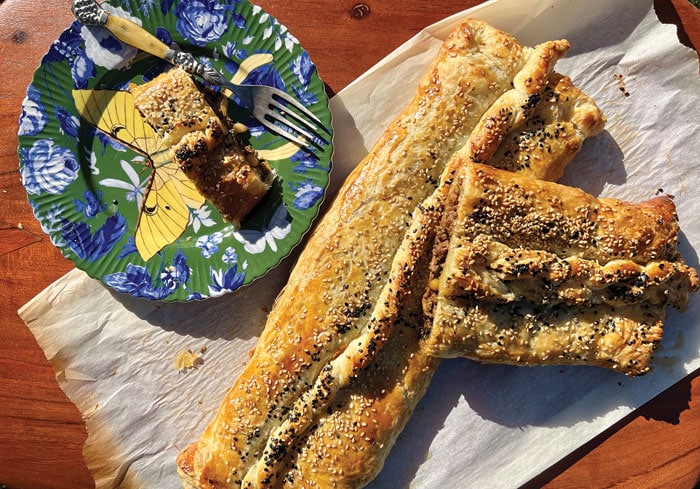
Recently, Rachel and I spent a day cooking and we made these most delicious meat burekas. My mother has been making them for as long as I can remember. She still loves making meat burekas for her grandchildren, along with more creative ones that are filled with any combination of sautéed tofu, kale, spinach, potatoes and mushrooms.
There is something soothing and meditative about chopping the onion and parsley, about taking the time to caramelize the onion, stirring in the meat and pine nuts and sprinkling in the warm spices. Rolling the puff pastry into long logs is much quicker and easier than forming individual burekas. But take the time to decorate the top with your own creative design. We promise, there is just something wonderful about crispy, flaky, golden brown puff pastry wrapped around a meaty filling. So perfectly festive!
When I removed these bundles of joy from the oven, even my husband Alan was moved to say “Wow!” And judging from the happy expressions of my Shabbat guests, they tasted really good too.
—Sharon
Spicy meat cigars and sweet chicken bastilla are much loved dishes of the Moroccan table. Both involve wrapping meat and chicken with a crispy pastry — meat cigars utilize a crunchy brik pastry and chicken bastilla, a paper-thin phyllo pastry. Rolling the cigars is painstaking (and involves deep frying); rolling the phyllo pastry is delicate and fiddly.
The first time I ever ate a meat bureka was 16 years ago in Israel. Neil and I were on vacation there with our young children. When we visited my extended family in Haifa, Rani, the husband of my youngest cousin Anat, made the most incredible meat burekas.
My family and I loved this food so much, that I began making them for Shabbat every week. While this recipe combined the ground beef of the cigars with the cinnamon and pine nuts of the chicken bastilla, the puff pastry gave it a much easier twist. All of it was absolutely mouthwatering. Ever since, making these long log shaped burekas has been a nod to Israel for me.
These meat burekas always brings me back to my loving Israeli family. Despite the difficulties in communicating with each other — I don’t speak Hebrew and some of them don’t speak English so well and only some are able to communicate with me in Spanish — we have an unshakable bond. The relationships were built by our parents and now our children have bonded.
When missiles rained down on Tel Aviv during the summer of 2022, my daughter Rebekah was on an internship working in a school with young children. Scared, she headed to Haifa to be with Anat and Rani and their kids, where she ended up having the best time. They fed her very well and when she returned to Tel Aviv, they even made sure to give her a delicious homemade cake to take back.
It’s crazy how so many of our memories are linked to food, or is food linked to memories?
My family in Israel is in my thoughts constantly. Anat and Rani’s younger daughter Mika is serving on an IDF base in the North.
We pray that Hashem bless all the soldiers of Israel and may He bring them, and the hostages, home safely.
—Rachel
Meat Burekas Recipe
1/4 cup extra virgin olive oil
1 large onion, finely diced
1 lb ground beef
1 tsp kosher salt
1/2 tsp ground black pepper
1 tsp sweet paprika
1 tsp ground cinnamon
1/2 cup water
1/2 cup Italian parsley, finely chopped
1/2 cup toasted pine nuts
1 package puff pastry, defrosted
1 egg, beaten for egg wash
Sesame seeds for garnish
Preheat oven to 425°F.
In a skillet, warm oil over medium heat.
Add onion and sauté until translucent.
Continue to sauté until onion is golden brown.
Add the beef, salt, pepper, paprika, cinnamon and sauté. Use a wooden spoon to break the meat into small pieces. Add the water, cover and simmer until all the water evaporates.
Add parsley and pine nuts and stir to combine. Set aside.
Line a large baking sheet with parchment paper.
On a lightly floured surface, lay out one sheet of puff pastry. Using a rolling pin, lightly thin the pastry into a long rectangle.
Place the pastry dough onto baking sheet
Spoon the meat mixture in a long layer down the middle of the pastry. Pull both sides up to cover the meat. Turn pastry log seam side down. Trim the ends of the pastry and reserve.
Using a fork press down on ends of bureka to seal. Poke a few holes on top to release steam while in oven.
Repeat assembly with second sheet of pastry and remaining meat filling.
Take the reserved pastry and create a decorative braid. Place on top of the logs.
Brush the pastry with egg wash and sprinkle with sesame seeds.
Bake for 20 minutes until pastry is golden brown.
Rachel Sheff and Sharon Gomperts have been friends since high school. They love cooking and sharing recipes. They have collaborated on Sephardic Educational Center projects and community cooking classes. Follow them on Instagram @sephardicspicegirls and on Facebook at Sephardic Spice SEC Food.
In the days following Shabbat HaShachor — the black Saturday of October 7th, on which Hamas perpetrated horrific, barbaric atrocities against Israelis — we asked our community at Valley Beth Shalom for names of loved ones who had been murdered, kidnapped, or called up for military service to defend the future of the Jewish people. I offered to read all of the names at each Shabbat service to add a human face to the war. In just several days, we collected well over 100 names. This war is not a case of six degrees of separation. This war feels very personal. Everyone I know has been affected by the savage Hamas attacks.
Not a day goes by when an Israeli family doesn’t enter our synagogue in tears, wanting to know when and where they can say Mourner’s Kaddish. For the victims of murder, we’re familiar with the ritual of Kaddish. Many of us are mourning. For soldiers in the IDF, we have all participated in raising money and gathering resources that they desperately need. For the kidnapped, how can we respond? What does the Jewish tradition say? We need to know because our entire family is being held hostage.
Our close friends, Jon and Rachel Goldberg-Polin, had not heard back from their son Hersh. Hersh was at the music festival. He had been kidnapped and is being held captive in Gaza.
The news of the war began for me when my cell phone buzzed me awake on Shabbat Simchat Torah. While I don’t normally answer my phone on Shabbat, there was something unusual about all of our phones ringing at once. The awful videos began to rush in: Bloodthirsty murder, girls being kidnapped by men on motorcycles, a half-naked young woman paraded through Gaza on the back of a pickup truck. Then, the horror came closer. Our close friends, Jon and Rachel Goldberg-Polin, had not heard back from their son Hersh. Hersh was at the music festival. He had been kidnapped and is being held captive in Gaza.His story has been told in the pages of The Wall Street Journal, The Los Angeles Times, and Rolling Stone.
At approximately 8 a.m., Jon and Rachel received a text from their 23-year-old Hersh that read “I love you” and “I am sorry.” They have not heard anything since. As Rachel expressed in a recent interview, “I am living every mother’s worst nightmare.” Photos have surfaced that show Hersh huddled in a bomb shelter with other youngsters, trying to defend themselves until Hamas kidnapped all but eight of them. A survivor of the music festival informed Jon and Rachel that their son had lost part of his arm amidst the Hamas butchery, according to The Los Angeles Times. He needs immediate medical attention.
We love Hersh. When we lived in Jerusalem, our families spent Shabbatot together. Hersh and his two sisters were approximately 10 years older than our kids and they used to play together on Shabbat. Our kids loved them. They still do. I can still see 12-year-old Hersh patiently playing with my 2-year-old son on the carpet.Hersh loves basketball, and he liked to tell me about the crazy Jerusalem HaPoel games. He enjoyed music and having fun. Hersh Goldberg-Polin is our collective son.
The story has sparked a global movement. American media has published Hersh’s story. Banners can be seen in soccer games in Germany reading “Bring Hersh Home.” I encourage you to like and share his pages on social media. We must bring Hersh home.
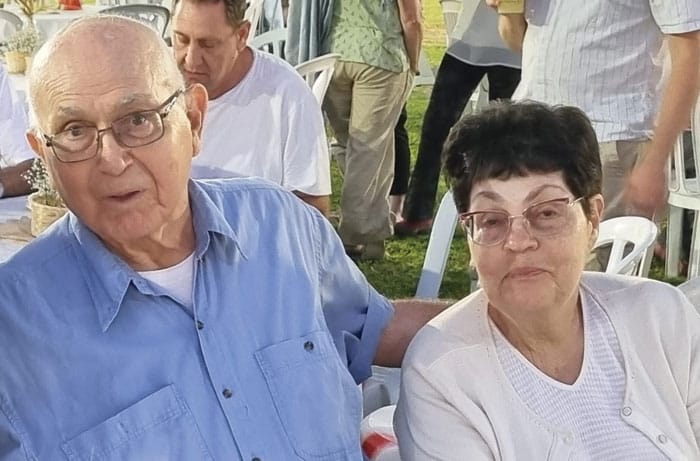
Amiram and Nurit Cooper, kidnapped from their home in Kibbutz Nir Oz. Nurit has been released.
Unfortunately, Hersh is not the only captive to whom we feel connected.Our friend, Rona Passman, has an elderly aunt and uncle who have been kidnapped as well. Hamas kidnapped Amiram and Nurit Cooper from their home in Kibbutz Nir Oz. Hamas attacked the kibbutz, burned down houses, and massacred and kidnapped families. Haaretz has reported that between a quarter and a third of the kibbutz’s 350 families have been killed or kidnapped. After raising their flag over the kibbutz, Hamas kidnapped 84-year-old Amiram and 79-year-old Nurit among the captives.Thank goodness, Nurit was released on October 23, along with another hostage.She was part of the 4 released hostages so far.Yet, Amiram remains in captivity.Amiram is our collective uncle. We must bring Amiram home.There are countless stories of the approximately 222 Israelis being held hostage in Gaza. Shira Albag is beginning a media campaign about her 18-year-old daughter, Liri, who is among the kidnapped. Others are beginning personal campaigns as well. We must bring Liri home. We must bring them all home.
President Biden hosted a Zoom meeting for all of the families of American citizens. Jon and Rachel attended the meeting. The parents pleaded for any news concerning their children in captivity. The parents pleaded for medical attention for all of the hostages. At this point, there are no answers. In this world of pain and peril, how do we move forward from here? What does our tradition say?
The Jewish tradition of Pidyon Shvuyim (redeeming captives) is long and complicated … Halakha, or Jewish law, views the redemption of captives as a higher priority than building a synagogue, even after the funds have been raised.
The Jewish tradition of Pidyon Shvuyim (redeeming captives) is long and complicated. Beginning in Leviticus 19:16, part of a section of scripture that academics deem as the Holiness Code, the Torah instructs us “Do not stand idly by the blood of your neighbor …” Based on this verse, Rashi explains that we must rescue one another from death. Maimonides codified these positions by stating that even if a Jewish community raises money to build a synagogue, they may use it instead to redeem those held as captives (Mattenat Aniyyim 8:11).Halakha, Jewish law, views the redemption of captives as a higher priority than building a synagogue, even after the funds have been raised.
The opinions of our rabbis stem from our Babylonian Talmud, which calls the redemption of captives “a great mitzvah” (Bava Batra 8b). The discussion of this concept appears throughout many tractates of the Talmud. There is a tension in another section that introduces the concern for paying too great a price for the return of a captive (Gittin 45a). The dilemma is whether a hefty price will encourage the kidnap of additional hostages. We saw this concern play out when Gilad Schalit was redeemed in 2011 after five years of captivity. In exchange for his release, more than 1,000 Hamas prisoners were released, including the evil mastermind behind the October 7th Hamas assault.How do we redeem Jewish captives without encouraging the kidnapping of more Jewish captives?
If Schalit’s exchange for 1000 terrorists directly invited Hamas’s brazen assault on humanity, we must now bring these 222 back in a way that does not encourage another similar round.
If Schalit’s exchange for 1000 terrorists directly invited Hamas’s brazen assault on humanity, we must now bring these 222 back in a way that does not encourage another similar round.
I have spent much time considering my halakhic obligation since I found out about Hersh. We must redeem the 222 Israeli hostages as quickly as possible. Our tradition mandates it. At the same time, if Schalit’s exchange for 1000 terrorists directly invited Hamas’s brazen assault on humanity, we must now bring these 222 back in a way that does not encourage another similar round.
Hersh Goldberg-Polin, kidnapped and being held captive in Gaza.
We must find examples of freeing hostages from which we can learn. There are two positive case studies for redeeming the hostages without a demoralizing diplomatic exchange of thousands of terrorists for innocents.
The first way to reframe the conversation can be seen by examining the raid on Entebbe … That public display of force proved itself to be an effective deterrent for decades.
The first way to reframe the conversation can be seen by examining the raid on Entebbe. On July 4, 1976, two Palestinians and two Germans hijacked a plane of 248 passengers and diverted the plane to an airport in Uganda. Over two days, the world negotiated the release of citizens of different countries. 148 non-Israeli passengers were released, while the terrorists held onto 94 remaining passengers, most of whom were Israeli. It is worth noting that the 12 member Air France airline crew remained, refusing to leave the Israelis behind.
In a military rescue operation only imaginable by Hollywood action filmmakers, commandos from the IDF Special Forces arrived and rescued practically all of the hostages. The leader of the operation, Commander Yonatan Netanyahu, was tragically killed toward the conclusion of the mission. This mission laid before the world a new policy of the Jewish people toward captives: We will rescue Jews no matter the challenge, and we will make the perpetrators pay for their crime. That public display of force proved itself to be an effective deterrent for decades.
Entebbe stood as a reaction to the failure of the Munich Olympics in 1972 where Israel trusted others to save Jews from terrorists. After the bloody massacre of Jews perpetrated by those Palestinian terrorists in 1972, we had to change our approach in rescuing Jewish captives. We stand today in a moment of shifting historical tides once again.
To learn from the Entebbe precedent is to assume that the IDF is quietly preparing, mapping clues, and strategizing for rescue missions. While this kind of response would certainly prove to build the public morale, as I’m not a military expert, I can offer little insight. I want to believe that Israel can pull it off. I want to believe that we, as a people, still possess a courageous Yonatan amongst us.
The second way to reframe the redemption of Jewish hostages utilizing a positive case study is to examine our effort to free Soviet Jewry. Rather than clandestine diplomatic negotiations, throughout the 1980’s, the entire American Jewish community publicly and tirelessly fought to free Soviet Jewry. That campaign reflected a marathon effort that unfolded over years and years. A leader of that movement from our own VBS community, Ed Robin (z”l) helped inspire and mobilize Jews from across the country to gather publicly in Washington DC and demand global pressure at a particular inflection point.
On Freedom Sunday, December 7, 1987, American Jewish leaders gathered 250,000 on the National Mall in Washington DC to force public pressure on the Soviet Union to allow Soviet Jews to emigrate. In his own words, Robin wrote in The Jewish Journal on December 5, 2007, “The Soviet Jewry movement was proof positive that a group of determined people has the power to force a compelling moral issue front and center on the agendas of the United States and the entire world. Freedom Sunday in many ways marked the culmination of the most successful mass advocacy effort ever undertaken by American Jews.” It is time for successful mass advocacy once again.
It is our collective responsibility to apply pressure to our governments and all governments that the hostages must be freed. To allow Hersh, or Nurit, or Amiram, or Liri to sit in Gaza for another day is a tragedy for us all.
It is not for the Israeli government alone to negotiate for the 222 hostages.It is definitely not for the American government to negotiate for the release of American citizens alone, and leave the Israelis in captivity.It is our collective responsibility to apply pressure to our governments and all governments that the hostages must be freed. To allow Hersh, or Nurit, or Amiram, or Liri to sit in Gaza for another day is a tragedy for us all.
Isolated protests have arisen throughout the world such as the Israeli American Council’s “Bring Them Home Now” rally in New York October 19. Graffiti bearing slogans such as “Bring Hersh Home” have been spray painted in Barcelona. There is no unifying movement to free the hostages. When I was growing up, a large sign was in front of every American synagogue that read “Save Soviet Jewry.” It reinforced a value that we’re all family and our entire family deserves to be free.
As American Jews, it is now incumbent on us to hang banners from all of our synagogues that read clearly: “Bring Them Home/We Stand in Solidarity with Israel.” Valley Beth Shalom has produced the graphics and made it available for other synagogues across our city and across the country to use. Valley Beth Shalom will hang our banner in the most public manner so that everyone can be reminded each day of the value of Pidyon Shvuyim, redeeming the hostages. We must bring them all home.
35 years after Freedom Sunday, can American Jewish leaders mobilize and stand together behind this cause? Can the American Jewish community once again muster the kind of public mass advocacy that can bring global pressure onto Hamas, the Palestinian Authority, and the larger Arab world? Turkey, Egypt, and Qatar have all publicly acknowledged the possibility of playing some role in negotiating the release of the hostages. The United States government should apply pressure to all foreign governments who maintain relations with Hamas until the hostages are freed. I don’t hear any American Jewish leaders raising awareness for the hostages. Their freedom is our moral and halakhic obligation.
As Jews, we must redeem the hostages. The freedom-loving world should insist that the hostages be freed because the act of kidnapping people and holding them for ransom is barbaric and intolerable. Why aren’t we shouting about the hostages? We must sustain the level of pain and anguish that we felt on October 7th. I guarantee the families of the kidnapped have not yet numbed to the pain. We cannot desensitize either.
Israel is fighting a war that will most likely increase in fronts, in complexity, and in severity. It maintains the weaponry to win the war. How quickly Israel wins, how many IDF soldiers are exposed, and how much devastation for local civilian populations in Gaza, in Lebanon, and possibly in Syria are questions for Israel to decide. Many American Jews have stepped up to support the war effort. Israel must win decisively, but we will not decide the war. In this moment, we can help Israel in four ways: First, donating money to help organizations and even helping the IDF secure resources; second, calling our elected officials and advocating for them to support Israel through legislation and public statements; third, traveling to Israel and volunteering while soldiers are away fighting (I suggest reviewing Nefesh B’Nefesh’s volunteer list: nbn.org.il/life-in-israel/education/higher-education/volunteer-programs); and fourth, publicly advocating for the release of the hostages.
In many ways, the fourth goal is challenging. To publicly advocate for Israel and the release of the hostages takes a toll on us emotionally and physically. There is no assurance that anybody is listening or that they will be freed. It is too easy to forget about their plight because, after all, the hostages and their families are distant. It is human nature to favor what we see and what is near. Yet, Judaism often encourages us to consider the exact opposite. I encourage you to remember Hersh, Nurit, Amiram, and Liri.
Judaism calls us to consider ideas beyond our immediate grasp such as God, relationship, community, and Israel. We train ourselves to care about these values through routine ritual. We cover our eyes to say the Shema or to light the Shabbat candles. We come together for Shabbat dinner or celebrations or in mourning. We train our behavior through reminders and practice.
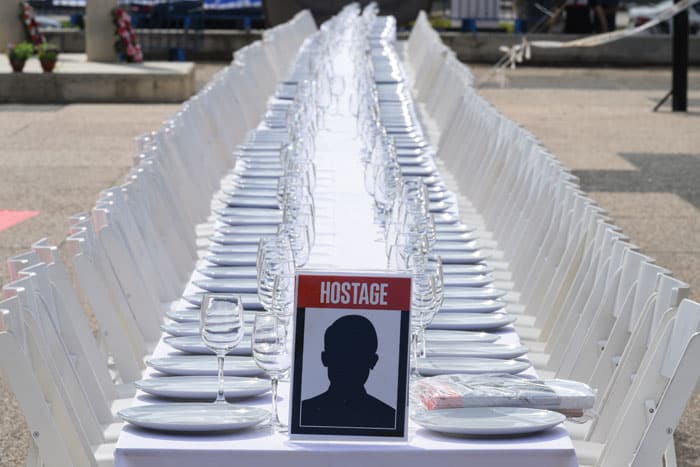
We must also develop communal and personal reminders of the hostages. Although “Kidnapped” signs have appeared throughout Boston and other cities around the world, I have not seen any signage on display yet at our synagogues.Last Shabbat at Valley Beth Shalom, we covered one of the seats on our bimah with the Israeli flag, recognizing that we have members of our family who are missing. Looking at our bimah, one immediately recognizes that something is wrong. We recite the prayer for Pidyon Shvuyim, redeeming the hostages, each Shabbat.
Last Shabbat at home, we lit an extra candle for Hersh. And after reciting the blessing over the candles, we said aloud, “We miss you Hersh and we hope you come home soon.” Our children wished for Hersh’s safe return as well. Prayer is the act of saying out loud the things that matter. The hostages matter.
Sean Gallup/Getty Images
I went to sleep last week, and I dreamt that Hersh returned home. I dreamt that Jon called and asked me to have his son stay with us in L.A. for a while. I imagined Hersh and I walking together to Valley Beth Shalom on Shabbat. I envisioned him sitting at center court and cheering on the Lakers. I felt him having dinner with our family, laughing and acting silly again.
It was a Shabbat dream. It was a taste of the world as it will be one day. We must bring Hersh home. We must bring them all home. We must walk through the streets and scream in pain. We must hang banners from our synagogues. We must shake the pillars of power with mass advocacy. We must ritualize our remembrance of them. So that when they’re freed and we bring Hersh to Valley Beth Shalom, we can all look him in the eyes and say, “I never forgot you. I worked every day to bring you home.”
Rabbi Nolan Lebovitz serves as the senior rabbi at Valley Beth Shalom in Encino, CA, and sits on the Executive Board of the Zionist Rabbinic Coalition. A Fulbright Scholar, Lebovitz spent time last year studying at Bar Ilan University in Israel. He wrote and directed two documentaries: “Roadmap Genesis” in 2015, and “Roadmap Jerusalem” in 2018.
One verse, five voices. Edited by Salvador Litvak, the Accidental Talmudist
And the Lord appeared to Avram, and He said, “To your seed I will give this land,” and there he built an altar to the Lord, Who had appeared to him.
– Gen. 12:7
Cantor Michelle Bider Stone Temple Beth Am
We feel helpless. We are so far away. A call goes out for luggage to bring goods to soldiers for the El Al flight the next morning. We mobilize. Hundreds of suitcases appear on Holt Ave within an hour. The cars overwhelm the street. What else can we do? We are 7,500 miles away. We feel helpless. Yet, in our minds, it’s as if we could reach out our windows and touch the sand of the Nova festival. Our fingertips graze the grass of Kibbutz Kfar Aza. Our hearts are shattered, bleeding on the living room floor where someone’s savta was murdered. The lumps in our throats remain in the miklat, in the safe room, with our cousins seeking shelter from rockets in Tel Aviv and Jerusalem. Our souls are praying with our friends whose children are on tanks heading for the Gaza border.
“To Your seed I will give this land.” We may be 7,500 miles away, but we are the seed and this is our land. In this verse, Avraham follows God’s words with one action, he builds an altar. In the following verse, Avraham continues with four more actions. God tells Avraham that this land will be for his progeny, and Avraham responds with five verbs, five actions. We are a people of action. We feel compelled to do, so we don’t feel helpless. This land, this country is our homeland, and despite being far away, we will always be called to action. Am Yisrael Chai.
Rabbi Nolan Lebovitz Valley Beth Shalom
There is a strange subtext in the land belonging “to your seed.” Did God give the land to Avram as well? Rather, the Torah advocates for an aspirational outlook that parents should intend for our children to enjoy greater wisdom and security. This feels intuitive for us, but it is not a concept that we should take for granted. In antiquity, Egyptians were buried with their servants and their wealth because they wished to carry their legacy into the next world. As Jews, the legacy of our lives remains our effect on future generations. We share this value as Americans as well. In 1963, President Kennedy famously said, “Although children may be the victims of fate, they will not be the victims of our neglect.” We must construct the best collective future possible for our children. This applies to protecting the future of Israel for our seed, especially at this moment. As the war ensues, and we hear calls for restraint, we must not forget the images of the atrocities committed against our children. Hamas isn’t interested in coexistence or peace. They want to kill our children, rape our daughters, behead our babies. This verse has become more pressing now than ever before. We cannot permit a future for our children that includes Hamas. In the same way that God asks humanity to steward the Earth, Jews hold the responsibility to steward the Holy Land. We must ask ourselves, “How am I helping to protect Israel for our children today?”
Elan Javanfard L.M.F.T., Professor & Author, Psycho-Spiritual Insights blog
This parsha provides us a powerful lesson in the attitude of gratitude. Gratitude is a positive emotional response characterized by acknowledging and appreciating the benefits, kindness, or positive experiences received from others or life circumstances. The Or HaChaim writes the Torah wishes to compliment Avraham on his great love for Hashem, since Hashem appeared to him and promised him not only children but that his descendants would inherit Eretz Yisrael. Avraham considered the mere fact that Hashem appeared to him as sufficient reason to build an altar! The feeling that Hashem had deemed him worthy to appear to him was so overpowering that Avraham considered the promise of children and of the land as secondary. This is why the Torah stresses that he built the altar “to the Hashem who appeared to him.”
We can learn a valuable lesson from our forefather. Author Brené Brown writes, “What separates privilege from entitlement is gratitude.” Incorporating gratitude into your daily routine through practices like gratitude journaling, expressing thanks, or engaging in acts of kindness can cultivate a positive outlook, improve our relationship with Hashem, and enhance overall quality of life. Gratitude is the last truly free gift remaining on this planet. Providing your time or just your presence can sometimes mean the world to someone. This can be perfectly summarized by David Hamelech in Psalms 16:11, “In Your presence is perfect joy.” May we all cultivate more gratitude into our lives and experience the ripple effect of receiving its gifts.
Rabbi David Seidenberg Creator, neohasid.org; author, “Kabbalah and Ecology”
Avram/Avraham is promised the land four times in Lech Lecha. The first time is our verse, then 13:15, 15:18, and 17:8. But inside this promise is another: do injustice, betray the poor, attack the stranger, mistreat the land, and God promises to expel you from the land. This is implicit in the dark revelation that comes between the second and third times God gifts Avram the land, when Avram is told: “Your seed will be a stranger in a land that is not theirs, and they will enslave them…for the sin of the Emorites is not full” (15:13). This second promise becomes explicit in subsequent books of the Torah and Prophets.
This week seems like the wrong week to talk about this promise, when we are aching so deeply over the murders and hostages taken by Hamas, may they be uprooted. But what if we are just filling up our own “sin-quota” until we get served with another exile? Because if the covenant is real, no enemy can dislodge the Jewish people from the land, except if we force God’s hand by miscarrying justice. That includes telling Gaza civilians to flee without establishing a way for them to flee safely – a Torah command and not just part of the Geneva Conventions. A third promise follows the second: if we humble our hearts, even if we are in exile, God will re-establish us in the land. May Hashem grant us strength to make a pre-emptive strike by humbling our hearts now.
Rabbi/Cantor Eva Robbins Co-Rabbi, Nvay Shalom & Faculty AJRCA
Imagine at the ripe old age of 75 you hear G-d speaking to you? G-d tells you to leave everything behind, your home, your family, and your birthplace. You’re told to go to some far-off land where you are to settle and become a great nation, “All will know your name and you will be blessed.” Most importantly you will be a blessing to all that come to know you. Wow, a pretty spectacular moment. The reward for your long life is to begin anew, this time with remarkable outcomes.
When you finally reach your destination there are inhabitants already there. Now what? This time G-d doesn’t just speak to you but appears to you, not once but twice, promising this land will become your heirs and you don’t even have a child. Imagine your response – shock, apprehension, fear, awe, gratitude? Avraham’s immediate response – ‘build an altar.’ In this overwhelming revelation he understands he will have a child and the future will generate incredible goodness. In G-d’s presence at his twilight years he has hope and an overwhelming need to express gratitude. He hears, he sees, and feels attached to the Holy One.
We are reminded that even in old age miracles and blessings await us. Opening ourselves to possibility, we can attune ourselves to G-d’s voice and presence. We too can become a blessing and seed greatness for our heirs. There is potential in every moment. As Psalm 92 reminds us, “They shall bring forth fruit in old age.”