fbpx

August 17, 2023

My Parisian Affair: 10 Favorite Pastry Shops

When I take my yearly trip alone to France tongues start wagging. They wonder, “Why does she leave her husband behind?” Audacious friends inquire, “Is there someone special waiting for you?” Even my French teacher has the chutzpah to suggest an affair (or aventure) would  improve my accent. But my husband doesn’t worry. When he whispers in my ear at the airport, “Be careful. Watch out,” we both know that he really means is, “Don’t eat too much cake.”

Yes, my inhibitions loosen while travelling in France—the home of crusty baguettes and a hundred or so of my favorite pastries. He has seen my face light up at the sight of a crackling croissant in the morning and how a tray of pastries arranged like a Klee print leaves me breathless. He knows what makes me swoon post-menopause.

Before getting into this year’s recommendations, here are a few tips for sniffing out superior baked goods:

  1. Ignore the “best of” anything on social media. Mostly, these selections are retreads from influencers who feed off each other like crazed pastry zombies. Yelp is of no use in France, unless you want advice from other tourists.
  2. Never travel more than 15 minutes for a pastry. Don’t plan your day around a destination bakery, unless you want to risk the heartache of the store being closed, as they often are in France. A few years ago I walked for an hour in the heat in a less than charming neighborhood to bite into the “best” apricot tart. Was it good? Yes, but is any tart worth walking two hours and then waiting in line in order to eat with a plastic fork? Are you beginning to understand why my husband stays home?
  3. Price should never be a consideration. If you flew to Paris for vacation, why tie yourself in knots over the cost of a raspberry tart or a chocolate éclair? Isn’t it worth $12 for a few transcendent moments? Like fine chocolates, pastries are an affordable luxury, as I keep explaining to my husband.
  4. Nothing compares with discovering a mom and pop shop that has honed its offerings over many generations. Explore a residential neighborhood by foot and watch where the locals go. Parisians lined up at lunchtime, schoolchildren picking up after-school treats, and an elegant, clean décor are good clues.

Here are some favorite spots in central Paris from this year’s trip. Enjoy and remember my husband’s warning: “Be careful!” But not too careful.

Left Bank

Des Gâteaux et Du Pain, 7th and 15th. Celebrated for the delicate design and intense flavor of her bio (organic) pastries, Chef Claire Damon is enjoying a moment. Her puck-shaped lemon tart, built on a crumbly brown sugar crust and filled with reversed layers of slick meringue on  bottom and a layer of rich puckery lemon curd on top is just right. I need to return with friends for a more complete sampling.

Angelina, 6th. If you love Paris, you’ve probably made the trip to the classic belle epoque tea room on rue Rivoli for their thick hot chocolate. I recommend the lunch space at Musée du Luxembourg for a less hectic experience. I can’t resist their refined version of the American club sandwich. In May, I topped it off with the seasonal frasiers—perfect squares of fluffy sponge layers, light whipped cream and juicy strawberry halves. Did I mention the brilliant red strawberry glaze topping? The proverbial cherry on top.

Les Gourmandises d’Eiffel, 7th. An unpretentious bake shop on rue Grenelle, steps away from the popular rue Cler market, this artisanal boulangerie was my regular spot for last minute baguettes. Their Sunday special—a giant, round egg bread topped with crunchy, pearled sugar that tastes like Italian panettone minus the dried fruit—is sold by the slice. A big, moist chunk  keeps on the counter for a few days, perfect for making beautiful morning toast.

Right Bank

Ritz Le Comptoir, 1st. The bakery at the Ritz is open to the public in the same way as the Hemingway bar is—as a tourist attraction where the price for experience is high. Breaking my own rules, I went to the swanky address on rue Chabon across from Chanel at about 3:00 p.m. with dreams of lingering over treats and sipping an espresso or two at a small table. I’d been ogling the pastries for a year online, having become addicted to a marketing campaign that featured cute Chef François Perret with his darling little pastries. My dreams crashed when I realized the tiny place had only five tables and the line was long. Shlepping home on the Metro with my jam-filled, glazed raspberry madeleines and crisp mocha millefeuille, was not a catastrophe, but it was a mood breaker. I hope I don’t sound like a Karen.

Blé Sucré, 12th. Just a few steps from the Marché d’Aligre, this unpretentious shop is known for its low cost pure butter croissants and madeleines. A couple of outdoor tables make it possible to enjoy your carbs with coffee in the morning while watching children play in the little square adjacent.

Du Pain et Des Idées, 10th. If you wander over to the Canal St Martin, Paris’s Silverlake, take the time to wait on line at this pretty wood-paneled bakery. Oversized escargots, snail-shaped viennoiseries, overflowing with rum-soaked raisins, pistachios, cherries, pralines and chocolate keep coming out of the ovens all day long. Many of their sourdough breads, for which the owner won the coveted “Best Worker of France” certification, can be bought by the slice.

Tapisserie, 11th. Console yourself with a pastry at this tiny takeout shop on gentrified rue Charonne when you can’t get a table at restaurant Septime across the street. Under the same ownership, the young bakers turn out a few seasonal specialties each day. In the spring, I nibbled on a rustic rhubarb tart and a pillowy apple turnover (chausson aux pommes) that still makes me a smile.

Luxe Pastry Chains

These brand names with several locations can be trusted for consistent fine quality:

Yann Couvreur. Often found in ordinary neighborhoods where the clientele is French, Couvreur’s prices are fair for such high quality. Drop in for breakfast, sit at the counter and treat yourself to a five-star kouigin amman or other viennoiserie with coffee. The classic fancy pastries are all here in individual portions to-go.

Pierre Hermé. Best known for his flavorful macarons that fly out the door, Chef Hermé is considered the master chocolatier of France—a serious title in the land of cuisine. Though I’m not a big macaron fan, I will stop into Hermé for a coffee and pastry at the airport or train station. In town, the visual excitement of the windows and displays are hard to resist.

Aux Merveilleux de Fred. The first time I saw a Fred shop near the Marché d’Aligre, I resisted the scent of chocolate and the sight of adorable bakers in white coats decorating cakes in the window. Too much kitsch! Eventually, I stepped in and tried the specialty—a five-inch round globe filled with light layers of airy meringue, flavored whipped cream and a biscuit landing pad, then finished with chocolate shavings or crunchy coffee bits. Now I go back whenever I need an escape into a sugary fairy tale.

Still need a nosh? These two Jewish bakeries in the Marais deliver comfort along with taste:

Florence Kahn, rue des Ecouffes. When I visited at Passover, the counter was piled high with homemade matzo sandwiches stuffed with pastrami! Almond and coconut macaroons were light and small enough to munch through a day of sightseeing. A Yiddish Patisserie, Kahn is best known for its bagels and takeout sandwiches.

Sacha Finkelstajn, rue Rosiers. Standing on the long, loud line one afternoon surrounded by Ukrainians, I time-travelled back to my neighborhood in the Bronx. It was tough choosing which specialty of the Eastern European diaspora to try: neat trays of bagels, bialies, pletzels, rye bread, matzo, mandelbread, challah, borekas, strudel, cheesecake line the shelves. In addition to baked goods, deli items like fresh sour cream, herring and smoked fish are available for takeout.

As Hemingway once said, “Paris is a moveable feast.” Go taste it.


Los Angeles food writer Helene Siegel is the author of 40 cookbooks, including the “Totally Cookbook” series and “Pure Chocolate.” She runs the Pastry Session blog.

My Parisian Affair: 10 Favorite Pastry Shops Read More »

Raising Children to Kill — Then and Now

The news that Palestinian Authority summer camps are training children to use weapons and glorify terrorists is a troubling reminder that some regimes view children as little more than tools to be exploited.

Hundreds of thousands of children have been used as soldiers in various international conflicts in recent decades, according to human rights groups.

The Ugandan rebel group known as the “Lord’s Resistance Army” has made the abduction and enslavement of children “its main method of recruitment,” experts say.

In Bolivia, an estimated 40% of the army consists of teenagers who were forcibly conscripted.

The participation of Palestinian Arab children in terrorism against Israelis has become so commonplace that it has attracted the attention of Palestinian advocates in the United States. They’ve persuaded a handful of members of Congress to introduce legislation to restrict U.S. aid to Israel if the Israeli military detains minors who engage in violence.

A Nazi Version of Cinderella

Dictators in previous generations likewise prioritized training children to hate and kill. Adolf Hitler, for example, viewed Germany’s schools as a breeding ground for raising an entire generation of Nazis.

Following Hitler’s rise to power, German school curricula were radically revised to reflect Nazi ideas, and traditional text books were replaced with Nazi versions. Biology texts now advocated the theory of “Aryan” racial superiority. Atlases focused on the alleged danger to Germany posed by surrounding nations and the supposed theft from Germany of various territories. History books presented justifications for renewed German militarism. The Nazis even concocted their own version of Cinderella, with the prince choosing a racially pure young heroine and rebuffing her racially alien stepmother.

At a press conference in September 1934, President Franklin D. Roosevelt expressed concern that the German government seemed to be preparing young people for war with Germany’s neighbors. He related a story he heard from an American tourist in Germany, about an eight year-old German boy who in his bedtime prayers each night would say, “Dear God, please permit it that I shall die with a French bullet in my heart.”

Unfortunately, that did not change FDR’s policy of maintaining friendly diplomatic and trade relations with Nazi Germany in the 1930s.

Disney Exposes the Nazis

During World War Two, Disney created a series of short cartoon films to support the American war effort and expose the nature of Nazism. They were shown in movie theaters, prior to the main feature. One especially striking nine-minute film was called “Education for Death: The Making of the Nazi.”

The storyline follows a German child, Hans, as the Nazi school system turns him into a worshipper of Hitler. When Hans’s teacher shows the pupils a fox capturing and eating a rabbit, Hans makes the innocent mistake of expressing sympathy for “the poor rabbit.” As punishment, he has to put on a dunce camp and sit in a corner, while another student gives the “correct” answer: “The world belongs to the strong…The rabbit is a coward and deserves to die.”

Finally surrendering to peer pressure, Hans agrees that the rabbit was “a weakling” who got what it deserved. The teacher then provides the moral of the story: the German people are “an unconquerable super race” who will “destroy all weak and cowardly nations.”

The Disney narrator describes how Hans’s upbringing then proceeds with endless “marching and ‘Heil’-ing, ‘Heil’-ing and marching.” The little boy becomes almost a robot, blindly heeding the Nazi Party’s orders to “trample on the rights of others.” The narrator concludes: “For now his education is complete–his education for death.”

Nazi-educated German children filled the ranks of the Hitler Youth movement. Its members took part in numerous atrocities, from forcing Vienna’s Jews to scrub the streets with toothbrushes in 1938, to the mass shooting of Jews swimming from sinking boats in the German harbor of Lubeck, just before Germany’s surrender in 1945.

In addition, many of those who graduated from Hitler Youth joined the Gestapo and participated in the mass murder of European Jewry. While other branches of the Nazi apparatus collapsed or surrendered in the waning days of World War II, Hitler Youth remained fanatically loyal to their Fuhrer to the very end, which is why they are often mentioned in accounts of atrocities that were perpetrated in the spring of 1945.

Menachem Weinryb, an Auschwitz survivor who was forced to take part in a death march from Poland to Germany, later recalled how when the prisoners reached the Belsen area on April 13, 1945, the German guards went to a nearby town “and returned with a lot of young people from the Hitler Youth [and local policemen]…They chased us all into a large barn…we were five to six thousand people…[They] poured out petrol and set the barn on fire. Several thousand people were burned alive.”

Raising children to kill, whether in Nazi Germany in the 1930s or in the Middle East today, always has deadly consequences.

“The Little Brown (Shirt) Schoolhouse,” by Edmund Duffy, Baltimore Sun, April 15, 1933. Duffy invoked a classic symbol of American education, the one-room rural school building known as “the little red schoolhouse.” His Nazi version referred to the brown shirts that were part of the Nazi stormtroopers’ uniforms. (From Cartoonists Against the Holocaust, by Rafael Medoff and Craig Yoe. Forthcoming from Dark Horse in 2024.)
“The Patriot Master’s Reward,” by Irwin D. Hoffman, Jewish Daily Bulletin, April 19, 1934. The teacher who bullies his students and teaches them to hate Jews is considered a true patriot in Hitler’s eyes. (From Cartoonists Against the Holocaust, by Rafael Medoff and Craig Yoe. Forthcoming from Dark Horse in 2024.)
“Regimentation–from Teething Ring to Tombstone,” by Vaughn Shoemaker, Chicago Daily News (date unknown). Shoemaker charted the Nazis’ cradle-to-grave system of indoctrination and absolute control. (From Cartoonists Against the Holocaust, by Rafael Medoff and Craig Yoe. Forthcoming from Dark Horse in 2024.)

Dr. Medoff is founding director of The David S. Wyman Institute for Holocaust Studies and author of more than 20 books about Jewish history and the Holocaust. His latest is America and the Holocaust: A Documentary History, published by the Jewish Publication Society & University of Nebraska Press.

Raising Children to Kill — Then and Now Read More »

Print Issue: Arguing With Everyone | Aug 18, 2023

CLICK HERE FOR FULLSCREEN VERSION

Print Issue: Arguing With Everyone | Aug 18, 2023 Read More »

Memories of an Old-New Republic

“There was a time when writers cared more about the truth than their status; when reason and respectful debate were privileged over trendy ideology and virtue signaling; when critical thinking and analysis were honored more than branding and ‘influencers.’”

This is how Karen Lehrman Bloch begins her cover story this week on the irrepressible Martin Peretz’s new memoir: “The Controversialist: Arguments with Everyone, Left Right and Center.”

This story is close to my heart because it revolves around The New Republic (TNR), a weekly magazine I fell in love with in the 1990s and that I dearly miss today. Among other things, I could always count on TNR for intelligent, surprising analysis rather than today’s predictable political bias.

This story is close to my heart because it revolves around The New Republic (TNR), a weekly magazine I fell in love with in the 1990s and that I dearly miss today. I could always count on TNR for intelligent, surprising analysis rather than today’s predictable political bias.

In this fragile and tribalized era, a magazine that puts intelligent analysis above political bias sounds downright quaint. This political bias, however, has had a troubling effect on our journalism, in at least three ways. 

One, a loss of trust. If I feel that a writer or publication will bash only the “other side” but rarely if ever their own side, I don’t trust them. Their objective is not to pursue truth but to help one side win. The truth doesn’t care who wins; the truth itself is a victory.

The second effect is boredom. Ideological bias makes journalism dull and predictable. If I feel that a writer is wearing a uniform for a political party, I doze off. Nothing he or she writes will ever surprise me. These are writers at the mercy of a political agenda, which makes them the most boring kind of writers.

In its heyday, under the ownership of Martin Peretz, TNR was anything but boring. I would read a biography of John Adams that got rave reviews, for example, and then I’d open TNR to discover a brilliant, dissenting take on the book.

In addition to TNR’s well-known and well-earned popularity in the halls of power, its lesser-known quality was its delivery of sheer intellectual delight. Everything from politics to culture aimed to provoke thought. Its secret motto could well have been, “Thou shalt never bore.”

The third troubling effect of political bias has been an erosion of culture. “Politics seems everywhere to have swamped culture,” Joseph Epstein writes in this month’s Commentary. “It has not merely overwhelmed culture as a subject of interest but has infiltrated it through political identity and correctness… Culture seeks out the best, irrespective of race, color, or creed. Contemporary politics puts diversity, inclusiveness, equity above quality, and respects only the divisions of race, color, and creed.”

Epstein cites examples of general interest magazines like the old TNR which have become “more and more political in character.” The New Yorker, for example, “never descended to the level of party politics until the turn of the new century, when it began attacking George W. Bush and Dick Cheney, laid off Barack Obama, and went into high dudgeon against Donald Trump. In doing so, the magazine has lost its cultural authority, the authority that comes with being above the ruck.”

Being above the ruck means being unafraid to embrace the complex truth wherever it takes you. As Bloch writes, “TNR was both influential and well-respected precisely because of its complexity — its willingness to call out both sides.”

The book highlights the influence of Jewish intellectuals to that golden age of vigorous journalism, offering a chance, Bloch writes, “to revisit a hugely important time in both Jewish and American history. Jewish intellectuals, previously shut out by both universities and established magazines, were finally given a well-respected platform to dissect and devise important ideas.”

It’s sad, surely, that so many of today’s Jewish intellectuals seem to have fallen under the mainstream spell of political and ideological bias. But let’s not be too surprised: this is yet another sign of how safely assimilated our Jewish intellectuals have become. They’re no longer the rebels trying to break through forbidden doors; now they’re the conformists keeping the rebels out.

This is yet another sign of how safely assimilated our Jewish intellectuals have become. They’re no longer the rebels trying to break through forbidden doors; now they’re the conformists keeping the rebels out.

Will Jewish intellectuals ever regain their dissenting mojo? There are more than a few courageous Jewish voices out there who are trying, among them TNR alumni. As Bloch writes, “[Peretz] ends the book with faith in the people he’s taught and worked with. And the truth is, most of us who worked there will never be silent about how far journalism has fallen, and the dangers of extremism and insipid ideology. We will continue to try to reteach the world the true meaning of liberalism.”

Amen to that. Our new republic needs it.

Memories of an Old-New Republic Read More »

Sephardic Torah | Women’s Prayer Groups: Rabbi Yosef Messas

It is commonly believed that halakhically-based women’s prayer groups originated in contemporary circles of the progressive wing of Modern Orthodoxy. Think again.

In his book Nahalat Avot, Rabbi Yosef Messas reveals that in certain ancient communities in Spain, there were pious religious women who conducted their own early morning prayer services.

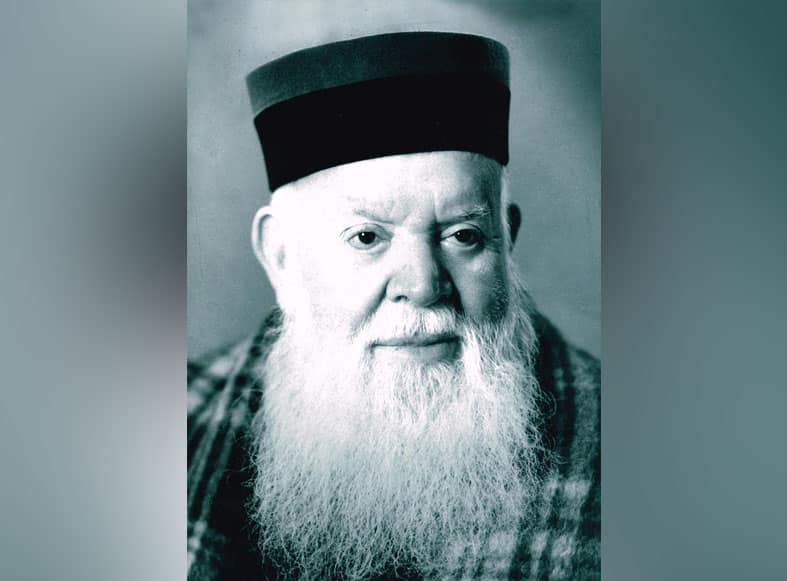
Born in Meknes, Morocco, Rabbi Messas was one of the 20th century’s outstanding halakhic authorities. He served as the Chief Rabbi of Tlemcen, Algeria and the Chief Rabbinic Judge (Dayan) in Meknes. A prolific author of 48 rabbinic books, he was also a talented liturgical poet and artist whose drawings graced many pages of his books. In 1964 he made Aliyah, and in 1968 became the Chief Sephardic Rabbi of Haifa, a position he held until his passing in 1974.

Nahalat Avot is an eight volume collection of Rabbi Messas’ sermons from his years in Meknes, Morocco, starting in 1943. Published in stages between 1971 and 1987, Nahalat Avot is a treasury of Torah wisdom.

Discussing the dictum that one should wake up early in the morning for prayers “with the strength of a lion,” Rabbi Messas quotes a poetic verse from the Torah that describes the Jewish nation: “Lo, a people that rises like a lioness and leaps up like a lion” (Numbers 23:24).

“Rashi teaches that this verse is a metaphor for the Jewish people rising early to put on Tallit and Tefillin, read the Shema and pray,” says Rabbi Messas. “If so, why did the verse mention the female lioness before the male lion?”

Rabbi Messas’ answer to his thought-provoking question reveals a beautiful piece of Sephardic history:

“I saw written in a book, that in certain communities in Spain, the learned and pure women would wake up very early in the morning and go to their own designated synagogues, where they would conduct a prayer service. One of the women would lead as shliha d’tsibbur (designated prayer leader), and on the days of Torah reading, they would read from a Torah scroll. Some of the women wore Tefillin, and all of them were wrapped in a Tallit. They conducted such services on weekdays, Shabbat and holidays. Women are exempt from time-bound commandments, so these women voluntarily took upon these obligations. After services they went home to wake up their husbands and sons to go and pray. This is ‘the lioness waking up before the lion’.”

The women in Spain – and Rabbi Yosef Messas – were years ahead of their time. Something for both Ashkenazim and Sephardim to think about.

Shabbat Shalom


Rabbi Daniel Bouskila is the director of the Sephardic Educational Center and the rabbi of the Westwood Village Synagogue.

Sephardic Torah | Women’s Prayer Groups: Rabbi Yosef Messas Read More »

Managing Emotional Pain through Acceptance

Third in a series about Jewish Mindfulness 

For a long time I have disdained the way our culture seems to encourage us to marinate in our emotions, and even flaunt them. It’s normal for people to refer to themselves as “survivors” of relationships they call abusive or dysfunctional, and of physical or emotional experiences they call traumatic. Many experiences and relationships truly are abusive, dysfunctional, and traumatic. But they are frequently used to cover such a broad swath of experiences that the meaning of these powerful words become trivialized.    

Dr. Edith Eger, a Holocaust survivor and PTSD expert, wrote in her extraordinary book “The Choice” that there is no hierarchy of pain, meaning that everyone’s pain is significant and must be respected. I understand this and would never disagree with a woman of her professional stature and personal history, but it’s hard to deny that the victim mentality has become commonplace. How can you build a forward-looking, optimistic life when you remain fixated on the past?

Jewish mindfulness has made me temper my reproachful attitude toward those who cling to their pain and let it define them. I have come to understand that when this happens, it may be because real pain (at whatever level it was experienced) was never processed in a healthy way. Judaism predated the mindfulness movement by a few thousand years, but both teach a restorative path that encourages emotional pain to lift naturally. 

In Exodus (6: 5-9), God tells Moses, “I have now heard the moaning of the Israelites because the Egyptians are holding them in bondage.” God is validating the pain of His people. But when Moses promises that God will lead them out of bondage, the people do not believe him because of their emotional exhaustion. This kotzer ruach, or constriction of the spirit, literally leaves them short of breath, a reminder of how mindful breathing can be medicinal during acute stress.  

Accepting pain is also a critical step. Both Mindfulness-Based Stress Reduction (MBSR) as well as Dialectical Behavioral Therapy (DBT) therapy teach that thoughts create emotions. At first this sounds confusing: are they not the same thing? In fact, thoughts have words, while emotions are simply feelings. Learning to control our thoughts can help us learn to control and manage our emotions. This isn’t easy and takes a great deal of practice. 

For example, when I’m upset, I will only inflame my emotions by allowing my thoughts to judge them: “What’s wrong with me that I’m getting upset over this? Why does this person always have to frustrate me this way?” “I bet other people don’t have this problem as often as I do.” 

Mindfulness, DBT and similar psychological philosophies encourage us to simply feel that pain. Don’t fight it. Don’t analyze it. Just “let it flow and let it go,” as my mindfulness course leader, Rabbi Dov Ber Cohen, often says. Pain and negative emotions have their uses in the short term. Don’t be upset that you’re upset or feel frustrated that you’re frustrated. “Pain is pain but pain plus resistance is suffering,” said a close friend of mine who has walked this walk. 

In addition to not judging our emotions, these three mindfulness practices can be extremely effective in managing negative or painful feelings:

1. Sit with that feeling. I know a person whose therapist told him to bring a chair outside and invite his pain to sit alongside him. Acknowledging the reality of the pain will ease its grip.

2. Put it in perspective. Know that there is a time and place for feeling pain, but that it’s not going to hijack the rest of your life, either. It may not even hijack the rest of your week or even your day.

Pain is here to teach us something and to help us grow. It’s up to us to find out how to use the pain for personal growth or to help others. 

3. Find the purpose. Pain is here to teach us something and to help us grow. It’s up to us to find out how to use the pain for personal growth or to help others. 

I discussed this topic with one of my sons, Rabbi Noach Gruen, a day school rebbe in Norfolk, Virginia. He pointed out to me that the Jewish model for aveilus, or mourning, provides the ideal paradigm for dealing with painful emotions. When we lose a close relative, we sit shiva — seven days of literally sitting with our grief. We don’t run away or distract ourselves from our pain. We need to feel it, and talk about our loss when it is fresh and experienced most acutely. But shiva ends. We get up and are escorted outside by friends. It’s time to reengage with life.

Shiva is followed by shloshim, the first month after a loss; in the remaining 11 months of the year the restrictions of mourning are gently lifted as we navigate away from our most intense grief, while still being mindful of our loss. Sometimes, well-meaning but misguided people say hurtful things to someone in pain, such as “This will be for the good,” or “God knows what He’s doing.” The Sages of Pirkei Avot know better: “Do not try to pacify your friend in his hour of anger, nor comfort a person when their dead is laying before them” (Avot, Chapter 4). At times like these, only quiet empathy can offer whatever comfort is possible.  

During the last few weeks I was tested by very strong and negative emotions stemming from a professional defeat. This disappointment stung so badly that despite my new understanding of sitting with pain to let it go, I felt rebellious: I would take my sweet time wallowing in resentment and misery. After all, I earned it!  

But the next day, while discussing the situation with a colleague, I began to recover rapidly. Given how intensely I had suffered the day before, I surprised myself by quickly losing interest in my self-righteous pique. I considered what I could learn from the situation and felt ready to move on. Was this mindfulness at work? Or my life experience and Jewish wisdom helping me rise above it? I assume it was both, and am grateful that I proved stronger than my pique.

Mindfulness helps us manage difficult emotions, but what about helping us maximize positive, happy ones? In the next column I’ll look at how mindful practices can optimize even our happy thoughts.


Judy Gruen is the author of several books, including “The Skeptic and the Rabbi: Falling in Love With Faith.” Her next book, “Bylines and Blessings,” will be published in February 2024.

Managing Emotional Pain through Acceptance Read More »

Rabbis of LA | Camp Ramah Laid Foundation for Rabbi Elliot Dorff

Although he celebrated his 80th birthday two months ago, Rabbi Elliot Dorff has a schedule that would wear out someone a quarter of his age. The author of 29 books covering a wide range of interests, including bioethics, epistemology, and the depth and breadth of Jewish law, Dorff teaches at UCLA School of Law and American Jewish University (where he is the Sol & Anne Dorff Distinguished Professor in Philosophy) and is involved in a multitude of local and national organizations. 

But when asked what had the biggest influence in his life, the answer is surprising: “Camp Ramah has had a really important impact on my life.” 

Sitting in his sun-filled home, Dorff explained that “in the beginning – I started when I was 12 years old in 1955 – it was simply because it was just joyous. It showed. We sang a lot together, we danced together, we put on plays together, we played sports, we also learned. We had two hours of study every morning.” Ramah, he said, “is in my blood.”

There were two features at camp that shaped his life. “Number one was the sense of meaning and joy in the Jewish tradition it fostered through all kinds of activities that were just fun as well as some serious discussions.” The second was that “it set up the structure for thinking seriously about life and moral issues.”

Ramah would also influence his personal life. In 1961, when he was 18, he attended a Ramah conference in the Poconos for counselors, where he met his wife, Marlynn. “She was from Philadelphia, and I dragged her back to Wisconsin, where we were counselors until 1964.” When Dorff and Marlynn moved to Los Angeles, he became the professor-in-residence at Ramah, where he stayed for 16 years.

One lesson that especially influenced him occurred when Dorff was 15. Rabbi David Mogilner, director of the Wisconsin camp, would meet with 15 and 16 year old campers every Monday.  He asked how many keep kosher at home and out, then how many don’t keep kosher at all and finally, how many keep kosher at home but not out. The Dorff family fell into the last category. “It’s you people I don’t understand,” the rabbi said, “because you are inconsistent.” Reminiscing about this, Dorff said the rabbi “was basically saying why would anybody in his or her right mind do any of these Jewish things or believe in these Jewish things?” What truly impressed him was that “a rabbi who had devoted his life to Jewish tradition was not afraid, but eager to ask all kinds of questions that would undermine the system. Until then, I had assumed Judaism was something you did because your family did it, tradition.”

At home, he was raised in Milwaukee, Wisconsin by supportive parents he described as “typical second-generation” Jews. Both grew up in Orthodox synagogues and later joined Conservative synagogues. “My father put it this way,” said Rabbi Dorff. “‘I didn’t leave Orthodoxy, it left me because it wasn’t modern.’” 

But at 15, he made a decision that would change his life. “If I was going to be religiously Jewish, it came at a real social cost,” he said.  Friday night basketball games vanished. After a Saturday night movie, everyone would head to the Big Boy, with its famous cheeseburgers. Dorff ordered salad or a fish sandwich. His non-Jewish friends thought it was cool, showing he had principles. His Jewish friends told him it was medieval. 

By college, he had made up his mind to become a congregational rabbi and teach on the side. After gaining a doctorate in philosophy, Rabbi Dorff was thinking about his first congregation. When a teaching position beckoned at the University of Judaism, the president, Rabbi David Lieber, convinced Dorff to come out and interview. “Before Marlynn and I came out in November 1969, I never had been west of the Mississippi,” Dorff said. “After Rabbi Lieber had me teach a few classes, he asked what I thought.”  When the young rabbi repeated his intention of being a congregational rabbi and teaching on the side, Lieber had a two-tiered response. 

He told Dorff he should start with the academic piece because academics earn less than congregational rabbis, and it’s always easier to go from less to more. Finally, Lieber told him, in congregations many will compliment you while in academia they are rare. Better to start with fewer. “Those,” said Rabbi Dorff, “were the two winning arguments that brought us to Los Angeles in 1971. I figured I would be here two or three years, then take a congregation in the Midwest. Fifty-three years later, I have yet to get serious.”

“To be a serious Conservative Jew, you need a serious commitment to the tradition and also a serious commitment to the modern world, and you have to integrate them.”

He did get serious when asked what people don’t understand about Conservative Judaism. “It’s not Goldilocks, not too warm, not too cold,” Dorff said. “It is the middle movement, but it is a serious commitment to a form of Judaism that is traditional and also open to the outside world so that the way we practice our tradition is informed by science, literature, economics, politics and everything else. To be a serious Conservative Jew, you need to understand both, a serious commitment to the tradition and also a serious commitment to the modern world, and you have to integrate them.”

Fast Takes with Rabbi Dorff

Jewish Journal: Your favorite time of the Jewish year?

Rabbi Dorff: Shabbat.

JJ: What superpower would you like to have?

Rabbi Dorff: To make this the Messianic world in which there is no war or want or fear or sickness.

JJ: Your favorite Jewish food?

Rabbi Dorff: Potato kugel.

Rabbis of LA | Camp Ramah Laid Foundation for Rabbi Elliot Dorff Read More »

I Sort of Did It

It has taken over 60 years, but I finally mustered the courage and did it. I’ve spent almost a lifetime watching other people do it and wishing I could be like them but wishing to be someone else is generally not a good thing. I learned that God wants us to be ourselves, not another Moses. I said to my wife, “I’m about to do something I wanted to do forever.” Without even asking, she said, “Do it.” That’s trust. But being about to do something is still not the same as doing it. We’ve all seen someone balancing on the tip of a diving board and then climbing back down. 

“Come on, Mark, what the hell did you do?” I feel slightly ashamed because many of you will think this is not a biggie. But have you ever wanted to do something forever and not done it? Courage is a very odd thing. In some areas, I have tremendous courage, and in others, I have zilch. For me, each day my courage buckets need to be refilled.

I had been doing pushups for months, then one day I lost the courage to continue. I thought and believed the idea that I didn’t have the strength. Not the slightest bit true. I had more than enough strength. Yet I went weeks without doing a single pushup.

I can’t tell you how many panic attacks I’ve had before shows and performed despite my fear. I have done so many things in life with courage that I never knew I had. 

Remember the courage it took to ask someone out on a date? Then rebuilding that courage to do it again after being turned down? One explanation of courage is the ability to do something that frightens you, and that’s me. I can’t tell you how many panic attacks I’ve had before shows and performed despite my fear. I have done so many things in life with courage that I never knew I had. 

But this thing was different. When I was very young, my mother frightened me about doing this thing, and I remained frightened for 60-plus years. Writing two books was less frightening than  doing this. I have been aware of this fear forever. Being aware of something is a start, but not the solution.

Before I tell you what it is, let me give you a few hints. Chefs do it, Ice Cream truck drivers, Marines, Pilgrims in Islam, and the Shinto religion of Japan all do it. Coal miners never do it. New Yorkers that ride the subway never should. 

Before I tell you what it is, let me give you a few hints. Chefs do it, Ice Cream truck drivers, Marines, Pilgrims in Islam, and the Shinto religion of Japan all do it. Coal miners never do it. New Yorkers that ride the subway never should. 

If you still haven’t guessed, I bought white pants. And I mean WHITE. My heart just raced while writing those words.

When I was a child, I wore white shirts, white socks, white tee shirts, and white briefs, but I never wore white pants. I always wanted white pants, but my mother, being my personal shopper, would never buy them for me. (Except for a protective cup for sports, I don’t remember my father ever buying me any form of apparel). 

The mere thought of me in white pants gave my mother agita. Agita is an Italian word even Yiddish speakers use. “You’re a slob. You’ll ruin them.” “Learn to use a napkin, and I’ll get you white pants.” She was right. I never did learn how to use a napkin. Her words scared me. Every time I’d see someone walk by in white jeans, cords, or khakis, I’d think, “Are they crazy? Where is their mother? Suppose they stain them?”

The author in his white pants

So now you know. I ordered a pair of white pants on Amazon. White pants are one of the great filth magnets of all time, and I bought a pair.

Coming home, I found a soft package on my doorstep. I took it to the dining room table and tore into it, practically ripping it open with my white teeth. And there they were, the whitest pants you’ve ever seen. I might even call them Blinding White. I put them on faster than a twelve-year-old getting into a bathing suit. I then ran to a full-length mirror and looked at them on me. I knew the second I saw them that they did not fit and that I needed to return them. I carefully took them off and put them back in the plastic bag so they would not get dirty. Will I reorder a new pair? Stay tuned.


Mark Schiff is a comedian, actor and writer, and host of the ‘You Don’t Know Schiff’ podcast. His new book is “Why Not? Lessons on Comedy, Courage and Chutzpah.”

I Sort of Did It Read More »

Mother-Son Bonding Over Diamonds in Antwerp

My 24-year-old son Gabriel lives 5,663 away in Brussels, Belgium; 5662 miles too far for a Jewish mother. Fortunately, I visited him this summer. Sadly Rabbi Zevi and Sara Ives, who Gabriel goes to every Friday night for Shabbat dinner, were out of town. But Gabriel knows when I travel, I want to connect with my Tribe and explore the local history of the Jewish people.

Brussels is not very Jewish, but nearby Antwerp has 15,000 Hasidic Jews who live and dominate the diamond industry. This Flemish city is a trading center for 85% of the world’s rough diamonds and around 50% of the globe’s cut diamonds. 

Before the Netflix series, “Rough Diamonds,” I knew the Jewish diamond trade in Antwerp went back to the 15th century, when Jews expelled from Spain and Portugal settled in what is now Belgium. Antwerp’s Jewish population grew as Jews fled persecution in Eastern Europe.

Antwerp was home to many Jews who survived the Holocaust because they sewed diamonds into their clothes. It’s one reason why this city has one of the highest concentrations of Holocaust survivors and their descendants.  Another reason is after WWII, the city’s mayor encouraged Jews to return to Antwerp to work again in the diamond trade. 

I wanted to find an Antwerp guide whose family had lived in the region for decades and was a multi-generational diamond trader.  Searching on AirBnB experiences, we were lucky to find Henri Keesje, a third generation diamond trader with a BA in history who offers private tours.

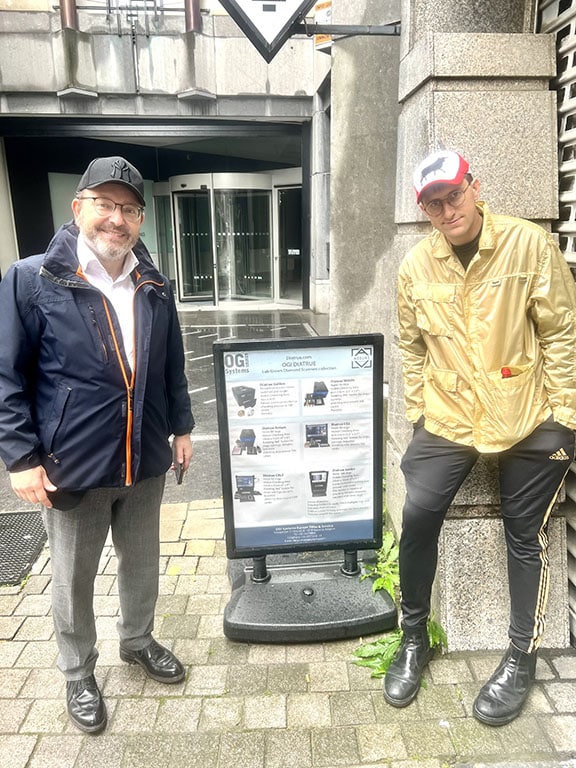
We met Henri outside the Astoria Hotel and walked the short block to the diamond center. With the rise in antisemitism, not knowing if it was safe to expose he’s Jewish, he wore a NY Yankees baseball cap to hide his kippah and dressed in a modern style, no exposed payos or tzitzit. Before we began, I played Jewish geography so he knew we were Jewish. He smiled when he learned he knew Gabriel’s Rabbi in Brussels. 

In typical Jewish fashion, this was not a knowledgeable tour guide telling stories and the tourists listening politely.  Gabriel and I had separately done research and peppered Henri with constant questions and commentary.   

Gabriel, the scientist, researched how diamonds were created, sourced, valued and cut.  Me, the economist, was fascinated by how business was done and the global threats and opportunities in the industry. I was curious how a $50 billion dollar industry spanned only one non-descript block in the heart of Antwerp.

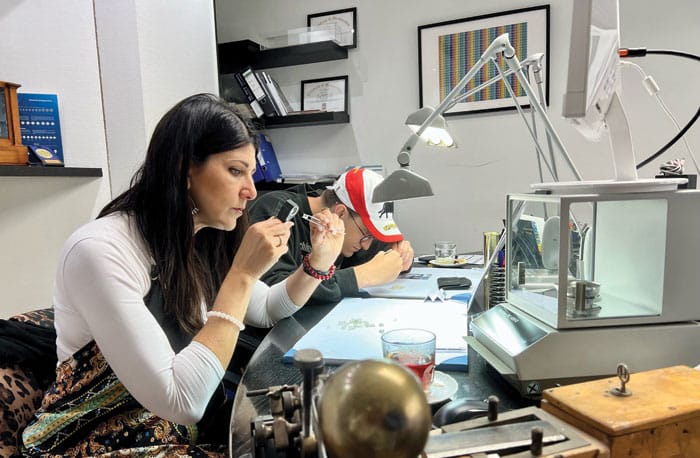
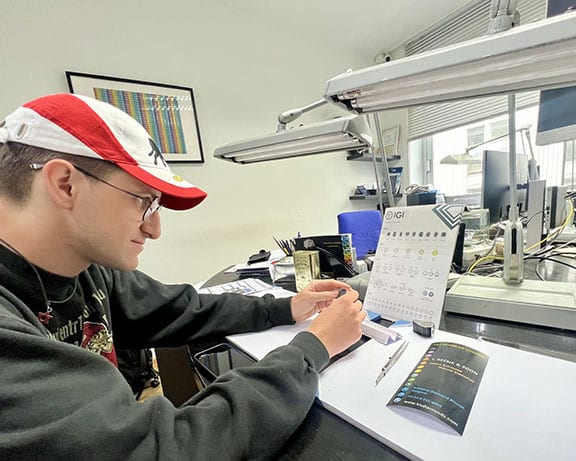
Because it is Henri’s passion to be an ambassador for the trade, we learned no other diamond trader does what he does … take you into his office and allow you to handle both rough and polished diamonds. As history and technology geeks, we also loved seeing the evolution of tools from centuries ago to navigating the online trading platforms and AI (artificial intelligence) tools that have transformed the industry. What we saw was mind blowing — and, of course, all the technological innovations come out of Israel. 

We learned Henri and his father’s business is world renowned for colored enhanced diamonds. For someone who’s never liked diamonds (because I love bold deep colors), I fell in love with these diamonds! His family has perfected a specialized procedure of ionic beams and heat treatment to transform natural diamonds into permanent shades of blue, yellow, pink, green, cognac and my favorite, turquoise.

Gabriel said when he finds his Jewish bride, he’ll buy the diamond from Henri. If I’m lucky enough to get married again, I hope my beloved will get one of his rings with a single deep turquoise diamond floating in a titanium band.

Before we went into Henri’s office, we gave our passports and fingerprints to the guards and then Henri took us into the magnificent trading hall which is featured in “Rough Diamonds.” After centuries of business, it’s still the center of Antwerp’s trade in rough and polished diamonds. 

But to do business there you must be an approved member of the Diamond Bourse. The Bourse was founded in 1904 by Antwerp diamond merchants who wanted to move their diamond dealing from the Petit Duc café to a more structured and secure place of business than trading diamonds in a public cafe. 

To join the Bourse, there’s in-person interview where you’re grilled on who you know and what kind of deals you’ve done. Then your photo and name are posted on a bulletin board in the grand hall for three months. People who pass through can comment on dealings with you. If you pass the court of public opinion, followed by a criminal background check, then you’re admitted to this prestigious group. 

Once you’re in and maintain good status, it enables you to go to any diamond trading center in the world. However, if you screw over another member, an independent court called the “arbitrage” acts like a Beit Dein (Jewish religious court) to rule on the case.  If you lose, you’re expelled from the Diamond Bourse globally and your name/picture/country of origin/crime will be posted on the great hall’s bulletin board so traders know NOT to do business with you.

Outside the hall, the industry has changed dramatically because of three elements; technology, lab grown diamonds and low global labor costs.  Henri showed us all the new technology and walked us through how the internet has transformed how the diamond business works.

Because of sophisticated 3-D visual technology, diamonds are not traded in person, but online, putting brokers out of business. 

Israeli company Sarine has reimagined the diamond industry using AI to disrupt every aspect from how to cut a rough diamond to accurately assessing the four Cs: cut, clarity, carat, and color.  To address the issue of fake diamonds, dealers use the Israeli technology OGI System, which instantly checks if a diamond is real, or lab grown. 

Because of the low costs of labor, India has become Antwerp’s major competitor as a diamond center. Henri said that the Belgium government is sensitive to the issue and in 2017 enacted a “Carat Tax,” which aids registered diamond traders by removing the complexity of the profit-based tax system. The traders are no longer taxed on profits but on a percentage of their overall turnover.

With all the AI disruption and global competition, Henri taught us the most important aspect of the business that can never be disrupted is trust between humans. 

With all the AI disruption and global competition, Henri taught us the most important aspect of the business that can never be disrupted is trust between humans. As Jews, we’re not only a religion, we’re also a family. It makes sense why Jews have dominated the diamond trade in this region for centuries. You trust your family. But this family is growing and blending.  With the innovations in the industry, it’s easier for anyone to learn the trade.  Henri, being a great teacher, is starting a private diamond business school where pupils can learn the trade in a one-two week intense course.

Gabriel smiled at me and shook his shoulders, another career path he could pursue? Our tour with Henri was was by far the most fascinating experience of this trip and when I felt closest to my son. Together we studied and learned. It felt like we were chevruta (study) partners coming to meet with the Rabbi. Sitting side by side, looking at rough and polished diamonds through a jeweler’s loop was one of those moments as a parent you pray for; making a precious memory.

To learn more or contact Henri Keesje visit  http://www.treatedcolors.com/ or call 32 476 890 305 or email keesjehenri@hotmail.com


Audrey Jacobs is a financial adviser and has three sons.

Mother-Son Bonding Over Diamonds in Antwerp Read More »

What You Should Know About Spinal Muscular Atrophy

When we think about genetic diseases, the ones that usually come to mind are cystic fibrosis, Fragile X and, of course, Tay-Sachs disease. One disease that many people are not aware of is spinal muscular atrophy, also known as SMA. But SMA is more common than you’d imagine. One-in-40 to one-in-60 people are carriers for the disease, and it affects one in 6,000 to 10,000 babies. In fact, the disease is so prevalent that the American College of Obstetricians and Gynecologists (ACOG), the professional association of OB/GYN physicians in the U.S., recommends carrier screening of SMA for all women who are planning on being pregnant. As August is Spinal Muscular Atrophy awareness month, we talked to Estie Rose, a genetic counselor with JScreen, a nonprofit genetic testing initiative out of Emory University, about this debilitating, usually fatal condition.

What is SMA?

Spinal muscular atrophy is a genetic disease in which there is a lack of communication between the nerves and the muscles so that the nerves are not telling the muscles how to work properly. Most typically, you’ll see issues in the lungs so those with SMA will have trouble breathing, as the nerves aren’t telling the lungs to breathe. There is also be a weakened cough, scoliosis, a progressive loss of motor facilities and trouble eating and speaking. Basically, the muscles all over the body are not doing their job, so individuals with SMA are very sick and get progressively worse.

How fatal is it?

The median age of death is 10 ½ months without treatment. Those with a less severe form of SMA can live a little longer with ventilatory support, airway clearance, nutritional support, physical therapy and adaptive equipment and gastrostomy tubes.

Do they perform newborn screening for SMA?

Newborn screening for the disease is available in 47 states, which can detect about 95% of the cases of babies born with SMA. 

Are there treatments?

There are some new treatments that have been effective in managing SMA. The most common is a gene therapy, FDA approved in 2019. As individuals with SMA are missing a gene that is vital in the production of a protein involved in nerve and muscle control, working copies of this gene are given intravenously via viral vector. With the working gene now introduced into the body, the necessary protein is produced typically allowing the child to breathe and eat on their own, and possibly sit and stand and maybe even walk. While this gene therapy is effective, Rose cautions, “It’s not a cure. These kids still have SMA but at least they’re creating some of this protein in their bodies that can help with some of these symptoms.” 

For those not using gene therapy, there are two other medications that can help slow down the progression of the disease. FDA approved in 2016, Sprinraza is a lumbar puncture treatment administered four times in the first 60 days, followed by one every four months. Another, Evrysdi, FDA-approved in 2020, is an oral treatment taken daily. 

With available treatments, does SMA seem to be not as serious a problem?

Again, it is important to remember that these treatments do not cure SMA, and the child is in for a difficult road ahead. Rose reiterates, “While you’re greatly improving the quality of life, these kids they still have SMA and they’re still dealing with a chronic illness.” These treatments are also expensive (the gene therapy is $2.125 million for the one dose, although most cases are covered by insurance). And we don’t know the long term prognosis yet with these treatments, as they are so new and only babies born in the last few years have had the benefit of the therapies.

“Parents are very lucky that they have these treatments available, but I think it’s crucial for people to get tested before pregnancy so that treatment is not their only option.“ – Estie Rose, JScreen

All of this, Rose emphasizes, makes carrier screening before pregnancy absolutely crucial. “Parents are very lucky that they have these treatments available, but I think it’s crucial for people to get tested before pregnancy so that treatment is not their only option. Before pregnancy, they have other options like prenatal diagnosis. They might use assisted reproductive technologies like IVF. They might decide to use an egg or sperm donor. They might decide to adopt. They just have so many more options if they do the screening early.”

Do direct-to-consumer tests like 23andMe screen for SMA?

Actually, they don’t. Rose explains that these services use a form of testing called genotyping, which does not look at the entire gene and therefore would not detect these kinds of mutations that cause SMA. So when having carrier screening, be sure that your screening panel includes SMA. 

Having a genetic counselor help you through this process is also vital to help you make decisions on your family planning. And the earlier you have carrier screening, the more options you’ll have to welcome a healthy baby.

For more information about genetic diseases and where you can get carrier screening, visit GeneTestNow.com.

What You Should Know About Spinal Muscular Atrophy Read More »