Consul General Hillel Newman, on behalf of the Consulate General of Israel to the Pacific Southwest, inaugurated a computer hub at the Ministerios Betesda church in the city of Santa Ana this past Sunday. In attendance was Congressman Lou Correa who spoke about how technology is so vital to the community he serves and the importance of education for success. He also emphasized “We all are one community. Nobody in society does it on their own. All of us need a hand to succeed.”
Pastor Ronald Vives and Youth Pastor Ricardo Vives of Ministerios Betesda, graciously hosted the event and moderated the program. Anaheim City Council Member Stephen Faessel and Lisbeth Rosales, aide of Santa Ana City Councilmember Thai Viet Phan, both delivered remarks and presented certificates in praise and recognition of Israel.
Everyone joined the ribbon cutting ceremony, which also included philanthropist Liz Hirsch Naftali who was instrumental in supporting the initiative.
In his remarks, Consul General Newman noted “Our presence here in this ceremony represents Israel’s foundational belief of highlighting the significance of sharing technology and innovation to the world. Israel is one of the leading nations in innovation and technology. We understand more than most that brainpower is a nation’s most valuable asset. I know our communities share a passion for education and we hope together this hub will provide resources and tools to those who need it.”
This hub is part of an outreach effort to communities on behalf of the Consulate which also includes murals with messages of hope and support, among other initiatives.
Becky Hoffman has been senior rabbi at Temple Ahavat Shalom for only three years, but the seed for her career was planted much earlier: At her bat mitzvah.At Temple Beth Hillel in Valley Village, Rabbi Jim Kaufman had a custom of escorting each b’nei mitzvah to the front of the Ark for a private conversation. When it was Becky Hoffman’s turn, he told her, “I should think of becoming a rabbi. He might have said this to everyone. But I took him seriously.” (Turned out Rabbi Kaufman had the same message for her brother, now a lawyer, and her sister, now an educator.)
But it wasn’t until she was in college at UC San Diego that she decided she would become Rabbi Becky Hoffman. Education classes strongly appealed to her, but the other factor was becoming involved with a synagogue in Encinitas. “The senior rabbi there had been an assistant at Temple Beth Hillel when I was growing up,” she explained.. “At Confirmation, he said if any of you go to school in San Diego, give us a call. I did. I ended up being the youth advisor there and taught religious school. I thought to myself, ‘This is what I want to do.’”
When Rabbi Hoffman returned home, she earned her Master’s degree at American Jewish University. “I always have wanted to be a rabbi. Now I have the Education degree and believe that they are one and the same.” Being a rabbi, she explained, “is being an educator in a different format. I can educate from the pulpit, I can educate in relationships, I can educate in conversations, and having the education degree gives me the background and the experience of knowing how to guide conversations, how to relate to people, how to grow.” But “more than anything,” she told theJournal, her professional life is about making memories. “If we can cultivate positive memories and experiences,” she is convinced, “we are fostering a love of Judaism.”
There was a family aspect as well. The oldest of three, her maternal grandmother died the year she was born, a difficult blow for her mother. Her grandmother’s memory never was invoked, until “On the day of my ordination, my mother said to me that my grandmother would have been so proud of that moment.”
Rabbi Becky initially served as associate rabbi at Kol Tikvah in Woodland Hills. After a decade there, she decided she wanted to lead her own congregation and applied to Temple Ahavat Shalom (TAS), Northridge, where she never had lived or worked. “When I walked into my interview,” she said, “I looked around and thought, I know these people. It was a very similar demographic. “The openness, the welcoming, the desire to do good in the world, love of community. Immediately, I knew that about the community.”
Growing up in the Valley,” she said,” really helped me … It’s been a shortcut for understanding. Because I grew up in the Valley and have worked in the Valley, I have a common understanding and experience of the people in my community. Not to mention I grew up with some of them.”
Life threw a kink into her start at TAS. The COVID quarantine went into effect the week after she signed her contract. “When I came in for my interview,” she said, “I talked about dinners and the plans I had.” She laughed again. “I wish I had a time machine and could go back! It’s laughable. I didn’t have a meal at my synagogue for over a year. We didn’t eat with anybody. I didn’t go out for coffee with anybody … I felt hampered with the tools that I have available to be able to relate to people.”
Even three years later, Rabbi Becky isn’t sure how the pandemic affected her congregation. “We are not out of it yet,” she said. “We are in a trauma, emerging from a trauma, and we are not quite understanding the short- or long-term ramifications of it … We are definitely more in-person, but we have a very active livestream,” Rabbi Becky said. “We were one of the last adapters, from Zoom to a livestream service, a significant change.”
Looking back, Rabbi Becky chooses her words carefully. “I think about little things … like when we do a Hakafa with the Torah, I tell people touching and feeling the Torah might not be comfortable for you. It’s perfectly fine to wave at the Torah.” That is one of the constant reminders, she said, “that we are in a different place. I don’t know where we are going.”
Her personal life is more settled. Married to a Conservative rabbi, Joshua Hoffman, they have three teenagers. While Rabbi Becky is Reform, there have been few problems. “We are both progressive, and over the years, the Reform movement and Conservative movement have moved closer to each other,” she said.
Fast Takes with Rabbi Becky Hoffman
Jewish Journal: The best book you’ve ever read?
Rabbi Hoffman: The book I returned to most when I was young was “Little Women.” It inspired me.
J.J. What is your favorite Jewish food?
Rabbi Hoffman: My mother’s kreplach.
J.J. What is your favorite hobby?
Rabbi Hoffman: I just took my first class – we will see if it takes – on how to become a soferit. I love the look of holy lettering. So beautiful.
Since starting my Jewish mindfulness coaching program, I have come to appreciate that developing true mindfulness involves a fusion of physical, emotional, mental, and spiritual tools. As our teacher, Rabbi Dov Ber Cohen has said, no one can master these in only eight weeks. This is the work of months, if not years.
But can we really change ourselves from the inside out? Can we reprogram the deeply ingrained soundtrack of our minds, how we react to people and circumstances? Rabbi Dr. Laibl Wolf, an Australian psychologist, author, and teacher of Hasidic thought, agrees that we can learn to change our nature (shinui hateva), including our mind’s perception of things and our emotions. However, this is possible only if we believe it is possible. “If you don’t believe it’s possible, no workshop or program will help,” Rabbi Wolf said. “Our default reactions are the result of repetition and practice. To change it, we also need repetition and practice.”
One reason that developing that sense of inner calm, or menuchat hanefesh, is so difficult is because “99% of our thoughts are past- or future-oriented, and our minds jump around nonstop,” Rabbi Dov Ber says. Not only are we assaulted by an endless salvo of information, demands, advertisements, and messages, but we often catastrophize, even though most of the worst-case scenarios we imagine never end up happening.
After our first Zoom sessions, Rabbi Dov Ber gave us the gentlest of homework: to keep a chart of our target activities: mindful breathing (hashkata), for three minutes a day; nonjudgmental observation of our thoughts before they morph into harmful emotions (habata); engaging in nurturing actions; prayer to Hashem to help us achieve our goals; weekly check-ins with our accountability partners; and journaling our successes and challenges.
We weren’t expected to do each thing each day, and when a few people admitted after the first few weeks that they hadn’t even started any of the practices, Rabbi Dov Ber reassured everyone it was all fine. Whatever we could achieve and whenever we began was a victory. No matter how small, our practice would lead to major results. My own log had a lot of empty spaces where check marks could have appeared, but I never skimped on the self-nurturing activities, if I say so myself.
I struggled with the most elemental ingredient of the program, which was hashkata, stopping to breathe deeply for three minutes a day. Unless I’m out in nature for a hike or on vacation, I get antsy sitting still without doing something at the same time: working, reading, eating, talking, or watching something. I want to retrain my thinking because I understand that stopping for mindful breathing is doing something, and something important at that. Close to bedtime, when my husband, Jeff, plays meditation music (the kind that makes me feel like I’m going under heavy sedation), I can enjoy the breathing exercise, but by then I’m ready to surrender after a long day.
I want to retrain my thinking because I understand that stopping for mindful breathing is doing something, and something important at that.
In any case, I discovered that simply being a member of the group had its own power. After all, I had chosen this goal and became more conscious of my thoughts and actions throughout the day, including body language. Out of sheer habit I frequently start holding my breath and tightening my stomach muscles and shoulders. I began to catch this and relax those overtaxed muscles. Though I resisted sitting down for formal breathing meditations, I chose several micro-mini meditative breathing sessions, even when standing up.
To my surprise, I felt motivated to examine other aspects of my daily life and incorporate mindfulness in them. I’d ask myself: do you really need a second helping of that? (No.) Why not stop and recite some Tehillim for the people in my WhatsApp groups who need healing? (Yes.) Can you visualize letting go of that resentment over the way X treated you? (Not yet.) When I wrote in my gratitude journal and saw how cramped my script had become, I loosened the grip of my pen. I used to have nice penmanship; with practice I would try to reclaim it.
It didn’t take long to feel very small yet perceptible changes that led to a calmer me. And while in general things were easygoing during these first few weeks of the program, giving me more time and psychic space to focus on the lessons, my newbie tools were still tested. Out of the blue my husband and I were faced with a situation that could easily balloon into a legal and financial threat. We needed to process our shock and disbelief over the situation, but we applied the mindful philosophy of not jumping to extreme or worst possible outcomes, and our faith that Hashem had sent us this test for a reason.
It didn’t take long to feel very small yet perceptible changes that led to a calmer me.
On a Sunday afternoon, when I could not reach Jeff for several hours, I really had to fight my fears. He had gone out with a friend on only his second bike ride since his serious accident last November, when he separated his shoulder and fractured a few ribs. What wife wouldn’t have been scared? I davened to Hashem to make sure he and his friend were safe and to please help me stay calm. Within an hour, after several more texts pleading, “Where are you?” he called. The two of them had unexpectedly been on a trail out of cell phone range.
Finally, on the Fourth of July we were on Mulholland Drive — the road I refused to travel since my brother’s fatal car accident there. Months ago I wrote a column about finally agreeing to be driven on Mulholland with my friend Mollie to attend a party. We only needed to be on that road for a half a block before reaching our destination, and with that success, I felt ready to drive there with Jeff for another social event at the same location. But I had forgotten which route Mollie had taken, and therefore was alarmed to discover — too late — that my route kept us on Mulholland not for a half a block but for three miles. I clutched the steering wheel and glanced to the right at those low, lousy guardrails and wondered, “Is this where it happened?” before forcing myself to redirect my thoughts. This was also a mindfulness lesson: acknowledge my anxiety, don’t judge it, and then actively shove that thought away. Jeff talked me through the short but seemingly interminable drive, guiding my breathing and reassuring me that we were really almost there.
When we arrived, I explained to our friends why we were a bit frazzled. But taking some moments for deep breathing cleared the path for a beautiful evening.
Judy Gruen is the author of several books, including “The Skeptic and the Rabbi: Falling in Love With Faith.” Her next book, “Bylines and Blessings,” will be published in February 2024.
One verse, five voices. Edited by Salvador Litvak, the Accidental Talmudist
So I [Moses] spoke to you, but you did not listen, and you rebelled against the command of the Lord, and you acted wickedly and went up to the mountain.
– Deut. 1:43
Dr. Sheila Tuller Keiter
Judaic Studies Faculty, Shalhevet High School
As Ol’ Blue Eyes once sang, “Regrets, I’ve had a few.” The final book of the Torah, sefer Devarim, opens with Moshe’s experiencing his Frank Sinatra moment of reflection. The end is near, and Moshe faces the final curtain. Remembering his history with Israel, Moshe is most pained by the sin of the spies. Just a few weeks ago, we read how the Israelites responded with despair to the bad report from ten of the twelve spies. Their pessimism and lack of faith in God doomed them to spend 40 years in the desert so a new generation born in freedom could ultimately conquer the Promised Land.
In this verse, Moshe recalls the strange epilogue of that story. A group of Israelites, regretting their behavior, sought to enter the land and conquer it, only to be decimated by their enemies. But why should this have happened? Didn’t these people do exactly what Hashem originally intended? They recognized their error and tried to rectify matters by fulfilling God’s will!
Moshe identifies the problem: Their supposed act of contrition was really rebellion against God’s will. Hashem had already rendered His verdict. Their remorse came too late. These people sought to circumvent God’s judgment, hoping to manipulate Him through their actions. As Moshe delivers his final instructions to Israel, he reminds them that they are not the arbiters of justice, nor can they substitute their own morality for that of the divine. In the end, we must do it His way.
David Porush
Student, teacher, writer.
Moses begins his rousing speech to the nation by reminding them of the sin of the spies 40 years ago. Shamed by Moses’ rebuke of their cowardice, their parents charged up the mountain to rectify it. But without G’d’s protection for their campaign, they were decimated in war and doomed to wander the wilderness until they die out.
Now, the next generation have become a mighty military force poised by the Jordan River, ready to conquer Canaan. Deuteronomy 1:1 tells us precisely where Moses is giving his speech, “in the wilderness east of the Jordan — that is, in the Arabah — opposite Suph, between Paran and Tophel, Laban, Hazeroth and Di-zahab.” Nonetheless the exact place seems impossible for the Sages to pinpoint on a map, so Rashi says that these are not geographical coordinates but actually spiritual ones. They allude to times that the previous generation of Israelites provoked God.
Yet they’re not only in a spiritual place. They have to be somewhere on the map, but where?
Moses’ rhetorical genius — and the spiritual logic of the Torah at this climactic moment —suggest an answer: They are exactly where their parents failed forty years ago. Could the moment be any more stirring or dramatic? Think of the emotions that filled the heart of the Israelites as Moses points to the very place where it all went sideways 40 years ago and fated them to decades in the wilderness. The unnamed place must have further inspired Israel to conquer the Promised Land and fulfill their forestalled destiny, now with God on their side.
Laya Saul
Award-winning author and international speaker
We messed up. It was not the first time nor the last time. Now we have to ask ourselves: How do we behave when we stumble — when we miss the mark — whether it’s intentional or accidental? Can we get humble and admit what we did? Are we willing to take responsibility for our missteps? Can we forgo the voice of the ego that wants to justify or rationalize (rational lies)?
It’s not easy to admit when we’ve gone way off track. To make it even worse, when we see the truth of how we’ve fallen, it’s often downright humiliating. But, the pain of embarrassment can actually be a gift that saves us from more pain later if we can learn from our mistakes. You don’t know what “hot” is until you get burned at least once. Once we know and get the warning, can we pay attention and walk the walk of truth? Learning to deal with pain, then getting past it, and not wallowing in the gunk of it, to overcome and even thrive, is a strength that is worth developing even though it can be hard.
In our verse, we’re reminded that we didn’t listen to Moshe. He wasn’t some politician or guru; he was the leader of the nation who spoke *directly* to the Eternal. Can we get past the growing pains? Will we listen to Eternal’s truth that the Torah is teaching, even daring, to allow ourselves to serve God in a state of joy?
Rebbetzin Miriam Yerushalmi
CEO SANE; Author, “Reaching New Heights” Series
What’s wrong with going up the mountain? The answer might be in Pirkei Avot 6:2, which apparently is based on this verse, as it says, “Every day a heavenly voice goes forth from Mount Horeb proclaiming: “Woe unto mankind for their contempt towards the Torah, for whoever is not occupied with the study of Torah is called nazuf … Like a gold ring in the snout of a pig is a beautiful woman bereft of sense … And whoever is regularly occupied with the study of the Torah is surely exalted, as it is said, and from Mattanah to Nahaliel; and Nahaliel to Bamoth”
Mattanah means “gift,” Nahaliel means “an inheritance from G-d,” and Bamoth means ”high places.” What’s the connection?
The Lubavitcher Rebbe explains that a bamah, platform, is something physically high that stands out as a separate entity from the ground it rests on. To ignore Hashem’s commands, for example, to disregard our obligation to pray and learn Torah every day, telling ourselves —women especially — “I’m busy, Hashem knows what’s in my heart, He’ll understand,” or “it’s not my thing; I’m not good at it, He’ll understand,” is acting “bereft of sense.” If we don’t pray, learn, or do mitzvot, we create our own “bamoth” that separate us from Hashem. Hashem gifted the Torah to us; to accept it as our inheritance, we need to ascend, “go up the mountain,” to get closer to Him. Regularly occupying ourselves with Torah and mitzvos enables us to reach new heights in a holy way.
Rivkah Slonim
Education Director at the Rohr Chabad Center at Binghamton University
In an enigmatic passage the Talmud (Kidushin 31a-b) states: “It is possible for a son to serve his father a pasyoni (a delectable bird) and be punished for it. And for another son to put his father to work at a grindstone and be brought for this to the World to come.” Rashi explains: In the first case, the father asks his son where did you get this delicacy, and the son replies: “What do you care old man? Chew and eat!” While in the second scenario, when the king recruited the elderly father to work, the son said: “You stay here and grind and I will go in your place …”
Simply put, context is pivotal. The value and meaning of what we do flows from why and how we do it. On the words: you rebelled … you acted wickedly … the Or Hachayaim Hakodosh comments: “You did not alight the mountain (to enter Canaan) in a show of faith in God, to rectify your previous sin of not hearkening on to the Divine command to go into the Land and conquer it. You went up in defiance, without humility, without seeking to redress your previous behavior. When God told you yes, you said no, and now when God says no, you say yes, we WILL go up.”
It is not our actions alone but the intention that distinguishes the pedestrian from the mundane. It is tethering ourselves to the transcendent that makes the difference between going up and falling down.
I absolutely loved “Joy Ride.” The new movie accompanies Audrey (Ashley Park), a Chinese-American lawyer embarking on a life-changing trip to China. As an adoptee raised by White parents, this marks Audrey’s first return to her birth country. Accompanying her are her loyal best friends, Kat (Stephanie Hsu) and Lolo (Sherry Cola), along with the quirky yet lovable Deadeye (Sabrina Wu). The movie is hilarious, surprising and heartfelt. However, amidst all the fun, I couldn’t help but ask—was it too one-sided?
Can a movie about a woman connecting with her heritage in China really justify a 92-minute runtime that makes no mention of China’s ruthless suppressive government? What about China’s ongoing genocide of the Uighur Muslim population, or its encroachment on Hong Kong’s independence? Should they have mentioned China’s aggressive silencing of dissent at home and in America on the subject of Taiwan?
The reason I’m asking this, if it isn’t already obvious, is because I couldn’t help but wonder what people would say if someone made a movie about four Jewish American women on an “unapologetically raunchy” trip through Israel with no mention of Palestinian refugees or the occupation.
I couldn’t help but wonder what people would say if someone made a movie about four Jewish American women on an “unapologetically raunchy” trip through Israel with no mention of Palestinian refugees or the occupation.
Such a film would not solely be hailed as “an amusingly rude and high-spirited romp.” Rather, it would be assailed by anti-Israel keyboard activists as propaganda, as apologetics for colonialism, and undoubtedly, as “one-sided.” If I had to guess, this would even be the case for favorable reviews, which would no doubt reserve at least one paragraph to bemoan the film’s lack of nuance on the matter of the Israeli-Palestinian conflict.
For comparison, when Abbi and Ilana went on a “Birthmark” trip in the show “Broad City,” (an episode that ended up taking place entirely on a plane due to the outbreak of hostilities in Israel when they were slotted to film), reviewers were quick to politicize the trip even though the show hadn’t.
Describing the episode in GQ, Eric Thurm wrote, “If you’re unfamiliar with the concept: Taglit, the nonprofit behind Birthright, sponsors free (yes, free) ten-day trips to Israel for young diaspora Jews, who are then supposed to learn about their heritage and connect with their ancestors [while] avoiding talking about Palestine.”
In an article that was bizarrely featured in both the Forward and the anti-Israel publication Mondoweiss, Iranian-American journalist Alex Shams wrote, “To my pleasant surprise, ‘Broad City’ addressed Birthright — and the Jewish American relationship to Israel — in an extremely critical way.”
One can only imagine what would have been written had Abbi and Ilana actually made it to Ben Gurion Airport.
Meanwhile, not a single “Joy Ride” review that I’ve read has made even a passing mention of the Uighurs or the CCP.
Also, while “Broad City” roundly mocks the entire concept of a Jewish heritage tour in Israel, ascribing cynical and gross motivations to Birthright, “Joy Ride” sees the experience of connecting with one’s roots as not merely profound, but absolutely necessary for Audrey’s development as a character. “If you do not know where you’re from,” a character asks her early in the film, “how do you know who you are?”
Considering this, it seems fair to say that either China should be held to the same standard as Israel and “Joy Ride” condemned for its “one-sided” portrayal, or that Israel should be held to the same standard as China and people should be able to travel there, perform there, and make art that takes place there without referencing the Israeli-Palestinian conflict.
The very framing of this dichotomy, however, elides the fact that China and Israel are not equivalent. Israel, despite the baseless accusations of its critics, is not engaged in genocide. China is. Israel, despite what is so often repeated, does not silence critique abroad. China does. If you want proof, go watch videos of American actors and athletes apologizing in heavily-accented Chinese for the great offense of calling Taiwan “a country” or some such thing.
Generally speaking, I think that it’s OK for a movie to be one-sided now and again. Not every movie has to be about every thing and the choice to set a movie in a particular country, or to celebrate that country’s history and culture, does not necessarily obligate one to address every political issue that the country is dealing with.
That said, nuance is a good thing, and people want to know the real Israel. They want to grapple with its shortcomings and contradictions. They want to learn about the occupation and hear the Palestinian narrative. Lucky for us, there is no shortage of opportunities to do so. It has become increasingly impossible to mention Israel without also mentioning Palestine, and this is especially true in Jewish spaces. For many American Jews, their relationship with Israel is primarily mediated through activism and awareness of the conflict.
Considering this, perhaps we could stand to watch a movie about Israel that’s just about having fun in Tel Aviv and crying at the Western Wall. After all, there are countless other opportunities throughout the year when the media prompts us to reflect on Israel’s “complexities.”
When it comes to China and Hollywood, however, considering the chilling effect that the former has had on the free expression of the latter, it would have been bold and powerful for “Joy Ride” to be a little less “one-sided.”
Matthew Schultz is the author of the essay collection “What Came Before” (2020).
Does Judaism have a global mission, and if so, can Tisha B’Av help us fulfill it? Strange pair of questions?
Not to Rabbi Benzion Meir Hai Uziel, Israel’s first Sephardic Chief Rabbi. “The message that Judaism brings to the entire world is for global peace,” says Rabbi Uziel. “Judaism does not only seek peace for the Jewish people, but for all of mankind – for every individual, nation and religion on earth.”
In Rabbi Uziel’s grand vision, Judaism’s global mission is to help eradicate war and eliminate oppressive dictatorships who rule by the sword.
“A world without justice and filled with war is an ugly and frightening world,” says Rabbi Uziel. “Our goal as a Jewish people must be to help bring peace into the world – for all of humanity.”
How do we get there? What will it take for the Jewish people to realize Rabbi Uziel’s lofty aspirations for our transforming the world from a global battlefield to an abode of peace?
“We will never be able to achieve our global mission of bringing peace to all of mankind without first achieving internal peace amongst the Jewish people,” says Rabbi Uziel. “The prerequisite for fulfilling our larger mission on earth is to remove all causes of divisiveness and disputes from within, and replace them with with mutual respect and love, fostering peace and unity amongst us.”
Tisha B’Av is our annual reminder of what divided us two thousand years ago, and what continues to divide us today: sinat hinam – baseless hatred. As Maimonides teaches, the deeper message behind fasting and mourning on Tisha B’Av is “to arouse our hearts and initiate the paths of repentance, so that we will improve our conduct.”
For Rabbi Uziel, these “paths of repentance” towards “improving our conduct” will not only make for a better “Jewish world” – but for a better world, for all of humanity. The internalization of Tisha B’Av’s message of healing from within is, so to speak, our “first giant step for mankind.”
Rabbi Uziel challenges us to take Tisha B’Av seriously, because a larger mission awaits us. He invites us to imagine what we can achieve as a united Jewish people. He invites to imagine the Jewish people working together to eliminate war, violence, oppression and injustice from the world. He died in 1953, so he imagined this long before John Lennon did.
On this coming Tisha B’Av, let’s imagine – together.
To read more articles from The Media Line, click here.
I’ve just finished reading Parallel Lines, a first novel by veteran Washington Post correspondent Ruth Eglash. In the book, Eglash fictionalizes the stories and ideas that her Jerusalem reporting stimulated. She does so through the eyes of three young girls, each representing one of the holy city’s primary ethnicities. While the similarities between the girls are striking, Jerusalem takes center stage as we witness the city’s impact on the protagonists’ lives.
The Media Line: “Fact or fiction?” kept going through my mind as I scrolled through the pages and read really intensely your new book. The three characters Nour, Tamar, and Rivki each [are] different, and yet, growing up in Jerusalem as teenagers. Why did you choose teenage characters as opposed to parents?
Ruth Eglash: I wanted to explore this conflict’s impact on young people. That was uppermost in my mind when I wrote this book. I thought, “How can I bring shape to this conflict that I have been covering?” As you noted, I am a long-time journalist and have been covering this conflict for over 20 years. I really wanted to focus on how it impacts young people. I don’t think, as journalists, we talk about that enough.
Journalists tend to interview the adults driving the conflict. We interview politicians and parents but don’t talk to young people. I felt we needed to know what it’s like to grow up in a city that is always in conflict, permanently tense, and divided. What does that do to the next generation?
TML: Ruth, what is the common bond between these three young women, and what do they have in common?
RE: Teenagers are teenagers. Teenage girls share many of the same concerns when they reach a certain age. They look at themselves. They worry about their friends. They worry about how the world sees them. They also worry about things going on around them. I think that’s universal; it’s true for teenage girls everywhere.
I have interviewed so many people from so many different backgrounds in Jerusalem. One thing that hit me is that ordinary people’s concerns are similar in Jerusalem, Israel, the West Bank, and everywhere in the world.
TML: Ruth, aren’t you often asked why your book didn’t have a journalist as a character?
RE: You know, it’s funny. Whenever I have sat down to write fiction, there’s always been a journalist protagonist. However, this book was really driven by my own children, who were coming of age in the years when the book is set: 2015 and 2016. They gave me inspiration. I was writing about the conflict for theWashington Post. At the same time, I was trying to explain it to my children. I had an audience of millions, but also these three young people. It was an interesting contrast: my efforts to explain things to an audience of millions and my efforts to explain things to an audience of three young people living through it.
TML: Can you touch on some of your other experiences that you drew from in order to create this book?
RE: The book is set in 2015 and 2016, a time Israelis refer to as the “Stabbing Intifada.” There was an increase in violent attacks, terrorist attacks, stabbings, shootings, and vehicular attacks in Jerusalem. I was on the scene for many of those. In other cases, I wrote stories interviewing both victims and perpetrators or the families of perpetrators. In many cases, the perpetrators had been killed. I really got to see both sides of the conflict.
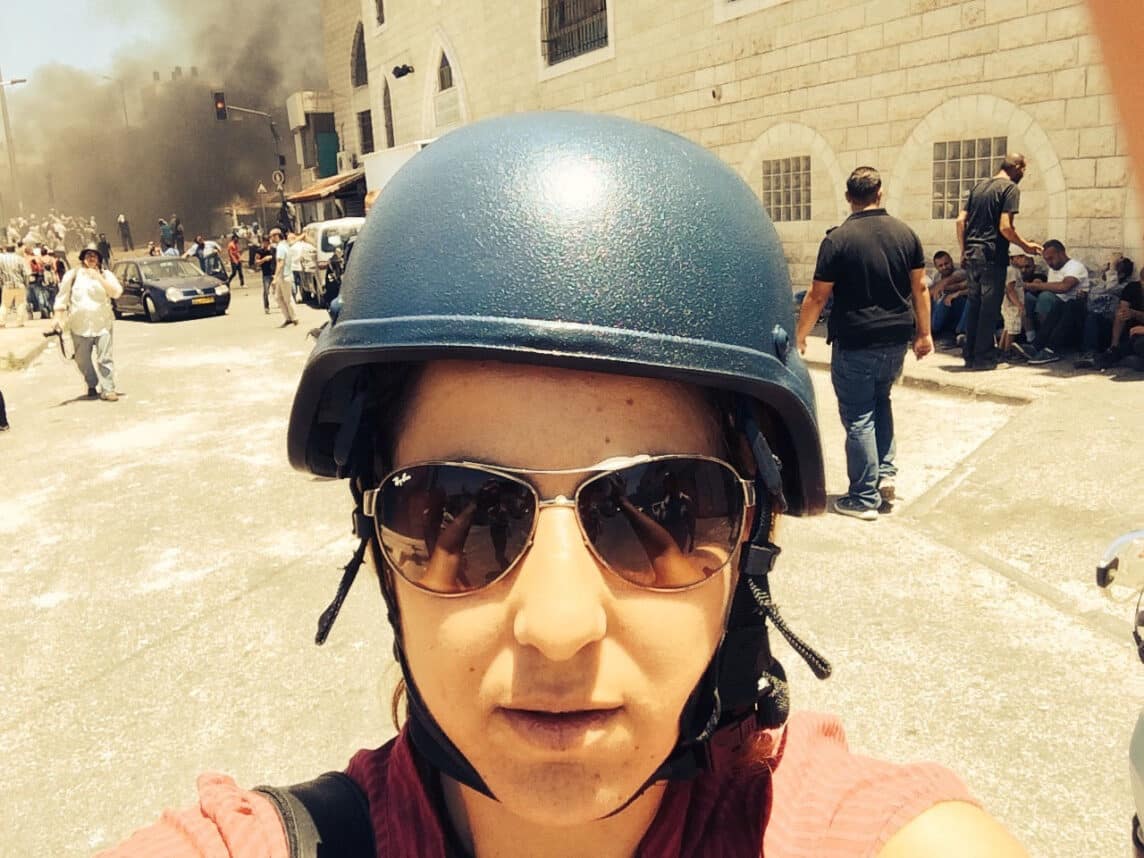
Ruth Eglash, working in the Shuafat neighborhood in East Jerusalem, 2014. (Courtesy)
There’s one part of the book where I get into the feeling of what’s happening in East Jerusalem. People familiar with the story will recognize one of those references. Those are real experiences I had as a reporter.
TML: Those living in Jerusalem might have more knowledge of some of the items and things that you write about in your book. Is it more difficult to draw and paint the picture that you’re trying to do so clearly for the larger audience?
RE: People who have read the book so far and live in Jerusalem identify with the setting, the story, the intricate details, and the nuances of this conflict. My aim, however, was to reach people who don’t live here. People who live outside of Israel, don’t understand the conflict, or know nothing about it, but want to understand and learn more.
I also targeted the book at people who think they know about the conflict from the news or social media. They don’t really know it, however. You can only really understand the nuances, the contradictions, the overlap, and the dissonance between each of the different communities when you live in Jerusalem.
TML: Ruth, who really is your audience? I mean, you have some dark moments that are written in the book eloquently, but yet, they’re hard moments.
uth: I think this book will challenge all groups. We live in a world that is so polarized, where people have such strong opinions and struggle to see the other side’s point of view. Especially here.
We see the narratives of either one side or the other. People hold on to those narratives and refuse to acknowledge the other side. Reading this book is going to be very difficult. There were times when I was writing it, and I thought, “Well, no one will like this book. No one can identify with it because it shows the other side.” It shows the different Jerusalem narratives.
I hope people will have an open mind when they read it and learn something about the other side. I’ve already had feedback from people who say, “It was difficult to read, but I also learned something new. I saw a different perspective.” That, essentially, is my goal.
TML: You present graphic descriptions of some horrific moments. Some are bloody and gory, and yet you tell this story through the eyes of young women; teenagers. Is this book for youth?
RE: This book is aimed at youth. That was my goal. Unfortunately, today, teenagers are not immune or cut off from witnessing terrible acts on television. They are exposed to the internet and see many different things.
In Jerusalem, moreover, this is the reality for many teenagers. They are interested in all the usual things: clothing, pop culture, and music, the other sex. But they are also, unfortunately, in the middle of an ongoing conflict. It’s all around them. They are aware of things happening.
Many of the stories in the book are based on the experiences of my daughter Gefen, who was studying in Jerusalem at the time. She would come home from school at the age of 13 or 14 and say that the train had stopped because people were protesting. Or, that everyone had to get off the bus because there had been a suspicious package. She would ask, “Why would someone do something like that?”
Teenagers are aware. We should give them more credit. It’s vital for them to read this and understand that all sides are going through similar experiences.
TML: The themes are much about dual narratives, particularly when speaking about Tamar and Nour, and then you pair a Jewish doctor, Dr. Friedman with Nour, and Dr. Jalal with Rivki. Were there times that you just wanted to just scrap what you wrote and rewrite it, because you weren’t sure that it was going to play out effectively?
RE: I did a lot of writing and rewriting. I really wanted to highlight these places in Jerusalem, even though the communities live totally separately, and the narratives, as you say, are dueling with no crossover.
There are places in Jerusalem where the communities meet, and I wanted to highlight that. One is on the light rail, which is why I named the book, Parallel Lines. That’s why some of the scenes are set on the light rail. The different communities also meet in the hospitals, of which there are three major ones in Jerusalem. They are a study in coexistence, in a beautiful way.
I also did many stories in Hadassah Hospital. One of my favorites was in 2015, about two Hadassah doctors. The first, a Palestinian, was named Dr. Eid, while the second, a Jewish American Israeli, was named Dr. Fried. They worked together, saving the lives of victims of these attacks while also working to help the perpetrators. It was important to me to show the contradictions and nuances that are not obvious.
TML: What is your goal in Parallel Lines regarding political lines, societal lines, and religious lines?
RE: My main goal is for as many people as possible to read it. I know that the Israeli-Palestinian conflict is not something people like reading about. It upsets many people. It has a lot of sensitivities. My goal, however, is for people living outside Jerusalem and Israel to better understand what life is like for those living here. Or, for those people who live outside of Israel and think they know about the conflict but don’t really understand the heart of it, the nuances, the different ways of life, and the different people. I want as many people as possible to read my book.
TML: The elders of the family tend to represent the more rational view of humankind. If you look today at the population, do you really see that this exists, that it’s possible to see Jews, Arabs and Muslims breaking bread together?
RE: Some would say writing this story as fiction is wishful thinking. Perhaps I used my imagination too much when showing different groups in Jerusalem living together and getting along. I don’t think I’ve taken it that far. However, based on my research for this book and my work as a journalist, I think that many in Jerusalem want to live here in peace.
I don’t know if they will break bread together, but I do know that they want to live here. They want to live their lives and understand that the other side is here; there is no escaping that. They don’t expect the other side to vanish, so they must find a way to live together. That was my message.
Most people want to live their lives. And if that means together, then together.
Ruth Eglash working in Morocco after the Abraham Accords were signed. (Tzachi Shemesh)
TML: The inner fabric of Israeli society is woven together through your book, and you illustrate this through the light rail when they stop and announce the different stops [such as] Bab al-Amud orSha’ar Shechem. That’s Damascus Gate. You also speak about Nour looking to take matriculation exams both in Arabic and Hebrew. My question is, does this really change things? Do you feel that society having the meshing of the different voices of the different religions plays out and counts?
RE: I remember the time before the light rail, which has been in Jerusalem for perhaps 10 years. Before that, the different communities, the neighborhoods, were separate. Now, you have this train running through the middle of Jerusalem, stopping in all the different neighborhoods, and allowing the people living there to use the same train. That really strikes me.
The train links everyone together. I don’t know about the future, but change will be slow. The young Palestinian women I interviewed for this book, whom I sat with and heard their stories, were hopeful and positive. They focused on learning and living their lives, becoming better educated, and working within that fabric.
The point you raise about young Palestinians studying both Palestinian matriculation exams, the Arabic “Tawjihi,” and the Israeli matriculation exam, the “Bagrut,” is true. I wrote that story several years ago. I was in a school in East Jerusalem where these brave and intelligent young women were studying for two sets of exams! They knew that if they wanted to improve their situation, that’s what they needed to do.
TML: Rivki, who represents the Haredi community is afflicted with Crohn’s disease and finds herself in Hadassah Medical Center. And [it is] her first tempting to the outside world… But if you look at the Haredi world today, has much changed?
RE: It’s a very insular community, but there are moments when it is exposed to the secular world. There’s no way to hide from it. In Jerusalem, young women are increasingly obliged to work to support their families.
We meet Haredi people in accounting firms and the bank, we see them traveling on the light rail, or we see them in the hospital. There is no choice. Some elements of the ultra-Orthodox community are modernizing. I know them. I’ve interviewed them.
Do I think they will completely change their way of living? Probably not. I do think they understand that they need to move forward. I think there is more of this understanding within the community than we suspect.
TML: The light rail and Hadassah Medical Center are the bridges where your characters meet, and yet, most remain untouchable. Then you depict this picture of Nour and her friends going to Jaffa for an interfaith event. How realistic is it today when we look at the whole picture of what happens in Israel, and separating Jerusalem from the rest of the country?
RE: Jerusalem is a unique entity. Even though it’s multicultural, with so many different groups, faiths, and nationalities, it’s difficult for them to meet and interact. That was the starting point for the book. But when I looked at other places in Israel, I saw that this wasn’t so.
Nour takes her class to Jaffa to visit a project by Jewish and Arab women working together. There are other places in Israel where the interaction is more natural. Jerusalem, however, remains this place of conflict and division.
I won’t try and answer your question because I don’t have one. However, that’s how it is, perhaps because of Jerusalem’s holiness, spirituality, and the strong place it holds in the hearts of the different faiths living here.
TML: It’s very difficult to be a journalist covering not just Jerusalem, but Jerusalem and the Middle East. Ruth, in looking back at years of coverage, how hard is it today to get that story straight?
RE: It’s challenging to be a journalist covering this region, particularly the Israeli-Palestinian conflict. There is so much scrutiny of the media. Journalists have become part of the conflict, and the narrative is at the center. Each side has a narrative, and the people who tell it are part of the conflict.
It’s becoming harder, especially with social media and platforms like Twitter and Facebook. Our readers interact with, and react to, what we publish. That’s one of the reasons I decided to write fiction. Journalists have lost their ability to influence, change, or convince people. The events here, even the facts, are subjective. That’s one of the central problems in reporting from here.
TML: Well, no spoiler alerts here today. I hope everyone will go out and get Parallel Lines. And it’s an easy read, but I think it’s important because we get a sense of Jerusalem. We get a sense of the different voices that are living in this country.
As the daughter of the Shamash (guardian) of the Tomb of Ezra the Scribe, my grandmother grew up in the small village of Al Uzair. Located in the south of Iraq, the large compound where they lived sat on the west bank of the mighty Tigris River. The River was home to several varieties of fish. The most popular fish was called Shabbut, a spectacular tasting carp. This fish was used in masgouf, the renowned Iraqi barbecue dish. In the Spring and summer, Arab vendors would prepare this dish on the banks of the River to be enjoyed by picnicking families. But at home, my grandmother and her family would always eat the traditional Iraqi Jewish dish called Salona.
My grandmother always seemed especially happy whenever she was cooking fish, which annoyed me terribly as a child. I only liked good old Aussie, beer battered and deep fried fish and chips. As I grew older and my taste buds matured, I learned to love fish. I learned to appreciate the simplicity of a whole grilled fish. I learned to savor the complex flavors of her Salona, a sweet and sour stewed fish.
As I grew older and my taste buds matured, I learned to love fish. I learned to appreciate the simplicity of a whole grilled fish.
I still remember preparing it with her. Cutting rings of onion and thick slices of tomato. Preparing the sauce and baking the fish in the oven.
But the recipe I offer here is revised and simplified. Usually made with white fish, like sea bream or sea bass, I made it with wild salmon. Instead of onions, I used leeks to impart a unique sweet depth to the sauce. Instead of regular tomatoes, I used cherry tomatoes for a concentrated bright, sweet tang. In another non-traditional twist, I added chickpeas to make this a hearty meal.
What I didn’t mess with was the special sauce recipe, which includes fresh lemons, pomegranate molasses, sweet paprika, curry powder and cayenne pepper.
This one skillet dish is simply full of nutrition and spicy, sweet, curried flavor.
—Sharon
Most of the year I cook Moroccan fish, super saucy and spicy. But come summertime, I love to grill or oven roast my fish. Especially since Shabbat starts so late. It’s so easy to prep ahead and then cook the fish right before lighting candles.
If you follow Sharon and I on Instagram (@sephardicspicegirls), you can usually catch my Friday fish stories.
To keep it interesting, I change the fresh ingredients. I will add potatoes or artichokes or olives. There will be preserved lemons and spices and herbs. Sometimes white wine. It all depends on my mood and the fresh fish that catches my eye at the fish counter.
To keep it interesting, I change the fresh ingredients. I will add potatoes or artichokes or olives. There will be preserved lemons and spices and herbs. Sometimes white wine. It all depends on my mood and the fresh fish that catches my eye at the fish counter.
One thing is always certain — the prep has to be quick and easy.
—Rachel
Sweet and Sour Salmon Salona
2 lbs wild salmon, skin on
1/4 cup extra virgin olive oil
2 large leeks, white and pale green parts washed and thinly sliced
8 cloves garlic, chopped
12 oz cherry tomatoes, halved
2 tsp mild curry powder
2 tsp sweet paprika
1 tsp cayenne pepper
Juice of 2 lemons
1/2 cup water
3 Tbsp tomato paste
1 Tbsp pomegranate molasses
1 Tbsp sugar
Salt & Pepper, to taste
1 14oz can garbanzo beans, drained
1 cup chopped parsley, for garnish
Line a sheet pan with paper towels. Cut salmon into equal portions, arrange the salmon with the skin down and sprinkle generously with salt. Allow to sit for 20 minutes. Wipe the fish with paper towel, making sure to remove any moisture from the fish.
In a large skillet, warm the olive oil over medium heat. Add the leeks and sauté for five minutes, until soft and translucent.
Add the garlic, tomatoes, curry, paprika and cayenne pepper and sauté for 5 minutes.
Add the fresh lemon juice and water and stir well.
Add the tomato paste, pomegranate molasses, sugar, salt and pepper. Stir well and add garbanzo beans.
Bring the sauce to a simmer and place the salmon in the sauce.
Cover the salmon with some of the sauce, lower heat and cook for 15 to 20 minutes.
Garnish with parsley before serving.
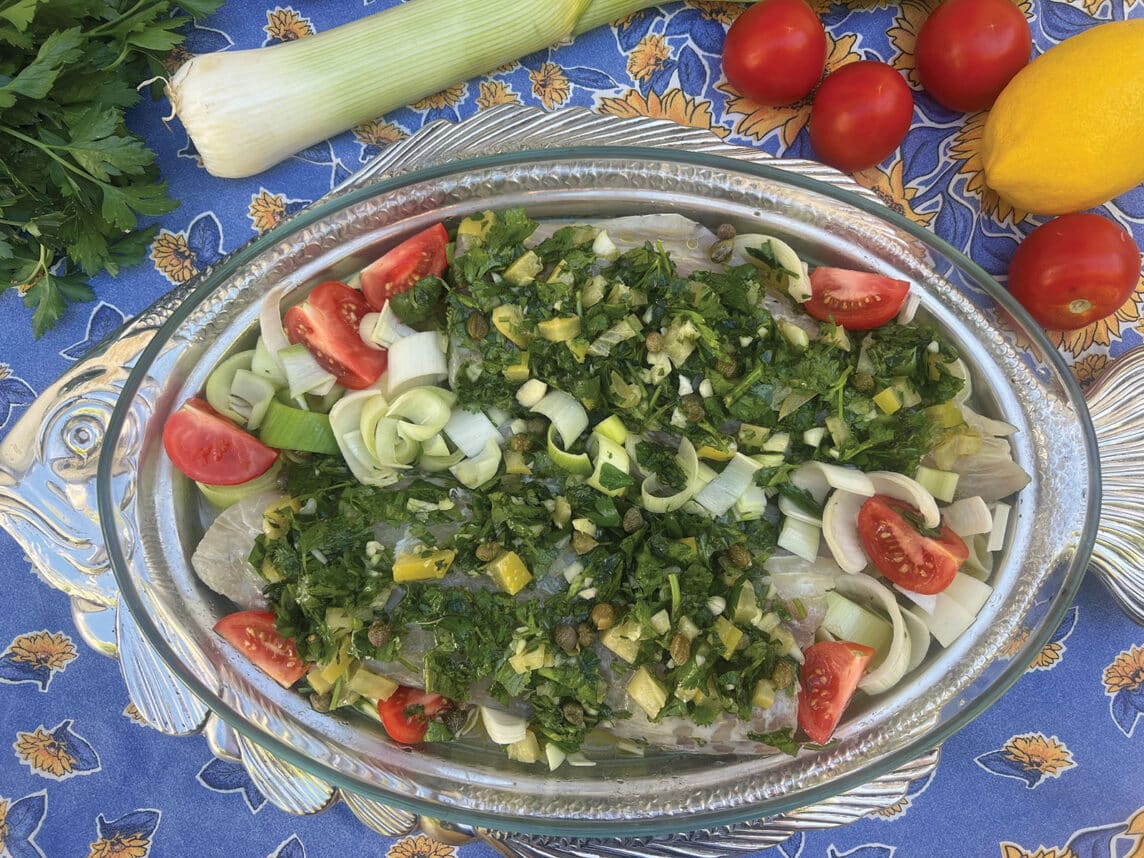
Summer Oven Roasted Fish
2 lbs sea bass or branzino fillets with skin
1 large leek, white and pale green parts washed and thinly sliced
4 Roma tomatoes, quartered.
1 tablespoon extra-virgin olive oil
1/2 cup chopped parsley
1/2 cup chopped cilantro
1/2 preserved lemon, chopped skin only or grated lemon rind of one lemon
3 garlic cloves, chopped
1 Tbsp capers
2 Tbsp extra virgin olive oil
Salt & Pepper, to taste
1/2 cup white wine
Line a sheet pan with paper towels. Arrange the fish filets with the skin down and sprinkle generously with salt. Allow to sit for 20 minutes.
Wipe the fish with a paper towel, making sure to remove any moisture from the fish.
Preheat oven to 400°F.
In a small bowl, combine the leeks and tomatoes with 1 tablespoon of olive oil, salt and pepper. Spread on the bottom of an oven safe dish.
Combine the herbs, preserved lemon, garlic, capers and 2 tablespoons of olive oil salt and pepper.
Place the fish on top of the leek mixture, then spread the herb mixture over the fish.
Pour the wine around the sides of dish making sure not to displace the herbs.
Bake uncovered for 20-25 minutes.
Sharon Gomperts and Rachel Emquies Sheff have been friends since high school. The Sephardic Spice Girls project has grown from their collaboration on events for the Sephardic Educational Center in Jerusalem. Follow them on Instagram @sephardicspicegirls and on Facebook at Sephardic Spice SEC Food. Website sephardicspicegirls.com/full-recipes.
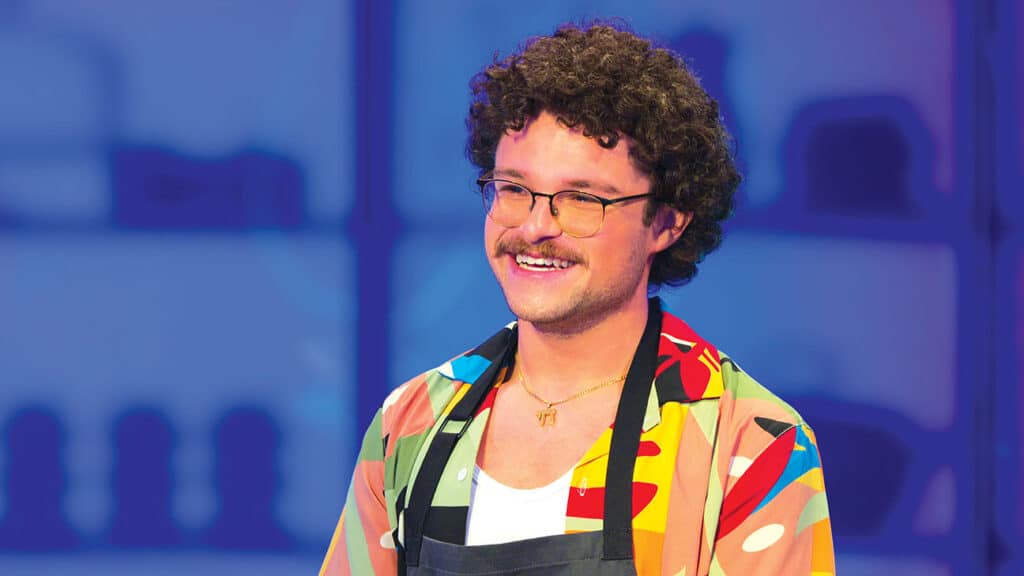
On Netflix’s popular competition/reality show, “Is It Cake, Too?,” contestants try to trick the judges into believing their cake is an actual object. Jarid Altmark 22, was proud to finally make something from his Jewish heritage: He made a matzah ball soup pot cake.
Altmark hasbeen on several competitive shows on The Food Network, including “Halloween Wars.” But when he heard that on “Is It Cake, Too?”he could make anything that had an important meaning in his life, he decided to create a cake that looked like a soup pot and the ingredients you’d need to make matzah ball soup: Matzah, and onion, celery, and carrots.
When he heard that he could make anything that had an important meaning in his life, he decided to create a cake that looked like a soup pot.
“This was the first time I got to do something authentically Jewish,” Altmark told the Journal. “Ironically, I’ve been on two Christmas shows where I decorated realistic Christmas tree cakes even though I haven’t decorated a real Christmas tree before. My first thought was the Dutch Oven that had matzah ball soup. It’s a staple in my kitchen, is visually interesting, and I thought I could share my Nana’s story while creating something visually interesting.”
He said the cake was inspired by his grandmother Gloria, the family’s main cook, who made matzah ball soup for Passover and Poppy, his grandfather, at one point worked as a bread baker.
“He was a New Yorker, and you know, New Yorkers wear so many different hats,” he said.
Altmark used vanilla orange cake, mango curd and dark chocolate ganache, with orange modeling chocolate to mimic the look of a pot and the vegetables. The goal is for the contestant to trick the judges into thinking their cake is the real item.
One of these is real. One is Altmark’s cake
The Orlando resident graduated from the University of Central Florida in 2021 with a bachelor’s degree in advertising and public relations, while also studying screenwriting — but his bar mitzvah held hint to his future vocation.
“I made 300 cupcakes,” he said. “150 vanilla and 150 chocolate.”
Altmark, who recently finished a Taglit/Birthright Israel trip that he greatly enjoyed, told the Journal he’s been making cakes since he was 10, which he taught himself by watchingYouTube videos. He said he later took classes, including one from the person who made Princess Diana’s wedding cake.
He was once a judge on “Buddy vs. Duff,” which features Jewish cake artist
Duff Goldman.
“I met him virtually but not in real life,” Altmark said. “I know he’s a fellow
tribe member.”
There was one time a cake he made didn’t come out perfect: One Passover, he made his Poppy a cake “because it was his birthday. I used pareve marshmallows as fondant and Pesach cake mix,” he said. “It didn’t taste the best, but it was technically appropriate for the holiday.”
On the show, contestants have 10 hours to make the cake and judges Chrishell Stause (of Netflix’s “Selling Sunset”), actor and comedian Blake Anderson, and actor / comedian Maz Jobrani have a tough job of figuring out which one is cake and which one is real.
For the first part of the show, hosted by Mikey Day, Altmark was able to look at a living room mixed with real furniture and items as well as cake disguised as them. He was able to call out that a candle looked lopsided, and he was correct in thinking it was cake and not a candle.
He said he was proud of what he created.
“This matzah ball soup cake is the most personal piece of art I’ve ever created,” he said. “It not only tells my story, but it resonates with the whole Jewish community, and I’ve gotten great outreach which is really special.”
He also does ceramics, which he sells under his lifestyle brand of merchandise called Bored and Baked.
While some put marijuana in baked goods, he says he hasn’t done so, but he assumes it would go well with cake.
“If you can bake it, you can get baked from it,” Altmark said.






 2 lbs sea bass or branzino fillets with skin