fbpx

July 20, 2023

Herzog to Congress: Israel-US Bond ‘Absolutely Unbreakable’ Despite Differences

To read more articles from The Media Line, click here.

In Israeli President Isaac Herzog‘s address yesterday to the US Congress, he described Israel’s ties with the US as a “sacred bond,” while seeking to ease concerns that Israeli democracy is eroding. However, he also warned about the fine line between criticism of the Israeli government and anti-Semitism.

During his 45-minute speech to a joint meeting of Congress on Wednesday, Herzog called America “our greatest partner and friend,” while also acknowledging criticism from some House progressives.

“I am not oblivious to criticism among friends, including some expressed by respected members of this House. I respect criticism, especially from friends, although one does not always have to accept it,” he said.

“But criticism of Israel must not cross the line into negation of the state of Israel’s right to exist,” Herzog went on. “Questioning the Jewish people’s right to self-determination is not legitimate diplomacy, it is anti-Semitism.”

Interrupted several times with thunderous applause and standing ovations, Herzog told a chamber packed with members of the U.S. Senate and House of Representatives that Israel and the United States “will always remain family,” despite not always seeing eye to eye.

“Our bond may be challenged at times, but it is absolutely unbreakable,” he asserted.

According to Danny Ayalon, former Israeli ambassador to the US and former deputy foreign minister, President Herzog’s speech “hit all the right notes, and resonated with his audience.”

“He bolstered the bipartisan support for Israel which has been kind of undermined during the Obama-Netanyahu years,” Ayalon said. “His messages about LGBTQ [issues], human rights, all those were music to the ears of the Democrats. It was obvious how enthusiastically the Democrats responded to him.”

Professor Efraim Inbar, president of the Jerusalem Institute for Strategy and Security, told The Media Line that Herzog delivered an “excellent” speech.

“It was well received as we saw the number of times Congress members applauded and gave standing ovations. It was a friendly audience; Herzog stressed the shared values, and that the US is more secure with strong Israel,” Inbar said.

Several progressive Democrats boycotted the speech over the treatment of Palestinians by Prime Minister Binyamin Netanyahu’s far-right government.

Herzog praised the Trump-brokered Abraham Accords while thanking the Biden Administration’s efforts to broker a normalization deal with Saudi Arabia and warned of the threat posed by Iran.

“Perhaps the greatest challenge Israel and the United States face at this time together is the Iranian nuclear program,” he said. “Let there be no doubt: Iran does not strive to attain nuclear energy for peaceful purposes. Iran is building nuclear capabilities, that pose a threat to the stability of the Middle East and beyond.”

Inbar affirmed the importance for Israel to normalize relations with Saudi Arabia.

“After all, Saudi Arabia is the leader of the Muslim world, and normalization would give greater legitimacy to Israel. Saudi Arabia is a rich country with a huge market and influence,” he said.

Herzog also described a lasting peace between Israelis and Palestinians as his “deep yearning,” though he did not endorse any specific proposals.

The Israeli president’s position is mostly ceremonial, but Ayalon says the president behaved in such a way that it didn’t matter that he doesn’t have executive powers. His biggest achievement was his ability to connect with the American leadership.

“In my mind, the objective of the visit in the absence of a Netanyahu visit was achieved during the first five minutes of the meeting between Herzog and Biden at the White House,” Ayalon said.

President Joe Biden, who hosted Herzog on Tuesday, urged Israel’s government Wednesday not to “rush” the proposed judicial reforms, which have prompted giant demonstrations.

“Finding consensus on controversial areas of policy means taking the time you need,” Biden was quoted as saying in The New York Times.

Herzog described the societal rift over the controversial judicial reforms as “painful, and deeply unnerving,” but called the demonstrations against them the “clearest tribute to the fortitude of Israel’s democracy.”

“Although we are working through sore issues, just like you, I know that our democracy is strong and resilient. Israel has democracy in its DNA,” Herzog told lawmakers.

Ayalon described the visit as highly successful, saying that it “really served messages that the Americans wanted to send to the region—that its relationship with Israel is ironclad.”

“The Americans have been very clear,” Abalone continued. “They are not intervening in Israel’s domestic policies, and they have told Netanyahu that whatever you do, it has to have a wide consensus.”

It is expected the second and third reading of the contentious judicial reform will go to vote in the Knesset early next week. If it passes into law, it will be hard to see Netanyahu given the same reception that Herzog enjoyed on his visit.

Professor Shmuel Sandler of the Department of Political Studies at Bar-Ilan University told The Media Line that Netanyahu is “looking for a way out, but it won’t be easy for him.”

“Herzog’s visit was critical especially to show Israeli enemies that Israel and the US are allies, and it was a signal to Netanyahu that if he wants to come to the White House, he needs to do something,” Sandler explained.

Ayalon blames “far right elements like Itamar Ben Gvir and Smotrich [who] are pushing for the judicial changes.”

“The Americans put all the responsibility on Netanyahu. Their message is that he should put his house in order and call the shots—not be led by radical elements within his coalition government,” he said.

Herzog to Congress: Israel-US Bond ‘Absolutely Unbreakable’ Despite Differences Read More »

Campus Watch July 20, 2023

AJC Urges Opposition to Ethnic Studies Bill

The American Jewish Committee (AJC) chapters in San Francisco, Los Angeles and San Diego are urging members of the California State Senate Education Committee to vote against a bill that would allow a council of people who supported the initial ethnic studies curriculum draft the ability to veto the content of the curriculum.

In a letter obtained by the Journal, the AJC chapters wrote that the bill, AB 506, would bestow veto power to the CSU Council on Ethnic Studies. “To the best of our knowledge this group is a voluntary collaborative that is using the CSU name and not an organization officially appointed or endorsed to speak on behalf of the CSU,” the AJC chapters wrote.  They added that the Council “supported the first draft of the California Ethnic Studies Model Curriculum (ESMC), which encountered substantial opposition across the political spectrum in California and was particularly denounced for the inclusion of antisemitic content” and that a previous iteration of the bill would have established the faculty senate as a “safeguard” against the Council. “That important safeguard has now been eliminated,” the AJC chapters wrote. 

AZ Hotel Cancels College Republicans United Convention Featuring White Nationalist Nick Fuentes

The Arizona hotel that was hosting a College Republicans United (CRU) event on July 30 featuring white nationalist Nick Fuentes has reportedly canceled the event.

The Algemeiner reported that the hotel, the Hassayampa Inn, told the outlet that the hotel was informed that the event was a “college students award ceremony” when it was booked but now the hotel will not be providing their venue for the event. 

The hotel’s cancellation comes after three local GOP parties claimed that they never provided authorization for the CRU to list their names as sponsors for the convention and alleged that the CRU didn’t tell them that Fuentes was speaking. In a tweet, the CRU argued that “various groups agreed to support our students” and that “Fuentes has a message that resonates with a lot of college age students.” The Arizona Mirror reported that Fuentes is a “Holocaust-denier who routinely makes antisemitic remarks.”

New York Gov Signs Bill Requiring State-Funded Colleges to Publicly Report Hate Crimes

On July 11, New York Governor Kathy Hochul (D) signed a bill requiring state-funded colleges to publicly report all hate crimes on their websites.

The bill also requires state-funded colleges to tell students the procedures on how exactly the college will investigate hate crimes. “I want every single college to have to adopt and implement these programs so every single student when they leave the security of their home, feels just as secure on a college campus,” Hochul said, per the New York Post. 

Jewish Students Say They Don’t Feel Safe at University of Amsterdam 

The student newspaper Folia published a report on July 3 quoting Jewish students who are claiming that they do not feel safe on campus i  due to what Folia described as “strong anti-Israel sentiment.”

The Folia report, which also received coverage in the Algemeiner, described how a week earlier, protesters at the Netherlands university occupied a campus building with calls for “decarbonizing, decolonizing, and democratizing” the university. A sign stating, “Cut ties with Israeli protesters. Free Palestine” was hung from a balcony; Tamar Efrati, an Israeli Jewish student who wears a Star of David necklace, told the student paper that a protester called her a “dirty Zionist.” Additionally, protesters issued calls for an intifada. An anonymous university law student similarly told Folia that he had sent a letter to the university saying that he now feels uncomfortable wearing his yarmulke on campus. 

A university spokesperson told Folia they “were shocked by the banners calling for a boycott and the proclamations calling for an intifada. We completely understand and deeply regret that Jewish students did not feel safe due to an implicit call for violence.”

More Than 230 Jewish Scholars, Academics Warn of “Censorious Culture” in Academia

An open letter signed by more than 230 Jewish scholars and academics published in Fathom Journal warned of the “censorious culture” perpetuated by the left in academia.

The letter, whose signatories included George Mason University Professor David Bernstein and Harvard Professor Emeritus Alan Dershowitz, argued that too many universities have imposed “a set of moral and intellectual attitudes that restrict critical inquiry, viewpoint diversity, and intellectual openness.” The letter also argued that there has been an “ascendency of an ideology that reduces people to ‘oppressed’ and ‘oppressors’ and categorizes individuals into monolithic group identities poses a particular threat to the Jewish people. In this stark, neo-Manichean worldview, Jews are frequently grouped with the privileged, and Israel is dogmatically singled out as an oppressor-state – a shallow dichotomy that foments new variants of antisemitism and reinforces old ones.” The letter concluded with a call for “leaders and educators to stand up for our deeply held liberal principles and our own tradition of ‘argument for the sake of heaven.’”

Campus Watch July 20, 2023 Read More »

The Passage of Time – A poem for Parsha Devarim

And the days when we went from Kadesh barnea, until we crossed the brook of Zered, numbered thirty-eight years, until all the generation of the men of war expired from the midst of the camp …
          Deuteronomy 2:14

The time jump is one of my favorite tropes.
Suddenly the characters are older and we

have no idea what they’ve experienced
since we last saw them. We can see the

wisdom and damage on their faces.
We know they’ve been through some stuff.

Time jumps remind me of my own mortality.
So many years have passed under my feet.

I look in the mirror and, like the characters,
I have no idea how either of us got here.

And I was here for all of it!
How is it possible I used to not have a child

and now I have a teenager? When did I
learn how to do this? Did I ever?

How is it possible I used to pine over the
impossibility of finding a soulmate, and

now it’s like I have a whole separate body.
How is it possible I used to be locked

behind the bars of a crib, and now I’m
free to operate a motor vehicle?

Thirty-eight years of events passed
between when the Israelites almost

got to enter the Promised Land and
when their children finally did

leaving the ones who walked out of Egypt
as dust on the wrong side of the river.

I don’t think I’ve learned from their mistakes, and
I am continually startled by the passage of time.


Rick Lupert, a poet, songleader and graphic designer, is the author of 27 books including “God Wrestler: A Poem for Every Torah Portion.”

The Passage of Time – A poem for Parsha Devarim Read More »

Chalav Yisrael Ice Cream Shop Opens in Pico-Robertson

Just in time for the steamy days of summer, Valley Swirl, a chalav yisrael ice cream shop, has opened in Pico-Robertson. Located at Pico and Beverly Boulevards, this shop offers soft serve, scoops, milkshakes, boba, coffee and ice cream pies. Customers can get toppings like rainbow and chocolate sprinkles, Oreo and graham cracker crumble, peanut bits and whipped cream, and have their ice cream in a cup or a cinnamon dusted waffle cone. 

Valley Swirl started out in at a kiosk inside the kosher supermarket Cambridge Farms in Valley Village. It then expanded to a location on La Brea Boulevard and the newest outpost on Pico, as well an ice cream truck that travels to Jewish communities in the L.A. basin and the Valley.

Owner Jacob Goldstein, who grew up in Pico, has always worked in food – his first job was at Jeff’s Gourmet Sausage Factory, located just minutes from the newest Valley Swirl. Along with owning the shop, he also runs Chillbachi, a kosher rolled ice cream catering company that operates in L.A., New York and Miami.

“I decided to work with ice cream because it was something I felt I could do without too many technical skills,” Goldstein said. “All you have to know is how to scoop ice cream.”  

Ice cream shops usually have kosher op-tions, but few offer chalav yisrael, which is a stricter level of dairy kashrut.

Ice cream shops usually have kosher options, but few offer chalav yisrael, which is a stricter level of dairy kashrut.

“Valley Swirl really does open up options for people eating chalav yisrael,” said Goldstein. “They can enjoy the ice cream and treats in a more exciting way. Everyone can create their own flavors and have fun while they’re eating.” 

Valley Swirl is also introducing customers who have always kept kosher to boba, a bubble tea with chewy tapioca pearls at the bottom. Like chalav yisrael ice cream, it’s hard to find boba in kosher establishments.

“The funniest conversation I have is when people ask what boba is,” Goldstein said. “I try to explain it, but it always sounds worse and worse. But then they love it.”

The Pico location, which is a large stand along with a seating area, has space for 30 people to sit outside and eat. It looks modern and features a trendy pink, blue and purple color scheme. 

“We really wanted to have a cool environment where you can sit around and relax and have fun with your friends,” said Goldstein. 

The shop is open from 11 a.m. to 9 p.m. on Sundays and weekdays – aside from Fridays, when it closes early for Shabbat – and then reopens after Shabbat ends, closing at 1 a.m. This was important to Goldstein, who would never have anything to do on a Saturday night when he was growing up. 

“Saturday nights were always so boring,” he said. “It’s exciting that my little brother and sister and their friends in high school are coming and having a good time. That’s what was always missing in the hood.”

Soon, Goldstein plans to have a dedicated vegan soft serve machine so that people who want plant-based ice cream, or who want to come to Valley Swirl after eating meat, can enjoy it as well. Right now, all the equipment is dairy, not parve. 

Though the Pico location just opened, Goldstein is already receiving positive feedback and feeling the love from the community.

“Business has been unbelievable,” he said. “The support has been great. People are coming back over and over again.”

Chalav Yisrael Ice Cream Shop Opens in Pico-Robertson Read More »

Vegetarian Recipes for the Nine Days

The Nine Days of Av (July 18-27) are a communal time of mourning. 

“In Judaism we often use food to reflect our emotional state, sometimes feasting and celebrating and others reflecting our sorrow,” Deborah Kornberg, chef-owner of SPICE + LEAF and cooking teacher, told the Journal. “During the Nine Days of Av, it is traditional to not eat meat to reflect our collective loss and the suffering of the Jewish people.”

“During the Nine Days of Av, it is traditional to not eat meat to reflect our collective loss and the suffering of the Jewish people.”
– Deborah Kornberg

Here are some vegetarian recipes to honor this time of year, starting with Kornberg’s Shiitake Mushroom lettuce wraps. They make a great appetizer of a delicious light lunch. “They are packed with flavor, and of course, spice,” she said.

Shiitake Endive Bites with a Teriyaki Dipping Sauce
By Debbie Kornberg

Teriyaki Dipping Sauce:

½ cup coconut aminos or soy sauce

¼ cup rice vinegar

3 Tbsp SPICE + LEAF Gallberry Honey

2 Tbsp sesame oil 

2 garlic cloves, minced

1 Tbsp fresh ginger, minced

1 tsp SPICE + LEAF Aleppo Pepper

1 Tbsp.cornstarch or arrowroot

¼ cup water

Shiitake Bites:

½ cup raw cashews, toasted and chopped

3 Tbsp + 1 Tbsp. SPICE + LEAF Galili Olive Oil

4 cups (10 oz) shiitake mushrooms, sliced

2 cups (8 oz) white button mushrooms or cremini, sliced

3 garlic cloves, minced

2 green onions, diced

2 tsp. fresh ginger, minced (can add more if you love ginger)

¾ cup celery, diced

2 tbsp cilantro, coarsely chopped (can substitute with parsley if you prefer)

Pinch of salt

½ cup carrots, shredded

1 Tbsp + 1 tsp sesame seeds, toasted

3 small endives, cleaned and dried. Little Gems, Butter or Romaine lettuce as little cups to hold the mixture

Teriyaki Dipping Sauce: 

Using a small pot, combine coconut aminos or soy sauce, rice vinegar, honey, sesame oil, garlic and ginger. Over a low heat, bring to a low simmer and continue simmering for about 3–5 minutes. While sauce is simmering, in a small bowl, combine arrowroot and water. Using a whisk, mix well until the corn starch (or arrowroot) is fully incorporated into the water. Gently add arrowroot-water combo into the pot of sauce and continue mixing with whisk. The sauce will slowly thicken. The longer it stays on the stove, the thicker it will get, about 3–5 minutes. Turn off the stove and set aside.

Shiitake Endive Bites:

Using a sauté pan, place ½ cup of raw cashews into a dry pan (no oil). Toast for about 5 minutes on medium to medium-low heat. Continually stir nuts, so they are toasted evenly on all sides. When cashews start to get a toasty brown color, remove from the pan and place into a bowl. Set aside until the end.

Using the same sauté pan, heat up 3 Tbsp of olive oil and add mushrooms. Sauté on medium heat for about 7 minutes. Mushrooms should cook down and get a little sear on them. After cooking, place mushrooms in a bowl and set aside. 

Using the same sauté pan, put on medium-low heat, and add 1 Tbsp of olive oil. Then add garlic, green onions, ginger, cilantro, celery and salt. Sauté for about 5 minutes. Then add carrots and sauteed mushrooms, and cook for another minute or two mixing everything together. 

Place mushroom mixture in a bowl and add ¼ cup toasted chopped cashews and 1 Tbsp sesame seeds. Mix well. 

Preparing the Endives:

Cut off the stem of the endive bulb so each leaf can be pulled off one by one. Discard any wilted leaves. Wash and pat dry. 

Putting it all Together:

Using a spoon, scoop some of the Shiitake mixture into an endive cup, drizzle a little Teriyaki sauce on top. Then sprinkle some extra cashews and sesame seeds on top. Place on a serving platter. 


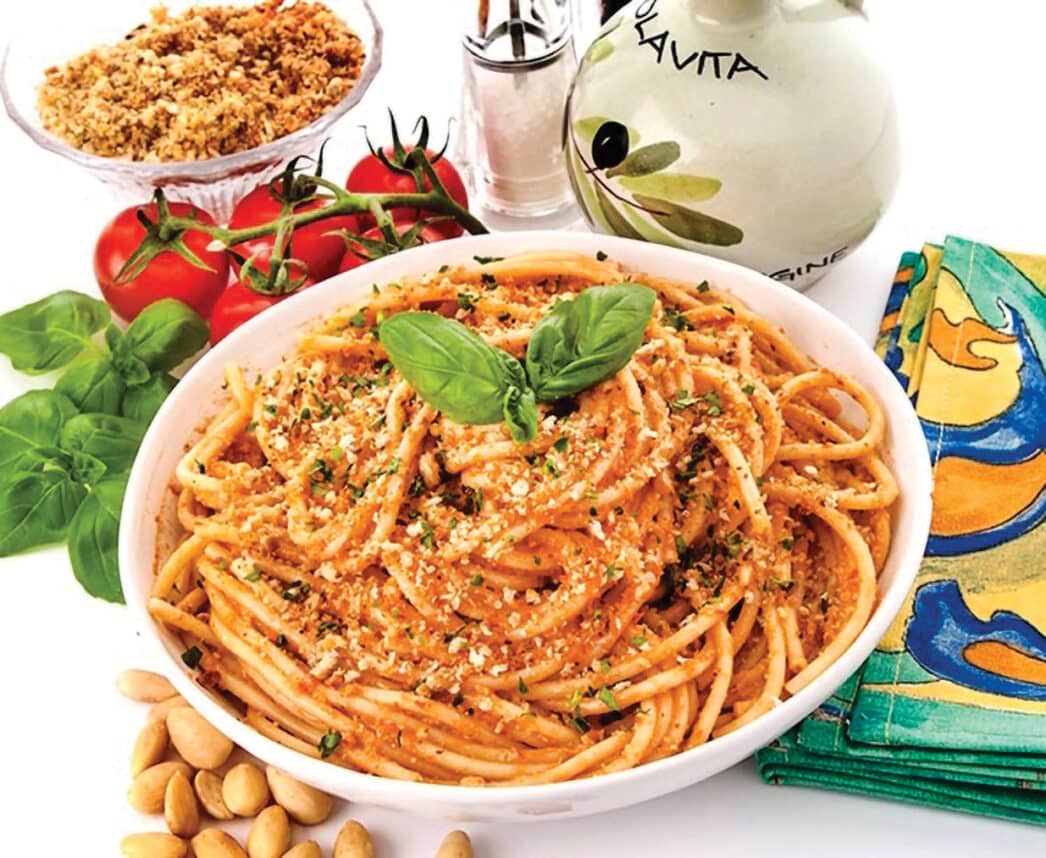
Judy Elbaum’s Bucatini with Tomato Pesto is a great, pareve vegetarian meal to serve during the Nine Days.  

“In this scrumptious Sicilian pasta dish, a thick spaghetti-type pasta is tossed with a fresh, aromatic tomato pesto and then sprinkled with toasted bread crumbs,” Elbaum, founder of Leave it to Bubbe, told the Journal.  “The tomato pesto comes together quickly in a blender, yielding a dairy free tomato sauce that cooks briefly when it comes into contact with the freshly boiled pasta.”

Bucatini with Tomato Pesto
Photo by John Paul Endress


Bucatini with Tomato Pesto 

2 lbs Roma or San Marzano tomatoes

¾ cup blanched almonds

1 bunch of fresh basil

salt

freshly ground pepper

1 cup extra virgin olive oil

1 pound bucatini

1 cup toasted bread crumbs

Bring a large pot of water to a boil. Place tomatoes, almonds, basil, salt and pepper in a blender. Slowly add all the olive oil—usually 3/4 cup to 1 cup, and blend all the ingredients emulsify and blend together into a smooth and creamy (from the almonds) tomato pesto. Pour half the sauce into a serving bowl. Place the  pasta into the boiling water and cook for 8 to 10 minutes, until it is al dente. Drain the pasta, then place in a large bowl. Add the remaining sauce to the pasta and toss well.  Serve with toasted bread crumbs, decorate with basil, and pass around the extra sauce.

To toast bread crumbs: You will need about 1 cup of breadcrumbs for 4 servings.  Heat 2 tablespoons of olive oil in a large skillet, then sauté the bread crumbs in the oil for a few minutes until golden brown, being careful not to burn the crumbs.   


Danny Corsun said his roasted cauliflower transports him to Tel Aviv. The flavors that explode from it are unmatched, and it can be used as a side dish or entree,” Corsun, founder of the Culinary Judaics Academy (CJA), told the Journal. “I hope you will close your eyes, and join me in the Shuk Carmel as we eat it together!”

CJA’S Za’atar & Cilantro Encrusted Roasted Cauliflower

1 large head of cauliflower

¼ cup olive oil, plus some to drizzle

1 cup fresh cilantro

3 Tbsp Za’atar

3 tsp garlic powder

1 tsp salt

1 tsp pepper

2 tsp cajun or blackening spice

1 tsp cumin

1 tsp coriander

1 16 oz container of Labneh


Preheat oven or grill to 425°F

Wash cauliflower and cut stem/leaves off leaving the head in one intact piece. Set aside.

In a food processor combine olive oil, cilantro, 2 Tbsp of Za’atar, 2 tsp garlic powder, salt, pepper, 1 tsp of cajun seasoning, coriander, and cumin. Process until smooth.

Place cauliflower in a large bowl and using either a pastry brush or your hands, bathe the cauliflower in the olive oil/cilantro/spice mixture. Coating every inch. Turn the cauliflower upside down to make sure you also coat the underside and get the mixture into the crevices toward its center. We want this flavor to permeate every piece!   

 If roasting in the oven, place cauliflower on a parchment paper lined sheet pan and place in the center rack of the oven. Roast for 25 minutes or until crusty, golden brown and just tender. Test doneness by piercing the head of the cauliflower with a knife. You are looking for it to be able to pass through the cauliflower, but not for it to be mushy; there should still be some bite to it. If cooking on the grill, grill all sides to get a nice, caramelized crust and then wrap with aluminum foil and finish cooking (turning once or twice to get all sides), until the proper doneness is achieved (see above).

Add the Labneh to a separate bowl and mix in the 1 tbsp of Za’atar, 1 tsp of cajun seasoning, 1 tsp of garlic powder and salt/pepper to taste. Transfer to a platter and drizzle with olive oil and then place whole cauliflower on top of it and serve. Enjoy!

Vegetarian Recipes for the Nine Days Read More »

Creative Aging: Embracing Mystery

Editor’s note: 11th in a series.

So I’m a former advertising agency copywriter. There’s a commercial currently running that I’ve seen a hundred times. An older lady says, “Age is just a number.” And then, directed to give a look of defiant confidence, she tilts her head into the camera, “And mine is unlisted.” 

Clever line. Give this copywriter an award. But what the actor has been scripted to say carries absolutely no validity. At age of 72, I can testify that age is not just a number. It is inherent with meaning as well as happy and harsh realities that cannot be denied.

I Googled “old age and Torah,” to see what Jewish viewpoints were. Of course, the first website that came up was Chabad.org: “The Torah considers old age a virtue and a blessing. Throughout the Torah, “old” (zakein) is synonymous with “wise”; the Torah commands us to respect all elderly, regardless of their scholarship and piety, because the many trials and experiences that each additional year of life brings yield a wisdom which the most accomplished young prodigy cannot equal.”

What does it mean “to respect all elderly regardless of their scholarship and piety?” The commentary is telling us the wisdom that comes from the practical experiences of a long life is as important if not more so than wisdom that only comes from scholarship and piety. You gain that life wisdom as you age. You become more humble as you age. Who then would want to deny the gift of years and believe that age is just a number? Denying your age is like denying your existence as well as what you have celebrated, witnessed, endured and learned. 

Also, contrary to trendy vernacular, the 70s are not the new 60s. And the 50s are not the new 40s. As many vitamins as can be ingested, as many animal products that aren’t eaten, as many yoga classes as can be attended — our internal organs, knees, hips, backs, feet, brains and guts announce themselves everyday telling us what age we really are.  

At my 72nd birthday dinner a few weeks ago, my kids asked what wisdom I had to share. I finished twisting my mushroom pasta into the tablespoon, looking from one kid to the next and then to my wife. 

“Mystery.”

It just popped out. I had never heard myself say that before. I continued with an extemporaneous explanation that I didn’t even know was rolling around in my head. Only recently, did I tell them have I learned to accept and embrace mystery.  When I was younger I never considered mystery because I was working so fanatically to strategize my next move, to get ahead, believing I could control life and make the world work the way I was planning. At this age, I realize that what succeeded and failed, how the stars aligned, and how the world proceeds in all its ways, is all a mystery. The outcomes of some mysteries have been fascinating and beautiful, and others have been excruciatingly painful. With the risk of sounding kabbalistic, I now know that so much is concealed. We are not meant to understand everything. I am finding that incorporating the realities of mystery into how I live at this age, helps the world make sense to me, gives me peace and enhances my creative. Mystery, I believe, is at the core of all creativity.

The outcomes of some mysteries have been fascinating and beautiful, and others have been excruciatingly painful. With the risk of sounding kabbalistic, I now know that so much is concealed. 

When I turned 40, I hosted my birthday party on a Saturday night in the ad agency where I was the creative director. Among all the other events that evening, I invited a Hasidic rabbi to teach Kabbalah, because only at age 40 is when it is believed you are grounded enough to open to its mysteries and not lose your balance in its revelations. Perhaps in the days of the Kabbalistic masters, 40 was considered old. Maybe for me today, 72 is the new 40? 


Gary Wexler woke up one morning and found he had morphed into an old Jewish guy.

Creative Aging: Embracing Mystery Read More »

Rob Kutner: Snot Goblins, Humor and Heart

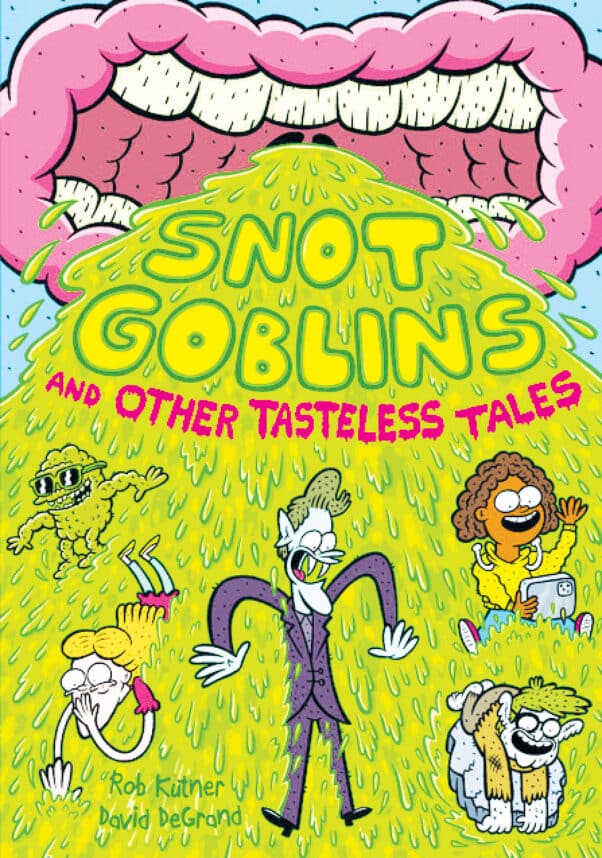
“Snot Goblins: and Other Tasteless Tales” is not your typical gross-out graphic novel. For one thing, it’s filled with humor and history.

“‘Deep gross’ is the spot we carved out for ourselves,” Rob Kutner, author and five-time Emmy-winning writer, told the Journal. “They’re all plays on horror tropes with a comedic angle and a heavy emphasis on disgusting substances wherever possible; juvenile humor.” 

He added, “We wanted it to be the book that teachers will be horrified by, but the cool librarians will slip to the smart kids.” 

Written by Kutner and illustrated by David DeGrand, “Snot Goblins” features five gross tales that are kids’ stories (ages 8 – 12) with nuances that will engage adults. 


“In TV they call it co-viewing,” he said.

The adults will either want to read it alongside their kids or the kids will reference things in the book and pique the parents’ curiosity.  

“I approached it with, ‘Don’t underestimate kids; reach a little bit above them, but not too far that they can’t follow,’” he said.

The title story “Snot Goblins” is about a race of snot that are like demons. 

“This boy gets out of school because he is ‘sick’ and then his booger gets loose,” Kutner said.  “He realizes there’s much darker forces at work, so he and the kids take charge and fight the snot goblins.”

“The Bleeding Heart Vampire” is an immigration story. A turn-of-the-century vampire, who doesn’t like to kill people, is a disappointment to his family. So he travels from a small town in Romania to America.

“I thought about our immigrants who left the Old World for the New World, and just reinvented themselves,” Kutner said. 

The vampire ends up on the Lower East Side in New York.

“There’s lots of Jews, there’s lots of kosher butchers, so he gets a night job sucking the blood out of meat to make sure that it’s kosher, [that] it has no blood in it,” Kutner said. “It’s sort of a compromise job for him.” 

 Kutner also took the opportunity to take his character on a whirlwind trip through early 20th-century history. In one instance, he crosses paths with Thomas Edison and Bonnie and Clyde. 

The story is about “a nerdy vampire who uses science and technology at a weird time to figure out how to get blood,” Kutner said. “But also he’s discovering the world.”

Growing up, Kutner learned things “sideways” through parodies like Mad Magazine, and wanted to do the same for his readers.

“I wanted to introduce kids [to history] without trying to be a textbook,” he said. “With some of the other stories, I did this with culture, religion, etc,”

“The Stepmummy” is about a blended family where a dad marries a 2,000-year-old mummy. 

“Hatshepsut was a real Pharaoh who was a great leader [and] overlooked in history because she was a woman,” he said. It’s told from the point of view of the tween daughter, who also gets a disgusting stepbrother in the union. 

“It’s a lot of Egyptology with an emphasis on real life gross stuff,” he said. 

“Troll Versus Troll” is about the cave trolls who live underground going to war with Internet trolls, and “Whooo’s There?” is about two tween girls who are ghost hunters with their own YouTube channel, investigating a haunted Psychiatric Hospital. “The tables get turned on them in terms of who becomes the hunter and who becomes the hunted,” Kutner said.

All of the stories take place in the same vague universe.

“If you look carefully, you’ll see there’s elements from other stories inside each one,” he said. “It takes place all in the same world, even though they’re not explicitly interacting.”

Kutner, who lives in L.A. with his wife Sheryl Zohn and their two kids, grew up in Atlanta, Georgia. 

“I became Jewish by going to a Christian school,” Kutner said. “And that made me a weird rebel with an outsider perspective that was an even more enhanced Jewish outsider perspective than the typical one.”  

“I became Jewish by going to a Christian school. And that made me a weird rebel with an outsider perspective.“

Kutner, whose family was Reform, attended a private Presbyterian school, starting with pre-school. 

“My parents are pretty active in terms of Jewish community involvement,” he said. 

Kutner got more involved in Jewish observance around junior high. Some of his Christian peers became evangelical and started “witnessing” everyone around them. Their questions led to Kutner exploring his roots. He went on a summer program in Israel in high school and came back wanting to keep kosher and observe shabbat.

He has gone from Reform to Conservative, and spent a year studying at the Pardes Institute in Jerusalem. “It is a very traditional, but also egalitarian, yeshiva,” he said. “And that got me on kind of a Jewish living path.”

Kutner described the main line prep school he attended in the conservative South as almost an authoritarian structure, one that prepared him in ways they never could have imagined.

“And just as those Ivan Reitman movies – “Ghostbusters” and “Animal House” – are all about upending the very stuffy things, I had that vibe. I was the heckler who saw everything was funny.”

 This perspective has served him well.

Kutner, whose TV credits include “The Daily Show,” “Conan” and “Teen Titans Go!”, has also written the humor books “Apocalypse How,” “The Future According to Me” and the graphic novel “Shrinkage.” He also ghost-wrote the upcoming MCU Scott Lang “memoir” from the movie “Ant-Man & the Wasp 3.”

Kutner and DeGrand (who was an illustrator for the Mad Magazine reboot a few years ago) had previously collaborated on cartoons. When publishers asked DeGrand if he had ideas for graphic novels, he mentioned Kutner, since they worked so well together.

Three years ago, Rob Kutner and David DeGrand set out to write a book of stories about really gross things. 

“Snot Goblins” comes out on July 25.

Rob Kutner: Snot Goblins, Humor and Heart Read More »

Still Fasting on a Future Festival

The refusal to accept modernity,

while making what is temporary sacrosanct,

raised to the power of eternity,

is a major value messianists have banked,


especially since the holy temple’s sad destruction,

that they recall in sorrow on the Ninth of Av,

while faithfully believing that a reproduction

might well restore to them what they no longer have.


It’s said that when messiah comes, the fast

will be transformed into a festival in which

Jews will rejoice, but until this the die is cast:

the day a Rubicon they can’t cross like a ditch.


Zinovy Zinik writes about literary emigration (“Dublin Dragomans,” TLS, 6/26/04). In Dublin on Bloomsday in 1988 he met Anthony Burgess, who pointed out to him that Leopold Bloom was a Yid only for the Irish plebs, because his mother was Irish and his father a converted Hungarian Jew.

The diaspora, that is life outside your home, created a new religion: that of a demolished temple, a disintegrated past.  If Talmudists are to be believed, the temple will remain in ruins until kingdom come.  Then and only then will Jews gather in the Holy Land and the temple will be restored.  Judaism, therefore, has become the religion of permanent waiting, of marking time and whittling away in the world that resembles an antechamber to that other world where life, pressed in between packed suitcases(The Hafetz Haim, one of the most saintly as well as scholarly rabbis of the twentieth century, used to keep a suitcase packed all the time, waiting for the Messiah, and never invested in furniture.  GWH) is shaped by strict Talmudic laws.  It is a state of temporariness raised to the power of eternity.  It is the fear of returning to your own lost past that may have turned out to be someone else’s (Roman, Turkish, British) life, the refusal to go back home made sacrosanct.


Gershon Hepner is a poet who has written over 25,000 poems on subjects ranging from music to literature, politics to Torah. He grew up in England and moved to Los Angeles in 1976. Using his varied interests and experiences, he has authored dozens of papers in medical and academic journals, and authored “Legal Friction: Law, Narrative, and Identity Politics in Biblical Israel.” He can be reached at gershonhepner@gmail.com.

Still Fasting on a Future Festival Read More »

A Bisl Torah – The Power of Memory

As our older kids returned from Camp Ramah, they regaled us with tales about new friends, hobbies and experiences during their four weeks away. They were thrilled when we decided to visit Camp Ramah just a week after their return. We explained to the kids that camp might look or feel different. They shook their tween heads and proceeded to discuss everything they would find back in Ojai.

But sadly, it was different. The kids ran to their bunks. Different kids and different counselors. While the space felt safe, there was a strong, pervasive feeling that this was now someone else’s camp.

For anyone that has visited a previous home with new owners, it is a similar experience. There is a desire to run through the hallways, find old bedrooms and see familiar trees in the yard. But hurt ensues when a beloved tree has been uprooted, and old bedrooms are now renovated into offices. It is seemingly impossible to replicate our most formative of moments.

It is a profound realization: the power of memory is often more comforting than trying to recreate what was. So much of Jewish ritual asks us to remember. To remember the exodus out of Egypt. To remember creation and Shabbat. Next week we will sit on the ground, chant Eicha and remember the destruction of the Temple in Jerusalem. We recall these pivotal occurrences in history, not for means of replication but to allow collective Jewish memory transcend generations, gleaning wisdom over the span of thousands of years to shape our present. Memory is the medium in which we share our personal and communal stories, connecting past with future.

The Baal Shem Tov, founder of the Hasidic movement teaches, “Forgetfulness leads to exile; remembering is the key to redemption.” It is the remembering of what was that will inform what can be.

For those that wish to return to what was, whether it is a return to camp or “the good old times”, if we let them, our memories hold the power to nudge us forward.

 May our memories cause us to be a blessing, for God and for each other.

Amen.


Rabbi Nicole Guzik is senior rabbi at Sinai Temple. She can be reached at her Facebook page at Rabbi Nicole Guzik or on Instagram @rabbiguzik. For more writings, visit Rabbi Guzik’s blog section from Sinai Temple’s website.

A Bisl Torah – The Power of Memory Read More »

A Moment in Time: “Take My Hand, and We’ll Build our Tomorrow”

Dear all,

This month, Ron and I celebrate our 21st wedding anniversary! (I guess we have entered the legal adult stage of our marriage!)

For our ceremony in 2002, I wrote a love song based on traditional wedding liturgy.

How touching it was that our kids pulled out their ukuleles to accompany me when I sang the song to Ron earlier this week!

It’s truly a moment in time implanted in my soul! How awesome that a sacred day from so many years ago becomes sacred once again through the voices of the next generation!

Below are the full lyrics, and linked is the original recording of Ze Dodi.

Ze dodi, v’ze re-i. This is my beloved and my friend.

Har-ei anachnu m’kudashim echad la-sheini.

Ani l’dodi v’dodi li.

I close my eyes, and I see your sweet face,

And I smile because you’re the one I love.

My beshert, my life partner,

Your embrace is what I am certain of.

Ze dodi….

Take my hand, and we’ll build our tomorrow

And we’ll nurture the blessings of our home.

Dodi, my beloved

Finding you brings meaning to shalom.

Ze dodi….

With love and shalom,

Rabbi Zach Shapiro

A Moment in Time: “Take My Hand, and We’ll Build our Tomorrow” Read More »