Rabbi Miriam Hamrell of Ahavat Torah Congregation in Santa Monica, the synagogue she founded in 2003, has retired after 20 years at the pulpit.
Hamrell, who is Israeli, was one of the only female rabbis born and raised in Israel to head an American-Jewish congregation. She was ordained at the Academy of Jewish Religion in May of 2003 and founded Ahavat Torah along with cantorial soloist Gary Levin and 20 other Jews just a few months later. Later, she rose to prominence for teaching Torah to women prisoners at the California Institution for Women in Corona as well as welcoming former prisoners into her warm, community-led synagogue.
“It is hard to count the many blessed and meaningful experiences I had at and with Ahavat Torah Congregation,” said Hamrell. “Our non-judgmental synagogue is based upon an Israeli kibbutz model, where everyone is equal and everyone has a certain talent and task to contribute to the well-being of the whole community.”
Almost every time a new person came to the congregation, Hamrell would take them for a walk on the beach or have a cup of tea or lunch with them. She would ask them questions and figure out how the community could best cater to their needs.
“Every person has a spark of godliness within them, and all we need to do is spend time to find this spark, elevate and embrace it,” she said. “This kibbutz model worked best for finding the way this person can contribute with his spark and be involved within and for the community.”
“Every person has a spark of godliness within them, and all we need to do is spend time to find this spark, elevate and embrace it.”
Over the past two decades, Hamrell would invite members to her home for Shabbat dinner and hold havdalah, selichot services and summer concert events in her yard. She took her congregation to Israel three times as well.
“I wanted to show them Israel through the eyes of their sabra rabbi,” she said. “We went to places and restaurants that tourists usually do not see. I loved it.”
During her time at Ahavat Torah, Hamrell would also make a four-hour round-trip drive to Corona twice a month to teach Torah to women prisoners, some of whom ended up becoming members of her synagogue. Several congregants also ended up volunteering at the prison.
Along with learning with women prisoners, Hamrell taught four classes a week at her synagogue, including ones on the Tanya, understanding the deep meaning of prayers, the weekly Torah portion and ethics when it came to gossip and monetary issues.
“These were very meaningful to me personally and for those who attended,” she said. “The classes were very participatory, and everyone attending was contributing to the whole of the class with their involvements and teachings that made the classes very rich in content and experience. The motto of the synagogue from the very beginning has been, ‘One Torah, One Community, Many Teachers.’”
In retirement, Hamrell plans to spend more time with her family, including her nine grandchildren, and stay active in her synagogue as a member, participating in the wellness, literary salon and social action groups.
“These are my friends. This is my community. This is my home away from home,” she said.
Hamrell hopes that Ahavat Torah, now led by Rabbi Michal Morris Kamil, will attract more young families and children to continue its legacy – and that members will look back fondly at her time with them.
“I hope and pray that people in general and in my congregation will remember my rabbinical leadership as one who always loved peace and pursued peace,” Hamrell said. “One who loved teaching, who listened not only with my ears, but also with my heart.”
Theoretically, it should have been simple: the public wants the government to take into account the threat of pilots and other elite soldiers to quit their volunteer reservist duty — so the government, as representatives of the public, ought to listen.
Theoretically, it should have been simple: the public feels that protesting by refusing to attend to reservist duty is a bridge too far as it weakens the IDF and endangers the country – and so then the leaders of the protest movement, which claims to be a representative of the public, ought to listen.
Theoretically, a functioning government relies on the support of the public and must be attentive to what the public says. Theoretically, a functional government relies on the support of the public, and care must be taken not to lose it.
Practically, none of this happens in Israel today. Israel enters a very tense week, in which the first piece of judicial reform legislation is supposed to pass, and no attention is paid to what the public wants. It’s natural that the government does not pay attention to the leaders of the protest movement. It’s also natural that the protest movement leaders do not listen to the government. What is surprising, what is strange, is that both the government and the protest leaders stopped paying attention to what the majority of the public wants.
What is surprising, what is strange, is that both the government and the protest leaders stopped paying attention to what the majority of the public wants.
The government is no longer interested in the question of whether the public is in favor of its legislation (under the current circumstances, a majority would give up on it). The protest movement is no longer interested in whether the public believes that the situation justifies the means of refusing reserve duty and blocking roads (the public finds these measures too extreme). The public is no longer relevant. Israel’s system of government is a democracy, the public is the supposed sovereign, but nowadays the public is no more than an ineffective spectator.
What would have happened had both listened to the public? A survey published Monday found 58% who favor a halt of reform legislation and a focus on strengthening unity. In the same survey 68% opposed the reservists’ protest. Reading more polls, and trying to extract consistent insights from them, leads to the following conclusion: If the public had its way, the government would stop the legislation, negotiations would resume, the opposition would accept certain measures of legal reform, reservists would return to their units. Surely, some Israelis would be bitter with such a conclusion. Those who failed to pass a comprehensive reform and those who failed in their attempt to overthrow the government. They are the minority.
Alas, the battle now taking place in Israel will not be decided by a majority, but rather by brute force. The government has the power to legislate at its disposal even in the absence of public support. The protest movement has power because many of its supporters are dominant in centers of power, such as army units and financial institutions. And both sides seem to insist on violating, at least for the time being, the Cold War theory known as MAD – “Mutual Assured Destruction.” The superpowers hoped that a nuclear war would not be initiated by a rival, because of the assumption that no one is crazy enough to bring about the destruction of an opponent at the cost of his own destruction. The USA would not attack the USSR — and the USSR would not attack the USA — as long as both understood that an attack meant unbearable damage to both sides.
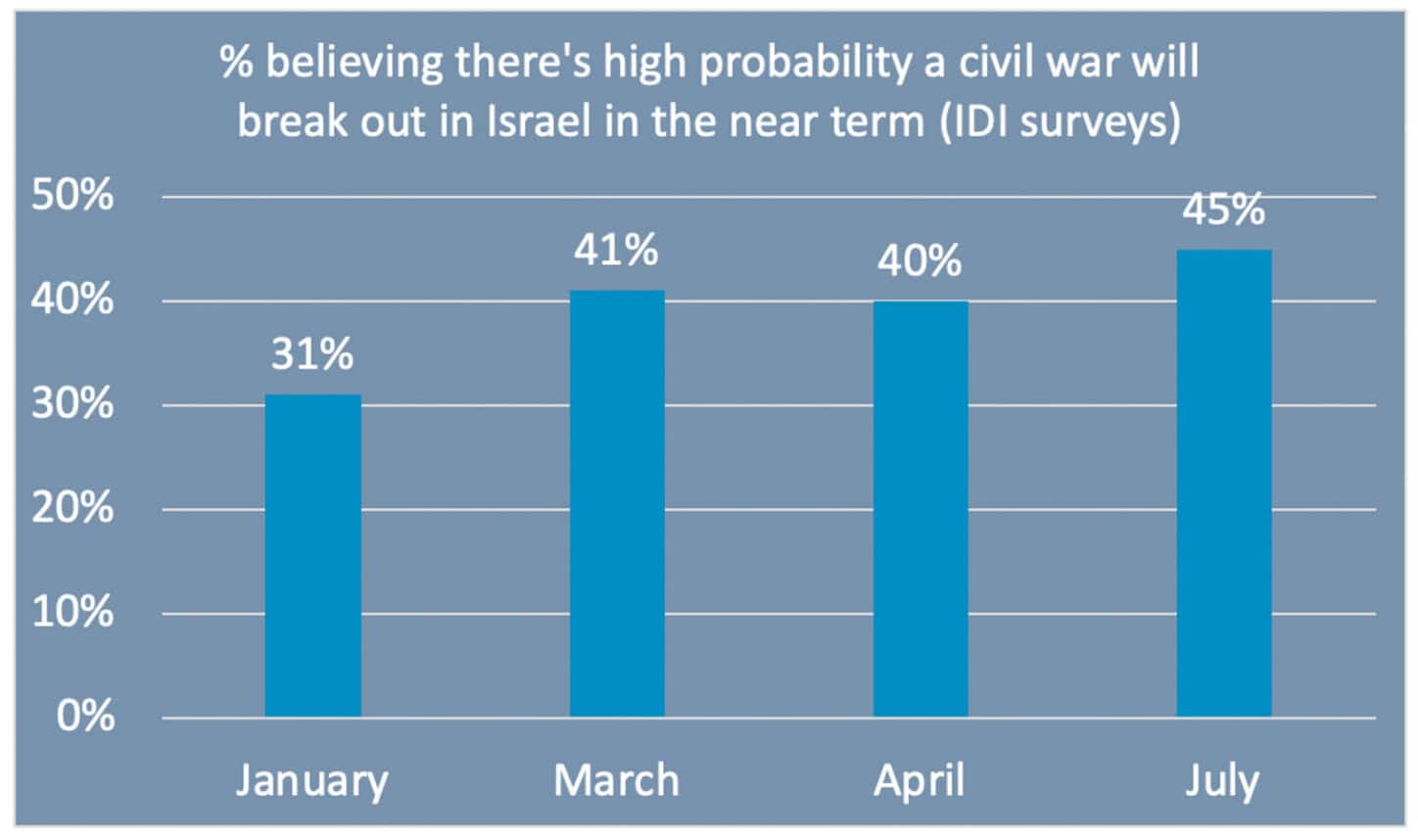
This logic, it turns out, does not hold in Israel. The government and the protest are facing each other, armed with what in civilian terms is equivalent to nuclear arrowheads (45% believe a civil war is likely in the near term), and give the impression that they intend to shoot. One side insists on destroying the reform initiative, even if the price is the state’s destruction. The other side insists on passing the reform, even if the price is the state’s destruction.
In his fascinating book “Israel in a Nuclear Middle East”, Jesse Ferris writes about MAD and its ability to ensure Israel’s existence in the event that Iran acquires nuclear weapons. “Is it possible to discourage a messianic leader motivated by a desire to realize redemption” from using nuclear weapons Ferris asks, and then continues: “The well-known Islamic scholar Bernard Lewis thought not. Regarding the Iranian leadership during the days of President Mahmoud Ahmadinejad, he said: “For people with such an [apocalyptic] worldview, mutual assured destruction is not a constraint but an incentive.” Yitzhak Shamir, former Prime Minister of Israel, also believed that in the Middle East, “it is impossible to maintain a balance of terror according to the American-Soviet formula.” The reason for this – Shamir thought – is that “it is impossible to trust the rationality of some of the Arab rulers.”
Looking at Israel this week one must ask: And what about Jewish rulers?
Something I wrote in Hebrew
Here’s what I wrote on the attempts to portray the Israeli left-right divide using American terms:
An attempt to portray the Israeli center-left with the terms used to describe a post-national radical from Berkeley is pathetic. The Israeli center-left is much more patriotic than any progressive group in any western country you might choose. It wraps itself in the national flag. It highlights its militarist combat past … There is no American style “conservatism” in Israel. The Israeli right is a strange mixture of a revolutionary spirit, a clerical attitude, a post-colonialist grumbling and a lot of populism. There is no “progressiveness” in Israel either, except on the fringes of the left. The protesters are bourgeois, somewhat conservative, patriotic, family-oriented.
A week’s numbers
This is what civil anxiety looks like.
A reader’s response:
Amy Hertzfeld says: “Shmuel, some of your recent columns … made me worry about the future of Israel”. My response: I am worried, and so should you.
Shmuel Rosner is senior political editor. For more analysis of Israeli and international politics, visit Rosner’s Domain at jewishjournal.com/rosnersdomain.
Avraham and Sarah lived in a tent that was open on all sides. Why? They wanted to communicate with the world that they were open to hosting guests and welcoming in everybody, even if they were strangers.
In the new picture book “How to Welcome an Alien” (Kalaniot Books), out on August 1, kids ages 4-7 can learn about the mitzvah of hachnasat orchim, of hosting guests, in a fun and whimsical way.
In the story, written by author Rebecca Klempner and illustrated by Shirley Waisman, a friendly alien family from outer space lands in the Abraham’s backyard (the family name is a nod, of course, to the Jewish patriarch). Dina, a child and the book’s main character, kindly welcomes the strange aliens into her home.
While Dina’s mom is a little skeptical, Dina reminds her: “It’s a mitzvah to give guests food and drink and a place to rest.” Dina and her parents give the aliens some food and drinks as well as a little time to settle down, and end up helping them repair their spaceship so they can get back home.
Klempner, who previously wrote three other children’s books, was inspired to write “How to Welcome an Alien” when she stumbled upon an interesting Hebrew translation.
“I noticed that ‘ger,’ the word used for ‘stranger,’ as in the mitzvah of welcoming a stranger, is occasionally translated as ‘alien,’ and my brain went wild with that,” she said.
“I noticed that ‘ger,’ the word used for ‘stranger,’ as in the mitzvah of welcoming a stranger, is occasionally translated as ‘alien,’ and my brain went wild with that.”
The author also decided she wanted to put out this book, “largely in response to anti-immigrant political messaging which pervaded media at the time I was writing it,” she said. “I became concerned, in particular, when I heard my fellow Jews make comments about immigrants, which seemed at odds [with] my understanding of Torah.”
When talking about the mitzvah of hachnassas orchim, Klempner brings up how Jews are supposed to be welcoming of all other kinds of “aliens,” including refugees, newcomers to the neighborhood and immigrants.
“My husband’s parents are both immigrants, and if others hadn’t welcomed them to this country, where would he be now?” she said. “In fact, three of his grandparents were already refugees before they reached their final homes. One was a political refugee on two separate occasions. According to the UNHCR, there were 32.5 million refugees last year, a higher number than at any point in history since the Second World War. This is not a problem we can relegate to the past.”
When Klempner first got married, she and her husband welcomed many different guests for Shabbat and holidays, not just for meals, but for overnight visits as well. When they had children, they cut back, and then continued to host family-only meals during COVID. However, post-COVID, they’re now welcoming people once again and hosting at least once a month.
“I enjoy hosting friends and family, but the mitzvah really becomes more meaningful when we invite people whose need for hospitality is greater, for example, they are visiting from out of town, they’ve been dealing with a family crisis that prevents them from preparing for Shabbat or a holiday or they aren’t someone who receives many invitations,” she said.
“How to Welcome an Alien” may have a silly premise, but on a deeper level, it teaches readers to always be hospitable and keep the tent open just like Abraham and Sarah did.
As Klempner said, “I want my young readers to view those around them, and themselves, with curiosity, kindness and the desire to give.”
Kylie Ora Lobell is the Community Editor of the Jewish Journal.
In late May, Jewish leaders and organizations across the United States welcomed the Biden administration’s long-awaited National Strategy to Counter Antisemitism. President Biden deserves credit for a strategy that breaks new ground in terms of its level of engagement and its whole-of-government and whole-of-society approach. The authors seem to feel the same way: The strategy reminds readers three times that it represents the most comprehensive and ambitious government effort to counter antisemitism in American history.
Regrettably, the strategy’s commendable goals and novel ideas (and lofty self-appraisal) come hand-in-hand with a hefty list of omissions, distortions and internal contradictions. The adoption of a strategy to counter antisemitism is an important gesture, but the strategy itself is a tendentious mess.
Who Are the Antisemites?
What emerges from the text is that the Biden administration is deeply committed to combating some kinds of antisemitism, but eager to ignore or even downplay others. Herein lies the strategy’s great missed opportunity. The president could have used the unmatched influence of the White House to send an unmistakable message that all types of antisemitism must be fought with equal vigor. Instead, the officials behind the strategy chose to double down on familiar partisan and ideological stances that focus on the antisemitism of rivals while glossing over the antisemitism of colleagues and allies.
The officials behind the strategy chose to double down on familiar partisan and ideological stances that focus on the antisemitism of rivals while glossing over the antisemitism of colleagues and allies.
President Biden himself sets the stage on the first page of his introductory letter to the strategy. After opening with a discussion of the venomous 2017 “Unite the Right” rally in Charlottesville, Virginia, he asserts the organizing principle of the entire document: “People who peddle these antisemitic conspiracy theories and fuel racial, ethnic, and religious hatred against Jews also target other communities — including Black and brown Americans; Asian Americans, Native Hawaiians, and Pacific Islanders; LGBTQI+ individuals; Muslim Americans; women and girls; and so many others.”
White nationalists, neo-Nazis and members of the “alt-right” at the “Unite the Right” rally August 12, 2017 in Charlottesville, Virginia. (Photo by Chip Somodevilla/Getty Images)
In analytic terms, one would say that this is a model with limited explanatory power. The president’s description is accurate when considering the antisemitism of right-wing white supremacists. But what does this understanding say about Islamist antisemitism? Or the antisemitic attacks carried out by Black Hebrew Israelites or other Black Americans? Where does the antisemitism of the extreme left fit in? At best, the strategy ignores these categories of antisemitism. At worst, it goes out of its way to obscure them.
The seizing of a rabbi and congregants as hostages in a Colleyville, Texas synagogue in 2022 provides a telling example. The hostage taker was an Islamist who demanded the release from prison of an al-Qaeda affiliate. The strategy, though, is unwilling to specify any antisemitic ideology other than white supremacy: “antisemitic conspiracy theories are often foundational to white supremacy as well as numerous other violent extremist ideologies. For example, in January 2022, an armed hostage-taker motivated by other violent notions terrorized the members of a synagogue in Colleyville, Texas.”
The strategy mentions Islamophobia more than 20 times, but Islamist antisemitism is nowhere to be found. Those who engage in antisemitic violence and claim to do so in the name of Islam are simply motivated by “other violent notions.” According to the White House, it appears, some antisemitisms must not be named.
The administration has produced a strategy for countering right-wing antisemitism. The endeavor is necessary, but insufficient.
The administration has produced a strategy for countering right-wing antisemitism. The endeavor is necessary, but insufficient.
What Is Antisemitism?
More fundamental than the question of who is guilty of antisemitism is the question of what antisemitism is in the first place. The strategy’s definition of antisemitism was the subject of considerable controversy in the weeks and months before the document was published, with various interested parties lobbying the administration to influence the outcome. The result is that the relevant section of the strategy trips over itself trying to please too many at once.
The authors begin by rightly pointing out the need for an unambiguous definition of antisemitism: “Without awareness of antisemitism and education about the threat it poses, Americans across society cannot identify and address antisemitism. If we cannot name, identify, and admit a problem, we cannot begin to solve it.”
The authors promptly ignore their own admonition. The United States, readers are told, “embraces” the definition unanimously adopted by the International Holocaust Remembrance Alliance (IHRA, of which the United States is a member), but also “welcomes and appreciates” a competing definition and “notes” yet others. In other words, the White House’s response to its own call for an unequivocal definition is a confounding example of equivocation.
The major Jewish organizations, most of which had lobbied for the IHRA definition, were perhaps too eager to declare victory and understandably concerned about maintaining good working relations with the White House. In their joint statement about the strategy, they declared that they “welcome the embrace” of the IHRA definition, but they did not embrace the “welcome” given to the other definition.
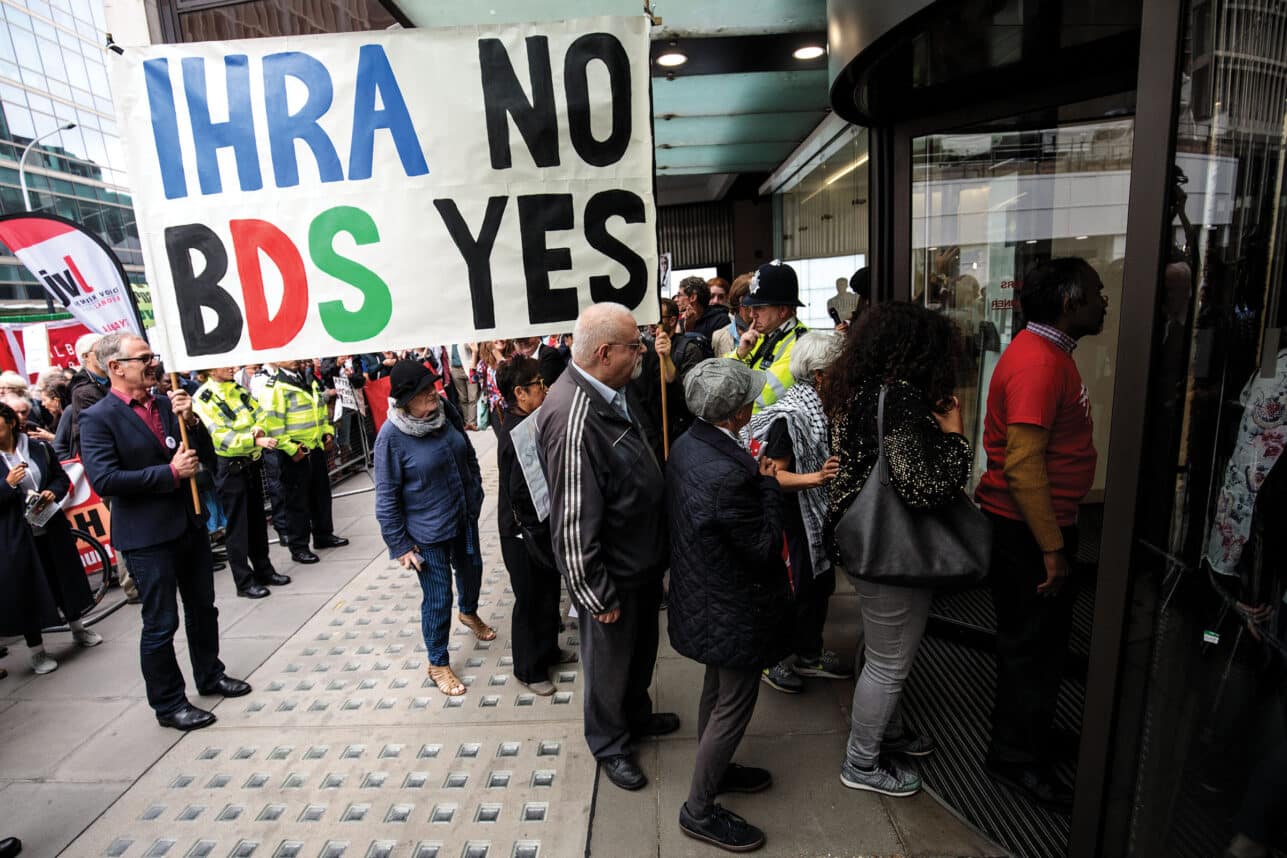
Protesters demonstrate outside a meeting of the National Executive of Britain’s Labour Party on September 4, 2018 in London, England. (Photo by Jack Taylor/Getty Images)
The strategy’s doublespeak surrounding the definition punctuates the text throughout and appears to reflect the pressure that has been put on the administration by progressives. The result is unwieldy. Thus, the strategy informs readers that “when Israel is singled out because of anti-Jewish hatred, that is antisemitism.” This is obviously, tautologically true. Anything done because of anti-Jewish hatred is antisemitism.
The IHRA definition and its accompanying examples explicitly allow for legitimate criticism of Israel. The reason the IHRA definition raises some progressive hackles is because it points out that the act of singling out Israel — that is, holding Israel to a double standard — is not legitimate criticism and is itself antisemitic. The strategy adds the qualification to its sentence about Israel and mentions the other definitions in an effort to placate those who insist on holding Israel to a double standard, but do not like being labeled antisemites.
The administration takes what could have been an authoritative statement with great moral power, and instead strips it of its meaning, while winking at those who see fit to treat the Jewish state differently from any other.
The administration takes what could have been an authoritative statement with great moral power, and instead strips it of its meaning, while winking at those who see fit to treat the Jewish state differently from any other.
Where Is the Antisemitism?
The White House gives itself a pass by limiting the geographic scope of the strategy to antisemitism within the United States. Doing so allows the administration to ignore three of the greatest sources of antisemitism in the world today, the Palestinian Authority, the United Nations and Iran, all of which the United States is trying to accommodate diplomatically, to fund directly or indirectly, or both.
Ten days before the publication of the strategy, Palestinian Authority President (and serial Holocaust denier) Mahmoud Abbas delivered an antisemitic speech at a United Nations event lamenting the “nakba,” the failure to defeat and destroy Israel in 1948. Among his outrageous remarks were a denial of Jewish ties to the Temple Mount in Jerusalem, a claim that the United States supported the establishment of Israel to expel American Jews, and a likening of statements made by Israeli officials to those of Nazi propagandist Joseph Goebbels. In a Security Council meeting the following week, the U.S. Ambassador to the UN, Linda Thomas-Greenfield, rejected Abbas’s hateful remarks, but went on to encourage other states to support the Palestinian Authority and help with its finances, which continue to be used to create economic incentives for the murder of Israelis.
In the weeks since then, the administration has announced new funding for the United Nations Relief and Works Agency, despite years of documented violent antisemitic content in its schools and the inclusion of Palestinian terrorist group members among its teaching faculty. The United States also announced that it is rejoining (and funding) the United Nations Educational, Scientific and Cultural Organization. UNESCO repeatedly has singled out Israel for condemnation and taken steps to deny the Jewish connection to the Land of Israel.
Meanwhile, the Biden administration reportedly is moving toward new understandings with Iran, which hosts a Holocaust cartoon contest, persecutes its own tiny Jewish minority and calls for the annihilation of the Jewish state while pursuing nuclear weapons capabilities. These understandings would give Iran access to around 20 billion dollars in sanctions relief and allow it to continue enriching uranium to a level that has no peaceful purpose. Iran is not mentioned in the strategy, even though the Islamic Republic and its terrorist proxies Hezbollah, Hamas and Palestinian Islamic Jihad have maimed and murdered many more Jews than American antisemites ever have, regardless of their political or ideological inclination.
The strategy’s exclusively domestic scope sidesteps the fact that the United States is helping fund the Palestinian Authority, the UN and Iran, all of which indisputably are engaged in overt acts of antisemitism according to the same IHRA definition that the strategy “embraces.”
The strategy’s exclusively domestic scope sidesteps the fact that the United States is helping fund the Palestinian Authority, the UN and Iran, all of which indisputably are engaged in overt acts of antisemitism according to the same IHRA definition that the strategy “embraces.”
What to Do about It?
The flip side of the strategy’s lumping antisemitism together with Islamophobia, anti-Black racism and other types of racial, religious, ethnic and other discrimination is its insistence on using the same tools to counter them all. For example, the strategy calls on “employers — including states, cities, K-12 schools, institutions of higher education, private companies, and nonprofits — to review their own diversity, equity, inclusion and accessibility (DEIA) programs to ensure full inclusion of antisemitism awareness and training as well as workplace religious accommodation requirements and best practices to prevent religious discrimination.”
This is the White House calling on the fox to guard the henhouse. DEIA programs, especially on campus, have been documented excluding Jews and not just ignoring antisemitism, but actively spreading antisemitic ideas and practices. The strategy mentions that “[o]n college campuses, Jewish students, educators, and administrators have been derided, ostracized, and sometimes discriminated against because of their actual or perceived views on Israel.” Left unsaid is that those guilty of deriding, ostracizing and discriminating against Jews are themselves students, educators and administrators, including those responsible for making and implementing DEIA policy.
In June 2021, President Biden signed an executive order establishing a DEIA initiative as part of his effort to “develop a Federal workforce that looks like America.” Creating a government, a student body or a judiciary that looks like America is a just and laudable goal when considering traditionally underrepresented parts of the population. But what does it mean for Jews? Should the participation of Jews be limited to around 2.4% in these institutions because that is what America looks like? Quotas for Jews were phased out when Americans fought for civil rights. Are quotas coming back, now that equality of opportunity is out and equity of outcomes is in?
If this sounds like hypothetical hyperbole, have a look at trends in the Ivy League, in professional and cultural organizations, and in politics. The DEIA approach informing the antisemitism strategy pretends that it is countering discrimination of all types, but in practice it simply is replacing some types of discrimination with others. For Jews contending with antisemitism, DEIA has proved to be part of the problem, not the solution.
Who Wrote the Strategy?
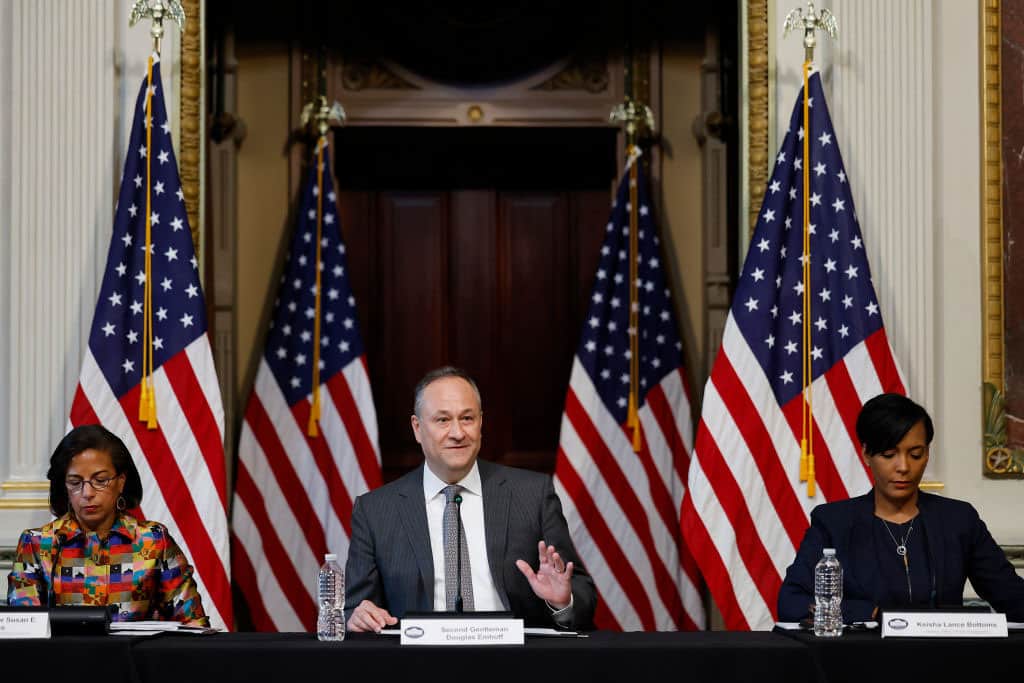
The two leads on the development of the strategy were Second Gentleman Douglas Emhoff and Susan Rice, who recently concluded her tenure as director of the Domestic Policy Council.
Second gentleman Douglas Emhoff (C) delivers remarks during a roundtable about the rise of antisemitism with White House Domestic Policy Advisor Susan Rice (L) and Senior Advisor to the President for Public Engagement Keisha Lance Bottoms on December 07, 2022 in Washington, DC. (Photo by Chip Somodevilla/Getty Images)
Undoubtedly, a long list of Jewish friends and colleagues can attest to Rice’s liberal values, her lifelong relationships with Jews and her “allyship.” She has spoken warmly before AIPAC and the ADL. Yet among Israeli decision-makers, Rice is known for her hostility and deceptiveness, making her a curious choice to take the lead in formulating the administration’s antisemitism strategy.
One wonders if Rice does not understand the scope and severity of the threats facing the Jewish people today or if she is inclined to dismiss those threats posed by anyone but her domestic political rivals. It is an open question regarding the extent to which her influence or the partisan tribalism in the White House (and Washington more broadly) explains many of the strategy’s shortcomings and blind spots.
What’s Next?
The strategy leaves American Jews and Jewish organizations having to strike an awkward balance of adopting, supplementing and dismissing its various elements. On the one hand, they and their allies will need to work to implement and entrench the strategy’s finer points. The strategy’s four pillars, including expanded awareness of antisemitism and appreciation of Jewish heritage, improving safety and security for Jewish communities, reversing the normalization of antisemitism and the building of cross-community solidarity, are all worthy goals.
On the other hand, they will have to fill in the strategy’s yawning gaps regarding the diverse sources of antisemitism, which remains a problem that crosses the political spectrum and religious and ethnic lines. Ignoring antisemitism’s varieties will not make them go away, and it risks providing them cover.
To counter antisemitism effectively they will need to propose alternative approaches that genuinely contribute to liberty and justice for all.
Perhaps most dauntingly, American Jews and their leaders will have to navigate the stormy waters of American identity politics. They need to reject clearly and unapologetically many of the fashionable ideas, policies and institutions that are supposed to address racism and other discrimination in the United States but which themselves are exacerbating the problem of American antisemitism. To counter antisemitism effectively they will need to propose alternative approaches that genuinely contribute to liberty and justice for all.
Jonathan Schachter is a senior fellow at Hudson Institute.