Thoughts on the Shabbat of Passover, 2023 (adapted from previous versions)
“Trying to be free from what?” I ask myself, in my yearly meditation on freedom.
Like a bird on the wire,
like a drunk in a midnight choir
I have tried in my way to be free.
These obscurely luminous words by Leonard Cohen express some deep, beloved and tortuous mystery – the mythical allure of drunkenness as a path to freedom. Being drunk to forget, to become numb, to find hilarity. I read somewhere that it takes at least four cups of wine to get started.
I love Cary Grant and Katharine Hepburn movies, such as George Cukor’s 1938 gem “Holiday.” Johnny (Cary Grant) and Julia (Doris Nolan) fall in love and want to get married. Johnny has worked enough for a while and plans a long holiday to find the meaning of life. Julia, who seeks a proper husband who will work in her father’s bank, is seeking stability. In the process of meeting Julia’s family (a family impoverished in spirit in direct proportion to its material plenty) Johnny meets Julia’s vivacious sister, Linda (Katharine Hepburn).
The condition laid down for Johnny to marry Julia is that he forget about the holiday. He must work in Julia’s father’s bank. Trade freedom for money. Buy his way into slavery. Linda is praying that Johnny does not succumb, that for once someone will not fall for the allure of lucre.
Julia implores Johnny for forget about freedom. It seems that Johnny will cave in to Julia’s suasions. Linda is disconsolate and considers getting drunk. She turns to her drunken brother, Ned (Lew Ayres) to find out what it is like. He tells her (this is my paraphrasing from the dialogue):
It’s grand to get good and drunk. It brings you to life. You begin to know all about it. You feel important. And then the game starts, a swell, exciting game. You think as clear as crystal, but every move, every sentence is a problem. That gets interesting. You get beat at the game, but that’s good. You don’t mind. You don’t mind anything. You sleep. In the end, you die.
(Screenplay by Donald Ogden Stewart and Sidney Buchanan, from the play by Philip Barry).
Linda and her brother Ned yearn to be free. Johnny, in his yearning to be free, finally decides not to walk into the spiritual prison that marriage to Julia would be. He gives it one last chance: he begs Julia to join him on his holiday to Europe. Julia turns him down. Linda finds out that Johnny is setting sail and instead of getting drunk, she plans to rush down to the docks and join Johnny. As she leaves the house, she begs Ned to join her. Ned tragically can’t do it.
Ned’s path to freedom is blocked by the drunken stupor, in which he feels free enough. Linda makes a break for it, and in the most touching moment of the movie, Linda says, “I’ll be back for you, Ned.”
Is that what the drunk in the midnight choir is bellowing about? He does not have the words to express the misery of ephemeral freedom through booze. As Ned says, “Every move, every sentence is a problem.” In Leonard’s song, the drunk needs the hymnal, he needs the church, he needs the choir to sing a song of redemption.
I think there is a rip in the fabric of the heart of every conscious person. The heart is ripped open by a hymn trying to escape from a dark chamber of forgotten prayers. We don’t know the words, we don’t know the music and we don’t know how to sing. But we know there is a song written about us and for us, we who imagine the drunk in the midnight choir, trying in our own way to be free.
In our midnight choir, we don’t only drink to remember freedom, we drink to loosen the chains that stop us from entering the chamber of forgotten prayers.
The freedom of the drunk is a metaphor for those trying to escape the torment of being trapped in the pain of existence. Even as the drunk drinks to numb the pain, he knows enough to stumble to the midnight choir. This drunk might never go to church in a sober state – too cynical, too shutdown. Julia, in the movie, is the sober cynic. Ned, we hope, will find his way to a midnight choir, as his first step to liberation. First, liberation from numbing the pain through substance or emotional addictions. Then, learn how to pick locks on shackles.
Johnny and Linda break the chains and head for the holiday, looking for a way to be free. I hope they find the meaning they are seeking. It won’t be as easy as getting on a boat.
We love this song about the midnight choir because we are each trying to sing a song that will open up our own way to be free.
I hope you find a song to sing this year, a new one, or an old one, or a forgotten one. I hope your Passover seders are fun and interesting, but no Passover seder that I know of is going to give you that song. It will only give you a cue to find the song. You’ll have to search for the song. Maybe the song is under the Afikoman.
There is a magic moment. You’ve earned the meal through some diligent – traditional or not – telling of the story. Then we have all the Passover songs. Then the song inside the song. We create our own midnight choir.
Who knows one? Who knows one song, one poem that will let the hymn out from the rip in the heart?
Who knows two? Who knows two lines, one couplet of one hymn that will break a lock like ringing a bell?
I know two lines that Bob Dylan wrote:
I see my light come shining, from the west unto the east
Any day now, any day now, I shall be released.
Who knows one? I don’t yet know one. So I join the midnight choir. Perhaps someone will teach me a song.
This week, we’re giving you a treat of one whole hour of just the Schmuckgirls! They discuss the continuation of engagement season and the start of wedding season. They also talk about the new Instagram verification, kosher hechsher drama, the holiness of the month of Nissan and debate how difficult it is to keep Passover. Libby and Marla also share how their own Jewish identity has grown since they first started the podcast. The girls go on to discuss immediate fireworks vs. a slow burn when dating, and how to know how long you should continue to date someone. They also talk about the lasting effects of the pandemic and people’s abilities to be social digitally vs. IRL. Marla and Libby go on to debate how difficult a relationship should be before recognizing that maybe this person isn’t for you, the importance of your partner being in your life but not being your life and of how to avoid being jealous of your friends.
Thoughts on the Shabbat of Passover, 2023 (adapted from previous versions)
“Trying to be free from what?” I ask myself, in my yearly meditation on freedom.
Like a bird on the wire, like a drunk in a midnight choir I have tried in my way to be free.
These obscurely luminous words by Leonard Cohen express some deep, beloved and tortuous mystery – the mythical allure of drunkenness as a path to freedom. Being drunk to forget, to become numb, to find hilarity. I read somewhere that it takes at least four cups of wine to get started.
I love Cary Grant and Katharine Hepburn movies, such as George Cukor’s 1938 gem “Holiday.” Johnny (Cary Grant) and Julia (Doris Nolan) fall in love and want to get married. Johnny has worked enough for a while and plans a long holiday to find the meaning of life. Julia, who seeks a proper husband who will work in her father’s bank, is seeking stability. In the process of meeting Julia’s family (a family impoverished in spirit in direct proportion to its material plenty) Johnny meets Julia’s vivacious sister, Linda (Katharine Hepburn).
The condition laid down for Johnny to marry Julia is that he forget about the holiday. He must work in Julia’s father’s bank. Trade freedom for money. Buy his way into slavery. Linda is praying that Johnny does not succumb, that for once someone will not fall for the allure of lucre.
Julia implores Johnny for forget about freedom. It seems that Johnny will cave in to Julia’s persuasions. Linda is disconsolate and considers getting drunk. She turns to her drunken brother, Ned (Lew Ayres) to find out what it is like. He tells her (this is my paraphrasing from the dialogue):
It’s grand to get good and drunk. It brings you to life. You begin to know all about it. You feel important. And then the game starts, a swell, exciting game. You think as clear as crystal, but every move, every sentence is a problem. That gets interesting. You get beat at the game, but that’s good. You don’t mind. You don’t mind anything. You sleep. In the end, you die.(Screenplay by Donald Ogden Stewart and Sidney Buchanan, from the play by Philip Barry).
Linda and her brother Ned yearn to be free. Johnny, in his yearning to be free, finally decides not to walk into the spiritual prison that marriage to Julia would be. He gives it one last chance: he begs Julia to join him on his holiday to Europe. Julia turns him down. Linda finds out that Johnny is setting sail and instead of getting drunk, she plans to rush down to the docks and join Johnny. As she leaves the house, she begs Ned to join her. Ned tragically can’t do it.
Ned’s path to freedom is blocked by the drunken stupor, in which he feels free enough. Linda makes a break for it, and in the most touching moment of the movie, Linda says, “I’ll be back for you, Ned.”
Is that what the drunk in the midnight choir is bellowing about? He does not have the words to express the misery of ephemeral freedom through booze. As Ned says, “Every move, every sentence is a problem.” In Leonard’s song, the drunk needs the hymnal, he needs the church, he needs the choir to sing a song of redemption.
I think there is a rip in the fabric of the heart of every conscious person. The heart is ripped open by a hymn trying to escape from a dark chamber of forgotten prayers. We don’t know the words, we don’t know the music and we don’t know how to sing. But we know there is a song written about us and for us, we who imagine the drunk in the midnight choir, trying in our own way to be free.
In our midnight choir, we don’t only drink to remember freedom, we drink to loosen the chains that stop us from entering the chamber of forgotten prayers.
The freedom of the drunk is a metaphor for those trying to escape the torment of being trapped in the pain of existence. Even as the drunk drinks to numb the pain, he knows enough to stumble to the midnight choir. This drunk might never go to church in a sober state – too cynical, too shutdown. Julia, in the movie, is the sober cynic. Ned, we hope, will find his way to a midnight choir, as his first step to liberation. First, liberation from numbing the pain through substance or emotional addictions. Then, learn how to pick locks on shackles.
Johnny and Linda break the chains and head for the holiday, looking for a way to be free. I hope they find the meaning they are seeking. It won’t be as easy as getting on a boat.
We love this song about the midnight choir because we are each trying to sing a song that will open up our own way to be free.
I hope you find a song to sing this year, a new one, or an old one, or a forgotten one. I hope your Passover seders are fun and interesting, but no Passover seder that I know of is going to give you that song. It will only give you a cue to find the song. You’ll have to search for the song. Maybe the song is under the Afikoman.
There is a magic moment. You’ve earned the meal through some diligent – traditional or not – telling of the story. Then we have all the Passover songs. Then the song inside the song. We create our own midnight choir.
Who knows one? Who knows one song, one poem that will let the hymn out from the rip in the heart?
Who knows two? Who knows two lines, one couplet of one hymn that will break a lock like ringing a bell?
I know two lines that Bob Dylan wrote:
I see my light come shining, from the west unto the east Any day now, any day now, I shall be released.
Who knows one? I don’t yet know one. So I join the midnight choir. Perhaps someone will teach me a song.
StandWithUs announced on April 4 that they have been informed by the Department of Education’s Office of Civil Rights (OCR) that they will be investigating their complaint against George Washington University (GWU).
The complaint, filed in January, alleged that the university failed to take proper action against Assistant Professor of Psychology Lara Sheehi, who is accused in the complaint of targeting and invalidating the identities of Jewish Israeli students in her class and then retaliating against them when they complained to university administrators. Sheehi defended herself in a lengthy CounterPunch post the following month, arguing that StandWithUs “willfully misrepresents facts” in their complaint and were targeting a pro-Palestinian Arab woman.
More recently, GWU President Mark S. Wrighton announced on March 27 that a third-party investigation conducted by the law firm Crowell & Moring “found no evidence substantiating the allegations of discriminatory and retaliatory conduct alleged in the complaint,” according to a Summary of Findings from the investigation. “Many of the statements the complaint alleges were made by Dr. Sheehi were, according to those who heard them, either inaccurate or taken out of context and misrepresented.” The summary also states that StandWithUs “and a few of the students in the class, advocated for an expansive view of the definition of antisemitism, which, if accepted in the university environment, could infringe on free speech principles and academic freedom.” StandWithUs stood by their complaint and urged GWU to release the full investigation report rather than simply a summary.
“While professors may enjoy the right to spew wrongheaded and even hateful ideologies in some circumstances, they do not have the right to subject students to discriminatory conduct based on those views,” StandWithUs CEO and Co-Founder Roz Rothstein said in a statement. “University administrators have an affirmative obligation to respond adequately when students report allegations of such misconduct. We are pleased that OCR has recognized the need to investigate these allegations in a thorough and unbiased manner.”
“We are hopeful that, rather than continuing to circle the wagons in an effort to protect its own reputation, GW will finally be required to join the ranks of those administrations who recognize the need to take real, meaningful steps to support Jewish students and combat anti-Jewish bigotry on campus in its many forms,” StandWithUs Center for Combating Antisemitism Director Carly Gammill said in a statement.
A university spokesperson said in a statement to the Journal, “The university is in receipt of the request for information from the U.S. Department of Education related to the Title VI complaint from StandWithUs. The university will fully participate in the department’s inquiry.”
From the moment on Jan. 4 when Justice Minister Yariv Levin introduced his plan to overhaul Israel’s judicial system, the controversy was not over whether reforms were needed (they are), but over whether Levin went too far.
Well, this just in: The architect of the judicial overhaul himself has admitted that it went too far.
In an interview with Channel 14 two weeks ago that came online Monday, Levin admitted that criticism of a key part of his plan was “genuine.” Why? Because, as he says, “in a system in which a coalition majority can choose an unlimited number of justices, we’ll find ourselves in a situation in which a coalition, which in any case controls the government and the Knesset, would also take control over the Supreme Court of Justice within the space of a single term of office — bringing about a situation in which all three branches of government become one.”
In plain talk, Levin describes exactly what critics complained about from the start– the overhaul was an undemocratic power grab that took complete control of the High Court and hence all three branches of the government.
How dangerous was the power grab? Levin acknowledged that it “could ultimately cause a constitutional crisis…and cannot be allowed in a democratic state.”
What could have triggered such astonishing candor from a politician? Maybe Levin felt guilty that his overhaul caused such havoc in the country and was looking for some sympathy. Maybe he wanted to hype some late minor amendments he made to his plan. But as David Horovitz writes in Times Of Israel, even under the amended legislation the coalition “still has heavy influence over the appointments of any further justices in each government term… still gets to choose the Supreme Court president, and thus to determine the composition of High Court panels, and still has full control over the appointments of judges to the lower courts, meaning that all judges in the system know that they answer to political masters.”
In other words, the overhaul is still a blatant power grab. But the story gets worse. Levin’s original bill was actually approved by the Knesset in its first reading on February 21, more than 6 weeks after weekly protests had broken out throughout Israel. Who could have imagined that while hundreds of thousands of Israelis demonstrated week after week, the man behind the plan agreed with them?
And what did the coalition do during these fateful weeks? Instead of pausing to reassess, they doubled down and attacked the protestors, maligning them as “anarchists” who just wanted to take the government down, or Nazis who were destroying democracy, or sore losers who couldn’t tolerate losing, or secular Israelis going against the religious and Mizrahi working class, or any other insult that would change the subject from their blunder.
As for Bibi, even though he knew the overhaul would undermine democracy, he shamelessly tried to claim the opposite, which further damaged his credibility.
By attacking the legitimacy of the protests from the beginning, Bibi and the pro-overhaul forces only served to poison the atmosphere, both in Israel and the U.S. Instead of a people arguing and debating a fundamental constitutional issue, we became two armies fighting one another.
Because Bibi allowed the civil strife to escalate for so long, it has now taken on a life of its own and exacerbated religious and ethnic fissures in Israeli society.
Because Bibi allowed the civil strife to escalate for so long, it now has taken on a life of its own and exacerbated religious and ethnic fissures in Israeli society. The Passover pause on the overhaul, which few Israelis believe is real, was too little too late. Trust in Bibi has frayed. Most Israelis understand that staying on the throne is Bibi’s #1 priority, and if that means appeasing his extremist partners, so be it.
None of this means we should let Bibi off the hook. Even if many have lost faith in him, we must insist that he take responsibility for his divided nation. As the leader of the country and a man who doesn’t shrink from pressure, healing his nation must come before everything, including his coalition.
As the leader of the country and a man who doesn’t shrink from pressure, healing his nation must come before everything, even his coalition.
When he recites the Haggadah Wednesday night and gets to the part about how each generation sees enemies trying to destroy us, he ought to remember that our Sages didn’t mean fellow Jews.
One encouraged to talk at great length will, eventually, reveal himself inconsistent, foolish, or mistaken. This is the operation of both the celebrity interview and a criminal interrogation.
The criminal suspect is, of course, aware of the absolute necessity of dissimulation. This very imperative, eventually, leads him to self-indictment. He devotes all of his energies to concealment and misdirection, but the skilled interrogator encourages him to continue, as the suspect’s extended defense will eventually elaborate into inconsistencies, and contradictions. His energy, and, so, his ability to improvise, is progressively compromised by the imperative of concealment. The smart money is on the side of the interrogator.
This is also the case with the celebrity interviewee.
The off-the-cuff repartee on the old, late night talk show panels was largely scripted. The guests were there to flog a project, a cause, or a career; they showed up with their agenda (generally simple self-promotion) and the host’s gag writers punched it up, and it was presented as “chat.”
Today’s daytime panel shows have replaced the gossip over the back fence of a simpler time. Women hanging up their washing once enjoyed the camaraderie and the permitted light viciousness of gossip. Who does not?
This, however, took place in the backyard, and was not broadcast to the world. Today’s universal audience imposes on its entertainers miming backyard gossip, the need for stringent control: one wrong word, unacceptable sentiment, or, indeed reticence at endorsement of a prevailing opinion, could lead to outrage, dismissal, and blacklisting. The need for control imposes upon the chattering celebrities a unanimity, relieved only by the occasional confected disagreement on minor points of doctrine.
But self-control is onerous, and even Rumplestiltskin had to eventually proclaim his duplicity to the world. This was not actually a shout of triumph, but a release from the burden of self-control. As are the various unfortunate ebullitions of antisemitism among the current gossipers en titre. These eruptions are like those of the cornered criminal – out of excuses he will curse the judicial system, or the world that made him.
Celebrities maddened by the need for pretense lash out.
Indicting the Jews is the equivalent of kicking the cat, screaming at the secretary, or, in effect, wife-beating: it is identifying the cause of an unavoidable discomfort as one less powerful than oneself.
Here the Jew-hater reveals himself through his inconsistency.For he cannot simultaneously assert that Jews Rule the World, and demonstrate he finds us an acceptably passive object for attack.
A zissen Pesach.
David Mamet is an award-winning author and playwright.
When I wake up in the morning and decide that I am conscious enough to actually rise from my bed, I say twelve words: Modah ani lefanecha, Melech chai v’kayam, shechechzarta bi nishmati. B’chemla raba emunatecha. Which means: “I give thanks before you, living and eternal King, who has restored my soul within me, with compassion. Great is your faithfulness.”
Making this affirmation each morning sets a positive tone to my day. As Rabbi Efrem Goldberg explains in his “6-Minute Siddur Snippets” podcasts, “Before our feet hit the floor, we are Modeh, we are thankful. My soul has been restored; I’m alive.” No matter what yesterday looked like, God has given us a new day. Grammatically, you’d expect the statement would likely be Ani Modeh, “but the first word out of our mouths cannot be ‘I,’” Rabbi Goldberg says.
So why do we even need this? Because as Jews who always live under precarious circumstances, we should not go even seconds into our new day without expressing gratitude.
Modeh Ani(Modah is the feminine form) isn’t a prayer or blessing, which would have God’s name in it. We don’t make blessings until we are out of bed and have washed our hands. And most of the words in Modeh Ani will be repeated in the morning blessing that also thanks God for restoring our souls after sleep. So why do we even need this? Because as Jews who always live under precarious circumstances, we should not go even seconds into our new day without expressing gratitude. This isn’t my idea; it was the thinking of Rabbi Moshe ben Yehudah Machir of Sfat, who introduced Modeh Ani in the 16th century. Saying Modeh Ani also feels more personal. It not only means “thank” but also “admit” and “acknowledge.” For me, it is an exceptionally powerful and empowering announcement that frames my day with the gratitude and humility I need.
The dozen words of Modeh Ani contain several layers of depth. For example, in the phrase “who has restored my soul with compassion,” commentators explain that the word for compassion, chemla, is the same word the Torah uses to describe the feelings Pharoah’s daughter, Batya, felt when she saw Moshe floating in that basket. This suggests that chemla refers to a deep perception of a person’s distinctive value, the awareness that something precious may be lost if that person weren’t there. Modeh Ani reminds us that God sees and appreciates our worth and value as individuals.
I have also embraced the interpretation that the final words, raba emunasecha, “great is your faithfulness,” refers to God’s faithfulness inme. This dovetails beautifully with the idea of chemla, that recognition that we are each “artisanal” creations. If God has faith in me, who am I to argue? If God has given me a new day, I have a purpose and a mission to perform, something only I can do. This is also empowering.
I don’t always wake up feeling great, and you may not either. Sometimes I wake up with a pounding headache. Sometimes I’ve only slept minimally and fitfully; it will take an awful lot of high-octane coffee before I am good for anything at all. Yet gratitude is a decision, and God helps to lead us on the path we choose to go.
A few weeks ago I woke up from a dreadful dream in which something had happened to my husband. I was frightened and wanted to jump right out of bed and go see him in the kitchen, where I figured he’d be at that time, but my instinct was to first say Modah Ani. I didn’t even rush the words, and I felt calmer saying them. My bad dream was just a dream, but neverthelessI then dashed out of our room to find him, even though I must have looked like a bad dream myself, with my bedhead hair and pale, fearful expression. Until that morning I hadn’t realized that in addition to framing my day with the mindset of gratitude — no matter what — that saying Modah Ani could also ground me from a place of fear.
So, if you’d like to jumpstart your day with a small but powerful dose of gratitude, positivity and self-worth, saying “Modeh Ani” is a great place to start.
Judy Gruen’s latest book is “The Skeptic and the Rabbi: Falling in Love With Faith.”
Even while Israel continues to be roiled by their current internal political disputes, the country’s international challenges are not going away. Potential crises from Iran, Syria and other regional antagonists still loom on the near horizon, and the Palestinian menace is omnipresent as well. But there are broader and more sweeping changes coming too, which are likely to create a fundamentally different regional landscape for the Netanyahu government and its successors to navigate.
The Chinese era of Middle Eastern geopolitics has begun.
Over the course of Israel’s 75 years since independence, the Jewish state has navigated two distinct eras of global superpower involvement. For roughly Israel’s first forty years of existence, the Middle East was viewed by both the United State and the Soviet Union as one of many staging grounds for Cold War confrontations. The Soviets’ initial support for Israel was based on the belief that a socialist state in a key strategic location could be a valuable asset, but the USSR quickly switched sides and became a strong supporter of Israel’s Arab antagonists. After some periods of equivocation in the 1950s and ’60s, the U.S. ultimately emerged as Israel’s strongest diplomatic and military ally.
The Soviet/Arab and American/Israel faceoff continued until the fall of the Berlin wall in 1989, when the U.S.S.R’s demise created a unipolar world in which the United States became the planet’s only true superpower. But the U.S. has never been able to gain sufficient credibility in the Arab world to act as an effective convening influence. So while there was not another country of similar size and strength to serve as a counterweight to the American presence in the Middle East, progress toward peace during these years was uneven at best.
We have now entered a new era of global power politics, as the People’s Republic of China has emerged as a counterbalance to the Western alliance.
But we have now entered a new era of global power politics, as the People’s Republic of China has emerged as a counterbalance to the Western alliance. President Xi Jinping’s recent trip to Russia was carefully designed to show a world audience that China was much more capable than the United States of bringing peace to Ukraine. And Beijing’s role in brokering the diplomatic agreement between Saudi Arabia and Iran last month signals the Chinese interest in becoming a key player in this region too.
The Middle East is a neighborhood where outside intervention from global powers has rarely succeeded. Until now, China has kept a safe distance from the region’s treacherous geopolitics. President Biden’s advisors have minimized the import of the role that China played in these negotiations, pointing out that the Saudis and Iranians had already been talking for some time and that Chinese diplomats only entered the conversations in their final stages. But more important than the size or impact of China’s presence in these discussions is the fact that Beijing has worked so hard to take credit. By positioning themselves as a peacemaker in a part of the world where America’s successes are now a distant memory, Beijing has obviously decided that a public presence in the Middle East is to their benefit.
Unlike the Soviet Union’s unabashed support for Israel’s Arab foes, China does not appear to be interested in taking sides. (In fact, the last two U.S. presidents have quietly warned Israel about getting too close to the Chinese.) There has not been a time in modern history when the world’s two superpowers have both declared an interest in the region without lining up on opposite sides. China and the U.S are motivated by very different interests.But they both want to maintain some level of economic and security-based stability in this part of the world, even if only to serve their own purposes.
China is certainly no friend of the United States, and the competition between the two countries is growing more intense – and frequently belligerent — every day. But there has never been a time in modern history in which both of the world’s most dominant nations have overlapping goals in the Middle East. That could potentially create an opportunity for a diplomatic breakthrough — or make the region even more dangerous than it is now.
Dan Schnur is a Professor at the University of California – Berkeley, USC and Pepperdine. Join Dan for his weekly webinar “Politics in the Time of Coronavirus” (www.lawac.org) on Tuesdays at 5 PM.
In contemplating gratitude, author Eckhart Tolle wrote, “Acknowledging the good that you already have in your life is the foundation for all abundance.” From time to time, we read true-life stories that recount the pain of others and are left feeling sad, anxious or hopeless. But rare is the telling of a story that leaves us feeling wholly compassionate for the pain someone has endured, while infusing us with a flood of renewed gratitude (and even awe) for our own abundance. In his inspirational novel, “The Lip Reader,” Michael Thal enables us to experience the nexus of deep compassion and wide-eyed gratitude through the journey of a woman who ultimately frees herself from the emotional burdens of her physical limitations.
“The Lip Reader” tells the story of Zhila Shirazi, an Iranian Jew who, at the age of three, loses hearing in both of her ears as a result of meningitis. Readers soon learn that for Zhila and millions of others worldwide, deafness is often treated as a miserable liability. “In my country of Iran, a disability is a curse,” Zhila says early in the novel. She adds, “People with disabilities in mid-20th century Iran were considered tragic and pitiful. Those afflicted were seen as unfit or even feeble-minded and incapable of contributing to society. Their worth was only valued as entertainment in a circus sideshow or as objects of scorn. Many disabled individuals were forced to undergo sterilization so as not to pass disabling genes to their offspring.”
Zhila struggles with deafness her whole life, but always strives to make peace with her disability. The book’s themes of escaping the metaphoric prison of society’s harsh confines, as well as peace with oneself as the ultimate emblem of freedom, is especially inspiring during Passover.
In real life, Zhila Shirazi (a fictional name) was Thal’s beloved partner of 16 years, a Tehran-born Jewish woman named Jila whom he met in 1999.
Thal writes in the first person as Zhila, an impressive feat given that, as an Ashkenazi man, he manages to capture the voice of an Iranian Jewish woman with nuance and authenticity. But this achievement is rooted in experience: In real life, Zhila Shirazi (a fictional name) was Thal’s beloved partner of 16 years, a Tehran-born Jewish woman named Jila whom he met in 1999. In 2010, Jila was diagnosed with colon cancer. She passed away in 2015 at age 65, leaving Thal broken with heartache.
To help cope with his grief, Thal decided to write Jila’s story, a process that took four years and the help of Azin David and Dr. Juliet Hananian, both Iranian American Jews who helped guide Thal’s research. In writing “The Lip Reader,” Thal freed himself from some of the overwhelming grief that threatened to shackle him to despair for perpetuity. “I was prepared to tell Jila’s story, the story she told me,” Thal told the Journal in an email interview. “A year after Jila died, I met my in-laws at the cemetery for the unveiling of her headstone. I had spent the past year crying, depressed and missing my Jila terribly. I thought I could bring her back if I wrote her story. I thought using her voice would be the best way to go about doing that. It was the hardest book I ever wrote.”
A former Glendale Unified School District teacher, Thal awoke one morning at age 44 with severe bilateral sensoneural hearing loss (doctors diagnosed it as an overnight hearing loss due to a virus). His near deafness forced him to leave his tenured position as a sixth-grade teacher in Glendale and put pen to paper. Thal has written six books, including “Goodbye Tchaikovsky,” and authored over 80 articles. Born in Oceanside, New York, he studied history at University of Buffalo and completed his graduate work in Elementary Education at Washington University, St. Louis. Thal moved to L.A. in 1973.
During their time together, Jila told Thal her story in American Sign Language, the language the couple used to communicate with one another.
During their time together, Jila told Thal her story in American Sign Language, the language the couple used to communicate with one another. Set in Iran (beginning in the 1960s) and then the United States, “The Lip Reader” is a humbling series of stories about Zhila’s early life, the near-death dangers of living in post-revolutionary Iran and the incredible difficulty of immigrating to the U.S. and starting life anew. Some of the stories are true, while others are fictionalized.
In the book, which won the 2022 eLit Award for best inspirational novel, Zhila describes her desperate childhood wish to be tested and fitted for a pair of hearing aids. An intelligent and resourceful little girl, Zhila reads lips, but is unable to understand her teacher when the woman turns her back to write on the chalkboard.
Incredibly, Zhila faces a problem that makes her deafness even more painful: At her family’s insistence, she is forced to keep her disability a secret from her teachers, friends and even her relatives. As a result, her unknowing teacher physically and verbally abuses Zhila in class, believing she is deliberately not listening to instruction. The teacher, Mrs. Gaidi (another fictional name) stabs Zhila in her head with a pencil and shouts, “That should wake you up, you stupid Jew, now get out of my class and don’t come back until you learn respect.”
Her parents, Zhila explains, wanted to keep her deafness a secret because “they feared ridicule from the community for their inability to sire healthy, normal children,” and sadly, hearing aids, they surmised, “would be stark evidence of my inferiority.” When Zhila finally realizes her dream of being tested for hearing aids, she’s devastated to learn that the hearing loss in her right ear is too severe to be treated with such a device.
Again, readers can’t help but be moved by Thal’s heart-wrenching descriptions of a little girl’s wish for one of the most seemingly mundane, yet extraordinary senses that many of us take for granted: our hearing. Both Jila and Thal were born with hearing but lost this precious sense due to sudden illness. Their stories are a powerful reminder of the fragility of our own abundance.
When Zhila’s mother, Sara, is unable to buy expensive hearing aids, the child responds, “I will get a job! I will help pay for it!” When Sara still refuses, Zhila confronts her in the street with a desperate plea: “Maamaan! [“mother” in Persian] I want to hear music and laughter. I hate being so different. You do not want people to know! You are afraid they will gossip that your daughter is defective. God forbid they see a hearing aid and realize I am deaf!”
If living as a deaf girl and as a Jew in Iran weren’t difficult enough, the Islamic Revolution renders life wholly intolerable for Zhila and her family. One day, her father, Solomon, a pharmacist in Iran, is suddenly arrested and dragged away to the city’s notorious Evin Prison. The frantic family fears Solomon will be killed, but Zhila’s extraordinary intervention saves her father’s life. Still, the family is horrified when Solomon returns home badly bruised, traumatized from torture while in prison, and blind in both eyes.
According to Thal, this is based on a true story; Jila’s father was arrested, tortured, nearly killed and blinded by prison guards in post-revolutionary Iran. Amid such pain, the family’s survival is incredible. In fact, the stories of the 850,000 Jews who escaped or were forced to leave Arab and Muslim countries in the 20th century is one of the most powerful links in the millennia-long chain between the ancient Israelites’ exodus from Egypt and the mass exodus of Jews from inhospitable countries in the last 100 years.
The setback involving hearing aids nevertheless pushed Zhila to become a uniquely skilled lip reader. “Jila could lip read English as well as Farsi,” said Thal. “Most deaf people aren’t very good at lip-reading. They get about 30-40% of a conversation through their lip-reading skills. Jila got about 60%.”
The heartbreaking challenges of Zhila’s life only increase, as readers learn of the brutal discrimination she and tens of thousands of Iranian Jews faced even before the 1979 revolution that turned the country into a fanatic theocracy.
Zhila survives many painful hardships, but perhaps her greatest achievement is a quiet and elegant embrace of her deafness — a self-liberation that allows her to eventually experience the pleasures of life.
Zhila survives many painful hardships, but perhaps her greatest achievement is a quiet and elegant embrace of her deafness — a self-liberation that allows her to eventually experience the pleasures of life. Surrounded by many who seem to view her as deficient, Zhila manages to make her disability remarkably smaller. But her journey to embracing her lack of hearing is rooted in painful honesty. At one point, when discussing marriage, Zhila even tells her mother, “You think I will never find a good man because I am deaf.”
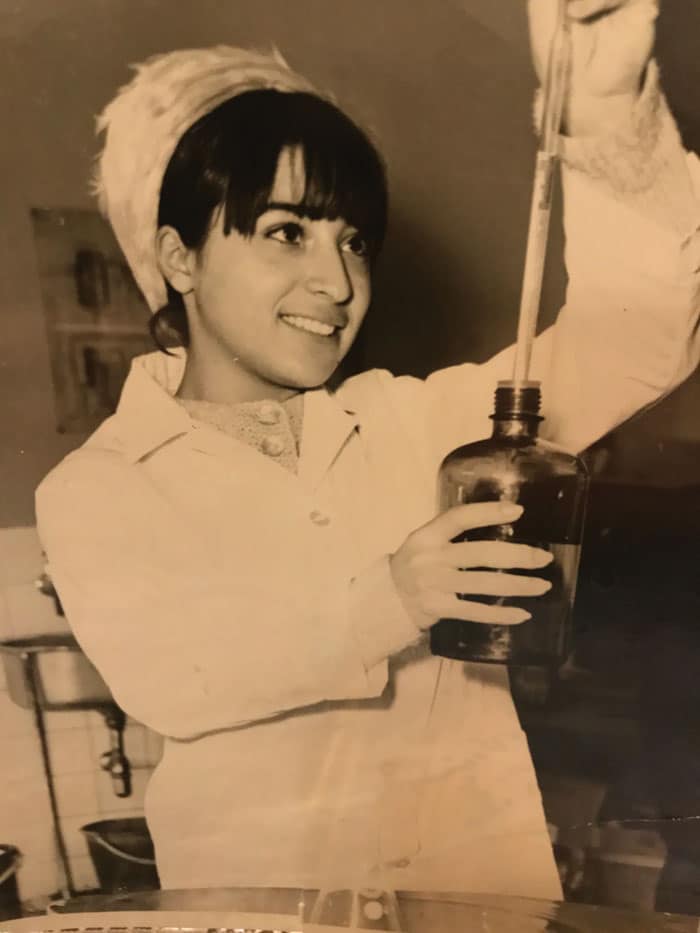
Zhila in college Photo from michaelthal.com
Inevitably, she does find a good man. After decades of hardship, Zhila finally immigrates to the U.S., where she meets the fictional Mickey, a Jewish divorcé who lost his hearing later in life and who falls in love with Zhila’s beauty, strength and resilience. Naturally, the character is based on Thal himself. When asked if he had difficulty remaining objective in writing about Mickey, Thal responded, “I didn’t have a hard time being objective; Jila had a few complaints about me, and I capitalized on them.”
Thal repeatedly asked Jila to marry him, but she declined, citing financial concerns. In her youth, she was struck by a car and suffered lifelong medical problems and back pain. In the novel, Thal captures the depth of the accident when Zhila tells readers, “These are the hazards of deafness. I live in a world of constant, watchful action. I must be observant because I cannot hear the sounds of danger.”
Thal knew that if Jila married him, she would lose her Medicaid health insurance. But during a trip to Hawaii to visit Jila’s childhood friend, the couple learned that ancient Hawaiians were not married by ceremony; many were married by promising to love and respect each other. Jila and Thal made this promise atop a serene Hawaiian mountaintop; to each other, they were husband and wife.
As the writer of Jila’s story, Thal maintains enough distance to also share some of her family secrets, though with enough changes to avoid disrespecting Jila’s living family members. For readers, it’s a satisfying decision, given the novel’s profound warnings about the burdens of maintaining secrets and the unique freedom that arrives with telling the truth about oneself. When Zhila is finally ready to tell others of her deafness, she does so with a sense of peace and confident elegance.
Jila’s story is also proof that redemption doesn’t occur overnight for those who arrive seeking freedom in America. Thal’s descriptions of the remarkable hardships Zhila and her family members endure when they resettle in Los Angeles, particularly by having to begin careers over again, are enough to make most readers appreciate how hard Iranian Americans and other immigrants have worked to start new lives in this country. It’s my hope that the book inspires particular appreciation for the Iranian Jewish experience in Southern California, home to the largest such diaspora community in the country.
As for Thal, he finds tremendous meaning in keeping Jila’s story alive, staying connected with his children (from a previous marriage) and through his involvement with Temple Beth Solomon (TBS), the world’s first synagogue for the deaf, based in Granada Hills. “My exposure to TBS has introduced me to other deaf people,” said Thal. “When Jila was alive, I didn’t need to meet other deaf people. Jila filled that need. After she died, I felt so alone.”
In the novel, Thal recounts the beginning and end of Jila’s cancer with profound honesty, though he admits, “writing about her illness was difficult. It was so hard to watch a vibrant, beautiful woman deteriorate. But through it all, she never complained. When she had the strength, she’d do what she loved to do most of all, help others.”
“The Lip Reader” proves that personal redemption is ultimately derived from within, and that retelling the stories of those whom we have lost is one of the greatest acts of love. Despite having witnessed her painful physical deterioration, Thal prefers to remember his beloved Jila’s most enduring traits: “She was sweet, kind, loving and she gave the best hugs,” he said. “Jila meant everything to me. Her sister used to say, ‘Jila and Michael were joined at the hip.’ She was right, and I’m still suffering from the unwanted amputation.”
“The Lip Reader” is available in trade paperback, hardcover, and digital, and can be purchased on Amazon, Barnes & Noble, Bookshop, and IndieBound
Tabby Refael is an award-winning writer, speaker, civic action activist and weekly columnist for The Jewish Journal of Greater Los Angeles. Follow Tabby on Twitter and Instagram @TabbyRefael
Months of protesting, civil disobedience and international opprobrium have reached a seeming conclusion. Prime Minister Netanyahu has paused — at least for now — his government’s plans to reform the Israeli judiciary.
In other words, the great national showdown between protestors and the government has ended in victory for the protestors. This is, in my view, a sweet and an inspiring moment for Israeli democracy. After November’s election swept a frightening far-right slate of politicians into power, many Israelis and Jews around the world felt that we had entered a dark and hopeless chapter in Israeli history. Today, things feel different.
That said, this is also a vulnerable moment. The government is humiliated and supporters of the reform feel betrayed and resentful.
While the protest movement’s sense of triumph will quickly fade when new issues arise, the resentment of the right threatens to linger in the air for decades to come.
Moreover, while the protest movement’s sense of triumph will quickly fade when new issues arise, the resentment of the right threatens to linger in the air for decades to come.
One solution would be for the opposition — who mobilized an unprecedented movement to defeat judicial reform — to quickly reposition itself as champions of judicial reform.
This is for three reasons:
First, some of the right’s grievances towards the Israeli judiciary are legitimate. Most Israelis acknowledge this and the opposition can afford to admit it.
Second, a partial victory for all is better than a total victory for one side.
Third, this issue isn’t going anywhere. The right wants judicial reform and will continue to pursue it. Right now, with Bibi in retreat, the opposition has considerable power in determining what this reform looks like. In a few years, this might not be the case.
Recall the similarly controversial legislative showdown that took place surrounding the “Nation-State Law,” a basic law passed in 2018 which declares Israel to be the Nation-State of the Jewish people.
The Nation-State Law was on the right’s legislative wishlist for years before being passed. While many critics of the law call it discriminatory and undemocratic, it is quite easy to imagine worse versions of the Nation-State Law than the one we ended up with, which is largely symbolic. Indeed, one abandoned draft included a clause allowing for the creation of segregated communities.
Had the opposition succeeded in quashing the Nation-State Law in 2018, it might have found itself dealing with a far worse Nation-State Law penned by Ben-Gvir and Smotrich in 2023. In other words, a loss under favorable conditions might be a win in the long run.
Lest this victory be a pyrrhic one, the opposition should immediately reach out to the government and start working on a version of judicial reform that both sides can count as a win — a reform based on broad national consensus.
Conditions are favorable now. Lest this victory be a pyrrhic one, the opposition should immediately reach out to the government and start working on a version of judicial reform that both sides can count as a win — a reform based on broad national consensus. Only then will we have a chance of moving on from this matter.
Like the Nation-State Law, judicial reform has been on the right’s legislative wishlist for years. The controversial override clause may have become world famous in 2023, but it’s been on the docket since at least 2018. If we don’t deal with it now, it will surely come back to haunt us in another five years, and who knows who we will be dealing with when that day comes.
And so we protestors should adopt a new slogan to chant at our rallies: “Judicial reform is dead! Long live judicial reform!”
Matthew Schultz is the author of the essay collection “What Came Before” (2020). He is a rabbinical student at Hebrew College in Newton, Massachusetts.