fbpx

April 4, 2023

From Thailand to the French Riviera, Chabad Delivers Shmurah Matzah

Rabbi Yosef Chaim Kantor, Director of Chabad of Thailand and Chief Rabbi of the Southeastern Asian country’s Jewish community, has ordered 10,000 individual-sized shmurah matzah from Israel in preparation of Passover seders that will be held throughout the country, including in the capital city of Bangkok, where he is based. This year, Chabad of Thailand expects between 8,000 to 10,000 guests total at the seders, ranging from Bangkok to Phuket, Koh Samui and Chiang Mai, and according to Rabbi Kantor, those guests will be a mix between the “local community” and the “traveling community.” 

Traveling guests, who are predominantly Israelis, and locals, including many retirees, count on Chabad to provide access to Jewish rituals and kosher products. For Chabad, foremost among those products is shmurah matzah. 

Shmurah matzah (“Matzah Shmurah” in Hebrew) means “guarded” or “watched,” due to the meticulously careful watch that is kept upon the grains to ensure there are no traces or water or fermentation as they are transported to the mill. Shmurah matzah is made worldwide, from Israel to North America, Ukraine and Russia. Chabad even churns out its own shmurah matzah at the historic Chabad bakery in Kfar Habad, Israel. According to a survey by Chabad.com, over one million pounds of handmade shmurah matzah are made in the U.S. alone each year.

“The Rebbe was very specific that it’s our duty to make sure that Jewish communities are provided matzah at the highest level of spiritual observance, and that level is shmurah matzah,” Rabbi Chaim Cunin of Chabad of California, told the Journal. In 1969, Rabbi Cunin’s father, Rabbi Boruch Shlomo Cunin, established the first Chabad house in the world, near UCLA.

“Matzah is 3,335 years old. One of the very first mitzvot we did as a people was to partake in the mitzvah of matzah.” – Rabbi Chaim Cunin

The Rebbe (Rabbi Menachem M. Schneerson) first began addressing the importance of eating shmurah matzah in 1954. “Matzah is 3,335 years old. One of the very first mitzvot we did as a people was to partake in the mitzvah of matzah,” said Cunin. “Matzah is so identified with who we are as a people, and that’s not just from an external perspective, but from a deep internal perspective.”

The Zohar famously refers to matzah as the “bread of our faith” and “the bread of our healing,” and according to Cunin, “the idea of providing and procuring matzah for communities dates back to the very beginnings of Chabad.” The Torah specifically instructs, “And you shall guard the matzot” (Exodus 12:17). Specifically, Shmurah matzah is only required to be consumed at the beginning of the seder meal and for the afikomen at the end, and the blessing must be made over three pieces of matzah. The Rebbe took great joy in distributing shmurah matzah to Chabad emissaries and others who cherished the matzah given by him. 

The Rebbe’s father, Levi Yitzchak Schneerson (1978-1944), the leading kabbalist and halachic authority in his time,  was arrested in 1939 in the former Soviet Union. He ultimately died as a result of the imprisonment and torture, for opposing the Party’s attempts to wipe out Jewish practice. “That was very much tied to his heroic efforts to provide kosher matzah to the community,” Cunin said. Schneerson distributed matzah to Jews throughout the Soviet Union. “The communist authorities wanted him to offer illegitimate certification for non-kosher matzah that the regime was creating and he refused; that was one of the acts that caused him to be imprisoned, tortured, and to die in exile in Kazakhstan.”

Shmurah matzah is considered the gold standard of matzah. The product (made by Chabad) was even served at the first-ever White House Passover seder, hosted by the Obamas in 2009. 

“There’s something about the Jews and matzah,” said Cunin. “Matzah touches the very soul of our faith.” Indeed, there are famously heartbreaking stories of Jews who even found ways to bake matzah in the Nazi death camps.

“When I was growing up, if someone wanted shmurah matzah, they’d have to come to Chabad,” said Cunin. “Now, the miracle is you that can even get it at Costco or Ralphs, at least in Los Angeles.” Those interested in procuring shmurah matzah should contact their local Chabad center, and the product is available at nearly all kosher supermarkets, as well as several major retailers such as Costco, and online through Chabad’s digital Judaica store or even on Amazon. Before the war that Russia launched against the country last year, Ukraine was one of the world’s largest producers of shmurah matzah.

Currently, there are 5,000 Chabad centers spanning 100 countries. In Thailand, Rabbi Kantor (mentioned above) estimates that about 5,000 Jews live in the country; on an average Friday night, Chabad centers in Thailand host between 2,000-3,000 guests for Shabbat dinner. 

“It’s never been more important to bring people together as it is now,” said Kantor, who was born in Melbourne, Australia, but became the pioneering rabbi in Thailand when he and his wife, Nechama, who is originally from Hancock Park, started Chabad of Thailand 30 years ago. 

In the sun-kissed towns of the French Riviera, Rabbi Mendel Matusof, a Chabad emissary in Cannes, France, also operates Chabad centers in nearby cities, including St. Tropez, working with a total of seven Chabad centers in the region. This year, Matusof is expecting about 300 seder guests in Cannes and nearly 700 in the smaller cities close to Cannes. A central Chabad office in Paris had organized all of the Israeli-made shmurah matzah distribution that will be sent to major cities all over the country, including Marseilles, Lyon, Toulouse, Strasbourg and Cannes. 

“The shmurah matzah is very special,” said Matusof, whose mother and father established Chabad in Cannes in 1979 (he joined in 2000).  “It’s the fact that it’s hand-made and so much attention was given to each matzah. Besides people coming to the seders, we distribute hundreds of packs of three shmurah matzah for people to use at seders at home.”

In Cannes and neighboring cities, seder guests are often divided evenly between locals and tourists. Most locals are North African Jews, including those originally from Tunisia, Algeria and Morocco. During the famous Cannes Film Festival, even more visiting Jews attend Shabbat dinner at Chabad than usual. 

“People are more relaxed here than in cities like New York, Paris or London,” he said. “We’re next to the sea; some of our centers, like in St. Tropez, even have a sea view. You see the boats and the water and you feel like the Jews going out of Egypt. There’s a custom on the second day of Passover, when we celebrate the crossing of the sea, to go to the shores of the Mediterranean to sing and dance.” 

According to Matusof, during the month of August (the peak of tourist season), thousands of Jewish tourists visit Cannes. That explains why each August, Chabad procures a small plane that flies over the Mediterranean Sea with a large banner that reads “Shabbat Shalom” and lists the time of Shabbat candle lighting for tourists enjoying the sand and sea. 

Woven into the heart and soul of Chabad’s mission is a special obligation to provide for the spiritual needs of Jewish communities, and ensuring access to kosher matzah is at the top of its priorities. 

As Cunin said, “Anywhere there’s a Chabad, or one within a geographic reach, there’ll be distribution of shmurah matzah.”


Tabby Refael is an award-winning writer, speaker and civic action activist, and weekly columnist for The Jewish Journal of Greater Los Angeles. Follow her on Twitter and Instagram @TabbyRefael


From Thailand to the French Riviera, Chabad Delivers Shmurah Matzah Read More »

Reimagining Seder Leftovers

You put a lot of time, energy and heart into your Passover seders. The last thing you want to do is let anything go to waste. Instead, you can repurpose your leftovers.

“Recreating leftovers not only reduces food waste, it gives you another chance to use the same materials to create even more delicious, enjoyable [and] lovely treats,” Debby Segura, a designer, gourmet cook and cooking teacher, told the Journal.

Segura calls leftover broth from the seder “liquid gold.”

For instance, Segura calls leftover broth from the seder “liquid gold.” 

The seder is such a big meal that people may not eat much soup. But that’s okay. 

“Freeze it in a big Ziplock bag and save it for later in the holiday, when it’ll be appreciated,” Segura said. 

Toward the end of Passover, when everyone’s had their fill of meat, matzah and sweets, it’s the perfect time for a soup, brimming with fresh vegetables. 

“Simply pull the baggie of leftover chicken broth out of the freezer, thaw it out and start chopping,” she said.

Debby Segura’s Leftover Chicken Broth Minestrone

3-4 quarts clear chicken broth, room
     temperature. If it needs a little color,
     add some turmeric or saffron
1 cup chopped aromatics: white or brown
     onions and/or the white part of
     scallions, leeks, chopped fennel or any
     combination thereof.
¾ cup chopped celery (left over from the Seder!)
¾ cup carrots, sliced in ¼ thick rounds
¼ cup diced parsnip
2 cups sliced green cabbage (use those
     outer leaves you won’t be using for coleslaw!)
1 cup zucchini, cut into ½” cubes
1 cup chopped tomatoes (no seeds)
1 cup mushrooms, chopped or sliced in ¼” slices
1 ½ cups Yukon gold potatoes, cut into
     ½” cubes (or left over from the Seder!)
½ cup greens or herbs such as parsley
     (from the seder, too) and Swiss chard
Kosher salt and white pepper, to taste

Pour the broth through a fine strainer or sieve into a large soup pot, and bring it to a simmer. Add the aromatics, celery and carrots. Simmer until tender. 

Then add the cabbage, zucchini, tomatoes and mushrooms. Simmer until the zucchini is tender. 

Add the potatoes and simmer until tender but not mushy. Add the greens and herbs, and turn off the stove. When it has cooled enough to sip, add kosher salt and white pepper to taste. As I reach for that white pepper, I always remember my Grandma Mamie’s words: “What? I should work so hard cooking to have people complain the food looks dirty? Use white pepper!”

Serves 8 to 10 as first course, 6 as an entrée.


“If you made mashed potatoes as a side dish for the seder and have leftovers, you’re in luck,” Segura said. “Whether you bake them in ramekins, custard cups or muffin tins, individual kugels are mashed potatoes’ cute little cousins.” 

Since you’ll need about a cup of mashed potatoes per kugel, you’ll go through your leftovers quickly. 

“Tiny potato kugels are an adorable accompaniment for any entree,” she said. 

Photo by Debby Segura

Debby Segura’s Passover Mashed Potatoes and Individual Kugels from Leftovers

Mashed Potatoes
3½ pounds Yukon gold potatoes, peeled
    and cut into ¾” chunks
1 garlic clove per potato, (about 6-8
    depending on the size of the potatoes)
    with root ends and peel removed,
    thinly sliced
2 Tbsp kosher salt
2 tsp onion soup mix (powder)
2 Tbsp flavorless oil or margarine
Additional salt and white pepper to taste

Place the cubes of potato and garlic cloves in a large soup pot with the kosher salt and water that is about 2” above the potatoes. Bring to a boil. Then, lower the flame, cover the pot and simmer for about 15 minutes or until the potato cubes are tender. Drain most of the water and reserve it. 

While the potatoes are still warm, add onion soup powder and oil or margarine, and mash everything together. Add reserved water to create the desired texture. Add seasonings to taste. Serve hot. 

Individual Kugels
1 cup leftover mashed potatoes per kugel, at room temperature
Chicken or vegetable broth
Matzah meal or almond flour to dust the tins or ramekins

Toppings
Caramelized onions. sautéed mushrooms, chives or garlic chives, snipped into ½ ” long pieces
Kosher salt

Place a rack at the center of the oven and preheat to 450°F. Use olive oil to generously grease as many individual ramekins or muffin tins as desired. Then dust with matzah meal or almond flour. Mix the leftover mashed potatoes with broth until fluffy and no longer stiff. Do not overmash or whip the potato mixture or it will become gummy.

Divide the mixture into the prepared pans. Arrange the caramelized onions, sautéed mushrooms or chives on top of the potatoes. Add a sprinkle of kosher salt. At this point, the Kugels can be refrigerated and used the next day if desired.

Bake the Kugels in a preheated oven for about 20 minutes or until the potato mixture just begins to color. Serve hot. 

Serves 8 to 10.


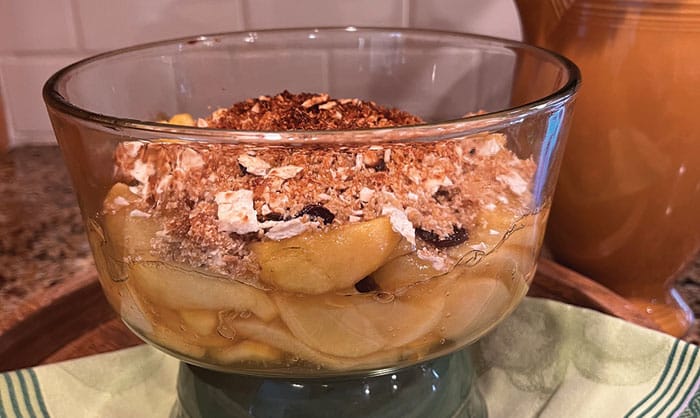
Raise your hand if you always buy too many apples for charoset. Segura’s Passover apple crisp is a great way to use all of those extras . 

“This is a holiday of desserts loaded with eggs, egg whites, and heavy doses of matzah meal, potato starch, sugar, sugar and more sugar,” Segura said. “This one has no eggs, a little matzah meal, a tiny bit of potato starch and just a little sugar.”

This dessert is easy to make, and a real crowd pleaser. 

Photo by Debby Segura

Debby Segura’s Passover Apple Crisp 

Filling
5 large Gala or Golden Delicious apples,
     cored, peeled and cut in wedges
2 tsp potato starch (optional)
2 Tbsp brown sugar

Note: if you happen to have an open bottle of apple juice, white grape juice or Martinelli’s, add two or three tablespoons.

Topping
¼ cup matzah meal, crushed matzah bits or almond flour (for a gluten-free crisp)
¼ cup brown sugar
¼ cup flavorless oil (such as safflower oil)
½ tsp ground cinnamon
¼ tsp ground nutmeg
A pinch of ground ginger, ground cloves and salt

Preheat the oven to 425°F and place a rack on the middle level of the oven. Add the apple slices to a large, microwave safe bowl and toss lightly with the potato starch. Microwave for 6 minutes, stir, and then microwave again for about 3 minutes until the apples are tender. (The timing varies with different microwave ovens.).

To make the topping, in a small mixing bowl, combine the matzah meal or almond flour, brown sugar, oil and spices. 

Pour the hot fruit mixture into an 8” or 9” round baking pan. Generously sprinkle the topping mixture on top of the filling. 

Place the pan into the preheated oven and bake until the topping just begins to brown, about 10 to 15 minutes. Cool at least 45 minutes to allow the filling to set before serving. Serve warm or at room temperature with a scoop of vanilla ice cream, If desired.

Serves 4 to 6. This recipe may be doubled. 

While you can make this the day before, the topping may become a little soggy. To serve the next day, refresh the topping by reheating for 15 minutes at 350 F. 

This crisp may also be frozen. To serve after freezing, thaw completely and reheat for 15 minutes at 350° F.

Happy Passover!

Reimagining Seder Leftovers Read More »

Dear Tabby: Passover Edition

For some strange reason, preparing for Passover elicits a lot of anxiety and stress in some Jews. 

I’m kidding, of course. I commence feeling anxious about Passover the day after Hanukkah. And apparently, I’m not the only one, as the latest submissions from readers reveal. If you have a question you’d like answered in this partially useful advice column, please email deartabby@jewishjournal.com.

Dear Tabby,

My Persian friends are always excited about Passover because of “Dayenu.” But why the green onions?

Yours, 

Sam

Dear Sam,

There are some questions that are as eternal as time itself: What is the meaning of life? Who is G-d? And why do Persian Jews beat each other with scallions during the Passover seder?

In short, Persian (and Afghani) Jews attack one another with pungent scallions during the “Dayenu” recitation of the seder for two reasons. First, the scallions resemble the unforgiving whips of the Egyptian taskmasters (unless you’re at a table with my family, who turn the scallions around and use the hard bulbs). Second, in case anyone at the seder is tempted to romanticize their own metaphorical Egypt (whether it’s a cell phone addiction or a desire to be at Happy Hour, rather than a family seder), the scallions are a wake-up call that we have better pursuits in life. The Israelites actually romanticized life back in Egypt, telling Moses, “We remember the fish that we ate in Egypt free of charge, the cucumbers, the watermelons, the leeks, the onions, and the garlic” (Bamidbar 11:5-6). Remind me to never describe the watermelons back in Iran with such sentimentality. 

Dear Tabby, 

What are the best Sephardic dishes to make on Passover as a new Sephardic wife? 

Thanks,

Ariel 

Dear Ariel, 

I suggest the following sumptuous dishes for Sephardim and Mizrahim during Passover: Basmati rice, Basmati rice-stuffed chicken, Basmati rice-and-meat stuffed bell peppers, Basmati crispy rice (Persian tadig), Basmati rice pudding, and finally, Basmati rice balls topped with kosher imitation crab, cucumbers and avocado (with more Basmati rice pudding for dessert). As you can see, diversity of ingredients is key. B’teavon. 

Dear Tabby, 

What’s the best way to defend yourself during “Dayenu”? Scallion attack strategies are also appreciated.

Warmly, 

Liora

Dear Liora, 

I assume you’re asking this question because you’re Persian. First, grab your scallions early and quickly. The amateurs (or the very elegant) will each take one dignified scallion; you should hoard between 8-12 a few minutes before “Dayenu” is recited. Next, identify whom you’ve annoyed or insulted in the past year that’s sitting at the table. They’ve been waiting months to enact their revenge against you. Avoid them by hiding behind children or the elderly. I’m also a big fan of the airborne scallion. Rather than relying on short distances and direct hits, I also hurl scallions across the room at targets. Sometimes, it’s a direct strike. Other times, I’m forced to clean old scallions out of lamp shades and flower pots. 

Dear Tabby, 

Just thinking about Passover is overwhelming. What kind of comic relief do you suggest to get through it? 

Thanks,

Daphna

Dear Daphna, 

Look up “Persian Passover Dayenu” in the search function of YouTube. Enjoy. 

Dear Tabby, 

How do you avoid starving your family while trying to turn your kitchen over? Any tips and tricks would be greatly appreciated!

Thank you, 

Raymonde

Dear Raymonde, 

Anyone who has kids knows that feeding them in the volatile few days between preparing your kitchen for Passover and the start of the holiday itself is a time of high anxiety (if not all-out misery). If your kids eat fruits and veggies, buy them by the barrelful. If they still complain that they’re hungry, remind them that their grandparents, great-grandparents and ancestors ate simple, clean foods year-round, in the days before Wacky Mac, frozen, dinosaur-shaped chicken nuggets, or Streit’s matzo ball and soup mix (my favorite, which I infuse with a lot of turmeric, cilantro and dill and try to pass off as a Persian stew). If all else fails, remind them how fortunate they are to choose to be a little hungry, while hundreds of millions of children worldwide struggle with hunger without a choice. And promise them a heaping plate of chocolate-covered matzah the morning after the first seder.


Tabby Refael is an award-winning, LA-based writer, speaker and weekly editorial columnist for the Jewish Journal of Greater Los Angeles.

Dear Tabby: Passover Edition Read More »

Next Year in a Free Tehran!

As an Iranian-Jew, freely transitioning from my Nowruz “haftseen” table to preparations for a Passover Seder, I see the revolution unfolding in Iran and cannot help but connect it to the story of Exodus. After four decades of suffering under the Islamic Republic, the Iranian people are showing an unprecedented determination to abolish the repressive ruling regime and rebuild a new and free Iran. Activists have referred to this struggle to overthrow the Islamic regime as Gozar, a Persian word that essentially translates to “transition” or “journey.” 

Gozar and Exodus have a series of clear similarities as they reflect two great people working to escape generations of bondage.

Determination

We all know that the transition out of Egypt was an arduous journey for the Jewish people. In fact, the distance between modern day Cairo and Jerusalem should not have taken forty years, even on foot. Nonetheless, according to the oral history, it took the Israelites four decades to make the passage. The sages opine that the length of time was necessary to allow the Israelites to make, not only the physical journey, but also to shake off the mentality of oppression that they carried with them as slaves. 

Similarly, we see that, after four decades, the Iranian people are shedding the mentality of oppression imposed on them by tyrants in Tehran. The mullahs can no longer suppress their natural desires for freedom and self-determination. They are no longer fooled by the promises of another fake election and the false choice of hardliners and reformers. They are no longer beguiled by the trickle-down benefits of JCPOA with the false assurance of improved human rights. Today Iranians are fully aware that the Islamic Republic cannot be reformed or salvaged. The only way to save their homeland is to abolish this corrupt, despotic regime.

Leadership

Moses’ role as the prophet of the Jewish people is one of the most important, yet complicated aspects of the Exodus story. Moses was very reluctant to accept the mantle of leadership and even tried to reject the divine order, making excuses – such as his speech impediment– as a reason not to accept the responsibility. According to oral history, God assigned Aaron to assist Moses in his mission and they, together, led the Jews out of bondage. Interestingly, the mission ended at the end of the destination for Moses after which the responsibility of leadership was given to the Israelites.

Today, ordinary Iranians lack basic rights – freedom of expression, freedom of assembly, and freedom of religion – and certainly are unable to elect their own leaders within the borders of their country. As a result, they are trusting individuals and influencers abroad who represent aspects of their struggles to lead the process of Gozar. This informal group includes Crown Prince Reza Pahlavi, Nobel Laureate Shirin Ebadi, women’s rights activist Masih Alinejad as well as entertainers and athletes, authors and activists. All have expressed a commitment to assist the people of Iran by representing them abroad and raising their voices to the international community.

Although Reza Pahlavi arguably has been the name most invoked by the demonstrators over the past six months and during other protests held in Iran over the past four decades, neither the Crown Prince nor any other person has claimed to be heir apparent of a post-regime Iran. Instead, all the leaders have demurred and hesitated to claim the reins. Instead, they seem to share a common belief that the Iranian people deserve the right to choose their own leadership and governance system in a free, fair and safe election.

Another parallel with Exodus can be found in the internal dissension in some quarters of the protest movement; just as the Jews traveling toward the Promised Land fought among themselves, so too we see dissidents quarreling among themselves even as they seek a better future for their country. Perhaps this should not surprise us – decades of repression leave a legacy of trauma and fosters a high degree of dysfunction. This has shown up most prominently on social media where dissidents and regime supporters have been warring through sexist remarks, allegations of “fascism,” accusations of racism, and other ad hominem attacks. It’s unfortunate and hopefully leadership can remind the revolutionaries of the need to focus their fire on the real enemy, the tyrannical regime in Tehran.

Charter

Here again, we are reminded of Moses bringing the tablets down from Sinai. The Ten Commandments prohibited idol worshiping and guided people to follow a basic set of guidelines with the ultimate purpose of promoting coexistence and kindness. These rules were simple but fundamental to the continuation of a civilization that has now lasted over 5700 years. The Commandments are simple, yet foundational. Although they bear much resemblance to the Code of Hammurabi which emerged centuries before, they have been the basis of major religious and governance codes for millennia.

While the Israelites received their mandates from a higher being, the Iranian activists abroad and in the country collaborated to write their manifesto in a new document. The charter, entitled “Solidarity and Cooperation for Freedom (Mahsa)” provides the most fundamental and essential guidelines for activists who are determined to fight for a free Iran. Despite the massive effort it took to draft this charter, it was quickly dismissed by detractors as “too simple” and too basic.  The criticism of the charter is not wrong; dialogue and engagement are indeed essential practices in a democracy. After 40 years of silence and fear of authority, Iranians are expressing themselves and engage in oppositional conversations on Instagram, Telegram, Twitter Space and Clubhouse, and are experiencing democracy, in small doses.  Yet we have to be mindful of detractors whose motive behind criticism is protection of the Iranian regime and delegitimization of the opposition activists. At this moment, this simple charter is the best hope for a foundation of tomorrow’s free Iran and today’s unfolding Gozar.

Iranians now have a clear destination, inspiring leadership, and a compelling set of commandments – but perhaps more than anything, they have an unbreakable will and infinite determination. It will be impossible for them to return to their proverbial Egypt. 

Freedom

The process of liberation continues for the Iranian people but the hardest parts are over. Iranians now have a clear destination, inspiring leadership, and a compelling set of commandments – but perhaps more than anything, they have an unbreakable will and infinite determination. It will be impossible for them to return to their proverbial Egypt. 

The pharaohs of Iran know this reality very well. They are fighting back with all their ammunition including violent repression at home, insidious proxy wars and terrorism abroad as well as by pursuing economic deals with unlikely partners to regain a sense of legitimacy. But their fate is already sealed, their time is set to expire.

The world now has reached a point where it can envision a new Iran where the most important exports will be goods and goodwill, not terror and extremism; where science is more about creating progress not enabling violence; where art is about creating beauty not generating propaganda; where foreign policy is about building allies, not eliminating enemies. 

It took the Israelites 40 years to make the physical and psychological journey out of bondage. When they entered the “promised land of milk and honey,” they had little more than Ten Commandments and the shirts on their back. They had to build a new civilization, choose new leaders and overcome new obstacles throughout history.  

It was an arduous, difficult, exhausting journey and, even today, it remains far from easy or utopian. But as Jewish people around the world will celebrate this week, all would affirm that it has been well worth it. Because freedom is worth everything. 

Next year in a free Tehran!


Marjan Keypour is an Iranian-born human rights activist and the founder of ARAMIran.org and StopFemicideIran.org. She was a presenter at the recent Gozar conference at Stanford University.

Next Year in a Free Tehran! Read More »

Cousin Rose at Passover

Each year at Passover, I think about Rose, my grandmother’s cousin, who was born in a shtetl, but kept creating new memories during the holiday in the late 1990s. 

Rose Pinsky Halpern, the embodiment of a lively, short Jewish woman from the old country, was born in 1910. But we really didn’t get to know each other until the 1990s, when we started corresponding, me writing from Northern California, and she answering from the South Bronx. She was one of the last of the relatives who fled Ukraine for America in the 1920s. She was still active, traveling and fighting for the rights of seniors. 

In 1997 my girlfriend’s family lived in New York, and she invited me there at Passover. Before the first seder, I took the subway to visit Rose, 87, in her high-rise apartment. 

I hadn’t been there long, admiring the view of Yankee Stadium, when the phone rang. 

Rose’s hearing wasn’t very good. She asked me to answer the plastic wall phone. 

“I’m calling for Rose Halpern,” said a male voice on the phone. “It’s the New York Communist Party. We’d like to invite her to our Passover seder on Saturday night.” 

I repeated the message to Rose. 

“Tell them I’ll think about it,” Rose instructed me.

I can’t remember the last time I’d answered the phone for anyone. And I’d never had the New York Communist Party on the other end. Who knew they even had a seder?  

I can’t remember the last time I’d answered the phone for anyone. And I’d never had the New York Communist Party on the other end. Who knew they even had a seder?

More importantly, I now had an answer to the question I’d been wondering for years — was Rose a Communist? My mom in California adored Rose. She mentioned Rose’s alleged Communist past, but had told me not to ask her about it. I didn’t always listen to my mother, and now I didn’t need to. 

The call ended, and we returned to our visit.  I tried to act like this was normal. As if every day I answered the phone for my elderly cousin and the Communist Party was on the other end. 

We continued to look at old family photos. Rose gave me a treasured black and white photo, showing the immigrants from her shtetl at a reunion dinner in 1929. 

That night I called my parents, hoping to discuss my return to California for the next night’s seder. But no one picked up.

I found out why the next day. My mom was in intensive care. She had ended chemotherapy a few months earlier. Instead of a second seder, I saw my mom at St. Jude’s Hospital in Fullerton in Orange County, enveloped in tubes.

It was hard to talk to my mom at such a dire time. But my visit to Rose gave us something to discuss that was off topic from the bigger issues. I told my mom about my trip to the South Bronx, and that indeed Rose was a Communist. We looked over the 20-inch photo that Rose had given me, and figured out where our relatives were.  

My mom, Rita, died of ovarian cancer two months later. But Rose carried on, and I visited during her final years. I got to ask her why she’d become a Communist. Her answer was that she believed in racial equality in the 1930s, and the Communists did, too. I didn’t probe too deeply, although later I would make a Freedom of Information Act request and learn that the FBI investigated Rose from the 1940s to the 1960s. They never found anything incriminating. 

The next year, in 1998, my girlfriend Alison and I returned to New York for Passover. This time, we invited Rose to a large family seder in Queens. Rose was the oldest person there, and the best dressed. She’d had her nails and hair done, and I remember feeling proud as she read during the seder. I don’t know if the Communist Party of New York ever counted Rose among its seder attendees, but she was an honored guest that night.

And that picture of the shtetl’s reunion? It’s now framed and hanging in the house I share with my then-girlfriend. Alison and I have been married for 23 years, with enough time to have created plenty of Passover memories. They almost always include the ones about Rose.


Larry Sokoloff grew up in Orange County, which in his childhood was renowned as an anti-Communist stronghold. He is a professor emeritus at San Jose State University, an attorney and a freelance writer. 

Cousin Rose at Passover Read More »

Before We Eat, Reflect: Asking our Jewish Leaders Questions

“Why is this night different from all other nights?” 

Traditionally, the youngest at our seder tables ask this question every year. 

The objective of the Four Questions is encouraging inquisitiveness among children while adding to our own understanding of the purpose of the Passover holiday. Of course, it’s one of many rituals we must endure before we can get to the part of the seder we’re most looking forward to—eating!

Asking questions, however, being a central part of what Pesach is about, ahead of the holiday this year we contacted a handful of our community’s leaders and thinkers—the head of the L.A. Federation, an AJU rabbi who’s quickly become a voice for women Persian Jews in the city—and prompted them to reflect on what Passover, the most observed of all the Jewish holidays, means to them. 

Hopefully, their responses, some of which were edited for clarity, will inspire rich, meaningful discussion around your seder tables this week—and not take up too much time before you get to the brisket.

Chag sameach.

Rabbi Noah Farkas, president and CEO of Jewish Federation of Greater Los Angeles

Why do we ask four questions during the seder?

At the center of the Seder are four questions. There is, however, also a hidden question. It’s a question that is hard to voice because its weight is heavy on the lips, born of trauma, pain, and disorientation. That question is: Who am I, now? 

With rising antisemitism and our brothers and sisters in Israel embroiled in deep debate about the future of the Jewish state, this question persists. When the antisemites try to define us, will we let them? When we have starkly different views of Jewish destiny, who is right? 

This question of identity is never asked at the Seder, but it is answered again and again. The Haggadah states, “… [I]n each generation, there are those that stand against us to destroy us, but the Holy One, Blessed One, rescues us from their hands.” The rabbis teach that every generation faces a great challenge; having faith and optimism in the face of great uncertainty pulls you through. It was the same under Pharaoh’s switch, under the Caesar’s spear, under Hitler’s boot as it is now. Antisemitism and strife in Israel are our great challenges but they will not define us. We are not defined by our challenges, but as the story relates, our capacity for redemption.

“Who are we, now? We are ancient and modern, we are survivors, and most of all we are one nation, and one family ready as always for redemption.” – Rabbi Noah Farkas

Who are we, now? We are ancient and modern, we are survivors, and most of all we are one nation, and one family ready as always for redemption. 

Rabbi Tarlan Rabizadeh, vice president for Jewish engagement at American Jewish University

Why do we read the Haggadah?

The whole haggadah is about parents teaching their children how to ask questions. That’s how you let go of the enslavement. Until you ask questions of the status quo, you’re not able to see a future for yourself and have the emunah, the faith, to get up and leave for a future that’s unknown. The art of asking questions. That’s what Passover’s about. The haggadah is our first curriculum guide as the Jewish people.

Jesse Gabriel, California assemblymember 

Why is this year’s Passover different from all other years’ Passovers?

I’ll be celebrating in Israel with my three young kids. It’s the first time that any of them will be visiting Israel, and I’m excited to show them a country that means so much to our people and to me personally.

What’s your favorite Passover memory?

Passover always brings back amazing memories of sitting around the Seder table with my grandparents discussing current events and the secret to my grandpa’s perfect beet maror. I miss having them at our table, but I always feel their presence at holidays and simchas.

At the conclusion of the Passover seder, we say, “Next Year in Jerusalem.” Where would you like the Los Angeles Jewish community to be this time next year? 

Next year may our community be more united and unified. We live in complex times and face real challenges, but we will be immensely strengthened if we can confront them together.

Gilla Nissan, teacher, author, speaker

What is the primary objective of the Passover seder?

When we say ‘Hallel’ at the end of Passover, we are actually crowning God. The seder is made up of steps to go from narrowness, from slavery, and at the end of the seder, we should be in an expansive, expanded place, and we are crowning God as the king of kings and the master of the universe. The aim of the entire seder is to go step by step and in the end crown the divine to be the leader of the world.

Orna Wolens, Jewish Federation of Greater Los Angeles board chair 

What is the main message of Pesach?

With Passover, this most cherished and meaningful of holidays, Jews throughout the world, manifest both optimism and memory as we retell the story of our people. I marvel at how every Passover is its own moment in time. Every Seder is a journey of discovery and interpretation grounded in tradition, order, and ritual. I am grateful to be a part of a Jewish community and organization like The Jewish Federation of Greater Los Angeles that is connecting young people to our cherished traditions, sharing our stories with our neighbors of diverse backgrounds, and providing Seder services and meals to the elderly and most vulnerable in our community.

Before We Eat, Reflect: Asking our Jewish Leaders Questions Read More »

The Women Who Saved Moses and the Israelites

The liturgy of Passover is particularly focused on thanking G-d for enabling the Israelite slaves to escape ancient Egypt. And when we anecdotally tell the story of Passover, whether to small children at Jewish schools or to our non-Jewish friends, we often focus on the heroism of Moses (though in the actual Haggadah, his name is only mentioned once). 

But this year, I finally realized that we Jews probably would have perished in Egypt, or have been non-Jewish Egyptians today, if it were not for the wise decisions of several women who, I argue, not only saved Moses, but all of the Israelites over 3,000 years ago. 

Normally, a decree by Egypt’s Pharaoh, the most powerful man in the region (if not the world) at the time, would have been enacted to the letter. But perhaps Pharaoh had never met an independent-thinking Jewish woman, or in this case, two of them: Shifrah and Puah, the Hebrew midwives who knew that Pharaoh had ordered the immediate death of every newborn Jewish male, but who, amazingly, refused to follow orders because they “feared — the midwives did — G-d and they did not do as he spoke to them the king of Egypt did — and they kept alive the boys” (Exodus 1:15-21). 

When summoned by Pharaoh, the midwives’ explanation for why there were still so many male Jewish newborns reveals the women’s’ sage intuition as well as Pharaoh’s cruel bigotry: Shifrah and Puah told Pharaoh that Hebrew women were skilled and swift at childbirth, but the midwives also concocted a story that painted the Israelites as overly vigorous, using a reference that’s often reserved for reproducing animals, not humans. They knew that Pharaoh firmly believed that the Israelites were less human than Egyptians, and surely enough, he bought the story. As we know, antisemites today rationalize their hate and violence against Jews, including Israelis, by dehumanizing them at every turn. 

In refusing to kill newborn Israelite males, Shifrah and Puah were also the first women to save Moses’ life, but not the last. 

Talmudic sages believed that Shifrah and Puah were actually Moses’s mother, Yocheved, and his older sister, Miriam (with Yocheved being Shifrah). But whether or not Yocheved was one of the midwives, she also saved Moses’s life, and in doing so, saved the lives of the ancient Israelites because her son grew to lead them out of Egypt. After Moses was born, Yocheved kept him alive for three months, nourishing him until he grew so big that she could no longer hide him. 

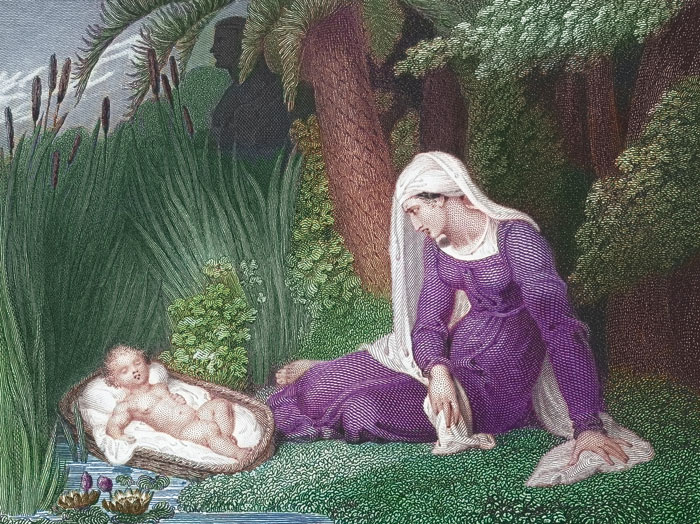
The doting, yet desperate mother then made what is referred to as an ark, the same word that is used for Noah’s famous vessel in Genesis 6:14, out of reeds, clay and pitch. She placed her younger son in the arc and asked her daughter, Miriam, to watch over it as it floated on the Nile. 

Miriam deserves so much recognition for her life-saving decisions that beginning in the 1980s, some Jews started a tradition of reserving “Miriam’s Cup” at the seder table. In recounting how Moses was sent down the river, the Torah does not use specific names for Yocheved or Miriam, but describes how Moses’s sister “stationed herself at a distance to know what would be done to him” (Exodus 2:4).

Miriam saved Moses’ life not only by keeping watch over him in his small ark, but more importantly, by securing nourishment for him once Pharaoh’s daughter discovered him in the river. It was Miriam who spoke with the woman, who is only mentioned as “Pharaoh’s daughter” in the Torah, but whom Jews call Batya (“daughter of G-d”), and suggested a nursemaid to feed the baby. That nursemaid, as Miriam knew, would be Yocheved. “Shall I go and call for you a woman who can nurse from the Hebrews, so that she will nurse for you the boy?” Miriam asked Batya, who agreed and even offered to compensate Yocheved for nursing the baby. In this way, Moses’ own Israelite mother was able to continue to nurse him and inculcate him with Jewish values.

Jews believe that Miriam again saved Moshe (and all of the Israelites) as they wandered in the wilderness for 40 years because she was accompanied by a miraculous well of water (Be’erah shel Miriam). That well sustained the people for decades and sadly, dried up after her death. Miriam brought life to the Israelites, whether literally or through infusing them with communal joy, as she played her timbrel and led the women in joyous song and dance after the miraculous crossing of the Red Sea.

It took an amazing combination of divine intervention and human compassion for Moses to live, thrive and eventually confront Pharaoh on behalf of his G-d and his people. 

But it was Pharaoh’s daughter, Batya, who also helped ensure Moses’s physical safety as he grew up in Pharaoh’s place. Batya saved Moses’ life when she pulled him from the water (she named him “Monios” because he was drawn from water; in Hebrew, the word is Moshe). Batya knew immediately that Moses was an Israelite, saying, “From the boys of the Hebrews is this one,” but she nevertheless took compassion upon the crying infant. Surely, Batya’s maidservants would have known of Moses’s real identity as well. It took an amazing combination of divine intervention and human compassion for Moses to live, thrive and eventually confront Pharaoh on behalf of his G-d and his people. 

And then, there was Tzipporah, who would become Moses’ wife. Moses met Tzipporah’s father, Jethro, who was a Midianite priest, and sought refuge from him. When Moses admitted that he was fleeing from Pharaoh, Jethro, who was an advisor to the Egyptian ruler, had Moses thrown into a pit to starve to death. 

For 10 years, Tzipporah secretly brought Moses food and water in the pit. After a decade, she reminded her father of the Israelite and suggested seeing whether he was alive or dead. When Jethro found Moses standing and praying in the pit, Tzipporah explained the miracle by crediting the G-d of the Israelites. Moses was released (and washed, given a haircut and offered a chance to eat with Jethro and his family in their home). Is it any wonder that Moses asked to marry someone as kind as Tzipporah?

Amazingly, Tzipporah saved Moses’s life once more. One of the most debated verses of the Torah recounts how G-d actually sent an angel to kill Moses, before being appeased by Tzipporah. Exodus 4:24–26 tells how Moses and his family stayed at an inn while traveling from Midian to return to Egypt to tell Pharaoh of the plagues. Why did G-d want to kill Moses? (The question seems absurd, given Moses’s role in Jewish history and redemption). Most believe it was because Moses had delayed circumcising his son, Gershom (some believe it was his other son, Eliezer; either way, travel wasn’t exactly easy or safe in those days and stopping to circumcise a son may have been dangerous). 

According to Rashi, Tzipporah saw that the destructive angels, Af and Hemah, had swallowed Moses until his area of circumcision, and she immediately understood that Gershom would need to be circumcised to avoid G-d’s anger and wrath. Exodus 4:24 describes, “Now he [Moses] was on the way, in an inn, that the Lord met him and sought to put him to death. So, Zipporah took a sharp stone and severed her son’s foreskin and cast it to his feet…”

At times, it seems as though the extraordinary women mentioned above conspired together to ensure the survival of Moses. And in keeping Moses alive, they ensured the ultimate freedom and survival of the ancient Israelites, whose descendants would go on to receive the Torah thousands of years ago, and who continue to infuse the world with kindness, morality and resilience today.


Tabby Refael is an award-winning weekly columnist for the Jewish Journal, and an LA-based speaker and civic action activist. Follow her on Twitter and Instagram @TabbyRefael.

The Women Who Saved Moses and the Israelites Read More »

Rosner’s Domain | A Seder to (almost) Remember

4,682 years after the creation of the world, in the year 922 C.E., Jews assembled to celebrate the Seder night on two different days. Thus begins chapter six of a book I wrote a few years ago. With a story that symbolizes our ability to divide. That year – 922 – Jews who lived in Land of Israel started Passover on a Sunday, whereas in Babylonia the Jews gathered to mark the exodus from on Tuesday. When the Jews in Israel had already asked the four questions, the Jews in Babylonia were still burning the leavened foods they had found. When the Jews in Babylonia were still drinking the four glasses of wine, the Jews in Israel were in the middle of Chol Hamoed – the intermediate festival days. Two major Jewish communities – two different calendars.

This is an example of an acute crisis in Jewish relations because of legal interpretation. In the period during which the Land of Israel was under Muslim rule, from 638 C.E. to the end of the 11th century, Jews were allowed to return to their homeland. This is when the great drama of schism over the Jewish calendar occurred, a drama in which two eminent Jews played the leading roles. One was Saadia Gaon, who lived in Sura, Babylonia. The other was the less known Aharon Ben Meir, who lived in Tiberias in the Land of Israel. The sensational discovery of the Cairo Genizah in the 19th century revealed previously unknown details about the huge controversy between these two men, which divided Jew from Jew, date from date, and holiday from holiday.

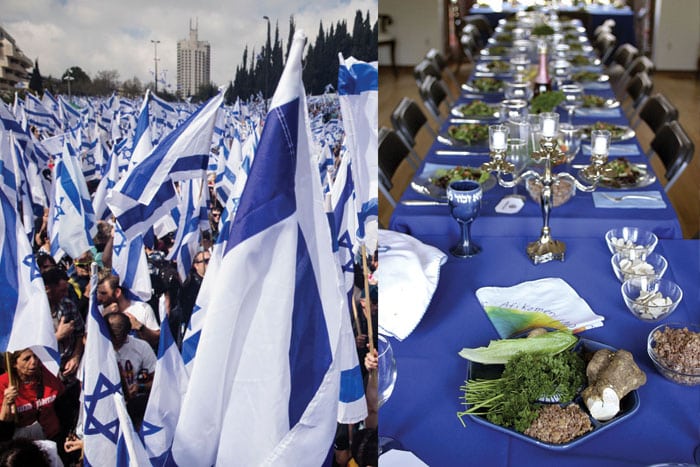
I was reminded of this story as I prepared myself for celebrating Pesach of this year, with echoes of last week’s events still ringing in my ears. Not many people realize this, but we were very close to having another Pesach for the ages. Last Sunday night, when hundreds of thousands of Israelis took to the streets determined to send a message to the government that it must halt its legislative horses, a conversation about Seder night had already begun. Many protesters, dead serious, were planning to pass the first night of Passover having a Seder of disorder. In Hebrew – Seder means “order”. So – translated properly – they were planning something that sounds like “an order of disorder”, a “Seder shel E-Seder”.

Imagine that: Israelis on the road, to have their Seders with family, meeting other Israelis blocking the roads, preparing to have their one-in-a-lifetime Seder of protest and discontent. 

Imagine that: Millions of Israelis on the road, to have their celebration with families all around the countries, meeting hundreds of thousands of other Israelis blocking the roads, preparing to have their one-in-a-lifetime Seder of protest and discontent. It could have been a night to remember. It could have been a nightmare. It would have been both. 

The exact reason underlying the year 922 dispute is complicated, and somewhat esoteric. It concerns the procedure by which Jews calculate the lunar conjunction, which is the moment that determines the start of a new month, and the consequent fixing of the Jewish calendar and its festivals. But like many other differences of opinion between Jews, the critical question that Saadia Gaon and Ben Meir bickered about was not how to calculate the calendar, but rather who was authorized to decide which method would be employed to do so. It was a debate over authority. How strangely remote from our current reality, and yet, how relevant. Jews having a fight about the nuanced reading of legal proceedings. Jews have a fight about who has the authority to determine the proper reading of the law. It is the courts? Or maybe the politicians? Sometimes, an obscure debate becomes a matter of great strife. Sometimes, what seems like a crucial argument ends up being almost bizarre. Truly – you celebrated in two different dates because of this? Seriously – you considered celebrating on the main road because of that?

In many Diaspora Jewish communities, as I wrote in another book – #IsraeliJudaism – it is conventional to add politically charged texts and rituals to the Haggadah. For Seder night in 1969, which coincided with the one-year anniversary of the assassination of Martin Luther King Jr. in the United States, American civil rights activists composed the “Freedom Haggadah.” But in Israel, as I reported when the book was written, a few years ago, the inclination to politicize the Haggadah is not as strong. Israeli families are fulfilling the vision of Theodor Herzl, whose novel Altneuland includes a fairly traditional Seder night in Tiberias at its core. 

Is this changing? It’s too early to say. An attempt to convince Israelis to use an Israeli “Freedom Hagadah”, with texts by authors such as authors David Grossman and Etgar Keret and poet Nurit Zarchi, was made this year. I skimmed through the pages of this document until I got to the last page, where alongside the traditional “Next Year in Jerusalem” appears a modern text by novelist Haim Be’er. “Next year in our Jerusalem that will once again be… a city of justice, freedom and peace, a city of courts… strong fortresses for public integrity”. 

Jerusalem? 

Be’er is writing about the eternal Jerusalem, but I can still hear the echoes of contemporary protesters that were planning a Seder on the main road crossing Tel Aviv.

Something I wrote in Hebrew

This is one of the mistakes made by the government, when its members attacked the “anarchists” or “evaders”. They thought they were speaking to Old Israel, the one in which evading a summon for military reserve duty was considered a red line. But they were wrong: in today’s Israel, an Israel that has already crossed many red lines, the call to evade such summon was not controversial. This was not a fringe call by fringe people. For a large, powerful camp, it was the obvious policy. You want to know what else most of the protesters supported? Delay in paying taxes, alternative Independence Day ceremonies, disruption of Memorial Day ceremonies, transferring money abroad, blocking roads for long hours. In short, they supported the crossing of many red lines.

A week’s numbers

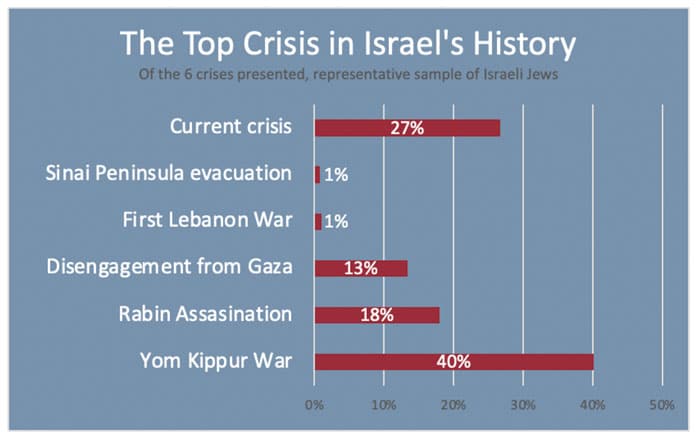
Is the crisis in Israel serious? Here’s what people feel:

A reader’s response:

Alvin Nassau asks: “Were Israelis outraged by Biden’s interference in Israel’s internal affairs?”

Answer: Yes – but some blamed Biden while others blamed Netanyahu. 


Shmuel Rosner is senior political editor. For more analysis of Israeli and international politics, visit Rosner’s Domain at jewishjournal.com/rosnersdomain.

Rosner’s Domain | A Seder to (almost) Remember Read More »

Table for Five: Passover Edition

One verse, five voices. Edited by Salvador Litvak, the Accidental Talmudist

And He said, “You will not be able to see My face, for man shall not see Me and live.”
– Exodus 33:20,
Torah reading for Chol Hamoed Shabbat


Bracha Goetz
Author of 42 books that help souls shine

You will not be able to see into the future. Why? Because what you do determines how the future will play out. 

Expressed in another consciousness-raising way in Psalms 121:5, we learn: “God is your shadow.” Wow, that seems like a pretty lowly way to describe The Infinite Oneness! But as the Baal Shem Tov elucidates, a shadow copies every movement that a person makes. God’s actions correspond to our actions. The future is determined by how we live. So while we are still alive, we are still determining how the future will emerge based on our actions. 

This Torah wisdom is tremendously empowering. 

Passover is a recurring point in the spiral of time imbued with intense spiritual potential for us to break free from enslavement in our past so that we can more fully behave as our authentic selves. We have increased Divine assistance during the Passover holiday to emerge from a narrow and constrained place and transcend limitations to which we have gotten accustomed. 

No matter how lowly, shameful, or unworthy we may feel, the ability to transcend our limitations is more possible now. Making that first crack in a bad habit and getting released from the prison of an addiction can be more easily accomplished at this time of spiritual liberation. 

You are amazingly, infinitely resilient. And each small positive action forward is a joyful victory to celebrate. You get to see a bright future ahead as you let your soul shine.


Rabbi Chaim Singer-Frankes
Multi-Faith Chaplain, Kaiser Medical Center, Panorama City

God and Moses’ connection is arguably the preeminent and singular relationship in all history. In verse 11, Moses encounters God “face to face, as one speaks to a friend.” Lo and behold, nine verses later and God is forbidding any human from looking upon God’s face, lest they die. So as the saying goes, “What gives?” 

The Torah tells us that this encounter happens in the Ohel Mo’ed, i.e. The Tent of Meeting, where Moses receives his charge from God to lead the people after Israel gains a Divine pardon for the sin of the golden calf. Moses then entreats God to reveal God’s self. With assurances to His exemplary servant, God relents with a promise that Moses will obtain a unique grace, extraordinary compassion, even access to the Divine name! Should that not suffice? 

In the most intimate moments, friends, partners, and lovers become better acquainted than ever. Promises are forged. These instances feel like windows beyond our normal reckoning, a view to the eternal. One might say, it’s impossible to put the feeling into words. And yet, how completely do we know the others in our lives? Despite our sincere bid, can the most devoted confidant fully know us? Oftentimes we have a hint, a micro-expression which betrays the intimacy, that breaks the unspoken harmony. A sign: it’s too much to handle. How much more so is it between The Almighty and Moses? If not the whole Divine revelation, at least the most awesome measure of loving mercy. 


Rabbi David Eliezrie
President Rabbinical Council of Orange County

We live in a time where we think all is possible. Technology is bubbling with astonishing new apps. Medicine is bursting with new ideas. We live in countries where freedom and human rights are central values. These remarkable accomplishments prompt us to think all is possible. 

Herein lies the danger. The world is much more complex; beyond the physical dimension is a Divine attribute that we cannot comprehend. Pondering the greatness of G-d, how he or she (because G-d transcends gender) creates a humility and appreciation that the world was created and orchestrated by a power we cannot comprehend. Yes, we can control much, but not everything. 

This is most important when it comes to moral decisions. We tend to rationalize, “I feel good about this so it must be good.” A person who knows that the world was created by a G-d that is so awesome that we cannot comprehend its greatness or see its glory will then pause and ask, “Is this what G-d wants?” 

That is defined in the Torah, which is the guidebook that G-d gave to the world. 

The Hasidic master Rabbi Schneur Zalman faced a fateful decision: To study in Vilna under the great Rabbi Eliyahu, or go to Mezritch and learn with the Hasidic master, Rabbi Dov Ber. In Vilna the focus was on  the legalism of Talmud, in Mezritch, the spiritual and mystical were emphasized. Ultimately, he chose Mezritch, commenting; “In Vilna they teach you how to master Torah, in Mezritch they teach how the Torah can master you.”


Rabbi Avraham Greenstein
AJRCA Professor of Hebrew

This verse reveals to us a piece of coded divine terminology. We learn that a non-corporeal God has a “face.” This is rather surprising, and it demands explanation. 

Some clues to the meaning of this apparently euphemistic language can be found in the verses that surround it. In response to Moses’ request to see God’s glory, God tells Moses that He will pass “all of my goodness” over “your face” (33:18-19). There is a seeming reciprocity of faces taking place. Moreover, it is apparent that God’s face, as it were, is something even more overwhelming and awesome than all of His “goodness.” 

We do, in fact, learn what is meant by God’s goodness. A few verses later, God reveals to Moses the Thirteen Attributes of Mercy (34:6-7). We learn that God is as unceasingly compassionate, patient, and forgiving as He is righteous and just. This is in itself a profound statement of divine intention and orientation towards humanity, yet it falls short of what must be meant by God’s face. This is because God’s face represents His very identity, not merely His relationship with His creations. 

God Himself — His “face” — is vast and unfathomable, and a true recognition of this threatens to leave no room for human life. God’s ineluctable and all-permeating existence would subsume our own. Nevertheless, we can be assured that God sees and nurtures our individual faces, i.e. what makes each of us unique and distinct. Our task is to reciprocate, to turn our faces to God.


Nili Isenberg
Judaic Studies Faculty, Pressman Academy

Abraham Ibn Ezra was one of our most important biblical commentators. In addition to his biblical commentaries, he also wrote beautiful liturgical poems. One such piyyut, which I have enjoyed singing around the Shabbat table, comes to mind. In the poem,  “Tzama Nafshi” (“My Soul Thirsts for God”), the first verse borrows from our passage: “The one true God created me / And told me I am alive / ‘but man cannot see me and live.’” 

This is the paradox: We long to know God, and yet God is elusive. As it says in Shir HaShirim, which is read this Shabbat of Passover, “I sought the one my soul loves, but did not find him” (Song of Songs 3:1). 

One way we feel the closeness of God on these holidays is at Yizkor. When we reach out with “El Maleh Rachamim” (“God, full of mercy”) in a request to the Divine to grant rest to the souls of our departed, we can surely feel God’s presence among us beside those of the deceased.

But it is not our time to rest with God. We are commanded to “choose life” (Deuteronomy 30:19). We strive to live a life of Torah, a life of blessings and gratitude. We come together at synagogue for our holiday prayers and gather around our festive meals to sing songs. In this way, as Ibn Ezra says “with heart and flesh,” may we merit a taste of the World to Come and God’s presence this Passover.

Table for Five: Passover Edition Read More »

Lotsa Matzah for Passover

Happy Passover! Welcome to a week filled with food, family and lotsa matzah!

Here are some creative ways to enjoy matzah during Passover.

“Growing up, my mom would always make bimuelos during Passover.”  – Samantha Ferraro

“Growing up, my mom would always make bimuelos during Passover, which are Sephardic donuts made from crushed matzah and egg,” Samantha Ferraro, founder of the Little Ferraro Kitchen, told the Journal. “We normally dip these fried matzah donuts in a simple syrup, which are simply delicious.” 

To create her Baklava Bimuelos, Ferraro took inspiration from the flavors of baklava and doused the matzah donuts in a rose water syrup. Chopped pistachios garnish this delicious Passover treat.

Samantha Ferraro’s Baklava Bimuelos

Bimuelos
1 1/2 cups crushed matzah or about 7-8 matzah
Water, as needed
2 eggs, whisked
3/4 tsp cinnamon
3/4 tsp cardamom
2 Tbsp brown sugar
Pinch of salt
Canola or vegetable oil for frying

Rose Water Syrup/Garnish
1 cup sugar
1/2 cup water
1 tsp rose water
1 tsp lemon juice
Ground pistachios

In a food processor, grind matzah into fine crumbs. Then, put ground matzah in a large bowl, and pour in enough water to just cover the matzah.

Add whisked eggs, cinnamon, cardamom, sugar and salt, and mix to combine. Set aside.

Heat 2 to 3 inches of oil in a pot until oil is to 360 degrees Fahrenheit. You can test the oil by placing a piece of the mixture in the oil. If it sizzles, it’s ready.

Use a cookie scoop or tablespoon to round batter into a ball shape. Place in the hot oil, about 3-4 at a time. Fry donuts on both sides for about 4 to 5 minutes. When done, take them out of the oil and place on a paper-towel lined baking sheet.

To make the syrup, add the sugar, water, rose water and lemon juice to a small pot. Bring it to a gentle boil. Cook until sugar has dissolved and syrup has thickened, about 5 to 7 minutes.

Once syrup is done, you can either put the donuts and syrup in a bowl, and toss them together. Or keep the syrup on the side and dip the bimuelos in it.

Garnish with chopped pistachios and serve.

Yields 10 to 12 bimuelos. 


In 2016, Judy Elbaum, founder of Leave it to Bubbe, started using her homemade Passover granola to make her version of Rice Krispie treats. They were such a hit, she’s been making them for Passover ever since. 

“For a sweet Passover, make sure to have a batch of these on hand,” Elbaum told the Journal.

While Elbaum provided the recipe for her homemade Passover granola, if you need to save time, you can use a store-bought version.  

Courtesy of Judy Elbaum

Judy Elbaum’s Passover Granola Treats

3 Tbsp butter or margarine
10 ounces large marshmallows or 4 cups of miniature marshmallows
Extra miniature marshmallows for inside the treats
6 cups of Passover granola (recipe below)
Sprinkles (optional)

Spray a 9” x 9” or a 9” x 13” pan (depending on how thick you want the treats to be) with kosher for Passover vegetable spray. If you can’t find tasteless oil, use butter or margarine to grease the pans.

Melt the butter or margarine over low heat in a large saucepan. Add the marshmallows to the melted butter and stir until completely melted and combined. Remove from the heat and add the 6 cups of granola to the saucepan. Fold in extra miniature marshmallows, if desired.

Stir all ingredients together until well combined.

The mixture will be sticky, so use a spatula (sprayed with Passover vegetable oil) or use some buttered wax paper or aluminum foil to press the mixture into the prepared pan. If desired, top with sprinkles.

Allow the granola treats to cool. Then cut into squares.

Makes 12 to 16 servings.

Passover Granola

2 1/2 cups matzah farfel
1 cup shredded coconut
1 cup sliced almonds
1/4 cup butter or margarine
1/4 cup brown sugar
1/4 cup honey
1/2 tsp salt

Preheat the oven to 325°F.

Combine the first three ingredients in a bowl. Then, place the mixture on a cookie sheet.

Bake for 15 to 20 minutes. Toss mixture every few minutes, and check to make sure the sides are not burning. Remove when lightly toasted. Then increase the oven to 350 degrees.

While farfel, coconut and almonds are in the oven, combine butter or margarine, brown sugar, honey and salt in a saucepan.

Bring to a boil, then reduce heat and simmer for 3 minutes, stirring. Remove from heat.

Place toasted farfel, coconut and nuts in a large mixing bowl. Pour syrup mixture on it, and mix all ingredients well. Make sure everything is evenly coated.

Place granola on a cookie sheet and toast for 20 to 25 minutes, until golden brown. Check frequently and toss to prevent sticking and burning. Cool thoroughly.

Note: It’s delicious and addictive. You can add some spices, like cinnamon, and flavoring, such as vanilla. You can also use different nuts and some dried fruits.


A matzah roundup would not be complete without matzah brei.

“This phenomenal start to a Pesach morning is a kicked up version of the classic,” Danny Corsun, founder of Culinary Judaics Academy, told the Journal. “It can be served with jam, maple syrup, cinnamon sugar or just as is.”

While this version requires more work than conventional matzah brei, Corsun said it’s worth it! 

CJA’s Not Your Average Matzah Brei

4 eggs (separate yolks from whites)
2 cups of milk (can use water or apple juice)
3 Tbsp brown sugar
1 Tbsp honey
1 tsp cinnamon
½ tsp salt
1 tsp vanilla extract
1 box of matzah
Jam of choice (strawberry is a favorite)
Real maple syrup
Cinnamon sugar

Crack and separate eggs into two bowls and set aside.

Crush matzah slices into small pieces into a third, large bowl. Add milk (or water/apple juice) to moisten. Depending on the consistency, you can add more liquid if necessary. You do not want it too dry.

Add egg yolks to the bowl and incorporate.

Add brown sugar, honey, vanilla, cinnamon and salt, and mix well. 

Beat egg whites until they achieve stiff peaks. Then, gently fold them into the matzah mixture making sure not to mix the air out. Once fully incorporated, pour into a large well oiled or buttered nonstick pan.

Cook, undisturbed, on medium heat for about 4-5 minutes or until golden brown. Take a large frying pan lid or a plate, cover the pan and invert matzah brei onto it. Then slide it back into the pan to cook the other side. Cover with lid and cook for an additional 3 minutes, again until golden brown.

Remember, make sure you do not overcook it or else it will be too dry on the inside.

Once both sides are done, slide matzah brei onto a serving platter, slice into wedges and serve hot with your favorite topping. Serves 8.

Enjoy!

Lotsa Matzah for Passover Read More »