fbpx

February 23, 2023

Spring Themed Mishloach Manot

The joyous festival of Purim, told in the Book of Esther, begins on the evening of March 6 and goes until sundown on March 7, this year.

One of the traditions of Purim is creating and sending Mishloach Manot, also called a Purim basket. These gifts of food or drink, meant to ensure everyone has enough food for the Purim feast, are sent to family, friends and others on Purim day.

Michal Levison, a speaker, cookbook author and founder of Seasoned Moments, suggested a growth theme for your Mishloach Manot.

“Since spring is a time of renewal and growth, a time for planting, putting together a Mishloach Manot around this theme is very appealing,” she said. “I like to give healthy foods, usable things or things that will last. Anyone can grow herbs, even in a small apartment. I love giving seeds as a gift.”

In addition to seeds that people can plant, as well as sunflower seeds, nuts and fresh fruit, you can write a note on seeded paper. The hamantaschen can be poppy and you can bake cookies in the shape of flowers. Don’t forget a bottle of rose water.

“Everything can be placed in a nice terra cotta pot with a spade and gloves,” Levison said.

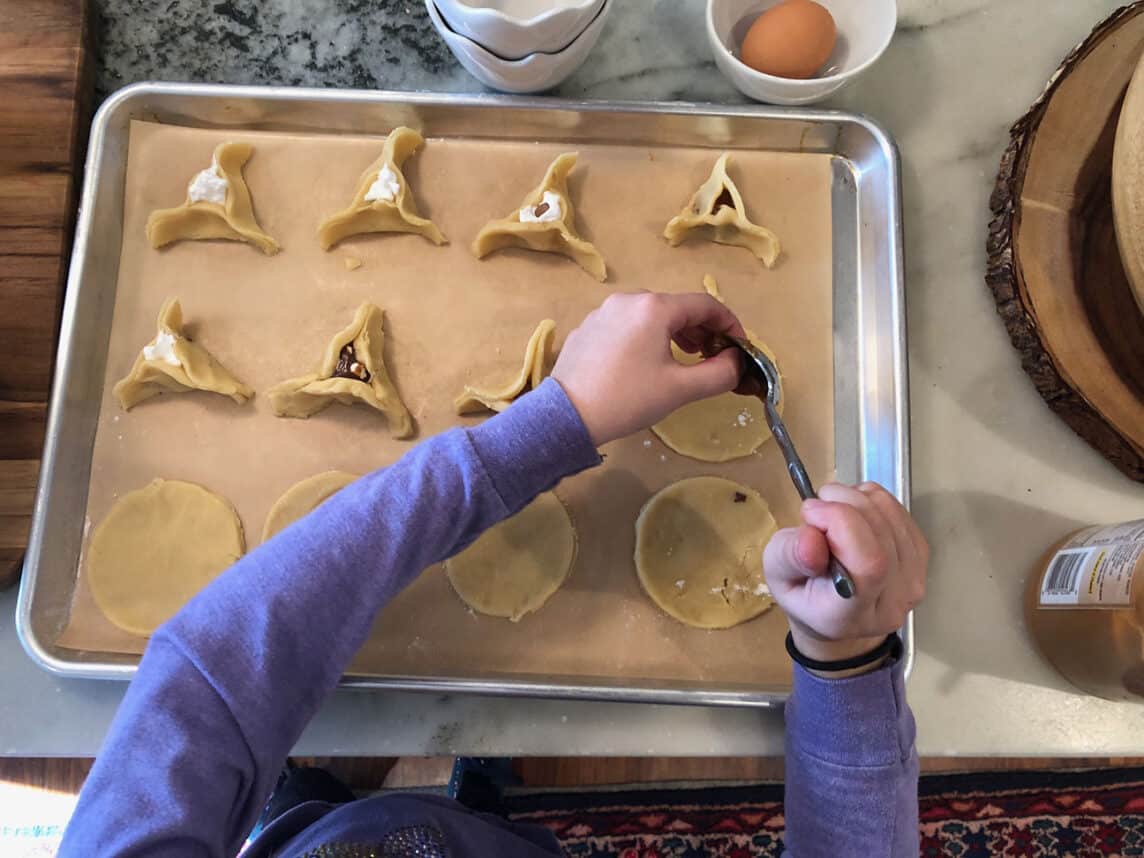
Photo courtesy of Michal Levison

Grandmother Bella’s Hamantaschen Recipe


Dough

4 cups flour

3 sticks butter (she used margarine but I think butter is so much better, and for parve I use vegetable shortening or coconut oil)

½ cup sugar

1 whole egg plus an egg yolk

2 tablespoons baking powder

½ cup seltzer

2 teaspoons vanilla

I like to add 1 teaspoon of lemon zest


Poppy Filling

‎8 ounces whole unground poppy seeds

‎1/4 cup unsalted butter ‎

‎1 cup milk (can sub with almond milk)‎

‎1/2 cup sugar

‎1 tablespoon jam (any jam you like, I prefer apricot)

1 teaspoon lemon zest

‎1/4 teaspoon salt

‎2 large eggs, beaten


Preheat the oven to 350 degrees. Line cookie sheets with parchment paper.

Mix all the dough ingredients together to form a soft ball. Knead for five minutes and form into a flat disc. Refrigerate for at least two hours (or overnight). 

In the meantime, make the filling. Grind the poppy seeds for 20 seconds.

Melt the butter in a pan over medium heat. Whisk in the milk, sugar, jam, zest and salt. Stir until the sugar dissolves.

Crack the eggs into a bowl. Take a cup of the hot liquid and whisk into the eggs. Whisk this egg mixture back into the butter mixture in the pan. Whisk for another 3-4 minutes until the mixture thickens and turns a light yellow. Mixture should coat the back of a spoon. Remove pan from heat and whisk in the ground poppy seeds. Let the mixture cool to room temperature before using. 

Roll out the dough to ¼ inch thickness on a well floured surface. Cut into 3 inch rounds with a cookie cutter or cup. Add 1 teaspoon of filling and draw up the sides to form a triangle shape. Pinch the corners to secure the shape. Place your cookies on the prepared pans.

Bake at 350 for about 15-20 minutes, until golden.


Flower Sugar Cookies

4 1/2 cups all-purpose flour

1 teaspoon baking powder

1 teaspoon salt

1 cup unsalted butter, at room temperature

1 3/4 cups sugar

2 large eggs, at room temperature

1 teaspoon vanilla extract

2 tablespoons milk


In a bowl, whisk together the flour, baking powder and salt, and set aside.

In the bowl of a stand mixer fitted with a paddle attachment, cream the butter and sugar. Mix everything together on medium speed until fluffy and well-incorporated. Add the eggs one at a time, beating well after each addition. Then add the vanilla extract and milk.

Turn the mixer to low, add the dry ingredients and mix until they’re just mixed in. If you want to color the cookies, add your food coloring now. Scrape the bottom and sides of the bowl with a spatula, and finish mixing all the dough by hand. 

Divide the dough in two and flat each half into a disc. Wrap in plastic wrap and refrigerate for half an hour.

Preheat your oven to 350 degrees. For faster clean-up, you can roll out the dough between two sheets of parchment. Otherwise, roll it out on a surface dusted with powdered sugar. Roll the dough to ¼” thickness.

Using a flower cookie cutter, cut out your cookies and place them on a parchment lined sheet pan. To prevent the butter from melting, place the sheet pan in the freezer before you bake.

Bake your cookies for around 10 minutes or until the edges are just starting to take on a little bit of color.

* * *

Debby Segura suggested putting “Daisy Bread” in your spring-themed Mishloach Manot. These are simple challah rolls dolled up to look like flowers. 

“Make a Mishloach Manot basket with one of these, a couple pats of creamery butter and a tiny jar of marmalade,” Segura, a designer, gourmet cook and cooking teacher, told the Journal.

Add posey of Gerber daisies and you are good to go.


Purim Challah Daisies

Photo by Debby Segura

4 ½ cups Better for Bread flour

3 tablespoons sugar

1 tablespoon (or 2 envelopes) Rapid Rise Yeast

1½ teaspoons kosher salt

1 egg

3 tablespoons Canola oil

Warm water

Non-stick cooking spray

Egg wash (Mix together one egg yolk and a tablespoon of water)

Optional sprinkles: Sesame seeds, poppy seeds


Place the dry ingredients (flour, sugar, yeast and salt) in the work bowl of a (large) 14-cup food processor. Into a two-cup glass-measuring cup, add the egg and the canola oil, along with warm water to total 2 cups. Reserve. Place the top on the food processor, and turn it on. Pour in the wet ingredients. Watch carefully, and when the dough Just forms one cohesive ball, allow the machine to continue running precisely 60 seconds, to complete kneading.

Spray a large mixing bowl with non-stick cooking spray. Remove the dough from the food processor and place it in the bowl. Rotate the dough once to coat it with the spray and cover the bowl of dough loosely with plastic wrap. Allow the dough to rise until it has doubled in size, about 1 to 1 ½ hours.

Punch the dough down to remove air bubbles and divide into 9 equal pieces. Divide the first piece of dough into 8 small pieces and roll each small piece into a ball. Flatten each of the remaining 8 pieces of dough into round circular discs each measuring about 5-6” across. Going around the edge of the disc, use a sharp knife to make 6 2” cuts on the edge of the disc, so your dough resembles an asterisk!  Pinch the end of each leg of the asterisk to form 6 petals. Place the dough daisy on a cookie sheet lined with parchment paper. Repeat this process for the other 7 pieces of dough spacing the daisies about 2” apart. With your thumb, make a dent at the center of each daisy and place a dough ball in each dent. 

Lightly spray the dough daisies with non-stick cooking spray, cover loosely with plastic wrap, and allow it to rise again until almost doubled in bulk, about 50 minutes. Paint the dough shapes with egg wash.  Carefully (and generously!) sprinkle as shown in the picture with sesame seeds, poppy seeds, or sugar.

Bake the bread in the center of a preheated oven for 30 minutes or until golden brown. Remove from the pan and cool on a rack.

Spring Themed Mishloach Manot Read More »

Moving the Chairs for Better Holiness – A poem for Parsha Terumah

And you shall place the table on the outer side of the dividing curtain and the menorah opposite the table, on the southern side of the Mishkan, and you shall place the table on the northern side.
-Exodus 26:35

If you’re like me (and I have every reason
to believe you are not) you don’t walk into a room
without rearranging the chairs

especially if you’re in charge of what happens
in that room. It’s not a demonstration of power
but rather a hidden knowledge, or at least

gut feeling that whatever is about to happen
in that room would be better if the chairs
were closer together and maybe curved.

You (probably not, but for sure I) put just as much
thought into how much light you allow to
pour out of the sockets in that room.

Again, not a control thing, but an innate
sensibility that your rearrangements will
allow the room’s impending occupants

to feel so holy, they’ll be talking about
it all the way until they write the next Torah.
They’ll be basing the success of any future event

solely on what they experienced in your room
half of which is because of the intimacy allowed
by your precise chair placement!

People should be as close together as possible.
(Pandemic sensibility be damned.)
If your holy experience isn’t informed by

your neighbor’s breath on the back of your neck
why even bother? Everything in the tabernacle
had its exact place. Where the curtains were hung,

what the colors were they used to weave
the entrance screen together were holy.
So move the chairs if you must.

I know I must.
Your efforts make a difference.
We’re saving souls out here.


God Wrestler: a poem for every Torah Portion by Rick LupertLos Angeles poet Rick Lupert created the Poetry Super Highway (an online publication and resource for poets), and hosted the Cobalt Cafe weekly poetry reading for almost 21 years. He’s authored 26 collections of poetry, including “God Wrestler: A Poem for Every Torah Portion“, “I’m a Jew, Are You” (Jewish themed poems) and “Feeding Holy Cats” (Poetry written while a staff member on the first Birthright Israel trip), and most recently “I Am Not Writing a Book of Poems in Hawaii” (Poems written in Hawaii – Ain’t Got No Press, August 2022) and edited the anthologies “Ekphrastia Gone Wild”, “A Poet’s Haggadah”, and “The Night Goes on All Night.” He writes the daily web comic “Cat and Banana” with fellow Los Angeles poet Brendan Constantine. He’s widely published and reads his poetry wherever they let him.

Moving the Chairs for Better Holiness – A poem for Parsha Terumah Read More »

Jewish Groups Brace for Possible “Day of Hate”

Various Jewish groups have issued statements advising the community on what to do to combat a possible “National Day of Hate” that white supremacists are planning on February 25.

Jewish Telegraphic Agency (JTA) reported that various police bulletins have been warning about a “Day of Hate” that day; the Anti-Defamation League (ADL) has found that Crew-319, an Iowa-based white supremacist group, is behind the Day of Hate. However, the Chicago and New York Police Departments have both said there aren’t currently any “concrete threats” to the Jewish community, per JTA. The Atlantic’s Yair Rosenberg also shared a Facebook post from New York City Councilmember James Gennaro saying that a flyer for the Day of Hate that’s been circulating on social media for the Day of Hate “has been fabricated” but there will be a higher law enforcement presence near synagogues on February 25.

Subsequently, Gennaro’s office posted on Facebook confirmation that the Day of Hate is real.

Jewish groups have issued statements addressing the matter.

“While ADL is not aware of any specific threats, we know that these [white supremacist] groups are hoping for increased antisemitic flier distributions, protests and graffiti,” ADL CEO Jonathan Greenblatt said in a statement. “We know this is frightening; it is completely unacceptable that the Jewish community — or any community — should be targeted by extremists spreading hate and alarm. The hate groups behind this effort hope that we will be afraid and isolated. Instead, we are coming together in resolve and solidarity.” Greenblatt urged the Jewish community to share “a message of unity against antisemitism and hate.” “Before the Jewish Sabbath, please be sure to let your online community know that you will not back down, and you will not be intimidated by extremists,” he said.

The Jewish Federation of Greater Los Angeles said in a statement posted to social media that they “are aware of the possible antisemitic actions taking place on Saturday. Should an incident occur, we are prepared to respond vigilantly.” The Federation added that law enforcement has pledged to increase patrols around the community as a precautionary measure and urged the community “to avoid any public spaces with large gatherings of people demonstrating, as agitators may take advantage of the situation and escalate quickly to violence.”

Stop Antisemitism tweeted, “We strongly urge everyone to be vigilant, specifically during Synagogue services this Shabbat. If you see something, say something and call 911 immediately!”

StandWithUs CEO and Co-Founder Roz Rothstein, the daughter of Holocaust survivors, tweeted out a graphic encouraging the community to celebrate a “Shabbat of Love” to counter the Day of Hate. “This Shabbat: Do something wonderful to counter the ‘Day of Hate,’” StandWithUs tweeted.

Club Z Founder and Executive Director Masha Merkulova urged the Jewish community “to go to synagogue this Shabbat and celebrate loudly, proudly and more joyfully than ever before.” “It is critically important that we do not cower in the face of this virulent Jew-hatred,” she said. “We must show the world that we are not afraid, we will not be silent, and we will always stand united against hate and violence toward the Jewish people. The people of Israel live. The Nation of Israel endures.”

Attorney Gabriel Groisman, the former mayor of Bal Harbour, FL, posted a video to social media encouraging the Jewish community to engage in a “weekend of Jewish pride.” “This weekend I’m asking Jewish men to put on their kippahs,” Groisman said. “Women and everyone else, put on a Star of David. It’s a weekend to be visibly Jewish. Let them see that not only we’re not afraid of them, but we’re proud of who they are.”

The American Jewish Committee tweeted, “Neo-Nazi groups are reportedly organizing a national “Day of Hate” against Jews on Saturday. We will not be intimidated. We are resilient. We are strong. We are #JewishandProud.”

This article has been updated.

Jewish Groups Brace for Possible “Day of Hate” Read More »

Inclusive Shabbat for Jewish Disability Awareness and Inclusion Month

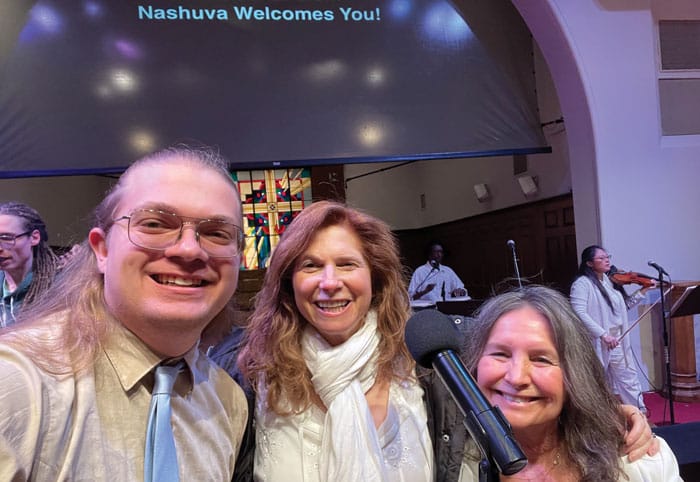
In February, for Jewish Disability Awareness and Inclusion Month (JDAIM) Elaine Hall and The Miracle Project partnered with Nashuva and Temple Aliyah to bring inclusive services to their communities.

“An inclusive Shabbat is a worship service that allows people to worship freely and with joy, expressing themselves in all the ways that they can.” – Mike Stein

“An inclusive Shabbat is a worship service that allows people to worship freely and with joy, expressing themselves in all the ways that they can,” hazzan Mike Stein of Temple Aliyah told the Journal. “Inclusive means that neurodiverse and neurotypical people will sing and participate together.”

“Every Shabbat is an inclusive Shabbat, as we always welcome everyone and there is no exclusivity,” Rabbi Naomi Levy of Nashuva told the Journal. “However, during the month of February, the focus is to make sure that members who are neurodiverse or have other disabilities know and feel that they are treasured and are a blessing.” 

For the last 15 years, the young men and women of The Miracle Project, a theater and film program for children and young adults with and without disabilities, have helped lead Nashuva’s service. This is their second year partnering with Temple Aliyah. They have also done programs with Beit T’Shuvah, Adat Ari El and other synagogues around Los Angeles.

“It never fails that this particular service is not only a source of inspiration, but tears and joy and it’s intensely moving,” Levy said. Hall told the Journal that at a JDAIM Shabbat “those who experience the world differently, either in the areas of cognition, communication, sensory processing or physically, are not only welcomed and included, as they always should be anyway, they are given the platform to become leaders in the congregation,”. 

During an inclusive Shabbat, individuals with autism and other disabilities lead traditional prayers, and also offer their own prayers through song or a speech. Someone from the group will lead the chorus using sign language. In Temple Aliyah’s case, a congregant donated funds for an ASL (sign language) interpreter who signed the entire service. Non-speaking autistic individuals may type their drash and it can be read by another congregant. 

For instance, at the Nashuva service on February 3, Hall introduced her son, Neal Katz, a non-speaking autistic young adult who types to communicate. Using his iPhone as a communication device, Neal said, “Shabbat Shalom.” Hall then read his speech.

“I am grateful for differences or life would be boring. Everyone is different: like creative, athletic, academic, artist, sports star and engineer. Just like ability and challenges, strengths and weaknesses. I really love when people are accepting and inclusive and non-judgmental and celebrate difference and accept that all people are not the same,” he said.

Also at Nashuva, singer-songwriter Adin Boyer, a member of The Miracle Project’s company class, premiered his original song, “Everything,” and  joined the Nashuva band for Debbie Friedman’s “Miriam’s Song,” while Hall and Noa Levy Eshman led the congregation in dance. Levy’s inspiring sermon combined the themes of Shabbat Shira with inclusion. Soon after, Adin, who is working on his second album and announced that he had recently auditioned for “American Idol,” led the congregation in a soulful rendition of Leonard Cohen’s “Hallelujah.” 

“This service is not about a performance,” Hall said. “It is about allowing those members of the Jewish community to lead the congregation in prayer and song. It is about celebrating the strengths and gifts of all of G-d’s creations. It is about B’zelim Elohim.”  

At Temple Aliyah’s February 10 service the Our Space Kolot Tikva Choir and The Miracle Project teamed up with their musicians and other choirs, including the Valley Beth Shalom youth choir. 

Quinn Lohmann, a participant in The Miracle Project, led the congregation in “B’zelim Elohim” by Dan Nichols. Singer/actress Naomi Rubin, a member of The Miracle Project company class who had a recurring role on Netflix’s “Atypical,” led Kolot Tikva in Stein’s original song, “One Breath.” 

Other highlights included a young man on the spectrum from the Kolot Tikvah choir, who is about to become a bar mitzvah, leading the Shema. Susan North Gilboa brought dance music and those with and without disabilities danced at the Oneg.  

“I love to hear our young people who are neurodiverse,” Stein said. “Many of them have extraordinary talents that are not revealed unless they are in this type of situation. Giving our participants the opportunity to be creative, to sing from their hearts, to be applauded and just be who they are is the most satisfying aspect of this entire experience.”

Hall’s dream is that one day there will be no need for a specific month to celebrate disability. Every Shabbat will be welcoming and inclusive of those who experience the world differently.  

“Ramps will be built and mezuzahs lowered on the doors for wheelchair users,” she said. “Each synagogue will have an ASL interpreter, and there will be an audio describer for those who are blind or have low vision. There will be a quiet room for those with sensory sensitivities, and perhaps an all acoustic service adjacent to the regular service for those with whom loud music can be a challenge.” 

Hall and Stein are currently applying for grants and receiving donations through The Miracle Project to create a template for others to create Jewish Disability Awareness and Inclusion Shabbats in every L.A. synagogue and for every service.

“It is very important to see the world through the perspective of someone else’s experience and every single year the young men and women of The Miracle Project and Elaine Hall teach us to pray with a new heart and to see God with new eyes.”

– Rabbi Naomi Levy, Nashuva

“It is very important to see the world through the perspective of someone else’s experience and every single year the young men and women of The Miracle Project and Elaine Hall teach us to pray with a new heart and to see God with new eyes, and to deepen our understanding of what it means that we are all created in God’s image,” Levy said. “This inclusive Shabbat really highlights not just the talents of the students at The Miracle Project, but the spiritual depth that gets opened up for us in ways that are truly unexpected.”

Inclusive Shabbat for Jewish Disability Awareness and Inclusion Month Read More »

A Memorable Shabbat in Las Vegas

I bumped into my friend David Smith recently and was reminded why it’s always a good idea to travel, especially if you cannot be home over Shabbat. I know it sounds weird, but sometimes your house can be your own worst enemy when it comes to life experiences.

Years ago, I was performing in Las Vegas for a week at the Improv at Harrah’s, one of my favorite places to do shows. It has unfortunately closed, and while some of my favorite memories are what a great showroom it was, a particular Shabbat experience I had there that still stands out.

After shows at the Improv we used to have to go outside and sign autographs, T-Shirts, etc. and generally just say hello to the crowd. It was also the week of the Computer Electronics Show (CES), one of the biggest events in Vegas. Almost every room in the city is sold out and while you’d think that would be a great week to be booked at the Improv, it’s one of the slowest comedy weeks there is.

Because so many huge companies are represented, they have massive parties at night, and why would you go to the Improv when, for example, YouTube has flown in Jay Leno to perform? Nonetheless, the shows at the Improv are still good, even when not packed.

When I’m anywhere over Shabbat, part of the fun (for me at least) is trying to figure out what I’m going to do as far as meals, and where I’m going to walk around on Saturday. Vegas is easy. There’s a big Jewish community and my friend Shoshana Siegelstein is the local caterer there.  Once you place an order, she drops off a box with enough food to last you three days. She even has cholent, and you keep the crock-pot! I have a stack of them sitting on top of my fridge back here in L.A. and, over the years, I’ve given many away. Since I’m too far from a synagogue I just do the service in my room and that’s that. Plenty to walk around and see in Vegas also, so no issues there.

One night after one of the shows I was outside signing things and saying hi to the audience as they exited and up walked my friend David. He was in town for another convention. We both go to the same synagogue in L.A. and while it was nice to see a familiar face, it was what he told me that made the weekend turn into a memorable one. CES has a few electronic companies that have a high percentage of Orthodox Jews who work there. David said that since CES ended late Thursday and that many of them could not fly back Friday and get back to the east coast before Shabbat started, they were staying through the weekend. “They are having services Friday night and Saturday morning at the Bellagio,” David told me. “Meals are there also. Just show up.” Apparently, a wealthy owner of one of the larger companies was sponsoring the whole thing. I told David I didn’t really have appropriate attire for a synagogue atmosphere but he said not to worry about it.

It was wintertime and Shabbat started about 4:30 PM. The service was early and I had plenty of time to attend and even go to dinner before I had to go back and do two shows, one at 8:30 and one at 10:30. While in a perfect world I’d obviously rather not do shows on Friday night, it never really bothered me that much. As far as Shabbat stuff, I’d do as much as I could, hold the mic slightly differently (there is a concept called “shinui” where you do things in a different way to make a distinction that it’s the Sabbath) and once I was offstage, I never lost sight that it was Shabbat. I even checked with a buddy of mine who is a strict, observant Jew and asked if I was doing anything wrong as far as the mic (it’s very technical as far as electrical output, etc.) and I remember him telling me, “Probably not. Not with today’s sound systems.” Would an ultra Orthodox guy do it? Highly unlikely, but to each his own.

I showed up Friday night and what amazed me was just how different everyone was. I fit right in, because no one really did. There were people well dressed, some in jeans; some religious, some not so much, ultra-Orthodox, Askenazi, Sephardi, Americans, Israelis, you name it. Chabad was hosting the event and following the service, which was a mashup of Ashkenazi and Sephardi, we were all invited into the large banquet room next door for a lavish dinner. It was open seating and Jews with payot hanging on the side of their heads were sitting next to Israelis in jeans and everyone was having what seemed to be a great time. When I told some of the people at the table I actually had to get back because I had a show to do, there was zero judgment from the more religious guys. Only, “Can we come tomorrow night?” I immediately said of course and told them I’d put them on the guest list.

Right before I left, though, the Rabbi stood up and thanked everyone for coming. He even implored everyone there to come back the next day saying they not only had a large Kiddush, but a big lunch as well. He told us to tell friends to come also and that the sponsor had flown in the babka and herring he liked from Brooklyn.  No messing around as far as the food went!

The next morning I showed up and the service was being led by a Sephardi guy and I remember making eye contact with another Ashkenazi guy. We were both totally lost and gave the “I have no idea what’s going on” shoulder shrug as the beginning of the service sounds quite different.

Once the Sephardi guy leading got to the second part starting with Barchu, he simply turned around and went, “Ashekenazim!,” then motioned his head like it was our turn to take over. He was sharing and wanted to make sure we knew what was going on. They took part one, and we would handle part two. We all looked around seeing if anyone wanted to continue leading the service and eventually a Hasidic guy jumped up with some pleasant nudging from a few people.

The Torah reading was also divided up on the fly between Sephardim, ultra-Orthodox Satmar Hasidim, and some modern Orthodox guys. It was like a Jewish United Nations gathering without the Israel bashing … even from the Satmar guys!

When the service ended it was a little too early for lunch so on one of the balconies there was a huge Kiddush set up with the herring and babka that was flown in and plenty of other stuff. Since we were at the Bellagio, it felt like we were in a fancy neighborhood in Italy overlooking a mountain village outside of Tuscany. Various staff were walking around recording and taking pictures with their phones.

After a period of schmoozing we were all invited into one of the banquet rooms for lunch. The food was great, and the atmosphere could not have been friendlier. Here I was, a modern Orthodox hard core Zionist, sitting with Satmar Hasidic Jews who were the farthest thing from Zionist, and, instead of focusing on our differences, we did the opposite. It was a bunch of Jews enjoying Shabbat, just that simple.

By the time the meal ended, a bunch of guys said they would see me at the show that night, and they all showed up. I was put on the WhatsApp group for the Jews that came to CES every year and continued to receive their messages pretty much up until COVID.

When people ask about meaningful Shabbats they have had, I’m sure there are some in Jerusalem, family reunions, and many other obvious ones that pop up. But every now and then, if you let it happen, some of the best religious experiences can come when you least expect it. Especially when you’re out of town, with a bunch of Jews from all over the world, in Sin City, in the heart of a casino.

You never know.           

A Memorable Shabbat in Las Vegas Read More »

Print Issue: On Edge | February 24, 2023

CLICK HERE FOR FULLSCREEN VERSION

Print Issue: On Edge | February 24, 2023 Read More »

How Do We Carry Joy and Sorrow at the Same Time?

On my way to a morning beauty appointment, I felt squeezed by guilt. This bit of deferred maintenance was both expensive and indulgent, a rare treat. While I’d looked forward to it for weeks, my little vanity mission felt misplaced and inappropriate. Our community had just suffered the devastating loss of a beloved teacher and community member. I then received shocking news that the husband of a close friend had been diagnosed with cancer, already metastasized and raging through his body. A series of terrorist attacks in Israel murdered or severely injured precious, innocent lives, including children. And I was worried about laugh lines and my collagen’s retirement?   

Balancing life’s ups and downs often requires us to toggle between feelings of joy and grief. Lately, though, the waves of bad news felt like a tsunami and harder to manage emotionally. Personally we had joy, including the welcome arrival of a new granddaughter, Libby, named for my dear mother and the first child of our daughter and son-in-law. We also expect another new grandchild any day now in Norfolk, Virginia, the third such blessing for one of our sons and his wife. 

How do we make space for sadness and compassion while also allowing our full measure of gladness and joy? First, we cry. When my mother passed away a mere two weeks before our eldest son’s bar mitzvah, I got up from shiva only to face the task of making table cards for guests and thinking about balloons. It was hard to jostle my focus from the low chair of bereavement to a festive brunch buffet.

Emotional tears — the only salty ones, by the way — also release oxytocin and endorphins. No wonder we feel better after a good cry.

Because I was still in the first month of mourning at the bar mitzvah party, I walked up and down along the shul’s foyer while the comedian we hired told jokes. As I walked, the tears I cried expressed both joy and pain. Recently, I was fascinated to learn that we shed three types of tears: reflex tears that cleanse foreign matter from the eye; basal tears that coat the eye and supply nutrients; and emotional tears, which flush stress hormones and other toxins out of our system. Emotional tears — the only salty ones, by the way — also release oxytocin and endorphins. No wonder we feel better after a good cry.  

A Midrash says that tears were God’s gift, a sign of His love for Adam and Eve after they were banished from the Garden of Eden. Who wouldn’t cry leaving that garden and having to tough it out in the big, wide, turbulent world? The first couple would face inevitable sorrows and difficulties. God said, “For this reason I give you out of My heavenly treasure this priceless pearl. Look! It is a tear! And when grief overtakes you and your heart aches so that you are not able to endure it, and great anguish grips your soul, then there will fall from your eyes this tiny tear. Then your burden will grow lighter.”

It takes a sophisticated mindset and robust faith to hold feelings of sorrow and joy simultaneously. In ancient times, the only people at a high enough level to receive Prophecy not only had to be wise, pious, calm, and focused on serving God; they also had to live in a state of simcha, or happiness. Yet in that complex emotional state where happiness lived, Prophets had to accept and relay God’s stern warnings to the Jewish people about changing their behavior if they were to prevent disaster. What a task!  

When my beauty treatment was over, I refocused on what I could do for others. I supported my friend whose husband was so ill through phone calls and texts. I began writing something to help honor the memory of our community member and teacher. I davened and recited Tehillim for the injured and sick in our community and beyond.

I reclaimed my natural feeling of happiness and equilibrium, assured that this is how we are meant to live. Today, I rejoiced in the music and movement of the first dance class I’ve attended in a few years. At the final moment of the class, the instructor said, “Raise up your hands to bring the energy down!” And I did.


Judy Gruen’s latest book is “The Skeptic and the Rabbi: Falling in Love With Faith.”

How Do We Carry Joy and Sorrow at the Same Time? Read More »

Rabbis of LA | For a Sci-Fi Rabbi, Yehuda Hausman Sounds Quite Traditional

Fresh from serving Jewish Journal readers a deeply knowledgeable dose of ChatGPT and other strains from the artificial intelligence universe a week ago, Rabbi Yehuda Hausman demonstrates this time that he is capable of engineering a few surprises.

You might think that one so knowledgeably armed with the latest scientific discoveries would shun tradition.

That would be exactly wrong.

A dozen years after his ordination, the Los Angeles native was asked where he is in his journey. “When I close my eyes and think about Judaism,” said Rabbi Hausman, “I see a Beit Midrash (Torah study hall) … It is neither a library, nor a classroom nor a synagogue. It is all of them together. There are books on the walls, commentaries piled on tables and chairs, and people discussing them.” Then, the rabbi/educator said, ”I open my eyes. I realize I have spent my entire day working on a computer.”

While Yehuda Martin Hausman calls himself a sci-fi rabbi who daydreams of keeping Shabbat on Mars, he can sound quite traditional. He says he chose the rabbinate as a career “because I wanted my professional and spiritual lives to align.”

For a while, Hausman acknowledges, his plan worked. “I had a few years where I taught rabbinic students at physical campuses,” at the Ziegler School of Rabbinic Studies at American Jewish University and at the Academy for Jewish Religion California. Once a week he would drive to Encino to participate in Valley Beth Shalom’s Melton Classes.

Reflecting years later, Hausman realizes more than ever the value of in-person learning. “Long before the pandemic, I would tell myself, ‘We are the People of the Book. There can be no Judaism without books. Jewish community means physical community.’”

And yet, he acknowledges the reality of the digital revolution. “COVID showed us that even communal prayer, song, weddings and funerals can take place in cyberspace,” said Rabbi Hausman. This revolution has made the rabbi, to borrow a popular phrase, “feel like a stranger in a strange land.”

“Campus rabbis are expected to be on Facebook,” Hausman notes. “Synagogue rabbis must give webinars, and they also need to be available through Zoom.”

It is not surprising, then, to hear him declare his ambivalence for these ultra-modern platforms. He is constantly threading the needle between the real and the virtual, trying to make the best of each.

“Many of my colleagues and my former students have seemed to adapt and succeed rather well,” he concedes.

“What concerns me, what keeps me up at night, is that we do not anticipate.  We have no idea what is coming — until it arrives.” 

“What concerns me,” said Hausman, “what keeps me up at night, is that we do not anticipate.  

“We have no idea what is coming — until it arrives.” 

Lately Hausman has taken a break from thinking about today’s technological disruptions. Instead, he has begun thinking about what will confront the Jewish communities 50 and 100 years from now. Speaking of that distant time, what intrigues Rabbi Hausman about artificial intelligence? 

“Right now, everyone is asking the usual questions,” he says: “How can AI help us in healthcare, in criminal justice, in traffic co-ordination, in filmmaking? Or how can ChatGPT contribute to a religion such as Judaism?”

He speculates that decades from now, if society gets to a point where there is sentient AI, the question Hausman would pose is: “What religion would appeal to an artificial intelligence?” 

Hausman asserts that, for him, there is one answer: Rabbinic Judaism. 

He contends that computers follow their programming. They cannot sin. Therefore, they have no need of forgiveness or grace. Driving further down his logical freeway, Hausman asks: “Why would an AI want to meditate or pray? Or recite blessings over food it cannot eat? Therefore, for fulfillment, all it leaves are education and learning.

“Maybe,” he wishes wistfully, “it will be the AI’s who turn humanity back to books.”

The rabbi was asked if artificial intelligence is as central to his day-to-day life as it appears.

“In our house, we have Siri and Alexa,” Hausman said. “I see Google’s Waymo cars all over town, and tiny self-delivering (Wall-E) carts in Santa Monica and Hollywood. So, yes, AI is a big part of life.”

When asked his preferred teaching topics, the rabbi responded candidly: “Everything but Kabbalah and Computer Programming,” he said. “Both are equally esoteric.”

“Mark Twain said, don’t let your schooling interfere with your education. I have always taken that to heart.”

He identified four subjects – books, sci-fi, fantasy and poetry — as the most influential factors in his growing-up years. And, yes, one personality: 

“Mark Twain said, don’t let your schooling interfere with your education. I have always taken that to heart.”

Fast Takes with Yehuda Hausman

Jewish Journal: Have you ever encountered conflicts with Traditional Judaism?

Hausman: Judaism is about preserving tradition, and every day the world changes faster.

JJ: If you could travel anywhere, where would you go?

Hausman: The future. Obviously.

JJ: What is your favorite Jewish food?

Hausman: Haroset.

Rabbis of LA | For a Sci-Fi Rabbi, Yehuda Hausman Sounds Quite Traditional Read More »

Campus Watch Feb. 23, 2023

ADL CEO: GWU Needs Better Response to Antisemitism on Campus

Anti-Defamation League (ADL) CEO Jonathan Greenblatt called on George Washington University (GWU) to improve their response to antisemitism on campus in a February 17 Times of Israel blog post.

Greenblatt recapped the complaint filed by StandWithUs in January alleging that Assistant Professor of Psychology Lara Sheehi told a student it wasn’t their fault they were born Israel, called Zionism a mental illness and told a student that anti-Zionism is not antisemitism. Greenblatt commended the university for denouncing antisemitism and conducting a third party investigation, but asked: “Why has GWU not condemned the professor’s statements, or at least considered administrative leave pending the outcome of the third-party investigation? These steps would help to assure Jewish students, and send a message to the broader community, that the allegations are being taken seriously.” He also called on universities “to work directly with Jewish students” and measure their “progress by checking in with Jewish students and stakeholders to ensure that they feel as welcome and supported as other groups.”

Dorm Rooms of Three Jewish Students Vandalized at University of Denver

The dorm rooms of three Jewish students at the University of Denver (DU) were vandalized sometime during the timeframe of February 9-12.

StandWithUs announced in a press release that one student’s dorm was smeared with pork and the pork was left in front of their doorstep; two other students’ dorms had their mezuzahs torn down. 

University Vice Chancellor of Student Affairs and Inclusive Excellence Todd Adams said in a February 13 letter to student that the university investigating the matter. “We want to be very clear that these acts are NOT acceptable within DU’s community, and acknowledge the harm that has been caused to members of our community,” Adams said. “Every student, faculty, and staff member deserves a place to live, learn, and work that is respectful, welcoming, and safe.”

Antisemitic Slurs During Florida High School Soccer Game Fight

A fight occurred during a soccer game between two Florida high schools where antisemitic slurs were allegedly thrown around.

Fox News reported that the game was between Scheck Hillel Community School and Archbishop Coleman Carroll High School on February 15; parents of Scheck students have claimed members of the Carroll team shouted “Hitler was right” during the fight. Additionally, Stop Antisemitism tweeted that a Scheck student told them he was called a “dirty Jew” while being punched in the face.

The schools issued a joint statement denouncing the incident and are investigating it. “The Archdiocese of Miami and Scheck Hillel have zero tolerance for any kind of aggressive language and behavior, antisemitism or hate of any kind,” the statement read. “We are thankful for the faculty of both schools, who immediately managed the situation with care and concern for the students.”

UC Berkeley Student Senate Votes Against IHRA

UC Berkeley’s student senate voted against the International Holocaust Remembrance Alliance (IHRA) definition of antisemitism during a February 15 meeting that lasted until 3 a.m.

After a five-hour long discussion, the Associated Students of the University of California (ASUC) Senate voted to indefinitely table the resolution by a vote of 13 in favor, four against and three abstentions. ASUC Senator Shay Cohen, who introduced the resolution, posted to Instagram afterwards, “The AUSC failed the Berkeley Jewish community last night. Telling a minority group how they should define their lived experiences of oppression, discrimination, and hatred is never acceptable. Once again, Jewish students are left feeling unheard and discouraged to display their Jewish pride on this campus.”

“Exterminate Zionists!” Sticker at UIUC

A sticker saying, “Exterminate Zionists!” was found at the University of Illinois Urbana-Champaign (UIUC) campus.

Stop Antisemitism tweeted out the photo on February 17, stating: “The old antisemitism of the Holocaust has now taken a new contemporary twist simply by replacing ‘Jew’ with ‘Zionist’. Both must be shunned by modern society.” The sticker had “UIUC YDSA” written on it, an apparent reference to the school’s Young Democratic Socialists of America chapter, as well as “SSL” (Students Socialist League) and “Coalition of Public Power.”

UIUC YDSA issued a statement the sticker was “impersonating” them, SSL and Coalition for Public Power, suggesting the sticker got the last group’s name wrong. UIUC YDSA said that the sticker was indeed antisemitic. “UIUC YDSA condemns all forms of antisemitism and this fake sticker attempting to misinform people about the beliefs of organizations standing in solidarity with Palestine,” the statement read. “Socialists stand for liberation of the oppressed, and anyone that expresses views similar to the content similar of the fake sticker are not in line with our values.”

Campus Watch Feb. 23, 2023 Read More »

A Community on Edge

February 15, 2023, 9:45 a.m.: A Jewish man in his 40s was shot on the 1400 block of Shenandoah Street in the Pico-Robertson area after leaving prayer services. Two gunshots were fired, one of which hit him in the back. He survived.

February 16, 2023, 8 a.m.: Another Jewish man, this one in his 70s, was shot in the same neighborhood, this time on the 1600 block of South Bedford Street. This victim was also leaving morning services when he was shot; the gunman fired three times, one of which hit the victim in the bicep. He also survived. According to one source, the bullet went through the victim’s arm. 

In a span of 24 hours, two shootings against Jews suddenly put a Jewish neighborhood on edge. The details surrounding the shootings kept changing, which added to the anxiety.

Law enforcement initially believed the two shootings were not connected and were done by two different people. It was also initially believed that the first shooting may have been the result of personal dispute rather than antisemitism, whereas the second one was being investigated as a hate crime.

Subsequently, the Los Angeles Police Department (LAPD) said they believed the two shootings were done by the same person and that they were hate crimes. This announcement prompted Anti-Defamation League (ADL) Los Angeles Regional Director Jeffrey I. Abrams to issue a statement saying that “the LA Jewish community is on high alert.” 

A couple of hours later, the LAPD announced that a suspect had been arrested in Riverside County and was in custody. Abrams issued a follow-up statement that evening calling the arrest “a sigh of relief to L.A.’s Jewish community.” American Jewish Community (AJC) Los Angeles Regional Director Richard S. Hirschhaut tweeted that they were “relieved that the suspect in the Pico-Robertson shootings has been arrested. We commend @LAPDWestLA for their relentless pursuit of the alleged perpetrator and for treating these attacks as presumptive hate crimes. Keeping a community safe requires community-wide engagement. As horrific as the shootings were, we are heartened by the cooperation between @LAPDHQ and a host of community organizations. This is police-community relations at its best.”

Los Angeles Mayor Karen Bass said in a February 17 statement, “Antisemitism and terror are tragically on the rise across our city and across our nation. My administration is resolute against hate, and we have made it a chief component of our public safety agenda.” District Attorney George Gascon’s office announced that they were handing over the matter to the FBI and U.S. Attorney’s office, as the shootings involved multiple jurisdictions and the gunman was being charged with federal hate crimes. 

“Over the past two days, our community experienced two horrific acts we believe were motivated by antisemitic ideology that caused him to target the Jewish community,” United States Attorney Martin Estrada said in a statement. “It is important, especially in one of the most diverse areas in the world, that we celebrate our differences, and stand together to oppose acts of hate.”

Donald Alway, assistant director in charge of the FBI’s Los Angeles Field Office, also said in a statement, “In addition to targeting innocent people with violent physical attacks, these crimes instill fear in the community. There is no place in Los Angeles and, indeed, the United States of America, for fear to control communities and to intimidate people of faith. Law enforcement will work together to prevent hate crimes, whether they be civil liberties violations or acts of terror. On behalf of the FBI, I wish a full recovery to the victims who were senselessly attacked for their faith, as well as peace to the Jewish community.”

So, who is the gunman behind these shootings? A federal affidavit filed on February 17 identified him as Jaime Tran, 28. Tran had been homeless for the past 12-14 months and was living out of his car, a 2012 Honda Civic. Law enforcement was able to track him to the Palm Springs area thanks to cell phone location data; authorities later responded to reports of a man firing a gun in Cathedral City, where they found Tran with an AK-style rifle and a .380 caliber handgun in the front seat of his car. Tran was subsequently arrested. “It didn’t take very long,” Cathedral City Police Department Commander Jon Enos told KESQ-TV. “There was no struggle. But once we realized who he was, we secured him in a car. And then we made contact with the Los Angeles Police Department, who eventually sent over some representatives.”

Tran later claimed to have obtained the firearms from an unknown person in Arizona.

According to the affidavit, Tran admitted to law enforcement that he was the gunman and was driven by anti-Jewish animus; in fact, he used Yelp to find a kosher supermarket and chose his victims based on their “head gear.”

According to the affidavit, Tran admitted to law enforcement that he was the gunman and was driven by anti-Jewish animus; in fact, he used Yelp to find a kosher supermarket and chose his victims based on their “head gear.” Both victims wore head coverings. Tran chillingly asked law enforcement if the victims had died.  

Tran apparently has a history of antisemitism, as the affidavit cited an instance in which a former classmate of Tran’s, simply known as M.N.H., received multiple antisemitic phone calls and texts from Tran from August-November 2022. Tran had been expelled from dental school in 2018; the affidavit doesn’t indicate which school he attended, but The Los Angeles Times reported that it was UCLA Dental School. Some of the antisemitic text messages from Tran highlighted in the complaint include:

• “F—king Jew. Piece of shit Jew. F— YOU JEW. JEWBAG JEWBAGEL JEW.”

• “Someone is going to kill you, Jew. Someone is going to kill you, Jew. Someone is going to kill you, Jew. Someone is going to kill you, Jew.”

• “F—ing b—- Jew. Your mom is a slutty whore, your sister is a man, and your dad sucks dick for a living. Burn in an oven chamber you b—- Jew.”

The last text included a picture of a gas chamber, per the complaint.

Additionally, Tran sent multiple emails to former classmates toward the end of 2022 blaming COVID-19 vaccine mandates and lockdowns on “Iranian Jews” and referred to “Persian Jews” as being “primitive” and “narrow minded,” and who “scrap nickel and dimes” and “never donate to any charities.” “Going forward, I hope you all spread the word to your loved ones about the origins of COVID,” he wrote in one email. “I tagged the Iranian Jew, such as [M.N.H.], and his associates in this email so you could ask them about it. I also hope they quit putting tabs on me to the Jewish community and creeping on all of my socials.”

In another email Tran accused the “Persian/Iranian Jew of the Class of 2020” of fabricating COVID-19 and basing it on an “anesthesia incident that I had with” a couple of former classmates; it was not immediately clear what that anesthesia incident was. He also sent a picture of a flyer stating, “EVERY SINGLE ASPECT OF THE COVID AGENDA IS JEWISH.” Such flyers had been found multiple times in LA throughout the past year and are associated with the Goyim Defense League (GDL), a white supremacist group headed by Jon Minadeo II of Petaluma. Stop Antisemitism tweeted that this shows how Minadeo and the GDL “poison minds with their antisemitic flyers and cause real world violence against Jewish people.”

Other Jewish groups also condemned Tran’s reported antisemitism in statements to the Journal.

“The charging document for the shootings of two Jewish men details the actions of an individual with a deep hatred for Jews whose antisemitism motivated him to violence,” Abrams said. “It simply doesn’t get any scarier or more dangerous for the Jewish community. We are grateful that the immediate terror of this incident is behind us but recognize that antisemitism continues to take hold of our community.”

Hirschhaut said, “The Federal complaint against shooting suspect Jaime Tran reveals a litany of disturbing social pathologies, underpinned by vitriolic conspiracy theories about Jews, and Persian Jews in particular. That Tran was able to spew such hateful and threatening invective, targeting former classmates and others with impunity, begs the question of why there was no meaningful intervention before he ultimately acted upon his violent intentions.”

StandWithUs CEO and Co-Founder Roz Rothstein, the daughter of Holocaust survivors, said: “It is horrifying that once again, classic antisemitic tropes spewed by a deranged man escalated to violence against the Jews he collectively blames for COVID 19 and financial losses. Scapegoating Jews for one’s frustrations is a classic antisemitic tactic that we must, as a society, identify and reject as the bigotry it is.”

“Blaming Jews for disease and plague is a historic antisemitic trope.” – Robert J. Williams, USC Shoah Foundation

“Blaming Jews for disease and plague is a historic antisemitic trope,” Robert J. Williams, Finci-Viterbi Executive Director of the USC Shoah Foundation, said in a statement to the Journal. “The shooter claiming Jews were responsible for COVID is just the latest version of the same lie. These events remind us why it’s so important to combat disinformation.”

After a hearing on February 17, Tran is being held without bail. He faces a lifetime maximum sentence in federal prison without parole.

Though the affidavit does not mention it, Tran does have a prior criminal record. On July 3, he was arrested for felony possession of a firearm on a school campus. The Orange County Register reported that CSU Long Beach Vice President for Administration and Finance Scott Apel sent a February 17 letter to students saying that Tran was arrested after university police received a call of a man sitting on a bench with a firearm, and police later found that the firearm in Tran’s possession was stolen. Tran is reportedly an alumnus of the university. According to the Times, Tran claimed that he was carrying the firearm as a means of self-defense. 

Siamak Kordestani, West Coast director of the European Leadership Network, noticed that county records showed that Tran was released on bond, prompting him to ask Gascon’s office in a tweet what happened to the case. He received a reply from Gascon’s office on Twitter, who wrote that “at the time of that filing he had no previous criminal record & LADA was not made aware of any allegations of threats against the Jewish community.” 

In response, Gascon’s office tweeted that Tran’s bail was set at $30,000 and he posted bond. Fox News reporter Bill Melugin noted on Twitter that the felony firearm charge that Tran faces has a three-year maximum prison sentence and that Gascon’s directives requires deputy district attorneys “to avoid seeking cash bail, and if they do, seek the lowest amount, & it must be ‘aligned with the individual’s ability to pay.’ What was the sentence for this gun case?” Gascon’s office replied that the case remains open and that Tran is scheduled to appear in court on February 28 on the matter.

“The community is still afraid and there’s also anger. And the anger, I believe, is that we know that no matter where antisemitism comes from — whether it’s from the left or the right — the victims of antisemitism are always the same, which is us Jews.” – Rabbi Noah Farkas, head of Jewish Federation of Greater Los Angeles

While the LA Jewish community may have been able to breathe a sigh of relief once Tran was arrested, some argue that anxiety remains high in the community. Rabbi Noah Farkas, who heads the Jewish Federation of Greater Los Angeles, told the Journal in a phone interview that “the community is still afraid and there’s also anger. And the anger, I believe, is that we know that no matter where antisemitism comes from — whether it’s from the left or the right — the victims of antisemitism are always the same, which is us Jews. And we know that we have been sounding the alarm since last year, since Colleyville, since the Kanye West and Kyrie Irving things. For a long time now, we’ve been sounding the alarm that when you normalize hate speech, and if you have more followers on Twitter and Instagram than there are Jews in the world and you normalize this kind of hate speech, we know historically, we know sociologically, that hate speech leads to hate crime … and that’s exactly what has happened.”

Dr. Hillel Newman, Consul General of Israel in Los Angeles, told the Journal that he addressed the Pinto Center on Pico Boulevard during Shabbat services on February 17 and that while congregants were “somewhat shaken” they were in “good spirit[s].” “Rabbi Pinto is a wonderful, kind and gentle spiritual authority who leads the community in a most noble way, enjoying great admiration,” Newman said. 

In general, Newman’s sense is “that many in the community are on edge now, feeling uncertain about the future, but the majority are calm.” “There is increased interest in making Aliyah,” he added. “I feel that from the many questions I get in this regard. Of course, we will welcome anyone who wishes to immigrate to Israel, but we believe that first and foremost we must guarantee the safety and security of everyone and every community.”

Security remained a priority for the community over the weekend, as police increased patrols in Jewish community areas.

Security remained a priority for the community over the weekend, as police increased patrols in Jewish community areas. Both Young Israel of Century City and Beth Jacob Congregation sent out emails to their members, both of which were obtained by the Journal, saying that they would be beefing up their security after the shootings.

“Everyone is increasing their security profiles,” Farkas said.

Evan Bernstein, who heads the Community Security Service (CSS), said in a statement to the Journal, “The Los Angeles Jewish community should be reassured that the CSS Western States office is closely monitoring and working with its trained security volunteer leadership and teams on the ground, local law enforcement, and national Jewish communal security partners, including the Jewish Federation of Greater Los Angeles. We stand ready to continue ensuring the utmost safety and physical security of Jewish institutions nationwide.”

“Jews shouldn’t have to be fearful of expressing their First Amendment rights that every other American can enjoy — our right to assemble and our right to pray — and this just isn’t right,” Farkas told the Journal, “and we have to keep working to make life safer and more enjoyable for Jews to live here in the city.”

A Community on Edge Read More »