fbpx

February 23, 2023

A Tropical Cyclone, Middle Eastern Mezze and OBKLA

In November 2021, we were full of plans. Alan was determined to finally take a trip to Japan over the winter holidays, so he booked five tickets to Tokyo on Japan Airlines. Luckily, he decided to check their COVID policy (no tourists, only business travelers with a 10 day hotel quarantine) and he canceled our flights in the nick of time.

He tried to book a vacation in Hawaii but there was nothing available. Fiji was showing up in my Facebook feed. Fiji is a quick four hour plane trip from Sydney, Australia and my uncles, aunts and cousins vacation there all the time. The photos always look amazing. So Alan took my hint and booked us for 7 nights at the Marriott Momo Bay Resort.

Rachel and I were also busy making plans for cooking demos at Beth Jacob and Kahal Joseph, healthy cooking for Sharsheret and a special collaboration with OBKLA (Our Big Kitchen Los Angeles). We spoke with Chaya Segelman, who alongside her husband Yossi, runs this remarkable organization that provides nutritious, delicious meals for needy families. We sent Rachel’s recipe for albondigas, Spanish meatballs with potatoes and peas and my recipe for bright yellow Saffron and Turmeric rice. Chaya even printed up special stickers for this special Sephardic Spice Girls x OBKLA event. And we had a long list of volunteers ready to chop, prep and pack meals.

Before we left for our vacation, our youngest daughter Shevy had a bad cold. We kept testing her for Covid but the tests were negative and we were able to board the 11 hour flight to Fiji.

We arrived at our resort and it was tropical paradise. We spent our days swimming and kayaking and snorkeling and eating. Our eldest daughter Gabriella caught a cold and we thought nothing of it (ignoring the dire warnings of our middle daughter Alaxandra). On the last day of our vacation, we packed our bags and got in line to get our COVID tests. We were all negative, except Gabriella.

Well, Fiji has a Covid protocol that requires a 10 day quarantine. Alan needed to go back to work and the girls needed to get back to school. Gabriella and I were stuck in Paradise.

The resort placed all their Covid guests in villas on a faraway bay with a private beach (the Aussies that were stranded there with us called it “Covid Island”). The view from our patio was truly beautiful with white sand, swaying palm trees and stunning blue water. Fish splashed out of the water, birds swooped through the sky and off in the distance we heard the deep bellows of mooing cows. It was truly magical.

I tried to relax and enjoy the beauty. I tried to focus on the gift of spending time with Gabriella before she left for college. Every morning, we enjoyed a flat white coffee and tropical fruits for breakfast. We went for walks along the rugged coastline of the resort, we watched the waves and looked out over the vast expanse of the Pacific Ocean. We sat on the jetty and enjoyed the view of a distant hill covered with thick green foliage. We swam in the bay. We ordered every single vegetarian option on the menu. We read novels. We watched BBC News, the Big Bang Theory and Jane Austen movies. We drank endless cups of excellent Twinings Tea and we enjoyed all the Australian potato chips and chocolate that I bought at the gift shop before entering quarantine.

Luckily for me, I was stuck with my most relaxed child and we tried to make the most of the situation. But it was difficult to relax knowing that my family needed me in Los Angeles.

On Tuesday, I stepped on a sea urchin, which released thousands of soft black needles in my foot. My foot swelled up and it was extremely painful. I spent the rest of the time in Fiji taking antibiotics and soaking my foot in a pail of water, hoping to coax those needles out. On Thursday, it started to rain. On Friday, it was a deluge and a tropical cyclone had hit Fiji hard. I called the Covid guy and begged him to let us leave on Sunday instead of Monday. And he agreed.

On Saturday, the rain was still pouring nonstop and the power went out and the hotel electricity operated on a backup generator.

On Sunday morning, we were released from our luxurious prison. Gabriella and I packed our bags, then we breakfasted at the lagoon restaurant watching the pouring rain and listening to the howling wind. In the afternoon, we left for the airport. Our driver encountered flooded roads, but he backtracked through the town and got us to the airport.

We were next in the check-in line, when all the lights in the departure terminal went out. Somehow, we made it onto the plane several hours later. The rain and the wind were still unrelenting. I have never experienced such a steep ascent as the one that the Fiji Airways pilot took that night.

It felt good to get off the island. It was even better to be embraced by Alan at LAX.

—Sharon

Chaya saved those stickers and the recipes we gave her. And we were finally able to reschedule our event for this month and as an added bonus, we invited Sivan Kobi of Sivan’s Kitchen to join us.

The list of people who wanted to volunteer kept growing and growing, so Sharon and I decided that we would make a Mezze table for them to enjoy. We made the salads that we make for our family and friends every Shabbat.

It wasn’t easy to cater because we’re not used to cooking in an industrial kitchen. The pots and pans are huge, the flames on the stovetop are bigger and the ovens are much hotter and stronger. I gave up on measurements and decided to cook by feel. Soon, I got into a rhythm and gained momentum, and everything came together.

It reminded me of the advice I often give about cooking. Taste your way through the recipe. Adjust the seasonings to your likes. Add spices, more water or oil. Maybe the food needs to cook a little longer than the recipe states. There don’t have to be hard and fast rules.

It was thrilling to see the fantastic crowd that showed up to give back. It really turned into a fun party with people mingling and energetic Israeli music. It was equally exciting to see them enjoy the lach’majin, hummus and salads that we had prepared.

After chopping, preparing, and packing the meals, everyone enjoyed Sivan’s melt in your mouth tahini cookies for dessert.

When Global Kindness arrived to pick up the food, they told us that people were already lined up in anticipation. My heart ached, but I was also proud to be part of a community that cares.

Roasting the cauliflower with generous amounts of curry and turmeric makes the flavors pop. Adding roasted garbanzos and salted cashews add meat and crunch and the bed of creamy tahini make it heavenly. 

The recipes we share with you are truly easy to make and so incredibly healthful. We really hope you add them to your repertoire. The eggplant salad is soft, silky and luscious and really benefits from a slow braise. Roasting the cauliflower with generous amounts of curry and turmeric makes the flavors pop. Adding roasted garbanzos and salted cashews add meat and crunch and the bed of creamy tahini make it heavenly.The cabbage sald is positively addictive — the licorice flavor of thinly sliced fennel and crispy apple are highlighted with a dressing of oilive oil, apple cider vinegar, orange juice and a touch of honey. 

—Rachel

ZAALOUK MOROCCAN EGGPLANT APPETIZER

1 large onion, chopped
2 -3 eggplant, peeled and
chopped into 1-inch cubes
¼ cup olive oil
4 cloves garlic minced
2 tablespoon parsley chopped
2 tablespoon cilantro chopped
2 teaspoon smoked paprika
2 teaspoon cumin
1 teaspoon kosher salt
1/8 teaspoon cayenne powder
½ cup water
1 lemon (2-3 tablespoon juice)

In a Dutch oven or deep skillet, heat olive oil over medium heat. Add the onion and sauté until starts getting color. Add eggplant, tomato paste, garlic, parsley, cilantro, paprika, cumin, salt, cayenne, and 1/3 cup of water. Stir to combine.
Cover and cook over medium heat for 20-25 minutes, or until the eggplant are soft enough to mash.
Stir in lemon juice and continue cooking uncovered over low heat to reduce liquid, stirring frequently; occasionally scraping the bottom of the pan. Adjust the heat if necessary to avoid contents from scorching.
When the zaalouk is reduced to desired consistency, Mash with a potato masher leaving some large eggplant pieces. Taste, then adjust seasoning with salt or additional lemon juice if needed. Plate into serving dish and drizzle with olive oil. Serve warm or cold with pita or crusty bread.

Photo by Alexandra Gomperts

Curry Roasted Cauliflower

1 cauliflower, cut into florets
1 can garbanzos, drained
1 cup cashews
1/2 bunch Italian parsley, for garnish
1/2 bunch cilantro, for garnish
4 tablespoons extra virgin olive oil
1 tablespoon curry powder
1 tablespoon turmeric
1 teaspoon garlic powder
Salt & pepper to taste

Heat oven to 425
Line baking sheet with parchment paper
Toss cauliflower and garbanzos with oil and spices in a large bowl
Arrange on baking sheet in single layer
Bake till cauliflower is tender, about 25 minutes
Add cashews
Garnish with greens, if serving as a salad.

Fennel Cabbage Salad

1 bag shredded cabbage and carrot mix
1 fennel, thinly shaved
1 honey crisp apple, quartered and
thinly sliced
4 radish, thinly sliced, for garnish

Dressing
1/4 cup extra virgin olive oil
1/4 cup apple cider
1/2 cup orange juice
2 tablespoons honey

Whisk all dressing ingredients together.
Place cabbage, fennel, apple and radish in a large bowl.
Pour dressing over the cabbage salad and serve.


Rachel Sheff and Sharon Gomperts have been friends since high school. They love cooking and sharing recipes. They have collaborated on Sephardic Educational Center projects and community cooking classes. Follow them on Instagram @sephardicspicegirls and on Facebook at Sephardic Spice SEC Food.

A Tropical Cyclone, Middle Eastern Mezze and OBKLA Read More »
Creative Aging: On Cemeteries

Editor’s note: Third in a series

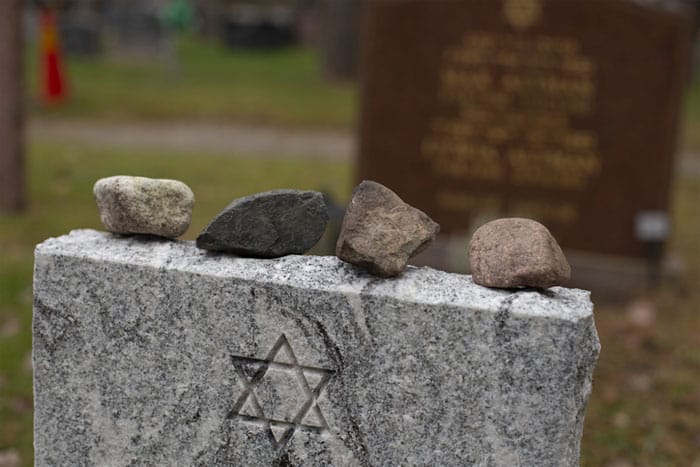
My mother and her four sisters would drag all of us cousins out to the cemetery so often, that they simply called the place “Waldheim,” as if they were on a first name basis with it. 

By the time I was 7 years old I knew the paths at Waldheim, southwest of Chicago, like I knew the way around my very Jewish neighborhood of Albany Park. I was fascinated by the Waldheim matzevot, the tall above ground tombstones. On each one there was a little metal plate that my cousins and I could pry open. Beneath it was the preserved photo of the dead person. We would try to imagine them laying down there underneath the earth as a bunch of bones, and laugh our heads off. 

I moved to Los Angeles at the age of 12. When I was in high school and college and began returning to Chicago alone to visit the family, my mother would wag her finger in my face, “Make sure you get out to Waldheim.” 

“You’ve given me a whole list of people to visit and now you expect me to spend time with the dead ones, too?” I would ask. 

She did. 

Over the years I felt so attached to Waldheim, that when I turned 40, and people asked where I wanted to celebrate my birthday, I suggested we do a destination party and set up tables and balloons at Waldheim, so everybody could be there. 

My parents and four aunts didn’t find that funny. 

Cemeteries are so much in my family’s blood, that in his 40s, my older brother began working for Mt. Sinai Memorial Park. And still does. It didn’t take him long to start hocking me that I needed to buy cemetery space. 

“I’m not buying cemetery space, Hal. I think I want to be buried in Israel. If I’m not going to be living there, at least I can be dead there.” 

“Why would you want to be buried in Israel?” he asked. 

“I’m a Zionist. And besides, you’ve never been to an Israeli funeral, Hal,” I explained. “They don’t make death pretty and sanitized with flowers, copper caskets and dignified visitation rooms. The places are raw and ugly, the body is lying on a long, flat stone, wrapped up tight in a sheet. Then they dump it right into the earth. It’s real death, not the American version like the luxurious pretty American bathroom that’s supposed to make you feel like your body isn’t really doing any of that stuff in there.”

And then there was my cousin Alan’s suggestion. For nearly 20 years now, Alan has been traveling back and forth to Slavatij, the family shtetl in Poland. Among other things, he’s been rehabbing the Jewish cemetery. Of course. Alan has been there so many times, he insists on calling the place by its proper Polish name, Slawatycze, pronounced Swavatijuh. My grandparents must be rolling in their graves. They hated the place.  

So, Alan tells me he’s thinking maybe he would be buried there, because “there is so much DNA” in that ground. I considered the idea for about a half of second. 

Nevertheless, as I was turning 70, I knew it was time to make a decision. 

Waldheim? Out of the question. The fence right near the family plot is now the dividing line between the cemetery and the parking lot of a Sportmart. I was never an athlete. 

Israel? They are running out of room and will soon be burying people on top of one another. 

Slavatij? Not even thinkable. 

I called Hal. “Okay, you win.” 

And then I told him I didn’t want Mt Sinai in the Valley. I didn’t want to be buried next to or overlooking the freeway. Where we live in Valley Village, I’ve been hearing freeway noise 24-hours a day for 40 years now. 

Why are all these Jewish cemeteries next to freeways? 

So we bought in Mt Sinai Simi Valley. Two nice plots under a tree with view. 

“But these plots are on the slope of a hill. How will people stand here?” my wife Dana asked. 

“What do we care,“ I answered. “We’ll be dead.”


Gary Wexler woke up one morning and found he had morphed into an old Jewish guy. 

Creative Aging: On Cemeteries Read More »

Table for Five: Terumah

One verse, five voices. Edited by Salvador Litvak, the Accidental Talmudist

“Tell the Israelite people to bring Me gifts; you shall accept gifts for Me from every person whose heart is so moved.” – Exodus 25:2


Sarah Pachter
Author and Speaker

Why would the pasuk use the word vayikach, “take” when referring to giving? 

“Vayikach” is used because when a person gives, they are really receiving. The word “natan,” to give, is a palindrome because when you give, it bounces right back to you. 

In the physical world, it doesn’t seem to work this way. If there are eight pizza slices and someone takes six, there will only be two left. 

The spiritual world functions like the flame of a candle. When one candle gives of its flame, the light multiplies. In the physical world when one gives, you no longer have, but in the spiritual world, when you give, you gain. 

As part of a happiness experiment, this past month I gave charity to anyone who asked (even via email!) It was one of the most joyous and empowering months I have ever felt. Giving is hard, but we reach inner depths that are unmatched. 

Halachically, it is better to give one dollar on ten different occasions rather than a ten dollar bill once. Frequent giving trains our hearts and minds to become natural givers. 

There were three opportunities with regards to giving for the tabernacle. The first two were a tax, but this pasuk refers to a volunteer donation. After giving twice prior, our hearts were moved and we gave so much that Moshe turned away donations. Our actions can shape our hearts desire.


Rabbi Chaim Miller
Author, Gutnick Chumash and “Practical Tanya”

Hasidism, which emerged in the eighteenth century, represented a “psychological turn” in textual interpretation. The Hasidic masters reread every line of the Torah as an exercise in self-awareness. Remarkably, this project predated Freud and Jung by over a century. (Jung remarked on his 80th birthday, “Do you know who anticipated my entire psychology in the eighteenth century? The Hasidic Rabbi Baer from Mezeritch.”) In our verse, we read of the “crowdfunding” efforts to collect donations for the construction of the Tabernacle. What does this symbolize in terms of our inner work? 

The Hasidic masters taught that the Tabernacle symbolizes the human body, which is a personal “Temple” where the Divine presence may rest. We “donate” to the personal Temple by taking good care of our bodies. Our verse teaches that these “donations” ought to be done lovingly, when our “heart is so moved.” 

In our busy lives, it is so easy to “toss” the body its needs without care. We eat junk, we deprive ourselves of sleep, we look in the mirror and stare at our bodies with contempt. 

Says the Torah: Your body is a Temple to the Divine! Look after it with love because it is a sacred location in the universe where G-d desires to be present.


Rabbi Brett Kopin
Milken Community School

“Bring Me gifts,” God says, “from every person whose heart is so moved.” God then specifies all the materials needed to construct the Tabernacle, initiating a complex nationwide project that fills the second half of Exodus. If done successfully, the miraculous will become a part of the everyday: God’s presence will dwell among the people. They will only need to look toward the Mishkan at the center of the camp to be reminded of the central goal of Judaism: to bridge Heaven and Earth. 

But how can God both order the people to bring gifts, and request that those gifts come voluntarily? Surely if the people’s hearts were moved, they would have brought gifts out of their own free will. Perhaps this opening verse of Terumah is aspirational: God’s hope for us is that our will ultimately aligns with God’s will. God’s insistence on the human construction of the Mishkan is rooted in the desire for the people to want to bring the gifts themselves, to want to construct holy spaces, and to want to bridge Heaven and Earth, without needing to be prompted. As we move through the second half of Exodus, filled with all the minutia of this holy construction, may these words remind us that building holy space does not come easily. It requires effort, creativity and a shared desire from God and people to bring it about. Ultimately, it requires inspiration from God, coupled with the generosity of the human spirit.


Liane Pritikin
Writer, Public Speaker, Marketing Executive

Growing up, my mom celebrated family birthdays with her famous chocolate strawberry banana cake. I must have talked about this cake a lot, because my college roommate surprised me with it for my 21st birthday. Years later, when living in Orlando working at Disney World, a good friend surprised me with – you guessed it – the chocolate strawberry banana cake! Two friends, worlds apart. Whose hearts moved them to call my mom and bake my favorite birthday cake and give me a little piece of home. 

In the opening of Parsha Terumah, G-d tells the Jewish people what He would like for His home. But only if we want to give. Only if we’re willing and excited. Only if our heart is so moved. Which is why parents, grandparents, aunts, uncles, anyone with a child in their life who makes them a picture displays it proudly. Is it Louvre Museum worthy? No. But it’s a gift from the heart. 

In English, G-d says “bring me gifts.” But a more literal translation of the Hebrew is “take gifts for me.” Is G-d asking us to give or take? 

In any relationship, we’re always taking a little part of ourselves – our time, energy, money, resources – and getting something more valuable in return. For some, this exchange is transactional. For others, it’s on a higher level – but only when your heart moves you. That’s what G-d wants from us. Not a transaction, but a relationship. And true heart-felt gifts for His home. 


Rabbi Ilana Grinblat
Director of Education, Open Temple

In her book, “The Path Made Clear,” Oprah Winfrey recounts a conversation with a grieving mother who told the story of her adult son’s death after a long illness. In his last moments, she embraced her son, and he whispered to her, “Oh, Mom, it is all so simple,” and then he closed his eyes and died. 

Indeed, perhaps life is simpler than we make it out to be. Oprah wrote: “When you become blinded by the status symbols, it’s easy to lose sight of the unique gifts only you can give the world. What I know for sure is that no matter how much wealth you come to possess, everything passes and changes with time. What is real – what is forever – is who you and what you’re meant to share with the world. That is your true treasure.” She explained: “For me, the great reward is the feeling of lasting contentment and self-respect that comes when you’re living out the truth of who you are.”

In this verse, God asks Moses to tell the people to share the gifts from their hearts. This verse is not merely about the building of the Tabernacle but also about our lives today. These words remind us that each of us has unique treasures that only we can give to God and to the world. That is the essence of life. The rest is commentary. 

Table for Five: Terumah Read More »

Tel Aviv Groove Culinary Festival Brings a Taste of Israel to Los Angeles

Tel Aviv Groove, a series of culinary events inspired by the vibrant Tel Aviv food and arts scene, returns to Los Angeles February 24 to 27. 

The four-day event features menus from top tier Israeli chefs, including chefs Jonathan Sharvit, Yoav Schverd, Daniel Shalit, Adir Cohen and Liad Ichiye. It will also highlight Israeli sommeliers, wines from the Binyamina Winery, olive oils from Ptora and whiskeys from Milk & Honey Distillery.

Chef Yossi Sherf
(Photo by Gil Aviram)

“As a chef for Tel Aviv Groove, my role is to bring the authentic flavors and the culinary traditions of Tel Aviv to life through my cooking,” Chef Yossi Sherf told the Journal. “I take great pride in sourcing the freshest and highest quality ingredients, and I strive to create dishes that are both delicious and visually stunning, representing Tel Aviv, to help people experience the sights, sounds, and flavors of this vibrant city.”

 Sherf, who grew up in a family of food enthusiasts, started working in restaurants and honed his skills under the tutelage of some of the best chefs in the business. He started his catering company in 2014, and is a regular guest chef at several local restaurants. Sherf sees himself not just as a chef, but as an ambassador of Tel Aviv’s culinary culture. 

“I love the stories and traditions behind each dish,” he said. “I believe that food has the power to bring people together and create connections that last a lifetime.” 

Chef Daniel Shalit
(Photo by Gil Aviram)

Sherf grew up in a religious household; his home was above the famous Viznitz Bakery in Bnei Brak. “Every morning, the mouthwatering aroma of freshly baked bread would fill our entire house, making it feel warm and welcoming,” he said. “But it was on Fridays that the bakery truly came to life. As the sun began to set, the community would gather at the bakery with their pots and pans, eagerly waiting to place them in the massive ovens for the family Shabbat meal.” 

The freshly baked challah and pastries would be part of his family’s Shabbat table. 

“There’s something special about sharing a family meal where everyone gathers around the table, savors delicious food, and bonds with each other,” he said. “Looking back, I realize that growing up above the Viznitz Bakery was more than just a physical location. It was a central hub of community and tradition, and a cherished part of my childhood.”

Chef Shalit also feels that connection.

“I think food unites people and comforts people in tough times. For Jews, there is the Shabbat dinner where all the family seats together, emphasizing how food brings the community together.” – Chef Daniel Shalit

“I think food unites people and comforts people in tough times,” Shalit told the Journal. “For Jews, there is the Shabbat dinner where all the family seats together, emphasizing how food brings the community together.”

Considered one of Israel’s most experienced chefs and culinary advisers, Shalit specializes in a wide variety of cuisines, such as Asian, “Shami” (authentic Lebanese and middle-eastern food) and more. “As a kid I always loved to watch my mother cooking and at a very young age started experimenting with flavors myself,” he said. 

Shalit, who has spent more than 25 years managing and operating kitchens in high-profile restaurants in Israel and abroad, studied at the Culinary Institute of America. Coming back to the United States as an accomplished chef is full circle, he said. 

“It is always exciting to cook for new audiences from different backgrounds and see how they react to my food,” he said. 

Shalit’s favorite food?

“My favorite food is simple food with the best and most fresh ingredients as this allows each ingredient to shine and get noticed,” Shalit said. 

Without hesitation, Sherf always says his favorite food is vegetables, as there are endless possibilities with this versatile ingredient. 

“I love the variety of flavors, textures, and colors that vegetables can bring to a dish, and the way they can elevate and transform a simple meal,” he said. “Not only are vegetables packed with nutrients, but they’re also incredibly adaptable and can be used in a variety of cuisines and styles of cooking.” 

Whether roasted, grilled, sautéed or served raw, vegetables are a staple in his kitchen and have a prominent place on his plate. 

“As a chef, I find inspiration in the simplicity and complexity of vegetables, and I believe they have the power to make any meal shine,” he said.

Known for its artistic vibe, sandy white beaches and thriving nightlife, Tel Aviv has also become one of the world’s most thriving and growing culinary hubs. The first U.S. Tel Aviv Groove took place in LA back in October. This time, the pop-up kicked off in New York from February 21 to 23, before heading back to Los Angeles. For more information, go to TLVGroove.com.

Here is an overview of the Los Angeles schedule:

February 24: To kick off the Los Angeles series of events, Chef Jonathan Sharvit will be hosted by Chef Joshua Gil at the cool Michelin-starred Mirame Restaurant, where the two will fuse their influences to create memorable dishes featuring the flavors of Mexico, California and Israel.

February 25: On the pop-up’s second day, Chef Yoav Schverd of Nua in Beverly Hills will host Chef Daniel Shalit for an evening of exciting collaborations and Israeli specials, accompanied by a wine menu from Binyamina Winery and a whisky menu from the Israeli Milk & Honey Distillery.

February 26: The third day of the Los Angeles pop-up will take place at Divino, Chef Goran Milic’s Brentwood restaurant, where Chef Daniel Shalit will be hosted for a joint creation of delightful specials that will be accompanied by a wine menu from Binyamina Winery and a whiskey menu from Milk & Honey Distillery. 

February 27: For the final day of Tel Aviv Groove in Los Angeles, Chef Adir Cohen and Chef Liad Ichiye will host Chef Jonathan Sharvit for a meal at the Kosher Next Door Restaurant and create an up-to-date Mediterranean dinner.

Tel Aviv Groove Culinary Festival Brings a Taste of Israel to Los Angeles Read More »

Kosher Food & Wine Experience Is Back

After a pandemic hiatus, the Kosher Food & Wine Experience returned to Los Angeles on February 9 at the Hollywood Palladium. Established in 2006, it’s attended by 2,000 people, who taste 400 kosher wines from all around the world, as well as food from local kosher eateries.

“We believe it highlights the spectacular diversity of kosher wines, curated from six continents, as well as the wide array of flavors and cultures that thrive in the LA restaurant scene.”

“KFWE Los Angeles is a celebration of kosher wine, spirits and cuisine,” David Whittemore, marketing director at Herzog Wine Cellars, said. “There is nothing like it on the West Coast. We believe it highlights the spectacular diversity of kosher wines, curated from six continents, as well as the wide array of flavors and cultures that thrive in the LA restaurant scene.”

This year’s KFWE featured a trade show for wine and spirit buyers and distributors during the daytime, which expanded to the general public at night. Both the general admission and VIP tickets, which cost between $90 to over $200 each, were sold out. VIP tickets included exclusive food, hand-rolled cigars and top-shelf whiskeys and wines. 

Royal Wine Corp., which manufactures, imports and distributes kosher wine, spirits and liqueurs, hosted KFWE. The company owns Baron Herzog wines, along with Tierra Sur, the upscale kosher restaurant and winery at Herzog Wine Cellars in Oxnard. The Herzog family, who started making wine in 19th century Czechoslovakia, has owned and operated Royal Wine Corp., which also makes the kosher wines, spirits and food under the  Kedem label, in the U.S. since 1958. 

In a statement, Joseph Herzog, president of operations at Herzog Wine Cellars, said KFWE “is the only event in Southern California where the Jewish community, wine lovers and foodies alike can experience top kosher restaurants and renowned wines in one outstanding location.”

Wine companies on display during KFWE included Baron Herzog, Barkan, Alfasi, Carmel Winery, Bartenura and Covenant, which originate in different regions like California, Israel, Chile, Italy , and France. 

Restaurants like Lenny’s Casita, Next Door, Holy Smokes Kosher Barbeque, La Gondola and Tierra Sur served hors d’oeuvres all night long, and Delice Bakery served up parve desserts to complement the dessert wines and champagnes. Orthodox Jewish online influencers Bari Mitzmann, Esti Iwaniski, and Daniel Kramer and Doni Schwartz of Passover Listings, who have large followings on Instagram, were in attendance. 

 KFWE is held every year in LA, London, Tel Aviv, New York, Dallas and Miami. The LA event, which took place just an hour from Herzog Wine and Tierra Sur in Oxnard, was a return to normalcy – but in a bigger way this time around. 

“KFWE Los Angeles brings storied winemakers from around the world to meet kosher consumers face-to-face, in a space where they can share a glass of wine together,” said Whittemore. “They experience the passion behind the bottles they love.”

Kosher Food & Wine Experience Is Back Read More »

God Save Ruth Wisse

“God save this retired Harvard honorable professor,”

to Ruth Wisse, who’s now an emerita,

this poet, though unliberally the lady’s lesser,

ripostes Republicanly. Though she is femmerita,

she expresses lucidly in prose what I

most clumsily attempt to write in rhyme,

and in the next two verses I will tell you why.

Though I’m unknighted, her views with mine chime,

close to an alleged midnight of democracy

in Israel. Like her I don’t see as a crime

attempts to curb heretical theocracy

that’s not based on a Torah rule or Montesquieu,

but on politically radical hypocrisy.

False staffs of leftist leaners may oppose my point of view,

but close to midnight my views rhyme with viva vocracy.


In the 2/16/13 WSJ, Ruth Wisse writes an article condemning the condemnation of an Israeli government to curb the power of the judiciary (“God Save This Honorable Court, but Not That One Leftist elites declaim against the power of the U.S. Supreme Court while trying to preserve judicial supremacy in Israel”):

This week thousands of left-leaning Israelis demonstrated against their government for threatening to reduce the supremacy of their Supreme Court. A week and a half earlier, Daphna Renan, a native Israeli and newly chaired professor at Harvard Law School, used her inaugural lecture to argue that “we have to reject the idea that judicial supremacy is an essential ingredient of federal authority.”

The lecture reprised “The Supreme Court Is Not Supposed to Have This Much Power,” an Atlantic essay Ms. Renan wrote last June with her Harvard colleague Nikolas Bowie. There they trace the idea of judicial supremacy to the post-Civil War era, when “white people who wanted to undo Reconstruction and the rise of organized labor” tried to “harness the power of an entrenched minority and use that power to undermine the more democratic legislative branch.”

Ms. Renan seeks a separation of governmental power that is more grounded in “the messy, contingent, provisional practices of Congress and the presidency.” Her aim is to secure a more egalitarian system of government that can be achieved only through instruments of republican self-rule and representative democracy and thus requires the judicial branch to hold less power.

How can matching parts of the Israeli and American electorates be so divided on this fundamental issue? American Jews, most of whom vote Democratic, are assumed to favor the Israeli left. The election of Benjamin Netanyahu’s right-leaning government touched off the same sort of panic in Israel that Donald Trump’s 2016 election did in similar sectors of America. Some Israelis were so confident of this alignment that they recently published in the Times of Israel a Feb. 2 open letter “to Israel’s friends in North America.” The letter asked Americans to help prevent Mr. Netanyahu’s government from eviscerating the independence of Israel’s judiciary, “the only body capable of protecting citizens from the tyranny of a majority.”

Ms. Renan, who worked for the Obama campaign and clerked for Justice Ruth Bader Ginsburg, presumably typifies the friend these Israelis have in mind. How then could they be asking for help in maintaining the absolute power of the Israeli Supreme Court from Americans who want to claw away such power from the U.S. Supreme Court?

The answer lies not in the judiciaries but in their contrasting political roles. Jews, who were politically dependent for two millennia, tended to invest authority in the rabbinate rather than any national government. Israel’s Supreme Court has constituted itself as the secular counterpart of rabbinic authority, claiming absolute power over both the rabbinate and the elected government. The justices, who control appointments to the court, were initially graduates of a single law school in Israel, and they are still trained by the Israeli equivalents of Harvard and Yale. In the much smaller country, the elites are even more uniformly left-leaning than in America.

As a consequence, the Israeli left has come to see the Supreme Court as its ally and a bulwark against the government, especially when a conservative coalition has strong religious representation. Critics, however, protest that the judiciary holds greater power in Israel than in any other Western democracy. “In the court’s own view,” writes historian Gadi Taub, once a spokesman for the left, “there are literally no limits to its authority. It recognizes no limits on standing, and it exercises judicial review over any government action and any and all legislation, including judicial review of what the court itself declared to be Israel’s constitution—our so-called ‘Basic Laws.’ ”

In the absence of a written constitution, Israel’s Supreme Court insists that its power transcends the power of other branches of government. This contrasts with the balance of power among the three American branches.

It was therefore unwise of President Biden to caution Israel on what is really none of America’s business: “The genius of American democracy and Israeli democracy is that they are both built on strong institutions, on checks and balances, on an independent judiciary. Building consensus for fundamental changes is really important to ensure that the people buy into them so they can be sustained.” What Israel actually seeks is to establish healthier checks and balances where none exist.

America’s highest court, in contrast to Israel’s, is the most obvious bulwark against such causes as substituting egalitarian outcomes for equal rights that are currently popular on the left. It is thus no surprise that some Democrats want to reduce the U.S. Supreme Court’s power when conservative justices seem to hold sway. This asymmetry is warning enough against attempts by Americans—Jewish or otherwise—to interfere in the workings of a fellow democracy that is differently constituted and faces different challenges. No Israeli can pretend to be a proponent of democracy if he invites such interference.

In “Is Bibi’s ‘Override Clause’ Jewish? Ask the 14th-century sage Rabbi Nissim of Girona,” Tablet, 2/15/23, Warren Zev Harvey, Professor Emeritus in the Department of Jewish Thought at the Hebrew University of Jerusalem where he has taught since 1977, writes:

What is this curious “override clause” that Israeli Prime Minister Benjamin Netanyahu’s new government is trying so hard to legislate, and liberal Israelis are trying equally hard to prevent? In essence, it means that the Knesset, with a simple majority vote of 61 to 59, can cancel or “override” a ruling of the Israeli Supreme Court; for example, it can reenact a law struck down as unconstitutional by the court. Those who support the override clause say it is important to give primary power to the popularly elected government and not to the elitist justices, who were chosen by a committee and not elected by the people. Those who oppose the override clause agree with Ahad Ha’am that what makes us Jews is our commitment to the biblical commandment, “Justice, justice thou shalt pursue” (Deuteronomy 16:20).

But was there ever such a thing as the override clause among the medieval Jewish philosophers? Whenever this question is asked, the immediate answer is “No, of course not!” Medieval Jewish philosophers loved controversy and disagreed about every subject under the sun, except for one—the primacy of the judges over the sovereigns. Nonetheless, there was one medieval Jewish philosopher who thought in constitutional terms strikingly similar to those of de Tocqueville. He wrote at length about the relative powers of the judges (the judicial branch) and the kings (the executive branch). He did hold a sort of override clause. I am thinking of Rabbi Nissim ben Reuben of Girona (d. 1376), known by acronym as RaN, a preeminent Talmudic scholar and the most important Jewish political philosopher between Maimonides in the 12th century and Don Isaac Abrabanel in the generation of the Spanish expulsion.

Rabbi Nissim argues in his “Homily on Justice” (Derashot, ch. 11) that the vocation of the judges is to judge in accordance with “righteous judgment” (Deuteronomy 16:18), while that of the kings is to preserve national security. He then pushes this distinction in a radical way that was unprecedented in the history of legal philosophy. The judges, he insists, possess the authority to judge only with righteous judgment; that is, they have no authority whatsoever to judge according to utilitarian or consequentialist considerations. They must judge according to the good in itself and the just in itself. Their considerations, in the language of the philosophers, must always be deontological. The kings, however, who are charged with the preservation of national security, do possess the authority to act according to utilitarian or consequentialist considerations.

Rabbi Nissim writes that when there is a grave threat to national security, the king has the authority to overturn or “override” the ruling of the judges. He gives as an example a dangerous murderer whom the judges cannot convict owing to procedural concerns (for example, there were not two witnesses). Rabbi Nissim explains that the judges rightly cannot execute him since “righteous judgment” requires strict observance of evidence law. However, the king has the authority to “override” their decision, and to sentence the murderer to death in order to preserve national security (cf. Maimonides, Laws of Kings 3:10). In times of dire emergency, the king invokes the “override clause.”

Rabbi Nissim’s discussions of the relative powers of judges and kings usually concerned the Jewish Sanhedrin and the Israelite kings, but also sometimes concerned gentile judges and kings. His sharp distinction between the roles of the judges and kings reflects his own philosophy of law and is prescriptive rather than descriptive. Historically, no polity, Jewish or non-Jewish, has ever adopted Rabbi Nissim’s approach. No historian corroborates his claim that the Sanhedrin was authorized to rule only according to deontological considerations.

Quite obviously, Rabbi Nissim’s “override clause” is very different from the one proposed by Israel’s government today. According to Rabbi Nissim, the king does not cancel or reenact any law, but merely overturns one particular decision of the judges in response to extraordinary circumstances at a given time (kefi tsorekh ha-shaʿah). Moreover, the king, according to Rabbi Nissim, does not say that he is acting in the name of true justice. On the contrary, he fully admits that in sentencing the murderer to death he is blatantly contradicting “righteous judgment,” but justifies his action by citing the urgent need to preserve national security.


Gershon Hepner is a poet who has written over 25,000 poems on subjects ranging from music to literature, politics to Torah. He grew up in England and moved to Los Angeles in 1976. Using his varied interests and experiences, he has authored dozens of papers in medical and academic journals, and authored “Legal Friction: Law, Narrative, and Identity Politics in Biblical Israel.” He can be reached at gershonhepner@gmail.com.

God Save Ruth Wisse Read More »

A Moment in Time: “Don’t Ever Tell Us that it Can’t be Done”

Dear all,

Shalom from Israel, where I am participating in the Central Conference of American Rabbis convention. We are learning about the joys, milestones, and complexities of Progressive Judaism in Israel.

Wednesday morning was groundbreaking. 150 of us made our way to the Kotel, the Western Wall, to join with Women of the Wall, an organization that has met for over 34 years once a month for a simple purpose: to allow women read from a Torah scroll at the Wall.

We stood in a line for close to an hour waiting to get through security. The officers weren’t only checking for weapons of physical destruction. They were also making sure that no one was hiding a Torah scroll on their person. In the eyes of some zealots, the Torah in the wrong hands leads to spiritualdestruction.

Mind you, Israel is a progressive nation. Women have been part of the fabric of the country at every level since its birth. But there are still mountains to climb with regard to religious equality. Men and women were separated as we entered the area nearing the Wall.

It was an intense morning. As I stood in support with male colleagues (again, the women were on the other side) protesters hurled insults, shoved bodies, and insisted: “this can’t be done.”

Security worked hard to protect us.

Gilad Kariv, an Israel Reform Rabbi and a member of the Knesset, was able to bring a Torah scroll through to an area near the Wall (but not at the Wall). In spite of the incredible difficulties, he held it high and the women on the other side of the divider chanted the text.

It was a perilous, nerve-wrecking, and yet glorious moment in time.

Despite the forces working against us, we persevered to pursue equality.

Sigh – there is a long way to go. But no one should ever tell us it can’t or shouldn’t be done. We will climb the mountain. We will cross the desert. And we will march until the walls of separation tumble.

Yes, the Wall is a sacred place. But more sacred than a structure are the people. And we can never forget this.

I wish you love and shalom,

Rabbi Zach Shapiro

A Moment in Time: “Don’t Ever Tell Us that it Can’t be Done” Read More »