fbpx

January 25, 2023

House Democrats & Left Wing Groups Competing For Pinocchios on Ilhan Omar

Anyone familiar with the Washington Post’s “Fact Checker,” is familiar with the newspaper’s grading system of awarding “Pinocchios” (to let its readers know whether a politician’s claims are honest, misleading, deceptive or outright falsehoods). The newspaper’s famed “Fact Checker” awards a “Geppetto Checkmark” for statements that are completely true; and grades other less completely honest statements on the Pinocchio scale, with “one Pinocchio” for statements that are “mostly true” and up to “four Pinocchios” for statements that are complete lies or what it calls “whoppers.”

After Republicans won the majority in the House last November, Speaker of the House Kevin McCarthy said he was planning to remove Congresswoman Ilhan Omar from the prestigious House Foreign Relations Committee. Shortly thereafter, certain groups – who seem to put partisanship over fighting antisemitism – have been seemingly competing for Pinocchios with their claims to McCarthy and others about Ilhan Omar.

First, on December 12, 2022, a collection of organizations, claiming to object as “Jewish Americans,” sent to Speaker McCarthy an open letter setting forth their opposition to his plan to remove Omar from the House Foreign Relations Committee; based on what these groups claimed to be “false accusations that she [Omar] is antisemitic or anti-Israel.” These eight groups ranged from the far-left “Bend the Arc” and “Americans For Peace Now” and the self-described “moderate” and “pro-Israel,” but definitely very pro-Democrat J Street. All of these groups endorsed a statement that characterizing Ilhan Omar as being either antisemitic or even anti-Israel is somehow “false.”

To be clear, these groups do not speak for Jewish Americans. They speak for their organizations only. And, based on all relevant surveys and studies, they speak for a tiny minority of Jewish Americans who put political allegiances and political ideology above the urgent concern to fight Jew-hatred (regardless of party affiliation).

Moreover, any group that claims it is “false” to assert Omar is antisemitic and anti-Israel, is not only plainly placing partisan political considerations ahead of the concern for fighting Jew-hatred, they are promoting fiction over reality.

Joining this promotion of outright fiction (what the Washington Post would characterize as “4 Pinocchios”) are now many Democrats in Congress. According to a recent report in Politico, Democrats are “mobilizing” to defend Omar in order to try and keep her on the House Foreign Relations Committee; with Jewish House members like Debbie Wasserman Schultz shamefully claiming: “[t]here’s no reason to remove Congresswoman Omar from her committees except revenge …” and Jewish Congressman Dean Phillips saying he “doesn’t think” Omar “is antisemitic.”

Setting aside the lying or self-delusion about Omar’s hate for Israel and her antisemitism, the hypocrisy and raw partisanship here is clear. These same groups and Democratic politicians wholly supported Republican Congresswoman Marjorie Taylor Green being removed from all of her committee assignments in Congress. They correctly condemned Taylor Green for how she leaned into antisemitic tropes with her conspiratorial references to the perennial Jewish “boogeyman” for antisemitic conspiracy theories (the “Rothschilds”) and for Taylor Green’s concerning calls for “Christian Nationalism.” Yet now, they are selling the fiction that Omar is not an antisemite in order to prevent McCarthy from removing her from the House Foreign Relations Committee. They want all people who care about fighting Jew-hatred to ignore the following actions and statements by Representative Omar:

  • On November 16, 2012, two days after Israel responded to Hamas (a US State Dept. recognized terrorist group), firing random long-range missiles and short range rockets at Israeli civilians, Omar tweeted, “Israel has hypnotized the world, may Allah awaken the people and help them see the evil doings of Israel. #Gaza #Palestine #Israel.” This tweet indisputably used and promoted the age-old antisemitic conspiratorial myth about Jewish powers of hypnosis for use in sinister and duplicitous plots. An antisemitic trope, which has been used for literally thousands of years to incite and justify the persecution and murder of Jews.
  • In February of 2019 Representative Omar tweeted that American politicians’ support for Israel is “all about the Benjamins.” Indisputably leaning very hard into another age-old and dangerous trope about Jews uniquely and nefariously using money to control politicians and governments, as Representative Omar also made it clear that she doesn’t think American politicians support Israel because of the USA’s and Israel’s shared values and interests, but rather because of nefarious “Jewish money.”
  • Within 18 days of Representative Omar making her antisemitic “all about the Benjamins” tweet, she said — at an event held in a restaurant owned by a man who once claimed that the U.S. is “getting its marching orders from Tel Aviv” (echoing David Duke, another anti-Semitic conspiracy theorist) — “I want to talk about the political influence in this country that says it is OK for people to push for allegiance to a foreign country.
  • After getting some pushback from some of her congressional colleagues for invoking yet another antisemitic slur, Representative Omar double-downed on her antisemitism, tweeting three days later: “I should not be expected to have allegiance/pledge support to a foreign country in order to serve my country in Congress or serve on committee.”

In the past, the same organizations and Democratic members of Congress denying Omar’s antisemitism, correctly expressed concern when Republicans have referenced American Jews being “disloyal.” They have done so because they know that the “dual loyalty” or disloyalty trope about Jews can be traced back millennia and has been used for centuries, including in the all too recent past by Hitler and Stalin, as a justification for persecuting, rounding up and murdering Jews. Yet, when Representative Omar aggressively and repeatedly uses this same trope in reference to the one Jewish nation in the world and its supporters in America, not only does the proverbial cat have their collective tongue; they lie as obviously as Pinocchio about Omar’s plain and obvious antisemitism.

To exemplify how obvious this lie should be to anyone paying attention, after Omar’s unapologetic streak of using antisemitic tropes about alleged Jewish money and disloyalty back in 2019, KKK Grand Wizard and notorious white supremacist, David Duke, posted his open support for her, and asserted that “Ilhan Omar is NOW the most important Member of the US Congress!”

To add to Representative Omar’s antisemitic and anti-Israel (and frankly anti-American) bona fides, during her questioning of Secretary of State Blinken – on the very committee these groups and Congressional Democrats are fighting to keep her on – Omar compared Hamas to Israel and the Taliban to America and very clearly equated all four as morally equivalent.

Frankly, the fact that Representative Omar would use her position on the prestigious House Foreign Affairs Committee to assert there is a moral equivalence between the actions of the militaries of two democracies (which do everything they reasonably can to avoid civilian casualties while fighting terrorists) and Hamas and the Taliban, two openly Islamist supremacist terrorist groups (who are terrorizing their own people), is reason enough to remove Representative Omar from all committees in the House of Representatives, and in particular the Foreign Affairs Committee.

It should be crystal clear to anyone paying even remote attention to Ilhan Omar’s statements and tweets over the last 10 years that Ilhan Omar has a history of frequently using dangerous antisemitic tropes (which themselves have a long history of endangering Jewish lives and leading to increased Jew-hatred and antisemitic violence). Even more evident is that Omar has a long and clear history of inciting hatred and promoting sanctions against the only Jewish state in the world and the only democracy in the entire Middle East and North Africa; at the same time that she regularly advocates against sanctions being imposed on some of the most totalitarian and repressive regimes in the world (such as Venezuela and Iran).

Thus, when any group, organization or politician asserts that any allegations that Omar is antisemitic or anti-Israel are “false,” it is also crystal clear that they are spreading what the Washington Post “Fact Checker” calls “whoppers” and grades with “four Pinocchios.” It should also be clear that the interests of anyone who makes such a claim are partisan and political, and not fighting the dangerous Jew-hatred that is unfortunately dramatically increasing at this time in America.

With Omar’s existing record of antisemitic rhetoric and incitement before she was elected to Congress she should have never been on the prestigious House Foreign Affairs Committee in the first place. After she chose to double and then triple down on her use of antisemitic tropes about Jewish money and dual loyalty – Omar should have been immediately sanctioned and removed from all committee positions – just like what happened to Taylor Green (who – unlike Omar – made her most egregious comments before she was elected to Congress).

Instead of being consistent, or at least being honest, about their partisanship, certain groups and politicians are trying to sell to the American public the fanciful notion that Omar is not an antisemite. They are also effectively trying to sell the dangerous idea that being an antisemite should only have negative consequences if you are on one side of the political aisle. But if that notion is terrible when people try to excuse or give a pass to Republicans for being antisemitic or engaging in antisemitic tropes, then it has to be just as terrible when the antisemite is a Democrat. Otherwise, we are not fighting Jew-hatred, we are just playing politics.


Micha Danzig served in the Israeli Army and is a former police officer with the NYPD. He is currently an attorney and is very active with numerous Jewish and pro-Israel organizations, including Stand With Us and the FIDF, and is a national board member of Herut North America.

House Democrats & Left Wing Groups Competing For Pinocchios on Ilhan Omar Read More »

IAC National Summit Preaches Unity Amidst ‘Polarizing’ Times

The Israeli American Council (IAC) held their 2023 National Summit at the Fairmont Hotel in Austin, TX from January 19-21, at a time when Israel’s latest government coalition is pursuing a controversial agenda and a time when antisemitism seems to be at a fever pitch. There was even a pro-Palestinian protest in front of the summit on January 21. Through it all, the IAC kept to their theme of celebrating Israel’s 75th anniversary with a message of love and unity.

Israel’s new ruling coalition is considering some controversial measures: possible changes to the Law of Return and judicial reform. The controversies were discussed at IAC, but most speakers tended to stress the need for Israelis and the Jewish community to remain united regardless of the measures.

During the conference’s opening plenary, IAC CEO Shoham Nicolet said that “Israel is still searching for a golden path” as a democracy.

During the conference’s opening plenary, IAC CEO Shoham Nicolet said that “Israel is still searching for a golden path” as a democracy. Nicolet said that even when the “temperature of these battles rise” in a democracy, it’s important for the Jewish and Israeli-American communities to “respect, trust, support, [and] love with no conditions Israel, its people and its democracy.” Israeli President Isaac Herzog also addressed the conference via video, stating that the “unbreakable bond” between the United States and Israel “goes beyond particular parties or particular moments.” Herzog acknowledged that after the most recent election in Israel, “questions were raised by many of our friends around the world and in the United States” regarding whether Israel will still continue to stand for “democracy, liberty and equality.” Herzog declared that Israel’s “democracy is strong,” saying that the differing voices among the branches of Israeli government simply reflect “the greatness of our democracy.” Herzog added that the “rule of law” and “freedom of speech” are “pillars of our Jewish and democratic state.”

“Israel will never compromise on its defining principles. We rely on all of you to be bridges of dialogue and ambassadors of goodwill.”
– Israeli President Isaac Herzog

“Israel will never compromise on its defining principles,” Herzog proclaimed, telling conference attendees: “We rely on all of you to be bridges of dialogue and ambassadors of goodwill.”

Israeli Minister of Diaspora Affairs and Social Equality Amichai Chikli also spoke during the main plenary and was asked about the concerns from American Jewish leaders about the current Netanyahu government. “We were very honest with our agenda and it is our responsibility to follow this agenda,” Chikili replied. However, he did say that the government is listening to Jewish leaders and cares about their concerns regarding the current government. As for questions about changing the “grandfather clause” of the Law of Return that allows for anyone with at least one Jewish grandparent to immigrate to Israel provided that they don’t practice another religion, Chikli said: “Israel will always remain safe haven for Jews everywhere on Earth,” he replied, adding that the government is taking steps for “to help the Jewish community to help themselves.”

During the conference’s closing plenary on January 21, Jewish Agency for Israel Chairman of the Executive Doron Almog said that the “greatest challenge of our time is to keep us united” amidst “polarizing times.”

A significant amount of attention at the conference was given to the topic of rising antisemitism. Israeli Special Envoy for Combating Antisemitism and Delegitimization of Israel Noa Tishby spoke during the opening plenary, saying that the recent tirades from rapper Kanye West resulted in his social media following doubling showed that antisemitism is an “addiction” that the world hasn’t been able to get rid of yet. While she acknowledged that criticism of Israel isn’t inherently antisemitic, Tishby argued that anti-Israel activists don’t care about Israeli government policy, as to them, Israel’s very existence is illegitimate. She also pointed out that the “diverse” nature of Israel’s prior coalition government should have been a boon for pro-Israel activists, yet nothing really changed in the pro-Israel activism sphere. 

During the closing plenary, Senator Jacky Rosen (D-Nev.) told attendees via video that she co-sponsored a bipartisan resolution recognizing the cultural impact Israeli Americans have had on the country and urged the Biden administration in a bipartisan letter to strengthen interagency coordination in fighting antisemitism, which the administration ultimately did. “I will continue to work across the aisle to fight antisemitism,” she said.

The keynote address at the conference was delivered by Texas Governor Greg Abbott, a Republican, where he discussed what he sees as similarities between Texas and Israel. He argued that the rule of law in the United States — and Texas — is rooted from the Ten Commandments, which is why it’s displayed on their capitol. He recalled an atheist suing the state of Texas of displaying the Ten Commandments on the capitol ground while Abbott served as the state’s attorney general. “I said, ‘Not on my watch will I allow the Ten Commandments to be down,’” Abbott said. He proceeded to argue before the Supreme Court that it was constitutional to have the Ten Commandments displayed — and won.

Abbott later turned his attention to the Iran nuclear deal, which the Biden administration has been attempting to revive, proclaiming that the U.S. should not enter into alliances with countries that chant “Death to America!” and threaten Israel’s existence. “So long as Iran is a threat to Israel Iran is a threat to Texas,” he declared, adding that the Texas state government is banned from doing business with entities that conduct business with Iran.

He also touted the state’s law against the Boycott, Divestment and Sanctions (BDS) movement, citing the fact that the state government was barred from doing business with Airbnb after the company delisted homes in Israeli settlements in the West Bank. 

Another similarity between Texas and Israel that Abbott sees: entrepreneurship. Abbott hailed Tel Aviv’s “dynamic ecosystem” before touting his state’s economic record. “Our economy quite literally is America’s undisputed economic leader,” he said, claiming that Texas is the country’s leader in fuel and cotton, among other products and that Texas has repeatedly led the country in exports and job growth as a $2 trillion economy.

Abbott recounted the hostage crisis at a synagogue in Colleyville, TX in 2022, lauding the “swift action by law enforcement” to save the hostages but acknowledged that the threat of antisemitism remains. Ergo, Abbott provided $10 million in security grants for houses of worship throughout the state.

“We have extraordinarily bright futures,” Abbott said of Texas and Israel, even though both face challenges on “preserving freedom” and securing their respective populaces from antisemitism. “We are accustomed to challenges and overcoming them,” he said.

IAC National Summit Preaches Unity Amidst ‘Polarizing’ Times Read More »

As We Commemorate Holocaust Remembrance, Let’s Remember the Memory Workers

This week is International Holocaust Remembrance Day and the ‘memory workers’ are hard at work. The term ‘memory worker’ is not one you are likely to know, but memory workers are all around you. They are voluntary representatives of those victimized by violence or persecution. They take on the burden of conveying the pain, even though it is not their trauma to carry.

Iris Chang, author ofThe Rape of Nanking,” was a memory worker. She told a story of 300,000 Chinese civilians who were murdered by the Japanese from December 1937 through early 1938. It was a history that was not her own. She paid the ultimate price through the impact on her mental health and her ultimate death by suicide.

Anna Rosmus, the young woman depicted in the 1990 film “The Nasty Girl,” is another memory worker. As a young woman in the 1970’s she confronted the history of her town of Passau, Germany, during the Nazi era. She paid through years of intimidation, just for telling the truth.

Kim Simon is a memory worker too. She coined the term in order to describe those who work in Holocaust memory and education. In 1994 after Steven Spielberg received the Academy Award for Best Picture for Schindler’s List, he called on the world to teach about the Holocaust. Among those who answered the call was 24-year-old Kim Simon, neé Hillman. After a short stint in Prague in the post Soviet period Kim ended up back in Los Angeles where she first volunteered, and then became a member of staff of what is now USC Shoah Foundation. When I arrived in LA in 2009 she was there to greet me. 

“These memories are toxic,” she told me, “somehow they get inside you.”

We live in a culture of easy memory. Around us are fragments of forgotten and bloody pasts. We give them artistic form and put them in parks. The monuments mean a lot to the families, but most passersby do not know their meaning.

We live in a culture of easy memory. Around us are fragments of forgotten and bloody pasts. We give them artistic form and put them in parks. The monuments mean a lot to the families, but most passers-by do not know their meaning. Holocaust Museum LA is a good example of a deeply meaningful memorial that intersects with basketball and dog-walkers. Other examples include the memorial to the fallen soldiers of the Vietnam war who are individually named on the Mall in Washington DC. and the Twin Towers which are memorialized in lower Manhattan by forbidding holes, surrounded by names of the lost. Their names are there, but even the families struggle to keep up with traumatic memory.

My friend is a third generation Holocaust survivor. “I am feeling guilty,” she told me. “I have spent fifteen years telling my grandmother’s story.  Now I need a break. It does not seem healthy any more.” She spent New Year’s in urgent care, burned out. “It’s just so lonely bearing the weight of 6 million souls that I cannot bring back!” Nor should she feel she has to.

My own burnout happened after fifteen years of memory work, daily listening to stories about the Holocaust and Rwanda. After many sleepless nights, my body and spirit could take no more.

‘It gets into your system.” Kim has seen enough to know. “The divorces, disabilities, and even deaths are disproportionate!’ she pointed it out to me almost a decade ago. She is not wrong. I had one divorce and one heart attack by fifty. I was not alone. My wife Heather, another memory worker, went through a divorce, then had a pulmonary embolism immediately after visiting the National Genocide Memorial in Armenia.

Over the last thirty years Kim Simon has been a fighter for Holocaust memory. Like many memory workers her contribution has been quiet but profound. She was a leader at USC Shoah Foundation for over two decades. On any given day you would find her at the United Nations, UNESCO, in Rwanda or China, fighting for memory and truth. It takes strength to be a bearer of memory.

As I write this I am sitting with Kim, who at 52 is intubated and wired to every device imaginable at Cedars Sinai ICU. She taps slowly on her iPad to tell me that just last week she was wrongly pronounced dead. For the last five years she has lived with Multiple System Atrophy, a little known neurological degenerative disease.

We hold hands as the monitors quietly beep. Kim has fought for memory until her dying day.  I ask her if it is OK for me to continue her work to reveal more about how genocide effects those who touch it.  She puts up her thumb.

We hold hands as the monitors quietly beep. Kim has fought for memory until her dying day.  I ask her if it is OK for me to continue her work to reveal more about how genocide effects those who touch it.  She puts up her thumb. Her words haunt me – it’s toxic. I wonder whether she is paying the ultimate price that memory can exact.


Stephen D. Smith is CEO of StoryFile and Executive Director Emeritus at USC Shoah Foundation.

As We Commemorate Holocaust Remembrance, Let’s Remember the Memory Workers Read More »

Creative Aging: A Field of Microaggressions

Editor’s note: Second in a series

My kids suggested that I never tell this story.

They say that even though I still claim my liberal identity, I will be caught in the crosshairs of America’s culture wars, become misunderstood, vulnerable, and targeted by a social media mob. I will be seen as an old white man, as a privileged old Jew, who just doesn’t get it. 

I’ve sat on this story for two years. I can’t any longer. This series is about creative aging, and inherent in aging with creativity is courage, coupled with a more urgent responsibility to speak up against injustice.  

I was compelled by last week’s story about the USC School of Social Work, issuing an edict that the word “field” is to be excised from the lexicon of their professional terminology.  Their students who intern are no longer going out into the field. “Field,” they believe, is a trigger word, provoking the trauma of slavery. Field is to be replaced with practicum.

If this is now an acceptable and lauded language revision, then should we Jews also revise everyday words such as camp, concentration, stripes, barracks, dog, train, smoke, gas, switch, canister, ashes, plaza, transport and shower? 

It was only when I read this story that I fully understood what really happened to me after 10 years of successful, fulfilling years of teaching in the Masters of Communication program at USC-Annenberg. And why I walked out midsemester two years ago despite being told, “Don’t do this. You are one of our best professors.” 

Students these days are demanding safe spaces, and universities are tying themselves in knots to provide them. Among other things, the problem with this new “safety-ism” movement is that it denies the realities of a difficult world which adult students must learn to navigate. By protecting them from any and all possible “microaggressions,” it not only infantilizes them but deceives them about what awaits them. It denies them perhaps the most crucial lesson in life: learning resilience.

What kind of message is the university conveying to students who are expected to handle the darkest aspects of life but not the word field? 

Will students studying social work learn resilience if they’re no longer exposed to that dreaded word field? Seriously? For social work? The same social work where they will encounter every human pain and failing, violence, rape, drugs, death, unraveled families, abused children…that social work? What kind of message is the university conveying to students who are expected to handle the darkest aspects of life but not the word field? How prepared will they be as social workers when the crap really starts flying in their faces? 

Which brings me to the story I never wanted to tell: After being accused by a few students of a microaggression, they demanded that they be allowed to rewrite my syllabus and that I allow them to hold me accountable by auditing me for further microaggressions throughout the semester.

What was my microaggression? 

During a graduate class on Nonprofit Marketing, which was themed around diversity, I made a harmless suggestion on Latino night that perhaps the Latino students wanted to run that evening instead of me, as they might be more authentic facilitators. I offered to spend time preparing them outside of class. I thought it would be a learning and educating experience that they would jump at. Instead, I received an email about how “I had perpetrated a microaggression which caused them great pain and for which I needed to be held accountable.” (Being held “accountable” is a big word in the micro-aggression world.) They explained that a microaggression isn’t about the perpetrator’s intent but the impact on the victim. 

I turned the letter over to the head of the department, who never brought me and the students together in dialogue, contrary to the spirit of the class. He spoke with them alone and told me how restorative the conversation had been. He requested I write a letter to the students guaranteeing that I did not hold them responsible for their actions, and would allow them to monitor me. 

I asked him if he spoke to the students about the language in their letter which was like the language of a kangaroo court, where I had been accused, judged and sentenced by them. He asked me why he would do that. “We’re a communication school,” I replied.  “We’re about words.” 

He said, “No.” 

So I quit. Two years later, at a time when practicum has replaced field, I better understand how keeping my integrity intact was an act of creative aging.


Gary Wexler woke up one morning and found he had morphed into an old Jewish guy. 

Creative Aging: A Field of Microaggressions Read More »

How Radical Social Justice Ideology Undermines Jewish Values, Identity and Pride

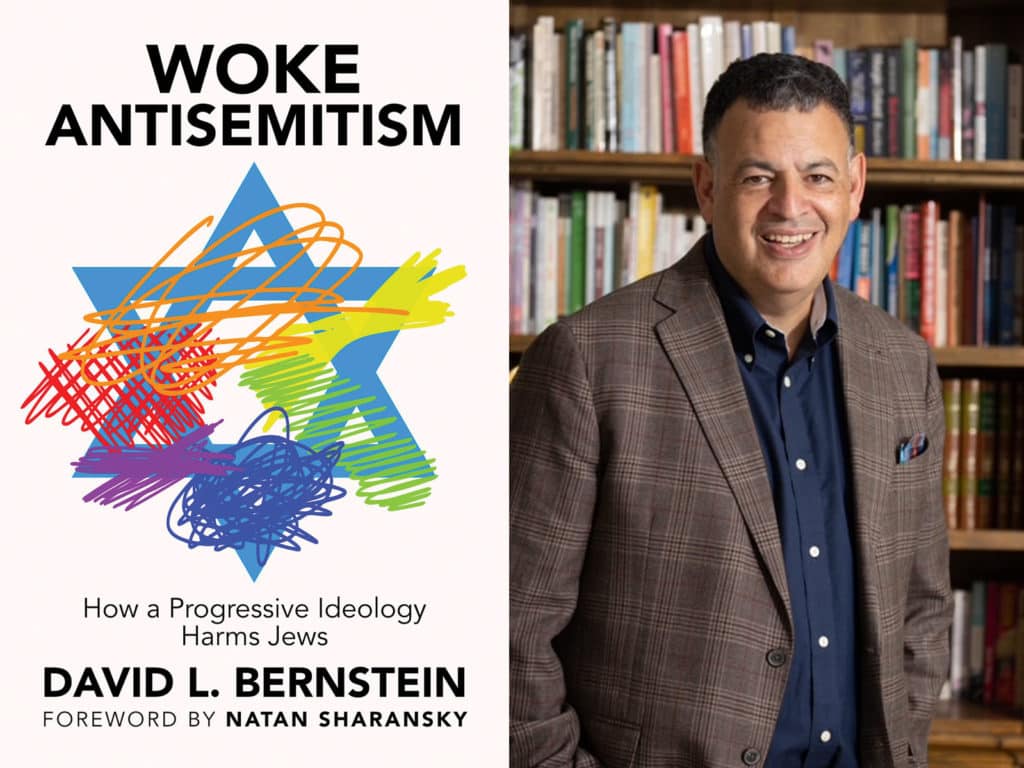
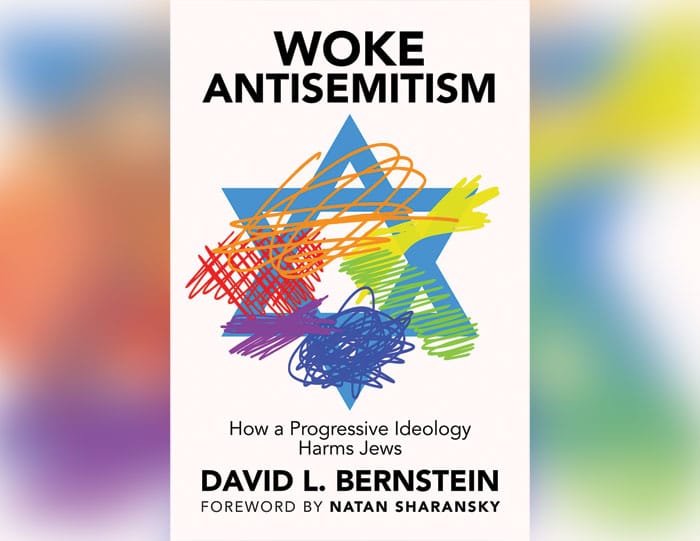
Adapted, with permission, Woke Antisemitism: How a Progressive Ideology Harms Jews.

Internalizing Whiteness

Whenever I have to fill out a form that asks me to designate my race and ethnicity, I always experience a momentary identity crisis. I am less than 50 percent European—23andMe has me at 50.4 percent Western Asian, owing to my Iraqi Jewish heritage—but the Asian designation doesn’t feel right either. The limited options of a government questionnaire can’t sum me up, yet woke ideology insists that I check the proverbial “White” box because, it claims, my white passing skin color entitles me to the benefits of a white supremacist society. Woke ideology insists that Jews not only benefit from white domination but also are complicit in it. If you think this sounds like an extreme interpretation, consider that the largest Jewish denomination in the US, the Reform movement, describes its diversity training for Rabbis thusly: “This space is for white clergy and will serve as a white antiracist affinity space. A white antiracist affinity space is one where white people can process their emotions and deepen their understanding around race and racism, without burdening or causing additional harm to People of Color (POC).” The URJ education program was designed to help rabbis “better understand our own identities as white Jews,” “learn how to recognize the invisibility of ‘whiteness’ (including patriarchal, heteronormative, Puritan/Christian values) that have become normalized,” and “understand how to disrupt our daily acts of ‘whiteness’ (behaviors and actions we may perpetuate unknowingly as they have been adapted overtime and deemed ‘the standard’ but may or may not be useful to our efforts towards creating communities of belonging).”

This understanding of white privilege demands that Jews declare ourselves white because the power structure thinks of us that way: we took advantage of the privileges and opportunity whiteness afforded us, so now we must acknowledge and disavow those attendant privileges. By accepting the notion that Jews are white, Jews not only downplay antisemitism (“white people cannot really be victims”), they allow others to define them and impose upon them a pseudo-consciousness, and they denigrate and erase the unique qualities endowed by our heritage and the Jewish condition through the ages. It should be obvious that this self-conception of Jewish whiteness is no way to imbue fealty to Judaism and to the Jewish people in the next generation. It doesn’t take a major feat of imagination to see how this ideological trend will run roughshod over Jewish identity and pride in the future. Few young Jews are likely to feel compelled to sustain a tradition mired in the moral taint of whiteness. The former Israeli politician and writer Einat Wilf called this phenomenon—whereby society, or a specific segment of society, cajoles Jews into giving up some key aspect of their identities in order to be part of “the Community of the Good”—paying “a pound of flesh.”

Teaching Jews to Despise Israel

The Whiteness label is not the only way that wokeness saps Jewish pride. A May 2022 poll conducted by the American Jewish Committee found that 23 percent of Jewish millennials reported that the anti-Israel climate on their campuses had forced them to hide their Jewish identity, 46 percent said it had not, and 11 percent claimed there was no anti-Israel climate in the US. Additionally, 28 percent said the anti-Israel climate on campus and elsewhere made them rethink their own commitment to Israel, while 54 percent say it did not.

The simplistic oppression narrative has already badly battered the connection many younger Jews feel toward the Jewish state. Imagine installing that same ideological software not just in certain elite colleges, as it is now, but in K–12 education, as proponents of the current anti-Racism pedagogy demand. My children’s public school system in Montgomery County, Maryland is now teaching students to “recognize and resist systems of oppression.” Under such an ideological regime, it will no longer be enough to worry just about how Israel is being portrayed in schools. The school won’t even need to mention Israel for the students to see the country through the binary lens—they will have been conditioned to see everything that way and most assuredly Jews and Israel will not be spared. Unless we put a stop to this damaging pedagogy in schools, it will inevitably take a grim toll on how young American Jews perceive Israel and themselves as Jews.

Dissing the Argumentative Jew

Another way woke ideology hurts Jews is it distorts our culture. Woke ideology aims to end debate on social issues, particularly the argument over why different groups…differ. In the woke world view, systemic oppression is the only acceptable explanation for group differences. I simply cannot fathom why so many progressive Jews are drawn to a political sensibility that is so flagrantly at odds with the large slice of Jewish culture that questions and debates ideas, the one in which many of them surely were raised. Judaism’s entire religious tradition is structured around Makloket: arguments about ethical living.

In “The Eclipse of Jewish Cultural Power,” Touro University professor Thane Rosenbaum addresses woke ideology’s specific impact of the creative Jewish persona: “It isn’t that Jews no longer occupy important positions in American culture, to say nothing of other fields. What’s disappearing from the cultural scene is the Jewish sensibility: its essential broad-mindedness, impish irreverence, openness to difference, and its skill in the art of disagreement…. Today, culture-makers fear being charged with plundering the stories of others, instead of being inspired to tell them. The new woke ground rules are ‘Stay in your lane. Do not fictionalize the experiences of people who are not you. Do not write (or speak) dialogue in their voices. Stop imagining the lives of others.” So when woke ideology silences the creative person or the gadfly, it doesn’t only undercut the free expression of ideas, it is an affront to an important dimension of Jewish identity: our essential character as a people who argue with each other and even, sometimes, with God, as the Biblical name of the Jewish people, “yisra-el,” literally denotes.

Invalidating Immigrant Jewish Narratives

In centering politically progressive narratives, some Jewish groups devalue the narratives of Jews who have come to this country from totalitarian systems such as the Former Soviet Union, the Middle East, Iran, and parts of Latin America. Woke ideology enforced in Jewish settings denigrates the lived experience of these once-oppressed populations. The Diversity, Equity and Inclusion trainings undertaken Reform Jewish movement’s trainings in “white affinity” spaces cited above, would strike many immigrant Jews as bizarre and politically extreme, reminiscent, for some, of what they experienced in totalitarian nations of their birth. Ironically, efforts at “inclusion” in the Jewish community offer the most traumatized Jews the least amount of succor. They represent, it seems, the wrong kind of diversity.

Repelling Jewish Conservatives

Jewish political conservatives who participate in mainstream Jewish life have long had to shrug off their politics, at least publicly. But woke hyper-politicization of Jewish life has made such compromises for many increasingly difficult. Jewish spaces can feel like hostile environments for Jews on the center-right, as woke ideology not only politicizes Jewish organizations, but adds a layer of judgment and moral rebuke if they don’t play nice. It has gotten so bad that even political moderates, like myself, feel alienated. A politically progressive nonprofit executive, Jared Feuer recounts the politicization of his beloved Reconstructionist synagogue when a new Rabbi, a known social justice warrior, ascended to the Bima: “The congregation must always be on the side of whomever progressive sentiment declares the oppressed. If a congregant admits they voted for a Republican, voices a divergent perspective, or speaks to concerns about this political orientation, they will be called out as an oppressor. This happened to me when I expressed disappointment about the direction of the rabbi’s d’vars and he tweeted in response: “It’s amazing how much attention the complaint of a single, straight, cis, white man can command.”

In a strangely controversial opinion piece, “Why I Keep Politics Off the Pulpit,” prominent L.A.-based Rabbi, David Wolpe laments, “[A]ll we hear all day long is politics. Can we not come to shul for something different, something deeper? I want to know what my rabbi thinks of Jacob and Rachel, not of Pence and Pelosi.” Rabbi Shai Held responded, “Demanding that politics be kept out of shul is like demanding that Torah be kept out of shul.” And therein lies the problem: some Progressive rabbis—religiously liberal but ideologically orthodox—seem to believe that their political views have been handed down to them directly from Mt. Sinai with the authority of the divine word. As Jewish life—particularly the liberal movements (Reform, Conservative, Reconstructionist)—has become increasingly ideological, the 25 percent of the Jewish community who vote Republican will become increasingly alienated and grow in numbers.

Shutting Down Discussion of Jewish Continuity

Jews have always debated ways of surviving both the external threat of antisemitism and the internal threat of assimilation.  Of course, we have legitimate differences of opinion among ourselves about how best to strengthen and perpetuate the Jewish people. But now even the idea of Jewish survival and continuity is under attack: a woke wing of the Jewish studies professoriate and community activists want to shut down the whole Jewish continuity enterprise that, they insist, was born in patriarchal sin. In the Journal of American Jewish History, Lila Corwin Berman, Kate Rosenblatt, and Ronit Y. Stahl argued that “a Jewish continuity paradigm…treated women and their bodies as data points in service of a particular vision of Jewish communal survival,” and that “American Jewish continuity discourse was embedded within patriarchal and misogynistic structures.” The authors asserted that “telling women who they can and should marry and when and how often they should have children is what we mean by the patriarchal and misogynistic foundations of the continuity paradigm and its apparatus.”

The supposedly ominous “apparatus” that the authors indict is not, however, a totalitarian government forcing people to adhere to some state dogma, or a coercive clergy in a ghettoized community forcing people into submission; rather, it is a set of communal and educational programs such as Birthright Israel, which takes young Jews to Israel in hopes that they’ll fall in love with the Jewish state and each other. The doyens of Brandeis and the American Jewish Committee who advance Jewish continuity never enacted forced fertility programs or put into effect mandated match-making services. In fact, the “continuity experts” that Berman, Rosenblatt, and Stahl rail against have never enjoyed unparalleled hegemony; multiple points of view have always been entertained at Jewish conferences and meetings and expressed in research by a vast range of scholars representing varied perspectives.

I wonder whether these scholars who argued for Jewish continuity programs are right to be alarmed that integration brings about “an enfeebled Jewish future”; or whether such integration might strengthen the Jewish community and expand its ranks; or whether the Jewish community should use scarce resources to invest in the “core” of Jewish life, or the “periphery,” or all levels equally? One would think these are important questions about which reasonable people might disagree.

These scholars and activists are making it harder for Jewish organizations to identify the policies and strategies that strengthen Jewish life—a prime example of how woke ideology makes it impossible to address real world problems and harms the very people it’s supposedly designed to help—in this case, Jews. If this trend keeps up, we won’t be able to speak openly about how best to build a Jewish future. A ban on all talk of Jewish continuity could be the next ideological straitjacket for Jewish organizations, subverting Jewishness and undermining Jewish pride.

Unchecked over time, woke ideology will impoverish Jewish life by draining it of its most compelling qualities. We may not know the full implications of this for years. I’m not suggesting every woke Jew will become a raging self-hater. Obviously, there are deeply committed Progressive Jews—rabbis and Jewish educators among them. Rather, I’m arguing that, left to its own devices, woke ideology is likely to sap Jewish pride and commitment by demanding that Jews think and behave in ways at odds with authentic and longstanding Jewish sensibilities. Ben M. Freeman put it like this: “The question ultimately is: how can we feel pride in our internal identities when society impulses an external identity upon us that does not relate to the truth of who we are?” We don’t have to go along. As Pamela Paresky put it, “We are not required to play the parts that others have written.”

How Radical Social Justice Ideology Undermines Jewish Values, Identity and Pride Read More »

Latest on Monterey Park Shooting: Victims Identified, Man Disarmed Gunman in Alhambra

More facts are coming to light about the shooting at a Monterey Park dance studio on January 22, as the 11 victims who died have been identified and video footage emerged of a man disarming the same gunman at an Alhambra dance studio.

The 11 victims are as follows, per the coroner’s office:

  • Chia Yau, 76.
  • Diana Tom, 70.
  • Hong Jian, 62.
  • Lillian Li, 63.
  • Ming Ma, 72.
  • Muoi Ung, 67.
  • My Nhan, 65.
  • Valentino Alvero, 68.
  • Wen Yu, 64.
  • Xiujuan Yu, 57.
  • Yu Kao, 72.

Nine other victims were wounded in the shooting.

The gunman, who law enforcement suspects to be Huu Can Tran, 72, died of a self-inflicted gunshot wound in a van after a standoff with law enforcement in Torrance on January 23. Authorities believe Tran entered the Star Ballroom Dance Studio at 10:22 p.m. on January 22 and fired 42 shots in the dance studio before subsequently heading to the Lai Lai Ballroom in Alhambra.

Brandon Tsay, 26, whose family owns the ballroom, told ABC7 that he saw “an Asian man” with a gun and appeared to be looking to harm people. Tsay said that “something came over me” and he “lunged” at the gunman in an attempt to take the gun away, and ultimately succeeded after a struggle. Tsay took hold off the gun and threatened to shoot the man, believed to be Tran, if he didn’t leave. The man eventually left, and Tsay called the police.

Police have yet to determine the motive for the shooting, though they believe Tran had a “personal motive and have discounted hate crime or terrorism as a possible inspiration for the attack,” per NBC News. Monterey Park Mayor Henry Lo told NBC, “My understanding is that he may have come because his ex-wife was reveling, celebrating the Lunar New Year, and it sounded like there was a history of domestic violence, which is unfortunate.” Chester Chong, who heads the Chinese Chamber of Commerce of Los Angeles, told ABC7 that he had heard from people in the community that the gunman may have been jealous because his wife was invited to participate in the Lunar New Year celebrations while he was not. Law enforcement sources similarly told LA Mag that Tran “was looking for his wife” and the shooting was likely “domestic violence.” Tran was married to a woman in 2005 but they have since divorced.

Tran had lived in a retirement community in Hemet; Hemet Police said that earlier in the month, Tran came to the station and alleged that his family had attempted to poison him for 10-20 years and accused them of fraud. He claimed to have documentation substantiating his allegations but never came back to the station. Police found hordes of ammunition, believed to be in the hundreds, in Tran’s home and suspect he was building his own firearm suppressors.

A member of the retirement community, Pat Roth, told Inland News, “Everybody around here just thought he was just some quiet, little guy. The people I’ve talked to are just stunned that he was involved in this.” But Ilie Bardahan, who dances at the Lai Lai Ballroom, described Tran to CNN as being “a little bit psycho” with a “very bad temperament.” Adam Hood, who used to rent an apartment from Tran before the two had a falling out, told CNN that Tran “could hate people to death” and “pushed it to the extreme.” Hood said that Tran was irked at the dance instructors at both the Star and Lai Lai dance studios because “he thought they spoke evil of him.” “That was baseless,” Hood said. “He was always unhappy with the people in the studios, always complaining about studio bosses and other instructors, not about the students. It was all in his mind.”

Latest on Monterey Park Shooting: Victims Identified, Man Disarmed Gunman in Alhambra Read More »

Unpacking Social Media

These days, we often judge each other by how many likes, comments and social media followers we have. We think: Someone is blowing up on TikTok? They must be amazingly talented. Someone always gets comments on their Instagram photos? They’re worth checking out. 

For most of us, when we post our own thoughts and photos and videos and links, not much happens. We may get a like here and there and a comment or two, but it can seem like we’re shouting into the void. If others can become internet famous, why can’t we? What are we doing wrong? 

I follow many influencers online. Some of them genuinely deserve the huge followings they have. They are talented. They have something fresh and new to say. You can tell that they are devoted to their craft; they have principles and they’re sticking to them. They rise above the noise.

But many of the “influencers” are mostly just that: noise. They’re just good marketers. They’re excellent at playing the social media game. Behind that high follower count and all that engagement, there might not be that much substance. What they have today is going to be gone tomorrow. Remember all the Vine stars from back in the day? All the people with MySpace followings? Some of these people might be able to transition into a real career, but most of them will not. 

I’m someone who often gets frustrated by the social media machine. I don’t have a huge Twitter following because I don’t get into fights with strangers over politics; I’m old fashioned and prefer to keep my political views to myself. I also don’t like hurting people’s feelings. 

I don’t have the greatest following on Instagram because I don’t do my makeup professionally every day or know how to use filters or take photos of myself wearing designer clothing – as if Macy’s counts as designer clothing. 

And I don’t have a following on TikTok because I don’t have TikTok. I don’t want that spyware in my phone. I also think the amount of likes people get there is often made up. But that’s just my speculation. 

I try not to let my lack of followers get me down, though. I’m too busy focusing on my craft and my personal life to become obsessed with social media. If I were to post all the time, I’d have to be on social media constantly, which I believe is unhealthy. I’ve noticed in the past that once I receive a little bit of attention, I just want more and more of it. I feel high when I get it – and depressed when I don’t. 

Back before social media, you could gain attention by being great at what you do. If Joan Didion were just coming up today, would anyone notice her? I doubt she’d be on Twitter. How about David Sedaris? Or other great writers? It seems that today, the people with the best marketing skills would win out. Today, I bet we’re missing out on a lot of talented people because we dismiss them for not being huge online.

If you’re struggling with social media, frustrated by the lack of traction you’re getting or may even be confused by it, here’s my advice: Don’t worry about it. 

If you’re struggling with social media, frustrated by the lack of traction you’re getting or may even be confused by it, here’s my advice: Don’t worry about it. There are plenty of other ways you can shine. This is rarely talked about, but email marketing can actually be much more effective than social media marketing. Anyone can build an email list and start promoting themselves that way.  

Here’s another piece of advice: Don’t be jealous of the people with big followings. That isn’t easy, either. They may find it difficult to disconnect, to socialize with people in real life, or, like me, get upset when they aren’t getting the kind of engagement they’d hoped for. Just because someone is smiling and looks happy on social media, it doesn’t mean they are in real life. They’re only presenting one side of themselves to the world, and they could well be struggling underneath it all.

The average person should use social media for fun, as a way to connect with friends and family and fun people, and to socialize, which is why it was created in the first place. Don’t get caught up in the noise. Rise above it instead. 

Don’t find me on social media. Email me instead! KylieOl@JewishJournal.com.


Kylie Ora Lobell is the Community Editor of the Jewish Journal.

Unpacking Social Media Read More »

The Woman Who Taught Me Math

The following is part of a series of columns devoted to the writer’s past teachers. 

Something changed when I turned twelve: I stopped being able to understand math concepts in a natural way that didn’t require extra cognitive exertion. It seemed as if overnight, my ability to quantitatively reason disappeared and I wasn’t able to “see” math like most of the other kids. Tackling math problems made me so anxious. 

When you’re a kid and you’re struggling with a particular academic subject, you often feel sad, hopeless and unmotivated. I felt broken. I also felt scared, wondering if I would ever be able to understand math again. My only consolation was that I was doing well in English, especially with creative writing projects. 

I spent the summer after sixth grade miserable and anxious. And then, on the first day of seventh grade in fall 1995, I entered Horace Mann Elementary and Middle School in Beverly Hills and checked a class list taped to a wall. I found my name beneath a math class taught by Cheryl Katz. 

I squealed and jumped up and down. It’s hard to believe that a kid would squeal over a math teacher, but Mrs. Katz was legendary. I believe the woman could have taught math to a potato. And I felt I had won the lottery.  

That year, Mrs. Katz, in all her wisdom, patience and knowledge, brought me back to math, as if reconciling two old friends and treating a painful wound. When I saw a math problem, I became anxious, but Mrs. Katz taught me to see math beyond numbers and to imagine applying it to the real world. For example, when we learned about unit rates, percentages and ratios, she told me to imagine shopping at the supermarket (one of my favorite pastimes because I’m a foodie). If, at the “25% Off” aisle, I bought a box of cookies for $2.50, what was the original cost of the cookies? And if there was a sales tax of 7.25% (thanks, California in 1996), what’s the total cost of the cookies? Numbers scared me, but who would be afraid of cookies? From then on, I pretended that every math problem about percent increase or decreases involved baked goods. 

I also spent so much time with Mrs. Katz because she had also taught my middle school elective classes. Her room, with its string art math projects and dozens of posters made by her loving students over the years, became one of my happy places. She helped me unlock one of the most important gifts a teacher can offer a child: renewed self-confidence. Even if I sometimes needed a few extra minutes to solve math problems, I no longer felt broken. 

I loved Mrs. Katz, but there were many other students at Horace Mann who were even closer to her. They had a unique bond that was nearly indescribable. And last week, thousands of us were left heartbroken when we learned that Mrs. Katz had passed away on January 8, after a prolonged battle with several illnesses. 

It was too much. Mrs. Katz was a legend, and legends don’t die. Her students often scored 100% on standardized tests, whereas other students in the state scored half that amount. But there was something else: Mrs. Katz, who didn’t have children of her own, was like a trusted mother to her students. 

Graceful, but commanding, she wasn’t scary, but you knew better than to cross her. She wasn’t overly complimentary, but you knew that she was always on your team. Above all, Mrs. Katz was elegant. 

Sometimes, she was outshined by our larger-than-life male teachers, but she always held her own. In fact, the school probably would have fallen apart without her (she was also in charge of the school schedule, student council, graduation ceremony, academic awards and our eighth grade honor group, the Spartans). 

In the 1980s and 1990s, there was a bond between Horace Mann students and teachers that I call “a golden age,” though I know I’m biased. I loved my male teachers, but there was something about a woman, Mrs. Katz, as the ultimate master of math that excited me, especially since back in Iran, most math teachers were men. And Mrs. Katz was fabulous and beautiful, with exquisite nails that made Barba Streisand look like she had worked all day with her hands in an onion field.

Horace Mann was special. It wasn’t uncommon for graduates to visit their former teachers year after year. It was so exciting to sit in Mrs. Katz’s class and watch her former students, whether in high school or even college, suddenly enter, stand in the back and smile as she taught a prealgebraic expression. I’m not sure this occurs at most schools. Of course, they respected her too much to ever speak while she was teaching a lesson.

At the time, there were many Jewish children at Horace Mann who had escaped Iran. And when you’re a refugee in a country that becomes your new home, your teachers play an extra special and important role in your education.

At the time, there were many Jewish children at Horace Mann who had escaped Iran. And when you’re a refugee in a country that becomes your new home, your teachers play an extra special and important role in your education, in the memories you cherish like sacred treasures and, yes, in your mental health. For me, Mrs. Katz embodied something that I lacked, but badly needed in my childhood: stability. 

But it was my older sister who had an extra special bond with her. As an eighth grader, my sister was bewildered when Mrs. Katz informed her — a pessimistic child refugee — that she had nominated her for the prestigious Junior Optimist International Awards. “I didn’t even know what ‘optimist’ meant,” my sister told me. Mrs. Katz helped my sister prepare for her interview and, when my sister surprised herself and won the award, Mrs. Katz drove her to the awards luncheon because my father had to work and my mother had just learned how to drive and feared freeways. My sister was the envy of the eighth grade because she was able to spend an entire afternoon outside of school with Mrs. Katz. When I asked her why she believed Mrs. Katz had nominated her, she said, “I think she just believed in me as someone who would actually show up.”

My sister and a slew of other students not only showed up, but also they actually arrived early to Mrs. Katz’s prestigious eighth grade (advanced) algebra class, simply to spend more time with her. In my book, that’s extraordinary. When, as a high school student, my sister visited Mrs. Katz and mentioned that she needed a job to help buy her first car, Mrs. Katz suggested tutoring younger students. She even introduced my sister to her first clients (kids at Horace Mann, naturally). My sister tutored students for decades, eventually obtained two master’s degrees in education, including one from Harvard, and now is a dean at a prominent local school. And decades later, my sister entered her beloved teacher’s classroom, pushing a double stroller and delighting the students with stories about Mrs. Katz’s famous brain teasers. 

When I called my sister to tell her that Mrs. Katz had passed, she was already sobbing and inconsolable, having heard the news minutes before. 

On Facebook, my sister shared the announcement of Mrs. Katz’s passing and wrote, “I’m beyond devastated. You were single-handedly the most important teacher to me and had a hand in every success and big moment in my life. This world is a little less right without you.”

Many friends told me that Mrs. Katz was the first teacher who helped them “make sense” of math. 

My friend, Michael Espinoza, told me about Mrs. Katz, “The story that always comes to my mind was when she explained to me that subtraction was only adding the opposite. It’s a method which I taught my daughters.” Many friends told me that Mrs. Katz was the first teacher who helped them “make sense” of math.   

At middle school dances in the nineties, we all cheered when the DJ began playing “YMCA” and Mrs. Katz led a teacher dance. In his eulogy, my former middle school teacher, Steve Kessler, said, “To see how much her students loved and respected her, one only had to look at their faces as she taught them. You could hear a pin drop as her students would hang on every syllable, nodding their heads in agreement as they learned that logical and sequential steps could help them solve difficult concepts.”

An educator for 44 years, Mrs. Katz had spent 39 of them teaching at Horace Mann (beginning in 1975) and was the school’s inaugural “Apple” awardee when the prestigious Beverly Hills Unified School District Apple Awards began in the late 1980s.

A few weeks ago, I did something I’ve never done before: I attended a shiva for a former teacher…  I now find myself counting the years and wondering how much longer my beloved teachers will be here. And that’s one math problem I can’t help but fear.

A few weeks ago, I did something I’ve never done before: I attended a shiva for a former teacher. When I saw Mr. Kessler, Horace Mann’s legendary papa bear (whom no one dared to cross, either), he threw his arms around me and simply allowed me to cry for a long time. For a few moments, I reverted back to that 12-year-old girl, and I didn’t realize how much I had needed that hug. When Mr. Kessler asked, “Will you please call me Steve?” I responded with a resounding, “No, I can’t and I won’t. You’re ‘Mr. Kessler.’” Isn’t it amazing that no matter our age, we still prefer to call our former teachers by honorific titles?

Horace Mann middle school faculty David Siskin, Steve Kessler, Cheryl Katz and David Foldvary accompanying the Spartans on their annual Disneyland trip in 2010 (Photo courtesy of David Foldvary).

The shiva was held at Mrs. Katz’s house in Beverlywood, where she had lived for over 40 years, and Mr. Kessler showed me the kitchen table where she sat and graded all of our math homework and tests. There was a sign-in sheet upon entry and when I arrived at night, I saw that many of my former Horace Mann teachers had stopped by that morning because they loved Mrs. Katz, too. When I saw their names and knew they had been there, I felt alive. 

But when Mrs. Katz’s family and her caregiver told me how much she loved hearing from her former students, I was struck with pain. I had visited her often in high school, but I hadn’t made enough time to see Mrs. Katz once I became an adult. I didn’t even attempt to find her contact information and write to her when, several years ago, I learned that she was sick.

When I saw those names on that sign-in sheet, I was struck by the realization that I need these people, my former teachers, back in my life. I want to buy them a cup of coffee and tell them a few simple words: “You had a profoundly positive impact on my life. Thank you for everything you did for me.” I wish I had shared those words with Mrs. Katz. 

As a kid, I didn’t bother to think that my teachers had lives and hobbies outside of school.  

But when I read a short LA Times obituary about Mrs. Katz, I learned that she loved to sing and dance. And that she was a “talented, budding artist, played piano and was a downhill skier.” I had never known that my brilliant math teacher was also a talented artist and pianist. I also learned that she was active in the Jewish community. In her memory, an educational scholarship fund is being established at Hadassah’s “Youth Aliyah Villages” in Israel.

The loss of Mrs. Katz has forced me to do some math of my own, and I am now realizing that as a child of the ’90s, many of my former teachers must be nearing their seventies and eighties. Though Mrs. Katz taught me to never be afraid of math, I now find myself counting the years and wondering how much longer my beloved teachers will be here. And that’s one math problem I can’t help but fear. 

So, if you see me in LA, enjoying coffee with someone whom I refuse to address on a first name basis and smiling profusely with the glow of wonder and gratitude, you’ll know why I seem so happy. Just give me a few extra seconds to calculate the tip.


Tabby Refael is an award-winning, LA-based writer, speaker and civic action activist. Follow her on Twitter and Instagram @TabbyRefael.

The Woman Who Taught Me Math Read More »

Wokeism and the Jews: A Reckoning

I remember learning about the notion of absolute truth in high school. I went to a private non-Jewish religious school, and so when we talked about absolute truths it was always against the backdrop of beliefs regarding God and theology. The existence of God, we were told, is an absolute truth. But we were also told that an absolute truth is an inflexible reality. It’s a fact that is fixed and invariable and cannot be altered. 

And no one questioned this. Not one student pushed back because, in such a religious setting, who would dare question the existence of God as an absolute truth?

Jewish tradition, on the other hand, has always prioritized the exercise of questioning everything. It isn’t necessarily transgressive to question even the existence of God in a Jewish space, as long as the tone and intent are honorable. One might even say it’s one of the most Jewish things to do—to ask the difficult questions that push against the grain. The value is in the dialogue that comes out of these challenges.

But now, the climate of that high school classroom has entered the mainstream, yet this time the setting is not a religious classroom or community. It’s an entire country and culture. It’s the United States of America. And Jewish communities, despite their history of prioritizing questions above answers, are not immune to this new climate that discourages diversity of viewpoint and the questioning of certain ideologies.

Given the rise of culture wars and increasingly militant identity politics in the U.S., it’s not surprising that the idea of absolute truth, long a component of religion, is being deployed as a way to control not just the dominant narrative but also the actual behaviors and words of people. If you want to know how to control people, look no further than the history of religion around the world. The Spanish Inquisition, spanning nearly 400 years, might be the most powerful (if extreme) example how religion can be mobilized to gain power and control and squash any kind of dissent or difference. Create a religion, harness its potential power over people, and you now have complete control because no one has the courage to push back. But given the Jewish tradition of honoring debate for the sake of debate, it’s concerning that some Jewish communities have embraced the new absolute truth delivered in the form of “woke” ideologies.

In their most extreme iterations, movements and ideologies can start to sound a lot like religions. David Bernstein, in his new book “Woke Antisemitism: How a Progressive Ideology Harms Jews,” addresses this issue and others. In Bernstein’s words, what is commonly known as “woke ideology” purports “to have the absolute truth about why there’s disparity in the world,” and this is where the problem begins.

American culture has become increasingly less religious. We are more secular these days, perhaps the result of too much cynicism and too little faith. Or perhaps it’s because we have been disappointed by organized religion. But try as we might, we are mostly incapable of abandoning paths that lead to dogma and ideology. We crave it. We long for the ease of reading from a script that someone else has written, a script that confirms our moral standing when we read from it. Classical liberalism, which values equality and civil liberties, may have filled this longing for a while. Think about political liberals, who in recent American history have been on the forefront of battles for civil rights, who have waged relentless wars against discrimination and fought for equality. What used to be seen as religious or moral ideals became liberal ideas. The perk was that one didn’t need to be religious to embrace these values. And for a while, it was enough. 

But history shows us that there will always be extremists who rise up to convince us not only that their way is better, but also that their way is the only way.

Why is this a problem? Because, as Bernstein points out, claiming directly or indirectly to have the absolute truth about something implies that there is no room for conversation; it “overrides the need for societal debate” about some of the most urgent matters of our time. While “woke ideology,” or “successor ideology” as Wesley Yang calls it, may claim to be a “successor to liberalism,” the truth is that in the “name of justice” it has hijacked liberalism for its own political agenda. Bernstein writes: “The problem I identify in this book arises because woke ideology crowds out all alternative explanations and theoretical frameworks, thereby establishing itself as the one and only explanation for society’s problems. In so doing, it shuts down liberal discourse and empowers radical voices.”

One problem is that many of today’s progressives believe they know the answer—not one of the answers, but the answer. They have not one shred of doubt when it comes to their reading of justice and equality. I refer often to a novel by American Jewish novelist E.L. Doctorow called “City of God” (2000) in discussions about this topic. It isn’t Doctorow’s most famous novel, but I think it may be his most important for one reason in particular, which connects directly to the problems addressed in Bernstein’s book. In the story, one character, a Reconstructionist rabbi, reflects on the importance of doubt in culture, society and religion, calling it the “great civilizer.” Doubt forces inquiry and analysis. It compels us to seek answers, to engage in a process that we hope will lead us to truth. In the case of Doctorow’s fictional rabbi, doubt is what directs us to a more profound understanding of who or what God is; it reveals to us a deeper knowledge of the nature of religion and theology. Theological uncertainty, then, is the answer rather than the question.

It was a concept that clearly captivated Doctorow, who wrote about it again, using the same phrase, in “Reporting the Universe” four years later:

In the course of my own life I have observed that the great civilizer on earth seems to have been doubt. Doubt, the constantly debated and flexible inner condition of theological uncertainty, the wish to believe in balance with rueful or nervous or grieving skepticism, seems to have held people in thrall to ethical behavior, while the true believers of whatever stamp, religious or religious statist, have done the murdering.

But when we talk about the importance of doubt, it’s not just about religion and theology. Doubt is not important only to religious discussions and inquiries. Doubt, the “great civilizer,” is a necessary component of all authentic ideological discourse. Even scientific inquiry—and science, remember, is in part about uncovering indisputable facts—must contain an element of doubt. Without doubt there are no questions. A hypothesis is just a hypothesis until it is proven. And even when it is proven, it doesn’t always mean that an indisputable fact has been uncovered. When one proposes an explanation for a phenomenon, it must be tested. If the proposed explanation of the phenomenon is confirmed, we have an answer. But what happens if we change a sample size or the environment in which the test was done? What happens if we examine the results differently? Perhaps we arrive at a different explanation, another answer. Without doubt, skepticism, and questions even about what we believe to be true, there is no scientific advancement.

A lack of doubt, replaced by a fixed certainty, is one of the most telling features of the twenty-first century. But nowhere is it more pronounced than in the woke ideology that Bernstein identifies as having taken root in American culture. His book gives us a glimpse into what happens to cultures that replace doubt and the inclination to question and debate (as we do in the Jewish tradition) with adamant certainty.

It goes without saying (and Bernstein points this out) that such an impulse is completely anti-Jewish—this insistence that there is no room for questioning or skepticism, this doggedness when it comes to the “woke” belief that people can only be divided into two categories: oppressor or oppressed. When did people become so simple, so unable to appreciate nuance and gray areas? The ability to function in complexity is one of the traits that make us human. When did we stop being human? More importantly, given that this impulse has taken hold in some Jewish communities, when did Jews stop being Jews?

While the absence of doubt in progressive and woke ideologies is a strong undercurrent of Bernstein’s book, the most important thread is how this phenomenon damages Jewish communities, “undercuts free discourse” and ultimately “foments antisemitism.” 

While the absence of doubt in progressive and woke ideologies is a strong undercurrent of Bernstein’s book, the most important thread is how this phenomenon damages Jewish communities, “undercuts free discourse” and ultimately “foments antisemitism.” It has taken deep root in many of our cherished progressive and liberal institutions (including the ACLU, according to Bernstein), and it’s impossible to avoid. “It insinuates itself into institutions and changes their values and culture, often without ever firing a shot, mostly because those who oppose the ideology never bother to resist.” 

Bernstein traces the rise of woke ideology and its infiltration into American Jewish spaces from the beginning. It’s a quick and engaging read because he grounds his argument in personal stories and carefully shows us the progression of woke ideologies. None of this happened over night. It happened right in front of our eyes. Even those of us who have already heeded the alarm when it comes to the danger of these ideas may not realize that they didn’t begin with the murder of George Floyd. In fact, Bernstein shows us that they were there all along, starting in the late 1980s and early 1990s, percolating on college campuses and popping up in political spaces. In the late 1990s they would emerge in corporate spaces as well. But most of us weren’t paying attention.

One early example that Bernstein describes is when he was accepted into Leadership Washington, “a cohort of business, government and nonprofit leaders who spent a year studying regional challenges and thinking through how to address them,” in 1998. He writes:

There were about forty of us in the program. Three days were devoted to “Multiculturalism”—what today would be called “Diversity, Equity and Inclusion” or “DEI.” I was excited. Multicultural programs were right up my alley. I soon realized, however, this was a totally different approach to diversity. John Butler—the program chair and the head of a Catholic high school in Washington—opened the program, stating that “racism equals prejudice plus power.” I had never heard that formulation before. “I think racism is hatred toward other races, and don’t think power, whatever that is, has anything to do with it,” I told Butler after the meeting. “You can disagree all you want but that’s what racism is,” he said. I wondered who gave him the final word on the matter. Such insistence on being right was hard for me to stomach; this was a demand for acquiescence. 

It wasn’t Butler’s opinion that Bernstein found so offensive. It was his insistence that there was no room for competing opinions, no space for dialogue or debate, that was unconscionable. Flash forward years later, and Bernstein shows us that organizations including the ACLU have also devolved into a similar acquiescence. And it’s that “very slouch to ideological acquiescence” that Bernstein fears is transpiring in the Jewish world today, “much of which is also abandoning its core principles.” His wording here is prescient and precise, and the allusion to William Butler Yeats’ famous poem “The Second Coming” is purposeful. Will the center hold? Will things fall apart? If “ideological acquiescence” is the beast toward which we’ve been slouching, how can we stop this path to catastrophe? 

It’s common these days for well-meaning people to read a book or two about which they become passionate and then quickly become an “authority” on the matter. But Bernstein is not such a person. He is extremely well-equipped and more entitled to speak about this issue than most people writing about it. His work in the leadership of American Jewish Committee (AJC), the David Project, an organization dedicated to educating and training Jewish college and high school students to advocate for Israel, and Jewish Council for Public Affairs (JCPA) among other positions gives him special insight into how woke ideologies have been growing in Jewish spaces for many years now.

Woke ideology “alienates from Jewish institutions many Jews with divergent political attitudes, by treating their views as bigotry or by otherwise insisting that their politics are beyond the pale. 

Some may wonder why the inclusion of woke ideologies in Jewish spaces is such a bad thing. Isn’t it just another perspective, one that deserves a seat at the table of Jewish opinions? But it’s a moot question given that this perspective disallows the possibility of others. Beyond that, it “short-circuits the deliberative process in Jewish organizations by making it impossible to discuss sensitive topics: among other issues, woke ideology makes identifying problems and solutions to declining Jewish affiliation more difficult, by insisting that such efforts are prejudicial and misogynistic.” Woke ideology “alienates from Jewish institutions many Jews with divergent political attitudes, by treating their views as bigotry or by otherwise insisting that their politics are beyond the pale. And woke ideology inflames both anti-Israelism and antisemitism by spreading dogma that empowers extremists and antisemites.”

In other words, woke ideology makes Jewish spaces less Jewish and less safe. And, Bernstein argues, “if we remain where we are today … we will enable more and more hostility toward Jews.” 

For Bernstein, debating “for the sake of heaven, which is central to [his] identity as a Jew, is worth protecting and nurturing.” He sees this tradition as “being threatened by people who think they have all the answers. For woke ideologues, all debate over social issues is over and everyone should fall in line with the prescribed dogma. And … that dogma begets ever more extreme forms of dogma.” Many of the tenets of woke ideology are “irrational,” and the more we defer to them, “the more extreme and more dangerous those beliefs become over time.” It’s not unlike religious extremism. Those who embrace these ideologies are not as secular as they claim to be.

In the fall of 2016 at a meeting of BLM and Black Jews, Bernstein witnessed the religion of woke ideology for himself: “At the end of the meeting, one of the organizers drew the Black participants into a circle. She preached, ‘I was blind but now I am Woke.’ The participants repeated the chant and loudly proclaimed AMEN.” Bernstein admits to always having been “moved by the spiritual fervor of the Black church. Through gospels, hymns, and professions of faith, churchgoers experience a deep, authentic connection to the divine spirit that I could not access.” But this moment was different for him, and was prescient in many ways. Seeing the very same “fervor” emerge during what was billed as a political program “confused” him, “until [he] realized that the call to be woke was, in fact, a profession of faith.” Bernstein concludes: “I felt like I was witnessing a religious revival in service of a new spiritual, political and social movement”—a new absolute truth.

Those who see these ideologies as simply part of a social movement to fight and end racism may mean well, but they are wrong, and it’s a mistake that will have troubling consequences for everyone, but especially Jewish communities. It’s a movement that “has its own internal logic, its own vocabulary, its own history, philosophy, and conception of morality and law. And, like all religions, woke ideology embodies a dogma that rebukes all challenges.”

In Judaism and Jewish life, challenges must not be rebuked. They must be welcomed. Ideologies that demand our complete acquiescence are not social justice. 

In Judaism and Jewish life, challenges must not be rebuked. They must be welcomed. Ideologies that demand our complete acquiescence are not social justice. They are designed to divide and conquer, to dismantle the very structure of dialogue and debate that has played a part in keeping the Jewish community intact for centuries. We know that white supremacy is a problem for Jews. Never would we consider allowing it into our institutions and synagogues. But pretending that this is the only source of antisemitism is a farce. As Bernstein says, “those concerned about the resurgence of antisemitism today largely fail to understand and name the animating ideology, one that most assuredly inflames left-wing antisemitism.” 

Are we willing to name it, or will we continue to acquiesce? 

For an excerpt from the book, click here.

Wokeism and the Jews: A Reckoning Read More »

Rosner’s Domain— The Jewish Wedding Challenge

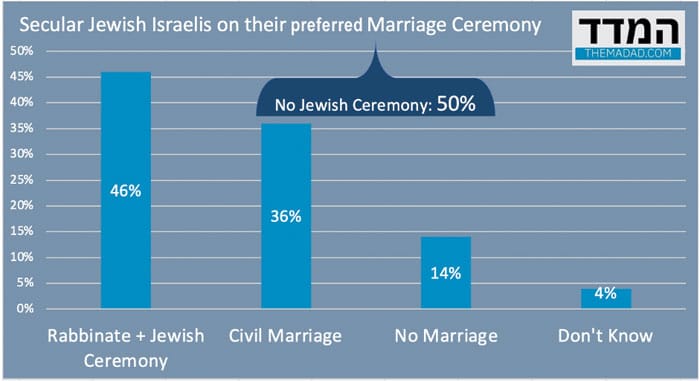
Let’s drop politics for one week. Let’s talk about something that isn’t politics. Well – it is about politics, and it isn’t. A new finding marks a significant, lasting change, which could have many consequences. It marks the distancing of a large public from everything that smells of “Judaism” and from everything that might imply a Jewish connection. That’s a social trend that has more than one political meaning. 

The data (from a survey by themadad.com) provides the starting point: we asked what Israeli secularists would do if they were given the legal option to marry as they see fit. And note that the wording is important: We asked about a hypothetical situation — “what would you do in case of” — which is currently not in sight. The current government is unlikely to be the government that legalizes civil marriages in Israel. On the other hand, the question of what people would do if there were a certain possibility still teaches us a lot about their state of mind. 

Look at the graph below in “A Week’s Numbers.” About 40% of Israeli Jews self-define as secular. What do these secularists tell us? Two things. First, they don’t like the rabbinate. Only a few of them (12%) would like to have a marriage certified by the Rabbinate. A reminder: In Israel today, that’s the only marriage that counts as legal. Thirty-four percent of seculars would still like to have a Jewish wedding, but not one that’s connected to the Rabbinate. And so, the combined share of secular Israelis who’d choose a Jewish wedding, Rabbinate or not, is less than 50%. In other words, more than half of the seculars in Israel would not choose a Jewish wedding.

That’s a big deal. But why do seculars not want a Jewish wedding? Good question. Maybe because they understand a “Jewish” wedding as a wedding that has a rabbinical connection, and they don’t like rabbinical connections. Maybe because the very context of Jewishness is no longer something they feel comfortable with, for a political, or social, or cultural reason. Either way, this is a significant finding. I’d say a troubling finding. A Jewish wedding is an easy way for anyone to celebrate an identity, a culture, an affinity to a certain tradition. A Jewish wedding ought to be something that we all want — an uncontroversial and happy celebration that mixes the personal and the communal. 

Of course, the conclusions you draw from such finding will not necessarily be the same.

Some will say: that’s a disaster — and so we need to tighten the supervision in such a way that will make it even more difficult for Israelis to have a marriage uncertified by the rabbinate. These Israelis (and I suspect that some government ministers might have this view) would call for enhancement of the power of the religious establishment to handle all marriages.  

Others will say: that’s a disaster — and what we need is the exact opposite. Look, they’ll say, at the damage the religious establishment had wrought. Because of its dogmatic approach, Jews not only stay away from rabbis, but they also stay away from Judaism itself. They do not even want a Jewish wedding!

Still others will say: What’s the problem? A wedding is a personal matter, and it’s none of anyone’s business what kind of wedding individual Israelis want.

Still others will say: This means a future of division of the people of Israel. Soon there will be no possibility of marriages between religious and non-religious Israelis. 

Still others will say: We must start a vigorous campaign to encourage rabbinate licensed weddings.

Still others will say: you got it backwards — what we must have is a vigorous campaign to encourage Jewish weddings (but not necessarily rabbinate licensed) and strengthen Jewish identity and Jewish pride.

The challenge is that we have a free society that strives to encourage and bolster a Jewish culture, in which a large population often feels distanced from that very culture. 

In short, the data is just data. The conclusions combine the data with more than a grain of ideology. The data does not solve the dilemma, or the debate or the challenge. It is merely a helpful tool for those who want to better manage this debate, and deal with the challenge. What exactly is the challenge? This too can be debated, but here’s one way to succinctly describe it: the challenge is that we have a free society that strives to encourage and bolster a Jewish culture, in which a large population often feels distanced from that very culture. It’s a social challenge, it’s an identity challenge, it’s an ideological challenge. We are far from seriously dealing with it.

Something I wrote in Hebrew

Here’s what I wrote when Israel’s court made the controversial decision that Shas leader Aryeh Deri could not serve as a minister (because of tax evasion indictment). 

Former PM Olmert did not think he was guilty when he entered the prison. Former President Katsav did not think he was guilty when he entered the prison. Former PM Rabin did not want to fire Deri when he was forced by the court to do it. Now, Netanyahu doesn’t want to do it either. And of course, Deri himself does not think there is any reason to prevent him from becoming a minister and many of his constituents, perhaps all, agree with him … None of this is important. The court decided, and its decision will  be enforced, because otherwise, the State of Israel ceases to be a state of laws and becomes a state of anarchy, and all that is left for the citizens to do is to arm themselves – because that is what people do when there’s anarchy.

A week’s numbers

This is the graph I explain above.

A reader’s response:

Elan Azulai asked: “Is what we see today the worst political atmosphere in Israel’s history?” Answer: you mean, more than the Rabin assassination (1996)? More than Begin’s threat to storm the Knesset (1952)? More than the murder of Emil Grünzweig in a demonstration against the Lebanon War (1983)? Maybe, but it’s surely not a clear-cut case.


Shmuel Rosner is senior political editor. For more analysis of Israeli and international politics, visit Rosner’s Domain at jewishjournal.com/rosnersdomain.

Rosner’s Domain— The Jewish Wedding Challenge Read More »