fbpx

August 3, 2022

On Becoming 75

Entering my 75th birthday has been a roller coaster ride, a year-long journey of bewilderment and many moments of sustained discomfort. Being born in the shadow of the Holocaust and having spent the past seventeen years facing consistent emotional and spiritual challenges as a caregiver have brought inevitable suffering. But these experiences also presented me with an opportunity to dig deeper to understand my own trajectory that culminated in becoming a rabbi. In considering the many challenging moments I have faced in my life — particularly since my teen years were filled with insecurities, performance anxiety, and messages of who I should be — I came to appreciate all that I had to unlearn. My parents’ Eastern European roots, the Jewish tradition, and the culture of the ’50s and ’60s continually reinforced my role as one meant to serve a male-dominated society. My appearance was more important than my mind and getting married and having children was my raison d’etre. And yet it is the very strength of my survivor family that flows through my veins and my DNA. Those were the sparks that ignited my need to learn new ways of being and tackle risky choices that would slowly but surely strengthen my resolve to expand and grow. Each one of us is the hero of our own story, and as we consider our stories we must find moments of resilience so we can face the future confidently.

The number itself made me feel ancient, as if I were crossing over to the other side, a place of no return, destined to wander the parched desert where very little blooms.

As I contemplated my own narrative, I questioned whether, if I were to leave this earth at any moment, I would feel regret or acceptance. Had I accomplished my goals, expressed my core values in my work and in my relationships? Did I leave a positive mark or a legacy for my children and grandchild? It was a moment in time to truly understand the arc of my life and reflect on whether I was able to embrace this new stage with a deep sense of gratitude instead of grieving the losses associated with change, especially in a society that desperately clings to youth. The number itself made me feel ancient, as if I were crossing over to the other side, a place of no return, destined to wander the parched desert where very little blooms.

Yet what’s in a number? Sometimes it is laden with enormous weight, markers of social or historical import (who will forget September 11, 2001 or January 6, 2021?)—dates we may want to forget or need to remember. Our tradition calls on us to honor those who have left the world on the date of their burial as an anniversary that, like a birthday, is marked with lighting a candle to burn in memory and gratitude for a full 24 hours. The numbers associated with Jewish holiday celebrations or commemorations are etched into our yearly cycle, providing opportunities to embrace the vast variety of emotional responses from laughter to tears. They honor these historical moments of our timeline, encouraging connections easily forgotten. 

Yes, 75 is only a number, but yes, it is a giant one. Three-quarters of a century is a massive amount of time, though in the scheme of things it is but a blink of an eye. For me it feels like “coming out of the closet.” Previously, I never thought about my age. Nobody ever asked how old I was, and as a result I have befriended colleagues that I later discovered were 20-30 years my junior, yet always feeling their equal. My youthful attitude and presence have always been embraced, leading me to feel as a contemporary to those generations younger than me. When a dear friend announced she was celebrating her 50th birthday, I exclaimed in shock, “You mean I’m almost 25 years older than you? I could be your mother.” It was a revelation for both of us.

To openly admit I am 75 has been a process of acceptance. Facing large-scale catastrophes in the world, now including Russia’s invasion of Ukraine, has brought insecurities and unknowns, heightening my sense of feeling tired and old. During this pandemic, being shut down and shut in, I have confronted many challenges as have so many of you. Living with a spouse who is chronically ill has been a double whammy, as I have experienced the impact from the outside and ongoing personal challenges from the inside. So many have had to cope with career, medical, and relationship problems all under the black cloud of fear and insecurity because of COVID-19, political chaos, antisemitism, and hatred of the other. For myself, losing so much person-to-person work has often felt like enforced retirement, only reinforcing my discomfort with aging and becoming 75. 

As a woman I have struggled with what it means to grow old, to be real, to be authentic. I was challenged during COVID to let my hair go grey, embracing my birthday in the true sense of its meaning: wearing the mantel of the elder. What I’ve come to accept is that authenticity comes from within. It means being honest, real and expressing core Jewish values of compassion, empathy and goodness — in sum, to be a mensch. It means expanding my mind and spirit, embodying the Divine, and treasuring the sacred. It means feeling comfortable with who I am, exerting every effort to strengthen my body, mind and spirit. Being 75, I’ve come to feel that it’s cool to be a woman and to be Jewish, in combination an expression of Shechinah, the feminine indwelling presence of the Holy One. 

Numbers in our tradition have great import. Each of the Hebrew letters represents a number. Using the process of gematria (Kabbalistic numerical formulations) we can find deeper understandings of words and their connection to other texts by virtue of sharing the same numerical value. The earliest Kabbalistic text Sefer Y’tzirah (The Book of Formation) teaches that the world was created with three things: text, story and number. Numbers tell stories; they bring to life all the emotional and spiritual baggage and wonder we carry deep in the crevices of our psyche. Every birthday is a reminder of being put on this earth, an expression of the love and passion two people shared resulting in the gift of life, an affirmation of our existence. As we go through life from our first birthday on, we are often showered with joy, parties and gifts, a continuous reminder of our value to others. We pridefully embrace the growing privileges that come with maturity and becoming an adult, investing in education, mentoring, and deeper assessment so we find the role that best fits who we were meant to be and why we were placed on this earth. As we approach midlife, we hopefully acquire experience and skill, and develop relationships that bring love and sharing, expanding the tapestry of our lives. Then we come to the third quarter, which is a time of refining, re-evaluating, and exploring the missteps as well as the richness and expansiveness of life, knowing that the last quarter might be filled with physical or medical challenges or perhaps new possibilities through retirement or redefinition of time and relationships. 

Moments of aging are important times to take stock and embrace with gratitude our longevity and incredible grit. The losses, the personal and cultural challenges, the pain, the suffering, the social and political climate, and of course the pandemic, are realities that impinge on our lives and only heighten our connection to the physical world. The age of 75 has felt more weighty than birthdays of the past. The numbers, as they grow, remind us of the one thing we all must face: dying. This existential reality, as we reach the third and fourth quarters of our lives, is a reminder that time is precious. Our tradition sees a world beyond and teaches that we are both body and soul. The body, purely physical, is buried in the earth, but the soul, ephemeral and the truest indicator of who we are, moves to be rebirthed in a new way. I’ve come to understand, as we age, that “the body will diminish in strength and agility, but the soul will continue to expand beyond imagination.” 

This potent birthday afforded me the opportunity to process these many stages as I recalled the life my parents built upon arriving in Toronto after the horrors they endured. I could tap into the foundation of Jewish values centered in family. My father, a maternal caregiver, brought his brother with his family, as well as my grandmother — all of them survivors — to live in a small, two-bedroom bungalow, nine of us close and cared for, treasuring freedom and a new future. Memories of sharing Jewish holidays and many Shabbats poured over me as I scanned hundreds of photographs taken by my father. This was a birthday that took me back in time and motivated me to create a special heirloom, a video of my 75 years. I was reminded of sitting in the back of the classroom in cheder, ignored by my teachers because I was a girl and learning Torah was not important for me. I was reminded of my teen years when I chose to become a secretary because I didn’t have the self-confidence or encouragement to go to college, and I was reminded of being faced with an abusive first husband who created an environment of fear and insecurity. And yet I chose to find pathways to shift my trajectory — to study, explore alternatives, and build confidence, to change my life and not be defeated by it. Building resilience is facing what is hard and discovering strength and not weakness. Turning pain and difficulty into opportunity is how we face getting older. 

Life is never a straight path. Torah teaches of the Israelites journey to the promised land, a mere three-day trip, but God sent them on a circuitous path, one that added distance and encounters that were to help bring spiritual and emotional development. But finally reaching their destination, they blew it. Ten of the twelve scouts confront the new landscape with trepidation, projecting their enemies as giants and feeling like “grasshoppers.” Driven by fears and inaccurate projections only to be punished with death, they turn down a great gift, and instead a whole generation is wiped from the earth because they couldn’t embrace risk and put faith in God.

The awareness of how time flies or how unannounced difficulty enters our lives reminds us of the need to be fully present.

So it is with our own lives. Our journeys are never direct but often confusing and unclear. Our life’s work is not just to live but also to step out of ourselves to understand what makes us tick, to see the purpose of painful and traumatic events, to recognize the hidden angelic beings that changed our lives, to assess who we were and who we have become. Each birthday, as we head toward the last quarter of our life, is an opportunity to evaluate, refine, and retune, to hopefully embrace the moment fully so that if we leave this world unexpectedly it will be with acceptance and without regret. I often teach that we must live each day as if it is our first and each moment as if it is our last. The awareness of how time flies or how unannounced difficulty enters our lives reminds us of the need to be fully present. “Teach us to count our days, then we shall acquire a heart of wisdom” (Psalm 90).  This means that we must make our days count.

We all face forks in the road that demand decisions that can lead either to dead ends or the promised land. Even some of our mistakes can have miraculous outcomes. Only later in hindsight do we understand that what was painful led us to gifts of awareness, fulfilling relationships, or opportunities that were truly blessings. My miserable first marriage brought me to the city of Cincinnati so my then husband could complete his Ph.D. in Psychology. But there I discovered a place where I could transform myself and find my b’shert. There are hidden miracles in the most unlikely places. The same letters in Hebrew can mean a test, a miracle to find refuge and lift one’s self. I came to Cincinnati kicking, but it was significant for my growth and expansion. Seeing the glass half full instead half empty I had the opportunity to appreciate with more clarity the purpose of mistakes and painful experiences. “Jewish gravity” is my new term for our process of living: What goes down, must come up.

Turning 75 has also been an incredible validation of my accomplishments and a life well-lived. Though time has flown at warp speed, and has been full of personal difficulty and challenges, there has also been a steady rise of spirit and skill in multiple dimensions. Each day represents a fullness of thousands of moments — moments both of reverberating memories of the past and dazzling awareness of the present. I have come to embrace many voices — the nurturer, the artist and designer, the musician and cantor, the rabbi and teacher, and now the writer of two theses, a book, and multiple Journal articles, despite failing English in high school. All of this grew out of the voice of silence, being told in my youth to be seen and not heard. Yet I hold deep inside that still small voice, the whisper of Divinity that holds me up and emanates through my work and relationships. COVID has demanded my newest voice, the one that is translated through Zoom and YouTube, mastering unexpected skills. Creating a video was a new journey into the unknown, learning and developing another way to express my creativity and communicate on new platforms. 

At 75 I’ve come to feel so blessed and filled with enormous gratitude to all those in my life. I wanted to honor this birthday by reviewing my past — from my birth to survivor parents on the edge of darkness, through 75 years of growth, expansion, accomplishment, and dedication to my most treasured values. I’ve come to cherish 50 years as a wife, partner and mother. This project turned into a “docu-memoir” in which I spent hours upon hours with photographs from years past, reminding myself of important moments and transformative experiences, creating an offering, a minchah service, a gift of gratitude to both the many precious angels in my life and the souls beyond who impacted my life from the beginning. It was also an opportunity to share the spiritual lessons I have learned that might inspire others to accept and embrace their own lives at whatever number they confront.

“They will still bear fruit in old age; they will stay vigorous and fresh” (Psalm 92). What could represent more hope than knowing that no matter what our age we can continue to plant seeds and harvest new glorious crops. We can continue to flourish even through the limitations of this pandemic. “It is never too late,” has become my motto. I have soared late in life. At age 49 I entered the UCLA Interior Design Program, then become a Bat Mitzvah at 51, was ordained as Chazzan at 57, and most recently was ordained as rabbi at 68. Everything Judaism values is based on the power of the soul to continue to grow, learn, and change. T’shuvah, to return, reminds us that at any moment we can turn things around. The Holy One waits with open arms in every moment. Even deep hurts and traumatic experiences can be healed. Grief and suffering linger and often resurface. Embracing their reality and finding ways to heal them is a gift at any age. 

Research on the brain reinforces the importance of continuing to learn, whether through books, a new language, instrument or new skill, creating neural pathways that strengthen the longevity of our thinking. Moving my body through walking or yoga has led me to discover an agility and sense of well-being necessary for me to remain grounded and sturdy, like an Etz Chayyim, a Tree of Life. 

The Rambam, in the Middle Ages, taught about the interconnectedness of the body and soul. When one is out of alignment the other is impacted. Focusing on my soul’s work is easier when my body feels well and whole. Taking care of my physical being supports my soul’s work. Both are important. Through silence, meditation or prayer we can bring peace, calm and insight. Each part of this triad — mind, body, and spirit—demands special attention and restoration. These past years I’ve been faced with vulnerability, first by experiencing vertigo, the horrific feeling of objects moving around you when they’re not. The sensation is a total lack of control often accompanied by nausea and difficulty walking. A chiropractic head movement corrected the problem, but I was reminded that aging brings medical crisis. This was a new reality I faced for the first time. The other was high cholesterol numbers, part of my COVID weight gain. The number 75 was reminding me I have entered new territory. I had two choices, go on Western medications or bring it down naturally. I chose the latter, creating a protocol that is now part of my routine. Knowing that I can bring about change is incredibly empowering. As a young adult, 75 represented senility and fragility. Today,  decades of science, medical research and spiritual teachings have provided tools and knowledge so that we can take better care of ourselves and embrace our latter years with more confidence.

Judaism teaches, “With the aged is wisdom, in the length of days is understanding.” In a youth-oriented society, aging has become one of the last “isms” that still plagues our culture. Becoming older often puts us on the fringe of society, leading many to feel isolated, rejected and depressed. Judaism is the opposite. Torah teaches, “In the presence of an old person shall you rise.” Knowledge and learning is one of our most deeply held values, and it is assumed that moving on in years is accumulating not only great wisdom but also experiences that enrich our well-being. We rise not for the heroes that American culture promotes — movie stars, sports figures, and multi-millionaires — but those who have spent their lives filling the reservoir of their being with vast knowledge becoming teachers for the rest of us. Over two decades ago Rabbi Zalman Shalomi-Schachter, z”l, wrote a book based on his own struggles with aging. His personal reflections turned into a wonderful acknowledgment of “Aging to Saging.” Through our own affirmations and focus on spiritual practice we can embrace a rich future and become elder statesmen (or stateswomen). As boomers, we have helped to create and nurture a more passionate perception of life at 75, 80, 85 and beyond.

Judaism offers a way to start each day. By saying, “Model Ani L’fanecha” (“Thank you God for returning my soul … with great faith in me.”). We tap into gratitude and confidence and enter the day a little less stressed. Taking a deep, slow breath of the gift of life, just as Torah teaches that “God blew into the nostrils of the first human the soul of life, becoming a living being,” we connect to our Divine source better able to handle what lies before us.

This is 75 for me — the growing awareness of my potential and my acceptance of and surrender to ongoing change and inevitable unknowns. “Regrets I’ve had a few, but too few to mention,” sang Frank Sinatra. I have very few. What I hold dearly is knowing from where I came, who I have become, and who I can still be. I treasure the love and support of my partner, family, and friends and God’s constant hand on my shoulder. I appreciate the gift of spirit that still has many years to learn, explore and discover the many wonders of this world before I move on to the next. It has become a very happy 75th!


Eva Robbins is a rabbi, cantor, artist and the author of “Spiritual Surgery: A Journey of Healing Mind, Body and Spirit.”

On Becoming 75 Read More »

The Soul of Zion

Take my life but you’ll never take my soul
I will meet my Father face to face
And see the new Jerusalem

It’s the chorus from the new song “State of Freedom,” by Joshua David Washington — JoDavi — from his latest full-length album, “Zion.” The verses of the song are based on Elazar ben Yair’s final speech in the Great Revolt against the Romans (66-70 AD). I was fortunate to be able to hear Washington sing twice in New York City on his “Zion” tour.

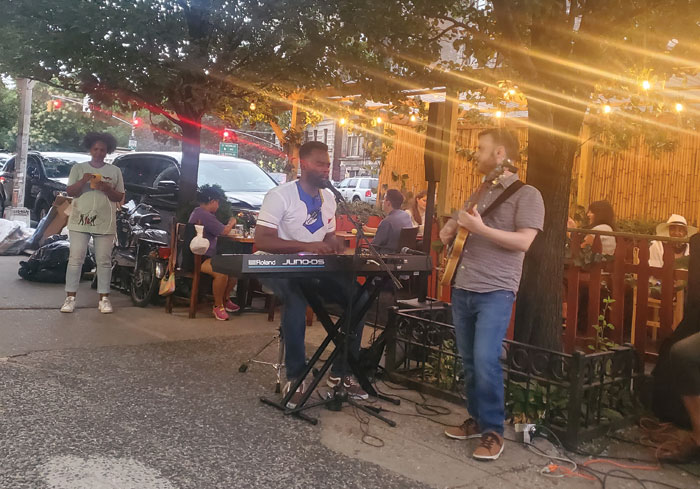
The second night was truly a magical — majestic — evening. Washington and his band played at the Tsion Café, a restaurant in Harlem opened eight years ago by Ethiopian Israeli Beejhy Barhany. Between Washington’s spiritual music and the café’s soulful ambience and savory Ethiopian food, the evening felt more meaningful than some Shabbat services I’ve attended.

”Marching upward to Zion is an imagery often used in the Black American church tradition. It is a place where G-d restores our soul, edifies our bodies, and shields us from our enemies.” – Joshua David Washington

“Zion to me is both a physical and spiritual place,” Washington told the Journal. “To Zion is where the rest of the lost tribes of Israel will return. But Zion also represents a place of higher calling and purpose. Marching upward to Zion is an imagery often used in the Black American church tradition. It is a place where G-d restores our soul, edifies our bodies, and shields us from our enemies.”  The soul of Zion, it seems, is a movable feast. 

Washington, who earlier this week performed at the Hotel Café in Los Angeles, calls his music “Cinema Soul.” “It has the sweeping orchestral elements that harken back to Motown and Philly soul, but it also has some reggae and other complementary elements that give it one unified message and sound.” Other songs on the album include “Yom Hashem” and “Shuvu L’Torah.” 

(For a full list of Zion’s tour dates, please look here.)

When he’s not creating music, Washington is the executive director of the Institute for Black Solidarity with Israel (IBSI). His father, Dumisani Washington, is founder and CEO of IBSI, and his wife, Olga Meshoe Washington, is national director for programming and engagement at Club Z. Fighting for Israel on the activist front lines, the Washington family knows better than anyone that the rifts between the Black and Jewish communities today were intentionally manufactured by leftist — antisemitic — ideology. 

Three Hebrew boys are meant to choose
Between a lie and what is True
They stand up tall before the King
Said “you can throw us to the flames.
It makes no difference what you do,
Cuz we will never bow to you.”

One of the saddest parts of today’s over-emphasis on race is that it destroyed one of the most beautiful aspects of NYC: its intrinsic mosaic of diversity. Playing with children from all backgrounds, my son was raised to not even see skin color; today he is being forced to only see skin color.

Barhany is working to heal those rifts — not through politics, but through the “harmony and connection” she creates at Tsion. “I wanted to create a space celebrating everyone’s identity.” In 2003, she created the Beta Israel of North America (BINA) Cultural Foundation, to foster greater understanding of Ethiopian Jews. “I’m very proud of who I am, and others should be as well.” Images of the “Ethiopian angel” appear throughout the café.
When she was four, Barhany’s family made the trek from Ethiopia to Israel, “fulfilling prophecy.” After her IDF service, she traveled around the world a bit and then settled in Harlem’s historically famous Sugar Hill neighborhood. “I felt at home here, and wanted to create a community, but also heal some bonds,” she said. The cafe is filled with art from local artists, jewelry from Ethiopia, and nightly live music of all genres. Barhany says the reaction has been quite positive, with patrons wanting to know more about her past.

The evening of “Zion” and Tsion was distinctly anti-politics. There was no hate or tension in the air. The indomitable spirits of both Washington and Barhany prevailed. 

When I came back the next day to talk with Barhany, a young woman introduced herself as a Ukrainian and Ethiopian Jew. Suddenly, I felt very boring. There was no way I was going to say I was from Russia, where my grandparents were born, and Philadelphia didn’t quite have the same panache. So for the first time, I rolled out the ethnicity card: “I’m Judean like you.” 

If the soul of “Zion” is a combination of bravery, warmth, and beauty — a feeling of being closer to G-d — then both Washington and Barhany have achieved this in the music and vibe they create. Tsion Café honors both individuality and identity — and the harmony both can create when divisive politics are removed. The space inspired us to think about events we could have there, but just as important the plans we began to make for our sons, who both become men this year. 

When my son returns from camp, I will take him up to Tsion to meet his Ethiopian brother, Berhan. Piece by piece, we will begin to put back together the beautiful mosaics of both Judaism and New York City. The light emanating from the soul of Tsion will make it possible. This last verse is from Washington’s “Return.”

The hearts of the fathers return to their children
And the hearts of the children return to their fathers
So it is written, so shall it come to pass.


Karen Lehrman Bloch is editor-in-chief of White Rose Magazine. 

The Soul of Zion Read More »

Rescued, Redeemed, Robbed

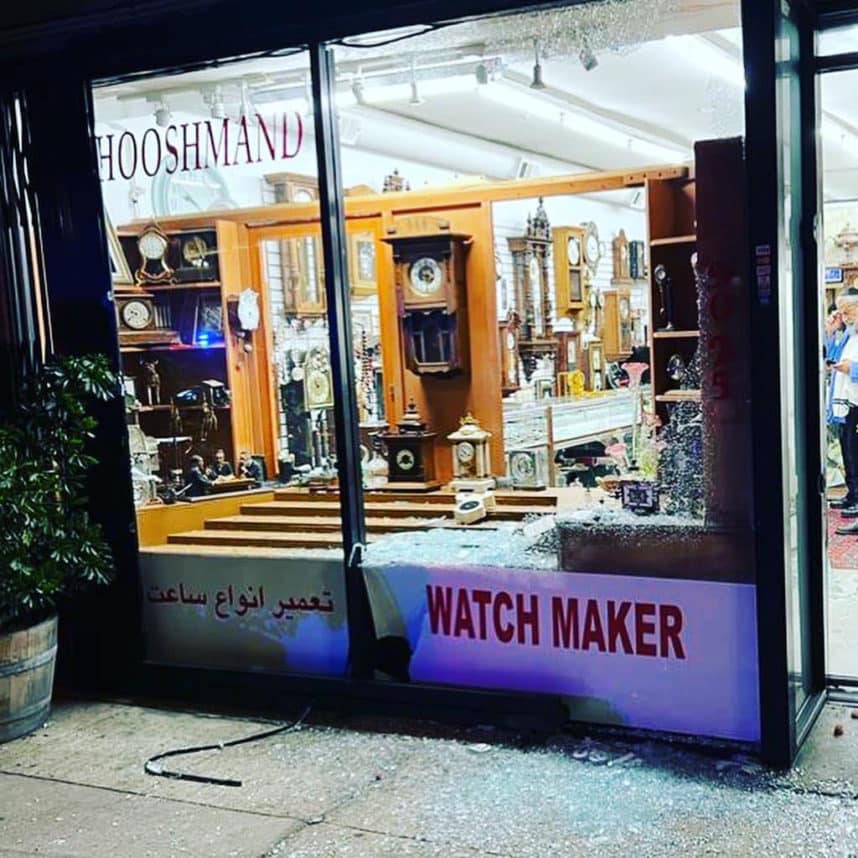
Menachem Kashanian, 28, was riding his bicycle to synagogue at 7:30 a.m. on Sunday, July 25 when he saw an older man sitting on the sidewalk, alone and visibly distraught. Kashanian instinctively stepped off of his bicycle and approached the man. That’s when he noticed the broken glass. 

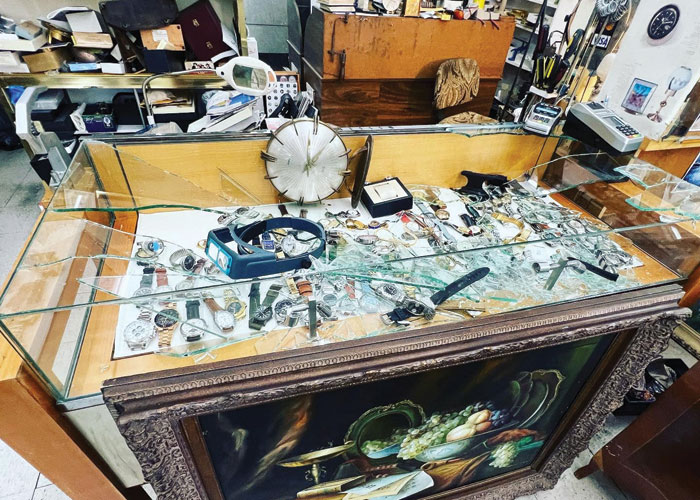
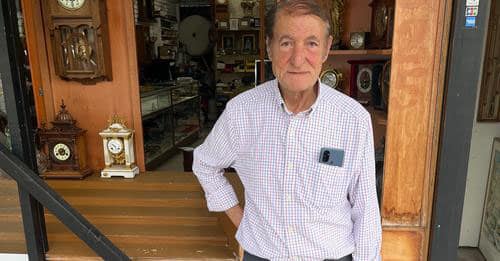
Hooshmand Talasazan, a 75-year-old Iranian Jewish small business owner who arrived in the United States as a refugee in 1997, sat on a chair, staring in disbelief at the remains of his life’s work: a watch and antique shop called Hooshmand Antique Watches on Pico Boulevard in West Los Angeles. Several hours earlier, at 4 a.m., two men spray-painted his security camera, broke locks and a metal security gate and ransacked the store. Video footage shows them breaking glass display cases with a sledgehammer. Outside the store, an accomplice waited curbside in an SUV.

Photo by Sam Yebri

“My heart almost stopped,” Talasazan told me about seeing the remains of his store that morning. “I saw how it was all damaged, destroyed and shattered. They took everything they could take.” In a solemn tone, Talasazan estimated that he suffered over $150,000 worth of stolen merchandise. 

That probably explains why, when Kashanian found him sitting alone on the sidewalk and staring at the wreckage, Talasazan told him, “Zendegeem raft; zendegeemo bordan” (‘My life is gone; they took my life”). Like Talasazan, Kashanian is also an Iranian American Jew and was able to converse with the shopkeeper in Persian.

Talasazan has been in the watch and antique business for 40 years—first in Tehran and then in Los Angeles. It’s all he knows. As his shaky voice described some of his lost items, it was almost as if he was in fond remembrance of old friends. Some stolen objects, like antique locks that Talasazan had brought with him from Iran, were collectors’ items that also held indescribable sentimental value for the aging shopkeeper. 

“The locks [from Iran] were so special,” he said. “They were truly collectors’ items and so very beautiful.” He valued the stolen locks at $70,000-$80,000. “They also took unique hand watches and pocket watches; some of them were 1940s/1950s-era watches,” he noted with sadness. 

Talasazan is still waiting for more information about theft coverage from his insurance company; he’s deeply worried about not being able to recoup his losses. 

When Kashanian found Talasazan sitting on the sidewalk outside his burglarized store, the young man pulled out his phone and began filming. “My first reaction was that I needed to film what’s happening,” he told me. “Everything was raw and left exactly as it was from the robbery,” he said. He posted the short video to social media, including Facebook and Instagram; it instantly went viral. 

It’s not easy to watch Kashanian’s video, especially when he turns his camera to Talasazan and captures a devastating moment of heartbreak from a man staring at the ruins of his livelihood and his passion. In that fleeting moment, Talasazan breaks down and quietly sobs. 

Kashanian had passed the store on his way to morning prayers and a class at Kehillat Bnai Torah, a synagogue located next to Talasazan’s store. With the help of Iranian American Jewish community members Yehuda Masjedi and Kiya Eshaghian, the young men brought a broom and a waste basket from an upstairs room and a large trash can from the neighboring synagogue and began sweeping the floors. Soon after, other worshippers from Kehillat Bnai Torah began to help as well. “We wanted to remove the stain of what had happened to him [Talasazan],” said Kashanian. 

And then, Kashanian took to his phone once again, this time, to create a GoFundMe campaign. Within hours, he had collected over $15,000 to help Talasazan. 

There was only one problem: “At first, he was embarrassed to accept any funds because he’s an extremely proud man,” Talasazan’s daughter, Niloufar Mobassery, told me about her father. “He was absolutely devastated and broken.”

Talasazan opened his store in 1998, one year after arriving to the U.S. as a protected refugee with his wife and two daughters (a third daughter arrived later from Iran). With the help of HIAS (formerly the Hebrew Immigrant Aid Society), the family was re-settled in Los Angeles. Talasazan’s store was first located on Beverly Boulevard but then moved to Pico Boulevard.

Hooshmand Talasazan (Photo by Menachem Kashanian)

“He left Iran more for us than for himself, so that we could have more opportunities,” said Mobassery, who also lives in Los Angeles. According to Mobassery, her father and mother have always lived modestly in the U.S., and for her father, the store is so much more than a place of work. “He’s a gentle and generous man,” she said. “This is all he knows and all he loves. The watches are his babies. He literally takes care of them; they’re very important to him. He has a tremendous love for what he does.”

Talasazan’s store did not have an alarm; shortly after the break-in, the owner of the building from whom he rents the shop contacted Talasazan’s eldest daughter, Ghazaleh Talasazan, with the bad news.

But this isn’t the first time Hooshmand Talasazan has been the victim of robbery; in fact, it’s the fourth time in 25 years. The last incident occurred in 2020, when his store was targeted during the civil unrest and mass looting that tore through Los Angeles after video footage of George Floyd dying while in police custody in Minneapolis went viral. 

I asked Mobassery, his daughter, how Talasazan recouped after that particular loss. “He didn’t,” she said. “During the 2020 robbery, he didn’t even have insurance.” But today, Talasazan is deeply moved and grateful to the local community for its incredible support, including GoFundMe donors as well as kind individuals who have sponsored security cameras and new glass for his storefront, and a local attorney who is offering him pro-bono services. Currently, the GoFundMe campaign has raised over $60,000, though much of it may be reimbursed to donors depending on the scope of Talasazan’s insurance coverage. 

“I’m so grateful to everyone who has helped me, to those who’ve stopped by to cheer me up,” he said. Some of those visitors have included children. Not surprisingly, with its multitude of charming watches small and large, the store was a favorite among local kids. 

“Like all the rest of us, he worked very hard and he really had high hopes,” said Mobassery, “but I don’t think his American dream ever came true. Not for him, personally. For his children, but not for him. His dream was to have a successful business, to own a house, and live a financially stable life.”

Sadly, Talasazan’s work life in America has been marred by theft. “From the day I came from Iran to LA, I’ve been robbed,” he said. “First by the manager of my first store on Beverly Drive, then when the store was on the other side of Pico, when a robber put a gun to my head in 2010, again in 2020, when looters actually ripped off the door and now.”

According to Mobassery, her father wants to stay at the current Pico location, though his family is pleading with him to move the store elsewhere. “We’re trying to change his mind. I don’t know how many more safeguards we can put in place,” she said. Despite his pain, Talasazan wants to stay in the heart of the city’s Iranian and Jewish community, and he’s deeply concerned about whether he’ll be able to afford rent prices if he moves the store away from Pico Boulevard.

Talasazan’s story is a somber reminder that sometimes a refugee or immigrant’s redemption in America can still be marred by lack of safety and security. 

Talasazan’s story is a somber reminder that sometimes a refugee or immigrant’s redemption in America can still be marred by lack of safety and security. Undoubtedly, Talasazan suffered indescribable loss when he escaped Iran at the age of 50 and began anew in this country, but the loss he’s suffered in the United States has left its own unique trauma. 

And in the end, the trauma of repeatedly lost livelihood — and the loss of trust in the American dream — finally seems to have shattered Talasazan. His daughter, Niloufar, captured such heartbreak when she asked me, “Wasn’t escaping Iran a challenge on its own? How much of a financial and emotional loss can one person take?” 

For more information on the GoFundMe for Hooshmand Talasazan, visit https://www.gofundme.com/f/hooshmand-the-watchmaker-recover-form


Tabby Refael is an award-winning weekly columnist and an LA-based writer, speaker and civic action activist. Follow her on Twitter @TabbyRefael

Rescued, Redeemed, Robbed Read More »

Mouthwatering Mujadara

The first time that Alan and I took my son Ariel out for dinner, we went to Grill Express on Fairfax Avenue in Los Angeles. It was our favorite kosher Israeli restaurant. Just as in Israel, they lined up the little bowls of pickles, olives and salatim on the table the moment you sat down. They served shwarma and pargiyot, falafel and sabich. On Thursday nights and Sundays, they served cholent, but they called it “chunt” just like in Israel. Grill Express is long gone, but that evening from twenty two years ago is forever etched in my memory.

My engagement to Alan was still two months in the future, but Alan and Ariel had already met and bonded.

I don’t remember what Alan and I ordered, but I remember that Ariel, 6 1/2 years old, proudly ordered steak kebab, mujadara and Israeli salad. I remember thinking, why kebab? Those chunks of meat are too dry! But I decided not to interfere with his choice. (Anyone who knows me, knows that this is most uncharacteristic of me.)

The food arrives and we are all happily eating. That is, until Ariel starts choking. Alan, who is sitting opposite me, has a look of complete terror on his face. The waitress is hovering helplessly and the entire restaurant has frozen in horror. I take my right hand and begin to stroke Ariel’s back in a circular motion. In a soothing voice I murmur “Just relax…..Everything is okay!”

Then I summoned all the strength I had in me and slapped his back. The way that piece of meat flew out of his mouth and across the table was almost comical. Relieved, the other diners returned to their meals. The story is a family legend, a fond memory of crisis averted.

Being Jewish is all about memory. This time every year, we remember the destruction of the the Holy Temple in Jerusalem on Tisha B’Av. First, Solomon’s Temple at the hands of the Babylonians, then the rebuilt Second Temple by the Romans. We remember our long exile from our homeland and the suffering experienced over the generations.

Being Jewish, we make it about the food. On the week preceding Tisha B’Av and the Seudah Mafseket before Tisha B’Av, it is traditional to eat lentils, a mourning food. Perfectly round and flat, legumes symbolize the cyclical nature of life and death. But they also symbolize fertility and rebirth. Amid the sadness of Tisha B’Av, we also pray for redemption from Exile.

Our Iraqi family tradition for the three weeks is to eat kitchri, a cumin and garlic flavored rice and lentil dish. It is a perfect meal served with plain yogurt or leben (labneh) and over the top greatness with a fried egg (and you can find the recipe on our website!).

—Sharon

Lentils originated thousands of years ago in India, where they are still an important crop and an immensely popular source of protein. From there the plant was domesticated in the Middle East and along with barley, lentils were an important part of the Biblical diet.

In my parent’s home, my mother always served lentil soup before the fast of Tisha B’Av. My mother made it with brown lentils, lots of sautéed onion, small chunks of carrots and delicately seasoned with salt and pepper and bay leaf. It’s still a family favorite whenever we feel like a hearty nutritious soup. The Rhodesli custom that I acquired through marriage to Neil was to serve Peshcado Frito (fried white fish) with stewed lentils served over rice.

Many years ago, when I started the Sephardic Spice SEC FOOD page on Facebook, I noticed many members posted mouthwatering pictures of mujadara around Tisha B’Av. So I decided to start making this nutritious staple of the Middle Eastern diet with my own spin.

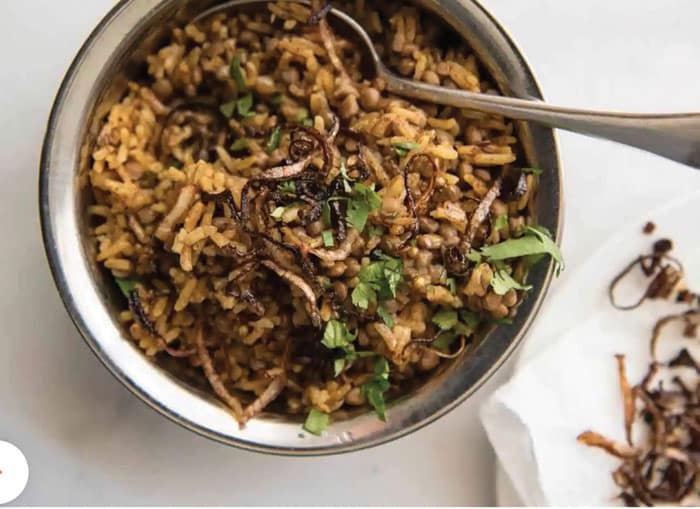
Mujadara, which means “pockmarked” in Arabic, is made with three ingredients—brown lentils, rice and lots of onion. 

Mujadara, which means “pockmarked” in Arabic, is made with three ingredients—brown lentils, rice and lots of onion. The traditional seasoning is salt, pepper, cumin and paprika. I can’t resist cooking the lentils and rice with bay leaf as well. But it’s the exquisitely thin and crispy sweet golden brown fried onion makes this dish a huge hit.

Ironically, this year Tisha B’Av falls on Shabbat and Sephardic Jews will never, ever serve lentils on Shabbat. So we’ll eat mujadara in the nine days. And we’ll make it other times during the year because it’s truly delicious.

—Rachel

Mujadara Recipe

2 1/2 cups brown or green lentils
1 cup long or short grain rice
1 teaspoon kosher salt
1/2 teaspoon white pepper
1 bay leaf
4 tablespoons extra virgin olive oil
5 onions, 3 finely chopped and 2 thinly
sliced
1 teaspoon cumin
1 teaspoon sweet paprika

  • Rinse lentils, strain and place in a large pot. Add 5 cups of water and bring mixture to a boil. Reduce heat, cover the pot and allow to simmer for 15 minutes until the lentils are tender.
  • Soak rice for 15 minutes, then rinse three times. Drain well.
    Add rice to the pot of lentils and season with salt and pepper. Add 2 cups water and the bay leaf, then bring to a boil.
  • Reduce heat, cover the pot and cook until the rice is tender and the water has been absorbed, about 15 minutes.
  • Allow the rice to rest in the covered pot for 15 minutes.
  • In a large skillet, heat two tablespoons of olive oil over medium heat and fry the chopped onions until golden brown. Transfer to the pot of lentils and rice, add cumin and toss well to combine.
  • In the same skillet, heat the remaining olive oil over medium heat and fry the sliced onions until caramelized, about 15 minutes. Then raise heat to high and crisp the onions for two minutes, until the onions are crispy.

Sharon Gomperts and Rachel Emquies Sheff have been friends since high school. The Sephardic Spice Girls project has grown from their collaboration on events for the Sephardic Educational Center in Jerusalem. Follow them on Instagram @sephardicspicegirls and on Facebook at Sephardic Spice SEC Food. Website sephardicspicegirls.com/full-recipes

Mouthwatering Mujadara Read More »

Rosner’s Domain: United in Not Feeling United

On the eve of Tisha B’Av — the day the Temple was destroyed, and a day on which we remember internal divides that brought about the catastrophe — Israel feels fragmented, divided. How divided? We can start with the bad news: Most of Israel feels “strongly divided.” And of course, “Israeli society” is not an entity, but rather a collection of individuals. So most of them feel divided. And another caveat: They feel divided, which doesn’t necessarily mean that they are divided. We will get to that point soon.

In a survey we conducted and analyzed earlier this week, we offered Israelis four options, from “strongly divided” to “strongly united.” The choice of “strongly united” is negligible to non-existent. The choice of “a little unified” is less than ten percent. The outcome is almost a consensus. Here is one thing on which we are unified: Israel is the opposite of unified.

On the right end of the political spectrum, the largest camp in Israel, about half of the respondents (the figures are based on 1,300 questionnaires) say that Israel is “strongly divided.” Another third say “somewhat divided.” The more we move leftward on the political map, toward right-center, center, left-center and left, the more the proportion of those who identify a deep division increases and the proportion of those who identify a slight division or unity decreases. In fact, on the left-of-center there are no respondents at all who believe that Israel is “strongly united.” Only a tiny number believe that Israel is “somewhat united.” And we should say that even on the right the combination of “strongly united” and “somewhat united” gets little support — less than one-fifth. For example, only 11% of Likud voters say “united” (somewhat or strongly). 

But there is one exception: voters of the “Religious Zionism” party. Among its hawkish religious voters about a quarter believe that Israel is united. Compared to other groups that’s a rosy perception. And there’s one more exception to the voters of the “Religious Zionism” party: Much like Israel’s Arab voters, they think that the main tension in Israel isn’t the one between “Right” and “Left,” as most other Jewish voters say. They think it is the tension between Jews and Arabs. 

This is based on another question that we asked this week. We have shown that most Israelis believe that the country is divided. But we wanted to know: “divided by what?” In our questionnaire, five options were presented: Jews-Arabs, religious-secular, right-left, rich-poor, Mizrahi-Ashkenazi. Of these, two are more dominant than the others: right-left, which makes sense, especially in an election atmosphere; and Jews-Arabs, which also makes sense, unless you’re a visitor from outer space.

Looking at these two questions, two interesting social-political trends seem clear. 

A considerable proportion of Jews of the religious-right have difficulty recognizing to what extent the political divide affects the rest of Israeli society. Religious Zionist voters are the ones who tend more than others to underestimate the severity of the division. They are also more inclined than others to underestimate the severity of the left-right divide. In other words, religious Zionist voters are not aligned with the feelings of the majority of other Jews in Israel. That’s not insignificant for a party that is currently expected to be the fourth largest in the next Knesset. 

Just as the center-left tends to emphisize the feeling of division in society more than the right, it also has a much stronger tendency to choose the right-left divide as the main one in Israeli society. True, Likud voters also choose the right-left divide at a high rate. But among Likud voters the gap between the two leading causes of tension is not very large (6%); that is, a picture of a fairly close competition between two causes. In contrast, among Blue and White voters there are almost twice as many who rank the right-left divide compared to the next divide in line (Jews-Arabs), and the situation is similar among those who vote for Labor, Yesh Atid, Meretz, Yisrael Beitenu. In other words: As one moves to the left, excluding Arab voters, the resulting picture is of a deeper split — a split whose cause is political rather than national.

Is a feeling of divide equivalent to an actual divide?

And we can’t end this column without asking a crucial question: Is a feeling of divide equivalent to an actual divide? Maybe, but not necessarily. It may be that we feel a deep split, but that in a moment of crisis it will become clear that we were wrong, that an external threat quickly moves us from superficial division to deep unity. Of course, that’s the optimistic interpretation. The pessimistic one sends us to ponder the gloomy possibility that the public is right. Sometimes, the very feeling of a divide feeds a downward process that ends up with even more divide. The less united we feel, the more we cling to our “camp,” and thus we further sharpen the feeling of division. So the pessimistic option is the one that sends us back to thinking about Tisha B’Av.

Something I wrote in Hebrew

Four parties merged: New Hope with Blue and White, Yamina with Derech Eretz (now the new Zionist Spirit). So, what do we need to look at when we look at the polls? Here’s what I wrote:

Pointers for next week: The most important thing is whether the Netanyahu bloc is trending in the direction of 61 seats. If not, all other movements are largely a slight ripple in stagnant water. More: Does the Zionist Spirit party show signs of life? If this doesn’t happen quickly, if the Ayelet Shaked-Yoaz Hendel union doesn’t show quick impact, the party will collapse. More: Does the downward trend continue for Labor and the upward trend continue for Meretz. More: Pay attention to United Torah Judaism (UTJ) as well. It also trends downward. This will not affect Netanyahu’s bloc because the voters of UTJ do not move to center-left parties. But it may well affect the mood in the ultra-Orthodox Ashkenazi parties, which are in a kind of silent war.

A week’s numbers

For what this means, see the above column.

A reader’s response:

Michael Schwartz writes in response to my last week’s column: “If the Jewish Agency is now a tool that Putin uses against Israel, that’s another reason (and there are many reasons) to close it down. The Jewish Agency was necessary when there was no state, now it is redundant.” 


Shmuel Rosner is senior political editor. For more analysis of Israeli and international politics, visit Rosner’s Domain at jewishjournal.com/rosnersdomain.

Rosner’s Domain: United in Not Feeling United Read More »

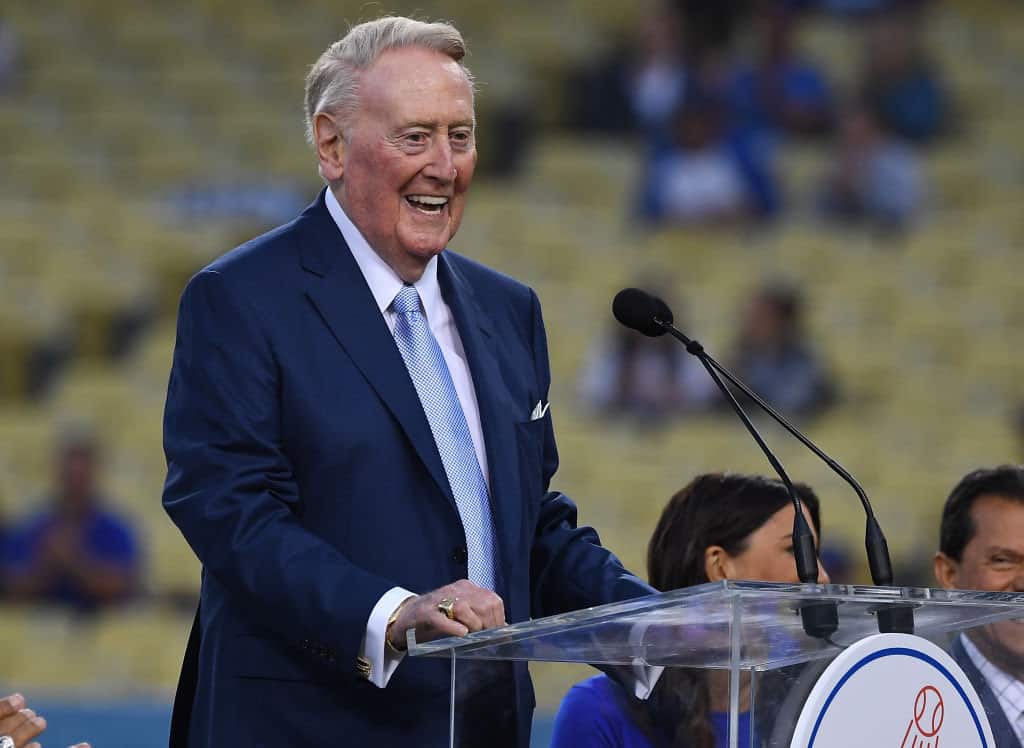
Where Have You Gone, Vin Scully?

Editor’s note: To honor the memory of Los Angeles Dodgers broadcasting legend Vin Scully, who passed away on Aug. 2 at the age of 94, we republish this Jewish Journal profile from 2016.

It was a hot August afternoon, and I sat nestled in the corner of a tent at Camp Ramah, in Ojai, California.  Distant sounds of rock music wafted across the boys’ shetach (area), mingled with the laughing voices of kids horsing around.  The rhythmic, satisfying “whoop” of baseballs hitting soft leather. One boy wrote a letter, another read, and a couple more of us listened to a transistor radio.  It was lazy, it was innocent, and it was 1974.

“His name is spelled L-O-P-E-S,” sang the lead lyrical soundtrack to that tranquil memory.  “He pronounces it “Lopes, not Lopez.  So welcome to the big time, Davey!”  And thus did Vin Scully introduce Davey Lopes to thousands of Dodger baseball fans throughout Southern California.  Just one of thousands of introductory moments that would be repeated for generations in this part of the country.

Vin Scully has since been recognized as the greatest broadcaster in baseball, if not sports, history.  In his final home game this past Sunday, after 67 years as the voice of the Los Angeles Dodgers, he went out in dramatic fashion.  His final call at Chavez Ravine was a division winning, walk off tenth inning home run by little known infielder Charlie Culberson.   He coined one more classic line as his golden voice soared above the roar of the crowd:  “Would you believe a home run?” he teased, as the Dodgers celebrated with wild abandon.

For those who grew up in Southern California, Vin Scully is a link to the mist of our collective past.  He bore witness to the groundbreaking physical and moral genius of Jackie Robinson.  He introduced us to a young, flamethrowing lefthander who would soon teach us all what it meant to feel pride in being Jewish at mid-century, not even 20 years following the Holocaust.  When the Dodgers brought baseball to Los Angeles, it was Vin Scully who gently showed us the ropes.

But his appeal, and the iconic veneration we have witnessed over the past couple weeks, go well beyond that.

We celebrate, in a word, his decency.

Scully once described an opposing player’s nagging injury: “Andre Dawson has a bruised knee, and is listed as day to day,” he told us one summer afternoon in 1991.  “Aren’t we all?”  Sandy Koufax described last week how Scully was unfailingly kind to players from both dugouts, and how his decency overshadowed even the technical lyricism of his narration.  Scully delighted in the diverse world he witnessed around him—the “Wild Horse” from Cuba, the astounding Mexican pitcher, the polite yet fiercely competitive future Hall of Fame pitcher from Texas, the professor of kinesiology who would win a Cy Young Award, a baby in the crowd.  Anyone.  Vin Scully delighted in the miracle of the human spirit.  In interviews, even now, he regularly remarks how blessed he has been by God.

It is no wonder that Vin Scully’s retirement hits us so hard.  To appreciate Scully’s decency is to also recognize the medium through which his values are transmitted: the languid pace of a baseball game.  And in 2016, paradoxically, we have a diminished appreciation for baseball and its slower pace—we need the more brutal and faster paced options of football and basketball.  We will genuinely miss Vin Scully, yet we as a community are losing patience for the lyrical stories that were his stock in trade, or the focused time and attention they demand.  We have no patience for extended rumination—we live our lives in short bursts of texts and tweets. We have no interest in narration devoid of edge, irony, slickness, or meanness.  We have no patience, in other words, for the breeding grounds of decency.

The High Holy Days recognize the complexity of what it means to be human — our positive and negative inclinations; our yetzer tov and yetzer hara. Both as individuals and as a society, we struggle between the twin poles of these inclinations.  How is it, we wonder, that we can long for the simple decency of a figure like Vin Scully, yet so consistently deny ourselves the conditions upon which that decency can thrive?  And how do find ourselves in the situation we do on the eve of this unprecedented election?

We have managed to anoint as one of the two principal nominees for president a man who demonstrates virtually no shred of this basic American decency.  We fear living in a world without the voice of Vin Scully because we rightly perceive ourselves slipping into a portal of unprecedented ugliness.  We have managed to nominate a man who delights in mocking the movements of a physically disabled reporter, whose reputation is based, in part, upon attacking the physical appearance of women, as the next president of the United States.  Imagine that.  We are about to lose a man who showed us each night what it means to regard each person as having been created in the image of God, and we may gain a leader who appears to believe that he alone was created in that image.

This is not a partisan issue at all. Barack Obama speaks with intelligence and vision.  John McCain and Bob Dole were genuine American heroes, who sacrificed in ways most of us can only imagine.  Al Gore and the Bushes came from families that devoted decades of life to public service.  Ronald Reagan brought style, grace, and the force of focused political principles to the office. Even the Clintons have devoted their entire lives to charity and public service; the criticisms of their behavior are of an entirely different magnitude from the sadistic meanness we see dripping from the character of the Republican nominee. Choosing our leaders has never before meant a wholesale abandonment of principles of simple decency.

“Where have you gone, Joe DiMaggio?” we once asked ourselves. “Our nation turns its lonely heart to you.”  In the twilight of 2016, we say farewell to a man who has soothed our souls for 67 years, and we may very well ask him that same question.  We enter these High Holy Days and this crucial election struggling with the maddening mystery of our collective time:  How can we, as a society, so venerate the simple decency of Vin Scully, yet simultaneously indulge our worst inclinations to embrace cruelty, bigotry and bullying as the desired traits of our leaders?  It is 2016, and we have sinned indeed.

It was precisely this issue that brought down the last great American demagogue.  “Have you no decency, sir?  At long last, have you no sense of decency?” we finally asked the senatorial inquisitor Sen. Joseph McCarthy in 1954.  We thankfully emerged from that collective stupor, and realized then that decency was indeed a necessary condition for American democracy.  Will we do the same in 2016?

In September 2015, my then 13 year old son caught an A.J. Ellis home run hit over the mid-left field wall.  As my son joyfully reacted with jubilation, and with the cameras trained on him, Vin Scully paused, and with a twinkle in his voice, remarked, “And that youngster is thrilled!  I think he’s also a little shocked he caught the ball— combination.”  That was Vin Scully’s gift to my family.  It was Vin Scully’s gift to all of us to create space in time, to capture the essence of the human condition through the prism of a baseball game.  It is our challenge to recover that spirit, to live by the credo of simple decency, and to demand it from our leaders– even in the face of a culture that demands our ever-increasing slavishness to an unrelenting harshness.


Stuart Tochner is an employment attorney in Los Angeles, and a member of the boards of trustees of Temple Beth Am and Camp Ramah in California.

Where Have You Gone, Vin Scully? Read More »

Biden Said it Best: You Don’t Have to Be Jewish to Be a Zionist

On July 13, 2022, President Biden arrived in Israel for the tenth visit of his career. Addressing Israel’s President and Prime Minister, he gave inspiring remarks, stating passionately that “you need not be a Jew to be a Zionist.” Truer words have rarely been spoken. While the restoration of Jewish nationhood in the land of Israel has deep roots in the ancient faith, most Americans — and freedom lovers around the world — support the Jewish state, the only democracy in the Middle East. The truth is that Israel has deep roots in common with the world’s other free nations.

This is why Israel has been consistently supported by United States administrations, starting on the very day of Israel’s independence when Harry Truman was the first world leader to officially recognize Israel. As President Kennedy once said: “The cause of Israel stands beyond Jewish life. In our pluralistic society … it has not been merely a Jewish cause, any more than Irish independence was the cause merely of those of Irish descent, because wherever freedom exists, there we are all committed. And wherever it is endangered, there we are all endangered.” In 1974, Richard Nixon became the first president to visit Israel; most presidents since have followed suit, deepening America’s commitment to its gallant ally. 

From the very beginning, Zionism — the movement for the re-establishment of a sovereign Jewish nation — has counted non-Jews among its most enthusiastic supporters. In 1891, several years before the modern Zionist movement was formally organized, a petition known as the Blackstone Memorial was presented to President Benjamin Harrison calling for the return of the Jewish people to their historic homeland, signed by “431 prominent Americans, including J.P. Morgan, John D. Rockefeller, future President William McKinley, and numerous congresspeople, as well as several notable organizations, including the Washington Post and New York Times.”

It’s easy to understand the reason so many leaders support Zionism. As President Biden put it, “the connection between the Israeli people and the American people is bone deep … We dream together.” In response to this statement, historian Gil Troy noted:

“While belonging to that exclusive club of democracies, Israel and America belong to an even smaller subset of ‘dreamocracies,’ countries founded around defining ideas, not just shared space… America is forged by a shared commitment to ‘life, liberty, and the pursuit of happiness.’ Similarly, Israel is more than a smaller, more contested, home — Israelis share a desire ‘to be a free people in our ancient homeland.’ Although particular to each nation, these dreams overlap in a universal vision.”

Our mutual support is explained by the depth of our shared values. Many of us have heard the increasingly shrill extremist voices calling for the United States to reverse its historic friendship with our fellow democracy and instead side with the dictatorships and terrorist groups arrayed against it. While in Israel, President Biden gave the first interview of his presidency to foreign media when he sat down with Israel Channel 12’s Yonit Levy. She took the opportunity to ask him directly about the “voices in the Democratic Party” calling for the destruction of Israel, and he admitted: “There are a few of them.” But, he countered: “I think they’re wrong. I think they’re making a mistake. Israel is a democracy. Israel is our ally. Israel is a friend.” 

The United States and Israel also took a strong step with the adoption on July 14 of the Jerusalem U.S.-Israel Strategic Partnership Joint Declaration. This document provides that “[t]he United States and Israel affirm that they will continue to work together to combat all efforts to boycott or delegitimize Israel, to deny its right to self-defense, or to unfairly single it out in any forum … While fully respecting the right to freedom of expression, they firmly reject the BDS campaign.”

Zionism is in fact a progressive movement. It was created to progress Jews from two millennia of discrimination, pogroms and persecution to self-governance and self-determination in their indigenous land.

Due to a well-organized campaign against it, Zionism is now considered a slur in certain circles. Inspired by the Soviet Union’s sponsored and later revoked UN resolution declaring Zionism racism, some in the U.S. are now invested in this false notion. But Zionism is in fact a progressive movement. It was created to progress Jews from two millennia of discrimination, pogroms and persecution to self-governance and self-determination in their indigenous land. Zionism is not in opposition to anyone else’s self-governance and self-determination, Palestinians included. On the other hand, “Free Palestine from the river to the sea,” the chant adopted by BDS and its celebrity followers, is indeed that — a call for the destruction of the single Jewish state in the world, a shamelessly antisemitic goal. 

Biden, and fortunately the majority of Americans, understand this. Indeed, Biden has done more than state his support; he has come through for the region and the world by helping increase ties between Israel and its neighbors. Following his visit, Biden became the first U.S. president to fly directly to Saudi Arabia from Israel. On July 15, Saudi Arabia made the historic announcement that it would open its airspace to aircraft of all nations, including flights originating in Israel. Two days later, Israel’s national airline, El Al, submitted an official request to overfly Saudi airspace. These may not seem like major steps to anyone outside the region, but their meanings are significant and they are the real life manifestation and a clear indication of a transforming Middle East.

President Biden got it exactly right. The truth is that while there are only a few million Jews in the world, there are hundreds of millions of Zionists. 

Lovers of democracy around the world understand that Israel — like those other precariously placed democracies including Ukraine and Taiwan — is fighting the battle for all free people to live in peace and dignity. President Biden got it exactly right. The truth is that while there are only a few million Jews in the world, there are hundreds of millions of Zionists.


Noa Tishby is Israel’s special envoy for combating antisemitism and delegitimization of Israel.

Biden Said it Best: You Don’t Have to Be Jewish to Be a Zionist Read More »

Antisemitism Without Antisemites

The Republican nominee for governor of Pennsylvania, pressed by the media about his association with an outspoken antisemite, last week condemned “antisemitism in any form” — yet refused to condemn the antisemite with whom he has been associating. 

It’s antisemitism without antisemites.

The GOP gubernatorial candidate, Doug Mastriano, was revealed to have been paying “consulting” fees to the social media platform Gab, a site where white supremacists and other antisemites regularly congregate. Among Gab’s users was the terrorist who massacred eleven worshippers at a Pittsburgh synagogue in 2018.

Gab founder and CEO Andrew Torba regularly makes openly antisemitic remarks. In one recent interview, he railed against “Zionist lies,” and said of Gab, “This is a Christian movement … We don’t want people who are Jewish.” Torba’s hatred of Jews doesn’t seem to trouble Mastriano. In an interview with Torba in May, Mastriano exclaimed, “Thank God for what you’ve done” (in creating Gab).

In recent days, Mastriano sidestepped reporters’ questions about his connection with Torba and ignored appeals to him by Jewish organizations to leave Gab. Evidently pursuing the votes of Torba’s followers was his priority. But as the criticism grew, Mastriano apparently decided it would be more advantageous to put some distance between himself and Gab. So he deleted his Gab account and issued a “condemnation,” but one that was barely worthy of the name.

“Andrew Torba doesn’t speak for me or my campaign,” Mastriano tweeted. “I reject antisemitism in any form.” Then he blamed “the Democrats and the media” for “smearing” him, and claimed his Democratic opponent in the gubernatorial race is the real “extremist” in the room.

So Torba doesn’t speak for him — yet Mastriano pointedly refrained from condemning the things that Torba says about Jews and the platform that he provides to bigots. Mastriano said he “rejects antisemitism,” but he doesn’t seem to reject antisemites — at least not those whose votes he hopes to attract.

Mastriano is an avid supporter of former president Donald Trump. It may not be coincidental that his handling of the Torba episode is reminiscent of the way Trump has responded when asked to condemn white supremacists and other extremists.

In February 2016, candidate Trump was asked by several interviewers if he disavowed the endorsement he had just received from former Ku Klux Klan leader David Duke. In one interview, Trump implausibly denied that he knew who Duke was (despite having made public comments about Duke in the past), then said: “I would disavow if I thought there was something wrong.” When another reporter pressed him on the issue, a somewhat exasperated Trump finally replied, “Okay, all right. I disavow, okay?”

It seemed as if Trump didn’t want to utter the words, “I disavow David Duke’s support,” lest that jeopardize his chances of attracting votes from among Duke’s followers. Perhaps that was the same motive for the answer Trump gave when NBC’s Savannah Guthrie asked him in October 2020 if he agreed that QAnon’s conspiracy theories are “crazy and not true.” Trump replied, “I don’t know about QAnon” and “What I do hear about it, they are very strongly against pedophilia.”

A reluctance to denounce individuals who might be politically useful has been evident on both sides of the aisle in recent years. 

A reluctance to denounce individuals who might be politically useful has been evident on both sides of the aisle in recent years. Recall what happened when Minnesota Democratic congresswoman Ilhan Omar made antisemitic remarks in 2019. That infamous controversy began when Rep. Omar claimed that a Jewish organization was paying members of Congress to be pro-Israel (“It’s all about the Benjamins, baby,” is how she put it.). A statement released by Speaker Nancy Pelosi and five other senior House Democrats condemned what they called “Omar’s use of antisemitic tropes and prejudicial accusations about Israel’s supporters.”

A few weeks later, Omar did it again, this time seemingly questioning the patriotism of some of her congressional colleagues. She asserted that supporters of Israel “think it is ok for people to push for allegiance to a foreign country.”

Minnesota Democratic congresswoman Ilhan Omar
Chip Somodevilla/Getty Images

Congressional Republicans, and some Democrats, wanted to pass a resolution condemning Omar and her statements. But Omar’s allies — led by the so-called Congressional “Squad” — convinced the Democratic leadership to adopt a very different resolution. Theirs did not mention Omar by name, and, instead of focusing on antisemitism, denounced “antisemitism, Islamophobia, racism, and other forms of bigotry.” In other words, it condemned antisemitism without condemning the antisemite. 

Condemning Omar by name would have alienated her followers. Condemning Andrew Torba by name would have offended his followers. Condemning David Duke or QAnon by name would have antagonized their followers. As a result, in each case, the “condemnations” that public pressure elicited were the absolute minimum that the politicians in question believed they could issue while still preserving their narrow political interests.

The concept of asking public figures to condemn a specific antisemitic colleague makes sense. Even if those who are issuing the condemnation have to be pressured into doing so, the fact that they are making such a statement helps set an appropriate standard for American society. It says clearly that such antisemitic sentiments are unacceptable; that helps drive antisemites to the margins.

A hollow condemnation of antisemitism, one that does not name the antisemite in question, undermines the whole purpose of such a condemnation.

But a hollow condemnation of antisemitism, one that does not name the antisemite in question, undermines the whole purpose of such a condemnation. It signals that the politicians in question are still willing to accept the antisemite because doing so gives them some political advantage. They are still treating the antisemite and his or her followers as a legitimate part of American political culture. They are, in effect, bringing the bigots back in from the margins of society. And that’s just wrong.


Dr. Medoff is founding director of The David S. Wyman Institute for Holocaust Studies and author of more than 20 books about Jewish history and the Holocaust. His latest is America and the Holocaust: A Documentary History, published by the Jewish Publication Society & University of Nebraska Press

Antisemitism Without Antisemites Read More »

Why I Dress for Work—Even at Home

Recently I saw a young man shopping at Trader Joe’s in his pajamas. This is no longer unusual, but I’m still a bit startled every time I see people in story time duds going about their business in public as if they are dressed in, well, clothes. In fact, these days it’s entirely possible that this man in sleep’s clothing may have been coming straight from work and popped into the market for some salad fixings. 

If so, he’s part of a trend, but is it a good one? I know I’m not alone in thinking that this casual dressing fad has gone over the tank top. A recent Wall Street Journal article titled, “Is Your Back-to-Work Look TOO RELAXED?” quoted employers who regret allowing workers, now corralled back to their cubicles, to use “their best judgment” about appropriate workplace attire. One exasperated executive complained that the extreme casualness among some workers crosses the line into “I don’t care” territory. That’s not a good look for employees.

Many workers are pushing back. Clinging to their Crocs and seriously distressed jeans, a defiant banker, data analyst, engineer, and product manager quoted in the story all copped to testing the tolerance levels of colleagues and supervisors by padding down the hallways in flip flops, short shorts, and loud, swirly print t-shirts. The product manager’s wife frequently asks her husband in the morning, “Are you really wearing that to work?”   

Admittedly, I never understood how people got any serious work done, even from home, while still in loungewear or play clothes. I’ve worked from home for many years but unless I’m crawling to my desk with a miserable fever, I don’t press that first keystroke until I’m fully dressed. Yes, it’s casual attire, but not ready for the luau. And I do always wear earrings and a little make-up. 

It doesn’t matter that no one else will see me as I work alone. I see me! I’ve worked hard to become a professional, and that is in fact a work in progress. I’d feel less capable, less grown-up, and less worthy of doctoring a client’s manuscript if I were wearing a nightshirt printed with the phrase, “I ❤️ naps.” Besides, the power of suggestion is too strong, and my eyelids would soon grow heavy.

Dressing for work at home sets my mood and mentally prepares me for a day of meaningful tasks. The way I dress reflects my sense of self, purpose, and dignity.

Dressing for work at home sets my mood and mentally prepares me for a day of meaningful tasks. The way I dress reflects my sense of self, purpose, and dignity. Suited up, caffeinated with two cups of Peet’s Big Bang coffee, and empowered by admiring the slogan on my pen holder that boasts, “. . . because I’m the editor. That’s why,” I’m ready to rock on all cylinders. 

Only two generations ago, men wore jackets and fedoras even to baseball games—hard to believe, but true. One generation ago, people dressed up to eat in a fine restaurant, attend a classical music concert, or go to shul or church. But today, someone in picnic clothes might still be headed into a Michelin-rated restaurant, not a 7-Eleven. Not long ago, I had an appointment with a new-to-me physician who was wearing jeans and rhinestone platform sandals. She seemed well informed and I liked her. This may become the new normal, but I don’t have to like it. Why would people who worked for so many years to earn their degrees and status still want to dress like college students? 

Perhaps clothing etiquette used to be too formal and rigid. I get that. Styles evolve and often for the good. I’d rebel too if I were still expected to wear a long dress and whalebone stays around my midsection while writing. (I wonder how Jane Austen did it? She must have had a really good chiropractor.) But as that same Wall Street Journal article asked, “How low should you go?” My hope is that it’s no lower. Our internal essence, unseen, is what matters most, but how we package that essence conveys a message about who we are and what we represent.


Judy Gruen’s most recent book is The Skeptic and the Rabbi: Falling in Love with Faith.

Why I Dress for Work—Even at Home Read More »

Bringing Back the Young

When I wrote last week about the alarming poll results showing a continuing drop in support for Israel among Democrats and among young people, I promised to follow up this with ideas on how to confront this growing problem. Recent polling showed that majorities these two groups now hold unfavorable opinions toward Israel, and the numbers are steadily worsening.

Several advocacy organizations, led by AIPAC’s new super PAC, the Democratic Majority for Israel, the Jewish Democratic Council of America, the Zioness Coalition and the Urban Empowerment Action PAC, have been waging a highly effective fight against the growing antipathy toward Israel among progressive voters. They deserve immense credit for their work. But the fact that so much time, energy and money must be expended to persuade Democratic voters to support a Jewish state should be taken as a warning sign rather than a cause for celebration. 

As I’ve written before, the anti-Semitism that emanates from the extreme right is just as pernicious as the anti-Zionism infecting the far left. But the Democratic Party has been the historic home for the majority of American Jews, so the loss of support among young people and liberals requires a more serious response than simply changing the subject to nationalistic ultra-conservatism. We will never win over the blood-and-soil bigots and racists — nor should we try. But bringing back the young and the left-leaning is a necessary goal to pursue.

First, we must recognize that we do not see ourselves the way most others do. By definition, progressives are invested in helping the dispossessed overcome adversity. After several millennia of oppression, most Jews see ourselves and the Jewish state as having earned that underdog status. But our academic, economic and political successes mean we are now regarded by many of our detractors not as the oppressed but as the oppressors. 

We think of ourselves as David. They see us as Goliath. Until we begin to rebuild our relationship with other underrepresented communities, and help them better understand our history (as we make a better effort to learn about theirs), that fundamental misperception will prevent the political left from being comfortable with Jews or Israel. 

The challenge is particularly acute in minority communities, as the once-vital relationship between Jewish and black advocates has largely withered and nascent connections with other groups have yet to fully take root. But we should be just as concerned with the precipitous drop in support for Israel among young voters as they move into more influential positions of civic and political leadership.

Especially worrisome are the markedly less favorable feelings that young American Jews have for Israel. Millennial and Generation Z Jews tend to be much more ambivalent about Israel than their parents and grandparents, which will make it much harder to shift opinions among voters of their age groups in the years ahead.

It’s not difficult to see how younger Jews have developed such different feelings about Israel than previous generations. Their attitudes were shaped not by independence or the Yom Kippur War, but by more recent news from the Middle East that is overwhelmingly focused on West Bank settlements and Gaza uprisings.

But us older Jews still assume that these young people will think like we do even while growing up in a dramatically different information environment. Because Middle Eastern politics can be so divisive, many Jewish institutions have stepped back from the difficult but necessary challenge of teaching our young people about the challenges and successes of modern-day Israel.

Jewish students read about biblical Israel but much less about the modern-day country. The resulting information vacuum is then filled by other, less sympathetic sources.

So Jewish students read about biblical Israel but much less about the modern-day country. They learn about Abraham and Moses, and maybe occasionally Ben-Gurion and Meir, but certainly not Lapid and Netanyahu. The resulting information vacuum is then filled by other, less sympathetic sources.

These conversations can be controversial and sometimes unpleasant. But we must be willing to have these conversations – both within and outside the Jewish community. But rather than keeping our next generation of young leaders safe from uncomfortable debate, perhaps it would be better to prepare them for the future challenges they will inevitably face. 


Dan Schnur is a Professor at the University of California – Berkeley, USC and Pepperdine. Join Dan for his weekly webinar “Politics in the Time of Coronavirus” (www/lawac.org) on Tuesdays at 5 PM.

Bringing Back the Young Read More »