fbpx

September 1, 2021

Rosner’s Domain: Proof of Adaptation

At the end of last year, attempting to summarize an eventful twelve months in a short 700-word article, I concluded with the following thoughts: “Proportion is essential. This was a challenging year; bad, but not the worst ever. With luck, when the pandemic is under control and the economy recovers, we might even remember it with bemusement and slight nostalgia: ‘Remember the year of the pandemic?’”.

What a fool I was. I could have written something else and saved that paragraph for this year. Instead, I’d write something slightly different: Remember the year when we thought the pandemic would be over by next year? I remember it, even though the time that has passed since the beginning of the pandemic is somewhat blurred. I also remember that both those two years, the one before last, when we thought the pandemic might be over soon, and the last, in which we realized that it’s going to take more time, were not the worst ever. 

When Rosh Hashanah arrives, it is better to focus on the good things that we have, rather than the bad things with which we must cope. 

Here is one good thing: the print is not dead. Proof: you hold a print issue in your hands. Here is another good thing: the Jewish people is still a living entity. Proof: you hold a print issue of the Jewish Journal in your hands. Here is another good thing: Israel is still around, amid political chaos and other hurdles. Proof: you read a column written in Tel Aviv. I write it as the people around me deal with the following challenges: one son just ended a short quarantine and goes back to work. He does not have COVID. One son just went back to the military, having spent more than a week at home, because more than thirty cases of COVID in his unit. Another son decided to take the risk and go to central America for a few weeks of vacation. We all assume he will get the virus. My daughter is going back to school, vaccinated twice. My wife and I work mostly from home, vaccinated three times. 

Three times! Israelis, as frustrated with their old or new government as they might be, should stop and take a minute to appreciate their good luck. Three times! Israel was an early vaccinated country. Then it was a vastly vaccinated country (with the usual share of detractors who still refuse to do the obvious thing). Then it was the first to take the risk and vaccinate us with a third shot. And again, this operation we quick and efficient. Two days after the third shot was offered, and two minutes after I entered the clinic, the process was over. More than a million and a half Israelis got the shot in less than two weeks—that, in a country of ten million (many of which are children who can’t even get the vaccine). 

Forgive me for feeling lucky on this new year’s eve. Forgive me for feeling that the year was not a bad year. Sure, it was complicated. Sure, it was challenging in many ways. But complications and challenges are not necessarily bad. They force us to rethink our models of living. They force us to reinvent our relationships and communities. They force us to rescale our priorities. We see people all around us doing these things—thinking afresh about work and life, reimagining ambitions, redesigning routines. 

In the book “Adapt: Why Success Always Starts with Failure,” by Tim Harford, there’s a wonderful story about guppy fish, who have less color if they live downstream and are more colorful if they live upstream. Harford describes the work of the researcher who cracked the mystery of this color difference, and then writes something quite illuminating. We, as people, tend to think about our life as if we are the researcher who can manipulate the colors of fish—but, in fact, we are the guppy. We are the fish. When we adapt, this is not about something that we do but often something that is done to us—like a pandemic. The wise guppy understands that when circumstances change, and he cannot control the change, what is left are three possibilities: try new things; try them with caution—to make sure that in case the trial fails it doesn’t kill you; identify failure and learn from it.    

Have we tried? Have we made sure to survive? Have we learned by trial and error? I think we did. Proof: you hold a print issue of the Jewish Journal in your hands.

Something I wrote in Hebrew

Here I will share paragraphs from what I write in Hebrew (mostly for themadad.com). Today, something about justices’ state salaries, and how Israelis view them:

“Israelis who identify with the right, and Israelis who identify as religious and ultra-Orthodox (in many cases these are overlapping definitions), are less trustful of the justice system. Therefore, they would cut more of the judges’ salaries. Israelis from the left, secular Israelis, trust the judiciary. Although they also think that judges’ salaries should be cut, in their case the cut is not accompanied by a sense of desire to punish or weaken the judiciary. They just think the judges are earning too much.”

A week’s numbers
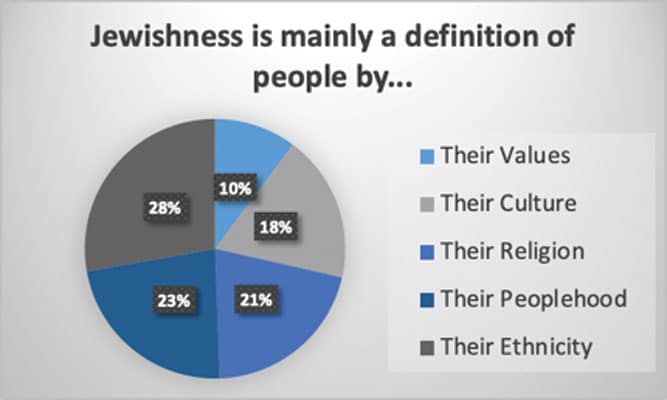
The data gathered by the “who is a Jew” public opinion project, a joint venture of themadad.com and Israel’s public TV, is fascinating. Here is one bit of it, representing the average view of Jewish Israelis. If you’d like to join in and answer the challenging questions (in English), there’s no better time than the beginning of a new year. Try: themadad.com/whojewworld

A reader’s response:

Responding on twitter @rosnersdomain Daniel Kupervaser argued that what Biden wants from Bennett is for “Jews to continue the massive funding of American elections”. 

My response: Daniel is Israeli and hence doesn’t see how inappropriate it is to make such comment. Because of their special circumstances, Israelis, by and large, lost the anti-Semitism sensors that Jews had been carrying around for the last two millennia.  


Shmuel Rosner is senior political editor. For more analysis of Israeli and international politics, visit Rosner’s Domain at jewishjournal.com/rosnersdomain.

Rosner’s Domain: Proof of Adaptation Read More »

Finding Hope When We Can’t See Much of It

This year seems to have traveled at warp speed. It seems like just yesterday that I was focused on the Days of Awe, both professionally and personally. And I can’t help but experience a bit of déjà vu, to be faced with the confusion and quandary of mask or not, in or out, all over again. 

Which one of us isn’t slightly disarmed, even acutely disturbed, anxious, or fearful as COVID remains our collective and universal nightmare? Yet despite this constant threat to our health and future, we need to navigate life while attending to what the High Holy Days demand of us—personal accountability, inner awareness, and movement toward change. Taking action to heal our pain, guilt and shame, as well as our relationships (familial, personal and collegial) we must acknowledge the bigger picture that often brings out the worst of who we are: tense, snippy, and impatient, or just plain out of sorts.

The connection between national, environmental and political crises and our own personal behavior is often more pronounced than we realize. The demands, restrictions and unknowns become internalized stressors, often leading us to behave in unrecognizable ways. The lens through which we see the world becomes foggy or negatively tinted. As we take account (Cheshbon HaNefesh) of our inadequacies, bad behavior, and errors of judgments, we must see the context of this past year and its overriding impact. The decline in mental health, including sleep and eating disorders, is alarming. Perhaps a little more rachmunos, compassion, is in order this year.

It is easy to fall prey to hopelessness when confronted with difficulty or a powerful adversary like COVID. But Proverbs teaches, “Hope deferred sickens the heart.” 

Celebrating the Birthday of the World affords us new eyes to see ahead. It gives us a pathway that generates optimism, Judaism’s core ingredient for sustainability, strength, and resiliency. It gives us, most of all, the possibility of hope. It is easy to fall prey to hopelessness when confronted with difficulty or a powerful adversary like COVID. But Proverbs teaches, “Hope deferred sickens the heart.” We need this medicinal tonic to guide our fragile souls and hold us in trying times. In fact, the root for the word tikvah, hope, (koof-vav-hay), is the same root for mikvah, ritual bath. They both bring healing for the spirit. And the two letters, koof-vav, signify a measuring line. It is the Kabbalistic description of the direct line from the Divine into the vacated space (tzim tzum) where G-d emanated and birthed Creation. What we all need right now is to be immersed in the healing waters of mikvah, the radiant light of Tikvah, while reconnecting to the One, the kav of renewal, rebirth and imagination.

What we all need right now is to be immersed in the healing waters of mikvah, the radiant light of Tikvah, while reconnecting to the One, the kav of renewal, rebirth and imagination.

How do we find hope when reality seems bleak and unrelenting? I asked this question frequently when trying to understand my parents, and other survivors of the Shoah, who held on during the worst pandemic of all, hatred of the Jew. With nothing to clutch, something within pulled these souls forward. This is as extreme as it gets, but we, too, grieving the comfort and familiarity of our past, need to find ways to enjoy the present and see potential for a future.

Both Jewish tradition and the growing field of Positive Psychology instruct us. This new discipline reflects a change from traditional psychology, which focuses on mental/emotional illness and fixing deficits, to emphasizing thinking patterns and behaviors that move us ahead. Circumstances may not change, but how we see them determines our response. Professor Carol Dweck teaches that we have either a fixed-unchangeable mindset or a growth-developing mindset. One holds us back while the other moves us forward. Our own thinking can undermine our capacity for hope.

Dr. Dan Tomasulo teaches that we can learn hopefulness by shifting perspective, since perceptions impact outcomes, the “self-fulfilling prophecy.” Seeing obstacles and setbacks as opportunities for growth repurposes reality. Hope is activated when we reduce our “negativity bias.” The name G-d gave the Israelite slaves was a “transformative” verb, “Eheyeh Asher Eheyeh”: “I will be that which I will become.” 

Hope is believing in ourselves, our capacity to transform and influence the future. Charting our strengths and moments from our past when we overcame the impossible reminds us of what we are made of. Judaism offers a new start every morning when we say, “Modeh Ani L’fanecha … B’Chemlah Rabba Emunatehah,” “Thank you G-d for returning my soul … with your great mercy and faith in me.” We frame the day from strength and optimism.

What if this Rosh Hashana we not only focus on deficits and sins, but also create a Cheshbon HaHoda-ah, an accounting of gratitude? There is a reason the tradition teaches us to say 100 blessings a day. The rabbis understood this would keep us hopeful. List the moments over the past year that were positive, growth-full, nurturing, and accomplishing; examine your qualities and strengths and use them as agency for change and creative solutions. Go to those you treasure and say, “Thank You!” Focus not only on apologies and mending the pain you’ve caused, but also forgive and let go of anger and disappointment, freeing up energy for good.

“There is ‘hope’ for a tree; if it is cut down it will renew itself; its shoots will not cease.” The Jewish people have been repeatedly cut down and yet stubbornly renew themselves. Every catastrophe has brought regeneration. We must choose to see possibility and renewal: not just survive, but thrive.

Mask in one hand, sanitizer in the other, we share the journey in a room together or smiling across a screen. Our world has changed, yet truly expanded. We study with people across the ocean or share wine with friends across the country. Our homes are our sanctuaries and nature, solace for the soul.

During the first exile, the Prophet Jeremiah sent a letter to the people in Babylonia telling them to make the best of every moment. “Build houses … gardens … multiply … seek peace,” while G-d says, “Seek Me … I will return you.” In this exile, within our own land, find the strength to lift yourself, see the beauty and grace in unexpected moments, see light and hope through optimistic eyes, and seek G-d. Reconnect to the kav, the umbilical cord of the Divine, and find hope.


Eva Robbins is a rabbi, cantor, artist and the author of “Spiritual Surgery: A Journey of Healing Mind, Body and Spirit.”

Finding Hope When We Can’t See Much of It Read More »

What Family Can Teach Us About Friendship

Growing up in a family of seven, and as the oldest of five children, was no joke. Life in our home could rarely be characterized as anything short of either a raucous party or a full-blown war. There wasn’t a lot of in between. The differences in personalities alone are enough to ensure that intensity is always the dominant mode when it comes to large families living under one roof.

I come from a line of passionate and highly-opinionated people who have no problem going against the status quo. We are all always right, all of the time—if you ask us, that is. I always say that it must be in the DNA. My great-grandfather, a Spanish immigrant of Sephardic ancestry who was a leader in the Latino workers’ rights movement in the U.S., was warned repeatedly to cease his Communist activity or face deportation. His response was to raise the red flag in front of the Los Angeles County courthouse before being arrested, tried, and ultimately deported in 1933 and executed in one of Franco’s “white terror” camps.

What can I say? We have strong opinions in my family, and when we believe passionately in something, we’re almost always willing to pay the price for those beliefs.

Of course, generations later it wasn’t the subjects of Communism or workers’ rights that dominated dinner table conversations in my home, but if you don’t think that discussions about the meaning of biblical passages or appropriate clothing for teenage girls or even general politics don’t feel just as loaded around the family dinner table, you’re wrong.

But this is the thing about family. When we argue with our family members, it feels like the stakes have never been higher. Each person needs not only to be heard, but also to be heard the loudest. It’s about staking out one’s place in the familial pecking order. It’s about both asserting one’s individuality and finding a sense of belonging. These are, truly, high stakes. And when the stakes are high, so are the emotional responses to disagreements.

I’d be lying if I said that, in addition to all the great times (and there were many), there wasn’t some yelling and screaming here and there. I would also be lying if I said that even as adults my siblings and I don’t have many disagreements when it comes to politics, religion, culture wars, and even the pandemic. But those disagreements, as vast and fierce as some of them are, have never caused us to jump ship. Not one of us would ever consider abandoning a familial relationship because we don’t see eye-to-eye on something.

In fact, it’s our disagreements, as much as our love, that bind us together.

Ideological diversity, a root cause of disagreement, is important because it challenges us. It teaches us to listen, and think, and, sometimes, even change a little—or, at the very least, become a little more understanding of the “other side.”

This may be the single most important lesson of family life. 

I can’t help but think that, especially now, the family unit is an important model for friendships. Families are rarely comprised of people who agree on everything, and perhaps there’s a good reason for that. At a certain point, most of us leave our family home and make our own; we also find and make our own friends, who often became like family. Many of us describe some of our closest friends as “family.” But these friends are typically people who we’ve bonded with out of shared interests, opinions, or professions. They are people just like us in most ways. In fact, they are the opposite of family.

What would it look like if we expanded our “friend family” to include people who think a bit differently from us? And what would it look like if, instead of jumping ship when we discover a friend has a different opinion about how to fight racism or how to end the pandemic or who to vote for, we listened and struggled through the dialogue, like a real family? What would happen if we stayed together instead of cutting each other off?

In a moment when things have never been more polarizing—politically and culturally—than they are now, and in a time when years-long friendships are instantly destroyed because one side expresses a different viewpoint, perhaps this is exactly what we need. Admittedly, I’m fortunate to have come from a family that stuck together even when they fought or disagreed, because it turns out it was one of the most valuable lessons I was taught: how to be a friend.

The family model is, ideally, one of tolerance. Even if we recoil from the idea of tolerating something with which we disagree, we have to face it, again and again in the context of the family structure. 

The family model is, ideally, one of tolerance. Even if we recoil from the idea of tolerating something with which we disagree, we have to face it, again and again in the context of the family structure. It’s not so easy to walk away or delete someone from Facebook over a disagreement when they are part of your family. Some do, of course, but the costs are always high. Being part of a family inevitably forces you to figure out how to learn not only to live with those who are different from you, but also to appreciate them, not in spite of their differences, but because of them.

It goes without saying that holidays can be some of the best and worst times when it comes to spending time with family. And yet, even those of us who dread going “home for the holidays” keep going back because we have a sense of responsibility, commitment, and—dare I say it?—because we love each other.

This year, as we consider who to invite to our Rosh Hashanah tables or our Sukkot parties, perhaps we should reach out to some of our friends with whom we may have lost touch or even pushed away in this last year because of political or ideological differences.

This year, as we consider who to invite to our Rosh Hashanah tables or our Sukkot parties, perhaps we should reach out to some of our friends with whom we may have lost touch or even pushed away in this last year because of political or ideological differences. Maybe it’s time to really treat our friends like family.


Monica Osborne is Executive Editor at the Jewish Journal. She is a former professor of literature, critical theory, and Jewish Studies, and is the author of “The Midrashic Impulse and the Contemporary Literary Response to Trauma.” Follow her on Twitter @DrMonicaOsborne

What Family Can Teach Us About Friendship Read More »

How Do I Convince My Child to be a Jew?

Although I didn’t know Sarah, she had asked for an appointment to see me. The issue was her son. He was dating a non-Jewish woman seriously, and when Sarah would ask him if he planned on raising his children as Jews, his answer was no; Judaism wasn’t important to him. Sarah had one question for me: how do I convince my son to be Jewish?

This same question motivated Rabbi Jonathan Sacks to write the book “A Letter in the Scroll,” which was published in 2000. As he explains in the introduction, he wrote the book as his response to the growing problem of assimilation; and in the book, he speaks personally about why he is a Jew. As you read the book, what becomes clear is that he believes that all Jews need to take this question seriously. To underscore the point, Rabbi Sacks writes in the introduction that he offered a first draft of the book to his son and daughter in law as a gift for their wedding. Even respected rabbis have to make sure to inspire their children to be Jews. 

The book begins with a question about our Torah reading. Moshe renews the covenant with the second generation of Jews, the children of those who left Egypt, and says: “I make this covenant … not with you alone, but both with those who are standing here with us this day before the LORD our God and with those who are not with us here this day.” This covenant includes all future generations.

Two Biblical commentators, Rabbi Isaac Arama and Don Isaac Abravanel, pose the very same question about this passage: How could the generation of the desert accept the covenant on behalf of their descendants without the consent of future generations? Why can’t any Jewish child refuse to accept the Torah, which they never consented to? It is worth noting that both Abravanel and Arama were among the Jews expelled from Spain in 1492. (According to Bentzion Netanyahu, they would meet to discuss theological issues, which is why there is a great deal of overlap in their Torah commentaries.) They had both watched many of their compatriots convert to Christianity, and wondered whether future generations would care about Judaism in the future. 

Over the years, three explanations have been given for this verse, and they are cited by the Malbim in his commentary. The first is that the covenant is actually irrelevant; Jews are obligated to keep the Torah because one cannot refuse the commandments of an all-powerful creator. The second answer is that the generation of the desert could accept the covenant for all future generations because the covenant is fundamentally a gift, which allows one to gain reward in the world to come; and one is entitled to assume consent, and thereby accept a gift on behalf of another person. The third answer, which is mystical, is that all future generations stood at Sinai; the soul of every future Jew, both born Jewish and converts, stood at Sinai and accepted the Torah.

These three answers can rephrased this way:  

You must be a Jew. 

It’s a gift to be a Jew. 

You were meant to be a Jew.

These answers, with a contemporary spin, are still used today. But are they convincing to the next generation of Jews?

These answers, with a contemporary spin, are still used today. But are they convincing to the next generation of Jews?

The answer of “you must be a Jew” now focuses on antisemitism, and argues that one has no choice; other people will always push Jews away, and Jews can never leave their ancestry behind. A Jew can try to assimilate, but the haters will still hate them. Ben Hecht, in his autobiography “A Child of the Century,” writes about a conversation with movie mogul David O. Selznick. Hecht wanted him to sign a telegram in support of the Zionist cause. Selznick said he wouldn’t because: “I’m an American and not a Jew. It would be silly of me to pretend suddenly that I’m a Jew, with some sort of full-blown Jewish psychology.” 

Hecht responded: “If I can prove that you are a Jew David, will you sign the telegram as a co-sponsor for me?”

Selznick asked Hecht: “How are you going to prove it?”

To which Hecht replied: “I will call up any three people you name, and ask them the following question: What would you call David O. Selznick, an American or a Jew? If any of the three answers that he calls you an American, you win. Otherwise you sign the telegram.”

Selznick signed the telegram. 

This type of response may have resonated in the 1940s, but seems foreign today. Abigail Pogrebin interviewed Jason Alexander of “Seinfeld” fame for her book “Stars of David.” Alexander explained that his parents would offer this very same argument: “‘There are people in this world who would kill you just because you’re a Jew, and you have to know what you’re dying for.'” Alexander wryly noted that “this was a real incentive program.” Focusing on antisemitism does not inspire people to love Judaism; it only inspires panic and guilt.  

The answer that “it’s a gift to be a Jew” no longer focuses on other-worldly rewards; instead it says Judaism is a gift because it makes you happy. This is a reasonable perspective, considering that a 2011 Gallup survey found that American Jews were the happiest religious group in the United States. This argument is quite popular, and many sermons and articles have focused on how Judaism contains important wisdom about health, psychology and relationships. 

In 1946 Rabbi Joshua Loth Liebman wrote “Peace of Mind,” which sold over a million copies in one year. Since then, books about Jewish wisdom for business, relationships, health and sex have been best sellers. Undoubtedly, many Jewish rituals do bring peace of mind, and there is a great deal of interest, both among Jews and non-Jews, about the gifts of Judaism. But the problem with this answer is that it reduces the Torah to a guide on psychology, health and finance; Judaism is no longer a spiritual journey or the search for transcendence. Yet even great thinkers were tempted to see the mitzvot as utilitarian. Maimonides wrote that the reason for eating kosher food is because it is healthier, and that pork in particular led to unhealthy conditions, and communities that raised pigs were “cesspools.” Don Isaac Abravanel offered a harsh criticism of Maimonides’ view, saying it transformed the Torah into a “short medical textbook.” Abravanel is correct. While we may find happiness in the pursuit of Judaism, that cannot be its purpose. There is plenty of non-kosher food that is healthy, and plenty of very happy people who don’t practice Judaism.

The most meaningful answer is the third one: “You were meant to be a Jew.” This response is not based on proofs or arguments. Instead one hears a voice in the depths of one’s soul that says: I am a Jew because I cannot imagine not being one. This person’s journey to Jewish identity is inexplicable, a magnetic pull that draws them near. Beginning with Avraham and Sarah, the Jewish journey has been an all-consuming passion for those who want to be a part of the greatest story on earth. Like Yonah, they say “I am a Hebrew.” Like Ruth, they say “don’t turn me away.” Like Avraham, they say “I am ready.” 

Rabbi Sacks concludes his book with an eloquent three-page summary about why he is a Jew.  In every word, one can recognize that he is driven by his love for Judaism, and cannot imagine being anything else. 

The weakness of the final approach is it doesn’t persuade. Those passionate about their Judaism can share what Judaism means to them, but it remains a personal experience. Rabbi Sacks writes in the introduction that his book “is a personal reply. None of us can answer the question for anyone else.” He writes simply to share his own experience.

But if you know you were meant to be a Jew, if you feel like your soul was at Mount Sinai, share that inspiration; perhaps you will inspire them.

How do you convince your children to love Judaism? There’s no answer for that question. But if you know you were meant to be a Jew, if you feel like your soul was at Mount Sinai, share that inspiration; perhaps you will inspire them.

Toward the end of the book, Rabbi Sacks shares a moving story about a Hasidic rabbi in Kew Garden Hills. The rabbi had moved there after the Holocaust and opened a small shtiebel. One Shabbat, a boy wandered in, wanting to see what a Hasidic rabbi is like. After services, the rabbi went over to the boy and said that Pesach was rapidly approaching, and he did not have a child old enough to ask the four questions; would the boy be his guest and say the Mah Nishtanah? The boy accepted the invitation, and sat at the Seder with the rabbi and his wife; at the side of the table was a carriage with their baby daughter. At one point during the Seder, the baby started to cry, and the rabbi excused himself. In another room, he rocked the baby to sleep, and sang a Yiddish song. The boy could make out the words, but didn’t know what they meant. 

After the Seder, the boy was intrigued enough to want to learn more about the rabbi’s story. He found out that both the rabbi and his wife had been in concentration camps, and the rabbi had been in the Warsaw Ghetto and Treblinka. After the war they reunited, but had difficulty having children. After years of trying, they were told by doctors to give up hope; despite all odds, this baby was born.

This boy was transformed by that evening, and decided to become religious, eventually becoming a rabbi. But what inspired him was not the rabbi’s story; it’s when he learned the meaning of the song the rabbi sang to his daughter. The words were: “it is good to be a Jew, it is good to be a Jew.” This rabbi, who had survived the Warsaw Ghetto and Treblinka, could still sing about his love for Judaism; he still knew he was meant to be a Jew. At that Seder, this young boy saw a role model of Jewish identity. 

There is no answer to the question of how to convince my child to be a Jew, but there is a response. If you feel the passion of Sinai, live that way, because that passion just might inspire others. And never be shy to say “it is good to be a Jew.”


Rabbi Chaim Steinmetz is the Senior Rabbi of Congregation Kehilath Jeshurun in New York.

How Do I Convince My Child to be a Jew? Read More »

My Playlist for 5782

In Israel, leading up to Rosh Hashanah, media outlets recount events of the past year, from dramatic political developments all the way to the playlists of the best and worst songs of the year. I miss that atmosphere. 

As a Jew, and as the representative of the State of Israel in Los Angeles, I would like to look back at the major events of the past year, and choose, from my perspective, the most significant. 

COVID-19

The past year has been overshadowed by the calamity of COVID-19. The global pandemic has taught humanity a lesson in humility. An unseen virus has brought tremendous damage to the global economy, caused mass unemployment, hospitalized millions and killed hundreds of thousands. This should make it clear to us that we are all vulnerable, and that we must work together in unity to overcome global challenges. From the depths of the darkness, the human spirit has risen once again. Humanity has proven that if we put our minds to it, we can find solutions. The vaccination has saved many lives. Great innovation has resulted from the tragedy of the virus. Fields like remote diagnostics, telemedicine, streaming cyber services and touchless devices have sprung up. Many of these innovative breakthroughs were born in Israel. We have once again shown that the human spirit is resilient and strong. 

Abraham Accords

The Jewish High Holy Days this year coincide with the first anniversary of the Abraham Accords. The Abraham Accords are a beacon of light in a sea of darkness. It took thirty years to sign the first peace agreement with Egypt (1979), an additional 14 years to sign the Oslo Accords (1993) and then peace with Jordan (1994), and now, a quarter of a century later, Israel has at last normalized relations with an additional four Arab countries. The vector is positive. These nations seek improved relations with Israel because they understand what we have to offer each other. 

Radicals Versus Pragmatists

During this past year, we sadly beheld a renewed confrontation between Israel and Hamas, the takeover of Afghanistan by the Taliban, and widespread demonstrations in Iran against the oppressive tyrannical regime. All of the above demonstrate that the most significant battle in the world today is not between Jews and Muslims, or between Christians and Muslims, but between moderates and radicals. Hamas, Taliban, Hezbollah and the Iranian regime present a real and imminent threat. They are a threat equally to Muslims, Christians and Jews. We should feel for the innocent moderate populations under the fearful rule of such extremists.

The most significant battle in the world today is not between Jews and Muslims, or between Christians and Muslims, but between moderates and radicals.

The moderate camp must be vigilant and stay unified, constantly  guarding against falsehoods and misinformation intended to sow dissension. 

Hate Crimes and Antisemitism

Amid the stress of the health crisis, political polarization, and the renewed activity of hate groups, official reports show a significant increase in the rate of hate crimes and antisemitism. According to a report from the State Attorney General, hate crimes have risen by 31 percent in the State of California. Attacks against Asians and hate crimes against Black people have more than doubled. According to the 2020 ADL Audit of Antisemitic incidents, California has suffered a 40 percent increase in antisemitic hate crimes over the past five years. 

This past year, Jews were attacked on the streets of Los Angeles and synagogues were vandalized. Jews should not be attacked on the streets for any reason, and Israel should not be vilified for acting in self-defense when attacked by Hamas rockets. Anti-Zionism is just another manifestation of antisemitism. 

All hate crimes should be called out for what they are, and minority groups should work together in unison.  

As we move forward into 5782, I wish us all an outstanding playlist of promise, good health and prosperity for the coming year.


Hillel Newman is the Consul General of The Consulate General of Israel in Los Angeles.

My Playlist for 5782 Read More »

How Can We Care For Our Elderly Parents?

Not a day goes by without a phone call from a worried and tearful son or daughter of an elderly parent. Their concerns are real. Are they taking their meds? Eating properly? Navigating their home to avoid falls? Getting outside for fresh air? The list goes on.

As a senior living advocate and placement specialist in Los Angeles, I have had hundreds of conversations with caring children. The concern for their parents’ physical needs are huge, but the greatest worry, especially since COVID became an issue, is the loneliness and isolation they’ve endured these past 17 months.  

Social isolation has been a “core concern” during the pandemic, according to a University of Washington study of social services and health care organizations across the state. According to Beverly Sanborn, licensed clinical social worker and Vice President of Program Development at Belmont Village, “if you had family and friends living with you or nearby, you probably did not feel the isolation and loneliness of the pandemic. However, the vast majority who live alone, without family nearby, it was horrendous.”

In the beginning, there were meal drops on the doorstep, Zoom and FaceTime calls and, finally, the vaccine arrived, and there was a race to find any connection to get vaccinated as soon as possible. We did everything we could to lift the spirits of our elderly patients, whether they lived at home alone or in a senior living community.

To avoid the isolation among residents at Belmont Village, management engaged every single employee, from the dishwasher to the executive director, to spend one-on-one time with each and every resident. “The job title was irrelevant, we all pitched in,” Sanborn stated.  

She added, “These bonding sessions between residents and employees ended up becoming such a great success, we started to re-think our approach to programming and have created smaller, more intimate activities with residents who have like interests. Much to our surprise, this greatly helped our introverted residents who were reluctant to come out even prior to the pandemic. After these special relationships were formed, they came out of their rooms because of the special bond they had created with the employee.”

Here’s the promising news. Senior living communities and senior centers have carefully resumed activities, dining, outings and entertainment. While wearing a mask is still required, it does not affect overall plans to expand and increase the programming to pre-pandemic levels. This has made a huge impact on seniors’ well-being. 

While some seniors still wish to remain in their own home, Sanborn highly recommends staying as engaged as possible, through religious, service or charitable organizations.

 She strongly encourages spending time in nature. “Take a walk in a park, have a picnic, walk at the beach, animal life and gardens.” Here are a few other options: 

Have a “movie night” where everyone rents the same film, or uses an app like Netflix party or Gaze to watch and chat at the same time.

Play games together, like online chess or scrabble. Apps like Kahoot and Drawful allow users to customize games and quizzes with their own family facts and interests.

Share memories through photos. Family members can use a shared photo app, such as FamilyAlbum or Google Photos, to upload new and old memories. If your senior loved one is less tech-savvy, send pictures via email or snail mail.

Explore keepsakes and heirloom treasures. Social isolation has given seniors plenty of time to clean out closets and attics of keepsakes. Get the family together to look through photo albums and old treasures on Zoom, and see what stories and memories they inspire.

Nothing surpasses a personal visit from a loved one. It’s the ultimate mitzvah.

These are a few great ideas, but, most of all, visit as often as possible. Nothing surpasses a personal visit from a loved one. It’s the ultimate mitzvah.


Sandra Heller is the owner of Compassionate Senior Solutions, an advocacy and senior living placement company. Her website is compassionateseniorsolutions.com

How Can We Care For Our Elderly Parents? Read More »

UNC Sticks With Anti-Israel Course Amidst Allegations It Violated Education Dept. Agreement

University of North Carolina (UNC)-Chapel Hill is sticking with an anti-Israel class despite Jewish and pro-Israel groups alleging that doing so would violate their agreement with the Department of Education’s Office of Civil Rights (OCR).

On August 20, the Zionist Organization of America (ZOA) National President Morton Klein and Center for Law and Justice Director Susan Tuchman sent a letter to UNC arguing that according to the agreement the university had signed in 2019, UNC is required to “take all steps reasonably designed to ensure that students enrolled in the University are not subjected to a hostile environment and to respond to allegations of anti-Semitic harassment.” But holding the class “The Conflict over ‘Israel/Palestine’” would violate this, as the instructor, Kylie Broderick, “has openly promoted false and antisemitic lies about Israel,” Klein and Tuchman alleged. As evidence, Klein and Tuchman pointed to Broderick’s tweets calling for the university to boycott Israel and viewing all of Israel as “occupied Palestinian territory.” Additionally, Broderick has tweeted that “there is only 1 legitimate side – the oppressed – versus imperialist propaganda. I don’t want to ever encourage [students] that there is reason to take on good faith the oppressive ideologies of American and Western Imperialism, Zionists & autocrats.”

“Jewish, pro-Israel and other students are at risk if the course on ‘Israel/Palestine’ continues to be taught by an instructor who openly declares that she has zero tolerance for views that do not demonize Israel or deny Israel’s very right to exist,” Klein and Tuchman wrote.

Jewish on Campus made similar allegations; StandWithUs did not allege that the agreement was broken but did urge the university to monitor and record Broderick’s classes and make them available to the public.

In a response to the Journal’s request for comment, Terry Rhodes, Dean of the College of Arts & Sciences at UNC-Chapel Hill, said in a statement, “The University of North Carolina at Chapel Hill strives to create a place where every member of our community feels safe and respected and can thrive in an environment free from racism, sexism, antisemitism, Islamophobia and all other forms of prohibited discrimination and harassment. Instructors uphold this commitment through course designs, mentoring and departmental review.” He added that the university provides “extra structural support” classes with “controversial” content, which can include recording the classes, requiring the instructor to grade assignments without knowing the identity of the students, providing EOC (Equal Opportunity and Compliance) resources and guest speakers.

“We are deeply committed to academic freedom, and academic freedom requires academic responsibility,” Rhodes said. “We emphasize and value open and inclusive classroom discussions and strive to teach different perspectives on a variety of topics.”

He also noted that the university will be offering a class called “Confronting Antisemitism” in the spring of 2022, which he said “broadly examines antisemitism throughout history as well as modern times and on campuses across the country.”

Jewish groups weighed in.

“This instructor has been very open about her belief that Israel has no right to exist,” Tuchman said in a statement to the Journal. “She’s also made it crystal clear that her anti-Israel views are the only views that are legitimate and acceptable. Given the evidence from the instructor herself, it’s impossible to understand how UNC could conclude that she would be an appropriate teacher about Israel and its history, and that she would create a classroom environment that is open and welcoming of views that aren’t completely hateful and hostile to Israel.”

StandWithUs CEO and Co-Founder Roz Rothstein said in a statement to the Journal, “We appreciate UNC’s stated commitment to ensuring an environment free from antisemitism. Given the prior antisemitic statements of this instructor, however, including her unequivocal position that the Israel-Palestine conflict has only one side, which includes a complete denial of the right of Jewish self-determination in Israel, the University must treat this course with special attention to prevent itself from becoming complicit in this type of hateful antisemitic indoctrination within its classrooms. 

“We have offered several concrete suggestions to UNC, and we urge UNC to enact these protective measures immediately for the protection of its Jewish and other pro-Israel students and the entire campus community. “

Broderick and OCR did not respond to the Journal’s requests for comment.

UNC Sticks With Anti-Israel Course Amidst Allegations It Violated Education Dept. Agreement Read More »

Will COVID-19 Ever Go Away?

As the new year approaches, we’re all wondering “when will the coronavirus go away?” It’s human nature to want a “yes” or “no.”  But COVID-19 is still new, the issues are complex, and much uncertainty remains. That’s the reality of pandemic life and we should face it. All we can do is trace the course of the pandemic and make reasoned projections based on the science and our previous pandemic experiences.  

I teach residents and medical students to be careful about using the word “forever.” Illnesses always evolve and bothersome symptoms rarely persist for the long run, at least not in their original form. And so for a primary care doctor, the default answer to whether an illness will persist “forever” is almost always no. 

So too for the pandemic.  

Vaccine technology will likely improve and vaccines more specific for the variants will likely be available before long.

As the last pandemic, the 1918 “Spanish flu,” occurred a century ago, no one has personal pandemic experience. Our species, however, has survived numerous pandemics that offer a glimpse into the possible COVID future. Smallpox was one of the most lethal epidemic diseases of mankind. Europeans, having been exposed to it for centuries, descended from smallpox survivors and had some inherited resistance. The indigenous American population had no such immunity. Smallpox was likely a major cause of the tidal wave of mortality that followed the arrival of Europeans and killed up to 90% of the native population of the Americas.   

The horrors of smallpox ended with a successful worldwide vaccination campaign. Unfortunately, such resounding success appears unlikely for COVID-19. Smallpox vaccination produces durable and reliable immunity. COVID-19 vaccination, though highly effective against lethal disease, wanes in protectiveness after months and fails to reliably prevent non-lethal illness. So, vaccinated individuals can still contract and spread the disease, preventing eradication.  

COVID-19 will more likely evolve similarly to influenza. Like COVID, flu can be a killer. The 1918 pandemic killed an estimated seven times the number that have succumbed to COVID worldwide so far.  Although flu still kills thousands during a typical season, most people face no more than the risk of a few days of fever and achiness. Like COVID vaccines, flu vaccination doesn’t provide 100% protection. However, also like COVID vaccines, it substantially reduces the risk of illness and when disease breaks through the protection, it’s milder.  

COVID poses a moving target. Astronomic numbers of virus multiplying in millions of infected individuals produce genetic variants. Some, like the Delta variant, have heightened infectiousness. These strains compete with the original strain, with the most infectious becoming predominant. The current variants are sufficiently contagious that in the long run we can expect almost everyone to fall into one of three groups: those with immunity from illness, the vaccinated, and “the hermits,” who isolate themselves efficiently enough to avoid exposure. 

The recent surge will likely reduce the number of susceptibles down to a level that limits spread. Although short of the “herd immunity” that would finally end the pandemic, it will likely provide “herd resistance” that reduces spread and allows a largely immune population to return to normal life.

Unfortunately, the waning of immunity among both vaccinated and those with natural immunity will likely allow the virus to continue percolating through the population at a low level. Infected individuals with immunity from either vaccination or illness will mostly have mild disease or may remain asymptomatic. The shrinking number of non-immune will continue to be at risk for severe or fatal infection.   

Over time, the highly infectious emerging variants may eventually cause less severe disease. After all, a less virulent virus that allows the infected to continue social activity will spread more readily than one that sends its victims home to bed.  Additionally, vaccine technology will likely improve and vaccines more specific for the variants will likely be available before long. Given that vaccine-mediated immunity wanes, periodic re-vaccination may become a part of life indefinitely. For the willing, it should prove a small price to pay for a return to normal social interaction.


Daniel Stone is Regional Medical Director of Cedars-Sinai Valley Network and a practicing internist and geriatrician with Cedars Sinai Medical Group. The views expressed in this column do not necessarily reflect those of Cedars-Sinai.

Will COVID-19 Ever Go Away? Read More »

Open a Paper, Open a Community

“Hey, Suissa, when’s the print coming back?” I can’t tell you how often I’ve heard that question in recent months. It’s heartwarming to see that, since we put the print edition on hiatus last year because of the COVID lockdown, the community has really missed it.

Well, we missed you, too. 

I must say it feels good to be back in print. Look, digital is amazing, instant and miraculous. We can post stories in seconds on our website. It’s like a popcorn machine that never stops popping. And yes, the print hiatus enabled us to significantly increase our online presence, turning us into a global brand. We published hundreds of stories and thought-provoking commentaries. We updated our content daily, sometimes hourly. We expanded our podcasts and social media. All of those goodies continue to pop daily and hourly on Jewishjournal.com.

But print is a completely different experience.

Because print is a physical product distributed in a specific geographical area, it defines a community. There’s nothing global about our print readership. The paper is produced for our local community and is read by our local community.

There’s an organic bond between paper and community. When you turn the pages of a paper, you can actually feel the community in your hands. No computer screen can duplicate that feeling.

There’s an organic bond between paper and community. When you turn the pages of a paper, you can actually feel the community in your hands. No computer screen can duplicate that feeling.

In a recent webinar on Jewish journalism, one of my co-panelists brought up his past experience editing a Jewish paper on the East Coast. “It’s like there was no community without the paper,” he said. “The paper defined the community.”

I reflected on what he said. Without a community paper, a community is just a hazy idea floating somewhere in our minds. A paper brings it all together, concretely, in one place. Page by page, through local stories and events and reporting and commentaries, you can see your community unfold. Even the ads are part of the experience, because advertisers are integral to the community.

Paper holds another edge over digital: it slows us down. Instead of constantly clicking on links, we leisurely flip pages. There’s no rush. We can savor the content to our satisfaction, without the restless urge to scan or click or check our Twitter feeds.

Paper is the Shabbat of the reading experience. It denotes a boundary from the harried pace of the digital life. Just as Shabbat slows us down to reconnect with things that are real, so does paper.

We were hoping, of course, to bring the paper back in a post-COVID world, when the pandemic-induced anxieties would be behind us. Well, the Delta variant had other plans. Even post-vaccine, we still worry about safety, about distancing, about wearing masks, about loneliness, about hugging. Who will go to synagogue over the High Holy Days and how will schools adapt to the continuing restrictions? So much still feels up in the air.

I’ll confess that when the Delta variant hit, we considered delaying the return of the print. But we concluded that the ongoing anxiety is even more reason to bring back the paper, which can serve as a weekly communal gathering place.

If there’s one thing I’ve learned during the pandemic, it’s that when you feel the world is spinning out of control, you attach yourself to the things that matter most— things like family, friendships, nature, health, spirituality and, yes, a local community paper. 

I’ve been touched by how so many people have missed the paper. For many of our readers, from the San Fernando Valley to the West Side to Pasadena and the South Bay, the Journal has become a weekly ritual that connects them to their tradition and community.

If there’s one thing I’ve learned during the pandemic, it’s that when you feel the world is spinning out of control, you attach yourself to the things that matter most— things like family, friendships, nature, health, spirituality and, yes, a local community paper. 

Sure, it takes a lot of work and expense to create, print and distribute a paper week after week. But the fact that our readers appreciate it so much is what keeps us going. And we’re fortunate to have an amazing team that helps produce the award-winning paper you’re holding in your hands.

As you’ll see, we didn’t make too many changes to the look and style of the paper; it’s got all the richness and variety you’ve come to expect. You may have heard that we were named the best Jewish paper in the country by the American Jewish Press Association for the second year in a row. Why mess with success?

We did add a new section called “Rabbis of L.A.” that will profile a different rabbi each week. Our Jewish community is as diverse and fascinating as any in the world. These features, written by Danielle Berrin, will help convey our diversity. You’ll find them opposite the last page, as a kind of weekly exclamation point.

As we enter the High Holy Days, with so many unanswered questions, rest assured that we’ve answered at least one: Yes, your favorite Jewish paper is back. So sit back, slow down, and, as our new print slogan says, “open your community.”

Shana Tova, and see you all next week.

Open a Paper, Open a Community Read More »

How I Spent My Summer Vacation (Again)

For nearly a year, I’ve been waiting for this paper to go back to print. And now, I feel as though I’ve been reunited with a long-lost love—namely, an inimitable connection with readers. Thank you for choosing to read my words. I consider it an indescribable privilege.

Those who have read my weekly columns during the pandemic know that in the past eighteen months, I’ve essentially regressed into a 1950s housewife, as, like many mothers, my professional pursuits took a backseat as I quickly morphed into a chef, housekeeper, chauffeur, teacher, medic, entertainer and hair stylist (I rue the day I tried to give myself bangs).

In January, my father was hospitalized with COVID-19 and pneumonia. This terrible experience resulted in three changes: I immediately let go of petty grudges and began showing my loved ones unabashed love; I tried dying my roots myself to cover all those stress-induced gray hairs, only to have an allergic reaction that turned my scalp azure blue; and I sought comfort in the warm, cheesy arms of Wacky Mac each night while my father was hospitalized. I gained five pounds in nearly one week.  

Between my hand-sown watermelon and that squirrel, I felt like a Disney princess surrounded by lush plant life and obedient creatures.

Yes, I became an apron-wearing June Cleaverzadeh and a pasta-hoarding, worried daughter. But this summer, I also became something I never imagined: a watermelon farmer.

At a local garden nursery, I bought a “Sugar Baby” watermelon plant with two dangling melons, each the size of a golf ball. “How sweet,” my mother said when she saw it in a pot on my balcony. She then proceeded to place three giant melons, including a Hami melon, on my kitchen table, adding, “Your melons are cute, but don’t be delusional. This is the real stuff.”

“How long will they take to grow full-sized?” asked my father with a devilishly hungry look on his face. The man has never met a melon he hasn’t carved. I quickly shooed him away toward the kitchen to set to work dicing my mother’s unsolicited (and clearly superior) offerings.

Soon, I found myself squatting on the balcony and talking to the Sugar Baby watermelon plant, encouraging it to grow and thrive. Once or twice, I chased a plucky squirrel that tried to eat from a birdfeeder off of the balcony. But between my hand-sown watermelon and that squirrel, I felt like a Disney princess surrounded by lush plant life and obedient creatures. Yes, that’s as close as I came to channeling Snow White in Pico-Robertson.

But I learned so much from those two small melons: Don’t waste your precious energy trying to rush something that follows its own timeline; don’t judge someone (or something) for what you perceive as a lack of growth, because there may be a bounty of activity beneath, in the metaphoric (or, in this case, literal) roots. And don’t ignore anything (or anyone) whom you love. Find small ways to connect and engage every day. I was known to sing Persian limericks to my precious watermelons, and I may have even read them the news from time to time.

I also learned to put my need to control everything aside, especially when I had to restrain myself from giving the plant water on Shabbat, even when it looked desperately parched (Jews are not permitted to water plants on Shabbat).

A few weeks ago, my husband and I took the kids on a three-day vacation. When I returned home, both melons were gone. A squirrel had ripped them off of the vine and ran off with his bounty. Whether he rolled them off of the balcony like small boulders is anyone’s guess.

It was a humbling lesson in the impermanence of life (and the need for mesh wire netting).

This week, I’ll be planting a dwarf pomegranate tree on my balcony in honor of Rosh Hashanah. If the squirrel bites into its beautiful fruit, this summer has taught me that there’s only one thing I can do: Hope the creature enjoys a year of sweetness, fertility, and numerous good deeds.


Tabby Refael is a Los Angeles-based writer, speaker and civic action activist. Follow her on Twitter @RefaelTabby


How I Spent My Summer Vacation (Again) Read More »