
Curious Times Episode 38: What New Tests Are We Facing Now?
Reflections on the new times we’re in, some of the hot issues, and this week’s Torah portion.
Curious Times Episode 38: What New Tests Are We Facing Now? Read More »
Reflections on the new times we’re in, some of the hot issues, and this week’s Torah portion.
Curious Times Episode 38: What New Tests Are We Facing Now? Read More »
Google Cloud’s Vice President of Developer Relations Amr Awadallah is no longer with the company following a post he wrote explaining how he used to be antisemitic.
The June 13 post, titled “We are one!” was posted to Awadallah’s LinkedIn Pulse page; the Pulse option allows for users to post their own written thoughts. “‘I hated the Jewish people, all the Jewish people’! and emphasis here is on the past tense,” Awadallah wrote. “Yes, I was anti-Semitic, even though I am a Semite, as this term broadly refers to the peoples who speak Semitic languages, such as Arabic and Hebrew, among others.” He added that the post was about his “redemption story.”
Awadallah explained that growing up in Egypt, “the only narrative I heard from everybody around me was that the Jewish people are here to kill all of us” and that “there was widespread anger over the many Palestinians slaughtered in the Nakba of 1948, and the many Egyptians killed during Israel’s occupation of [the] Sinai [Peninsula] from 1967 to 1973.” Awadallah claimed that his Israeli friends have told him that the Israeli narrative at the time was that the “Arabs want to kill all of us so that the land from the Jordan River to the Mediterranean sea becomes theirs.” “We were both taught to fear the other, and adding some really horrendous wars of rage in the mix, hatred became entrenched deep in our hearts and minds from a very young age. In retrospect, I blame our governments and elderly for doing that to us, for letting their prejudiced ideologies shape us in that manner, but they didn’t know any better either, and they did lose a lot of loved ones in those wars, regardless of intention.”
Awadallah said his views started changing after being mentored by his research advisors at Stanford University, including Mendel Rosenblum, a Jew. “Mendel was my first ‘Jewish angel’, he solidified the elimination of prejudice from my heart. Because of him, I learned not to fear the other, and not to label a whole group of people by the vile actions of the few.” He then “started to see all the other amazing Jewish people that I encountered in my life” and “in the arts.” Awadallah also said that he’s no longer an anti-Zionist but stated that “the Jewish people aren’t any more special than” anyone else and lectured the “prejudiced among Zionists” that “there is nothing humane in displacing and oppressing another entire population that are indigenous to that land to guarantee your own safety”; he did acknowledge though that “prejudice like that exists in the Arab world.”
He went onto say that the Arab leaders want “the fear of Israel to continue” and claimed that “the draconian measures of the current Israeli government against the Palestinian people are clearly at the root of this fear.” Awadallah shared a story he heard from an actress on the platform Clubhouse about Palestinians experiencing “humiliation” at Israeli checkpoints and that it’s an example of apartheid and claimed that Israel is not a modern democracy because it’s exclusive toward Jewish people. He also alleged that there is a widespread effort to erase “Palestine” and criticized Israel’s response toward Hamas rockets as being “collective punishment” toward the Gaza Strip, though he acknowledged that Hamas also oppresses the Palestinians. Awadallah urged Palestinians to engage in “peaceful nonviolent civil disobedience that highlights all the humanitarian issues taking place.”
Some of the responses to the post commended Awadallah for sharing his “powerful” story; another called it an “honest manifesto on the origins of hate.” Others, however, took issue with it.
“On one hand, I’m grateful that you no longer hate my children,” Daniel Golding, Google’s Director of Network Infrastructure and Tech Site Lead, wrote. “On the other, this has made my job as one of your colleagues much harder. The previous situation has made being a Jewish leader at Google tough. This has made it almost untenable. I’m unsure why you would write this under your title and company affiliation and it frustrates me.” He went onto criticize Awadallah for failing to mention “the eth[n]ic cleansing of the Egyptian Jewish community. They didn’t just disappear – they fled for their lives – 75,000 of them. As you try to understand the ‘why’, it’s very useful to understand the forced displacement of MENA [Middle East and North Africa] Jews, which is an interesting and sad mirror to Palestinian displacement.”
He added: “You decry the erasure of Palestinians, but you bend over backwards to erase Jews by claiming that everyone is a Jew. But Amr, everyone is not. And you don’t get to decide. Second, you are instructing American Jews to butt out, but as someone with even less stake in the conflict, you have decided to sound off about it loudly. You have no right to either define who is Jewish, while claiming to be, nor to tell me to stay out while you give your opinion at very great length. What is good for the goose is good for the gander.”
CNBC reported that various employees complained about the post, resulting in a “contentious” meeting on July 14 that required a human resources employee to intervene multiple times; throughout the meeting, Awadallah defended his post and maintained that the Google employees complaining about it were not understanding his message. There had also been complaints about Awadallah’s management style for months, according to CNBC.
CNBC also reported that Eyal Manor, Google Cloud’s Vice President of Engineering and Product, wrote in a July 15 email to employees, “I wanted to share that today is Amr Awadallah’s last day at Google. Effective immediately, the Cloud DevRel organization will report into Ben Jackson, who will report into Pali Bhat.” A spokesperson for Google confirmed to the Journal that Awadallah is no longer with Google, but would not provide a formal comment beyond that.
Associate Dean and Director of Global Social Action Agenda at the Simon Wiesenthal Center Rabbi Abraham Cooper said in a statement to the Journal, “No executive or employee who spouts antisemitic views of the Jewish people should have a place in corporate America and especially at Google, one of the most powerful entities in the world today. No tolerance for antisemitism or bigotry anywhere in corporate America and social media.”
Michael Spencer, Editor-In-Chief of The Last Futurist, wrote in a LinkedIn comment that the incident “continues to illustrate Google’s internal toxic culture. Google for all its political correctness is and remains one of the most dysfunctional corporate cultures with a widening chasm between management and workers and a sense of what is actually right. This is highly problematic for a company with that much power. How many people have been fired … at Google for ideological differences or internal comms difficulties? This is not an enlightened manifesto and is very poorly expressed and it saddens me that one would have to lose ones [sic] job or position due to the need to exhibit it.”
Google Exec Out After Admitting He Used to Be Antisemitic Read More »

“My Unorthodox Life,” a new reality show on Netflix that follows the life of Julia Haart, a formerly religious Jewish woman-turned-secular-CEO of a modeling agency premiered this week on Netflix. While showing offer her luxury lifestyle, Haart disparages the Orthodox community and recounts the oppression and fundamentalism she said she experienced.
To show a different side of the story, Alexandra Fleksher, co-host of the “Normal Frum Women” podcast and columnist for Mispacha Magazine, started a #MyOrthodoxLife hashtag on social media that’s blown up overnight. On Facebook, Instagram and Twitter, frum women are posting their stories, showing how they are out and about in the world, working hard, choosing to be Orthodox and not oppressed in the slightest.
“We’re not trying to diminish anyone who went off the derech,” Fleksher said, in an interview with the Journal. “We’re giving women the opportunity to share why they are proud to be Orthodox, and to change the narrative regarding the damage the show can do in terms of representing Orthodox women.”
“We’re giving women the opportunity to share why they are proud to be Orthodox, and to change the narrative regarding the damage the show can do in terms of representing Orthodox women.”
Fleksher kicked off the hashtag by posting her own story. She wrote on Instagram, “I want the world to know that there are Orthodox women who are leading happy, healthy and fulfilled Orthodox lives. Who straddle the fence of the modern world and ancient tradition, and are proud that our tradition interacts with the modern world and informs our values and lives. I’m a spiritually striving, discerning Orthodox woman who loves the best that this physical world has to offer.”
Other women soon followed suit. One Facebook post from Eve Levy, co-director at L’Chaim Center for Inspired Living, has received over 900 likes. She wrote, “I think I need my own TV series called ‘My Orthodox Life.’ Netflix, move over, you are focusing on the wrong stories. Not all of us have been filled with trauma and abuse. Not all of us are running away. I absolutely LOVE being an Orthodox Jewish Woman.”
Rivki Silver, co-host of the “Normal Frum Women” podcast, posted on Instagram about how she loves that the Torah gives her the “tools to become a more humble, more self-aware, a more grateful and kinder person.”
On Twitter, Tova Herskovitz, co-founder of Boss Brands, wrote about how she attended a Jewish outreach camp in Belarus, got a master’s degree, founded a community garden and started a WhatsApp group for moms of twins, all of which her Orthodox community supported.
“As someone who works to build bridges between the local Orthodox community and their neighbors, I was horrified to learn that there was a show that was going to portray Orthodox people as unrelatable and alien,” Herskovitz told the Journal. “I hope that Netflix and Hollywood realize that maligning the Orthodox community and our religious observance is not something they can do without resistance. Like any minority, we should be treated with respect and nuance rather than a trope.”
Silver said that perpetuating harmful stereotypes about the Orthodox community could lead to Jews being or feeling unsafe. “These hurtful tropes are not true. They can add to increased misperceptions. When I’m on the street with my hair covered and in modest dress with my children who are visibly Orthodox, I don’t feel as safe if I’m not in my community bubble. People will now think that I’m abusing my children with my fundamentalist beliefs. It’s very hurtful at a time when antisemitism is at a crazy all-time high.”
However, frum women are going to fight back and show their truth. Fleksher and Silver are showcasing real stories from frum women on their podcast, and they’re going to continue pushing the hashtag.
“I wanted frum women to have a platform to say, ‘This doesn’t feel right and it’s not the Judaism I know,’” Fleksher said. “Haart may have her own experiences and pain and difficulties and feel like she was suffocating in that world. I can respect that. But please don’t speak for all of us and paint these broad brushstrokes that this is what Orthodoxy is. We’re going to show the world that it’s not.”
Jewish Women Showing Off #MyOrthodoxLife in Response to Netflix’s “My Unorthodox Life” Read More »

Follow Shmuel Rosner on Twitter.
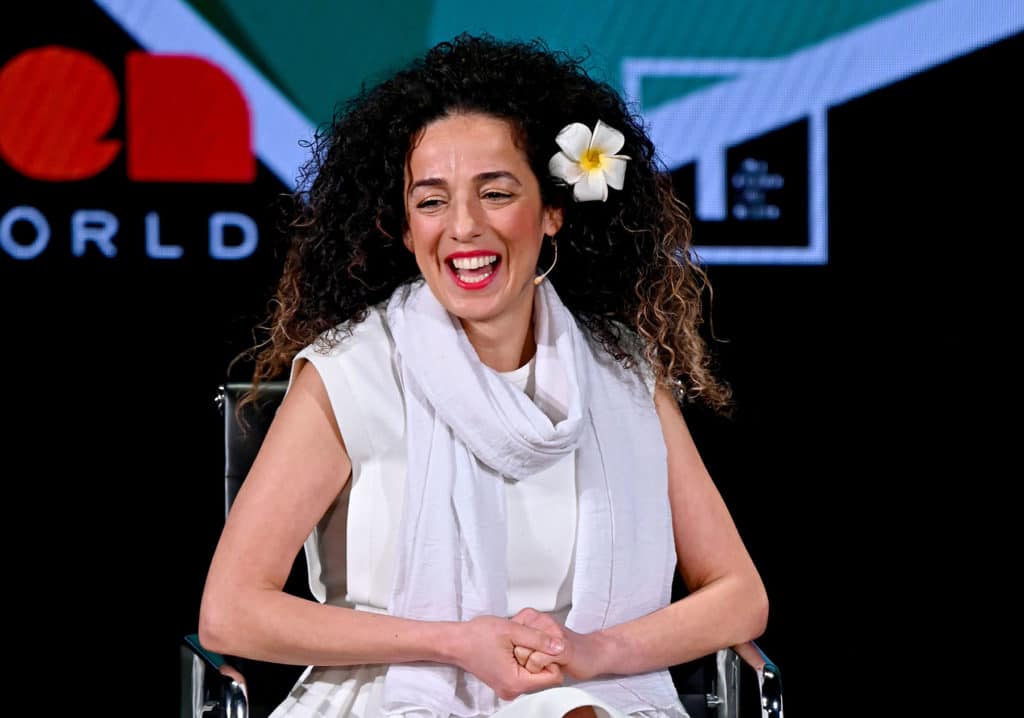
For months, they conducted surveillance while weighing their options. They watched her outside her Brooklyn home, taking photos and videos as she puttered around the yard or gardened. As weeks passed, the plan became more concrete: Once they kidnapped her, she’d be put on a speedboat bound for Caracas, Venezuela. From there, it would be easy to get her back to Iran, where she’d no doubt be tried, prosecuted and hanged.
The only problem? The Federal Bureau of Investigation was on to them.
Those who follow news related to America and the Middle East are still reeling from an indictment unsealed by the Justice Department this week alleging that two Iranian intelligence operatives were planning to kidnap prominent Iranian journalist Masih Alinejad on American soil.
Alinejad, who has lived in self-imposed exile in New York since 2014, is public enemy number one, as far as Tehran is concerned. And she has two secret weapons for fighting the regime: social media and—her hair.
In fact, The New York Post once referred to Alinejad as “the woman whose hair frightens Iran.” And with good reason: Her wildly popular viral campaigns encourage Iranian women to shed their mandatory hijab (Islamic headscarf) and post videos in which they’re harassed by local officials. She also posts videos ranging from anti-government protests throughout Iran to police arresting boys and girls for skating (yes, skating) on the street. My favorite recent video posted by Alinejad shows her entering the Interests Section of the Islamic Republic of Iran at the Pakistani Embassy in Washington D.C. to vote in the recent (though fraudulent) Iranian elections. She unabashedly uses her cell phone to film as security guards and officials scramble to deal with the hijab-less tour de force who has just entered the premises.
In fact, The New York Post once referred to Alinejad as “the woman whose hair frightens Iran.”
On Instagram, Alinejad has five million followers; on Facebook, one of her most famous campaigns (which is also a non-governmental organization, or NGO), “My Stealthy Freedom,” reaches over one million people.
Alinejad, who’s the author of “The Wind Beneath my Hair,” also reaches hundreds of thousands of Persian-language speakers as a host and commentator for Voice of America Persian News Network. She manages a lethal combination of political commentary and stinging humor that has left the mullahs yearning to get their hands on her for over a decade.
But she’s not the first Iranian dissident to be targeted abroad. In 2009, the regime tried to kill Jamshid Sharmahd, an anti-regime, Iranian-German activist, on American soil (in California). The attempt failed. But in 2020, operatives abducted him while he was traveling in Dubai and brought him back to Iran. He’s currently in detention while facing the death penalty.
In 2019, regime operatives tricked journalist Ruhollah Ram into leaving France for what he thought would be a brief trip to Iraq. He was kidnapped and taken back to Iran, where he was executed in 2020. Ram left behind a wife and two children.
By now, Iranian activists expect nothing less from the regime. And naturally, many commentators in America, whether on the left or the right, have had a lot to say this week about the unveiled plot to kidnap Alinejad: it reminds us that we can’t ignore the dangerous reach of Iran’s tentacles abroad, even here, in the United States; it reaffirms the nefarious bond between Iran and other dictatorships, such as Venezuela; and it offers self-evident proof for the need for a robust American intelligence apparatus at home.
But here’s my biggest takeaway from this unbelievable story: It’s a reminder of America’s irrefutable greatness and compassion.
But here’s my biggest takeaway from this unbelievable story: It’s a reminder of America’s irrefutable greatness and compassion.
Don’t believe me? Here’s what Alinejad herself said yesterday on a VOA Persian broadcast regarding the indictment:
“When the FBI came to my home eight months ago to tell me that my safety had been compromised, I couldn’t believe that I wasn’t safe on American soil. I jokingly responded that I’m used to receiving daily death threats. I still get threats that say, ‘We’ll kill you; we’ll throw acid on your face; we follow you everywhere.” So I joked with the FBI. But they firmly told me, ‘Look, these are the photos and videos of you that they [the operatives] took.’ I couldn’t believe that they had taken videos of me while I was going about my daily life. They’d taken pictures of me, my husband, and his children. Initially, I felt shocked. Then, I was worried, like anyone else would be. My stomach was on the floor. But then I thought about it: I’ve been afraid of the regime for a lifetime; now, the regime is afraid of me. So afraid that they’ve sent agents to Brooklyn to spy on my life. And they did see my life. What was I up to? I was in my garden, planting flowers. Then I re-entered my home to interview mothers whose children were killed by the regime; to interview women who said they don’t want this authoritarian government anymore. This was enough to scare the regime. This is what the FBI told me: that the regime not only wanted to make sure that I didn’t exist physically anymore, but they also wanted to destroy my Instagram, Twitter, Facebook, Telegram, and WhatsApp channels. So the FBI took control of it all. When the FBI came to my house, I sat down with 12 agents. I jokingly told them that whenever the police in Iran gathered, especially around women, but also around most Iranians, we would think they would torture, interrogate, or execute us. I couldn’t believe that all these policemen wanted to protect me. I wish the French police did the same thing to protect Ruhollah Zam. That’s the only thing I told the FBI at that moment. Because they told me I didn’t have the permission to leave the U.S., for safety concerns. I wish someone had told Ruhollah Zam that he didn’t have permission to leave for Iraq.”
She’s right, of course.
America saved Alinejad’s life twice; first, by allowing her entry and citizenship to the U.S. And now, by thwarting a kidnapping attempt on her life.
But the U.S. still owes her (not to mention the millions of Iranians in the diaspora and 82 million people in Iran) something else: a strong backbone against negotiating with genocidal fanatics.
“I know the administration is keen to conclude a nuclear deal with the Islamic Republic,” Alinejad said in a statement yesterday, “but we cannot ignore the regime’s abysmal human rights record and its criminal behavior. As an Iranian-American, I look to the Biden Administration to protect me as a U.S. citizen. I expect President Biden to care about human rights in the Middle East, especially in Iran, and to hold the Islamic Republic responsible for its actions.”
Thwarting a kidnapping plot is one thing. But not emboldening tyrants and assassins? That will take even greater American effort, strength and leadership.
Tabby Refael is a Los Angeles-based writer, speaker and civic action activist. Follow her on Twitter @RefaelTabby
Why is Iran so Scared of a Woman with Big Hair? Because She Lives in America Read More »
It was a sunny Tuesday morning in Los Angeles. I met a friend at the Four Seasons hotel in Beverly Hills, sat at a table reserved by the British American Business Council gathering, and eventually left after a torturous 90 minutes of watching the televised match. Another time was a 3 p.m. Saturday afternoon at the Mr. C hotel on Pico Boulevard where I had pre-paid for a beer on Shabbat and sat in front of the poolside big screen before trundling off after another cruel hour and a half. The final occasion was a Thursday lunchtime at an Irish pub on Fairfax where I was the only occupant and looked away as the horror unfolded on every one of the three television screens. Last Sunday night could have been different but even the best screenwriters were unable to write a happy ending for the England soccer team who lost yet another championship.
This weekend presents a spiritual challenge for those of us who observe Tisha B’Av, the saddest day of the Jewish calendar, when we remember and mourn the lost Temples in Jerusalem. The challenge is to sincerely mourn something we have never seen, because the second Temple was destroyed by Roman legions 2000 years ago. Visiting the ancient sites of Italy and reflecting on their violent history could be a good way to deepen the emotional experience of Tisha B’Av, and it is also the perfect time of year to enjoy a summer vacation in Tuscany or Venice. But how can we feel animosity toward the descendants of ancient Rome? After last Sunday night it’s not so hard if you are English, since the Italian football team defeated England at London’s Wembley Stadium and ransacked England’s first chance of winning an international tournament in 55 years.
Still it’s just a game. The people of England are good losers. In fact, we are such great losers that it is a national art form.
England’s soccer anthem refrain is “football’s coming home, it’s coming home,” but in an act of cultural appropriation, the opposing fans sang, “It’s coming Rome.” In homage to their Roman Ancestor Julius Caesar, they came, they saw and they conquered in a penalty shoot-out. We can also appropriate culture and misquote Russell Crowe in Gladiator: “I will have my revenge in this world or the next.” The next world is next year’s World Cup when we shall indeed have our revenge, unless we lose another penalty shoot-out, which is entirely possible.
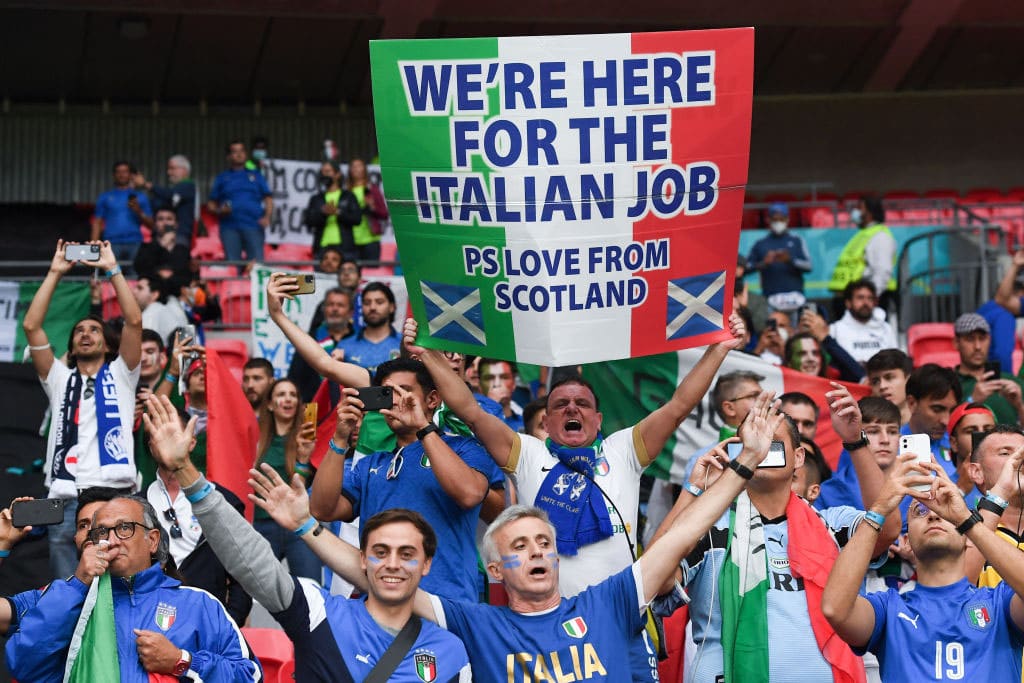
The fast of the 9th of Av is a time to reflect upon unity and spiritual matters, so we won’t stop and think about Scottish supporters who hate England so much that they joined Italian supporters at Wembley to cheer on our downfall. We also won’t reflect upon what nearly became a double-blow last Sunday when 25-year-old Italian tennis star Matteo Berrettini nearly won the men’s tennis championship at Wimbledon. He was cheered on by his countrymen, especially those from his birthplace of Rome. Enough already, we get the message. They say that “it’s not the winning that counts but the taking part,” but “they” are probably from Italy.
Fasting is more than just not eating. Days of fasting inspire action so that we move to improve the world. The prophet Isaiah said, “Is this fast I have chosen? A day for people to starve their bodies? No … it is to let the oppressed go free … share your bread with the hungry [and] take the wretched poor into your home” (58:5-7). We can focus on loving our enemies from other countries and making peace. If they don’t want peace, we can offer them an olive branch, feel contrition for our former behavior and say “the ball is in your court.” Unfortunately, the English ball is usually in the other side’s court.
Fasting is more than just not eating. Days of fasting inspire action so that we move to improve the world.
There are, however, people who live with true pain that is far more significant than losing at sports. I once filmed Shakespeare monologues around Los Angeles, delivering Mark Anthony’s famous speech from Julius Caesar outside City Hall in Los Angeles. Rather than filming against the backdrop of a Roman army encampment, we saw, in the background, a tent city of homeless people just beside the government building. The city council recently voted on restricting these camps, despite a shortage of housing accommodation. The homeless live with a daily pain that is similar to Tisha B’Av, remembering homes that were lost and dreaming of a secure future.
If you are observing the Fast of Av, have a meaningful and easy fast on Sunday. It is a great opportunity to focus on bringing peace into the world and considering where we could have behaved better in the past. Just be sure that you don’t break the fast on pizza, pasta or Scottish whiskey.
Marcus J Freed is an actor, filmmaker and business consultant. www.freedthinking.com.
Satirical Semite: Roman Holiday Read More »

As a child in the 1980s, I remember seeing commercials for Mothers Against Drunk Driving (MADD). As the clever acronym suggests, these moms were mad. They were mad that family members were being killed by drunk drivers. They were mad that laws to prevent these tragedies didn’t exist. And they were mad that no one was doing anything about it.
Anger can often be misguided, but in this case, it was exactly what was needed. The organization is largely credited with changing the mindset of an entire generation when it comes to driving while intoxicated. They were mad, they did something about it, and it worked.
Today, in the midst of the current culture wars about race and racism, a lot of moms are mad again. They are mad about what is happening in our schools and to our children. I happen to be one of the “mad moms” who hate to see what the culture war over race and racism is doing to the education of our children.
Why are we mad?
We are mad because our children are being taught that who they are as individuals, and the choices they make about how to treat others, matter less than the color of their skin.
We are mad because, while many of us have taught our children to respect and value difference not just when it comes to race, culture, and religion but also when it comes to different points of view, children are now being taught to shun viewpoint diversity and embrace closed-mindedness. They are told, emphatically, that anything short of parroting and performing the empty slogans disseminated by a small but aggressive group of activists renders them nothing short of racists.
I have been mad since last November, when my 8-year-old son’s private school in Hollywood brought in an “anti-bias” facilitator—first to train teachers, and then parents, in how to be “anti-racist.” In the parent session, antisemitism was given a pass and white parents (some of whom have non-white spouses and biracial children) were forced in some cases to admit that they contribute to racism by living in neighborhoods that are more than 50% white. Reciting the simplistic equation of racism coined by Ibram X. Kendi, the facilitator told white parents they are either “racists or anti-racists.” I still wonder what this meant to the many biracial parents in the session.
In the teachers’ session, a preschool teacher suggested that regularly sharing stories about people of different races and religions with young children was a great way to teach them to value difference. In response, the facilitator disparaged literature as “low-hanging fruit,” as too easy and not powerful enough. Instead, confrontational rhetoric about “white fragility,” anti-racism, defunding the police, and how “silence is violence” is the preferred way to handle the issue. The problem is that these one-sided slogans do more to divide than to bring children together. They reinforce racial difference and resentment and promote the very racial divide they purport to fight, although I am growing less and less convinced that the political activists pushing this toxic rhetoric are actually interested in racial healing. Perhaps, in fact, they want the opposite.
The problem is that these one-sided slogans do more to divide than to bring children together.
As both a mother and former professor of literature, I’m mad that my child’s teachers are being told that literature has little influence. There is nothing more powerful than story when it comes to teaching empathy, to exposing children to people who don’t look like them, and to giving young minds tools to think through issues in critical and nuanced ways. But perhaps that’s why the facilitator warned against it. She wants political obedience, not free thinking. Activism now comes before academics at many schools. I’m mad about that.
I’m mad that each time I write about this issue, parents and teachers reach out to tell me they agree, but that they can’t publicly say so. I’m not mad at these people; I’m mad at the Soviet-style doublethink culture that makes them feel as if they have to publicly agree with things they despise.
I’m mad that ideologically charged issues are now the backbone of many educational institutions, which are no longer bastions of critical thought and learning, having fallen prey to the indoctrination of identity politics.
I’m mad that ideologically charged issues are now the backbone of many educational institutions, which are no longer bastions of critical thought and learning, having fallen prey to the indoctrination of identity politics.
And I’m mad because while many of us understand that racism still exists and we must teach our children the complicated history of racism in America, we also believe that here, in America—unlike so many other places—most everyone is capable of living a life that transcends race and religion. Yes, we still have plenty of work to do in order to ensure that the playing field is more level, and we should all be committed to that work. But the new dogma tells children that the U.S. is a place where opportunities exist only for white people and that every part of our society operates as a conspiracy to subvert the ability of racial minorities to succeed (they never explain how it can be possible that Asians are by far the most successful racial group in America). And never mind the countless Black heterodox voices pushing back against these ideas.
Most parents—Black, white, Asian, Latino, Jewish, etc.—encourage their children by telling them that here, in America, you can be anything you want to be. But the new narrative is, for children of color, that you can’t get ahead because there are systems in place to prevent you from achieving your dreams. No matter how hard you work, they claim, you will never get out from under the structures of white supremacy that are designed, precisely, to crush you. Where is the audacity of hope in that?
Ironically, this pessimistic stance is taken primarily by white progressives, who tend to be “more left wing than Black and Hispanic Democrats on pretty much every issue,” including and especially when it comes to “racial issues or various measures of ‘racial resentment.’” This may explain why non-white voters are trending away from the Democratic Party.
But that doesn’t stop groups of predominately white progressives from telling racial minorities what is best for them. It doesn’t stop them from obliterating opportunities that have the potential to elevate non-white communities.
The idea that merit-based programs are racist, and that they should be expunged from academic institutions in order to fight racism, is an extension of this logic. Merit is racist, and therefore the standards must be lowered. But what about immigrant and non-white people who have, as Angel Eduardo says, been “fighting like hell for centuries to be seen as equal,” people who have fought their way into gifted and honors programs, or highly-selective universities and academic institutions, and who deserve to be evaluated on the merit of their work? Behind many of the students in these programs are immigrant parents who sacrificed everything to give their children the opportunities offered in America, who taught their children to work hard so that they could earn a spot in one of these programs. And now we are telling them that their hard work and their success are racist; that their sacrifices merely serve the institutional racism endemic to American society. Asian American families in particular are targeted by these racist policies.
It’s time to attack the outrageous and offensive canard that anyone who pushes back against this “anti-racist” indoctrination is secretly a racist. It’s time to recognize these attacks for what they are: an attempt to intimidate people into silence and manipulatively exploit their desire to be seen as good people.
It’s time to attack the outrageous and offensive canard that anyone who pushes back against this “anti-racist” indoctrination is secretly a racist.
But in a world where virtue signaling and proving we are “woke” or progressive is more important than actually doing the real work of improving communities and bringing them together, the billion-dollar Diversity, Equity, and Inclusion industry is the quick fix for everything, even though it rarely fixes anything.
Finally, I’m mad because I have worked hard to teach my son to love and respect others, to value differences, and treat people as individuals, not as members of groups. I have worked hard to teach him that we are all human beings who want the same things, who dream the same dreams. I’ve worked hard to teach him to be the child who stands up and speaks out when he sees injustices being committed against others.
I’m mad because none of that seems to matter anymore. He is simply reduced to his skin color.
Recently my son heard two of his closest friends (who are biracial) referred to as Black. He was shocked. “Are you sure?” he said. “But they’re just like me.”
“They’re just like me.” Isn’t that what we fought for in the civil rights movement? That all people be seen equally? But this is the newly racialized America—a place where the dreams of black and brown children can be hijacked by a political movement that needs them to see themselves as inferior, and most chillingly, that is invested in their failure, just as it tells white children that no matter what they do, they will always be seen as the oppressor.
That is not the way to equality, and it’s worth being mad about. And if the backlash of “mad moms” across the country continues to grow, I certainly won’t be mad about that.
Monica Osborne is Executive Editor at the Jewish Journal. She is a former professor of literature, critical theory, and Jewish Studies, and is the author of “The Midrashic Impulse and the Contemporary Literary Response to Trauma.” Follow her on Twitter @DrMonicaOsborne
Why I’m a Mad Mother Read More »

The pro-Israel media watchdog CAMERA [Committee for Accuracy in Middle East Media Reporting in America] wrote an open letter to The Los Angeles Times expressing “grave concern” over some of their reporters signing an anti-Israel letter.
CAMERA Executive Director Andrea Levin and Israel Office Director Tamar Sternthal wrote to Times Executive Chairman Patrick Soon-Shiong, Executive Editor Kevin Merida and Managing Editors Scott Kraft and Kimi Yoshino in a July 12 letter that nine Times journalists signed the anti-Israel June 9 letter, two of whom were anonymous. The June 9 letter, “An open letter on U.S. media coverage in Palestine,” argues that the media has whitewashed “Israel’s systematic oppression of Palestinians.” As examples, the letter points to reports from Human Rights Watch and B’Tselem calling Israel an apartheid state.
“These terms—apartheid, persecution, ethnic supremacy—are increasingly gaining institutional recognition after years of Palestinian advocacy, and we, as journalists, need to examine whether our coverage reflects that reality,” the letter states.
The letter also decries the coverage of Hamas rocket strikes against Israel as being treated as equally as Israeli strikes against Palestinians, arguing that the Israeli strikes caused far more damage than the Palestinian strikes did and therefore media reporting should reflect that. Additionally, the letter argues that referring to the potential evictions of Palestinian residents in the Sheikh Jarrar neighborhood of East Jerusalem shouldn’t be referred to as “evictions” because doing so “ignores the well-documented aim of the Israeli government to establish and maintain ethnic dominance over Palestinians.”
“By signing onto such a politically motivated and bigoted statement, they are taking a disgraceful stand against the ethical framework that has guided responsible journalism for the better part of a century: namely, the Society of Professional Journalists’ Code of Ethics (SPJ Code), which clearly sets forth the position that ‘impartiality should still be a reporter’s goal,’ even in today’s ‘superheated political environment,’” Levin and Sternthal wrote to the Times. They added that the United States was ranked last in terms of the public’s trust in the media in a recent Reuters Institute for the Study of Journalism survey.
“By signing onto such a politically motivated and bigoted statement, they are taking a disgraceful stand against the ethical framework that has guided responsible journalism for the better part of a century.”
“We are greatly troubled by the ailing relationship between the American public and its media,” Levin and Sternthal wrote. “We are certain you share this concern. Regrettably, The Los Angeles Times journalists who signed the Open Letter do not share that concern and their call to subvert core journalistic norms will worsen the media’s disastrous standing in public opinion and your paper’s reputation in particular.” They urged the Times to condemn the June 9 letter, arguing that it calls for “a radical, false, anti-Israel narrative in media portrayals.”
However, Levin and Sternthal stated that the recent coverage of Israel in the Times has reflected an anti-Israel bias, pointing to a June 8 article that portrayed “unequivocal Palestinian calls to massacre Jews and destroy the state of Israel as a struggle ‘for recognition and equality” and a June 7 article that focused on Israeli strikes of the Al Shorouq tower in the Gaza Strip but failed to mention that the tower “housed Hamas military intelligence offices and communications equipment for transmitting tactical military information to and from the terrorist organizations in the Gaza Strip,” per the Israel Defense Force.
Levin and Sternthal stated that the recent coverage of Israel in the Times has reflected an anti-Israel bias.
“We, as members of the public, urge you to protect the industry’s longstanding commitment to ethical journalism,” Levin and Sternthal wrote. “Reject the partisan agenda of journalists who have declared war on the most basic values of your profession. In these superheated political times, ethical journalists who practice their profession with integrity are the invaluable safeguard of our shared democracy, now more than ever.”
A spokesperson from the Times said in a statement to the Journal, “We are constantly reviewing our coverage of this important subject and we welcome and take seriously the concerns raised by all parties, which inform our daily discussions. We remain committed to Middle East coverage that is fair and complete.”

The Book of Deuteronomy plays games with our sense of duration. Examining it from the outside, one notes that it has just as many pages as any other book of the Torah. Reading it week to week, it takes just as long. To cross from its beginning to its end is just as much of a journey, filled with as many surprises and challenges. But while Genesis, Exodus, Leviticus, and Numbers cover centuries, or decades, or months of narrative time, Deuteronomy is the story of a single moment.
Granted, it is a long moment. The book takes the form of an address given by Moses to the Israelites before his death. If we trace the dates, we find that a month and a week have passed between start and finish. And yet, we don’t see the sun rise or set. We don’t see the Israelites depart and return. We don’t see Moses lie down to sleep or take breaks to dine. In this tableaux vivant, nothing moves save for the words themselves.
Most of Deuteronomy is Moses’ retelling of stories and laws that we have already heard. A close reader will notice, however, many discrepancies between the events as they played out and the way in which Moses reconstructs them now.
In Parashat Devarim, for instance, we see Moses’ recounting of the incident of spies, the twelve individuals who went into the land of Israel to scout it out, returning with an evil report of what they saw there. This is a pivotal story—it was, after all, on account of the sin of the spies that God condemned the Israelites to forty years of wandering in the wilderness.
But pivotal or not, Moses revises the story, now claiming that the impetus for sending spies into the land of Israel came from the Israelites themselves, and not from God.
A critical/historical explanation for these discrepancies would be that these are different texts written by different Biblical authors and therefore they contain slightly different versions of the same stories. A psychological explanation would be that the discrepancies can be explained by Moses’ emotional state at the time of this retelling. A religious explanation, however, understands the discrepancies as intentional. Moses is doing what all great rabbis do. He is interpreting the Torah.
This theory is explored in the book “Ani Maamin: Biblical Criticism, Historical Truth, and the Thirteen Principles of Faith” by Rabbi Dr. Joshua Berman. The version of laws and events in Deuteronomy is different than elsewhere in the Torah because Moses is speaking Torah Shebe’al Peh—the Oral Law, which along with the Written Law (the five books of Moses) constitute the Torah as a whole.
By the time of the Talmud—the great masterpiece of the Oral Law— the importance of interpretation will be well established. In one incident recorded in its pages, two students approach Rabbi Yehoshua in Peqi’in in the Galilee, who asks them, “What novel interpretation was taught in the study hall today?” They respond humbly, saying “We are your students, and we drink from your waters.” Rabbi Yehoshua responds, “There can be no house of study without novel interpretations” (Chagigah 3a).
Each of Moses’ novel interpretations is the work of his rabbinic mind. They are riddles to be decoded, midrashim that will add another layer of meaning to the text.
Each of Moses’ novel interpretations is the work of his rabbinic mind. They are riddles to be decoded, midrashim that will add another layer of meaning to the text.
What is gained, for instance, by Moses’ reimagining of the stories of the spies?
Well, for one thing, Moses’ version might prompt us to realize that while it was God’s command to send the spies, the need for the mission arose from the people’s lack of faith and unreadiness. A people secure in their faith would have no need for this reconnaissance mission. They would enter the land sight unseen for they would know that God was in their midst, and it just so happens that this is exactly what the new generation of Israelites will do.
Deuteronomy, then, should not be seen as a repetition. It is utterly new, and not just on account of the specific discrepancies we have mentioned. It is new because the Oral Law, what Ahad Ha’am called “the inner law, the law of the moral sense,” had not yet been given to the Israelites until this moment when it was demonstrated—not revealed—by our teacher Moses to the Israelites, his students, and to us as well.
Matthew Schultz is the author of the essay collection “What Came Before” (2020). He is a rabbinical student at Hebrew College in Newton, Massachusetts.
Unscrolled: The Inner Law Read More »
One of the great appeals of attending a political demonstration is the youthful energy of the cause. Generation Z takes pride in taking to the streets for social justice—certainly not a new phenomenon. Throughout American history, the proteins of young DNA have been idealism, progressivism and rebellion against authority. But there is one cause that, although positioned as confronting evil in the pursuit of good, draws fewer college students than a Jimmy Buffett concert. The fight against antisemitism skews dramatically toward older Americans.
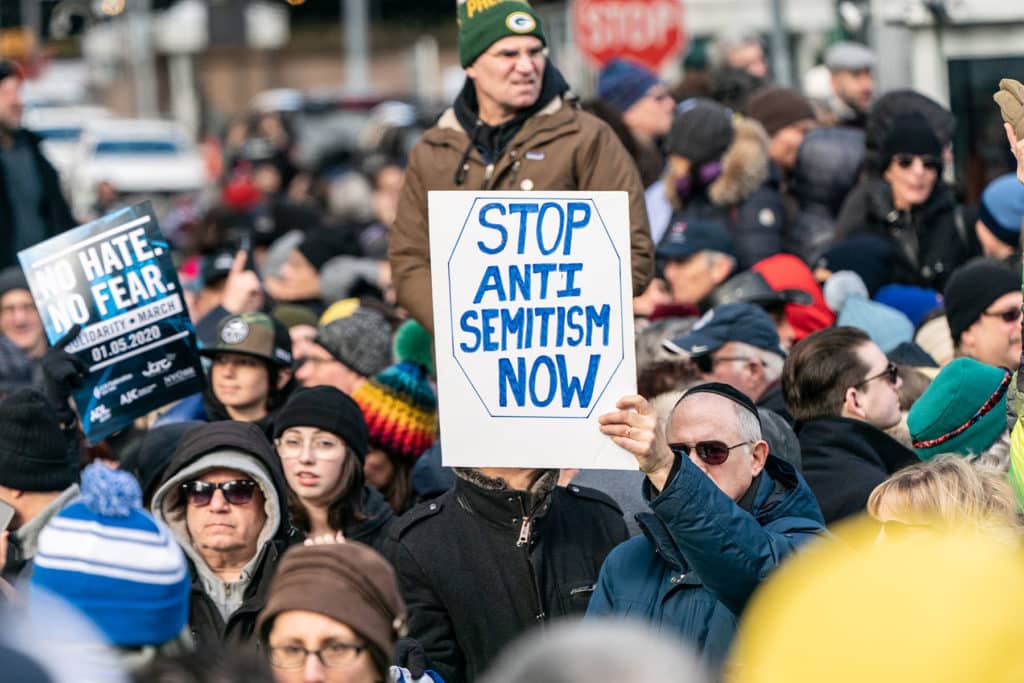
Last Sunday, several Jewish organizations sponsored a rally in Washington D.C. in response to the wave of hatred that crashed on American shores this summer. I had the privilege of speaking at this event, aptly titled the #NoFearRally, and was inspired to hear from victims of knife attacks, Jews attacked in restaurants by mobs of anti-Israel protestors, ex-white supremacists, and children of Holocaust survivors. The call to action on this very hot day was clear: We must combat the burgeoning virus of Jew-hatred in the United States, manifested across the political spectrum, in synagogues and on subway cars, its perpetrators stratifying all categories of race, religion and creed.
But in peering over the glass podium while presenting my speech, I saw what I usually see at Jewish gatherings. My parents’ and grandparents’ generations were represented thousands strong, accompanied by only a few hundred young faces. What does it mean that attendees of a rally in support of Jews are part of a completely different age demographic than those at rallies in support of immigrants, action on climate change, or reproductive freedom?
What does it mean that attendees of a rally in support of Jews are part of a completely different age demographic than those at rallies in support of immigrants, action on climate change, or reproductive freedom?
Here, some left-wing readers will smirk and indict my words for proving a point. This rally, as is the case with many rallies against antisemitism, was explicitly Zionist. And because it was so Zionist, young people, who are growing more hostile to Israel by the second, were repelled like vampires before garlic. I’m bracing myself for the hypothesis that if only this event had welcomed anti-Zionist organizations, and if only it had platformed speakers who are steadfast in their belief that white supremacy is the only pressing threat to American Jews, more young people would have ransacked CVS for posterboard.
As a young person myself, I call bulls–t.
The lack of interest in fighting antisemitism among young people isn’t about Zionism or Israel. Pray tell, where are the great rallies against Jew hatred by anti-Zionist organizations? There aren’t any, unless of course they can be woven into some universalist narrative exclusively against white nationalism. No, this isn’t about Israel. This is about the cultural framing of the Jewish experience as a right-wing issue.
If we are portrayed as the epitome of wealth, privilege, success and whiteness, our needs become right-wing needs, our safety a right-wing ploy to increase police presence, our homeland a right-wing bastion. It is therefore acceptable to undermine, trivialize and demonize all of these things, and it is therefore problematic to defend any of these things. Jewish particularism is an annoying insect that buzzes around progressivism, demanding much needed attention, but swatted away, because how could it possibly be that we, who defy the binary of who is oppressed and who is oppressive, deserve allyship?
Jewish particularism is an annoying insect that buzzes around progressivism, demanding much needed attention, but swatted away, because how could it possibly be that we, who defy the binary of who is oppressed and who is oppressive, deserve allyship?
Ask any Jewish college student what happens when they raise charges of antisemitism in a progressive space, regardless of whether the charges concern Israel. They will lose friends, acquaintances and opportunities. Our stories are not included in the now infamous diversity and inclusion trainings, or in the intersectional rhapsodies condemning bigotry and racism. That is not, and has never been, a coincidence.
I’m drawn to a recent anonymous submission to the Twitter account “Organizer Memes,” which provides commentary on young, left-wing activist circles. A student writes: “I shared memories of painful antisemitic experiences among a carefully selected group of friends and acquaintances I’ve made in the organizing space, over the least half decade, uncertain of how this information would be received.” And then: “There was a noticeable negative shift in how some people interact(ed) with people now that they knew I’m Jewish. Three people that I communicated with semi-regularly and who are involved in youth political organizing removed me from their follower lists over the course of several weeks. Some put *noticeable* distance between themselves and me … one person continued to deny Israeli statehood to a follower list of over 2,000 people for a couple days after I relayed my experiences.”
A group of students responded to a Jew with hostility after they shared their experience with antisemitism. Days later, like clockwork, they began posting condemnations of Israel on their social media pages, as if to appease the gnawing guilt on their conscience that treating this person differently was wrong. It became acceptable to treat this Jew abhorrently, because, “Look at what Israel is doing to the Palestinians!” This is a scenario that many Jewish young people, including myself, can describe in perfect detail. And unfortunately for many of us who have witnessed it first hand, the lesson learned is to keep your mouth shut going forward—which is exactly what is being asked of us by so-called anti-racists.
This summer, the Chancellor of Rutgers University released a statement condemning the rise in anti-Jewish violence that was a symbiotic consequence of Israel’s Operation Guardian of the Walls. After outrage from left-wing students, a second letter was released, in which the chancellor apologized for “failing to communicate support for our Palestinian community members.” The same week, I was scheduled to host a lecture on antisemitism at a local high school during an educational program on intolerance and racism. Though the panel had been organized and finalized in January, I received a text the morning of the event notifying me that it had been scrapped, with the administration citing concerns of “timing.” The other panels, it’s worth noting, carried on as planned.
Or consider April Powers, the Chief Equity and Inclusion Officer for The Society for Children’s Book Writers and Editors. After releasing a statement on the organization’s Facebook page condemning the antisemitic attacks seen across the country this summer, writing, “The SCBWI unequivocally recognizes that the world’s 14.7 million Jewish people (less than 0.018% of the population) have the right to life, safety, and freedom from scapegoating and fear,” Powers resigned from her position. In a series of online attacks against Powers and the SCBWI, one member posted: “I had no idea this was a Zionist/politically motivated organization that doesn’t serve all children.”
If you’re still not convinced, view the Twitter account of comedian and former Bernie Sanders surrogate Amer Zahr, who made headlines in May for saying to his thousands of followers: “This is a message to all the activists and leaders out there that are condemning antisemitism and condemning terrorism right now. Stop it. Stop. You are not helping alright… You are playing their games… It’s a distraction.”
In all scenarios, Israel was used as an excuse, a justification for failing to address Jew hatred, and by extension, a reason to resent the Jewish people even more. Which policies of Israel were criticized? Which legislation in the Knesset was harpooned as problematic? Not one.
When antisemitic violence erupts on the streets of American cities, as it did in December of 2019 when there was no Israeli military operation, there are no hashtags. When Jews are stabbed in broad daylight, miles away from Israel, there are no statements from progressive organizations—certainly not those who operate on college campuses. In the summer of 2021, not only did left-wing politicians stoke hatred by spreading mendacious conspiracy theories about the State of Israel, but also they were unable to condemn antisemitism unequivocally, and insisted on adding a condemnation of islamophobia for good measure. When Jewish Democrats finally mustered the courage to raise the issue of double standards against Israel in Congress, they were accused of “not being partners in justice” by Rep. Ilhan Omar, which simply implies that they are not real members of the left.
All of this is a consequence of Jewish needs falling out of favor with progressive values.
I don’t blame young people, not even Jewish young people, for feeling nervous when called to defend Jews. I am never surprised when I see countless more adult faces at a rally against antisemitism than I do young faces. The Jewish question has once again become toxic, a direct consequence of left-wing identity politics. One generation is carrying that banner louder and prouder than all others. When standing up to antisemitism becomes a political risk, the soil of our once Golden Diaspora is fertilized with the tears of our less fortunate ancestors.
Blake Flayton is a Jewish student activist and the co-founder of New Zionist Congress.
Fighting Antisemitism? Okay, Boomer. Read More »