
Sept. 6, 2019
Click here to view the paper fullscreen.
Click here to see our archives.


Swampscott, Scituate, Cotuit —
ragged towns on rugged coast
softened by the sun.
Ocean tides and noontime whistles
measured summer’s taffy days,
nighttime crickets’ legs rubbed love songs,
sunburns flaking under sheets.
Milton, Mashpee, Mattapan —
my grandfather’s cigar butt
clamped between his yellow teeth
swimming out toward the horizon
in a cap crisped stiff by hot Julys,
gentle jellyfish in current
bubbled up from somewhere sweet.
Dennis, Sandwich, Harwich Port —
Ray Charles could not stop loving me
mellow from the snack bar
on a breeze of something fried,
my name spelled out in scallop shells,
mother knitting in a beach chair
next year’s sweater on her lap.
Plymouth, Falmouth, Yarmouth Port —
pleated plaids replacing swimsuits
on the metal rounder racks at Zayre’s,
August folding up its beachhead,
towel ready for the wash,
I pressed my body to its striping,
not ready to rinse off the salt.
Paula Rudnick is a former television writer and producer who has worked the past 30 years as a volunteer for nonprofit organizations.

Can this internet wiz bring this ancient Jewish ritual to the world?
When my son was born 10 years ago, I decided to bring back a tradition I had cherished as a child but somehow lost as an adult. We started to light candles at sundown every Friday night. I also took him to Tot Shabbat on Saturday mornings and relished in the spiritual bonding the ancient melodies induce. But when services ended, that often was the end of our Shabbat. He would go to parties or play in tennis tournaments as though it was just a regular weekend afternoon.
I began to sense something more was needed when, during our long and harsh New York winters, video games became the default activity after services. All the beauty of Shabbat quickly was lost to the blasts of “Fortnite” gunfire. Meanwhile, the negative effects of our tech-based lives were becoming apparent — creating not just a culture of outrage, but a culture of digital gratification, a spiraling addiction to “likes” and followers.
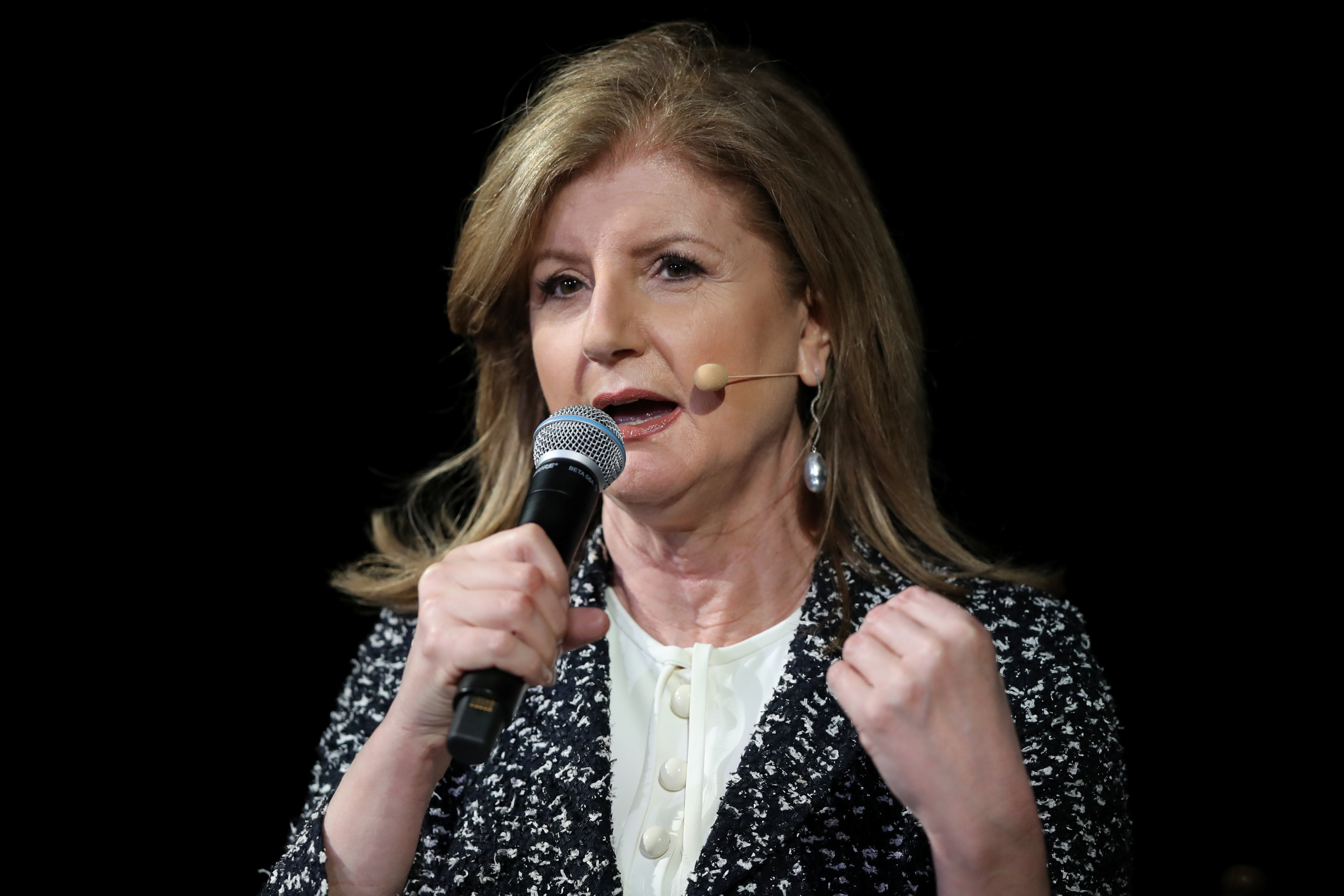
So it was with great interest to discover Arianna Huffington — founder and CEO of Thrive Global and the internet icon who set the media world on fire with Huffington Post — was addressing burnout and entering the Shabbat world.
Launch of Thrive Global
Huffington created Thrive Global in 2016 to give people and businesses practical tools to avoid burnout and boost well-being and productivity. “We are at an inflection point in history where technology has granted us powers that accelerate the speed of life beyond our capacity to cope,” Huffington wrote in her welcome letter on the Thrive Global homepage. “We’re more aware than ever that this way of living leaves us depleted, distracted and unfulfilled.”
Sections on the site include “Well-Being,” “Wisdom,” “Wonder” and “Purpose.” Last year, the big news was that Huffington, who is not Jewish, added a section called “Shabbat: A Day of Rest.”
“Arianna approached me at a bar mitzvah where I was officiating and she was a guest,” said Rabbi Jay Moses, who serves as the section’s Editor-at-Large. “She proposed Shabbat: A Day of Rest, with the Hebrew pronunciation rolling off her tongue. I was impressed with the authenticity of her approach to the idea, including the integrity of keeping the original Hebrew.”
An initial forage through the section can be a bit jolting. Many of the pieces are written by rabbis who quote the Bible and Talmud as though they were writing for a Jewish paper. But there is also a genuine level of acceptance that today’s problems with technology can be partially solved with this weekly Jewish tradition. “Shabbat is the greatest gift of the ancient Jewish people to human civilization,” Moses writes.
“Shabbat was a radical and beautiful innovation our ancestors brought to humanity,” Rabbi Angela Buchdahl of Central Synagogue in New York City writes.
The Beginning of a Revolution?
“There is a realm of time,” Rabbi Abraham Joshua Heschel writes in his 1951 classic book, “The Sabbath,” “where the goal is not to have but to be, not to own but to give, not to control but to share, not to subdue but to be in accord.”
Huffington was not the first to see that the essential humanity of Shabbat can be applied universally; in fact, one might say we’re in the midst of a Shabbat revolution.
In 2010, a small group of artists, writers, filmmakers and media professionals called ReBoot who, while not particularly religious, “felt a collective need to fight back against our increasingly fast-paced way of living,” created the Sabbath Manifesto, which includes such edicts as “Avoid technology,” “Connect with loved ones” and “Give back.” ReBoot also launched the National Day of Unplugging in 2009.
In 2013, Chief Rabbi Warren Goldstein of South Africa called on his community to come together for one complete Shabbat. The result was so successful, it turned into the Shabbat Project, which has thus far united Jews in more than 1,000 cities and almost 100 countries. “The idea is simple,” the website states, “Jews from all walks of life, from across the spectrum of religious affiliation, young and old, from all corners of the world — come together to experience the magic of one full Shabbat kept together — in full accordance with Jewish law.”
In 2014, One Table was launched with the goal of connecting Jewish millennials and others to the Shabbat meal experience. The initiative revolves around promoting and enabling Friday-night dinners, re-created in any way that brings “joy and connection,” executive director Aliza Kline told the Chicago Tribune.
Interspersed with these initiatives have been calls for “technology Sabbaths” by celebrities, and numerous articles on digital detoxes in which Shabbat is called “an act of mindfulness.” Vogue ran a piece in March 2017 called “How to Host a Shabbat Dinner and Why You Should.”
Even Pope Francis, in a 2018 documentary, opined on the merits of the Jewish day of rest: “We live with the accelerator down from morning to night. This ruins mental health, spiritual health and physical health. More so, it affects and destroys the family and therefore, society. ‘On the seventh day, He rested.’ What the Jews followed and still observe, was to consider the Sabbath as holy.”
The granddaddy of Shabbat initiatives was launched in the late 1990s as “Shabbat Across America,” which continues to bring Jews from across the religious spectrum to taste the restorative powers of Judaism’s holy day.
“Shabbat is not just a replacement for Prozac. It is a day that reminds us of the very purpose of human existence.” — Rabbi Chaim Steinmetz
An Antidote to Digital Addiction
One word summarizes the backlash against modern technology: enough. We need to slow down and regain our humanity. It’s ironic that it took a media maven and technology entrepreneur such as Huffington to see Shabbat as the perfect antidote to our digital addiction.
It also makes Huffington an ideal spokesperson for the beauty and value of this ancient ritual.
Perhaps not surprisingly, she sees Shabbat as helping us thrive, not just rest. The science is clear and conclusive, she writes: “When we prioritize our well-being, our decision-making, creativity, productivity and performance dramatically improve across the board. Taking care of ourselves, far from detracting from success, enhances productivity and creativity.”
One of the paradoxes of the internet is that it preys on our need for human connection. “We’re hard-wired to connect, so we’re tempted by technology,” Huffington told the Journal. “But the connection that it offers is often unfulfilling, and, as the research shows, overuse can make us unhappy and more prone to anxiety and depression.”
It’s sobering to realize that our minds are so busy trying to process gratuitous information that we forget important things, like kindness. Our lives revolve around digital clicks. And like any addiction, the clicks offer only temporary jolts of pleasure that need constant refills.
“We’re being controlled by something we should be controlling,” Huffington said. “We’re losing more and more of ourselves. We haven’t yet learned how to regulate and manage this increasingly powerful and addictive new element in our lives to serve our best interests.” Her bottom line: “We need to change our relationship with technology — to make disconnecting not only an option, but a regular part of our lives.”
The Boundaries of a Movement
“The idea of taking a day of rest is woven into the very fabric of existence,” Huffington writes in her introduction. “And some version of rest, downtime, contemplative thought, is part of every spiritual and philosophical tradition.”
“Obviously,” she continues, “in the biblical narrative, God didn’t need to take the 7th day off — but he was sending us a message. Because, unlike him, we do need to. But in our modern world, the worries and concerns and duties of those other six days have crept into the 7th, creating a culture of non-stop, 24/7 work.”
To be clear, the Shabbat section in Thrive Global is not about Jewish law and do’s and dont’s. “It’s about celebrating the ideas of Shabbat in whatever form they take in people’s individual lives,” Huffington writes.
It’s fair to ask, however: Is there a risk that in the mainstreaming of Shabbat, we will dilute an ancient tradition?
“The renewed interest in Shabbat is meaningful and an excellent way to bring biblical wisdom into the 21st century,” Rabbi Chaim Steinmetz of the Orthodox Congregation Kehilath Jeshurun in New York City told the Journal. “And yet, I worry. I worry that by reducing Shabbat to a psychological palliative of de-stressing and disconnecting, we have taken away its true meaning. Shabbat is meant as a day of humility and dignity. It is the day in which humanity humbly recognizes the God of creation and encounters a world that is much larger than themselves. At the same time, it is a day in which humanity, created in the image of God, is recognized as a free and dignified being who serves no master other than God.
“Shabbat is not just a replacement for Prozac,” he added. “It is a day that reminds us of the very purpose of human existence.”
“We’re hard-wired to connect, so we’re tempted by technology. But the connection that it offers is often unfulfilling, and, as the research shows, overuse can make us unhappy and more prone to anxiety and depression.”
To her credit, Huffington does make an effort to honor Shabbat’s religious roots. “The etymology of ‘Shabbat,’ ” she writes, “comes from the root Shin-Bet-Tav, and the idea is associated with two other commands, to remember (zachor) and to observe (shamor). In our always-on culture, it’s very easy to do neither.”
Still, roots or no roots, the reality is that the Orthodox version of Shabbat, which prohibits any use of technology from sundown Friday night to past sundown Saturday night, is not for everyone. For the Shabbat revolution to catch on, it will have to focus, at a minimum, on the essential human benefits of this Jewish idea.
Indeed, one of the key points of Thrive Global’s Shabbat section is that Shabbat is an idea meant for everyone. “Interestingly,” Moses writes, “the Hebrew Bible, which is often very concerned with the unique and distinct covenantal responsibilities of the Israelite tribe, explicitly includes the broader community in its mandate to celebrate Shabbat. Employees, guest sojourners, even cattle are to be granted a day of rest along with the Jewish household.”
Moses said he has two goals for the section. “One is to inspire people to live lives of greater health and more balance, so they can contribute to the healing of a world badly in need of repair. The second is to spread and promote the wisdom of Jewish texts and tradition from the last 3,000 years, which has so much to offer the contemporary seeker.”

Silence of the Soul
One clear way Shabbat can help the contemporary seeker is in lengthening our diminishing attention spans. In his piece for the section, Rabbi Andy Kahn of Congregation Emanu-El in New York, addresses this challenge: “Where we place our attention is central to the Jewish understanding of relating to God. ‘Shuv’ refers to the desired state: turning our attention to God. ‘Panah’ is the undesired state: to project our attention toward other gods. Our ancient ancestors knew that what we turned to — where we place our attention — predicted our future.
“It is this responsibility to control our attention that is the crux of the covenant between God and the Israelites,” he continues. “And this choice has never been more present and clear than it is today.”
Kahn quotes Matthew Crawford at the Institute for Advanced Cultural Studies, who has studied how constant noise has disrupted our collective attention. “In the process, we’ve sacrificed silence — the condition of not being addressed.”
The silence of Shabbat doesn’t just allow us to think and feel deeply, Kahn writes, “it’s a key Jewish way to attend to God.” He discusses the Book of Kings and how Elijah the prophet encounters God on Mount Horeb. “Elijah does not find God in all of the overtly distracting explosions of power through the elements (wind, earthquake, fire). Instead, Elijah finds God in the silence after — in the respite from those attention-demanding phenomena.”
“The Torah pleads with us to make room for just this kind of silence in our lives,” Kahn continues. “Rather than returning to the silence where God dwells, our attention is constantly pulled outward — toward the manifestations of power, the distractions, the shining totems built particularly to capture our attention.”
To listen inwardly to God, the Torah tells us, we need only seek out inner silence. “These moments of inward attention bring us to God’s greatest gift, shalom, a holistic peace,” Kahn writes.
In this space of holistic peace, we can better manage the stress of modern striving. Rabbi Joshua Rabin, a director at the United Synagogue of Conservative Judaism, writes: “When we unplug on Shabbat, we make a conscious rejection of the world of exhaustive comparison, and simply live as though nothing else matters but deep relationships and community. If we succeed in doing this, we will take one small step toward demonstrating Shabbat’s capacity to elevate every aspect of our lives, shaping a world that now, more than ever, needs a little less digital self-gratification, and a little more communal sanctification.”
“The Talmud teaches that Shabbat provides a person with an ‘extra soul.’ Shabbat is a day each week when each of us has the opportunity to utilize a double portion of our best selves.”
The Shabbat section also includes contributions from those who are not rabbis. “Growing up in the south of Spain, this ritual was handed down to us as one hands over the crown jewels,” Michele Attias writes. “Shabbat was our one day a week of reflection, spirituality and family time; just like my grandparents and great-grandparents had observed, all the way up to the Spanish Inquisition.
“As the sun began to set on a Friday afternoon,a silence descended and the peace that emerged was tangible.
“This tradition has created a sense of belonging and served as a strong foundation for Jews to survive pogroms and persecution over the years. It is an element that has bonded us together through generations when we hit one wall of uncertainty after another, it built the seeds of resilience, which grew into a ritual that has never had an expiry date.”
Buchdahl wants us to better control our time. She writes: “If we have no blueprint for our time, if we do not stop to reflect on the ultimate purpose of all that building, we may wake up one day and realize we’ve built a life without a soul. Judaism teaches us how to be the architect of our time. The Jewish view of time is refreshingly countercultural.
“Judaism divides time into two distinct categories: the sacred and the ordinary. In ordinary time, we are encouraged to busy ourselves with the important work that enables us to be fed and sustained, healthy and constantly growing. But sacred time is completely different. Sacred time is designed to slow us down, make us fully present, enable us to see ourselves and the world around us as Whole. Perfect. Finished.
“Sacred time is a time to just be.”
“In the biblical narrative, God didn’t need to take the 7th day off — but he was sending us a message. Because, unlike him, we do need to.”
The Rhythm of Nature
I hope that the section will eventually include former Chief Rabbi Lord Jonathan Sacks’ thoughts on Shabbat and nature. “There is an integrity to nature,” Sacks wrote in his April 2017 sermon “The Light We Make.” “Everything has its proper place, its ecological niche, its function and dignity in the totality of being. Holiness consists in respecting boundaries and honoring the natural order.
“The story of creation tells us that nature is not a blind struggle between contending forces, in which the strongest wins and power is the most important gift. To the contrary: The universe is fundamentally good. It is a place of ordered harmony, the intelligible design of a single creator. That harmony is constantly threatened by humankind.”
He notes that Shabbat, “the day of limits and holiness,” teaches us that there are boundaries to creation. “The ability to create goes hand in hand with the ability to destroy. Every new technology can be used to heal or harm. Every power can be turned to good or evil.
“We believe that God wants human beings to exercise power: responsibly, creatively, and within limits set by the integrity of nature.”
Blessed to live very close to Central Park, I have come to see nature as not just essential to our emotional health, but our best model for bringing back civil society. Nature is not perfect; we need rules and laws. But the basic principles of nature — authenticity, rhythm, harmony, restraint — underlie character, decency and dignity.
Social media is the opposite of nature — a tech jungle geared to incite ever-escalating tribal wars. But we evolved for competition, not incessant war.
“In the ceremony of Havdalah,” Sacks wrote in his March 2008 sermon “The Light of Holiness,” “we make light on the eighth day, the start of human creativity, and in so doing, we become God’s partners in the work of creation. We begin by creating light and proceed to make distinctions.
“This is a vision of great beauty. It sees the world as a place of order in which everything has its place and dignity within the richly differentiated tapestry of creation. To be holy is to be a guardian of that order, a task delegated to us by God.
“In the midst of what can sometimes seem to be the dark chaos of the human world, our task is to create order and light.”
To Steinmetz’s point, Shabbat is not just an occasion to recharge and re-center. It is also a time to truly listen to the inner silence — a reminder that our fundamental task is to create light, and we can’t do so if we are mired in the toxicity of technology.
The fact that Huffington’s embrace of Shabbat has emerged at this time may hold a hidden message for Jews. Perhaps subconsciously, she is telling us that the best response to the hatred of Jews is to stand tall and double down on our tradition — and share it with the world.
The Elephant in the Room: Anti-Semitism
One of the great ironies of this budding Shabbat revolution is that it has come at a time of rising anti-Semitism. While more and more Americans are embracing a beautiful Jewish tradition, more and more Americans are embracing that age-old animosity toward Jews.
The fact that Huffington’s embrace of Shabbat has emerged at this time may hold a hidden message for Jews. Perhaps subconsciously, she is telling us that the best response to the hatred of Jews is to stand tall and double down on our tradition — and share it with the world. Shabbat can bring out the best in humanity. As Buchdahl writes, “What is at stake here is not just our sanity. It is our very humanity.”
I traced those words on a bench in Central Park, absorbing the beauty of nature. And then I caught a Facebook photo of a friend out in the Hamptons, and I began to feel sad, mad at myself for not making an end-of-summer Hamptons stay happen for my son.
As I began to gather my stuff, I noticed a mother from my son’s school walking by slowly, debilitated. Her cancer had returned; she was headed to Mount Sinai Hospital for treatment. In addition to my sorrow for her, I felt shame for what I had been thinking about.
I had what I will now call a Shabbat moment. God gave us Shabbat to be able to feel many things, but perhaps most importantly, gratitude. Technology is trying its hardest to take that away. We need to be able to stay in that elegant serenity — the silence of the soul — no matter what our friends are doing, no matter what toxic events are happening in the world. Because it is only in that place, that moment, that we can truly give the light of Shabbat back to the world.
Shabbat Shalom.

Q & A with Arianna Huffington
JJ: What inspired you to create Thrive Global?
A.H.: The inspiration goes back to 2007, when I collapsed from exhaustion and broke my cheekbone. After that, I became more and more passionate about the connection between well-being and productivity. And that led me to write my two books, “Thrive” and “The Sleep Revolution.” And as I went around the world speaking about them and our culture of stress and burnout, I saw how deeply people wanted to change their lives. So I wanted to go beyond just speaking out and raising awareness; I felt the need to turn this passion into something real and tangible that would begin to help people change their daily lives. It was a call to action I just couldn’t ignore, and so I founded Thrive Global.
JJ: How is Thrive Global doing? What has been the reaction?
A.H.: The response has been amazing, and we’re continuing to expand all over the world. We’ve now launched Thrive in India and Greece, and have given trainings in five continents. We also just launched our new behavior-change app, Thrive, which helps boost well-being and performance with our science-backed, too-small-to-fail Microsteps.
JJ: What inspired you to create a Shabbat page?
A.H.: The principles of Shabbat — taking time to disconnect from our work to connect with our loved ones and focus on what gives us value and meaning in our lives — are central to Thrive Global. So it made sense to jump at the chance to amplify the movement to spread the vital messages of Shabbat.
JJ: You could have called it the Sabbath page. Why the Hebrew? Is the intent for it to be on Friday eve/Saturday and include the Jewish rituals, such as candle lighting?
A.H.: The name was chosen along with the section’s Editor-at-Large, Rabbi Jay Moses, and is about celebrating the ideas of Shabbat in whatever form they take in people’s individual lives.
JJ: What was your relationship to Shabbat before this?
A.H.: I feel blessed to have been to many Shabbat dinners at the homes of my friends and have always loved the experience.
JJ: What has been the reaction thus far to the Shabbat page?
A.H.: The reaction has been fantastic. People all over the world are hungry for tools that will inspire and empower them to unplug and connect with what brings meaning and purpose to their lives.
JJ: What were the main points of your talk to Hebrew University’s NEXUS: ISRAEL conference? How do you tell a tech conference to unplug?
A.H.: It’s about the effects of technology on our lives and how we can take control of that relationship. It’s definitely not about being anti-technology, but about how we can maximize the benefits of technology to maximize our performance and well-being. And, more generally, how we can lead a full life of wisdom and purpose.
JJ: What does the research show to be the most damaging aspects of spending too much time online in general, and social media in particular?
A.H.: In short, what the science shows is that it’s simply terrible for both our mental health and physical health, which, of course, are deeply connected. We’re hardwired to connect, so we’re tempted by technology. But the connection that it offers is often unfulfilling and, as the research shows, overuse can make us unhappy and more prone to anxiety and depression.
JJ: To what extent do you think it has contributed to our current hyper-polarized, hostile political environment?
A.H.: It’s almost certainly contributed. Studies show that empathy levels have been declining since the ’80s, right around the time when computers entered our lives. And we know from the science that screens and overuse of social media diminish our empathy and our ability to read social cues. This is a recipe for polarization.
JJ: What do you say to those who say social media is how they relax, that it’s more relaxing than having to be “on” in real life?
A.H.: The question is: What is that time on social media taking away from? There’s an opportunity cost to our screen time. And the alternative to being on social media isn’t just having to be “on,” it also includes downtime in which we can connect with ourselves, which is vitally important to our well-being.
JJ: Any plans for the future of your Shabbat track?
A.H.: “With the High Holidays approaching, we look forward to continuing to move to the foreground the conversation around the teachings of Shabbat and the benefits of unplugging. We’ll continue to refresh the section with new content on these always relevant themes and promote new pieces across our social media platforms. And we would love for Jewish Journal readers to submit their own stories of practicing Shabbat or how they unplug and connect with themselves and others, and we’d love to feature them on Thrive!”
Karen Lehrman Bloch is an author and cultural critic living in New York City.
Arianna Huffington Wants a Shabbat Revolution Read More »

The Israeli law that gives the state-mandated Orthodox rabbinate a monopoly over marriages of Jews in Israel is headed to the dustbin. It’s becoming a dead letter, an anachronism. This will happen regardless of election results, regardless of what the ultra-Orthodox parties say or do, regardless of what the coalition agreement mandates, regardless of the “status quo,” regardless of campaign promises. The age of rabbinate-mandated marriage is over because the public says it’s over. The Knesset, fashionably late, might decide to address the changes that already happen in the real world. Or not. I’m no longer certain it matters.
Why write about this topic now? Because analysis of up-to-date data reveals three things, and because Israel goes to the polls in 10 days amid a great debate about state-religious issues. Unfortunately, not even voters understand that some things aren’t determined by legislators and ministers. They are determined by the people.
Here is my proof:
First, support for relaxing laws governing the marriage market is widespread. Survey data published by Hiddush (an activist nongovernmental organization) clearly indicates that the only members of the public who oppose it are religious Israelis, who are still a minority. The wording of the question posed to Israeli Jews was: “Marriage and divorce of Jews in Israel is carried out only by Orthodox law. Do you support or oppose Israel recognizing all types of marriage, including Conservative, Reform or civil marriage?” Sixty percent of Likud voters support such marriages; 94% of Blue and White voters support such marriages.
The second issue clarified in the past few weeks is that a growing number of Israelis already are voting with their feet on this issue. The Central Bureau of Statistics released new data that reveals about 35,000 Jewish couples were married by the rabbinate in 2017. In the same year, another 8,000 couples married outside of the rabbinate — some in Cyprus, some in the Czech Republic or the United States. So, the number of ceremonies abroad is already close to one-fifth of all weddings of Israeli Jews. At the same time, the number of Israelis who don’t even bother to legally marry also has risen.
The third fact that’s important to know is that secular Israelis of the younger generation don’t want to hear about rabbinate-mandated marriage. Not all of them, of course, but a lot. If I were the chief rabbi of Israel, I would look at the data with great anxiety. The rabbinate has a product to sell. It is the only institution legally allowed to sell this product. And yet, people aren’t buying it.
If the secular half of the public turns its back on the rabbinate, all the known arguments for the exclusivity of a rabbinate-mandated route — the most common of which is the need to maintain the unity of the people — collapse. I suspect they have already collapsed.
Data from the Jewish People Policy Institute indicate two parallel phenomena leading to that presumed collapse. First, the parental generation is losing its interest in marriage through the rabbinate. That is, the assumption that when the children of Israelis decide to revolt against the rabbinate, their parents will pressure them back into submission no longer holds.
More important is the young generation’s tendency. The younger the (secular) Israeli, the less inclined he or she is to marry through the rabbinate. In other words it reveals that the rabbinate has no real chance of maintaining its monopoly for another generation. Yes, it can maintain it formally, legally. It can claim to maintain it. It can pretend to maintain it. But practically speaking, the rabbinate monopoly over marriage in Israel is over.
Shmuel Rosner is senior political editor. For more analysis of Israeli and international politics, visit Rosner’s Domain.
Shmuel’s book, #IsraeliJudaism, Portrait of a Cultural Revolution, is now available in English. The Jewish Review of Books called it “important, accessible new study”. Haaretz called it “impressively broad survey”. Order it here: amzn.to/2lDntvh
Israel’s Marriage Monopoly Is Over Read More »

“When you’re in culinary school, there isn’t a night of drinking that doesn’t end in cooking an entire feast,” personal chef Alyssa Samowitz said.
However, she quickly added that “feast” does not necessarily denote good — or even edible — food. She cited the night she and her inebriated peers at Rhode Island’s Johnson & Wales University thought it would be an excellent idea to combine pizza bites, ground beef and chicken nuggets (everything in their freezer), cover it with cheese and sauce and bake it.
Samowitz, 27, said her mother inspired her love for cooking: “It was a survival skill,” she explained. When she was a teenager, her mother went back to school and her father took over the cooking. For weeks on end, she and her brothers were fed hotdogs on a daily basis until one day she told her father he was fired from the kitchen. By trial and error (mostly error), Samowitz taught herself to cook. Her first recipe was one printed on the back of a packet of chips and her first attempt at sautéed broccoli consisted of boiling three cups of canola oil. “It’s no Jamie Oliver story,” she said, laughing.
A New York native, Samowitz graduated from Johnson & Wales in 2013 and the following day made aliyah. She began working at Mike’s Place, a restaurant-bar in Tel Aviv and the only place where the tickets are written in English. However, long hours, weekend shifts and poor pay drove Samowitz to quit the restaurant scene a year and a half later.
“The first thing they tell you [in culinary school] is that if you want a happy life, this is not the career for you,” she said. So Samowitz took a job working in a kindergarten — an experience that would later prove indispensable in her business as a personal chef.
“I made a rule that at any given time, something should always be in the oven, at least two things on the stovetop and something on the cutting board.”
Figuring she should pursue another career, in 2015 Samowitz enrolled in an online bachelor of arts program in disability education. Needing a side hustle, she advertised homemade meals on a popular local Facebook page and was floored by the sheer volume of responses. That same weekend, she opened a meal delivery business called Gourmet TLV. “I realized there was a huge market for people who were busy but who wanted to eat healthily,” she said.
https://www.instagram.com/p/Bu_FoRJHNDo/
One of her regular clients badgered Samowitz to stop the meal deliveries and cook in their home instead. It took a while for her to oblige. “I was anxious about having people watch me cook.” But there were definitely upsides. Because they were the ones paying for the groceries, she had more flexibility and creativity in her cooking.
Samowitz honed her skills for six months before dropping the meal deliveries altogether and becoming a personal chef, spending three hours in a family’s home and cooking food for the entire week. “The art is knowing how to pace yourself. I made a rule that at any given time, something should always be in the oven, at least two things on the stovetop and something on the cutting board.”
Samowitz’s new business model has been a boon for parents who are struggling to “do it all.” Still, she said, the choice to hire her comes with a lot of guilt for many mothers. “They tell me, ‘I do know how to cook, you know.’ Like they have to justify themselves. Like, would you ever tell your cleaner, ‘I also know how to clean?’”
The Personal Chef Who Hustles to Create Healthy Meals Read More »
Throughout the United States, people are engaging in intense and passionate conversations and debates regarding the political world’s current state. These exchanges have resulted in many heated family dinners and awkward watercooler interactions with co-workers. However, no one doubts these discussions come from places of concern for this country.
Nevertheless, this divide increasingly has made it difficult for dialogue and collaboration across party lines.
According to a 2017 Pew study, the percentage-point gap between Republicans and Democrats nearly has doubled in the past 20 years. In laymen’s terms, this means Republicans and Democrats have shifted farther away from each other on fundamental political values — which is known as hyper-partisanship.
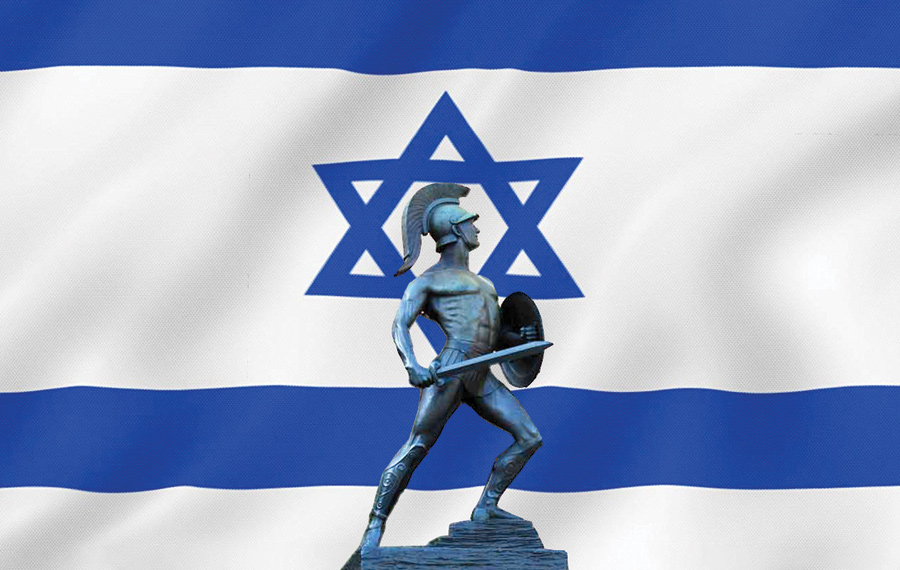
The notion that a progressive Democrat and fierce Republican can work together and even become friends seems an unlikely one. Yet, at USC, this paradox is a reality. In 2018, Trojans for Israel, a historically bipartisan organization on campus, decided it was time to readjust its leadership structure to better embody its diverse base.
We two students, coming from very different walks of life and opposite ends of the political spectrum, were chosen as co-presidents of the student group.
Trojans for Israel serves as USC’s premier bipartisan pro-Israel organization, which promotes and enhances the U.S.-Israel relationship. As the marquee group on campus, Trojans for Israel has created strong relationships with locally and nationally elected members of office as well as with student government and campus leaders.
As leaders on campus serving as student-elected senators in the undergraduate student government as well as in the Chabad and Hillel, the two of us are used to working with people with whom we do not see eye to eye. However, we were daunted and slightly uncomfortable with the thought of working alongside a counterpart on the opposite side of the political aisle. We believed this decision would only lead to tension and highlight the divide among the bipartisan group.
“The two of us are used to working with people with whom we do not see eye to eye. However, we were daunted and slightly uncomfortable with the thought of working alongside a counterpart on the opposite side of the political aisle.”
However, if anything, this move proved to unite Trojans for Israel and illustrate that bipartisanship can be achieved even in today’s hyper-partisan world.
Our organization has dealt with circumstances that bring out partisan conflict, such as when notable conservative commentator Ben Shapiro visited our campus to speak last October. Shapiro adamantly supports Israel and the U.S.-Israel relationship but has other opinions that made some groups on campus uncomfortable with his scheduled speech. Trojans for Israel prioritized the U.S.-Israel relationship over partisan opinions to focus on speaking out against the hateful anti-Israel sentiments and speeches being disseminated at the time, and showcase the importance of our bipartisan cause.
While the two of us essentially disagree on every U.S. domestic policy, our dedication to strengthening and protecting the unwavering U.S.-Israel relationship became the catalyst for a year of tangible success.
It was in keeping with the theme of bipartisanship that Trojans for Israel united with its crosstown rivals at UCLA to create the incredibly successful California Days of Action. Both groups campaigned for two House candidates — Steve Knight (R-Palmdale) and Gil Cisneros (D-Yorba Linda) — accumulating more than 200 hours of phone banking and close to 50 hours of canvassing. Showcasing the power and fortitude of bipartisanship, there were Democrats campaigning for Republicans, and Republicans campaigning for Democrats — all in the name of the U.S.-Israel relationship.
The two of us orchestrated Trojans for Israel’s meetings with a myriad of government officials including Democratic California Gov. Gavin Newsom, former U.S. Ambassador to the U.N. Nikki Haley, Speaker of the House Nancy Pelosi (D-San Francisco), Republican House Leader Kevin McCarthy (R-Bakersfield), Sen. Amy Klobuchar (D-Minn.) and Sen. Ben Sasse (R-Neb).
These accomplishments highlight students’ faith in the pro-Israel movement and emphasize the phrase “What unites us is greater than what divides us.”
Our successful year climaxed at the American Israel Public Affairs Committee’s (AIPAC) annual policy conference, with Trojans for Israel being awarded Activists of the Year in front the nearly 4,000 students in attendance.
The strength of Trojans for Israel is its emphasis on building a diverse bipartisan membership and exploring the differences and commonalities in each individual’s respective political viewpoints.
Trojans for Israel and the U.S.-Israel relationship are stronger because the group puts policy over partisanship. For the relationship between these two countries to continue to grow, there must be a reaffirmation of bipartisanship and a commitment to standing together on behalf of our shared cause.
Trojans for Israel and the pro-Israel movement as a whole highlight the substantial gains we can make by engaging in bipartisanship discourse. To solve the world’s most complicated problems as well as the simplest ones, bipartisanship is not a suggestion, but a mandate to which we must adhere.
Shayan Kohanteb is a rising junior studying business administration with minors in real estate development and comedy (performance) at USC. Sarah Rose Ritch is a rising junior studying sociology and law, history and politics with minors in dance and criminology/forensics at USC.
A Microcosm of Bipartisanship Read More »

The Palestinian Supreme Fatwa Council called Israel a “colonialist cancer” and accused the Jewish state of attacking Palestinian “religious and national symbols” at their Aug. 30 meeting.
Palestinian Media Watch (PMW) reports that, based on reporting from the Palestinian Authority’s (PA) official newspaper Al-Hayat Al-Jadida, the council said there is a “danger of attacks against the religious and national symbols in occupied Jerusalem, and held the occupation government fully responsible for these violations.” The council also condemned “all types of settlement, and emphasized that the Palestinian people will not stand idly by in the face of this colonialist cancer.”
PA Grand Mufti Sheikh Muhammad Hussein is the leader of the council; PMW notes that Hussein is responsible for the Aug. 13 clashes at the Temple Mount because he shut down all mosques in Jerusalem that day and pushed back the second Islamic morning prayer an hour. In doing so, Hussein maximized the amount of Palestinians present at the Temple Mount when Jews entered the holy site to pray during Tisha b’Av.
Additionally, Hussein issued a fatwa (‘ruling’ in Arabic), in July 2018 declaring that Muslims selling land to Jews is a crime punishable by death, according to the Gatestone Institute. The Jerusalem Post also notes that Hussein declared in 2006 shortly after he was appointed to the role of Mufti that Palestinian suicide bombings are a “legitimate” act of “resistance” and “quoted an ancient Islamic text encouraging Muslims to kill Jews” during a 2012 PA TV broadcast.
The Gatestone Institute explains that the PA considers the Palestinian mufti as the person with “the final say on most religious and non-religious issues. In other words, the mufti’s position parallels that of a US Supreme Court judge. If the mufti issues a legal opinion or religious decree, his people and leaders are expected to abide by it.”
Palestinian Fatwa Council Calls Israel a ‘Colonialist Cancer’ Read More »
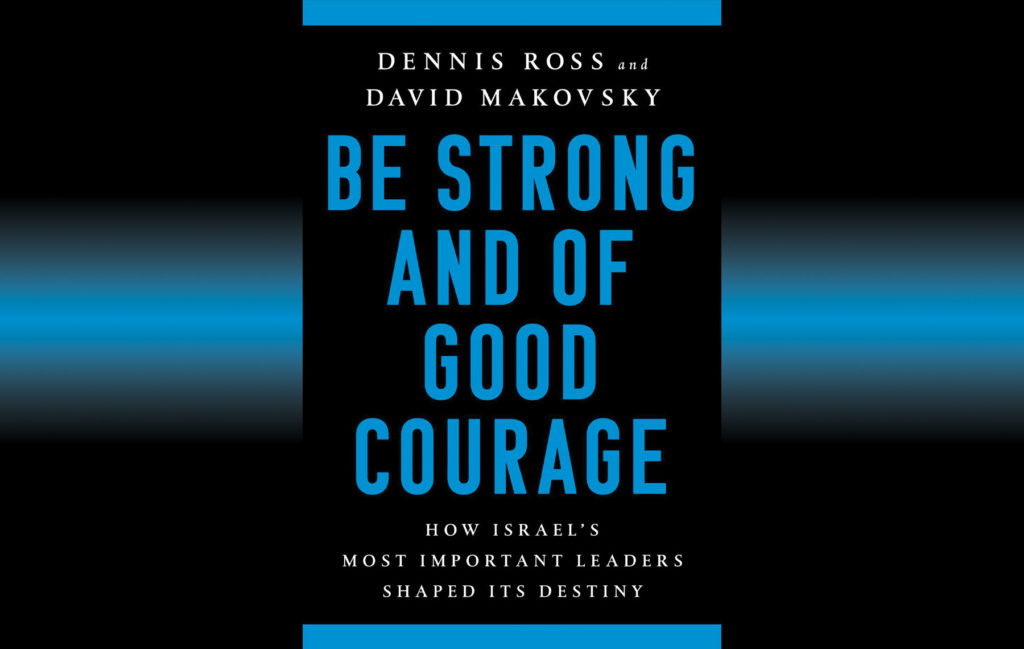
The following is an excerpt from “Be Strong and of Good Courage: How Israel’s Most Important Leaders Shaped Its Destiny” by Dennis Ross and David Makovsky. Reprinted with permission from PublicAffairs, a division of the Hachette Book Group.
Over the first two decades of Israeli statehood, [Menachem] Begin remained a political outsider while seeing few challenges from within his party. Herut [Party] lost election after election, yet the former Irgun leader commanded loyalty from his fellow party members even while shut out of power. In May 1967, however, the threat of war against Egypt, Jordan, and Syria changed the calculus for Begin. During this tense period, national leaders were questioning whether Prime Minister Levi Eshkol, who served simultaneously as defense minister, was up to leading Israel in battle. Underlying such anxieties was Eshkol’s lack of a military background or involvement in the pre-state underground. The reality is that Eshkol had dispatched an envoy, Foreign Minister Abba Eban, to win political backing in Washington, London, and Paris for Israel’s position after Egypt sent six divisions into the Sinai and to Israel’s border. However, this diplomacy, along with the subsequent trip of Mossad chief Meir Amit, was not discernible to the public. The public mistook Eshkol’s low-profile, active efforts to avert war as indecisiveness in the face of [Egyptian President Gamal Abdel] Nasser’s amassing of troops. In a dramatic departure, Begin even made a visit to his nemesis, [David] Ben-Gurion, urging him to come out of retirement and replace Eshkol. Yet here Begin observed that Ben-Gurion lacked his former command of policy detail. On June 1, to deal with growing unease within the country, Moshe Dayan became the new defense minister in Eshkol’s government. But Begin’s party was also invited to join a national emergency government, with the opposition leader serving as “minister without portfolio.” In this moment of national crisis, Begin was, at long last, empowered.
On June 6, the second day of the war, Begin called for the IDF to take the Old City of Jerusalem amid rapid progress in the larger fight. For Begin, the lover of symbolism and ceremony, opportunities abounded. The Irgun’s last campaign during the 1948 war, for instance, had been an unsuccessful attempt to take the Jewish Quarter. Now that effort could be redeemed. Moreover, Begin advocated that once the area was seized, the entire cabinet — along with Israel’s two chief rabbis — go to the Western Wall and read the Psalms passage invoking the return to Zion, as well as the shehecheyanu. Begin, ever the stickler with language, insisted that Israel use the term “liberated,” not “captured,” but ultimately agreed on the formulation that the Old City “is in our hands.” This is precisely how paratrooper leader Mordechai “Motta” Gur put it on seizing the Temple Mount/Haram al-Sharif. With the ultimate victory over the Arab states, though, came steep challenges for the Israeli leadership, and for Begin in particular. Israel now controlled triple its prewar land, having won the Golan Heights from Syria, the Sinai Peninsula and adjoining Gaza Strip from Egypt, and East Jerusalem and the West Bank from Jordan. The government needed to articulate a coherent plan.
Later in June 1967, while in New York for a session of the U.N. Security Council, Israeli foreign minister Abba Eban planned to meet separately with U.S. national security advisor McGeorge Bundy to discuss Israel’s newly acquired territories. Having a strategy about how to deal with the recently won lands and conveying this to the United States, in Eshkol’s view, was crucial. So in preparation for this Bundy-Eban discussion, the Israeli cabinet conducted a series of highly secretive meetings between June 14 and June 19, 1967. An Israeli debate of such scope and detail on territory, as indicated in hundreds of pages of declassified minutes, has not occurred since those days. The minutes reveal that a ministerial subcommittee on the matter was established and Begin was a member. Notwithstanding clear ideological differences among the participants, they developed a consensus on the future of the Sinai and Golan Heights: in exchange for peace, these lands in their entirety could be returned to Egypt and Syria. In other words, in return for peace, Israel’s future borders with Egypt and Syria should be the international border.
Begin saw neither the Golan Heights nor the Sinai to be part of ancient Israel. This is illustrated by their absence from the seals of both the Irgun and later the Herut party. Still, Begin voiced skepticism about whether Nasser would agree to restrictions on the Sinai, such as demilitarization, or to transit for Israeli ships through the Suez Canal, let alone sign a peace treaty with Israel. But in a larger sense, Begin was ready to negotiate.
The cabinet also agreed that East Jerusalem should be annexed. The fact that Israel had had no access to this holiest area for Jews between 1948 and 1967 was certainly one factor. The deeper historic resonance, for Begin and the others, also weighed heavily. The cabinet would decide not just to annex but to expand the municipal boundaries of the city.
The major area of dispute was the West Bank. But even in this debate, Begin was far from a lone maximalist. An overall consensus did emerge on the importance of the Jordan River serving as Israel’s eastern border, although whether as a “security border” or a “political border” was a dramatic and historic point of debate. Here, a well-known distinction crystallized between the views of Yigael Allon, a Labor minister and former general, and Moshe Dayan. Eshkol, initially cool to the idea of a Jordan River border, eventually expressed sympathy when the security role was highlighted. Begin — in listening to Allon, who had established his reputation as the daring commander of the pre-state Palmach fighting force — began to see the advantages of settling the West Bank, with a special emphasis on the strategic importance of the Jordan Valley. This area, on the territory’s eastern perimeter and adjacent to Jordan, had come under attack from the east in both the 1948 and 1967 wars. In later years, Begin would tout the value of settlements, less for strategic reasons than as an embodiment of historic Jewish rights.
In these early postwar meetings, the idea of Palestinian autonomy in the West Bank also first surfaced. While not opposing this idea in principle, Begin thought it tactically unwise to raise it now, given the torrent of international pressure that he believed was certain to follow. A decade later, though, Palestinian autonomy would become an organizing principle for him.
“Begin, ever the stickler with language, insisted that Israel use the term ‘liberated,’ not ‘captured,’ but ultimately agreed on the formulation that the Old City ‘is in our hands.’”
The postwar exuberance, and desire to expand territory, drew warnings from other quarters within the Israeli leadership. Whereas in 1967, Israel included 2.4 million Jews and around four hundred thousand Arabs, now the country stood to welcome an additional estimated 1.3 million Arab inhabitants from the West Bank, Gaza, and East Jerusalem. Given the higher Arab birth rate, these numbers contained plenty to worry about.
The declassified Hebrew minutes point to a very tense and extensive set of discussions over a few days, which are fascinating in foretelling much of the Israeli debate over the West Bank until this very day, when the same decision still hangs in front of Israel. Health Minister Yisrael Barzilai thus declared, “We are trying to do something that cannot go. We want a lot or not a lot of territory but the new territory [should be] without the people who live there.” When some ministers suggested Gaza could be annexed to Israel, Eshkol asked what would happen to its four hundred thousand Palestinian Arab inhabitants, later asking the same about the eight hundred thousand West Bank Palestinians as well as the one hundred thousand living in villages around Jerusalem. A West Bank withdrawal linked to peace with Jordan, according to leaders who offered these demographic concerns, would shift responsibility for these Arab civilians away from Israel. Justice Minister Yaakov Shimshon Shapiro argued that a failure to discuss Israel’s intentions regarding the newly occupied lands would open up the country to international criticism and undermine a constructive postwar partnership with the United States, which was eager to know Israel’s intentions.
Begin did not equivocate in response to these concerns: “I say, simply, Western Eretz Yisrael is all ours. What is the fear to say this?” Shapiro had a blunt reply: “In the not-too-distant future, we will become a binational state. And in a bit longer … we will be a minority.” In calling for the West Bank to be returned to Jordan, he contended that “otherwise, we are done with the entire Zionist enterprise and we will be a ghetto.” Eshkol shared these concerns, saying, “I don’t want more land and I don’t want more Arabs. When will we be a minority in this country?” Concurring were Tourism Minister Moshe Kol and Finance Minister Pinchas Sapir, who added that the further acquisition of land would raise international expectations for Israel to solve the Palestinian refugee problem on its own.
In response, Begin made a familiar-sounding case when he said, “We have to penetrate public opinion [to make the point] that we are here in western Eretz Yisrael not because might makes right but because right makes might.” This was his signature worldview: rights and not force are the source of policy decisions. But even he recognized that this rhetoric was insufficient to address the reality of an additional 1.2 million Arab inhabitants on Israel-controlled land.* Thus, in those days of June 1967, Begin would concede that the population issue constituted “one of the most serious problems of our future.” A future Arab majority, he knew, was unacceptable. Begin would even advocate that expulsion of Palestinians should be forbidden and that ultimately Palestinians should be able to vote in East Jerusalem, the West Bank, and Gaza. This idea that West Bank Arabs should vote in Israeli elections was nothing short of astonishing. Nobody on the mainstream Israeli left, let alone the right, favored giving West Bankers a vote. They saw this as potentially suicidal, diluting the voting Jewish majority. In promoting this position, Begin cited the 1871 German-French dispute over Alsace-Lorraine, where the newly formed German Empire settled its own citizens but also offered citizenship to the region’s French inhabitants. He believed this formulation would allow Israel to remain both Jewish and democratic while granting civil liberties to all its residents.
“Nobody on the mainstream Israeli left, let alone the right, favored giving West Bankers a vote. They saw this as potentially suicidal, diluting the voting Jewish majority.”
How could Begin’s position be reconciled with the actual numbers of Palestinians? Begin suggested that the Palestinians should be residents first and only gain citizenship after a seven-year period, citing the five-year span for immigrants in the United States. Those seven years, Begin believed, could allow Israel to reach a sustainable demographic advantage. To achieve this, he proposed that the Jewish Agency, nominally independent of the state, offer financial incentives for Jewish mothers to have additional children. In addition, he argued that a united Jerusalem would attract Jewish tourism, in turn boosting Jewish immigration. And in a show of prescience, he held out hope that the Soviet Union would open its doors — allowing Jews to emigrate — although this would not happen during the time frame he envisioned. He likewise hoped Israel and Jordan could cultivate closer economic ties, making the latter more attractive to the West Bank Palestinians and facilitating a kind of voluntary emigration in pursuit of Jordan’s economic potential. Yet his ultimate view was that Palestinians should have the right to Israeli citizenship. Thus, the right-wing Begin espoused an idea in the early postwar cabinets that was shared only on Israel’s leftward fringes by those supporting a binational state.
Begin did not force a vote on this issue, as none of his colleagues endorsed the idea of granting gradual citizenship. But he could claim foresight in having argued that the “Jordan solution” to the Palestinian dilemma was inadequate — though he himself had proposed a modified version of this option. The anxieties expressed by leaders such as Eshkol, Shapiro, Barzilai, Sapir, and Kol never coalesced into an action plan or policy. Thus, the lack of a decision became the decision. The template for the decades that followed flowed from that historic decision to postpone making fateful choices. Israel would control the territory, even without annexing it. Early on, the only issue on which the government could reach agreement was the need for a military government in the territory to ensure order. The Palestinian question has remained Israel’s most vexing challenge and is still unresolved. At the time, Begin’s instincts told him that Israel should keep all the West Bank, while his values indicated that the Arabs must also have rights.
*In the 1960s, it was common for Israeli politicians to refer to Palestinians as “Arabs living in the West Bank” instead of as “Palestinians.” Begin always insisted on referring to them as “Arabs of the Land of Israel,” thereby refusing a distinction between Arabs living inside Israel and those living in the West Bank. Even as Israeli politicians increasingly referred to these West Bankers as Palestinians, Begin stuck to his description for many years.
“Be Strong and of Good Courage: How Israel’s Most Important Leaders Shaped Its Destiny” can be purchased on Amazon.
Excerpt from ‘Be Strong and of Good Courage’: Minister Without Portfolio Read More »

Days before Hurricane Dorian struck the Bahamas, Rabbi Sholom Bluming of Chabad of Nassau flew to Miami. He did so to help coordinate relief efforts for the Bahamas that he knew would be needed after the Category 5 storm made landfall.
Speaking with the Journal from Miami, Bluming said, “We knew that we’d have to create the relief from Florida because that’s the only place [relief supplies and personnel] would be. It’s about helping all those in Abaco and the other islands that were really, really hurt.”
While Nassau, where Bluming lives, escaped the storm relatively unscathed, the Abaco Islands — home to approximately 70,000 people — were virtually decimated. “Ninety percent of the communities there were leveled and people were left homeless,” Bluming said.
Working with seven Chabad groups and the official government relief efforts, Bluming has helped mobilize Jews worldwide.
“We have seven locations in South Florida that we are using as drop-off places,” Bluming said. “People are bringing food, clothing, bug repellant, hygiene products and first aid kits, and we have a warehouse consolidating everything.”
The biggest issue, though, Bluming said, is being able to land a plane in Abaco “because all the airports are 4 feet under water. And yesterday the winds were still too strong to even fly in helicopters.” However, by early morning on Sept. 4, Bluming said a plane with medical supplies and doctors had been sent to the area.
“That’s the most important thing right now,” he said. “We have search and rescue teams, medics, EMTs that we need to get there. There’s a tremendous need on the ground right now.”
Chabad’s goal, Bluming said, is twofold: “To save as many lives as possible but also to bring hope and uplift as many people as we can. They need a sense of hope and belief that they can recover from this.”
Bluming also hoped to personally head to the area as soon as possible “to help people there. That’s the goal. The idea is to be there long term and help people rebuild — not just drop off supplies and leave.”

He added that the outpouring of support from around the world has been overwhelming, including from schools in Boston and Toronto, from Sao Paolo, Brazil, and from Chabad rabbis in small and big communities.
“We are called upon to create a better world and to be there for each other in times of need, Jew and non-Jew alike,” Bluming said. “At this hour, it’s time for Jewish communities around the world to shine that world of kindness and chesed to other people.”
The Journal spoke with Bluming again several days later, when he had finally made it to Freeport in the Bahamas. As of Sept. 10, Bluming said they were about to bring in their fifth container of supplies, including 46,000 meals, 3,900 rolls of toilet paper, 1,740 roll of paper towels, 22,700 bars of soap, 32,400 feminine hygiene products, 14,300 assorted diapers, 5,040 adult diapers, 3,440 toothbrushes, 2,000 tubes of toothpaste, 46,800 bottles of water and, 27,938 granola bars.
“We’ve created 17 distribution centers,” Bluming said. “The needs [of people] on the island are incredible. Everything has been totally destroyed. There’s no power, no water, but what we are bringing to people is the first line of relief.”
Beyond the very real, needed material supplies, Bluming also is bringing, as he puts it, “a little bit of encouragement. I stand there hugging people. They need that love, to know that somebody out there cares.”
He added that donations from Jews around the globe also have included books, games and toys. “We gave a doll to a little 7-year-old girl whose home had been destroyed. And she started crying with gratitude because it reminded her of the doll she lost.”
Bluming described overcrowded shelters and people huddling together. “Freeport,” he said, “has had a lot of devastation and a tremendous amount of death. So [it’s good] to be able to bring a little bit of relief. It’s very special when you see the resilience that people here have.”
None of this, he said, would be possible without help from Jews around the world. “From Lithuania to L.A. and Minnesota to Melbourne, Jews are reaching out,” Bluming said. “A synagogue in Pittsburgh collected tents and had them shipped to me to give out. At a preschool in Maryland, the kids wrote cards and had them sent here with words of support and encouragement.
“We are here for the short and long term to help,” he added. “So they can rebuild and have what they need and hopefully lift themselves up.”
Miles Nadal, founder and executive chairman of Peerage Capital in Toronto who has been instrumental in helping with relief efforts, told the Journal, “In the midst of this terrible tragedy and its devastating toll, we also receive an important reminder of our own humanity and our own frailty. It is a privilege to help those in distress, a blessing to be able to do so.
“Plus, when Rabbi Bluming calls [asking for help for others], I say ‘yes’ before he has even finished his first sentence.”
To contribute to the relief effort, visit the website.
Chabad Coordinating Hurricane Relief Efforts for the Bahamas Read More »

“You shall not wrong a stranger or oppress them, for you were strangers in the land of Egypt. You shall not abase any widow or orphan.” — Exodus/Shmot 22:20-21
“A person is obliged to help orphans and widows, in that their soul is downcast. … One doesn’t speak to them other than kindly or treat them with anything but respect … the person who attacks them or vexes them or hurts them or dominates them or ruins their income violates a commandment … .” — Maimonides, Mishneh Torah, Hilchot
Deot, 6:10
“[To claim asylum] the applicant must establish that race, religion, nationality, membership in a particular social group, or political opinion was or will be at least one central reason for persecuting the applicant.” — 8 U.S. Code, 1101
Winding through our Torah is a persistent refrain: the commandment to care for the widow, people without fathers, and strangers. It requires not only our empathy and friendship, but also material support, through a share of our harvest or our income (Deuteronomy/Devarim 24:19-22). What do these three types of people have in common?
In the patriarchal society of ancient Israel, each of these groups was comprised of people who did not have empowered men to look after their interests. Our Torah teaches that in a world riven by hierarchy, the well-being of the least empowered among us is a binding responsibility.
These commandments give rise to a way of being in the world. Our rabbis taught us to extend to society at large our ethical principles in dealing with one another.
What has this to do with immigration policy? The Trump administration routinely denies asylum to women fleeing domestic violence committed in countries where legal authorities ignore or stigmatize them. These women are precisely the kind of people our Torah commands us to defend; people who, in societies of privileged male power, have no individuals or institutions to protect them.
Our Torah teaches that the well-being of the least empowered among us is a binding responsibility.
We would never seek to impose Torah law on our country. The separation between the state and religious institutions in the U.S. is a structure religious minorities such as ours rely on to protect our own rights. But as Jews, we are obliged to rely on the moral grounding of our Torah as we respond to urgent issues of our day.
U.S. law provides for asylum, because of persecution or a well-founded fear of persecution “on account of race, religion, nationality, membership in a particular social group, or political opinion.” Women fleeing domestic violence are members of a particular social group. While most domestic violence is perpetrated in private, each transgression contributes to a social structure that keeps women disenfranchised and vulnerable. This is political violence — violence that enforces power differences between categories of people. It takes the form of beatings, mutilations, rape and murder on a horrific scale. Its victims come to us as strangers, traumatized and terrorized, seeking shelter and a chance to start again.
The commandment to aid and care for widows, orphans and strangers is a commandment to identify with and uphold people who are categorically disempowered and wronged because of their place on a power pyramid. Applying this ethic to today, we are called to speak up in opposition to President Donald Trump’s administration in favor of women and their children fleeing the systemic toleration of domestic violence.
Returning to Maimonides, we learn “No joy is greater and more glorious than the joy of gladdening the hearts of the poor, the orphans, the widows, and the strangers. One who gladdens the heart of these unhappy people imitates the Shechinah, as it is written: ‘[I am] … to revive the spirit of the downtrodden, to revive heart of the crushed.’ ” — Isaiah 57:15. Hilchot Magila v’Hanukah, 2:17
Rabbi Robin Podolsky teaches at Cal State Long Beach and writes for Shondaland and various blogs.
Women Fleeing Domestic Violence Read More »