fbpx

September 4, 2019

My Life with Friends

“With a friend at hand, you will see the light. If your friends are there, then everything’s all right.” — Elton John/Bernie Taupin,“Friends”

“If you live to be 100, I hope to live to be 100 minus 1 day, so I never have to live without you.” — Winnie the Pooh

My parents didn’t have many friends. So when my father died, my mother had almost no one to talk with. I’d call her and say, “Who did you talk to today?” Her answer most of the time was, “No one.” 

Mom lived alone in Florida and I live in Los Angeles. When a person you love is thousands of miles away and in pain, phone calls do little to alleviate it. Two of her sisters lived near her but after a lifetime of arguing, there was little communication among them. I tried to get Mom to join a senior club or a temple but she always had an excuse. 

A musty, humid Florida damp permeated her apartment. Most afternoons, she would sit in her rocker watching talk shows. I can’t imagine how lonesome her evenings must have been. 

One morning, we got a call that she had been found dead on the apartment floor. She’d been dead for a day or so. Did she kill herself or die by another cause? I’ll never know. 

In her younger days, she had an outgoing, warm and friendly side to her. She loved movies, theater, reading and music. She was also a terrific knitter. When I was a kid, if she needed yarn, we would go down to the Lower East Side of Manhattan to get it. Then at home, I would hold a skein of yarn between my hands while she rolled it into a ball. I loved doing that with her. She made the best sweaters. Putting one on, I could feel the love that went into it. 

But all that seemed to fade after my father’s death. I saw how her life changed and how it ended, and I realized how important it is to have friends and to fight off loneliness. We are born alone and we die alone. In our hour of greatest agony, we’re also alone. How very important it is to have someone to talk to and spend time with. 

“If you have friends, be grateful you have someone to talk to and laugh with. If you don’t, get some. It’s not hard.”

I have a great family and many friends but there are days I feel alone. I know I’m not, but that doesn’t stop me from feeling that way. New Yorkers will tell you it’s easy to feel alone in a crowd of 10,000. 

I accept the fact that loneliness is part of the human condition. Everyone feels it. When you get an unexpected medical diagnosis. When someone close to you dies. When you have a fight with your child and he or she refuses to talk to you. When your spouse threatens to walk out. When you wake up at 2 a.m. and think you’ll never find someone to share your life with. When you have to put down your dog. 

Having friends is good for your health and helps fight loneliness. So I belong to a synagogue and go regularly. People know me, say hello to me and seem genuinely glad that I’m there. That helps. For the past 15 years, my wife and I have belonged to a “Shabbos Potluck Group” that meets at a different house once a month. That helps. I meet with male friends at least twice a week. That helps. I have a job that I love and friends who respect what I do. That helps. And I call someone almost every day to see how he or she is doing. By checking in on someone else, you stop thinking about your problems, even if it’s for only five minutes. Now, make your own list. 

If you have friends, be grateful you have someone to talk to and laugh with. If you don’t, get some. It’s not hard. You know that person you’ve been telling for years that you want to have lunch with — get together with them. There are plenty of people waiting for you to call them or knock on their door. You’re never too old to make new friends.


Mark Schiff is a comedian, actor and writer.

My Life with Friends Read More »

A New American Holy Day

My grandkids don’t want to read the newspaper. They say it’s too depressing. Candidates for the highest office in the country belittle one another, calling one another liars. Headlines about mass shootings, followed by weeks of follow-up reporting on the deadly events. Reports about Congress at angry loggerheads. Ugly accusations, both on the front page and the editorial pages, that our leaders are racists; or disloyal; or bought by foreign powers or special interests or campaign donors; that our economic system is corrupt and racist; that immigrants are rapists and freeloaders; that some Republicans are fascists; that some Democrats and the Republican president are anti-Semites. Depressing identity politics — made more unbearable by the sheer number of identities that define themselves as oppressed — is the order of the day.

The grandkids aren’t wrong. This seemingly unlimited negativity poisons the soul. Suicides are up; families and friendships are destroyed; people can’t talk to one another. Joy is drained from all of us.

We Jews are now about halfway between Tisha b’Av, commemorating the destruction of the Temple in Jerusalem, and Yom Kippur, the day of atonement at the start of the new year. The first addresses our society; the second addresses ourselves. Together, they suggest a road map for a different America. 

It was the Babylonians in 586 B.C.E., then the Romans in 70 C.E., who destroyed the Temples. But the focus of Tisha b’Av is not on what they did to us, but on what we did to us. What happened to our society that resulted in this destruction? The Book of Lamentations (Eikhah), read on Tisha b’Av, is unyielding in its assignment of blame: We, as a society, are “aggrieved for our abundant transgressions”; we have “suffered because of [our] iniquities.” We read dirges (kinnot) on Tisha b’Av as well, in which we’re told that we have been destroyed because our society has been defined by “purposeless hatred”; we have “exchanged our dignity for degradation.” 

While on Tisha b’Av we say that God has abandoned us because of these collective failures, resulting in the destruction, you don’t have to be a theist to get the point. 

“Perhaps we might institute a national day of reflection … to reflect on our individual and collective errors.”

By Yom Kippur, the focus has narrowed. There is still a sense of collective responsibility, but the emphasis now is on personal flaws. While we are obligated throughout the year personally to seek forgiveness from those we have hurt, in the days before Yom Kippur, it is considered vital. We ask for forgiveness, face-to-face if possible. We enumerate our personal errors at the very start of the Yom Kippur service, immediately before the well-known Kol Nidre, including, among others, “gossip, lies, derision, talebearing, bickering, shaming people, cursing people, glorifying myself. …” And in a confession that we repeat throughout Yom Kippur, while we list our faults in the plural “we,” we are admonished to think in the singular “I.” All of this is intended not to burden us with guilt, but to free us to do better in the future.

This is a model from which we, as Americans, have much to learn. Perhaps we might institute a national day of reflection — not a day to go the beach or have barbecues, but to reflect on our individual and collective errors. On such a day this year, perhaps all of our presidential candidates might say only decent things about their opponents. Our political leaders might focus on our country’s many strengths. Each of us could ask for forgiveness and renewed closeness with those from whom we have become alienated. In our churches, synagogues and mosques, in all of our places of prayer or introspection, and in our homes, we could spend some time reflecting on what we have done, by our words and our conduct, to sow division and generate negativity.

A pipe dream? Yes. But maybe my grandkids, for at least one day, could read the newspaper.


Gregory R. Smith is a retired appellate attorney living in Los Angeles.

A New American Holy Day Read More »

Questions for Omar After She Tweeted My Article

I was notified last week that Rep. Ilhan Omar (D-Minn.) had tweeted an article of mine, which credited the freshman congresswoman for my newfound comfort in covering my hair with a headscarf rather than a wig, to her million-plus followers. 

The reactions I encountered from friends and family were twofold. The first, overall incredulousness for the publicity of it all (thousands of comments and retweets!). The second was sorrow and shame. One family member likened the article to complimenting Hitler for having a backbone. A rabbi cautioned that I should consider doing teshuvah (repentance) for writing the piece, which portrayed a positive aspect of Omar, whose statements and tweets have been anti-Semitic. Only my mother, a complex amalgam of PETA-supporting, bleeding-heart Republican, called it tikkun olam, and noted that in the midst of the hateful rhetoric going back and forth, I had said something friendly and human and true.

As for my personal reaction, I felt that I had been used. In her tweet, Omar sliced my sentence, cutting the portion that declared my discomfort with her views and exhibiting instead the part that showcased her coolness. In addition, my title had been changed, whether to become more readable or clickable I’m not sure, but I definitely wouldn’t have credited her with being an “inspiration.”

It’s not hard to admire Omar for her boldness, whether with regard to headgear or to forging forward despite death threats and controversy. It’s harder to draw inspiration from her, though, when her support of the boycott, divestment and sanctions (BDS) movement seems more about “banishing those damn Semites” than caringly and constructively finding solutions that meet both Israeli and Palestinian needs.

As an organizer for Better Angels, a political depolarization group, I’ve learned to enter fraught conversations only after setting firm ground rules: respectful language, using “I” statements, and an agreement to stay curious and connecting, instead of attacking and condemning. Were I to have the opportunity to converse with Omar in person, I would add one more ground rule: Can you sign on to the statement that I have a right to safety and security just as much as you have a right to safety and security? Because without that commitment, any conversation, and any potential inspiration I can draw from you, becomes a nonstarter.

“Rep. Omar, I’m not yet convinced we’re on the same page.”

And my ability to feel safe is drawn up with the safety of Israel. I have too much family there, too strong an emotional and spiritual connection, and too much familiarity with Jewish persecution across the globe to feel at ease if Israel is threatened. And checkpoints and settlements, which Omar has denounced and publicly hoped to visit during her aborted trip to Israel, are all safety measures to avoid terror attacks and losing wars of elimination. They emerged out of bloody necessity, not out of colonization or a power grab, as she has claimed.

Omar’s statements about Jews and Israel have many in the Orthodox Jewish community panicking, partly for their content, but more so for the ease with which she appears able to utter them, given her platform as a member of Congress. My original article title, “Silver Lining to Omar in Congress,” was meant to cheekily reference that sentiment.

But while Omar has backpedaled on several of her statements, citing ignorance or saying they were taken out of context, she’s still a supporter of the BDS movement, which promotes, among other things, the rights for 5 million descendants of Palestinian refugees to return to homes and residences in Israel. That essentially would mean a Palestinian majority in the State of Israel, planting Hamas eerily in control and, voila, curtains for Israel and all the Jews in it.

So that’s why, Rep. Omar, I’m not yet convinced we’re on the same page. I first need to know if we can agree to this basic foundation: I want you and your family to live and thrive safely, as long as you want me and my family to live and thrive safely. Are you with me? If so, then let’s talk.


Rachel Wizenfeld is a Los Angeles-based writer, a school psychology graduate student and an organizer for Better Angels, a national political depolarization group.

Questions for Omar After She Tweeted My Article Read More »

There’s Something About Persian Women

Forty years ago, thousands of Jews fled Iran after the Islamic Revolution, settling primarily in Los Angeles. One of our first priorities as immigrants and refugees? Establishing our own infrastructure that served the immediate needs of a community traumatized by conflict and unprepared for life in La La Land.

In L.A., we didn’t even mind traffic on the freeways because we were finally free.

After social services were launched, Iranians set up necessities ranging from supermarkets to driving schools. I have fond memories of a driving instructor begging my mother in Persian, “For the love of God, BRAKE!”

We went beyond surviving to thriving in fields that enabled us to become a successful immigrant community, except one: We didn’t stop along the way to ask, “Now that we’ve survived in the U.S., how are we really doing in this new and free country?”

It wasn’t long before a new generation of Iranian American Jews began to experience isolation and malaise, suffocating family pressures and a toxic lack of understanding between parents and children.

This was especially true with women. Yes, there were Persian-Jewish clergy, therapists and even experts on radio talk shows who aimed to increase people’s understanding of themselves and their children. But young Iranian American Jewish women, in particular, had little peer support and freedom from suffocating cultural norms.

Enter Dorsa Beroukhim Kay, 31, Nicole Nowparvar, 30, and Farah Shamolian, 30.

In 2014, they created the Jewish Iranian Women’s Foundation with the goal of “empowering the Jewish Iranian community by deepening one’s sense of self and cultivating meaningful connection.” In 2018, it became a nonprofit called Chaya.

“Chaya is a kabbalistic term for one of the five levels of your soul that functions for the betterment of your community,” said Nowparvar, Chaya’s executive director.

Chaya addresses community challenges ranging from cultural divides between traditional parents and more Americanized children to hurtful stereotypes about Persian Jews.

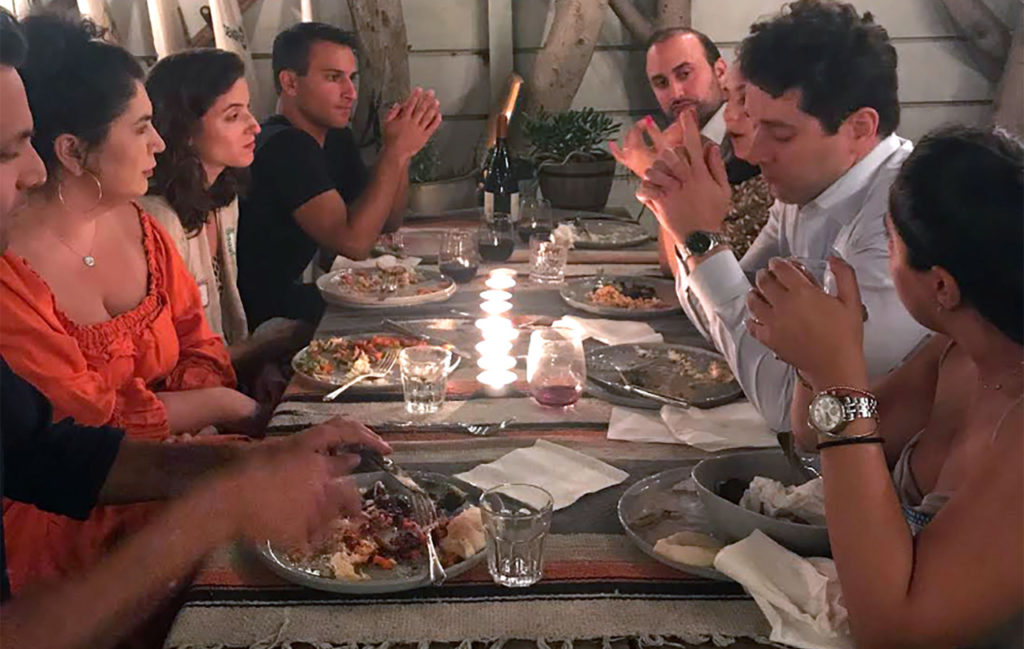
The organization began hosting a bimonthly event called “Dinner With Strangers,” choosing five young men and women to break bread and speak about controversial topics, facilitated by an expert.

Recently, Chaya held a “Dinner With Strangers” program for mothers and daughters. “It was a freeing experience that left us uniquely bonded to the mother-daughter pairs who were there, while also shedding another layer in the relationship my mom and I have with each other,” said Sharona Daneshrad, who attended the event with her mother.

It also launched Women on Purpose, which promotes career networking between generations, as well as the New Mother’s Club and Chaya Plus. The latter promotes unity among all Jews, and offers opportunities for non-Persian Jews to ask questions such as, “What are the stories of Iranian Jewry?” and “Why do you all beat one another with scallions at the Passover seder?”

It tackles issues with the help of speakers drawn from the community who help people communicate their needs in healthy, compassionate ways on topics such as fertility, mental health, self-care and relationships.

Chaya also embraced a crucial segment of Persian Jews that had been overlooked: Iranian-born mothers in L.A. whose mothers had been raised in a generation of unquestioned conformity to cultural norms, including strict obedience to elders and few options for women beyond motherhood.

Chaya’s founders soon learned there were many things to air out regarding inter- and intra-generational relationships.

Chaya will host its first fundraiser on Sept. 12 at a private residence in Beverly Hills, also marking the first time fathers will be invited to join the conversation. The program will feature psychologist Nazanin Ramzi Shamtobi as well as live music and visual art. Information can be found at chayacommunity.com.

“Chaya signifies a movement recognizing becoming the best version of yourself in a community struggling to break free of conformity and outdated social norms,” said Sharon Peykar, who is a regular at Chaya events. I’m starting to see a pattern here.

We may have spoken too soon in believing we were immediately free as soon as we escaped Iran.

As it turns out, it would take another 40 years to begin to remove the shackles, and the keys were in the hands of our women all along.


Tabby Refael is a Los Angeles-based writer and speaker. 

There’s Something About Persian Women Read More »

Arianna’s Shabbat Journey

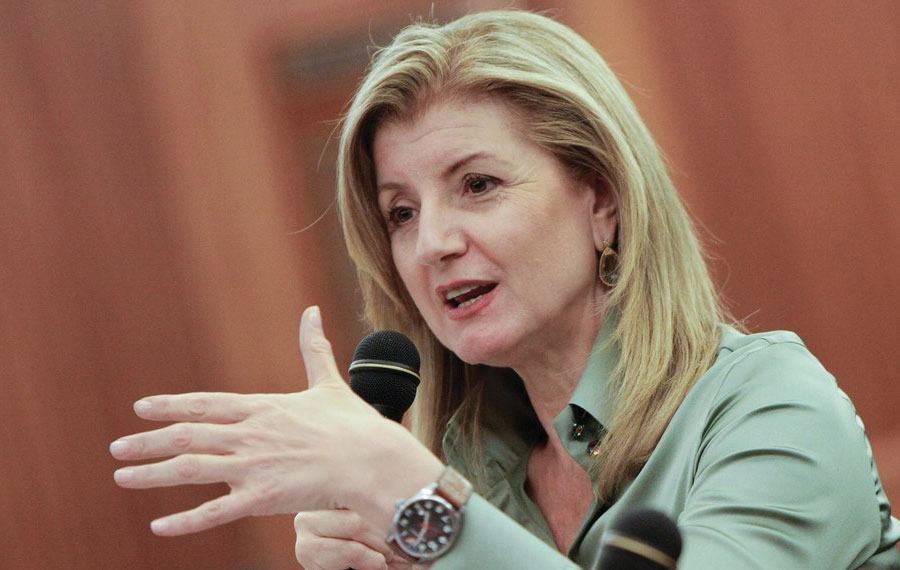
“We have been sacrificing the important on the altar of the urgent for so long that our lives have lost their balance and we have lost our center,” Arianna Huffington wrote. “And, of course, we have massively redefined the urgent. It’s no longer just dealing with a blazing fire —  it’s rather worrying about the probability of a fire starting and especially about the possibility of missing some fireworks.

“Some of my most beloved friends feel alive only when they are living life on the brink, dealing with half a dozen crises, wallowing in the drama of it all, and having to drug themselves to sleep when they wake up in the middle of the night.”

My friend Arianna wrote those words 19 years ago for a special Shabbat issue of a spiritual magazine I had started called Olam.

I got the idea for the piece at her mother’s memorial, when Arianna spoke of her mother’s disdain for “multitasking.”

“The last time my mother was upset with me was when she saw me talking with my children and opening my mail at the same time,” she wrote in her Olam article titled “My New New Thing: Single Tasking.”

Here is how she connected it to Shabbat:

“To move the important to the center of our existence and tend to our souls — which for me is the meaning of Shabbat — we need to bring timelessness into our lives. It also means, as my mother would urge, putting an end to multitasking — the weapon that helps us gain the heights, but is the enemy of the depths.”

How ironic that she would end up climbing the heights of the media world by launching The Huffington Post, an initiative that was hardly conducive to single tasking.

But as you’ll read in our cover story this week, it’s been a long journey. In an interview with Karen Lehrman Bloch, she admitted that she “collapsed from exhaustion” in 2007 and broke her cheekbone.

Awakened to our culture of stress and burnout, she wrote two books —  “Thrive” and “The Sleep Revolution” — before eventually going all in and launching a movement in 2016 called Thrive Global.

When I caught up with her at the 2018 Milken Global Summit, where she spoke on a panel on “life longevity,” guess what she told me right after her talk? This is what I wrote at the time:

“One of the first words out of [Huffington’s] mouth was, ‘Shabbat.’ She told me that her new movement, Thrive Global, is eager to start a ‘Shabbat track’ because this Jewish ritual of weekly renewal is just what the world needs right now.”

As we detail in our story, she did just that. It’s hard to think of a better supporter of Judaism’s “greatest gift to humanity” than a global media innovator who has experienced the deep need for that very gift.

She sees Thrive Global and Shabbat as organically connected.

“The principles of Shabbat — taking time to disconnect from our work to connect with our loved ones and focus on what gives us value and meaning in our lives — are central to Thrive Global,” she says. “So it made sense to jump at the chance to amplify the movement to spread the vital messages of Shabbat.”

What I find especially noteworthy is that 19 years ago, before anyone had heard of Facebook or Twitter or Instagram, before cellphones became hand-held supercomputers, Arianna was already expressing an urgent need to slow down and refocus on “what gives us value and meaning in our lives.”

Imagine: If some of us were suffering burnout and stress in 2000 before the advent of social media, what kind of stress and burnout must a Twitter junkie feel today?

It’s become a cliche that social media and the internet are societal disruptors on a scale we’ve never seen. On that score, Arianna makes a simple observation:

“There’s an opportunity cost to our screen time. And the alternative to being on social media isn’t just having to be ‘on,’ it also includes downtime in which we can connect with ourselves, which is vitally important to our well-being.”

As digital screens continue to swallow up more of our time, as our attention spans continue to shrink, the ancient Jewish ritual of Shabbat seems more indispensable to our “well-being” than ever.

Arianna Huffington is determined to get that message out. And if she has to occasionally multitask on her way to slowing us down, well, it’s for a good cause.

Arianna’s Shabbat Journey Read More »

Netanyahu Makes First Visit to Hebron Since 1998 and Vows It Will Never Be Empty of Jews

JERUSALEM (JTA) — Israeli Prime Minister Benjamin Netanyahu, making his first visit to Hebron since 1998, said Wednesday that the West Bank city “will never be empty of Jews.”

Netanyahu made the remarks at a ceremony to mark the 90th anniversary of the massacre of Jews in Hebron, a mostly Palestinian city about 18 miles from Jerusalem.

His last visit there was before he first became prime minister, according to reports.

“We are not strangers in Hebron, we will remain here forever,” Netanyahu he said at the afternoon ceremony. “We have not come to dispossess anyone, but nobody will dispossess us either.”

The ceremony took place in the plaza in front of the Tomb of the Patriarchs, a site holy to Jews and Muslims. Half of the site is used for Muslim worship and half for Jewish worship. Some 800 Jews live in their own enclave there among 200,000 Palestinians.

“We have come here to unite in memory, to express victory over the bloodthirsty rioters who committed the horrific massacre 90 years ago today,” Netanyahu said. “We have accomplished historical justice, and returned to the city of the patriarchs,” he also said.

Netanyahu did not announce any new Jewish building in Hebron or suggest applying sovereignty over the city, as many expected he would.

Knesset Speaker Yuli Edelstein and Culture Minister Miri Regev of Netanyahu’s Likud party both called for Israeli sovereignty over Hebron in their speeches.

The Palestinian Authority called Netanyahu’s visit a “dangerous escalation” meant to garner right-wing votes prior to the Sept. 17 election.

Earlier Wednesday at a conference in Hebron on the topic of the massacre, Israeli President Reuven Rivlin said the cave “was bought for full price” and “our right to this land was established as just and moral, a right to property over which is and will always be uncontestable.”

He called the city a “test of our ability to live together, Jews and Arabs, to live decent lives side by side.”

Netanyahu Makes First Visit to Hebron Since 1998 and Vows It Will Never Be Empty of Jews Read More »