fbpx

February 13, 2019

Poem: House of Women

It was a house of coffee cake and hairspray,
needlepoint and gossip,
men essential to the organism
but flung to sides
like water in a salad spinner,
not the heart of things.

My mother and her mother
crocheting on the beach,
bottoms waffled in damp nylon,
shoulders brushing nightly over soapsuds
in an aproned kiss.

They teased that I was like my father,
so I pulled away from them
the way I saw him do.

My sister tried to tap dance to their rhythm,
but her step-ball-change
was never on the beat.

She wears their lily-of-the-valley fragrance now,
souvenir of childhoods past.

Its notes of sweetness stir my stomach
with a ghostly longing
every time she washes and I dry.


Paula Rudnick is a former television writer and producer who has spent the past 30 years as a volunteer for nonprofit organizations. In the past several years, she has begun to write poetry — another nonprofit endeavor.

Poem: House of Women Read More »

Weekly Parsha: Tetzaveh

One verse, five voices. Edited by Salvador Litvak, Accidental Talmudist

“When Aaron kindles the lights in the afternoon, he shall make it go up in smoke, continual incense before the Lord for your generations.” –Exodus 25:2


Nina Litvak
AccidentalTalmudist.org

When Aaron lights incense on the golden altar, it creates a fragrant aroma and a cloud of smoke that resembles the clouds of the divine presence. This suggests that a pleasing smell is part of the experience of being near to God. Smell has a unique holiness because it’s the only sense that did not participate in the sin of eating from the tree of knowledge.

Despite its connection to holiness, smell is the sense we humans value least. If you had to sacrifice one sense, it probably would be smell. Yet our sages teach that smell is the most heavenly sense, because it reaches us through the nose, the organ through which the soul enters and leaves the body. The Talmud calls the pleasure of smell one that benefits the soul, not the body.

When Joseph was sold to the Ishmaelite caravan, it didn’t have the usual foul smell but instead contained sweet-smelling spices. Rabbi Chaim Shmuelevitz said that the spices in the caravan were a message to Joseph that God was with him. The fragrant odor was a sign of God’s presence, and Joseph understood the message and was strengthened.

Just as God chose the most humble man to lead us, and the most humble mountain on which to reveal himself to us, he chose the most humble sense to connect himself to us. Every time we smell a fragrant aroma, we can understand it, as Joseph did, as an assurance from God that he is near.

Rabbi Cheryl Peretz
Ziegler School AJU

Companies invest millions of dollars to create the best-smelling scents. Here, however, the Torah intimates that it is not the invention of modern perfume companies; rather, even God has a preferred scent. A blend of secret substances that exhale perfume during combustion, the k’toret, an incense offering, became an important act of sacred worship.

I cannot recall ever smelling incense burning in synagogue. In fact, as a child, while such practice seemed more common in other religions’ houses of worship, it was alien to Jewish religious experience. Yet, the Torah describes the burning of aromatic spices as important and normative daily — morning and evening — activities within the Temple ritual. So important was this sacrifice that altering them in any way would result in estrangement. In fact, it was this type of departure from sacrificial norms that apparently caused the death of Aaron’s own sons, Nadav and Avihu (see Leviticus 10).

Touch, sight, hearing, taste and smell — our senses work together to help us understand the world and react to changes in the environment. Moreover, each of our senses is connected to and heightens the experience of the others. 

Likewise, true prayer (which was instituted to replace Temple sacrifice after the destruction of the Temple) invites a whole body, total sensory encounter. As the Psalmist says, “May my prayer be set before you like incense; may the lifting up of my hands be like the evening sacrifice.” (Psalm 141:2) That’s a scent that is priceless!

Ilan Reiner
Author of “Israel History Maps”

Our parsha discusses three acts, as part of the routine work in the Mishkan (the Tabernacles), that need to be done twice a day, every day, with no exceptions, for generations to come. They are the burning of the offering, the incense of spices and the lighting of the menorah. All three are to be done once in the morning and once in the evening, every day (tamid), for every generation from now and forever (le’doroteikheim). All are related to fire and burning — the offering is burned on the altar, the incense goes up in smoke, and the candles are lit with fire.

Although all three seem to be linked, the words “tamid” (daily) and “le’ doroteikheim” (for generations to come) are mentioned only in regard to the offering and the incense. However, it’s the menorah that survived the turmoils of time and is with us to this day.

Even before the final destruction of the Temple, the priests ran out of lambs for offerings and incense for burning, because of the siege. But the menorah continued to be lit. The menorah stayed with us for generations upon generations. After the Babylonian exile, during the Maccabean uprising, carried by Jewish prisoners in Rome, engraved on coins, carved in synagogues and on tombs, and drawn in books. Always symbolizing light, knowledge and hope for a better tomorrow. Upon its foundation, the State of Israel chose the menorah as its emblem, to reflect the continuity and eternity of the Jewish people.

Rabbi Benjamin Blech
Professor of Talmud, Yeshiva University

“Wake up and smell the coffee.” “Stop and smell the roses.” “Something smells fishy.” “The deal stinks.” 

There is something profound in the emphasis a great many of our expressions place on the olfactory experience. 

Nineteenth-century physician and author Oliver Wendell Holmes Sr. recognized a great truth: “Memories, imagination, old sentiments and associations are more readily reached through the sense of smell than through any other channel.” Of all the five senses, the aroma surrounding an experience creates the most powerful, albeit very often subconscious, lasting impression. 

Famed author Vladimir Nabokov wrote, “nothing revives the past so completely as a smell that was once associated with it.” The midrash and Jewish mystics find a biblical rationale: The first sin of humankind corrupted four of our senses. We heard God’s warning not to eat of the tree. We saw the tree and we were tempted. We touched its fruit and we tasted it. Our sense of smell however did not sin. 

The tabernacle in the desert and subsequently the Temple in Jerusalem taught us through its rituals how to introduce spirituality into our lives. Significantly, morning and evening, the high priest was to burn incense of sweet spices — “a perpetual incense before the Lord throughout your generations.” It is a reminder to us to emphasize the sweet aromas of the Shabbat table, the odors of a Jewish home on all its holidays, the distinctive fragrances of Jewish life, which fill us with constant awareness of God’s closeness and presence. How can we find God, people ask? Maybe, like for all lost objects which seek that seem to be hidden, He is here — right under our nose.

Jackie Redner
Rabbi in Residence, Vista Del Mar Child and Family Services

For those who work with individuals with special needs, there is something that needs to be offered up. It involves smoke and light. The smoke holds our confusion. With light, we see our confusion and we offer it up. We accept that we are limited when it comes to the mystery of one who is unable to give voice to thought. 

I have worked closely with individuals on the autism spectrum who have been unspeaking for many years. For much of their early life, they were rarely truly seen. Only their confusing symptoms were seen … by our own confused eyes. For years, they received the world around them, unable to show that they understood, not only 1, 2, 3 or where their nose is, but also the wonder of light, water, earth, sound and emotion. All with a clarity of thought and awareness that we could never fathom with our own confused notions of what autism is and what it is not. 

They have taught me this. Behind the confusion — mine and theirs — the light is ever-present. I have had the great privilege of working closely with those who, through an arduous struggle, learned how to type, one letter at a time, in order to share their world with us. Their words are pulled from a deep well, bursting through ongoing internal noise and a body hard to control. The effort, if you ponder it for a moment, can bring you to your knees. Offer up the smoke of confusion and always assume intelligence. 

During Jewish Disability Awareness and Inclusion Month, Table for Five includes young voices from Vista Del Mar’s Moses-Aaron Cooperative Program. 

Weekly Parsha: Tetzaveh Read More »

Honoring Local Heroes of Jewish Education

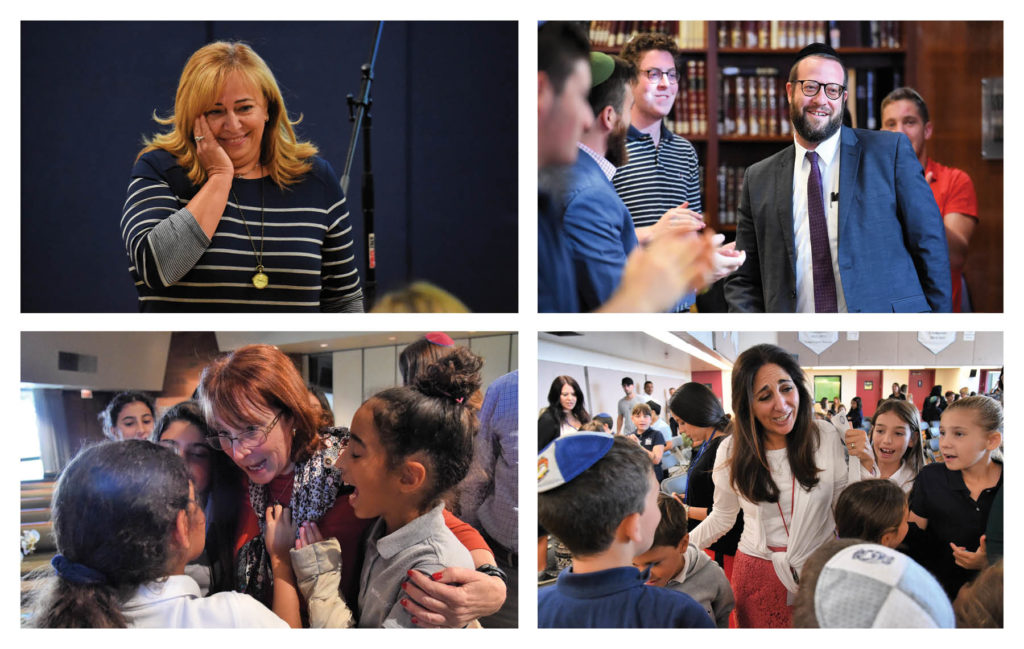
When she was young, Fanny Koyman never thought about pursuing a career in day-school education. And, accordingly, she certainly never imagined she would one day be honored for her excellence in teaching.

But three decades after joining the staff at Abraham Joshua Heschel Day School in Northridge, Koyman — now the lead Hebrew and Judaic studies teacher for the school’s transitional kindergarten and kindergarten classes — recently stood on the stage of the Luxe Sunset Boulevard Hotel ballroom to accept the award. 

“Thirty years have gone by at Heschel Day School and I realize the reason and the lesson my great-grandfather and grandfather passed down to me,” Koyman said.  “Every day we pass on the sacred Hebrew language that unites our Jewish people to our children so that they can continue the tradition.” 

Koyman is one of four local day-school educators to be honored with the 29th Annual Jewish Educator Awards (JEA). The other honorees are Florette Benhamou, a first-grade teacher at Harkham Hillel Hebrew Academy in Beverly Hills; Rabbi Shimon Abramczik, a Judaic studies teacher and dean of students at Yeshiva University High School of Los Angeles (YULA) in Pico-Robertson; and Patty Tanner, a K-6 math coordinator and sixth-grade general studies teacher at Wise School in Bel-Air. The awards were presented at a luncheon in December.

“Overcome with such strong feelings upon seeing his son, Jacob recited the Shema. Doing so, Abramczik said, was an act of passion that could inform how educators ought to approach their work.” 

The granddaughter of a rabbi, Koyman was born in Fez, Morocco, where her mother was a stenographer for the king and her father owned a tire factory. In 1969, when she was in first grade, her family moved to Israel. 

Inspired by her grandfather and his passion for Jewish law, Koyman enrolled in the pre-law program at Tel Aviv University. But in 1986 she put those plans on hold when she moved to Los Angeles with her husband so he could pursue his studies. Koyman took a job as a Hebrew tutor for the son of Heschel Day School’s head of  Hebrew and Judaic studies, Luisa Latham.

Fanny Koyman, the lead Hebrew and Judaic studies teacher for transitional kindergarten and kindergarten at Abraham Joshua Heschel Day School.
Photos courtesy of Milken Family Foundation

Latham encouraged Koyman to continue her studies, and while pursuing a degree at UCLA in psychology, Koyman became a teacher’s assistant at Heschel. In 1992, she began teaching the school’s first transitional kindergarten class. She has been on the school’s faculty ever since.

The Milken Family Foundation (MFF), a private Santa Monica-based organization focused on supporting education and medical research, in 1990 began giving the annual award to four outstanding teachers, administrators or other education professionals from Jewish day schools across Los Angeles. To date, 133 educators have received the award, which includes a $15,000 prize.

The MFF selected the 2018 winners from a pool of more than 1,000 educators from 37 Builders of Jewish Education (BJE)-accredited day schools, which submitted candidates for consideration. An MFF committee narrowed the list of nominees to about a dozen finalists. BJE then sent its staff members to the schools to observe the teachers in their classrooms before the four winners were chosen.

“Part of the reason we are doing this is to drive home the fact that a teacher is respected and kids should consider education as a profession, that a teacher can make a difference.”
— Richard Sandler

To be eligible for the awards, an educator must work at least 15 hours per week at the K-12 level and have worked a minimum of seven years at a BJE-affiliated school. Nominees are judged on their educational talent, leadership skills and commitment to their students. They must also show potential for greater contributions to the teaching profession, their community and society beyond their current positions.

In addition to recognizing top educators, the awards are intended to make a career in teaching more attractive to young people, who tend to think of teaching as a one-way ticket to being overworked and underpaid, said MFF Executive Vice President Richard Sandler. 

“Part of the reason we are doing this is to drive home the fact that a teacher is respected and kids should consider education as a profession, that a teacher can make a difference,” Sandler said. “Every one of us can talk about that special one, two or three teachers that affected us.”

Sandler is a member of the committee that decides the winners. Each year, he and BJE Executive Director Gil Graff announce the winners during surprise assemblies at the winners’ schools. 

“One of the things you find about great teachers and great principals is they don’t expect to be honored,” Sandler said. “They just realize this is what they do, they know why they do it, and they get their recognition from the fact that they get to work with kids. They see kids grow and the difference they make in people’s lives.”

Patty Tanner, the K-6 math coordinator for Wise School in Los Angeles.

Wise School’s Tanner attested to Sandler’s remarks when she accepted her award, noting that many of her former students continue to correspond with her and tell her the impact she had on them. A former buyer for Saks Fifth Avenue before becoming a teacher 30 years ago, Tanner said that even though teaching may not pay as well as other careers, the legacy she leaves her students makes up for the difference in financial compensation.

“At Saks, you are dealing with numbers and sales,” she told the Journal. “You are dealing with people here. You are interacting with people and their lives and what can be better.”

Sandler said the most memorable JEA winners are those like Koyman and Tanner, who discuss what motivates them in the classroom. “They consider it a privilege that they have the opportunity to teach,” he said. “They talk about the people in their lives who inspired them, how the students energize them every day.”

During her acceptance speech, Koyman spoke about how she used technology and experiential education to help her students learn Hebrew and Judaic studies. She designed imaginary trips to Israel by having her students create pretend passports and board mock El Al flights. They then visit stations simulating the Israel experience, including sampling fresh produce at The Shuk marketplace, and experimenting with floating eggs in salt water like in the Dead Sea. She also has brought 3D printing into the classroom, allowing students to make mezuzot they designed themselves.

“Judaism was the foundation that supported me throughout my life, and it is the same foundation I pass on to all our Jewish children,” Koyman said to the awards gathering. “Looking at where I am, I see how my past influenced my future and brought me to where I am today.”

Abramczik, the only rabbi among the latest winners, said he begins every school day at YULA with an optional 7:30 a.m. Talmud study session for students. Abramczik began teaching at YULA 12 years ago after earning his degree in Talmudic Letters at Yeshivat Bais Yisroel in Jerusalem.

Rabbi Shimon Abramczik, dean of students at YULA Boys High School.

Abramczik is also the Israel guidance counselor for seniors, helping them plan their upcoming gap years in Israel. He accompanies them on trips to Israel, where they visit yeshivot, and his students are also frequent guests at his Shabbat table. 

At the awards ceremony, Abramczik discussed the week’s Torah portion, which followed the reunion between the patriarch Jacob and his estranged son, Joseph, after 22 years.

Overcome with such strong feelings upon seeing his son, Jacob recited the Shema. Doing so, Abramczik said, was an act of passion that could inform how educators ought to approach their work. 

“We’re all educators,” he said. “People are always watching us. Let’s be passionate about it. If we show passion, that’s what makes a difference.”

The other award recipient, Benhamou, has been teaching at Harkham Hillel Hebrew Academy for nearly 30 years. The daughter of Jewish immigrants from Myanmar (then known as Burma) and Kolkata, India (then known as Calcutta), Benhamou begins each school day with a morning meeting where students sit on a rug, greet each other, play games and have open discussions.

Florette Benhamou, a first-grade teacher at Harkham Hillel Hebrew Academy

Benhamou subscribes to the teaching model called Responsive Classroom, which emphasizes that classrooms be inclusive and safe learning spaces. Throughout the day, Benhamou said, she makes a conscious effort to smile at her students and make eye contact with them so that they feel a sense of belonging. 

“[First-grade is] the most rewarding grade, “ she told the Journal, “as you get to see the most growth.” 

After accepting her award, Benhamou returned to her table where her father, Sassoon Ezra, was seated. He stood, placed his hands on Benhamou’s head and blessed her. Though his words were inaudible over the applause, the gesture befitted a day celebrating the passage of Jewish knowledge from one generation to the next.

Honoring Local Heroes of Jewish Education Read More »

Labor Party Is Still Alive but Dying

The precise moment when a politician becomes pathetic can be difficult to pin down. Take Labor Party leader Avi Gabbay for example.

When Gabbay declares he is going to be the next prime minister, it sounds ambitious, even unlikely, and yet tolerable. Then he says it again, and it feels awkward. Doesn’t he read the polls? Doesn’t he talk to voters? Then he says it again, and one looks again at the polls that show merely 2 percent of Israel’s voters believe he is the most fit to be prime minister.

Maybe that’s when a politician becomes pathetic. Or maybe he is just playing the game he must play. The game of “never-surrender,” of “we-will-fight-on-the-beaches-as-long-as-we-can.” 

Gabbay conquered the Labor Party when it was already in trouble. His short term as party leader — a term that will surely end very soon — was miserable. On Feb. 11, Labor members went to the polls to pick a list of candidates, knowing full well that the list must be short, as the party has little chance of becoming more than a footnote in the next Knesset — if it will even be there. 

“It is not easy for parties to die, especially for a party as important and great as the Labor Party.”

It is not easy for parties to die, especially for a party as important and great as the Labor Party. It was the party that was the main builder of Israel and ruled the country for many years. And yet, Labor seems to be dying. Its voters aren’t loyal — not like Likud voters. Its inner culture is destructive, its agenda unclear. One day it chooses a leader from the center-right (Gabbay), and the next it seriously ponders the option of merging with a far-left party (Meretz). One day it abandons the two-state solution as its main agenda to talk mainly about social justice, and the next day it suddenly raises the peace-camp flag — as a last-minute attempt to win back fleeing voters. 

The decline of a once great party is not pretty to watch, but ultimately, a party is just a vehicle. And the vehicle called Labor has had difficulty finding riders (voters) not because its model is outdated or its engine is creaky. It has difficulty finding riders because it can’t decide its destination. Social justice? There are other parties with similar agendas that can actually act on it (Kulanu). The peace process? Few voters see it as relevant. Safeguarding the Supreme Court? Yair Lapid can do that. Fighting for a more liberal Israel? Meretz can do that. Having power? Benny Gantz is the relevant alternative for those believing that unseating the right-wing coalition is a realistic goal. 

What is the Labor Party about? It is mostly about nostalgia. About missing a political arrangement that no longer exists, and wanting to revive an era that’s long gone. Labor leaders speak longingly about the time of Yitzhak Rabin’s 1990s, not realizing — how are they not realizing?! — that most Israelis don’t miss that Rabin era, and don’t consider it a great success that needs to be revived. The Middle East changed. Israel changed. The world changed. The agenda changed. When Israel moved to the center, the Labor Party hesitated — until it was too late. Now its space is taken, oddly, by people who walk like old Labor and talk like old Labor. Gantz the soldier comes from a family of farmers. Moshe Ya’alon the soldier is a member of a kibbutz. If you are looking for a new Rabin, a down-to-earth, no-nonsense, credible hawk, Labor would be the wrong place to search.

So, maybe Labor is not really dying. Maybe it is just changing its address. The spirit of Labor lives on in many of the new Israeli parties that seem more successful. And as it lives on, it does so not as the Labor of the ’90s, not as the Labor of Shimon Peres who dreamed about an unreachable peace and a New Middle East. It lives on as the Labor with the hawkish, often crude realism of the 1950s and 1970s, with centrist soldiers and highly patriotic Zionists.

So what if it is no longer called Labor? So what if it drives a newer, shinier vehicle?


Shmuel Rosner is senior political editor. For more analysis of Israeli and international politics, visit Rosner’s Domain at jewishjournal.com/rosnersdomain.

Labor Party Is Still Alive but Dying Read More »

Netflix Show ‘Russian Doll’ as a Manual for Spiritual Growth

This article contains spoilers from the Netflix series “Russian Doll.”

The new Netflix series “Russian Doll” is so splendidly Jewish.

The eight 30-minute episodes in Season 1 follow the life of the main character, Nadia, played by Natasha Lyonne (“Orange is the New Black”), who dies and wakes up at her 36th birthday party in a never-ending loop, “Groundhog Day”-style.

The series is Jewish in two distinct ways. It’s a rare combination of secular New York bagels and kosher pickles Jewish, and deep mystical and ethical principles Jewish.

On the surface, there are the trappings of the sort of Jewish history that’s threaded through the streets of the East Village: a birthday party in an old yeshiva building, now an ultra-fancy hipster loft encased in subway tile; a synagogue on 14th Street — at its center an old, bearded rabbi who was a couple of blocks away all along; and the necklace Nadia wears throughout the series, which represents not only her lost mother who left it to her, but her Holocaust survivor grandparents, who lost faith in paper money and trusted only gold currency.

As much as I love the ghost of the yeshiva, the mystical/practical rabbi and Lyonne’s representation of intergenerational trauma, I’m most compelled by the Jewish thought embedded in the plot. The idea that you can make a decision that minimizes rather than maximizes your humanity; a decision that hurts rather than helps those around you is the epitome of the Jewish concept of teshuvah. Often translated as “repentance,” teshuvah really means “returning”: returning to our best selves and the life we should be living.

Traditionally, Jews focus on teshuvah during Rosh Hashanah and Yom Kippur, but it is an ongoing process throughout the year. The classic interpretation of teshuvah is espoused by Maimonides, the 12th-century Spanish rabbi and philosopher. I love this description of his steps to Teshuvah by Rabbi Leora Kaye and artist/animator Hanan Harchol, not least because we see Nadia precisely as a “Jew on the street,” wandering the streets of Alphabet City over and over:

[Maimonides] wrote for the simple “Jew on the street” as much as for scholars, and his codes have remained relevant across the spectrum of Jewish belief until today. According to Maimonides, four of the most important steps of teshuvah are the following:

  1. Verbally confess your mistake and ask for forgiveness (Mishneh Torah 1:1).
  2. Express sincere remorse, resolving not to make the same mistake again (Mishneh Torah 2:2).
  3. Do everything in your power to “right the wrong,” to appease the person who has been hurt (Mishneh Torah 2:9).
  4. Act differently if the same situation happens again (Mishneh Torah 2:1).

When I first encountered this text in my early 20s, I appreciated its practical advice toward righting a wrong. So much better than guiltily agonizing for years and years. But I, like many people, had a problem with No. 4. If making a different decision in the same situation is the final step, then true teshuvah is hard to come by. To really do it right, you’d have to go back to a different multiverse, be presented with the exact same situation and then make a different decision.

This is Nadia’s story. She follows Maimonides’ steps of teshuvah, one by one, multiverse by multiverse. Being human, she sometimes slips, but in general, she moves forward. She apologies to her friend for a hurtful past comment; she reconsiders her refusal to connect with her ex-boyfriend’s young daughter; on two separate occasions she makes sure a homeless man has shoes on a cold night; and eventually, she puts her heart and soul into saving her teshuvah partner, Alan (Charlie Barnett).

“Russian Doll” not only depicts the behavior of teshuvah, as laid out by Maimonides, but also moves us by showing the characters’ inner growth. Before they can complete their teshuvah and live their fullest lives, both Nadia and Alan must face the demons that led them to fail others. This is teshuvah as a therapeutic practice. When she first sees the ghost of her neglected child-self, Nadia immediately dies, but little by little she grows stronger, able to face her own trauma and let go of her guilt.

“‘Russian Doll’ not only depicts the behavior of teshuvah, as laid out by Maimonides, but also moves us by showing the characters’ inner growth.”


Sitting down to write this story, I Googled “Maimonides Russian Doll” and discovered a post on ReformJudaism.org, discussing why Maimonides called his great work of commentary “Mishne Torah,” the “second Torah.”

[Maimonides] must have seen himself as upholding the commandment [of] repeating and retelling God’s law. Maimonides’ addition to the previous replications of God’s word finally results in the textual equivalent of a Matryoshka (Russian nesting) doll, one retelling nested inside another, each one a successively larger copy of the predecessor concealed within it.

In this analysis, Torah itself — including Maimonides’ commentary — is a Russian doll; a series of self-enclosing multiverses considering the same story from a different angle.

Like Torah, the video games Nadia designs for a living are both directional (moving forward in time) and cyclical (starting over and over). So it is with life. We may not wake up over and over at the same aging hipster birthday party, but we do repeat our patterns, and we do have the ability to change our lives by shifting our attitudes, behavior and ultimately our reality.

Teshuvah is the central Jewish expression of this concept; another way of saying that perhaps there are multiverses, different possible versions of each of us. It is up to us to decide which world we will live in and who we will be.   


Alicia Jo Rabins is a writer, musician and Torah teacher. Her most recent book of poetry is “Fruit Geode” (Augury Books).

Netflix Show ‘Russian Doll’ as a Manual for Spiritual Growth Read More »

Leg Braces Can’t Stop Molly Cutler’s Model Ambitions

Molly Cutler has been living with a neuromuscular disease called Charcot-Marie-Tooth since she was 5 years old. But she never let it stop her from doing anything she wanted: from going on school trips with her alma maters, L.A.’s Pressman Academy and Shalhevet, to moving to the other side of the country to attend George Washington University, or to making aliyah seven years ago, at the age of 22. 

The flip side to Cutler’s integration with “normal” life was that she never quite came to grips with her reality. She would try to conceal her condition either by isolating herself or trying to hide her leg braces, feet or hands — where her condition manifests itself. 

Making aliyah, Cutler said, was a game changer. She was driven by an insatiable craving for adventure and an intuitive feeling that the challenges of life in Israel would allow her to grow in ways she couldn’t dream of back home. “Moving to Israel has been so instrumental in my process of self-acceptance,” she said.

She attributes Israel’s culture of openness, forthrightness and what she calls its “no-sugar mentality” in driving her forward. “In the past, when people asked about my disability it could bring me to tears,” she said. But being in Israel has taught her to assert herself “in order to survive and thrive.” 

Israel, she said, “pushed me to my edge, culturally, to expose my vulnerabilities and learn how to handle whatever gets thrown at me.”

“Exposing myself to the normalization of disability has changed my life so much.”

A health coach and nutritionist, Cutler recalls her boyfriend telling her to join a group of disabled cyclists riding specially-adapted cycles in Tel Aviv’s Yarkon Park. Despite her active lifestyle, Cutler’s response was defiant: “I may have a disability, I’m not in denial of that, but I have a normal life.”

It took Cutler another year before she said, “What am I doing? The only reason I’m not doing it is because I’m afraid to associate myself with other people who have disabilities.” The realization marked a turning point in her life. Cutler joined the group and has ridden with them every Friday since. “Exposing myself to the normalization of disability has changed my life so much,” she said. 

Now Cutler is on a mission to normalize disabilities for the rest of society. She plans to do so by becoming one of Israel’s first disabled models. She has already begun collaborating with two brands in Israel and the U.S. 

“People are very visual creatures. When they see a picture in front of them, that shocks them initially, but then the next time it becomes more normal,” she explained. “It’s so crucial to the advancement of society. Israel has given me so much in learning how to be more confident. I see this as giving back to the country.”

Cutler said she regrets she was never exposed to people in the media who looked like her. “Just seeing that can make it so much easier to be more accepting,” she said. “For people to see we’re here and we contribute to society.”

It’s especially important for young people with disabilities to be exposed to people they can relate to, Cutler said, so that they can say, “Oh, look at her, she’s like me but she’s living her dream. I can do that too.”

“That’s a big motivator of why I’m becoming a model,” she said, “and why I’m so fueled by this mission.”

Leg Braces Can’t Stop Molly Cutler’s Model Ambitions Read More »

ADL Survey: 37% of Americans Faced ‘Severe Harassment’ Online

A survey released by the Anti-Defamation League (ADL) on Feb. 13 found that 37 percent of Americans faced some form of “severe harassment” online in 2018.

The ADL defined “severe harassment” as “including physical threats, sexual harassment, stalking and sustained harassment.” Fifty-three percent of respondents said they had experienced some form of online harassment, which included “offensive name calling” and attempts to “purposefully embarrass them.”

Around 56 percent of respondents said they experienced harassment on Facebook, 19 percent said they experienced harassment on Twitter and 17 percent experienced harassment on YouTube.

Fifty-nine percent of respondents felt that such harassment resulted in making hate crimes a more frequent occurrence and 22 percent said online harassment “makes them feel less safe in their community.”

“It’s deeply disturbing to see how prevalent online hate is, and how it affects so many Americans,” ADL CEO Jonathan Greenblatt said in a statement. “Cyberhate is not limited to what’s solely behind a screen; it can have grave effects on the quality of everyday lives – both online and offline.”

The survey interviewed 1,134 Americans from Dec. 17-27, 2018.

Read the full report here.

ADL Survey: 37% of Americans Faced ‘Severe Harassment’ Online Read More »

Telling the Stories of Experiments at Auschwitz

The story of medical atrocities inflicted on women in Auschwitz-Birkenau finally ought to be told. 

Alongside its gas chambers and crematoria, Auschwitz served as a mass scientific laboratory with a vast number of Jewish women used as live specimens. Women young and old were forced into large medical trials aimed at advancing the study of the female reproductive system. Most of those who survived suffered the long-lasting tragedy of having their womanhood forever compromised.

It started after selection at the unloading ramps, when women who were not condemned to the gas chambers often had an unknown substance injected into their breasts. Many female Jewish prisoners in the camp were subsequently forced to ingest food or liquid that likewise contained an unknown substance. Neither during nor after the Holocaust did the women learn what was being put into their bodies, and to this day it remains a challenge to conclusively state what kind of reproductive procedures the Nazis were practicing.

But what is known for certain is that Jewish women in Auschwitz stopped menstruating. Most missed their period for months. Many didn’t live long enough to ovulate again. Some who survived went years before their next menstrual cycle. Others remained permanently infertile. 

“Neither during nor after the Holocaust did the women learn what was being put into their bodies.”

These developments have long been considered to be the inevitable outcome of surviving the horrendous existence that was life in Auschwitz. Extreme malnutrition and immeasurable levels of physical and emotional trauma were the norm, and it has been commonly accepted that the fertility issues many women experienced after the Holocaust were a byproduct of those conditions.

However, over the course of decades of working with survivors of Nazi medical experiments, we have come across ample evidence that the cessation of Jewish women’s menstrual cycles in Auschwitz wasn’t simply a byproduct of the physical and emotional conditions in the camp. It likewise has become clear that survivors’ wrenching postwar fertility issues were tied, at least to some degree, to the unknown substances injected or ingested in Auschwitz.

It is hard to overstate the trauma that followed many female survivors throughout their lives. Losing their womanhood robbed these women of hope for a future — hope that they could ever have children, that those children could ever be healthy, that their family could somehow go on after the Holocaust.

Many survivors were unable to have children. Others suffered through multiple miscarriages or early onset of menopause. Some succumbed to gynecological cancers, while others gave birth to children with severe physical disabilities. 

Seven decades after the Holocaust, it is no longer possible to determine the degree to which hormone trials at Auschwitz contributed to survivors’ lifelong physical and emotional suffering. The victims themselves, who never learned what exactly was done to them or why, rarely perceived the routine injection or the forced ingestion as a medical experiment, and therefore never connected it to their reproductive health issues.

But the women we have worked with all remembered. They remembered when their periods stopped shortly after arriving in Auschwitz. They remembered the tiny reprieve of not having to suffer their monthly menstruation in a place where privacy was nonexistent, sanitary napkins were unavailable and hygienic conditions were beyond appalling. 

Every woman would.

There are still survivors alive who remember. We owe it to them — and to the many, many more whose voices have already been silenced — to actively seek out and document their stories. We can only hope that it is not too late for them — and us — to finally understand what was done to their bodies in the name of “reproductive science.”


Ruth Jolanda Weinberger is a historian at the Conference on Jewish Material Claims Against Germany and can be reached at ruth.weinberger@claimscon.org. Peggy Kleinplatz is a professor of medicine at the University of Ottawa and can be reached at (613) 563-0846. Paul Weindling is a professor of the history of medicine at Oxford Brookes University and can be reached at pjweindling@brookes.ac.uk. 

Telling the Stories of Experiments at Auschwitz Read More »

Open Debate Continued: Is N.Y.’s Abortion Law Halachic?

Editor’s Note: In the Feb. 8 Journal, New York State’s new abortion law, which legally ensures the right to abortion if Roe v. Wade were overturned, was debated by Rabbi N. Daniel Korobkin, first vice president of the Rabbinical Council of America (RCA), and Maharat Ruth Friedman and Rabbi Shmuel Herzfeld, both of Ohev Sholom — The National Synagogue in Washington, D.C. Korobkin and the RCA oppose the new law, known as the Reproductive Health Act, while Friedman and Herzfeld support it. At issue is whether the new law is halachic. Their debate continues:


Response From Maharat Ruth Friedman and Rabbi Shmuel Herzfeld

The public discourse regarding abortion is highly polarizing and tends to drive people into identifying themselves as being on one side or the other. The halachic approach is so valuable precisely for that reason. 

In contrast to the public debate on abortion, which is loud and cantankerous and full of extreme slogans, the personal dilemmas faced by the women (and men) who are confronted with terribly tragic situations are very private, personal and heartbreaking. It is in this context, in our role as congregational clergy, that some Jews who are deeply committed to halachah and ethics have turned to us for guidance. When we talk with such individuals, we painstakingly consider the full scope of the question before giving any guidance because we understand that whatever decision is made will have lifelong consequences for both the mother and father. 

Terms that were used by Rabbi Korobkin such as “homicide” and “infanticide” are incendiary and extreme. For people dealing with terrible and emotionally disastrous situations, hearing such terminology from an eminent rabbi and a rabbinic organization is brutally painful. Worse, these words also are inaccurate and don’t reflect the nuance of how the Torah views the termination of a pregnancy.

Virtually none of the halachic decisors throughout the centuries have ever considered an abortion to be tantamount to homicide. According to one major medieval source, abortion is actually not even prohibited (see Tosafot to Niddah 44a s.v. ihu). The many later commentators who understood Tosafot as saying that there is no prohibition against abortion are some of the greatest minds in Jewish history. They include (but are not limited to) Maharatz Chajes, Melechet Shlomo, Yakhil Shlomo, Torat Chesed, Beit Shlomo, Tzitz Eliezer, R’ Chaim Ozer Grodzinski (see Shut Achiezer 3, 65:14), Rosh (as quoted by the Shita Mekubetzet, Erkhin, 7a) and Ran (Chiddushei haRan, Chullin 57a). 

Whether abortion actually is permitted by Jewish law, the overwhelming opinion of medieval authorities is that abortion is not homicide. See, for example, the opinions of Behag, Ramban, Meiri and Ramah. 

Although the great 20th-century decisor, Rabbi Moshe Feinstein, does take a strict approach to abortion (Iggerot Moshe, Choshen Mishpat 2:69), his ruling is based on an unusual interpretation of Maimonides that abortion is murder (Retzichah V’Shmirat HaGuf 1:9).  However, before Rabbi Feinstein, most commentators did not interpret Maimonides that way and understood that Maimonides does not equate abortion with homicide. See, for example, Sema to C.M. 425:8; Nodeh b’Yehuda in Mahadurah Tinyanah C.M 59; Shut Geoney Batra’i Teshuvah 45, Rabbi Akiva Eiger in his notes on the Mishna in Oholot, Shut Achiezer Chelek 3 72:3, and the Beit Shlomo, Torat Chessed, and Levushei Mordechai).
Rabbi Korobkin states, “What is clear halachically is that all Orthodox poskim (halachic decisors) forbid abortion unless there is some degree of danger to the mother’s life.”

“If someone is truly facing this horrifying situation and would like to know what our tradition and Torah say about this highly nuanced topic, we encourage them to seek out guidance from their spiritual mentors.”

This is also simply not accurate. Halachah has a wide and nuanced perspective on this topic that is not reflected in Rabbi Korobkin’s rhetoric. 

Why does Rabbi Korobkin call it “homicide” when great rabbis like Rabbi Eliezer Waldenberg (Tzitz Eliezer 13:102; 14:101) and Rabbi Yaakov Emden allow abortion in extenuating circumstances, even when the life of the mother is not explicitly in danger (Sheelat Yaavetz, 43)?

The issue of whether to abort a fetus is extraordinarily delicate and shouldn’t be litigated in newspaper articles. If someone is truly facing this horrifying situation and would like to know what our tradition and Torah say about this highly nuanced topic, we encourage them to seek out guidance from their spiritual mentors and then, whatever they decide, find the embrace of their spiritual community to hold them during the years ahead.

Rabbi Shmuel Herzfeld has been the rabbi of Ohev Sholom — The National Synagogue in Washington, D.C., since 2004. Maharat Ruth Friedman, also one of Ohev Sholom’s clergy, was a member of the inaugural class of Yeshivat Maharat, the first institution to ordain Orthodox women as spiritual leaders and halachic authorities. 


Response From Rabbi Daniel Korobkin
I address this response to you both personally, out of respect and friendship. Please don’t take any of what I say, therefore, as a personal offense.

We agree fully on your concluding paragraph: “When faced with this very difficult issue, don’t use quotes from the media to inform your decision. Speak to your doctor and your rabbi. Each case is unique and because, as we all agree, the halachah is nuanced and involves voluminous debate and multiple opinions, you cannot infer anything from a public policy statement or discussions in the media to address your unique situation.”

That said, you have conflated three areas of rabbinic discourse: (1) halachah in theory, (2) public policy statements, and (3) personal counseling to an individual facing a real abortion. Each type of discourse must be treated differently, but by conflating them you have only added to the confusion on this very delicate issue. So allow me, for a moment, to pull them apart.

Your brief treatment of the halachic discourse on abortion is lacking. You have arrived at the dubious conclusion that Rabbi Feinstein and the majority of other 20th-century poskim simply pulled out of thin air the idea that abortion — specifically late-term abortion — is homicide. Were we to continue this halachic discussion, I’m afraid we would lose most of our audience; and so, instead of tossing around rabbis’ names and opinions (such as: Igrot Moshe 2:69; Nishmat Avraham C.M., 425:1:15; Achiezer 3:65:14; Meshekh Hokhmah Ex. 35:2; Yachel Yisrael 65, et al), I suggest we resume this halachic discussion in the beit midrash (study hall) over a stack of sefarim (books), which is where this discussion belongs.

Suffice it say for the present, you have once again cherry-picked and highlighted those opinions that align with your worldview that abortion is not a form of homicide, and have downplayed those that disagree with that worldview. Using halachic texts to bolster your pre-existent opinion is not the way of psak (rendering legal decisions). A posek’s role is to remove themselves and their emotions from the equation and to exercise resolute jurisprudence. Had you done so, you would have fairly surmised from the voluminous halachic literature that there are a variety of opinions — many of them quite nuanced — as to what extent abortion is or isn’t a form of homicide. You would have also acknowledged that the correct methodology in psak is to view the earlier sources through a lens of latter-day poskim. Citing medieval sources and giving them prominence over latter-day poskim makes as much sense as writing a legal brief on a complex point of business law by citing only sources before the 20th century. Finally, you would have concluded, contrary to your assertion, that the majority of 20th-century poskim deem late-term abortion as a form of homicide.

“A fetus’ life is different from a born person’s life, and it occupies a unique halachic status. But as you acknowledge, statements made in the media are perforce oversimplifications.“

Those who label abortion as homicide recognize the limitations of that designation. A fetus’ life is different from a born person’s life, and it occupies a unique halachic status. But as you acknowledge, statements made in the media are perforce oversimplifications. Why did we come out so strongly in opposition to the New York law? Because between 500,000 and 1 million abortions are performed in the United States every year. Worldwide, more than 50 million abortions are performed annually (as per the Guttmacher Institute and Centers for Disease Control and Prevention). The vast majority of these abortions are not necessitated by dangers to the mothers’ lives or the viability of the fetuses. For this level of sheer discarded fetal tissue and bloodshed, it is not hyperbole to invoke the biblical verse, “The blood of your brother is screaming to Me from the soil!” The pervasive cultural more of today is that personal autonomy reigns supreme — no one can tell me what I can or cannot do with my body, and that is why abortion is so commonplace. 

The purpose of public policy statements is not to pasken halachah. It is rather to put forth a worldview especially when it is not the accepted norm within society. The RCA and other religious organizations do that regularly when we perceive that society has taken a turn that we believe is worthy of challenge. We fear that more permissive abortion laws in New York for late-term abortion will result in more abortions, and we feel duty-bound to speak up. If we were living in a draconian society 500 years ago where all abortions were illegal and women were unnecessarily dying because they didn’t have access to abortions, I’m sure our statement would look quite different. But we’re living in today’s world, and today we seek to stop what we consider wholesale bloodshed.

Finally, by conflating a quote made as part of a public policy statement with how we would counsel individuals faced with the painful prospect of abortion, you are insinuating that my colleagues and I are insensitive to the plight of a woman who would come to us for advice. 

That is neither fair nor right.

You don’t know me, nor do you know the countless rabbinic colleagues who have spent years of their lives trying to alleviate the pain of their congregants. The women who come to us for discreet counsel on abortion — in addition to the agunot and abused wives — do so because of their confidence that we have their best interests at heart and that we try our utmost to empathetically take into account all the extenuating circumstances that would allow for a psak that on the one hand is faithful to halachah, but on the other hand would help make that person whole again.

It’s not necessary to tar colleagues with  a broad brush. I hope we can continue this debate in the intimacy of a talmudic hall that will honor the incredible complexity of one of life’s most sensitive subjects.

Rabbi N. Daniel Korobkin is senior rabbi of Beth Avraham Yoseph of Toronto Congregation and first vice president of the Rabbinical Council of America.

Open Debate Continued: Is N.Y.’s Abortion Law Halachic? Read More »

The Inheritance

Editor’s note: The following piece is a work of fiction.

Gina sashayed her hips as she folded chopped apples into the cake batter, humming along to Glenn Miller’s “In the Mood.” The buoyant big-band sounds energized her as she cooked Shabbat dinner for her husband, Aaron, and their three children. She inhaled deeply, gratified by the heavenly aroma of brisket, slowly simmering in the oven.     

Lavishing so much time and effort on Shabbat cooking was fairly new to Gina. Two years earlier, she had accepted an invitation by a Shomer Shabbat friend to attend a class on Shabbat, a day that means “cease.” With Aaron a borderline workaholic, and their children’s school and extracurricular activities making scheduling a routine dinnertime all but impossible, the concept of Shabbat as a time to stop, reflect and spend time as a family really spoke to Gina. 

She bought a family membership at a nearby Reform synagogue, where she hoped that Justin, 12, would agree to study for his bar mitzvah. Both 8-year-old Emily and 6-year-old Sam were very social and would gladly attend weekly religious school in the cheerfully decorated classrooms. Even Gina signed up for a Hebrew boot camp program.  

Gina slid the apple cake in the oven, relieved that meal preparation was finished. As much as she looked forward to dinner and to going to Shabbat services with her family, thinking about Aaron triggered a familiar little knot of anxiety inside. His relationship with Judaism was complicated. And her growing enthusiasm for Jewish involvement was complicating their marriage. 

As a busy real estate developer, Aaron’s projects kept him working late most evenings, so that Sam and Emily were fast asleep by the time he slipped into their rooms to kiss them softly on their heads. Gina knew better than to nag Aaron about his work hours. Instead, she’d sometimes text him in the late afternoon: Love to see you home for dinner tonight. Or, Can’t wait to see your smiling face! Every so often, it worked. Gina was thankful she had taken an extended break from her practice as a marriage and family therapist. Her children needed her.     

So, she considered it a major victory when Aaron promised to try to be home by 5:30 p.m. on Fridays, but after only a few weeks, he balked at going to temple, pleading exhaustion, a headache or both. Now, Gina frequently headed to services with the children, masking her disappointment for their sake. 

Tonight was the monthly “soul and music” service, where people brought their own instruments — Emily would bring her flute — and play as the congregation sang familiar Shabbat songs. Everyone had enjoyed it previous times, even Aaron.  

Gina’s phone rang, and she smiled as she said hello to her husband.    

“I’m sorry, hon,” he said. “I’ve got a problem here that I’ve got to straighten out. Go ahead and start dinner without me.”

“Aaron, you promised,” her tone a practiced calm. 

“I know, but the city inspector is hassling us over the height of a bathroom sink. For an eighth of an inch he wants to hold up the certificate of occupancy. Jesus! I’ve got to make some calls with some higher ups. I’ll call you later.” 

Gina hung up, her heart pounding with the frustration, even anger. Aaron was undermining all her efforts to carve out time for a family Shabbat, her efforts to strengthen the bonds between the two of them. Aaron’s absence tonight would be a glaring reminder that he was not onboard with Gina’s plan to make their family more Jewishly involved.    

She took a deep breath, trying to keep perspective. She appreciated Aaron’s hard work, which paid for their privileged lifestyle. But Gina knew too many families who were materially rich, yet with a vague emptiness at the core. All kids crave fair discipline and the sense of identity and purpose that healthy religion provides. She feared that Justin’s budding surliness would become a full-blown teenaged rebellion in a few years unless they could hold him close somehow.      

Recently, Gina had peeked at Justin’s email. Her stomach lurched when she saw the angry message he had sent to Aaron for missing Justin’s tennis match. How could she make Aaron understand how fleeting these years were with their children? Did he comprehend how high the stakes were? If Aaron’s seat at the dinner table remained empty tonight, Gina predicted that Justin would shovel in a few quick bites and then bolt to his room, slamming the door.  

“On Shabbat, Gina was suffused with a sense of peace that always took her little bit by surprise. Would that peace really spread over them all, like a protective spiritual canopy?”

As she set the table for five, Gina tried to recall the last time she and Aaron went on a date night. Four months? Five? There was tension in their marriage because of her spiritual quest. She needed to tactfully and supportively help Aaron regain his sense of priorities. 

For Emily and Sam, Jewish involvement already was paying off. They loved it when Rabbi Tziona called all the children up to the pulpit to sing “Lekhah Dodi.” Sam was particularly spiritually attuned, mesmerized when Gina lit her Shabbat candles, and hugging her tightly afterward. On Shabbat, Gina was suffused with a sense of peace that always took her a little bit by surprise. Would that peace really spread over them all, like a protective spiritual canopy? 

Sam also had begun asking questions about God: Is God married? Does God like everybody, even mean Mr. Larson down the block? Why did he let his friend Carson’s father get cancer? Some questions were easy to answer; others were deceptively complex. How much longer till his curiosity outstripped her God knowledge?  

Really, Aaron had such chutzpah. According to Aaron’s Orthodox family — his parents and three sisters — Gina was still “the shiksa,” yet she was the one working to engineer Jewish content into their family! Gina, not Aaron, recognized the need for a coherent spiritual identity, but her discussions with him over it were at a stalemate.

“Aaron, don’t you feel we need some religious direction in our family? Don’t you feel something is missing without it?” she had asked.

“We live good, honest lives,” he said. “The children are learning the most important values from us.”

Gina shook her head. “That’s not enough anymore, not in today’s world. Too many values are up for grabs. Judaism provides a center, and the rituals are so family-friendly. You know, when we drive down Pico Boulevard on Saturdays and I see those Orthodox families all walking together with everybody dressed up, I think they have something special. They’re not working or shopping or on their phones. They’re really unplugged. They have time to think, to pray and to just be together as a family.”   

This was sensitive territory for Aaron. During their courtship, he had explained his rebellion from Orthodoxy, which began in high school. 

“There was too much pressure to conform,” he said. “I looked around and saw other guys praying, some of them with real emotion. I could never feel that, and I got tired of faking it. Nobody ever explained how you got that feeling.”

In college, he went with a classmate to a bar on a Friday night, expecting to feel a tidal wave of guilt. Instead, he said, “I couldn’t believe how easy it was for everything else to fall away.” He stopped attending the daily minyan, started eating non-kosher meat, actual treif, and dating gentile women. The slide was fast and steep, an almost thrilling detachment from his 3,300-year-old religious roots.

By the time Gina and Aaron met, his connection to Judaism had worn down to something thinner than a single thread from his long-discarded tzitzit, once a tangible reminder of the 613 commandments: Remember the Sabbath day and keep it holy. Tithe to the poor. Do not bear a grudge. Do not marry a gentile. The first time Aaron’s parents saw their only son bare-headed, his father was grim-faced. His mother, Sima, fought back tears.   

Gina went through a six-month conversion program with a Reform rabbi. She felt proud to have joined this small, plucky, determined people, and was relieved to have officially left a Christian denomination that taught that if you didn’t believe in Jesus, there was no salvation. Gina embraced the Jewish notion of a direct relationship to God — no intermediaries required. Despite her conversion, only Aaron’s youngest sister, Hadassah, had attended their wedding, though she sat there looking stricken and left before the salad course.

Since that wedding 14 years earlier, Gina’s dealings with Aaron’s parents were respectful yet stiff, more like a détente than a relationship. Last year, though, Sima sent Gina birthday and Mother’s Day cards — a first. Gina was pleased, yet still unprepared for the shock a few months later of receiving an antique candelabrum from her mother-in-law.   

The handwritten card inside the package had read:

Gina — I have thought for a long time about giving this to you. With the children getting older, I decided it was time to pass it along as part of our family legacy. It was a wedding gift to me from my own grandmother, Malka, of blessed memory. It was always meant to be handed down to the women of the family. Fondly, Sima

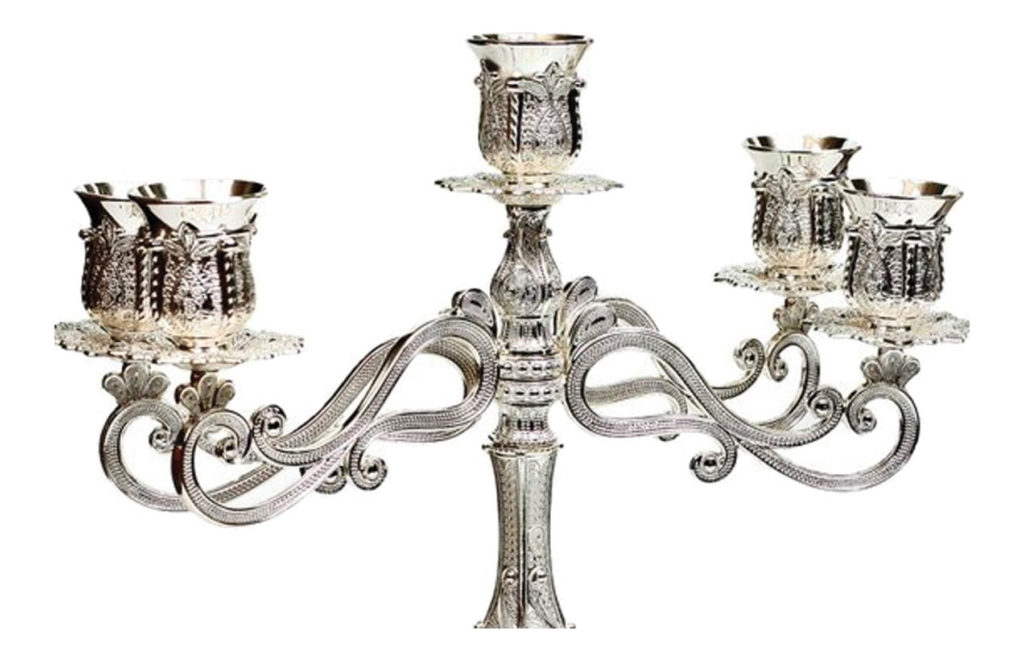
The five-armed candelabrum was crafted of filigreed silver, heavy physically and in spiritual significance. Gina turned it slowly in her hands, so stunned at receiving it that she forgot to breathe for so long that she began to feel faint. The polished silver winked at her. Was this Sima’s message that Gina’s conversion was “kosher enough” after all? Or as she was growing older, was her mother-in-law longing for a closer relationship with the mother of three of her grandchildren? Whatever the reason, Gina was grateful.  

Gina had been lighting Shabbat candles for two years in a set of ivory-colored Lenox candlestick holders, a wedding gift to her and Aaron. They were beautiful, elegant and completely nondenominational. Now that she had a real, Yiddishe-flavored Shabbat candelabrum, Gina longed to give it pride of place in the dining room. Yet she was anxious that the sight of this family heirloom might deepen the divide between her and Aaron, so she reluctantly tucked the box in the guest room closet. 

Each Friday night as she struck the match to light her candles, Gina imagined lighting candles nestled in that candelabrum, still secreted away like contraband. Now, after Aaron’s call this afternoon, Gina strode to the guest room, hauled it out from the box and set it on the side table in place of the Lenox candlesticks. She set her candles in each holder, and stood looking at them with pride. 

Let Aaron figure out his religious conflicts on his own. Gina would channel the strength of Sarah, of Rebecca, of Leah and of Rachel to teach as much Judaism as she could to their children. This was their inheritance, their birthright. Sima’s gift had empowered Gina to feel that she was a Jewish matriarch in her own right.  

Gina hardly wanted to become Orthodox, so she didn’t understand why Aaron said nothing when she joined the temple book club, and last fall chaired the Hanukkah boutique planning committee. Now she was taking an introduction to prayer class, knowing better than to share what she learned in class with him.   

One night she said, “You don’t seem to notice how my activities and involvement at temple give me a sense of community, or appreciate that our kids are making nice Jewish friends there. This is your religion, after all. How can you be so apathetic?” 

“Don’t you mean ‘our’ religion?” Aaron replied, causing Gina to flinch. “Remember, I’m the one who grew up with lots of religion and ritual. I admit it gave me a sense of identity and values, but it also became claustrophobic. Rituals can become mechanistic. I won’t be penned in by having to go to the synagogue every week.”  

Aaron’s resistance only strengthened Gina’s resolve, and after receiving the candelabrum, she even emailed Sima occasional articles she had enjoyed about Jewish observance and philosophy, sparking conversation and greater kinship between them. Gina had been startled to discover an Orthodox rabbi writing about things like sex, how to organize your mind, deal with frustration, and live with joy despite life’s troubles. When Aaron saw an article printout on her nightstand about the Orthodox view of marital intimacy and the laws of niddah and mikvah, she could feel tension radiating from him. He flopped into bed, snapped off his reading light, and roughly yanked the blanket up to his neck, turning his back to her.  

“Why does this upset you so much?” Gina asked. “Were you abused by some great-uncle or rabbi as a child? Help me understand.”

“You can’t understand,” he said, still facing the wall. “You weren’t told growing up that if you weren’t thrilled to live under the ‘yoke of Heaven’ 24 hours a day that there was something wrong with you. You didn’t have to pretend that you’d never want to eat anything treif, or touch a woman before you were married, because if you did, you weren’t a real Yirat Shamayim, a real believer. I believe in God, but I don’t need all his rules. I live my life honestly and work hard to support my family. Isn’t that enough?” 

He sat up and faced her. “I love you. I love the kids. But I won’t constantly be reminded of what I never measured up to.”

“Then why not try more temple activities, at least for the kids’ sake? Next Friday night is Drum Circle Shabbat, and the kids really liked that last time. Can you be open to something creative? It can’t be all or nothing.”  

“Gina would channel the strength of Sarah, of Rebecca, of Leah and of Rachel to teach as much Judaism as she could to their children.”

Aaron laughed. “Drum circles! You’re right, I don’t have any of that to haunt me from the past. Look, I don’t want to sound arrogant, but I knew more Rashi and Rambam commentaries by ninth grade than this rabbi knows now. I don’t buy a lot of this 21st-century interpretation of the text. It’s politicized, and a lot of it is shallow. Believe me, I wish I knew where I belonged Jewishly. I wish I could feel close to God, but I just can’t.”

Gina was quiet for a few moments. “Aaron, you were turned off to this when you were 17. You’re 42 years old now. Isn’t it time to give it another shot? Even a ‘shiksa’ like me knows our kids need a sense of purpose beyond themselves.” 

“I’ll try, but this is very hard for me.” 

They both slept fitfully that night. In the morning, Gina prayed that Aaron would begin to reconsider his relationship with his faith. 

• • • •

When Aaron came home that evening, Gina and the kids already were digging into the apple cake and chocolate chip cookies. His gaze was riveted by the sight of his great-grandmother’s candelabrum on the side table, the small flames swooning from a light breeze coming through the windows. 

“When … how … did you get that?”

“Your mother sent it to me as a gift. Isn’t it beautiful?” 

“My mother? She sent that to you?” Aaron was rooted to the spot, looking momentarily confused.   

“Don’t worry, Daddy, there’s lots of brisket left. It’s delicious,” Sam said. 

“Sit down, Aaron. You still have plenty of time to eat,” Gina said, filling his plate and setting it down before him. Aaron dipped a piece of challah into the brisket gravy as Emily chatted about the play her class was organizing, and Sam excitedly interrupted to report a lizard sighting on the school yard. Justin ate quietly, observing his father. Aaron was listening, trying to be present but clearly distracted by the candelabrum. He glanced at it frequently. It almost seemed as if he were seeing ghosts.   

“We used to have Shabbos dinners at my grandparents’ house with this on the table,” he said in a quiet voice. “Now it’s in our own home. Hard to believe.” Aaron smiled ruefully at his children. 

“It’s time to go, Mommy,” Sam said. “I don’t want them to sing without me. I want to sit right in front on the stage, so you and Daddy can see me.”

“Ready, Aaron?” Gina asked.

Aaron paused, as if unsure of himself, then rose heavily from the table. He lifted his jacket from the back of his chair, but moved slowly toward the door, as if he were pushing through a wall of water. As Sam and Emily clambered into the car, arguing about who would sit where, Aaron turned to look at the little flames still illuminating the dining room table.

“Gina … I’m sorry, I can’t.” 

“Dad? Are you coming or not?” Justin asked from the front door. 

“Not tonight, son.” 

Gina bit her lip and nodded. “OK, Aaron. Maybe next week.”

In the quiet house, Aaron sat down at his polished oak table, the glint of his great-grandmother’s candelabrum reflecting a moistness in his eyes. He tried to recall the feeling of peacefulness that Shabbos had brought when he was a child, before guilt and apathy overcame joy in his Jewish journey. He sat and watched the flames until the last one finally gave out, watched until the thin thread of smoke rose like a whisper in the air.  


Judy Gruen’s latest book is “The Skeptic and the Rabbi: Falling in Love With Faith” (She Writes Press).

The Inheritance Read More »