fbpx

February 13, 2019

Endurance of ‘Holocaust’ and ‘Schindler’s List’

Two anniversaries this spring deserve recognition as turning points in bringing the then largely ignored horror of the Holocaust home to the post-World War II generation, thanks to the enormous impact of television and movies.

In 1979, the miniseries “Holocaust” had viewers in Europe glued to their TVs, and on March 3, 1994, Steven Spielberg’s “Schindler’s List” opened in Berlin.

During that decade and a half, I went on a number of press trips to Germany at the invitation of the Federal Republic of Germany and the municipality of Berlin. I planned to do a series of interviews with the younger generation on the current art and theater scene and query the older generation on the fortunes of my favorite soccer teams from my own childhood in the German capital. But within a few minutes of starting the interviews, my interlocutors invariably turned the conversation to the Holocaust. Older interviewees attributed their awakening to watching the four-part “Holocaust” miniseries, starring Meryl Streep and James Woods, which had debuted in the United States on NBC in 1978. It traced the fates of two Berlin families, one Jewish and the other Christian.

Thirty-six percent of all Germans with TV sets watched the miniseries, and Der Spiegel, Germany’s equivalent of Time magazine, could barely contain its enthusiasm. “The [series] has managed to do what hundreds of books, plays, films and television broadcasts, thousands of documents and all concentration camp trials in three decades of post-war history failed to do — inform Germans about the crimes committed against the Jews in their name in such a way that millions were shaken,” its reviewer wrote.

That same year, the German parliament eliminated the statute of limitations, which had set a cutoff date for the prosecution of war crimes committed by German citizens.

“We don’t know what obstacles the producers of ‘Holocaust’ encountered, but it took Hollywood’s self-described ‘900-pound gorilla’ to put ‘Schindler’s List’ on movie screens.”

Fifteen years later, when “Schindler’s List” opened, German media competed in lauding the film based on the story of the “good German,” businessman Oskar Schindler, who did what most Germans could not or would not do to save Jews from Nazi extermination.

In an unusual front-page editorial, the Frankfurter Allgemeine Zeitung, Germany’s equivalent to The New York Times, noted, “All indications are that Spielberg’s film will move and excite the country. Everyone should see this film.” The Washington Post correspondent in Berlin credited the film with the “reopening of a national debate about guilt, courage and the unresolved mysteries of mass murder.”

We don’t know what obstacles the producers of “Holocaust” encountered in selling their project to NBC, but it took Hollywood’s self-described “900-pound gorilla” to put “Schindler’s List” on movie screens.

When he first outlined his vision to make an R-rated, three-hours-plus film in black and white without big stars, Spielberg said his bosses at Universal Pictures suggested if he felt the need to commemorate the Holocaust, he should make a generous donation to a museum but spare the studio the humiliation — and financial loss — of making a movie no one would watch. Spielberg said he agreed that the project would be a box-office flop, but he felt he had to go ahead and make it anyway.

So much for Hollywood prognostications. “Schindler’s List” was made with a $22 million budget. Its gross earnings, in the U.S. alone, came to almost $97 million.  It also brought Spielberg, after 17 films, his first Oscars, for best director and best picture.  

Last fall, Spielberg re-released the film on its 25th anniversary. The Forward stated that Spielberg decided to re-release the film based on his “perception of a renewed cycle of hate.” His view is buttressed by global reports of rising anti-Semitism, proving once again that in every generation, the battle against “the oldest hate” must be fought anew.

Endurance of ‘Holocaust’ and ‘Schindler’s List’ Read More »

Two Jewish Comedians Talk Mary Tyler Moore, #MeToo, and Mothering

Comedian Judy Gold emerged on stage at an Upper West Side theater on Feb. 11 and screeched, “Oh my God, I’m so excited,” as she welcomed comedian/actress/performer Sandra Bernhard to a live taping of her podcast “Kill Me Now.” 

It didn’t take long for the pair of Jewy comics to dive into celebrity gossip. Bernhard asked if the host had been invited to Jennifer Aniston’s 50th birthday party. “I wasn’t invited,” Bernhard said dryly. Gold asked: “Hasn’t she had a lot of work done?” to which Bernhard diplomatically replied, “She’s had a lot of tsuris.”

Being in the audience felt a lot like eavesdropping on two famous friends having a grown up slumber party. Their conversations roamed from what it was like growing up in a New Jersey suburb (Gold) and Scottsdale, Ariz. (Bernhard); how they’ve dealt with hostility toward female comics and sexual harassment over the course of their careers, as well as the fickle fortunes of fame.

Throughout, Gold dinged a hotel desk bell every time they mentioned someone or something Jewish. There were a lot of dings.

The comics riffed on their shared love of Carole King’s album “Tapestry,” reminisced about tearing the cellophane off new albums while sitting on shag-carpeted bedroom floors, and their mutual obsession with TV variety shows and “The Mary Tyler Moore Show.”

Although both women are Jewish, Gold builds her shtick around feeling awkward and unpopular because she is tall and gawky. Bernhard, on the other hand, is all cool fashionista. She has graced the cover of Elle, is known for her style as well as her Mick Jagger pout and is as unflappable as Gold is neurotic. 

To this day, Bernhard is thankful that she didn’t get cast in her high school production of “Funny Girl” despite her Barbra Streisand-esque nose and beautiful voice. Instead, the casting director picked a curvier “totally blond shiksa” and, Bernhard said, ended up sexually molesting the lead and others girls.

“From the get-go, HaShem protected me and I was never molested,” she said, although she did share another story. She said the late comedian Buddy Hackett invited her to come to his Beverly Hills house the morning after the premiere of her 1982 film “The King of Comedy” with Jerry Lewis and Robert DeNiro. She was 26 at the time. “He met me at the door in a terry-cloth robe,” Bernhard said. That was my #MeToo experience,” but she didn’t elaborate further.

“Judy Gold builds her shtick around feeling awkward and unpopular because she is tall and gawky. Sandra Bernhard, on the other hand, is all cool fashionista.”

Gold shared her own Hackett #MeToo moment. “The Concord Hotel was trying to stay open. Buddy liked me for some reason and asked me to open for him. He liked tall women. (Gold is 6 feet 3). He comes up to me right before I go on, he comes up to here on me,” Gold said, holding her hand at bust level, “and says, ‘Give me a kiss.’ I say, ‘I’m not giving you a kiss.’ He’s like, ‘Just give me a little tongue.’ And then he puts his face in my boobs,” shaking it back and forth. “Then I went right onstage.”

Bernhard she said that while she was growing up, she was teased by schoolmates for having her famously full “n-word lips.” After finishing high school early, she went to a kibbutz in Israel, where she had lots of cousins. She picked oranges and grapefruit, chopped weeds in cotton fields and, in the kibbutz slaughterhouse, vacuumed lungs out of chickens on the assembly line. She credits the manual labor with teaching her a strong work ethic.

After returning to the U.S., she moved to Los Angeles, enrolled in the Charles Ross School of Beauty and studied to be a manicurist for three months before working in salons while doing stand-up in local comedy clubs. Comics Paul Mooney and Lotus Weinstock mentored her.

Unlike other women working in comedy at the time, Bernhard refused to be self-deprecating in her act. The late Joan Rivers told her she’d never make it in show business unless she got a nose job but she never considered it.  

“From Day One, it was confidence, confidence, confidence,” Gold said, admiringly.  

“I was insecure, don’t get me wrong, but it never came out in my material,” Bernhard said. “I couldn’t let all the feminists down. All my ladies. They fought for me.”

Gold, on the other hand, wanted a nose job. In the exaggerated, Jewish mother voice she uses when quoting her late mother, Gold said, “You’ll get your nose done when Barbra Streisand gets hers.”

Starring with Lewis and De Niro in “King of Comedy,” was a career high for Bernhard. “I’m sure Jerry Lewis was very nice on set,” Gold, said. “No, he wasn’t,” Bernhard replied. “He was a horrible person.”

The two then talked about being Jewish mothers. “I tortured my daughter. I was involved in the Kabbalah Centre for a long time,” Bernhard said. “From the time she was in utero until she was 10, 11, I would drag her to the Kabbalah Centre.”

She said she then took her daughter to Chabad, where she was bat mitzvah’d. “I thought she would never want to be near anything [Jewish] again,” Bernhard said.  But about a month ago Bernhard went to visit her daughter in London, who said to her mother, ‘Let’s go to Shabbat in Golder’s Green.’ “So we went to synagogue,” and she was really into it, and I was like, ‘HaShem, thank you.’ ”

“You’re so lucky,” Gold said. “Yeah, I didn’t drive her completely away from her faith,” Bernhard replied.

And as any Jewish mother would, Gold responded, “Mazel tov on that, honey. Mazel tov.”


Debra Nussbaum Cohen writes from New York for Haaretz and is a contributing editor at The Forward. 

Two Jewish Comedians Talk Mary Tyler Moore, #MeToo, and Mothering Read More »

‘Aubergine’ Proves to be Poignant Blend of Flavors

There is a poignant blend of flavors when you mix Korean-American theatre with a religiously observant Jewish director. Todd Salovey’s latest production at the San Diego Repertory Theatre gives us a powerful insight into an East-West culture while taking us on a culinary journey through food and death. It might be set in a Korean family, but the themes are universal.

Brian Kim plays Ray, a disillusioned chef who is tending to his dying father, a patriarch who never fully expressed love or approval. Audrey Park is Cornelia, Ray’s former and now-reunited girlfriend who has a hip American edge but is the only one of them who speaks Korean and can provide a gateway to their heritage, by translating with Ray’s Korean-speaking uncle (Young Kim).

The play is sensitive and moving and during an audience feedback session Salovey explained the theme in the typically Jewish form of a question: “What is the best meal you have ever eaten?”This was the first question he asked actors when rehearsals began, and it is the question asked to audiences.

Julia Cho’s play is interesting. The dramatic action is tragi-comic, and a funny highlight is when Ray is frustrated with his uncle and speaks at him in angry English while his girlfriend Cornelia translates into Korean so the uncle can understand. Justin Humphries’ brilliant scenic design projects subtitle onto the backdrop so that we can see the simultaneous translation and appreciate that Cornelia is taking Ray’s insults and diplomatically translating them into a calm, flattering Korean that communicates his point while building a loving connection with his uncle.

The circular stage, set amid a square of broken slate, almost resembles a dining plate at an Asian fusion restaurant, and the father’s deathbed at the center of the stage eventually becomes the dining table where the family sits, albeit with the cremated ashes poignantly placed in a wooden box at the front.

Cho’s writing moves between epithets that could be from King Solomon’s book of Proverbs or Ecclesiastes, like “we hold the hands of the dying but we are not the ones holding their hands…they are holding ours.” When Ray provides a less eloquent outburst, he says “I’m sorry for swearing…I am a chef,” which led my mind immediately to the English chef Gordon Ramsay.

At times the play moves between traditional western theatre and the mid-20th-century style of Berthold Brecht, as the action is broken with a somewhat self-conscious commentary. All characters step out to give direct monologues to the audience before moving back into the narrative of the play, and, although I would have preferred to see this as two separate plays, with a continuous course of action inside the main narrative, it did provide a beauty of its own.

Terrell Donnell Sledge is notable as the west African caregiver Lucien who pledges his time and support to help the dying patriarch be as comfortable as possible during his final days, and to be there to support the family at the memorial service. When Ray buys ingredients and intuitively cooks an African dish without having the recipe, Lucien’s memories open up as he gently says that “the tastes remind me of home.”

When the characters speak of their family food memories being associated with love, guilt, expectation or drama, it is a culinary language that immediately resonates for a Jewish audience.

This is Todd Salovey’s 29th season at the San Diego Rep. His work continues to delight, move and provoke deeper thoughts.


“Aubergine” plays at the San Diego Repertory Theatre until February 17. For ticket information click here.

‘Aubergine’ Proves to be Poignant Blend of Flavors Read More »

Judaism Meets Science in Unorthodox Comedy ‘To Dust’

Jewish mourning rituals and the science of decomposition are unlikely topics for a comedy, but writer-director Shawn Snyder deftly mines them for dark humor and heart in his first directorial effort, “To Dust.” 

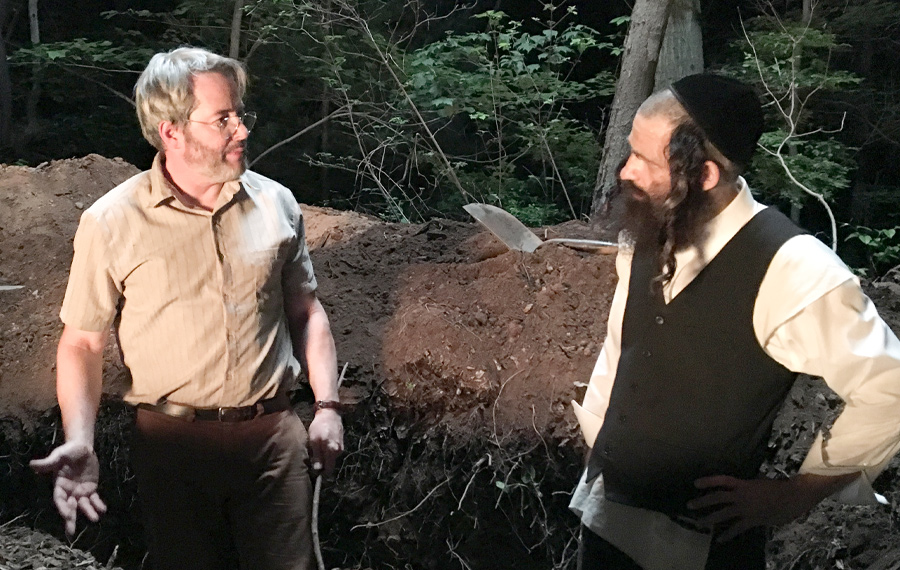
In the movie, a Chasidic cantor, distraught over his wife’s death and convinced that her soul won’t rest until her body turns to dust, conscripts a biology professor to find answers about the science of human decay. The improbable duo embarks on a scientific quest that involves grave-digging, a pig and breaking into a forensics “body farm.” Hungarian actor Géza Röhrig (“Son of Saul” — see our Q&A with him on Page 62) plays the cantor opposite stage and screen star Matthew Broderick as his reluctant accomplice.

“Are the questions of religion and science diametrically opposite or two sides of the same coin? To me, they’re more similar than we think,” Snyder said in an interview with the Journal. He said he got the idea for the film when he lost his mother to cancer 10 years ago. 

“I have always found the Jewish understanding for grief and the guideposts for grieving to be beautiful, poignant, meaningful and incredibly wise,” he said. “Mourning my mom in a Jewish way was very important to me. I’ve never found comfort at my mom’s grave — it’s not where I feel her presence. But after she died, I did think about what was happening with her body. I never went crazy with those thoughts, but I did think that a conversation between science and religion and emotion was ripe for exploration.”

Raised in a Reform Jewish family in Miami and Cooper City, Fla., Snyder didn’t know much about Chasidic life, so he did research that included talking to members of the community willing to speak to him. Some became advisers on the script and on the set, and Röhrig, who studied at a Chasidic yeshiva and is now Modern Orthodox, provided helpful input, Snyder said. 

“To Dust” contains a fair amount of profanity and some elements that religious Jews may find objectionable, which Snyder acknowledges. “The script dabbles in blasphemy but it was never intended to disrespect,” he said. “It’s intended to deal with the community authentically and also in the spirit of folklore and the Jewish tradition of storytelling. This is a man who wants to reconcile these thoughts he’s having with the beliefs of his community, and it’s an eternal battle to do that. I hope it’s an allegorical and respectful telling of the journey.”

“Are the questions of religion and science diametrically opposite or two sides of the same coin? To me, they’re more similar than we think.” 

— Shawn Snyder

The film’s journey to the screen was a serendipitous one that involved a $100,000 grant from the Alfred P. Sloan Foundation, which funds science in the arts, and the participation of actors Emily Mortimer, Alessandro Nivola and Ron Perlman, who championed it and signed on as producers. 

“The film called for an odd couple, and they’re certainly an odd couple, in real life as in the movie,” Snyder said of casting Röhrig and Broderick. “It was always a high-wire act to find the tone and a leap of faith that everything was going to land, but it did beautifully. While Géza appears to be the straight man and Matthew is on the surface the comic relief, what I love about their performances is the ways that Géza makes me laugh and Matthew breaks my heart.”

“To Dust” was shot in the summer of 2017 in upstate New York in a Chasidic community and a Jewish cemetery. It was a challenging endeavor but a dream come true for Snyder, who has wanted to make movies since he was 5 years old. 

After studying religion at Harvard, he became a musician before completing his graduate studies in film at New York University in his early 30s. “I always knew I would move in this direction but it took a long, circuitous route to get there,” he said. 

With his writing partner, Jason Begue, Snyder is working on a screenplay that “continues my interest in existential dread and existential questions and combines comedy and tragedy. It’s about a retired secular Jewish man in the suburbs,” he said. “A lot of the films I’m interested in writing are tethered to religion and our individual and collective search for meaning.”

Snyder and his non-Jewish wife are raising their 4-year-old daughter Jewish. They belong to “a lovely congregation in Brooklyn” that reminds him of the one in Miami where he attended day school and he became a bar mitzvah. He missed having that connection to the Jewish community. “My Jewish journey continues,” he said. “I have an undeniable Jewish ethos. It’s a lifelong, evolving thing.”

“To Dust” won the audience and new director awards at the Tribeca Film Festival in 2018. 

“One of my obsessions has always been how we grapple with our cultures of origin, how we search for personal meaning and how we put those two things together in conversation, to integrate them into the belief systems that we grow up with,” Snyder said. “I hope the film asks more questions than it answers. It’s talmudic in that regard. I hope audiences are challenged and moved, and want to continue the conversation.”


“To Dust” opens Feb. 15 at the Laemmle Royal and Town Center 5.

Judaism Meets Science in Unorthodox Comedy ‘To Dust’ Read More »

‘Songstruck’ Leaves Audience Awestruck

On a recent rainy Saturday night, facing a full house in the roomy sanctuary at West Hills Shomrei Torah Synagogue, Jackie Rafii, the shul’s cantorial soloist, stood center stage. She was there to introduce “Songstruck,” an evening of cantors performing songs and melodies of their own choosing. 

As the concert was about to start, Rafii appeared shaken. Speaking into a microphone she stammered, “We have a little technical problem. Nothing really, just a little thing. You know it’s raining outside, right? And there’s a lot of traffic. After all, this is L.A. La La Land? What I’m trying to say is none of the other cantors are here yet.”

There were murmurs and gasps from the more than 400 people who had packed the sanctuary. “But that’s OK,” Rafii said. “You know, the show must go on. So, I’m going to wing it till they get here. You’re OK with that, right?” The audience applauded guardedly. 

Rafii took a deep breath, nodded to the musicians behind her, and the band started to play “Another Day of Sun,” the opening number from the movie “La La Land.” In a supple, melodic vocal instrument that can handle pop music as deftly as liturgical melodies, Rafii sang the opening verse. 

In the brief pause after the end of that verse, someone in the audience suddenly stood up, and in a voice worthy of a Broadway show, belted out the next verse. The crowd craned to see the singer: a woman in an elegant, red evening gown. Then, in a different part of the audience, a man with a kippah, wearing suit and tie, took on the next verse. 

This was followed by another elegantly dressed audience member. Her powerful soprano voice took on the next verse as seamlessly as a runner taking the baton in a relay race. Finally, another male singer, also in a suit and kippah, joined in from another part of the audience. It dawned on the crowd that these were indeed the cantors slated to perform and that Rafii’s nervousness had been an act. The audience laughed and cheered.

The four cantors planted in the audience were Lisa Peicott from Wilshire Boulevard Temple; Daniel Friedman, senior cantor at Temple Ramat Zion; and Cantor Stephanie Kupfer and Senior Cantor Marcus Feldman from Sinai Temple. They moved to the stage and joined Rafii for the song’s final refrain.  

“In shul, we sing liturgical music but we became cantors because we love music, so a night of nonreligious music gives us a chance to express our love for all music.” — Lisa Piecott 

That opening gimmick allowed attendees to see these cantors in a more human and familiar light.

Peicott, who sang the aria “Quando M’en Vo” from Puccini’s “La Boheme,” told the Journal that “in shul, we sing liturgical music but we became cantors because we love music, so a night of nonreligious music gives us a chance to express our love for all music.” 

During the evening’s two-hour show, the five cantors plus Rabbi Erez Sherman and Cantor Ron Snow, displayed their musical chops in offerings that ranged from a 1950s top-of-the-charts ballad and jazzy standards to multi-layered dramatic songs from Broadway hits.

The program also included some liturgical songs. Feldman sang two Hebrew prayers set to music in the 20th century, one by former Sinai Temple Cantor Meir Finkelstein.

Daniel Raijman, guitarist and composer for film and TV who arranged the music and conducted the band for the evening, said that the show’s variety was one of its most challenging aspects. “Each cantor chose his or her own songs but once they did that, we had to figure out how to organize it and pace it,” he said. “In certain pieces, we had to use what we had — guitar, keyboards, violin, drums, electric bass and double bass — in place of horns or string section.”

Rafii said she was struck by the variety of music the cantors brought to the project. “I knew our guest cantors were incredibly talented and trained in various musical backgrounds,” she said. “But I was blown away by the level of versatility and skill when I asked them to share some of their favorite songs. As we brainstormed and rehearsed, I saw that these musical backgrounds were a core part of each of us, informing our musical passions, sensibilities and personalities.”

Rafii also brought her own varied background to “Songstruck.” While in law school, she took classes at a cantorial program and continued to do so while practicing as an attorney at an entertainment law firm. “I was feeling more and more pulled to the calling of the cantorate,” she said, “and nurturing that passion.” In 2017, she began working at Shomrei Torah as cantorial soloist and expects to become an ordained cantor “within the next few years.”

“Songstruck’s” showstopper came toward the end of the evening when Rafii, at the piano, sang her own composition, “One Thing.” The refrain was “You are the one thing that makes me feel whole.” Whether the “one thing” referred to Rafii’s fiancé, God, music or to all of them, it was touching and beautiful. 

“Songstruck” ended with all the cantors on stage singing “This Little Light of Mine.” At the start of the event, Rafii told the audience, “May your souls be moved,” and from the enthusiastic response — standing ovations and bouquets for the singers — that was clearly the case. n

‘Songstruck’ Leaves Audience Awestruck Read More »

Douglas, Arkin and Lorre Reveal the Secrets of ‘Kominsky’s’ Success

One of Netflix’s most popular new series is about a pair of 70-something buddies aging in Hollywood, prostate problems and all. In the deft hands of creator Chuck Lorre and Oscar winners Michael Douglas as actor-turned-acting teacher Sandy Kominsky and Alan Arkin as his agent Norman Newlander, “The Kominsky Method” is a poignantly funny hit. Production has begun on the second season to debut later this year, and the producer and stars invited members of the media to the set to discuss the show and what lies ahead. 

“I’m getting more attention from this show than even the Marvel movies. Even my kids like it, and they don’t like anything I do,” Douglas said. He added that baby boomers are a big part of the Kominsky audience. “They’ve been deprived of these kinds of characters for a long time.”

“Norman is fast becoming one of the most complex, richest and multi‑varied characters I’ve ever played in my life,” Arkin said. “We’re jumping from farce to comedy to near tragedy almost on a moment‑to‑moment basis from episode to episode, and I’m in heaven in that regard. It’s very exciting.”

Lorre, who has turned unknowns into stars in “The Big Bang Theory,” got his dream superstar pros for “Kominsky.” “I’m really grateful I get to work with these men. When I’m smart, I shut up and I listen because they come at it in ways I don’t anticipate, and it’s made it better.” 

“I’m getting more attention from this show than even the Marvel movies. Even my kids like it, and they don’t like anything I do.” — Michael Douglas

The two stars had never worked together before, but instantly clicked. “I felt strangely comfortable with Michael the minute we started working,” Arkin said. “We had had lunch about a month before. That’s all I knew of him outside of having seen him in 150,000 movies, and you never know what to expect. But I have found him extraordinarily flexible and easy to work with and fun.”

Douglas compared their relationship with the cherished one he had with Karl Malden in “The Streets of San Francisco” 45 years ago. When he watched his and Arkin’s first scene, he said, “I believe these guys have known each other for 40 years.”

Now 74, Douglas “never anticipated the kind of options that would even happen as I reach the three‑quarter‑of‑a‑century mark, and it’s wonderful. It’s a real treat too, because comedy is not something I’ve done a lot of, and the chance to work with great writing and somebody like Alan, who is so wonderfully gifted in his timing and his understanding of it, you learn something new. It’s a learning experience at a time in my life that I never thought I’d be learning anything new.”

Asked whether Kirk Douglas, his 102-year-old father, likes the show, Douglas replied, “I don’t think he gets it. ‘You’re funny? Alan’s funny,’ ” he quoted Kirk. “ ‘You’re not funny.’ ”

A fair amount of the show’s humor stems from the woes of aging. “We could bemoan the fact that aging is happening, or we can step aside and look at it as darkly comic,” Lorre said. “When it’s all falling apart, laugh or cry. I choose to laugh.”

Jewish humor and themes are also prevalent. “Norman is a secular Jew. He’s a character that has abandoned some aspects of [Judaism], but there are traditions that are just wired into your genes,” Lorre, who is Jewish, told the Journal. “There are attitudes and modes of behavior that are hard-wired whether you choose or not to be a faith-based person or a secular person.”

Last month, “The Kominsky Method” won two Golden Globe Awards, for Douglas and the series, and a nomination for Arkin, followed by three Screen Actors Guild and two Critics’ Choice Awards nominations. “The Golden Globes gave us one of the greatest gifts you can imagine,” Lorre said. “It says, ‘Look into this, give this a chance.’ And in a world of 500 shows, it’s astonishing to get that kind of a leg up. I’m still gobsmacked.”

The attention sets things up nicely for the second season, which will add new characters — and well-known stars — to complicate Sandy and Norman’s lives. “The first season was very much a walk through the darkness with health issues and Norman’s loss of his wife. And while health issues will remain a part of the series because that’s the reality of getting older, things change markedly for both Norman and Sandy in ways that are unexpected,” Lorre said. 

Jacqueline Bisset will play Sandy’s ex-wife, who still delights in pushing his buttons, and Jane Seymour will portray the love of young Norman’s life. Both now widowed, they meet again 50 years later. Paul Reiser will play a teacher who becomes involved with Sandy’s daughter, “a relationship that causes Sandy some difficulties,” Lorre said.

Arkin, now 84, joked that he’d be happy to get a script in which his character “has no dialogue and lies on a gurney with a breathing tube up his nose,” but in reality, he’s still playing parts in more active scenarios. He’ll portray a Wall Street tycoon in Disney’s live-action “Dumbo” and the mentor to private eye Mark Wahlberg in the Netflix murder mystery “Wonderland.”

Douglas doesn’t have anything else lined up yet, but he loves the creativity and freedom that streaming TV has offered him at this point in his career. “It’s just a whole new chapter,” he said. “A wonderful chapter.”


“The Kominsky Method” is streaming on Netflix.

Douglas, Arkin and Lorre Reveal the Secrets of ‘Kominsky’s’ Success Read More »

Conference Teaches Students to Stand Up for Israel

Illegitimate criticism of Israel was the major focus of the Maccabee Academy, hosted by the Maccabee Task Force (MTF) at the Venetian Hotel in Las Vegas on Feb. 10.

Four hundred and fifty students from 80 colleges attended the event, where MTF Executive Director David Brog said the organization is focusing on building a “big tent” of diverse perspectives on Israel in its effort to combat the boycott, divestment and sanctions (BDS) movement on college campuses.

Brog said anti-Semitic criticisms of Israel can be broken down into what former Jewish Agency Chairman Natan Sharansky called the three D’s: demonization, delegitimization and double standards. “What I object to is the singling out of Israel alone,” Brog said. 

He also spoke about author and journalist Yossi Klein Halevi’s contention that anti-Semitism tends to “take on the form of evil from that era,” such as racial inferiority in the Nazi era and the communist belief that Jews were greedy capitalists. Today, anti-Semitism takes the form of “hatred for the Jewish State,” Brog said. “Like every form of anti-Semitism, it relies on a caricature.” 

The conference also held panels that focused on MTF’s four pillars to combat BDS: “Growing the Base,” “Taking Back the Quad,” “Coalition Building” and MTF’s Israel Fact Finders’ trip.

In the “Growing the Base” panel, University of Illinois Urbana-Champaign Chabad Rabbi Dovid Tiechtel said most students don’t want to associate with Israel activism for fear it will affect their social standing.

“We have to be constantly proactive,” Tiechtel said, adding that it’s important to make students feel like “it’s cool to be a part of the pro-Israel community.”

University of Florida Hillel Rabbi Adam Grossman said the students should maximize activists “to get to know people outside our current network.” Although, he acknowledged, “It’s really, really hard. It is easier to find people like us rather than meet people who could shatter our worldview.”

The “Taking Back the Quad” panel featured New York University student Adela Cojab, who spoke about how NYU’s pro-Israel students hold a yearly rave on Israel Independence Day. However, she said, follow-up is key after such events. 

“He also spoke about author and journalist Yossi Klein Halevi’s contention that anti-Semitism tends to ‘take on the form of evil from that era.'”

“Follow-up is making sure that all the people that are being reached are still engaged,” Cojab said. She encouraged attendees to own their own narrative when it comes to supporting Israel on campus.

The “Coalition Building” panel featured UCLA student Lea Blum, who said the best way to build a coalition on campus is “to be genuine and care about the person, the culture or whatever you’re trying to achieve.”

As an example, she cited the UCLA group, Bruins for Israel, and its “Namaste Shalom” event celebrating both Indian and Israeli traditions. “Once you’re friends, then you can become allies,” she said.

The panel on MTF’s Fact Finders Trip provided details on how the organization takes student leaders to both Israel and the Palestinian territories to learn the nuances of both sides of the conflict.

City of New York Baruch College Hillel Executive Director Ilya Bratman, University of Wisconsin-Milwaukee Hillel Executive Director Julie Schack and Portland State University Jewish Agency for Israel fellow Hagit Ojalvo said the selection process for the trip is “very selective and very competitive.” Brachman said he focuses on recruiting students who have key relationships and show the most potential for future leadership.

The conference also featured writer and Israel Defense Forces (IDF) soldier Izzy Ezagui and progressive Zionist activist Erin Schrode.

Miami-born Ezagui, 29, told attendees he was inspired to join the IDF after participating in Birthright in 2008. During Operation Cast Lead in January 2009, he was struck by a mortar and lost his left arm. However, he eventually made his way back to serving in his unit again.

He now spends time traveling to speak about pro-Israel advocacy. He told attendees that the best way to win over people is to bring them to Israel or share their own experiences from Israel.

“Figure out your story. Start figuring out why Israel is important to you and turn it into an elevator pitch,” Ezagui said. When he’s confronted by members of Students for Justice in Palestine, he said he remains calm and asks for a dialogue. “Everyone else there is going to see how you behave and that’ll matter more.”

Similarly, Schrode said she became a Zionist after her 2011 Birthright trip. In 2016, at the age of 24, she ran for Congress in California’s 2nd Congressional District in the Bay Area received numerous anti-Semitic emails and death threats in response to her pro-Israel activism.

She said the experience made her realize that “the existence of the state of Israel had never mattered more to me as a place that safeguards the Jewish people.”

Schrode told the attendees that the best way to unite against anti-Semitism and fight for the state of Israel is “to rattle people, to preach truth.”

“How do you pull people away from propaganda of any kind?” she asked. “You build a new narrative.”  

Conference Teaches Students to Stand Up for Israel Read More »

Comey Discusses Trump, Mueller and Life After the FBI

Taking center stage before 1,600 people at the Saban Theatre in Beverly Hills on Feb. 10, former FBI Director James Comey broke the ice by commenting on what he believed everyone in the audience was thinking about: his height. 

“It’s a freak show, it really is,” said the 6-foot, 8-inch Comey. “In my head, I’m about 5 feet, 11 inches.”

Comey, who served as deputy attorney general under President George W. Bush, was appointed FBI director in 2013 by then-President Barack Obama. As most people are aware, he was fired on May 9, 2017, by President Donald Trump.

Recalling that fateful day, Comey spoke of how he had been addressing a room of FBI employees in Los Angeles when a headline flashed on the television screen that he had been fired. “I was numbed, honestly, and stunned, and felt like I’d been pushed out of a bullet train,” he said.

Trying to figure out how to move on, Comey said he followed the example of his wife, Patrice, who had coped with the death of their infant son from a preventable infection by working to spare other mothers from that pain. 

Comey spent most of the next year writing a book, “A Higher Loyalty: Truth, Lies, and Leadership,” which was published in April 2018. The idea, he said, was to write about leadership and disguise the book as a memoir. 

Comey told the audience at the Saban that he did not want to focus on his feud with Trump, rather, he wanted to discuss the qualities of ethical, effective leadership. An effective leader, he said, should combine kindness with toughness and confidence with humility. He noted that Obama had these abilities, adding, “I was stunned by how good Barack Obama was as a listener.” 

“We should all, wherever we are on the political spectrum, just root for Mueller to finish his work and let the facts be found that illuminate the truth, whatever that is.” — James Comey

Comey also touted having a sense of humor as an essential tool for any good leader. He praised both former President George W. Bush and Obama for having the ability to be funny. He noted that he could only recall one instance when President Trump had laughed. 

Following his 50-minute address to the audience, Comey participated in a 30-minute question-and-answer session moderated by attorney Kevin James. 

Comey was asked how he felt about being hated by both Republicans and Democrats over his decision to announce the reopening of the investigation into Hillary Clinton’s emails 11 days before the November 2016 presidential election. Comey replied that announcing the investigation or keeping it from the public was a choice between a bad decision and a catastrophic one. He said he chose the bad decision. 

People who are still upset with how he handled the Clinton investigation are viewing the incident through partisan lenses, Comey said. In its decision to reopen the investigation, he added, the FBI was attempting to rise above partisanship. 

When James asked Comey if he believed Trump’s legal troubles were
mounting, Comey took the opportunity to speak about his own views on the Mueller investigation. 

“I don’t know what [Mueller] is going to come up with,” Comey said. “I hope people don’t root for a particular result. We should all, wherever we are on the political spectrum, just root for Mueller to finish his work and let the facts be found that illuminate the truth, whatever that is.” 

Following the event, attorney William Bloch, who had read Comey’s book, told the Journal he was impressed that Comey made the evening about more than his bitterness toward the president. “I thought he was very thoughtful and philosophical in his approach,” Bloch said. “He took it up a notch from being about who is right and who is wrong.”

Julie and Charles Shamash attended with their son, Griffin, a junior at Milken Community Schools. Julie said she was opposed to Trump, while Charles said he supported the president. 

“America is not L.A. and New York,” Charles said. “We live in a bubble here. … There are people who think differently.”

Julie retorted, “When you ask someone who supports Trump, ‘Why do you like Trump?’ they can’t give you one reason.”

Comey Discusses Trump, Mueller and Life After the FBI Read More »

Continuing Alan Canter’s Legacy

It’s mid-morning on a Thursday at Canter’s Deli on Fairfax Avenue — nearly two weeks after the death of its patriarch, Alan Canter — and the place is packed, as usual. Just inside the front doors, bakery goods are stacked high in glass display cases, aromas of fresh corned beef and rye bread are in the air, and people are milling about — paying their bills, waiting for tables and picking up takeout orders. 

Alan Canter died Jan. 25 at the age of 82, but the family-owned deli didn’t miss a beat, running like the well-oiled machine he helped create. The impression one gets amid the bustle and din is that the Canter family and the restaurant’s staff and customers decided to honor his legacy by continuing to schmooze and nosh in his home away from home. 

Immediately following Alan’s death, his son Marc, a part-owner of Canter’s, returned to work because, he said, “Somebody had to be there. I haven’t really dove into it, but it’s starting to affect me,” he said. “You know there’s a circle of life but you are never really quite ready for it. … It’s an emptiness, that’s what it is.” 

It’s hard to find part of the Canter’s operation that wasn’t influenced by Alan. He hand-picked and cut the fruit for the fruit cups; he taught Marc and his staff how to make famous sandwiches like the Canter’s Fairfax (corned beef and pastrami piled high on rye) and the Buck Benny (grilled knockwurst and sauerkraut on a challah bun); and he showed the bakers how to hand-dip cookies in chocolate so they looked and tasted just right. 

Alan also maintained the Fairfax location’s retro-style dining room, with its Jetsons-like light fixtures and booths, and the articles displayed around the restaurant touting moments in the deli’s history. He used his mechanic’s background to fix and replace equipment and his charm to make people feel at home.  

In the kitchen, sheets of Manischewitz matzo are being broken every five minutes for another order of Canter’s classic matzo brei. Asked how many matzo breis are made daily, a chef replies: “Don’t ask.”  

“What’s really hard is trying to leave without buying something. You have the deli on the left and the bakery on the right. You go, ‘Well, wait a minute, I won’t be here for a few days, what do I want?’ ” — Bob Sherman

Alan’s daughter Jacqueline, who also runs Canter’s, says it’s become “a place for hipsters and bubbes.” The deli wasn’t just Alan’s home, it was his children’s home — a place where Jacqueline ate lunch every day, sat behind the cash register and pretended to be a clerk, explored the delicatessen and, most importantly, spent time with her dad. 

“He was so hardworking. He took pride in everything he did,” she said. “Once, he didn’t come home for three straight days because the refrigerator broke, so he and my brother were here trying to fix it.” 

Marc said when he’s running around he sometimes forgets that his dad isn’t there waiting for him to sit and eat lunch at their favorite table. Still, he said, “I feel like he’s with me. I feel like he is watching, and he’s here.”

Like their father, Jacqueline and Marc are friendly with every customer. At one point, Jacqueline stopped to sing Happy Birthday to a regular, whom she surprised with a black-and-white cookie on the house. Even while taking a moment to answer a reporter’s questions, if they heard their names called, the siblings went off to assist.

One of their customers, Bob Sherman, said he has had a love affair with Canter’s for decades, romanced by their homemade pickles, beef tongue (pickled or roasted), pastrami and potato salad.

“My first recollection was when my mom brought me here for lunch and I would have a Buck Benny,” Sherman said. “What’s really hard is trying to leave the place without buying something to go. You have the deli on the left and the bakery on the right. You go, ‘Well, wait a minute, I won’t be here for a few days, what do I want?’ I’m a diabetic so I have to be careful. But forget it, I’m gonna have the Danish and enjoy it.” 

Whether it’s 9 a.m. or 3:30 p.m., Canter’s doesn’t seem to have much of a lull. Although the restaurant isn’t kosher, its Jewish spirit is palpable, particularly with the phrase “L’Dor V’Dor” (from generation to generation) metaphorically written on the walls. 

For more than eight decades the deli has continued to thrive, thanks to four generations of Canters. Marc said Alan used to pester his own father with suggestions like making the switch from a Kaiser roll to a hamburger bun or adding a tomato slice rather than a clunky tomato wedge on the burgers.  

“When I got here, I pestered my dad,” Marc said. “Young minds are good. My dad said, ‘OK, you’re gonna go behind the deli. Don’t make changes. Just wait and see and we’ll talk about them.’ But then I just went in and started changing things. Hopefully, it will happen in the generations to come.”  

It already has. 

With the help of Marc’s 26-year-old son Alex, the extensive menu now includes gluten-free and vegetarian options. Alex also has created an app to improve online ordering. Since the app launched, Canter’s has been feeding more than 1,000 customers daily who don’t even set foot in the deli. Alex also has weekly phone calls with Marc, where he offers more ideas to help the business succeed.  

“He’s pestering me just like I pestered my dad,” Marc joked.

The family knows how to continue Alan’s legacy because they saw he loved what he did.

“He was the happiest when this place was running like a well-oiled machine,” Marc said. “He actually said to me on several occasions, ‘Now I can die in peace,’ because a couple of issues I solved without him. He wasn’t allowed to die when he was the only one that could solve some of these issues. It’s the highest compliment you can get from a parent.”

Continuing Alan Canter’s Legacy Read More »

Valentine’s Dessert: The Passionate Pavlova

According to polls, 40 percent of Americans have negative feelings about Valentine’s Day. The El Paso Zoo announced “Quit Bugging Me” for the holiday, in which patrons can name a cockroach after their ex and watch as it’s fed to a meerkat. The event proved so popular that the zoo added monkeys to the list of animals being fed. The Bronx Zoo has the same program, which calls it an “eternal and timeless gift.”

Each year in the U.S., billions of dollars are spent on greeting cards, and a few million roses are imported from South America. For a society obsessed with saving trees and lowering carbon emissions, this hardly seems loving (not the planet, anyway). 

In the restaurant industry, holidays like New Year’s Eve and Valentine’s Day are known as amateur nights, when obligatory clichés are on the menu. That doesn’t feel so … well, romantic. For one thing, chefs, bakers and other kitchen staffers rarely get to celebrate Valentine’s Day. It’s one of the busiest nights of the year for restaurants, which means the staff and chefs aren’t with their special someone and sometimes resent being at work. The evening is fraught with pressure — expectations, proposals that could go wrong, or tables for couples who want to eat and run in order to get to the “main event.”

Ask chefs what their idea of a perfect Valentine’s Day is, and most probably would say it’s a night off, avoiding the expensive prix fixe menus, roses and hoopla, and staying home, watching a movie and enjoying a bottle of bubbly and a bed picnic with their lovers. 

“Find your passion; chase it as Anna Pavlova did.”

Not that chefs aren’t romantics. I’d think most people who are passionate about food are romantic by nature. But what about singles? What about widows? Perhaps what we should celebrate on Valentine’s Day is passion. After all, what’s sexier than a person with purpose and passion, whatever the passion is? True love for one’s passion, be it a passion for cooking, teaching, music or architecture — that’s worth celebrating. And when two people bring together their passions — and nurture the passions of one another, the effect is a magical connection.

Take, for example, Russian dancer Anna Pavlova, considered the most influential ballerina of the early 20th century. After seeing the ballet “Sleeping Beauty” when she was 8, Pavlova decided she would become a dancer. At age 18 she was already a prima ballerina, touring all over the world and impressing audiences with her vivid facial expressions and her body’s fluidity.

Pavlova’s passion for dancing was boundless; her natural talent and incredible work ethic live on in the dance companies and schools named after her — even in one of the world’s most famous desserts. Legend has it that a diner in Australia proclaimed their dessert — crisp meringue with a fluffy marshmallow interior topped with lightly sweetened cream and fruit — to be “light like Pavlova.”

Find your passion; chase it as Pavlova did. You don’t need grand gestures to show you care; sometimes the simplest embrace can be the most romantic. If you don’t have a special someone in your life on the “official” day of love — but you have passion — love could be lurking around the corner. 

In the meantime — sweet consolation — more Pavlova for you.

VALENTINE’S DAY PAVLOVA

For the meringue:
5 ounces egg whites (about 5 eggs worth, cold)
1 cup baker’s sugar (fine sugar)
1 tablespoon cornstarch
1 teaspoon white vinegar

For the cream:
1 1/2 cups heavy whipping cream, chilled (or 1 can coconut cream chilled)
1/2 cup confectioners’ sugar
1 teaspoon vanilla paste (or extract)
1/2 teaspoon rosewater or orange flower water (optional)

Passion fruit gelée:
1 cup passion fruit pulp
1/8 cup cold water
3/4 teaspoon powdered gelatin

Topping:
2 cups fruit of choice (berries, sliced nectarines, peaches, bananas, pomegranates, figs, nuts, chocolate shavings, honey)

Preheat oven to 340 F.

Separate egg whites from yolks while eggs are cold, then allow them to come to room temperature. 

Using a clean, oil-free mixing bowl and beaters (or a stand mixer), beat whites until soft peaks form. Add sugar 1 tablespoon at a time and beat until thick and glossy or until a bit of meringue rubbed between your fingers doesn’t feel gritty (about 5 minutes.)

When the mixture is smooth, add cornstarch and vinegar and work in by hand until mixed through. 

Tracing around a cake pan, draw an 8-inch circle on a piece of baking paper. Turn over the paper onto a flat baking tray, dabbing a bit of meringue in corners of the paper to make it stick to the pan. Coax half the meringue mixture into a circle with a spatula and then pile the other half on top of the base coat, leaving it no more than 2 inches high with a dome top and edges sloping in. 

Gently transfer the pan into the oven and immediately turn down temperature to 240 F. Bake for 1 1/2 hours without opening the oven door (jarring the over door could collapse the meringue).

After baking, turn off the oven but leave the Pavlova in the oven to cool completely. You can do this the night before and leave the meringue in the oven overnight. Or store cooled meringue in an airtight container on your counter; don’t refrigerate.

To make the passion fruit gelee: Sprinkle gelatin on top of 1/8 cup cold water until powder absorbs. Then stir into passion fruit puree.

Microwave (or stovetop) for 1 minute until gelatin is dissolved. Pour into a small flat container to gel. When hardened, cut into cubes to decorate the top of dessert.

For whipped topping: Place cold heavy whipping cream or chilled coconut cream into a cold bowl. Using cold beaters, whip gently until thickened, then add in confectioners’ sugar and extracts, if using. Whip until soft peaks form, taking care not to overbeat. 

Assemble the dessert right before serving. Carefully loosen meringue from paper with a knife and place on a cake stand. If there are cracks, hide them with the cream.

Pile cream in the center leaving a border so meringue shows.

Carefully top with fruit and passion fruit gelée cubes. 

Serves 6 to 8. 


Yamit Behar Wood, an Israeli-American food and travel writer, is the executive chef at the U.S. Embassy in Kampala, Uganda, and founder of the New York Kitchen Catering Co. 

Valentine’s Dessert: The Passionate Pavlova Read More »