fbpx

January 2, 2019

Ply Them With Schnitzel

In Israel, when you are a child, you pretty much live on schnitzel with mashed potatoes, with fries, as a sandwich, in a pita with hummus or just by themselves, eaten cold after school. It’s a very popular food that was introduced by Ashkenazic Jews, mostly of German origin, when they immigrated from Europe. During the early years of Israel, because veal was not obtainable and pork is not a kosher option, chicken was the meat of choice; it’s tasty and inexpensive.

In Israel, there are entire frozen food sections devoted to schnitzel, in case you don’t or can’t make your own. These tasty cutlets usually are made from processed chicken or turkey with skin and organ meat included — kind of like McNuggets — not that there’s anything wrong with that. I don’t think I ever met a kid (or a man) who doesn’t love these and can’t eat them by the plateful right out of the frying pan. 

On my last trip to see my maternal grandmother, she asked me if I still like schnitzel. She was 90 years old and in an assisted-living facility but still had her own kitchen. I watched as she gingerly floured, egged and breaded the schnitzel and then fried them with her grandmotherly hands so I could enjoy my childhood snack. Her eyesight was not very good at that point and I think she put about twice the salt in them than she should have but they were more delicious for it and I have since always generously salted my schnitzel. 

My favorite way to eat schnitzel, though, is cold, on a soft bun smeared with mayo and a bit of ketchup, preferably on my way to or from the beach. This is pure memory food. My auntie or cousin used to pack us a lunch for a day at the beach; we could never wait until lunchtime and would gobble them up in the car on the way. The delectable nature of a schnitzel sandwich is almost too much to believe and hard to hold out for. When I make them, I always make two per person because even fussy eaters love them. I’ve noticed that the people who eat your schnitzel sandwich will always be the ones who claimed not to want one in the first place. Don’t fall for that trick. Make them one anyway!

The delectable nature of a schnitzel sandwich is almost too much to believe and hard to hold out for.

I had some hungry kids over recently and, much like when I make this in the café, I served my schnitzel with sweet red cabbage, mashed potatoes and lots of gravy, but for kids, all you really need is some fresh buns and some ketchup and they couldn’t be happier. As much as I love every single component of this meal, the red cabbage is such a big star here. It’s by no means dietetic, and I don’t even try to make it so because I’m from the “go all-in once in a while” school of thought. I sauté onions and red cabbage low and slow until they are melting and soft in olive oil. I add chopped sour apples, salt, sugar, freshly ground pepper and apple cider vinegar and I let the whole mass just barely caramelize in its own juice. I think it cuts the richness of the schnitzel and gravy beautifully.

All around, if you have some calories to spare, this dish has definite “last meal before prison” status in my book and it goes without saying that if there are little people in your life who are in need some good cheer, you’d do right by them to ply them with schnitzel. They will love you until the end of time.

CHICKEN SCHNITZEL

2 pounds boneless, skinless chicken breasts
1 cup all-purpose flour
1 tablespoon salt
1 teaspoon black pepper
1/2 teaspoon white pepper
2 tablespoons paprika
1 tablespoon garlic powder
1 1/2 cups bread crumbs or matzo meal
2 large eggs, beaten
1 teaspoon mustard
Water
Vegetable oil for frying (canola, grape seed, peanut, avocado but not olive oil)
Lemon wedges for serving
Fresh buns (if serving to kids)
Ketchup for dipping or a combination of equal parts ketchup and mayonnaise 

Butterfly chicken breasts by using a sharp knife to cut each breast in half lengthwise. Place a long strip of plastic wrap on your kitchen counter and place one half of one breast down. Lay another piece of plastic wrap on top and, using a meat mallet or a rolling pin, gently flatten the meat between the two pieces of plastic wrap until it is 1/4-inch thick and even. If the piece is too thick when flattened, then cut it in half again.

Set up a frying station with three flat bowls. Combine half the salt, black pepper, white pepper, paprika and garlic powder in the bowl with flour, and the other half of the spices into the bowl with breadcrumbs. In the third bowl, place beaten eggs mixed with mustard and a few tablespoons of water to thin. Place a flat sheet pan or plate nearby where you will place your coated schnitzels.

Pour 1/2 inch of oil into a frying pan and heat over medium. Place a small corner of bread into the oil; when oil is ready, the bread will begin to fry and sizzle. While you are waiting for oil to heat, begin coating the chicken breasts. Start with seasoned flour, dip into egg mixture and then into breadcrumbs, making sure to coat each part of the surface area in crumbs.

Set up a paper towel-lined plate to hold your cooked schnitzels. They should take 3-4 minutes per side to cook. Fry only a few at a time without crowding the pan so that the oil temperature doesn’t drop because that leads to oily schnitzel. Ideally, the frying temperature should stay at 375 degrees, so let the oil reheat between batches.

Sprinkle schnitzel with additional salt to taste, if desired, and serve with lemon wedges or with ketchup and mayonnaise on fresh buns for kids. 

Serves 4 adults or 8 kids.


Yamit Behar Wood, an Israeli-American food and travel writer, is the executive chef at the U.S. Embassy in Kampala, Uganda, and founder of the New York Kitchen Catering Co. 

Ply Them With Schnitzel Read More »

Weekly Parsha: Va’era

One verse, five voices. Edited by Salvador Litvak, Accidental Talmudist

And the necromancers of Egypt did likewise with their secret rites, and Pharaoh’s heart was steadfast. –Exodus 7:22


Dini Coopersmith
Public speaker and trip leader, Women’s Reconnection Trips

People see what they want to see. 

“Every man’s way is right in their own eyes,” says King Solomon (Proverbs 21:2). When we are faced with something undesirable, either financially or emotionally, we tend to experience cognitive dissonance and look for any excuse not to believe what we see or hear.

All the rivers already had turned to blood in Egypt, according to the Midrash, even the drinking water and bathing water. What possibly could the magicians of Egypt do to duplicate such a magnificent feat? 

The Ohr haChayim points out that they must have used drinking water they had purchased from the Jews. “This was in no way changing nature, as God had done, but in his stubbornness, Pharaoh did not notice it was just a visual magic trick on their part.” It’s incredible that Pharaoh, with so little “evidence,” decided to stay steadfast in his vision, ignore an all-powerful God and his instructions to let the Jewish people go, which ultimately led to his downfall. 

How often do we do the same thing: We harden our hearts against hearing feedback from a boss, colleague, spouse or friend because our ego is on the line, or our feelings are hurt. We refuse to see the truth because we view the ramifications of that truth as undesirable. We then get our way but it may lead to our undoing, or we miss out on growth, wisdom and truth, which would make our lives so much happier and more fulfilled.

David Sacks
Happy Minyan of Los Angeles

Because Pharaoh’s magicians were able to replicate the wonder that Moshe and Aaron did from HaShem, Pharaoh reasoned that he was HaShem’s equal. And if he is HaShem’s equal, why should he listen to HaShem?

While Pharaoh’s brazenness might seem shocking, I learned in the name of the Ishbitzer Rebbe, that deep down every person believes that they created themselves. In other words, that all of us have this “God complex.” 

Our rabbis teach that our spiritual dementia stems from our listening to the snake in the Garden of Eden. If we’re ever to heal ourselves, we need to understand what the snake convinced us of so that we can avoid making the same mistake. 

In short, the snake tricked us into thinking that if we ate from the Tree of Knowledge that we can be just like God. But becoming God was never a real possibility. Only HaShem is HaShem. The test was, God wanted to see if we knew that! 

Believe it or not, this same scene from the Garden of Eden plays itself out in our lives on a daily basis. 

Every day, HaShem creates situations in our lives where we get the opportunity to demonstrate that we’ve shed our spiritual insanity, that we finally know our true identity. That we aren’t God, but rather the children he loves, and that he is our Father in Heaven.

Rabbi Daniel Greyber
Rabbi, Beth El Synagogue in Durham, N.C.

The Egyptian magicians did the same? Abraham ibn Ezra asks, “If Aaron turned all the water in Egypt to blood, where did the Egyptian magicians get water to do their trick?” Some explain God made it rain for just this purpose. Others say the magicians went to Goshen, where the Israelites lived and the plagues had no effect, or that they got water from houses of Israelites who lived near the palace. 

Ibn Ezra says only visible water was affected by the plague, so they dug for new water as it says in verse 24. But one of my bar mitzvah students asked an even better question: Why would Egyptian magicians want to hurt Egyptians? God turned the river to blood to punish the Egyptians. Why would Pharaoh’s magicians do the same? Were they trying to curry favor? Were they following orders, afraid of Pharaoh’s wrath? Does that excuse their behavior? 

When I teach kids (and adults), I tell them that the measure of character is not your ability to do the right thing when everyone else is doing the right thing. It is the willingness to risk, to resist, to be unpopular and go against the grain. Abraham is called “Ivri,” from the root ayin-vet-reish, meaning, “to cross over” because he is from the other side of the Euphrates River. Abraham is other. To be a Jew is not to just go along; it is to be other.

Shaindy Jacobson
Director Rosh Chodesh Society, Rohr Jewish Learning Institute

A prominent scientist challenges God to a contest: Who can create the superior human being? The test is on! With great delight, the scientist bends toward the ground to gather some dust to make his human being. “No,” says God. “Use your own dust.” 

“And the necromancers of Egypt did likewise with their secret rites …” With all their occult powers, these sorcerers were impotent without God’s divinely given orders to the universe. Their successes were strictly incumbent upon the Creator of all creators because God is found everywhere: not only in the moments that seem to defy nature — which we see as miraculous — but he is also found within the very design of nature itself. Just as the magicians of Egypt tapped into their “secret rites,” made possible only by the Almighty, with which to create — so, too, has God endowed us with the ability to embrace our personal powers of creation. 

And herein lies the secret to our survival. 

We’ve been placed on this Earth to use all of our God-given faculties, resources and gifts to create whatever it is that will help make the world a better, more Godly place. We need to understand and know that neither science, technology nor the arts displace God. Rather, they all reveal his presence and wondrous ways. It is not only a blessed opportunity for us to be co-creators, to fashion things from the “dust” that is put before us, but to do so in appreciation of this divine mission.

Rabbi Chanan (Antony) Gordon
Motivational speaker

Pharaoh’s refusal to see the hand of God in a display of miraculous plagues that afflicted the Egyptians without harming their slaves, the Jews, is a classic example of cognitive dissonance, i.e. the mental impasse that occurs when one’s subjective beliefs are contradicted by new information. Pharaoh convinced himself and his subjects that he was a deity and beyond reproach. This understanding combined with the familiar presence of sorcery in Egypt at that time to become a monkey wrench that prevented Pharaoh from recognizing the truth.

Simply stated, Pharaoh had such a vested interest in believing that the unnatural events being exhibited in plain view could be explained away, that he became blind to the clear truth that was apparent for all to see. 

While it may appear to be foolish behavior or self-delusion on the part of Pharaoh, the Torah recognizes that, in fact, we are all prone to bias: You shall not pervert justice, you shall not display favoritism, and you shall not take a bribe, for the bribe will blind the eyes of the wise and distorts words that are just. (Deuteronomy 16:19).

Pharaoh’s refusal to recognize the truth ultimately resulted in his demise.

Anytime we make decisions, we need to check the subtle bribes that cloud our thinking. May we have the courage to recognize our biases, and make the necessary adjustments to recalibrate our lives in line with these newfound truths.

Weekly Parsha: Va’era Read More »

Poem: To Be a Jew

Editor’s Note: This poem was written by Amos Oz, from his essay titled “To Be a Jew,” written for the book “I am Jewish, Personal Reflections Inspired by the Last Words of Daniel Pearl”


I am a Jew and a Zionist. In saying this, I am not basing myself on religion. I have never learned to resort to verbal compromises like “the spirit of our Jewish past” or the “the values of Jewish tradition,” because values and tradition alike derive directly from religious tenets in which I cannot believe. It is impossible to sever Jewish values and Jewish tradition from their source, which is revelation, faith and commandments. Consequently, nouns like “mission,” “destiny” and “election,” when used with the adjective “Jewish,” only cause me embarrassment or worse.

A Jew, in my vocabulary, is someone who regards himself as a Jew, or someone who is forced to be a Jew. A Jew is someone who acknowledges his Jewishness. If he acknowledges it publicly, he is a Jew by choice. If he acknowledges it only to his inner self, he is a Jew by the force of his destiny. If he does not acknowledge any connection with the Jewish people either in public or in his tormented inner being, he is not a Jew, even if religious law defines him as such because his mother is Jewish. A Jew, in my unhalachic opinion, is someone who chooses to share the fate of other Jews, or who is condemned to do so.

Moreover: To be a Jew almost always means to relate mentally to the Jewish past, whether the relation is one of pride or gloom or both together, whether it consists of shame or rebellion or pride or nostalgia.

Moreover: To be a Jew almost always means to relate to the Jewish present, whether the relation is one of fear or confidence, pride in the achievement of Jews or shame for their actions, an urge to deflect them from their path or a compulsion to join them.

And finally: To be a Jew means to feel that wherever a Jew is persecuted for being a Jew — that means you.

Poem: To Be a Jew Read More »

Holy Lust Over Romance: Can We Rescue Sex?

We have finally done it. 

Many said it could not be done but, alas, we accomplished what no generation before us has ever achieved — we killed off sex.

Our efforts to end its tortured existence began with the Sexual Revolution. Paradoxically, this period of sexual openness led to a massive decline in sex between married couples. The proliferation of pornography and the rebellion against the supposed rigidity of marriage mark this era as the beginning of intimacy’s end.

Add to those influences the introduction of televisions, cellphones and tablets in almost all of our nation’s bedrooms, and we created the greatest threats to sex in human history. (What kind of sex could compete with Netflix’s “Narcos” and Amazon’s “The Marvelous Mrs. Maisel,” anyway?) 

And then, the #MeToo movement and the painful sexual scandals that riddled the Catholic Church put the final nails in the coffin of sex. Whatever was left of sex became something ugly, vulgar and bestial.

No longer would sex be seen as an act of lovemaking and intimacy. Sex, instead, became increasingly absent in committed relationships, rearing its head only in cases of harassment and sordid manipulation. Today, sexuality conjures up images of men behaving like pigs —objectifying women in the workplace, pitching lewd comments and catcalls, even engaging in shameful and criminal assault. These putrid incarnations of human sexuality have seemingly, tragically, come to define it. 

As for committed, monogamous relationships based on loving consent, recent studies show that one-third of marriages in the United States are almost entirely platonic. As for the married couples who are still doing it, studies show that, on average, they have sex less than twice a week for seven minutes at a time (which, I joke in my lectures, includes the time the husband spends begging). Marriages today are as bereft of sex as the moon is bereft of cheese. 

And don’t think that same-sex couples are having it a whole lot better. While it’s true that about 70 percent of gay male couples in monogamous relationships have sex, on average, three times a week or more during the first two years of their relationship, the numbers nosedive for couples who have been together 10 years or longer — just above 10 percent of gay couples still have sex three times a week, all according to a 2015 survey by the Families and Work Institute.

Can we rescue sex? Can we save marital intimacy? … We can get ourselves out of this downward spiral precisely because our Judaism offers an illuminated path.

It’s a stunning accomplishment for a single generation to kill off sex. After all, the procreative instinct is the single most compelling impulse known to humankind. To wrestle with something that strong — let alone cut its heart out — is something we never thought possible. Not that sex is completely dead. It still exists, accounting for as much as 15 percent of all internet content, according to some of the more reliable estimates.

How did we get here? Who allowed it to happen? And how can we ever go back?

The last question is particularly relevant. Because, I suspect — indeed, I know — that this current situation with sex is not the way women and men want it.

I know that women don’t want sex to be something dirty and abusive. I know that for all the horror stories we’ve been subjected to during the past year, and for all the sexual degradation that so many women have experienced at the hands of men, women still hope for, long for and believe in something higher. They still believe that sex can be about respect, mutuality and love. They still long for a passionate connection with a man who loves them.

And let’s remember that the #MeToo movement does not just encompass sexual abuse in heterosexual relationships but also in same-sex scenarios, as the painful case of “House of Cards” star Kevin Spacey shows.

Even we men don’t want to be the people we’ve seemingly become. We know there is a higher code built upon honor, sensitivity and chivalry. Indeed, many men still see sex as something to be shared passionately and exclusively with one woman — at her invitation and with mutual commitment and affection. Sex, these men understand, is a way for husband and wife to coalesce into one another, becoming “bone of one bone and flesh of one flesh.”

As for same-sex relationships, I should make it clear at the outset that, while I’m an orthodox Rabbi who believes passionately in the Torah’s emphasis on opposite-sex relationships and marriage, I have counseled many same-sex couples and I have a gay brother who is an extremely proud and committed observant Jew. Same-sex couples are regulars at our Shabbat table and I have fought discrimination against same-sex couples my entire life, emphasizing that, when it comes to marriage, the state should recognize “civil unions for all and marriage for none,” as marriage is a religious as opposed to a political institution. My focus, however, in this essay will be primarily on male-female relationships and marriage, based on my values system, but the importance of maintaining erotic dignity and sexual respect applies equally to same-sex relationships. 

For my Orthodox readers who will wonder how I can be tolerant of same-sex relationships, given my Orthodox credentials, I refer them to my many published essays on the subject, especially in my book “Moses of Oxford.” While the Bible calls homosexuality an “abomination,” the word appears approximately 122 times in the Torah. Eating nonkosher food is an “abomination” (Deuteronomy 14:3); a woman returning to her first husband after being married in the interim is an “abomination” (Deuteronomy 24:4); bringing a blemished sacrifice to God’s altar is an abomination (Deuteronomy 17:1); and Proverbs goes so far as to label envy, lying and gossip “an abomination to [the Lord]” (3:32, 16:22).

There are 613 commandments in the Torah. One is to refrain from gay sex. Another is for men and women to marry and have children. So when Jewish gay couples tell me they have never been attracted to members of the opposite sex and are desperately alone, I tell them, “You have 611 commandments left. That should keep you busy. Now, go create a kosher home. Turn off the TV on the Sabbath and share your meals with many guests. Pray to God three times a day and put on tefillin every morning.”

In the end, the sexual revolution allowed feminine sexual wisdom to be eclipsed by masculine sexual exploitation.

The Ten Commandments were given on two tablets to connote two different kinds of transgression: religious and moral. The first tablet discussed religious transgressions between God and man, such as the prohibitions of idolatry, blasphemy and desecration of the Sabbath. The second tablet contained moral sins between man and his fellow man, such as adultery, theft and murder.

Homosexuality is a religious, not a moral, sin. A moral sin involves injury to an innocent party. Who is harmed when two unattached, consenting adults are in a relationship? Homosexuality is akin to the prohibition against lighting fire on the Sabbath or eating bread during Passover; there is nothing immoral about it, but it violates the Divine will.

I am in favor of gay civil unions rather than marriage because I am against redefining marriage. But gay marriage doesn’t represent the end of Western civilization. The real killer is the tsunami of divorce and the untold disruption to children who become yo-yos going from house to house on weekends.

I have countless gay friends whose greatest fear — like that of so many straight people — is to end up alone. Should we just throw the book at these people? The Bible says, “It is not good for man to be alone.” All I ask from my religious brethren is this: Even as you oppose gay relationships because of your beliefs, please be tortured by your opposition. Understand that when our most deeply held beliefs conflict with our basic humanity, we should feel the tragedy of the conflict, not find convenient scapegoats upon whom to blame America’s ills.

As a marriage counselor, I have met with countless husbands and wives who have come to me to discuss marital discord, often boiling down their problems to just one. She says such things as: “He has a temper issue,” or, “He doesn’t listen to me,” or, “He watches TV at night and doesn’t know I’m alive.” He insists: “She is too critical,” or, “She is too demanding,” or, “I’m treated by my wife and kids as an ATM. I’m not a person to them. But I have feelings, too.” In the end, though, I generally discover that there’s another, muted issue at play — they generally have not had sex in months, sometimes years. The wife’s feeling of rejection is profound — her mascara slowly dissolving as she describes what it’s like to wear lingerie at night and have no one notice. The husband’s feeling of humiliation is pronounced — he painfully shares how he makes overtures night after night to the wife he loves only to be told that she’s too tired and needs to sleep.

Can we rescue sex? Can we save marital intimacy? Will women heal from the pain and horrors of the #MeToo movement? Will men rise to the occasion and embrace the gallant path of fairness and respect toward women? 

In short, the answer is yes. We can get ourselves out of this downward spiral precisely because our Judaism offers an illuminated path. 

In fact, of all the blessings, universal gifts and wisdom the Jewish religion has to offer the world, its view of sex is by far the most profound. It’s why,  as a child of divorce and despite my own shortcomings, I published the book “Kosher Sex 20 years ago. I never expected the book to become an epoch-defining tome, and I do not say that to take credit as an author. Rather, the book sold in huge numbers and succeeded in countless languages and cultures because, even a generation ago, people were looking for sex that was kosher, appropriate, passionate, intimate,  erotic yet respectful, electrifying yet intimate, romantic yet playful.

Let’s examine what Judaism tells us about sex. 

The first key idea is that sex is not for procreation. If sex were just for having kids, then pregnant women would not love sex. Indeed, there is not a single, nonhuman mammalian species in which the female accepts a male once she is impregnated. 

If sex were just for offspring, then post-menopausal women would not love its ardor. And if sex were just for genetic reproduction, then there would be no reason for human males to have a disproportionately large sexual appendage — yes, size does matter, but every human male is adequate — that facilitates an intimate face-to-face sexual relationship that only humans (and bonobo monkeys) are capable of.

More importantly, the argument that sex is for procreation abets the misconception that sex is an animal impulse, particularly in men, designed to ensure the widest possible distribution of the male’s gene pool. It makes men into animals and excuses the defeatist approach they often assume in dealing with their urges. It serves as a pathetic excuse for why men and women are unfaithful and why monogamy is defined as unnatural. It leads to the fraudulent belief that men and women are not seekers of intimacy but prefer instead an endless variety of anonymous partners. 

Tell me for whom this is really true? How many women would abide a man who does not make them feel chosen? And how many men, in their heart of hearts, do not seek to be known fully by a loving soul mate?

It’s time for men in general and husbands in particular to take the pledge: No more porn.

Strangely enough, the belief that sex is for procreation is held by the otherwise bitterly opposed bodies of thought espoused by evolutionary biologists and the Catholic Church. 

But if sex is not about procreation, is it about recreation? That seems to be what we tried during the sexual revolution. The argument went: just as men are capable of separating their bodies from their hearts, so too are women; so we can all copulate with no feelings other than the exhilaration of sexual climax. 

It was a stupid argument. The male body is built with the genitalia on the outside, enabling men, arguably, to more easily separate emotions from the sexual act. Anatomically, men find it easier to treat sex as something they do to someone else. But the same experience for a woman is internal and constitutes a literal sharing of self. The separation of emotion from the physical act seems contrary to a woman’s anatomical construct. Women also seem to be more sexually mature than men, preferring sex associated with real connection. Of all the lies promulgated by the Sexual Revolution, the canard that women would enjoy — in the words of Erica Jong — the zipless “copulation” (I’m using a euphemism here) is perhaps the greatest lie of all.

The same is true in gay relationships. So many gay women and men have told me that they reject the depiction of gay romantic culture as promiscuous and sexually driven. They tell me they are seeking love and romance, not a faceless and emotionless encounter. And I have many gay friends who marry and are desperate for children — either adopted or through a donor or surrogate.

In the end, the sexual revolution allowed feminine sexual wisdom to be eclipsed by masculine sexual exploitation. It also went against the grain of Judaism’s noble attempt to domesticate the male and inspire him to channel his erotic focus onto one woman, his wife. As sex became more available, it lost its mystery and potency. Devoid of its magic, sex suddenly became a lot less interesting than watching “Game of Thrones.” Sex as recreation led directly to the advent and ubiquity of pornography, and to the mainstreaming of degrading slogans like Playboy’s “Entertainment for Men.” Is that what women are — a form of entertainment? 

If Immanuel Kant was correct that the definition of immorality is treating a human being as a means rather than an end, then we can see how porn begins to transcend the distasteful and enter the realm of the immoral. So, sex as an act of recreation doesn’t seem to have played out well.

But if the ultimate purpose of sex is neither for procreation nor recreation, then what is it for?

The Bible expresses it more beautifully than it’s ever been said, right at the beginning of Genesis: “Therefore shall a man leave his father and leave his mother, he shall cleave unto his wife. And they shall become one flesh.” (Genesis 2:24)

The purpose of sex is intimacy. Sex is the sewing together of two halves into one whole. Sex is the orchestration of man and woman as bone of one bone and flesh of one flesh. Sex is the motion that brings forth such powerful and deep emotions, so potent that it can to render two separate entities as a single, unified whole. 

That’s why the Kabballah says that husbands and wives are meant to make love face-to-face, their eyes open wide and lips locked in a kiss. The eyes are the window to the soul, and with our mouths, we exchange life breaths. Sex, in which the bodies are intertwined, enables a three-pronged unity: one spirit, one soul, one flesh.

In the fusion of two souls together as one, sex is the ultimate end to loneliness, a plague that decimates our generation as people communicate through electronic devices and husbands and wives allow their private lives to be overtaken by child-rearing, mortgages and stultifying routine. Likewise, as the Bible says, sex is the highest form of knowledge, more profound than even verbal communication. When we speak, we choose our words, we filter our thoughts and only small drips of our soul can be revealed, one syllable at a time. When we make love, however, we remove all inhibition and surrender to the automatic impulse of spirit. We release the animating life force from within. All of us is revealed at once.

We can see now what must be done to rescue sex: restore its sanctity, regain its passion, and revive its intimacy. It begins with respect for its exclusive nature.

In the age of #MeToo, men are now afraid to be alone with a woman or to make a comment that can be misinterpreted, lest they be accused of something untoward. Is this what we want — men respecting women more out of fear than conviction? Will the #MeToo movement succeed if the changes it brings about in men stem not from values but from trepidation? Will such surface-level change actually last?

Judaism offers a far more holistic solution. 

Long ago, Judaism commanded that men and women who were not married not to be alone with each other in a closed space. Not because one might harass the other but rather out of a deep respect for the inherent attraction of each other. Men are not meant to suppress their magnetism toward women and women are not meant to repress their gravitation toward men. Sexual repression leads to an unhealthy society of aberrant behavior. Even worse is an asexual society where men and women are not strongly drawn to one another, a world devoid of a romantic spark. Far better is a society that allows the attraction between the sexes to exist naturally without suppression but also without any insensitive or unacceptable interaction, because it sets appropriate boundaries.

The prohibition of solitude between unmarried men and women, thus, lies in the simple idea of respect. Because men and women are naturally drawn to each other, they should not place themselves in situations that force them to tune out the attractiveness of each. The male executive who meets with a female subordinate and leaves the door slightly ajar is making a statement. Not that he does not trust that woman, or trust himself, but because he acknowledges her femininity and womanhood and therefore keeps the interaction strictly professional and focused on the human rather than the romantic level. The female executive who tells her male subordinate that they will meet over the conference table rather than the dinner table is making a statement that she understands she and he are not just people or co-workers, but a woman and a man who must at all times acknowledge and respect the need for appropriate professional boundaries. If the two people in question happen to be married, then committing to not being alone with a stranger — even one they work with — is a key pillar of esteem for a spouse. Again, the key here is respect and esteem and not just avoiding infidelity or inappropriate conduct. 

Marriage demands not just faithfulness but a sense of awe and reverence for one’s spouse, even when they are not around.

Two years ago, Pamela Anderson and I published an op-ed in the Wall Street Journal asking men to take the pledge: no more porn. It was followed up by a book we wrote, titled, “Lust for Love.” Both were rooted deeply in Jewish values. 

Porn objectifies women, making it harder for men to respect them. Porn also diminishes a husband’s attachment to his wife by giving him objective, not to mention fraudulent, images of female attractiveness by which to compare his wife, even if it happens subconsciously. Although it may not be the most romantic word, the single most accurate synonym for love is “subjectivity.” To love is to be subjective. To love is be rendered incapable of rational evaluation when judging the object of one’s affection. A man who loves his wife is intuitively drawn to her body. The man infected with porn, on the other hand, sees his wife’s physical features and immediately begins to compare it to the ghosts that haunt his erotic imagination. 

Porn, moreover, has desensitized us to eroticism. Ultimately, porn is a bore. It leads to overexposure, which in turn leads to contempt. Notice that when internet porn came on the scene, it quickly killed off magazines like Playboy.

Playboy, ironically, has begun dressing its models in the hope that men might start buying the magazine again. The reason: Porn so overexposes women that it leads to an erotic deadness in men. That considered, porn can succeed only in the greatest possible quantity. Men get bored so quickly that they need to click through hundreds of images just to maintain interest. No magazine, which is limited in the number of pages it can publish, can compete with terabytes of X-rated data. So, Playboy decided the best way to attract readership was to inject a healthy dose of mystery by publishing clad models.

Porn then becomes like the entry drug of, say, marijuana, where the “hit” quickly dissipates and an ever-stronger hit is required. Hence, the quick graduation from so-called “soft porn” to hard-core pornography, if not to pornographic addiction, where men are prepared to risk their careers, lives and relationships in pursuit of a fraudulent “fix” that can never be fully satisfying. 

A few years back, I debated Larry Flynt, the founder of Hustler, in front of thousands of people in Los Angeles. On that evening, I told Larry that his magazine was proof positive of just how boring porn was. Because if a naked woman was actually endlessly exciting to men, then a smart businessman like Flynt would pay one woman to be Miss January through December without having to spend money on 11 other models. But he can’t do that. If he didn’t introduce new women, his readers would get bored.

Which leads us to the boredom that porn brings to a marriage. If Playboy magazine can’t compete against an endless sea of online pornography, then how can a man’s wife? How can marital passion survive when husbands dissipate their erotic interest in their wives by finding so many cheap substitutes? 

For a start, Judaism discourages endlessly gazing upon nakedness — even that of one’s spouse. Judaism is amazingly insistent on modesty, even within marriage. In Jewish law, for example, a husband and wife are told to wear pajamas, lingerie or bathrobes rather than parading themselves around the bedroom naked. The “erotic obstacle” of clothing actually makes the body more, not less, electrifying.

Men are not supposed to be experts in the female body, just as women are not meant to be experts in the male body. Think about all the men who are self-conscious that they are not “large” enough. This presupposes that, to their minds, women are experts in male size. Based on what? Experience?

Marriage is meant to be an adventure, a journey of discovery, not a destination where we end up believing there is nothing left to explore about our spouse.

As I mentioned, to love is to be subjective in the evaluation of your spouse’s attractiveness. Love enhances your wife’s beauty and your husband’s desirability. But porn objectifies the human body, making husbands and wives less inviting to one another. Upon exposure to the body of the opposite sex, there is supposed to be an instinctual, electrifying response — one that is emotional rather than cerebral and draws us closer to our spouse. 

But porn addicts, who regularly ingest thousands of images of diverse female bodies, become “subjective” about them. They lose the capacity to have their emotions, especially love, impact their attraction, and they gradually lose the ability to be excited by their spouse’s body and marital sex. All of which, of course, debilitates the marital bond.

That’s why it’s time for men in general and husbands in particular to take the pledge: No more porn. Find the erotic excitement you crave in fulfilling and lasting marital relationships rather than a pursuit that is fundamentally dehumanizing to women and deeply disrespectful to your wife.

Next, there is the need for society to embrace modesty for men and women, in dress and behavior. Far from its purpose being to suppress women’s bodies, modesty enhances eroticism. Experts on relationships have long advocated for married couples to have “erotic obstacles,” impediments to desire that magnify lust. Indeed, we all desire what we don’t have and can’t get. 

Think of Steve Jobs and the genius of the iPhone. How did he make it the most successful consumer product in the history of the world? By making it impossible to buy. The introduction of every new iPhone requires the consumer to stand in line for hours, which only increases the lust for the object. And Jobs created mystery around Apple by never allowing its employees to speak about the products it had under development.

Studies show that men who cheat on their wives and leave their marriages for their mistresses often end up abandoning the new wife not long after the second marriage. When she was unavailable, she was appealing. When she is always available, she is less so. As James Goldsmith is reported to have said, “When you marry your mistress, you create a vacancy.” That’s why Judaism imposes a period of monthly sexual separation in marriage, making the object of erotic desire forbidden and off-limits. 

When I wrote “Kosher Sex,” I advocated for even non-Jewish couples to observe the biblical period of 12 days of sexual separation each month in marriage — the laws of Niddah — and scores of non-Jewish women responded positively. And even greater numbers of Jewish women began to observe the laws of the mikveh, mandating an immersion in a living body of water after menstruation and sexual separation, allowing a wife to emerge feeling revitalized and new. Every marriage needs a healthy injection of novelty, and nothing produces newness like the flowing waters of a living spring.

Forbiddance is a key ingredient in the recipe for lust. And if we want to rescue marriage, we need to revert back from the “romantic marriage” to the “lust marriage.” 

Recent U.S. census data seem to indicate that marriage in America may be on the way to the grave, with the number of adults who never marry hitting an all-time high of 1 in 5. In 1960 it was 1 in 10. We’re lucky it’s only that high. In Scandinavia, only 20 percent of the population bothers to marry. In France and Britain it’s about one-third.

To many a single mind, marriage is a bore. It’s about “settling down.” The single years are a house on fire. The married years are about a kid vomiting on your suit and so many bills hitting you that you feel punch-drunk. Passion and pleasure in all things, especially sex, is the goal of the age and most people are convinced that marriage just cannot provide it. As Zsa Zsa Gabor once said: “I know nothing about sex. I’ve always been married.”
Jewish tradition sees things differently. Adam, the first human, was a hybrid of male and female. When Adam fell asleep, God removed a tzela — often translated as “rib” but actually meaning “side” — the feminine side, from its person.

The result was the compartmentalization of masculine and feminine, man and woman, with each being incomplete without the other. Ever since, each instinctively and erotically seeks unification with the lost half.

I should add, based on my experience in counseling, that the same masculine-feminine dynamic often exists in same-sex couples, with one partner evincing a more nurturing energy and the other a more activating energy. This is the mystical reason why even in a secular age, the ideal still remains marriage, or committed monogamous union. It’s why every Hollywood romantic comedy ends with a wedding. We don’t marry to obviate loneliness, because shacking up would afford the same degree of companionship. Rather, we marry so that two halves can be sewn together as an indivisible whole.

He who separated us is He who can unite us.Humans intrinsically strive to achieve an ever-elusive wholeness through the spiritual union of marriage, which is why so many people who are not church-goers still want a church wedding.

But many people who are married still feel very lonely. The reason? People don’t want to be loved but desired. Not appreciated but lusted after. Not taken care of but chosen. Marriage today is based on the Christian concept of love rather than the Jewish concept of lust. The New Testament condemns lust: “For everything in the world — the lust of the flesh, the lust of the eyes, and the pride of life — comes not from the Father but from the world” (1 John 2:16).

St. Paul famously argued that “God is love” and that all marriages should be based on the comforts of compatibility, friendship and shared experience.

But Judaism believes that marriage must be built on deep desire and covetousness, the lust marriage rather than merely the love marriage. The holiest book of the Bible, the Song of Solomon, is an erotic poem that describes the burning yearning between a man and a woman: “Your breasts are like two fawns, like twin fawns of a gazelle that browse among the lilies” (4:5).

The Tenth Commandment is clear: “Thou shalt not covet thy neighbor’s wife” — which means you should be coveting your own.

Lust is, quite simply, much stronger than love.

How do we recapture it? By focusing on the three rules of erotic lust.

The first is frustrated desire, or erotic obstacles. Lust is enhanced through an inability to attain the object of your longing, the failure to satiate human yearning. It’s the reason why Plato argued for unconsummated, “platonic” relationships, so that desire would never wane. And it’s the reason the Torah makes a wife sexually unavailable to her husband for a dozen days out of every month.The second law of lust is mystery. Lust is enhanced in darkness and shadow. Ironically, the more the body is covered, the more one lusts after it.

The third law of erotic lust is sinfulness. The forbidden is erotic. A cursory glance at world classics demonstrates that it is not the righteous, loyal wife who fires the literary imagination but the unfaithful, sinful wife, like Anna Karenina, Madame Bovary, Tess, and Lady Chatterley.
To be sure, adultery is the most painful transgression of marriage and should be avoided at all costs. But now you know why the Torah made a husband and wife sexually forbidden to each other for a portion of every month, thereby injecting erotic sinfulness into an otherwise legal relationship. The many who complain that religion creates sexual taboos in relationships forget that such taboos can often enhance lust, while a permissive society that makes sex constantly available turns it from chocolate to vanilla.

Unlike the “love marriage,” which is based on closeness and constant intimacy, the “lust marriage” is based on separation, renewal and a measure of distance. Hence the centrality of the laws of Niddah and going to the mikveh, in Judaism. All great advice from a religion that champions lust over love in marriage.

“All of Torah is holy, but the Song of Songs [Solomon] is the Holy of Holies,” Rabbi Akiva says in the Talmud (Yaddayim 3:5). 

Huh?

On its face, the Song of Solomon is the Bible’s least worthy work. Its verses are positively scandalous.

“Oh, that you would kiss me with the kisses of your mouth! For your love is better than wine” (1:2).

“Your two breasts are like two fawns, twins of a gazelle, that feed among the lilies. Your lips distill nectar, my bride; honey and milk are under your tongue” (4:5,7,9-11).

“Your rounded thighs are like jewels, the work of a master hand. Your navel is a rounded bowl that never lacks mixed wine. Your belly is a heap of wheat, encircled with lilies. Your two breasts are like two fawns, twins of a gazelle. How fair and pleasant you are, O loved one, delectable maiden! You are stately as a palm tree, and your breasts are like its clusters. I say I will climb the palm tree and lay hold of its branches. Oh, may your breasts be like clusters of the vine, and the scent of your breath like apples, and your kisses like the best wine that goes down smoothly, gliding over lips and teeth. Come my beloved, let us go forth into the fields. There I will give you my love” (7:1,2, 6-12).

“Many waters cannot quench love, neither can floods drown it” (8:1-2, 7).

Why are these verses holy?

Eroticism, that very marrow of existence, the thirsty desire to uncover life’s secrets, is not shameful but holy. Not embarrassing but enriching. Not degrading but humanizing. But only so long as it is practiced in the confines of a committed, consensual and romantic relationship, the highest iteration of which is marriage. God is a scorching fire, the Creator a raging inferno. He is discovered not in the monotony of subsistence but in the ecstasy of living.

Moses first encounters God in a burning bush. The Torah is given on Mount Sinai in a raging conflagration. And our relationship with God and with all things must be suffused with ecstasy and passion.

How many people have complained that religion turned them off? They went to synagogue to find spiritual heights but drifted into a coma instead.

If Nietzsche was right that God is dead, it is only because we have killed Him off. We took a wondrous Creator and converted Him into a haunting spirit. We replaced the grandeur of Judaism with the monotony of minutiae. We don’t pray because we have a fire burning in our hearts but because we have debts burning in our pockets and religion is the magical, furry rabbit’s foot that provides the superstitious fix. Our prayers are shallow attempts at deal-making, our faith a cynical business transaction.

Along comes the Song of Solomon to challenge us to feel for God what a man feels for a woman. It challenges us to be erotically charged in every religious commitment. A man who is obsessed with a woman thrills to the mere brush of her touch. Every interaction is charged with lust. The human gravitation to God should have shades of the erotic.

Lust is curiosity incarnate, Eros the manifestation of a desire to know. It is the woman who awakes not groggy-eyed but, in the words of the Psalmist, with a rush to greet the dawn, the discovery of a new day.

We Americans suffer not from physical privation but from spiritual scarcity. Today offers not the mysteries of tomorrow but the routines of yesterday — a cynicism captured powerfully in Ecclesiastes: “What has been is what will be, and what has been done is what will be done; there is nothing new under the sun” (1:9-10).

Plato maintained that sexual attraction should not be consummated as it would obviate hunger. Satiation is the enemy of lust, routine the adversary of Eros.

But the Bible says that sex is knowledge. And the conjoining of two bodies as one in a loving and exclusive sexual embrace brings holiness into a marriage and into the world. In Song of Solomon the two lovers are described as being in a perpetual state of frustrated desire, confronted constantly with obstacles to consummation. “I opened to my beloved, but my beloved had turned and gone. I sought him, but found him not; I called him, but he gave no answer. I am lovesick” (5:2-8).

Hence, the solution to our society’s sexual ills — be they the disrespect of the #MeToo experience or the boredom of the sexless marriage — lies in rediscovering the sanctity of sex. Sexuality is not meant to be present where love is absent. It is not designed to be found where consent is lost. And it is not supposed to be offered where commitment is withheld.

By recapturing the erotic, we regain the desire to know.

The Song of Solomon tells us a magical story of a man and a woman who have but one desire — to explore each other.

For more than 3,000 years, we Jews have been in a relationship with God but have yet to learn the most valuable lesson of all — to know how much we don’t know.

Marriage is meant to be an adventure, a journey of discovery, not a destination where we end up believing there is nothing left to explore about our spouse. Sex is meant to be an act of intimacy between two committed partners who join in mutual consent, passion and desire.

The world is becoming a more boring place. We are becoming much more dependent on empty and superficial distractions just to sustain our interest.

Passionate and intimate sex can change that. It’s time to rediscover its electricity and recapture its magic.


Rabbi Shmuley Boteach is the author of 33 books, including “Kosher Sex,” “Kosher Adultery,” and “Lust for Love,” co-authored with Pamela Anderson. Follow him on Twitter and Instagram @RabbiShmuley.

Holy Lust Over Romance: Can We Rescue Sex? Read More »

My Letter to Amos

Editor’s Note: Israeli writer, novelist, journalist and intellectual Amos Oz died Dec. 28 in Tel Aviv. He was 79. 

Dear Amos,

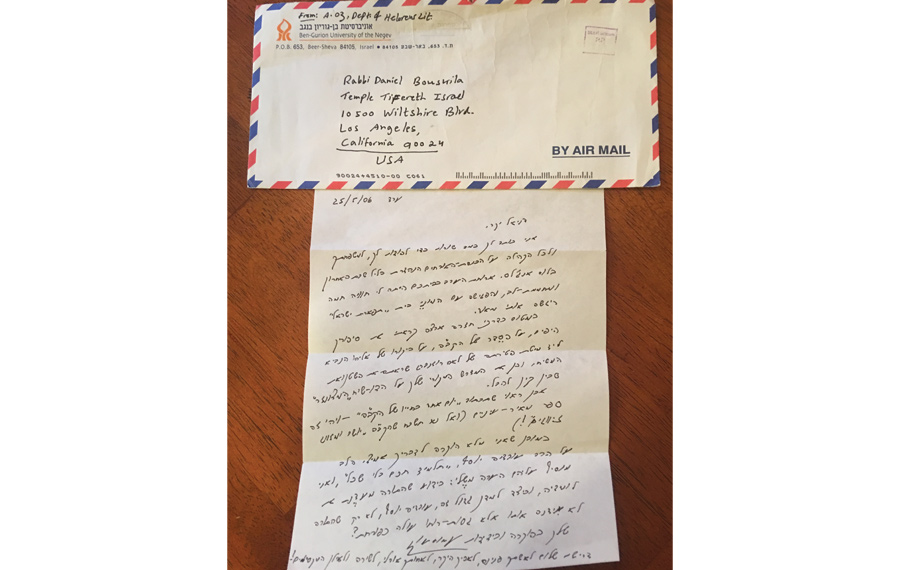
I’m sitting at my desk, painfully contemplating your untimely passing and trying to figure out how to express myself during this difficult moment. I want to write an article about you, but that’s so abstract and impersonal. Rather than writing the standard tribute, I decided to write this letter, from one friend to another. After all, it was through our letters — handwritten on small pieces of nondescript paper and airmailed in envelopes lined with red, white and blue — that you and I communicated for so many years. In those letters — written in your beautiful Hebrew handwriting with the crooked paragraphs that never properly aligned with the page’s margins — we exchanged ideas on Hebrew literature, the theology of Agnon and life in general. We freely expressed ourselves, explored new ideas and deepened our friendship. 

It’s not surprising that letter writing was such a powerful medium of communication for you. You elevated letter writing to an art form in your novel “Black Box,” whose diverse characters interact by writing letters to one another. You ingeniously showed us through the seemingly simple act of writing letters that one can construct an intriguing plot, develop characters in depth and transform mundane details of life into meaningful expressions of innermost emotions. 

You taught me how to appreciate those tiny details within a half-hour of when we first met. I had picked you up at Los Angeles International Airport on a Friday afternoon, and within a few minutes we were talking about what became our shared passion — the literature and persona of S.Y. Agnon. I was so engrossed in our discussion that I did not notice I had exceeded the speed limit. But a traffic cop noticed. There I was, with my literary role model in my car in our first-ever meeting, pulled over for a speeding ticket!

Once we parted ways with the friendly traffic officer, you remarkably put me at ease by saying, “I wonder if anybody actually reads all of the small, printed details on these traffic citations?” I looked over at you, wondering where you were going with this. “After all,” you continued in your poetic Hebrew, “somebody somewhere took the time and effort to painstakingly write this text. Somebody should honor that person by at least reading what they had to say.” Only you, Amos, a kind soul who reveled in the small, printed details of life, could remind me that behind the text of a speeding ticket is a person who took the time to compose it. Only you, Amos, a brilliant master of transforming mundane situations into exciting events, could elevate the annoyance of a speeding ticket into a potentially meaningful literary moment.

Your treatment of my speeding ticket reminds me of what you did in your masterful memoir “A Tale of Love and Darkness,” when you described with such loving detail the buildup toward the one phone call your family made every two to three months from Jerusalem to Tel Aviv. With charm, wit and humor, you said, “I don’t remember whether we put on our best clothes for the expedition to the pharmacy, for the phone call to Tel Aviv, but it wouldn’t surprise me if we did. It was a solemn undertaking.” 

Your sensitivity toward the author behind the speeding-ticket text reminds me of another story you tell in “A Tale of Love and Darkness,” about the moral dilemma over selecting which cheese to buy at Mr. Auster’s grocery shop, the kibbutz cheese made by the Jewish cooperative Tnuva or the Arab cheese produced in the nearby village. Like the speeding ticket, behind each block of cheese stood people who produced it, and your dilemma expressed a personal sensitivity toward each of them.

That’s what made you such a great author, my dear friend, your sensitivity toward people and your deep interest in their personal lives and feelings. You were a great author, not only because of your literary talents and creative genius, but because you spent a lot of time listening to others. 

I experienced your gift as a listener at my own Shabbat dinner table, when I saw how you interacted with my family, especially my children. You told my then 10-year-old daughter, Shira, that you wrote stories for a living, and you asked her if she had any good stories to tell. “I just wrote a short story,” she said. “Well, Shira,” you replied, “I would love to hear it.” 

Shira brought the story to the table, and for the next eight minutes we all listened to her choppy first attempt at narrative fiction. You sat there patiently, with your eyes closed, attentive to every single word. As she finished reading the story — which included a character named Victoria who had discovered a dead body — your reaction was not a standard “Good job; I really enjoyed it. Keep writing, kid.” Instead, you looked at Shira and treated her as your peer. “Shira,” you said, “from the time Victoria discovered the dead body until she reported it to the police, I would have wanted to know a bit more about how she reacted and what she felt. Did she cry? Was she afraid? Did she tremble? I think you need to fill those gaps so we get to know Victoria more personally.” How amazing that you, an internationally famous author, paid such a huge compliment to my little daughter by taking her seriously, listening to the details of her story and critiquing it with constructive suggestions.

“You were a voice of social justice, and you taught us what it means to use words in a constructive fashion to combat racism, xenophobia, extremism and zealotry.”

In the same way you listened to Shira with care and respect, you listened to the voices of so many others. You were the master of penetrating the minds and souls of the “Israeli next door.” You invited us into their little shops, their kibbutz fields, their living rooms, their bedrooms and their hearts. In your novels, we never read sweeping epics romanticizing Israel on a grand scale. Instead, you chose to explore for us the internal struggles, triumphs, fears, romances, aspirations and disappointments of the average Israeli.

In your dark novel “My Michael,” you took us on a painful journey through Hannah Gonen’s loneliness and depression. Many years later, we learned that Hannah’s struggle was a lens into your beloved mother’s bouts with depression. The very titles of some of your novels, short-story anthologies and collections of essays — “Between Friends,” “Scenes from a Village Life” and “Here and There in the Land of Israel” — speak to the personal dimension of Israeli life that you opened up for us. As such, you were the poet of Israel’s inner soul. Through your pen and pencil (I know you wrote with both!), you gave voice to the people of Israel, one person at a time.

I admire you for your courage and strength to always speak your mind, especially when it went against the flow. You respected everyone but feared no one. You were a voice of social justice, and you taught us what it means to use words in a constructive fashion to combat racism, xenophobia, extremism and zealotry. While the common talk in Israel is often about the next war, you dared us to think differently and envision peace. In that sense, my friend, you were a modern-day prophet, making your death that much more painful for all of us. 

I know you did not define yourself as a religious person, but as I once told you during a deep discussion about Agnon we had in a Palo Alto hotel lobby, if the definition of “religious” can include those who challenge and question God, then you, Amos — like Agnon — had a deeply religious soul.

As I write this final letter to you, I do so with the painful awareness that, this time, I don’t expect a response. I don’t know how much postage it would take for this to reach heaven, but I do know that if there is a heaven, you are certainly there. If heaven exists, then you most definitely are in its literary salon, already engaged in deep conversations with Tolstoy, Chekhov, Brenner and Agnon, your literary peers. 

The world has lost a literary giant, and Israel has lost her voice of conscience. As for me, I have lost a dear personal friend.

With eternal love and admiration,

Daniel


Rabbi Daniel Bouskila is the director of the Sephardic Educational Center and the rabbi of the Westwood Village Synagogue.

My Letter to Amos Read More »

Political Times They Are a-Changin’

Election seasons are like black holes. They devour everything, eliminate all other topics of concern, take over conversations, dominate the agenda like nothing else — except wars. Election seasons fill our brains with political gossip, petty trickery, unnecessary trivia. 

Like a horse race, it’s interesting when the horses are running but feels somewhat hollow after the winner crosses the finish line. So much time spent, attention diverted, minds preoccupied, so little substance.

And yet, election seasons can be a beneficial time if we look not just at the fluctuation of polls (read about the polls on the almost-daily online updates of Rosner’s Domain) but also at the underpinning trends that dominate the race. In Israel, these trends — in this election cycle — seem to suggest a paradox: On the one hand, we see fragmentation, or maybe it’s more appropriate to call it atomization, of the political system. On the other hand, we see old divisions disappear, and a relative consensus emerges. 

Take, as one example, what happened on the night of Dec. 28, when two ministers, two political leaders, announced that they were leaving their party, The Jewish Home, to establish their own party, The New Right. By doing this, Education Minister Naftali Bennett and Justice Minister Ayelet Shaked added another split to an already splintered political arena. They added another right-wing party to a crowded field of such parties. And yet — here lies the paradox — they also declared the end of an era, or at least attempted to make such declaration. They declared an end to the era of religious-secular sectarianism.  

Once Naftali Bennett and Ayelet Shaked realized that The Jewish Home Party limited their horizon, the two leaders jumped ship.

Let me explain: The Jewish Home, the party that made Bennett and Shaked, is the historical vehicle of religious-Zionism. It used to be called Mafdal, acronym of Miflaga Datit Leumit —  the religious national party. For seven decades, Israelis belonging to this sector voted in great numbers to this party, that in return focused on sectorial interests — more funds for religious schools, more accommodation for Hesder Yeshivas, more legislation that favors the settlers. This was a fine arrangement for a group that felt like a vulnerable minority but started to feel awkward and misplaced when religious-Zionists started to play a much more pronounced role as leaders in all Israeli institutions. 

Bennett and Shaked identified the changing times and wanted to turn The Jewish Home into something else, less sectorial, more cross-over. They failed. The DNA of The Jewish Home is one of sectorial politics, and it proved resistant to dramatic change. 

Bennett and Shaked have little interest in being the leaders of a sector. They entered politics to reach the top. And once they realized that The Jewish Home Party limited their horizon, by insisting on playing the old sectoral politics of religious-Zionism, the two leaders jumped ship. A bold and risky move — but one, if successful, of significance beyond the race horse.

According to early post-split polls, The New Right is going to attract many Israelis that used to vote for The Jewish Home. The message of religious-secular party, a post-sectorial party, resonates with these people who are no longer an endangered minority in need of special protection. Thus, the split could signify a new merge. The split is just a way to abandon the old religious-secular split to create a new partnership that no longer makes the yarmulke (or lack thereof) a defining feature of political vote. 

And this is just one example of an old political Israel that is cast aside as times change. Yesh Atid is a party of secular and religious, a party of centrism. Kulanu is a party of centrism. Gesher, a new party of Orly Levy Abekasis, is a party of centrism. These parties cast aside the old definitions of right and left, as does the new party of former generals seems to be positioning itself in a similar manner. Sure, this is partially because the “left” is no longer a viable currency in Israel’s politics, so everybody must rush to the center. But make no mistake: this is not just tactics. If General Gantz (considered to be more to the left) and General Yaalon (a longtime rightist) can form a party together it is because the traditional sectors and splits are dying.

Political Times They Are a-Changin’ Read More »

Guy Serussi: The Kid Attorney

The Jewish state has the dubious honor of having the most attorneys per capita in the world. One out every 100 people in Israel is a lawyer, and Guy Serussi, a whip-smart, upstart attorney with a heart of gold is one of them.

Serussi’s legal career has been in high gear since his teens. He knew he wanted to pursue law after seeing the 1999 Denzel Washington movie “The Hurricane,” based on the true story of Rubin “Hurricane” Carter, a boxer wrongly imprisoned for murder.  

After being drafted into the military, Serussi’s army career was blighted by a knee injury and he was demoted to a clerical role in an office. 

“In my view, litigation is the best self-expression a lawyer can have. Being in court takes all your skills and tests them in real time.” — Guy Serussi 

At the time, Serussi, a Ramat Gan native of Libyan and Ladino stock, said he felt “totally hopeless.” However, it wasn’t long before he decided that instead of wasting his time pushing pens, he might as well start studying for a law degree, even though it’s rare for Israeli teens to begin higher education just after graduating from high school, and almost unheard of while still in the army. But, Serussi said, “I was bored and I had a lot of time on my hands.”

By the time he was 25, he had undertaken his internship, passed the bar, earned a master’s degree in political marketing and government, and was working at a firm specializing in civil and commercial litigation. 

Now 27 (an age when most Israeli law students are just about to graduate), Serussi has his own firm with divisions in real estate law, corporate law and his favorite, civil litigation.

“In my view, litigation is the best self-expression a lawyer can have,” Serussi said. “Being in court takes all your skills and tests them in real time.”

Did it bother him that the legal field is so saturated?

Serussi laughed. “My lawyer number is 76909,” he said, referencing his registration with the Israel Bar Association. “But I believe that if you’re good at it and you have passion, there’s room for everyone.”

Serussi decided 10 to 15 percent of his firm’s cases would be pro bono, “because it makes me feel good and I also believe that the good will come back.”

He gave an example of a client who approached him about a rogue tenant who wouldn’t evacuate an apartment owned by the client’s deceased mother. The bereaved man, who had inherited the apartment, had no money to pay Serussi, but the lawyer helped him at no cost and managed to get the tenant evicted. 

“One week ago, I received a phone call that his brother-in-law wants to sell his house for 10 million shekels ($2,700,000) and he needs a lawyer,” Serussi said. “You just never know what door is opened when you [help] someone.”

Serussi’s latest project seeks to help young lawyers by sharing the experiences, wisdom and tips of some of the greatest legal minds in the country. Called “Short Sentence,” the initiative sees Serussi interviewing venerable powerhouses: attorneys who founded some of Israel’s biggest firms and who boast a client base that runs the gamut from the military-industrial complex to the prime minister himself.  

“I listen to these lawyers telling me the do’s and don’ts of [the profession],” Serussi said, “and I think one day, I want to be like them.”

Guy Serussi: The Kid Attorney Read More »

Airbnb: Bed and Breakfast on Homophobic Land

On Nov. 19, Airbnb issued a press release announcing it was “removing listings” in “Israeli settlements in the Occupied West Bank.” The announcement was met with outrage by many Israelis and Jews around the world. The company’s decision came after a long coordinated and well-financed campaign led by multiple groups (including the misleadingly named Jewish Voice for Peace, Code Pink and others), many of which reject peaceful solutions altogether for the Israeli-Palestinian conflict.

That being said, the most prominent group that led the campaign was Human Rights Watch (HRW), an issue for which HRW lobbied for at least two years. As an Israeli citizen, I am critical of the settlements myself, but I find this campaign and the decision of Airbnb, an online accommodation and vacation company, troubling.

But as a queer person, I find it hurtful and immoral. NGO Monitor highlighted that HRW, a nongovernmental organization, notes Airbnb’s policy regarding discrimination, which allows individuals to “make accommodation distinctions based on, for example, marital status, national origin, gender, or sexual orientation” when this is in adherence to local laws (for places outside of the United States and European Union), and even states, “Should it prove impossible for hosts of a certain area to list properties on a nondiscriminatory basis … Airbnb should disallow listings in that area.”

Although I started to read HRW’s report about Airbnb because I am an Israeli, I quickly realized that Airbnb’s policy is not only discriminatory toward Jewish Israelis, but also toward the LGBTQ community. As a queer person, I was disturbed and furious about HRW’s agenda and the organization’s complete disregard to the real discrimination that is at play. HRW didn’t pressure Airbnb about the 72 countries where being LGBTQ is illegal or the eight countries (seven of which have listings on Airbnb, and Iran, where Airbnb is looking to expand), where being LGBTQ can result in the death penalty and where transgender individuals are oppressed in the most horrific ways. It only pressured Airbnb about Israel, and wrongly so.

Outside of the settlements that were subjected to Airbnb’s new policy, within Palestinian society, families tend to see homosexuality, cross-dressing and transgender behavior as immoral acts against God, deserving of condemnation. A Pew study published in 2013 revealed the extremely homophobic attitude that prevails in Palestinian society, where only 1 percent of Palestinian respondents believed that homosexuality is morally “acceptable” behavior (countries with similar results included Egypt, Pakistan, Ghana, Nigeria and Uganda). Some LGBTQ Palestinians have relocated to Israel, often fleeing harsh intolerance that includes being physically abused, disowned and even murdered. In Gaza, gay men have been thrown off of rooftops and dragged through the streets tied to motorcycles. 

However, the Palestinian territories are not the worst places for LGBTQ people. There are far worse countries where gender identification and sexuality often come at a heavy price, countries where Airbnb’s policy actively protects LGBTQ-phobia. In a region where gender segregation is widespread and dress codes are mostly enforced by law, where much of the social structure is based on the distinction between men and women, anything that challenges the status quo is tackled violently. Airbnb’s policy is that LGBTQ-phobic hosts are allowed to discriminate against users in this region.

Culturally, there is no tolerance for transgender people in the Middle East. The most horrific government in the Middle East for LGBTQ people is in Iran, where Airbnb is looking to provide accommodations listings. The Iranian government’s wel-coming of transgender people contrasts dramatically with its criminalization and severe punishment (often the death sentence), of homosexual activity. In Iran, gay men are encouraged to undergo gender reassignment, as the alternative is punishment and ultimately death.

As of 2008, Iran carried out more forced gender reassignment operations than any other nation in the world. This is while same-sex sexual activity is legally banned, in accordance with the Shiite version of Islamic law. Homosexuality is punishable by death in the Islamic Republic. As Iran’s President Mahmoud Ahmadinejad said in 2007, when asked about Iranian homosexuals, “We don’t have this phenomenon in Iran.”

HRW also disingenuously discusses Egypt, where local laws could be interpreted to exclude same-sex and unmarried couples, but isn’t “aware of cases in which Airbnb hosts there faced official sanctions for renting properties to unmarried or same-sex couples.”

But in Egypt, according to Egyptian medical sources, almost all reassignment surgeries are female-to-male. This is due to the fact that trans women fear being associated with the stigma of homosexuality. This is the opposite from the situation in Iran, where the men feel pressured to undergo gender reassignment. However, this discrimination toward the LGBTQ community in Egypt is not mentioned in the HRW report.

My first reading of the HRW report was because of its campaign against Israeli settlements, however, as I read through this report, I realized that this campaign is not just wrong at its core, it is also wrong in the way it provides a cover-up for LGBTQ discrimination and human rights violations. Discrimination isn’t and can’t be selective; you cannot stand up for a specific political cause while ignoring all human rights violations and emboldening other forms of discrimination, specifically against the LGBTQ community.

I call on every LGBTQ person to condemn HRW’s deliberate belittling of our human rights and to boycott Airbnb until it changes its discriminatory policy. There is no moral justification for a company to profit from users that discriminate against LGBTQ people based on their gender or sexuality.


Hen Mazzig is an Israeli writer, public speaker and social justice activist from Tel Aviv. Twitter: @HenMazzig 

Airbnb: Bed and Breakfast on Homophobic Land Read More »

Why I Will Walk With the Women’s March

For all the anti-Semitism-based controversy roiling the Women’s March, we in Los Angeles who took part last year should have no crisis of conscience about doing so again on Jan. 19. Women’s March Los Angeles is separate from the national group. Many participating Jews incorporate observing Shabbat around the march (booking rooms downtown, davening early).

But what is happening with the national march committee? Ominous conversations about anti-Semitism have gone public. Jewish women, including members of Bend the Arc and the National Council of Jewish Women continue to have urgent meetings with the national leadership team to address issues of anti-Semitism and racism, trying to call one another in (not call one another out). Linda Sarsour, a Women’s March board member, found it necessary to issue an apology, stating, “We should have been faster and clearer in helping people understand our values and our commitment to fighting anti-Semitism. We regret that. Every member of our movement matters to us — including our incredible Jewish and LGBTQ members. We are deeply sorry for the harm we have caused, but we see you, we love you, and we are fighting with you.”

The Unity Statement for the national march includes, “We must create a society in which all women — including Black women, Indigenous women, poor women, immigrant women, disabled women, Jewish women, Muslim women, Latinx women, Asian and Pacific Islander women, lesbian, bi, queer and trans women — are free …” Yet some are saying that this is not enough. What happened and how should we respond? No one ought to expect that members of a broad coalition agree about every issue. What lines should not be crossed?

One key point: My governing assumption here is that Jews necessarily have an interest in intersectional politics, because we live at intersections: We are Jews and women, Jews and queer, Jews and people of color and, yes, Jews and working class. Just as each woman is a woman. Intersectionality represents the principle that none of us is free unless each of us is free. We who annually celebrate our delivery from slavery and the command to love the stranger are bound by that.

We must never forget that those movements intersect in the bodies of Jews of color for whom we are obliged to stand.

Two key issues around the march have been crystalized in conflicts with personalities, that of Sarsour and National Co-Chair Tamika Mallory. Sarsour is adamantly opposed to Israeli government policies and supports the boycott, divestment and sanctions (BDS) movement against Israel. She also has raised thousands of dollars to aid American-Jewish communities whose cemeteries have been desecrated, and built strong personal friendships with Jewish women. 

Regarding Sarsour, either one agrees with her that it is possible to support the BDS movement while not being anti-Semitic, or one does not. (I believe that it is possible.) If one believes that anti-Zionism necessarily equals anti-Semitism, then either it is acceptable to participate in a march with a leading organizer who holds an unconscious bias against oneself, as long as that the organizer commits to dialogue with Jewish people — or it is not. (I believe that it is.)

The conversations with Mallory that have emerged raise crucial issues about racism and anti-Semitism; about where movements on behalf of people of color, black people specifically, and Jews ought to intersect. Above all, we must never forget that those movements intersect in the bodies of Jews of color for whom we are obliged to stand.

The problem is that Mallory, a Christian, has a longstanding relationship with the Nation of Islam (NOI), whose leader Louis Farrakhan stands firm in his ideologically driven hatred of Jews, lesbians, gays and gender non-conforming people. This puts Farrakhan at odds with most of the march’s Principles of Unity. Yet Mallory won’t disavow her working relationship with Farrakhan or the NOI, which practices an adulterated Islam, unacceptable to mainstream Muslim thinkers. 

Adam Serwer, a biracial, black Jewish man has written an indispensable article for The Atlantic on this question. As “unworthy” of Mallory’s loyalty as he finds Farrakhan to be, Serwer points out that, for serious organizers within black communities, the NOI is impossible to dismiss. “But many black people come into contact with the Nation of Islam as a force in impoverished black communities — not simply as a champion of the black poor or working class, but of the black underclass: black people, especially men, who have been written off or abandoned by white society. They’ve seen the Fruit of Islam patrol rough neighborhoods and run off drug dealers, or they have a family member who went to prison and came out reformed, preaching a kind of pride, self-sufficiency, and entrepreneurship that, with a few adjustments, wouldn’t sound out of place coming from a conservative Republican. The self-respect, inner strength, and self-reliance reflected in the polished image of the men in suits and bow ties can be a powerful sight.”

Farrakhan also has indicated that he regards Jews to be a demonic force, the masterminds behind the social transformation of sexuality and gender in our world. This means that we should not mistake Farrakhan’s ravings for “anti-Semitism of the left.” Farrakhan is a deeply conservative demagogue who advocates male supremacy and retains a touching faith in unregulated capitalism despite what it never did for his people. (Think of him as a black Jordan Peterson, and it all snaps into place.)

The generation that created Black Lives Matter, a movement led by queer, black women articulating an intersectional politics that speaks to race, class, sexuality and gender, will render Farrakhan irrelevant soon enough — if that generation takes up the work of connecting with prisoners, addicts and other marginalized people. This applies to religious progressives of all traditions — including Jews.

Interestingly, Farrakhan’s fantasy of powerful Jews pulling invisible strings echoes a trope that drives today’s white nationalist movement. As Erik K. Ward writes in his insightful article “Skin in the Game,” “Antisemitism forms the theoretical core of White nationalism.” When white nationalists chant “Jews will not replace us,” they mean that, just as Farrakhan believes that LGBTQ people are being secretly manipulated by a Jewish cabal, so, too, are people of color and immigrants who, the racists believe, could never organize to defend their interests on their own and are being driven by Jews into “replacing” white people within job markets and neighborhoods from which they’ve been previously excluded.

So Jews have a stake in intersectional politics. Who benefits if the Women’s March, a key site of the anti-Trumpism, pro-democracy resistance, is fractured? What would be the point of turning away from urgent conversations among people who wish to build a world in which we are all free to practice our traditions, earn a living and breath clean air?

As my friend and teacher, Rabbi Rachel Adler says, “I’ve had lectures from many Jewish men about boycotting the Women’s March. They seem oblivious that Jewish women share the gender oppressions the Women’s March protests, even the privileged segment of Jewish women who are heterosexual and white. None of the men who demand that we boycott the march have pledged to help us eradicate sexual harassment and assault, pay inequities or glass ceilings in Jewish camps, schools, synagogues and communal institutions — or volunteered to examine their own disrespectful gender practices: interrupting women while they speak, appropriating women’s words and ideas, [making] intrusive comments on appearance and clothing or unwanted touching. I will go to the Women’s March as the Jewish woman I am with my kippah on my head. Possibly I’ll get ignored or disrespected or tossed out. But I’ve a lifetime of practice dealing with all that with Jewish men.”


Rabbi Robin Podolsky teaches at Cal State Long Beach, writes for Shondaland, and blogs at jewishjournal.com/erevrav

Why I Will Walk With the Women’s March Read More »

First Step or Last Step?

It seems as if all of political D.C. has broken out in song over the First Step Act of 2018. Finally, a bipartisan piece of legislation that not only passed both houses of Congress but also was signed by President Donald Trump. This law-and-order president signed criminal justice reform legislation that was put forward by conservative Republicans and also embraced by liberals such as Sen. Cory Booker (D-N.J.). 

It’s not hard to understand why there is a desire to celebrate. In a month that included two children dying while in the custody of U.S. Customs and Border Protection; Trump glorifying the government shutdown because $5 billion wasn’t earmarked for his border wall; Border Patrol officers shooting tear gas into a crowd that included pregnant women and children; U.S. culpability in the ongoing Saudi massacre in Yemen being revealed to the American public; and an early spring cleaning of Trump administration officials, we all need something to celebrate. 

We have to ask, however, should we celebrate this bill? 

The Trump administration’s record on criminal justice reform is less than stellar. Vox reported that under the leadership of Attorney General Jeff Sessions, the Justice Department pulled back investigations into local police departments that exposed abuses in places such as Ferguson, Mo. Sessions rescinded a Barack Obama-era memo that told federal prosecutors to avoid charges for low-level drug offenders that could trigger lengthy mandatory minimums. In addition, according to a statement by Sen. Dick Durbin (D-Ill.), Sessions has “reversed key prison reforms,” such as reducing the use of restricted housing and private prisons and improving education opportunities and re-entry services. 

On the other hand, the reformers say, Sessions is now gone and the First Step Act reduces the sentencing disparity between crack and powder cocaine; it reauthorizes the reforms of the Second Chance Act of 2007, thus providing funding for some re­entry programs; it goes a little way toward easing mandatory minimums; and increases access to education programs that can result in reduced sentence time, conditional upon an assessment and review by the attorney general. 

The bill impacts only a small minority of prisoners in the federal system, which holds a minority of the prisoners in the country.

This is the rub. There’s overwhelming evidence that assessment tools used to determine if a prisoner likely will reoffend are biased against communities of color (especially African­-American communities). They also have a high proportion of false negatives, that is, research shows that in many cases where the algorithm would have determined that an incarcerated person should not be released because they were at high risk of re­offending, in truth they didn’t re­offend. (The algorithm was tested on released prisoners.) This has to do with the fact that many algorithms take into account how many times a person has been arrested.

African-Americans are arrested at disproportionately higher rates, which skews the outcomes of the assessment tool. This and other serious issues have brought some leading civil rights organizations to oppose the First Step Act. 

There is a more significant problem with this act. Although it’s called the First Step Act, there is a serious danger that it would become the “Last Step Act.” First, the bill impacts only a small minority of prisoners in the federal system, which holds a minority of the prisoners in the country (California, for example, holds about as many prisoners as the federal system). More importantly, the bill doesn’t focus on the root causes of mass incarceration. 

Incarceration rates are not evenly divided across the country. A minority of counties account for the majority of incarcerations. In fact, the majority of the population of American prisons is derived form only a minority of neighborhoods. There is a correlation between those high incarceration neighborhoods with segregated housing and lack of funds for education and development. We’re not dealing with a problem that we can solve with a flawed Band-Aid. How many schools, hospitals, affordable housing units, teachers and restorative or reparative justice programs could we be supported with the $5 billion that Trump demands for his delusional wall obsession? 

Hopefully, when the next Congress takes office, it will have the vision and courage to address the problem of mass incarceration in a systemic and effective fashion.


Rabbi Aryeh Cohen is a professor of rabbinic literature at American Jewish University. His latest book is “Justice in the City: An Argument from the Sources of Rabbinic Judaism.” 

First Step or Last Step? Read More »