fbpx

January 2, 2019

Wintry Floating Candle Centerpieces

One of the most elegant ways to bring warmth to a table setting is floating candles. Nestled in cylinder vases, the candles are suspended in water above flowers or branches, casting a gentle glow over the surroundings. These types of candle arrangements are popular centerpieces at weddings and other formal affairs, but they are easy to adapt for your own home for any occasion.

For winter, I filled the vases with simple twigs for a stark yet classic look. Best of all, the twigs were from my yard and, therefore, free.

What you’ll need:
Glass cylinder vases
Twigs
Water
Floating candles

1. Floating candle centerpieces look best when you use a set of three or four vases in various heights. Look around the house to see what you have handy, or pick up some inexpensive vases at the dollar store or places like Michaels or Marshalls. Just be sure that the openings of the vases are large enough to accommodate your floating candles. 

2. Position a cluster of twigs in the vase. If you pick a cluster that’s wider than the vase, the twigs will squeeze in and hold tightly against the vase wall so that they don’t float when water is added. Trim the top of the twigs so there is room at the top of the vase for the candle.

3. Pour water into the vase, and place a floating candle on top of the water. You’ll see that the water magnifies the twigs beautifully. Keep in mind that floating candles are designed specifically to float on water — don’t use regular candles for this purpose. They are typically three inches in diameter, and you can find them at Michaels and Bed, Bath & Beyond.  


Jonathan Fong is the author of “Flowers That Wow” and “Parties That Wow,” and host of “Style With a Smile” on YouTube. You can see more of his do-it-yourself projects at jonathanfongstyle.com.

Wintry Floating Candle Centerpieces Read More »

The Last Word on Fanaticism From Amos Oz

What better way to honor the late Amos Oz, who died Dec. 28 at age 79, than by pondering his most recent book, “Dear Zealots: Letters from a Divided Land” (Houghton Mifflin Harcourt)?

Published in an English translation by Jessica Cohen barely a month before the author’s death, “Dear Zealots” is a brief valedictory by the revered Israeli author, whose life’s work included 17 novels (ranging from “Where the Jackals Howl” to “Judas”), eight works of nonfiction (ranging from “In the Land of Israel” to “Dear Zealots”) and two books for children.

“Dear Zealots” reflects the courage and candor that has characterized all of Oz’s work and, perhaps more importantly, his role in public life, both in Israel and the Diaspora. According to the author himself, his new book “seeks the listening ear of those whose opinions differ from my own,” an oblique acknowledgment that Oz found himself increasingly beleaguered in his own country as the pioneering vision of the founding generation of Zionists, who were predominantly secular and socialist, was overtaken by the increasingly aggressive stance of the political and religious right.

“They called me a traitor,” Oz once quipped. “I’m in good company.”

As recently as last April, for example, Oz reaffirmed his belief in the rightness of a two-state solution: “I don’t know what the future holds for Jerusalem but I know what should happen,” he told a German television interviewer. “Every country in the world should follow President Trump and move its embassy in Israel to Jerusalem. At the same time, each one of those countries ought to open its own embassy in East Jerusalem as the capital of the Palestinian people.”

Significantly, the very same stubborn insistence on speaking truth to power can be found in his latest and last book. “Many people forget that radical Islam does not have a monopoly on violent fanaticism,” he writes. “The Israeli government [dumps] the Palestinians’ fight to cast off Israeli occupation into the same junkyard from which fanatic Muslim murderers regularly emerge to commit horrors around the world.”

Oz was not always an advocate for rapprochement between Arabs and Jews in Palestine. “As a child in Jerusalem, I myself was a little Zionist-nationalist fanatic — self-righteous, enthusiastic, and brainwashed,” he writes of his experiences under British occupation in 1946 and 1947. “In my novel ‘Panther in the Basement,’ I retold the experiences that revealed to me, as a child, that sometimes there are two sides to a story, that conflicts are colored not only in black and white. … Much later, I learned to take comfort in the thought that, for fanatics, a traitor is anyone who dares to change.” 

“At the heart of Amos Oz’s last book is his insistence that, even though there are surely some fanatics among us, the core value of Judaism is argument rather than true belief, defiance rather than submission to authority.”

At the heart of Oz’s little book is his insistence that, even though there are surely some fanatics among us, the core value of Judaism is argument rather than true belief, defiance rather than submission to authority. “Moses could tell you how unaccustomed the Israelites are to being obedient,” Oz writes, and he reminds us that Abraham speaks out for the sinners of Sodom in the Torah: “He looks up to the heavens and utters what might be the boldest words in the Bible, if not in all of the history of religion: ‘Shall not the Judge of all the earth do justly?’ ” Exactly here he finds the scriptural basis for what he calls “the anarchist core, the rebellious gene that has flickered for thousands of years in Jewish culture.”

Surely, Oz intended to remind us of the irony to be found in the role of religious Zionists in Israeli politics today. Leveraging their ability to make or break a majority in the Knesset, they seek to enforce a strict code of belief and behavior on all Jews while, at the same time, arguing that the boundaries of Eretz Yisrael as described in the Tanakh ought to govern the statecraft of Medinat Yisrael, the country that actually exists in the here and now. But Oz points out that Jewish history and Jewish nature actually work against religious authority.

“It is no accident of history that the Jews do not have a pope,” he writes with characteristic charm and wit. “If someone were to stand up and declare himself, or herself, ‘the Jews’ pope,’ each of us would go up and tap him or her on the shoulder and say, ‘Hey, Pope, you don’t know me, but my grandma and your aunt used to do business together in Minsk, or Casablanca, so please sit down for five minutes — just five — while I explain to you once and for all what God wants us to do.’”

Oz suggests that the conflicts in Israel were inevitable because of the circumstances of its birth. “The State of Israel is the child of a mixed marriage … born from a merger of the Bible with the Enlightenment,” he argues. “Israel cannot be forcibly ‘Judaized.’ ” And he invites us to imagine the consequences if the biblical maximalists were successful.

“Let us say that they managed to annex all the occupied territories, eliminate all the Arabs once and for all, and cut Europe and America down to size,” he proposes. “Would this make things better for the Jewish people? Or would it perhaps bring total devastation upon us, much as our zealots have done before, more than once?”

Yet Oz actually holds his fellow Jews to the very highest moral standard, one that he regards as literally rooted in the soil of the Holy Land. “More than three thousand years ago, there was a culture here that saw fit to demand from the strong that they respect the weak,” he writes.  “It demanded not only charity (tzedaka) but also justice (tzedek) — the two words in Hebrew, unlike in other languages, are closely connected.  It demanded this justice not only from rulers, but from every human being.”

“Dear Zealots” seeks to answer the question that Oz himself poses on the very first page: “How does one cure a fanatic?” His answers will be uncomfortable to some readers, although no one who has read his earlier books will be surprised by his last testament, so sure-handed and stirring.


Jonathan Kirsch, author and publishing attorney, is the book editor of the Jewish Journal.

The Last Word on Fanaticism From Amos Oz Read More »

Israeli Film Fails to Make Oscars Shortlist

Israel’s more than half-century courtship to win an Oscar for best foreign language film has been akin to the tale of an attractive young woman, often chosen as a bridesmaid, but never as a bride.

Since submitting its first entry and earning its first nomination — “Sallah” in 1964 — Israel has made the shortlist of top nominees 10 times, without ever catching the Oscar bouquet.

This year, tribal boosters can stop biting their fingernails anticipating the outcome. Israel’s entry “The Cakemaker,” a challenging film about bisexual affairs between German and Israeli lovers, was eliminated in the first round.

The list of nine semifinalists among entries from 87 countries, announced by the Academy of Motion Picture Arts and Sciences on Dec. 17, didn’t include the Israeli entry.

Since submitting its first entry and earning its first nomination — “Sallah” in 1964 — Israel has made the short list of top nominees 10 times, without ever catching the Oscar bouquet.

However, Israel has some lofty company among snubbed contenders. Looking at the entire history of the Academy Awards, the three countries that lead in the number of both nominees and winners in the foreign language category — Italy, France and Spain — all missed the cut this year.

Yet if the themes chosen by a country’s filmmakers reflect in some ways the interests of their movie-going public, the world’s fascination with the Holocaust, World War II and their aftermaths, has never been higher.

This year, eight countries submitted films that deal directly or indirectly with the fate of Europe’s Jews during their darkest period, including Austria, France, Holland, Poland, Romania, Russia, Slovakia and Switzerland.

None of these countries’ films made the shortlist, but of particular interest is Russia’s “Sobibor,” centering on the 1943 uprising in the notorious concentration camp, and Romania’s oddly named “I Do Not Care If We Go Down in History as Barbarians,” which focuses on the massacre of Odessa’s Jews by the Romanian military.

The list of the nine semifinalists will be winnowed to five and the nominees announced on Jan. 22. The winner will clutch the golden statuette at the Oscar ceremony on Feb. 24.

Israeli Film Fails to Make Oscars Shortlist Read More »

Orthodox Union’s ‘Torah LA’ Spotlights Strengthening Family Ties

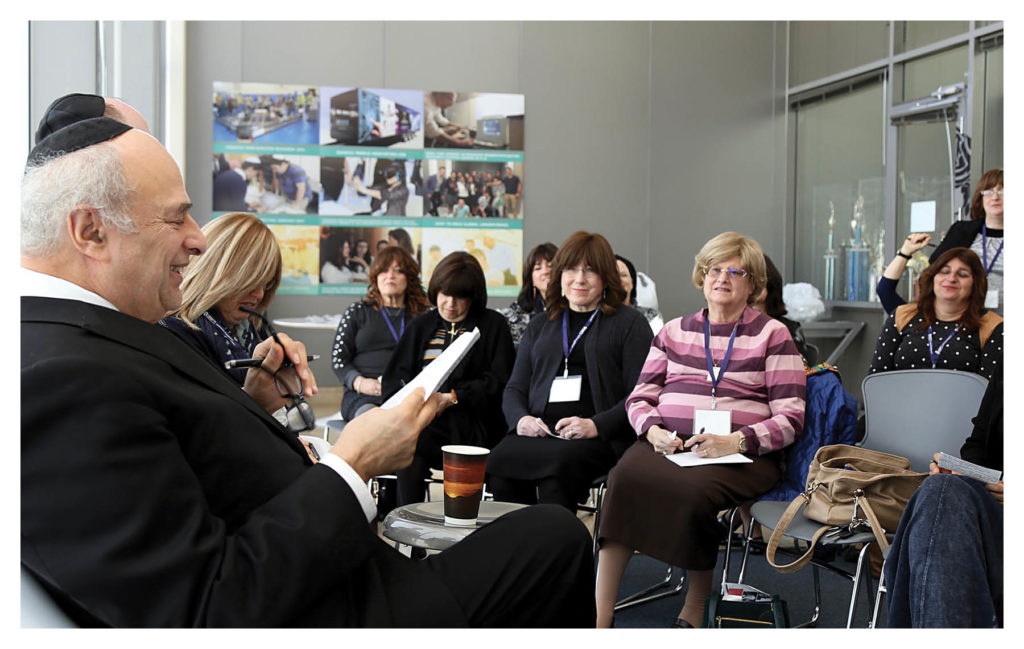
At a Dec. 14 Friday night tisch at Young Israel of Century City, Rabbi Moshe Weinberger of Aish Kodesh in Woodmere, N.Y., emphasized the need for people to devote more time to face-to-face encounters: between spouses, between parents and children and between individuals and God. 

Weinberger made his comments as part of the Orthodox Union’s second annual Torah LA project, held over the Dec. 14-16 weekend at synagogues throughout the city. The event culminated with a series of classes on Dec. 16 at Yeshiva University of Los Angeles Boys High School (YULA). 

This year’s theme was “Strengthening Our Families.” Steering Committee member Yaakov Siegel said of the theme, “We are all very focused on improving our family relationships and our best resource is guidance from Torah leaders.” 

Highlights of the day included Stern College for Women professor Rabbi Lawrence Hajioff, who spoke about achieving peace within marriage. The author of  “Will Jew Marry Me? A Guide to Dating, Relationships, Love, and Marriage,” Hajioff said the mindset of our disposable culture contributes to unhappy marriages.

“The three things that keep a marriage strong are healthy self-love, commitment and trust,” he said. “Strongly connected couples show ‘intentionality,’ so that instead of hugging for only two seconds, they hug for 10. Don’t be afraid to be the one who loves the most.”

In a session titled “Save a Family — Save a Dynasty,” Geraldine Weiner taught a section from the Book of Samuel, focusing on Avigayil, the wife of the cruel Naval, who refused to give the secretly anointed David and his army provisions as they ran for their lives from Shaul. When David vows to kill Naval, it is Avigayil who stops him. Avigayil also goes on to marry David. 

“[Avigayil] successfully used her many talents to negotiate a balance between the two conflicting sides of loyalty to her husband and family,” Weiner said. “She helped David succeed in his kingship and preserved his dynasty.” 

Addressing the subject of “Raising honorable menschen,” Dr. David Pelcovitz, the Gwendolyn & Joseph Straus Chair in Psychology & Jewish Education at Yeshiva University, listed three keys to success in parenting: letting children learn from their mistakes, keeping expectations high for moral and ethical behavior and conveying our values through our emotional reactions to things.  

“We are all very focused on improving our family relationships and our best resource is guidance from Torah leaders.” — Yaakov Siegel

“Everyone makes mistakes,” Pelcovitz said. “We rob our children of the ability to grow unless we let them fail and learn from their errors. Our children’s moral development depends on it. Saying, ‘You’re better than this,’ with calm and gentle disappointment but not anger, helps them develop morally.”

Parents should also convey confidence that their children can succeed, he said, noting, “If you believe in somebody and believe they have the ability to act a certain way, it can become self-fulfilling.” 

Pelcovitz also discussed helping children “build their ethical decision-making muscle” by talking with them about halachic and ethical dilemmas they have faced. He said doing so with his children and grandchildren has brought him closer to them.

Pelcovitz was also one of the presenters at a special session for rabbis’ wives on combatting spiritual apathy. He suggested rebbetizins could act as mentors by standing by a person, not over the person. “True connections grow between people when we allow them to be imperfect … and allow ourselves to be imperfect too,” he said. They do not grow if we seem to be trying to “force” spirituality on them.

Rabbis’ wives, who perform double and often triple duty with their own jobs, as mothers, and as unpaid counselors for their congregations, also need to carve out time for themselves. Said Pelcovitz, “Stillness and tranquility lead to spirituality.”

In summing up the theme of  “Strengthening Families,” Pelcovitz perhaps said it best when he spoke about fostering strong relationships with your children from an early age.

As a kid, Pelcovitz said he always was embarrassed when he won the “good middos” (character) award at camp, when most of the other kids valued the awards for sports.

“When my parents saw my reaction, they held up the award with tears in their eyes and told me, ‘This is everything to us.’ If parents show more emotion over material prizes than spiritual ones, they are sending the wrong message.” 

To watch videos of the presentations, visit ou.org/torahla.


Judy Gruen is the author of “The Skeptic and the Rabbi: Falling in Love With Faith.”

Orthodox Union’s ‘Torah LA’ Spotlights Strengthening Family Ties Read More »

Tevye’s Daughter Comes to America: A Rewriting of the Jewish Immigrant Narrative

Waves of Jewish immigrants washed up on the shores of the Atlantic at the turn of the century in the hopes of fulfilling the American dream, not imagining the harsh realities in store for them on the other side of the ocean. They saw their new country as the land of opportunity. Those were the stories they were told. 

Rosellen Brown’s remarkable novel “The Lake on Fire” (Sarabande Books) takes the familiar immigrant narrative of the newcomer imagining the “streets paved with gold” and tells a different story.  The main character, Chaya Shaderowsky, leaves her home in Zhitomir, Ukraine, in 1891. Her parents and four siblings move to ironically named Christa, Wis., to make a new Jewish life. Yet once she receives an education and sees her family’s utopic farm in Christa failing, Chaya abandons what she still barely knows. Along with her prodigious little brother, Asher, they strike out to make it on their own in the great city of Chicago.

This novel captivates the reader because it varies from the traditional narrative of the failure of the American dream. Typically, the tale involves a starry-eyed immigrant arriving to the land of opportunity only to discover most of these opportunities unavailable to them. “The Lake on Fire” is about someone who tries to bypass the traditional narrative because she sees holes in the story she is given. Chaya is not wide-eyed and naïve, but someone who is a little weary before she even makes the trip across the Atlantic. She talks about her skepticism when the dreamer from the village, Faivel the bookbinder, describes an Eden-like America:

 “They will give us tools and the animals we will need to start our new life, and bring us in a wagon and show us to our own spot of clean dirt.” … But the children had to wonder what he meant by “clean dirt,” the planting dirt he promised. Their mother and Chaya and the other girls had enough trouble keeping the house straight, swept, swabbed. There was no such thing as dirt that was not an affliction…

That the children see the problem with the story and ask intelligent questions are indications that the adults leading them on this expedition are dangerously unprepared. From the beginning, Chaya critically examines the excitement of her elders and the idea of “clean” transitions. She is not a dreamer with her head in the clouds. She knows that dirt connects to intense, detailed labor; dirt is dirt is dirt; the transition to America will therefore be messy. Her experiences of the difficulty of housework tell her that the shadow of “affliction” will follow her in making a new home in this strange country. 

Chaya’s blind spot is that she believes her awareness of the messiness ahead will still lead to a moderate amount of success. Clearly familiar with the tales of Jewish girls coming to the city and ending up working in factories, after Chaya arrives in Chicago, she attempts to avoid the pitfalls of her fellow émigrés slaving away in the garment factories. Chaya sidesteps the shmata business and takes a job in a cigar factory, yet the work proves to be almost as arduous: “her fingers were nicked and a urinous yellow, her back was in spasm when, the trolley clanging into the distance, she walked towards Liberty Street just before midnight.” The urinous yellow of her fingers metaphorically presents Chaya’s low state because the dirt is in fact not “clean.” While she may hear the “clanging” of the trolley, it is in “the distance;” she can only afford to walk. Ironically, Chaya walks down Liberty Street — a name that would have one think that this is a land filled with freedom — but she is captive to a job that holds her till midnight, giving her no opportunity to enjoy that freedom. The book is hard to put down because even at these points when Chaya is at her lowest, she is a compelling, inquisitive narrator who does her best to navigate the difficulties that face her.

The book is hard to put down because even at these points when Chaya is at her lowest, she is a compelling, inquisitive narrator who does her best to navigate the difficulties that face her.

Brown writes her novel on the shoulders of many Yiddishists who told stories about similar struggles of survival around the turn of the century. But while the elders like Faivel the bookbinder and Chaya’s parents fit the molds of older characters from Yiddish tales, Chaya’s voice feels unique, as if it belongs to the next generation of these stories. Instead of a Tevye-like jocular male narrator, we have a serious, young girl in the center of this world, trying to use the liturgy and her family’s traditions to find herself in a strange land.

In Sholom Aleichem’s “Tevye the Dairyman,” Tevye constantly fills his girls’ heads with stories and then, more often than not, a daughter selectively chooses lessons from these tales to do the opposite. The dream Chaya and Asher are fulfilling in Chicago is not just any American dream, but has roots in the concept of the Jewish dream of finding an autonomous homeland. And this dream also proves to be an idea promulgated by her elders without much foundation in the truth.

Brown’s novel has all the archetypes of the traditional Yiddish story: the father with his head in the clouds; the mother with her two feet planted firmly on the ground; and the child determined to abandon both of her parents’ worlds for a new frontier. Although the rift between parents and child grows wider, somehow the child makes a new start by ironically synthesizing the dreams of one parent with the practical nature of the other to forge a new path. Brown seems to have invented the character of Chaya to answer the question: What would Tevye’s daughters have done had he brought them to America? 

The answer is that her faith in her parents would wane while she spent her time trying to understand why their vision of America was unattainable. Their first dream, the hanging of a flag the community painstakingly created in Zhitomir with “Am Olam” embroidered on it and the phrase “Arise from the dust, throw off the contempt of the nations, for the time has come!” is literally torn to shreds when the immigrants try to raise it before their ship docks. While the elders mourn the destroyed flag, Chaya is angry at the false narrative that promulgated it: “Chaya was repelled by the spectacle of her respected elders reduced to gawking children, inept and unprepared .… Whatever it was he shouted when he ruined the flag, at that moment were they cursed? How else could the end have been written at the very beginning?”

From the first pages of the novel, Chaya tells us that the role of elder and child has been reversed and the ripped flag will somehow symbolize the end. She realizes that her parents’ version of the dream is doomed before it even begins, and the question she poses is less of a “how,” but a “why.” This moment of the tearing of the flag and the destruction of her hopes prompts Chaya to question whether their dream had been torn apart or whether success for her and her family was never really possible.

Against her parents’ wishes, Chaya rearranges the problematic narrative of a promised land she was given in order to create possibilities for her and her brother. Yet even in Chaya’s rewriting of this dream, Brown makes it clear that the fulfillment of any dream is more complicated than stories will have us believe. Transitioning between two worlds implies there will always be a shadow hanging over any new success one finds. Chaya flees Zhitomir, Ukraine, but the Wisconsin farm has the same shtetl.

After she arrives in Chicago, the first thing she asks is to be taken to “where the Jewish people live.” Brown ironically highlights the reality that Chaya will always be en-bubbled. Even after she begins rubbing elbows with the upper classes and thinks she has broken free, it soon becomes clear that the well-to-do are in their own bubble — their own shtetl if you will — one that is possibly more toxic than the one Chaya had inhabited.

When she goes on a shopping trip to a wealthy store and sees workers carrying a flag and picketing, her companion says, “Watching them is no help to anyone, it is only meant to depress us. We have work to do, too.” The way Brown cleverly parallels the different concepts of work for the poor and the wealthy shows how little those who succeed think about those without the opportunity to do so. When the shopping trip is complete, Chaya “had never in her life felt so shamed, and more so for her silence.” She had succeeded, but could not enjoy having climbed the ladder because it also meant she was part of the ranks of those who refuse to think about the less fortunate. Brown observes how, on some level, each element of society lives in its bubble and instead of individuals breaking free by popping them, they float from one bubble to the next. Chaya desperately tries to be part of two worlds, but finds it nearly impossible to forget the people she once worked alongside.

She actually offers a very Jewish solution: books and words. The Jewish people have always been the people of the book with a focus on education, and Chaya and Asher take to heart these elements of the heritage they received from their shtetl. 

“The Lake on Fire” is about the danger of telling stories that romanticize rising to the top because they bolster a false sense of reality. Brown repeatedly takes to task the particular tale of Cinderella, pushing readers to think about the pieces of the story we might be missing in this happily-ever-after tale. Before finding her upper-class fiancée, Chaya thinks: “I wonder if the prince loved Cinderella because he plucked her out of the ashes, not in spite of it. Because she was her terrible sisters’ servant while he was riding around the forests on the castle grounds and going to parties and drinking champagne and — whatever things they do at the castle. That would make a man feel much better about himself.” Chaya questions the entire premise of the fairy tale, wondering if the prince was even in love with the maid, or if he just wanted to feel better about an unfair universe that had made her a pauper and him a prince. Brown extends the traditional story and grounds it in reality by having the reader wonder if Cinderella would have been happy after the wedding day. What would have happened to her relationships with her poorer friends and would her royal family have accepted her?

There are many books about the failure of the American dream and the danger of believing in fairy tales, but Brown’s is different. She doesn’t just disparage the story people are told, but she actually offers a very Jewish solution: books and words. The Jewish people have always been the people of the book with a focus on education, and Chaya and Asher take to heart these elements of the heritage they received from their shtetl. Just as in “Tevye the Dairyman,” books are both the illness and the anecdote for the protagonists, who by consistently reading and educating themselves, are able to achieve their goals.

When the book describes the siblings’ finally achieving success, it says, “so they began their slow, word-by-word, page-by-page ascent into a life that would have been preposterous to imagine.” It was not hard work or luck that enable Chaya and Asher to rise in society’s ranks, but the attainment of a new language and the knowledge that came with it. The books they constantly steal and read and educate themselves with are what provide them with the foundation to enter the drawing rooms of high society, but also question the structures that support those rooms’ existence. Education expands the bubbles people live in and may be the one opportunity, Brown argues, that people have to see a bigger world, to transcend class systems. 

Chaya may read a great deal but she also decries the fact that the books she was given hadn’t prepared her for reality. Brown has written a book about being weary of the stories we read, and seems to have written the book she wished her protagonist had had to make her difficult journey a little easier — a Cinderella story that does not end the moment the prince marries the girl who wore the glass slipper.

Brown constantly reminds the reader that her novel doesn’t have all the facts but it is the acknowledgment of missing information that makes the novel feel real. The first sentence of Brown’s novel is: “For all the years of her life, this was the story Chaya-Libbe told. The missing parts stayed missing.” From the beginning, Brown reminds readers we are in the world of fiction and the story is circumscribed, bias and missing essential details. Brown adds a more accurate account of the American dream to the literary canon by forcing readers to acknowledge that even this novel doesn’t give the whole story. Let’s hope the next young girl striking out to make it on her own picks it up.


Na’amit Sturm Nagel teaches English literature at Shalhevet High School in Los Angeles.

Tevye’s Daughter Comes to America: A Rewriting of the Jewish Immigrant Narrative Read More »

Missing Woman, Drug Cartels and Police Corruption in New Israeli Series ‘When Heroes Fly’

Four estranged Israeli army buddies who fought together in Lebanon reunite on a dangerous quest to find a missing woman in the TV series “When Heroes Fly,” a hit Israeli thriller from Keshet International and Netflix. The show also involves a Colombian drug cartel, a mysterious cult and police corruption.

Created and directed by Omri Givon (“Hostages”), and loosely based on a book of the same name by Amir Gutfruend, the series shifts back and forth in time to tell the story of friendships forged and destroyed lives scarred by war and the lengths men will go to for love.

Givon zeroed in on the last section of the novel for the plot and invented new backstories for his characters. “The thing that was most interesting to me was the friendship between this group of men, which is very strong in the Israeli army,” Givon told the Journal. “They’re your brothers for life. They all have a trauma to face that’s connected to their army service. It’s about trauma and the past, and letting go and dealing with demons.”

These include drug addiction, a cancer diagnosis, post-traumatic stress disorder (PTSD) and for Dubi, an Orthodox Jew (Nadav Nates), a crisis of faith. Givon, who is secular, created the character to dramatize the effects that battle and the disappearance and presumed death of his sister Yaeli (Ninette Tayeb) can have on a believer’s faith in God. “[Dubi’s] the spiritual one. The way he looks at life is very clear. But after what happens, he questions everything,” Givon said. 

Tomer Kapon, who has appeared in “Fauda,” “One Week and a Day,” “7 Days in Entebbe” and worked with Givon on “Hostages,” plays the shellshocked Aviv, Yaeli’s ex-boyfriend. He met with PTSD-afflicted veterans to research his character and said the series has “opened a conversation in Israel about all those young men who are ashamed to admit that they’re suffering.” 

He added that the show “breaks the archetypal, macho [stereotype] and opens another door to look into the average Israeli man.” 

“[The show has] had an amazing impact,” Givon said. “We didn’t know how the Israeli audience would react to our showing this side of war, but people wanted to hear about it and wanted to talk about it. I hope it will be the same outside of Israel.”

Givon also credits the success of “When Heroes Fly” to its depiction of army-created friendship and the popularity of post-service trips to foreign countries like India, Thailand and Colombia, the destination where Yaeli was last seen. Although shooting in Bogota and the Colombian jungle was tough, Givon praised the local crew members for their assistance. “They’re like Israelis, but with manners,” he said, laughing. 

Kapon and Tayeb noted the many bruises they received running through the thick vegetation. “Israelis don’t have stunt doubles yet,” Kapon said. Prior to their seven weeks in Colombia, he and his co-stars filmed the flashback scenes where the Israel Defense Forces supplied a tank and personnel to serve as on-set advisers. The actors also trained with the IDF’s Golani Brigade at its base, doing drills. “It brought me back to doing service,” Kapon said. 

Tayeb, who is known primarily as a musician in Israel, was apprehensive when she read the script. “I was afraid I would not be able to tell Yaeli’s story the way it should be,” she said, adding that the unforgettable love story between Yaeli and Aviv was too good to pass up.

She said of the series, “It’s a story that a lot of people can relate to. It’s a story about war and friendship and love and what you’re willing to do for that love.” 

“The show breaks the archetypal, macho [stereotype] and opens another door to look into the average Israeli man.” — Tomer Kapon

Other “When Heroes Fly” cast members may be familiar to American TV viewers. Michael Aloni stars in the Israeli comedy series “Shtisel,” now streaming on Netflix, and Oded Fehr of  “The Mummy” and “Resident Evil” franchises is in the Hulu drama “The First.” Kapon’s next project is the Amazon series “The Boys,” playing a French psychopath, which he calls his “first meaty role” in an American production. 

“When Heroes Fly” won the best series award at the Cannes TV festival in April and has been renewed for a second season. “We’re going to stay with the characters from the first season and there will be new ones,” Givon said. The Jerusalem-born Tel Aviv resident, who studied filmmaking in high school, also is working on a mystery thriller series called “The Grave.” 

Analyzing the current success of “When Heroes Fly,” Givon said, “Every good story is about character and emotional change. I think what worked is we had a strong plot and structure [with] the mystery about Yaeli. But for me, it’s an excuse to tell the story of people dealing with demons and having second chances in the end. I think it’s something that everyone can connect to.”


“When Heroes Fly” premieres Jan. 10 on Netflix.

Missing Woman, Drug Cartels and Police Corruption in New Israeli Series ‘When Heroes Fly’ Read More »

One-Man Show Captures the Immigrant Experience in ‘Forever Brooklyn’

You don’t have to be Jewish to write a play called “Forever Brooklyn: A Kosher Musical Comedy.” Just ask the playwright: Episcopal Irish-American Philadelphia native Mark W. Curran.

The play, a one-man show about a Jewish kid hoping to make it big in showbiz in the 1950s and ’60s, begins its world premiere run at the Whitefire Theatre in Sherman Oaks on Jan. 5.

“I do a lot of research and draw from my own experience,” Curran, who now lives in Los Angeles, told the Journal. “I grew up in a mixed neighborhood with a lot of Jewish and Italian families, and I’ve met many people from New York and Brooklyn and heard stories about growing up there. The stories had a similar theme of immigrant parents who tried to assimilate into a new culture. It was a mix of the old and new.”

Books, movies and internet surfing provided further context. Curran watched Woody Allen movies and “The Jazz Singer” with Neil Diamond. He read “Jews of Brooklyn” and “The Neighborhoods of Brooklyn,” both about immigrants in the borough. In addition, when his parents divorced and he was living with his father as a teenager, his mother married a Jewish man, and he was exposed to the Jewish culture at weddings, funerals and bar and bat mitzvahs. 

Curran first had the idea for the show in the mid-1980s. He worked on it off and on over the years before finishing it about six months ago. Casting was the next hurdle. He needed to find a charismatic young actor who could sing, was charming and funny, and could play protagonist Melvin Kaplofkis and all the other characters, including Melvin’s family members, his agent and mobster Vinny Scarmoochie, who conscripts the kid to collect protection money from local business owners. 

Curran ran an ad in Backstage, which drew 2,500 responses in the form of video auditions. After watching every one, which took about six weeks, he narrowed the candidates to 20, and then to 10, before meeting the top two in person. “Danny DiTorrice had the least experience but he won it hands down,” Curran said. “I knew he was the guy from the moment I met him, but I met one other guy just to be sure.”

“It will have a special resonance for a Jewish audience, [but] the ideas of assimilation in a new country and family conflict are universal.” — Mark Curran

In the play, DiTorrice, an Italian-American native of Colorado, performs musical selections that run the gamut from klezmer music to traditional Hebrew songs like “Oseh Shalom,” “Havah Nagilah,” and the Israeli national anthem, “Hatikvah,” to song parodies that put new lyrics to everything from “Tzena, Tzena” to “Maria” from “West Side Story.” The list reflects Curran’s eclectic tastes.

“It’s influenced by the music I grew up with: Frank Sinatra, Bobby Darin, musicals like ‘West Side Story’ and ‘Fiddler on the Roof,’” the writer-director said. In his youth, Curran played in bar bands as a drummer and singer in clubs on the East Coast before moving to Los Angeles in 1987.

Going into “Forever Brooklyn,” his objective was to capture the flavor of the immigrant experience and mindset and the struggle between old and new, but to keep it “light and fun and festive, something that, in particular, seniors who grew up in that period would enjoy,” he said. 

Although Curran thinks the play will have a special resonance for a Jewish audience, “the ideas of assimilation in a new country and family conflict are universal,” he said. 

He hopes to take the production elsewhere after the L.A. run, especially to the Jewish communities of southeast Florida. As a show with one actor and virtual video-projection sets, it travels easily, Curran said. He also would love to bring it to New York, “but that depends on investors,” he said. Meanwhile, he’s developing a series of one-act plays.

For now, though, Curran is concentrating on “Forever Brooklyn” and what he would like theatergoers to take away from seeing it. “It’s OK to hold on to the old traditions but to forge a new path. And we should not judge people by their appearance, the color of their skin or ethnicity,” he said. “We don’t clobber people over the head with that, but that’s the essence of it. We’re all children of God.”


“Forever Brooklyn” runs Jan. 5-Feb. 9 at the Whitefire Theatre in Sherman Oaks.

One-Man Show Captures the Immigrant Experience in ‘Forever Brooklyn’ Read More »

JEDLAB’s Facebook Reaches 10,000 Jewish Educators

Since 2013, Jewish educators have been finding online support through JEDLAB, a Facebook group that allows them to ask questions, suggest solutions, brainstorm ideas and fine-tune educational initiatives. 

JEDLAB began with just 10 educators but rapidly grew to 500 members within five months. By the end of 2018, JEDLAB’s participants numbered 10,000 worldwide.

The idea for JEDLAB took root at the 2013 North American Jewish Day Schools conference, when Los Angeles-based educator Yechiel Hoffman, then immediate past executive director of LimmudLA, and Ken Gordon, then senior social media and content strategist for the Partnership for Excellence in Jewish Education (PEJE), realized meeting educators at conferences every year or every other year couldn’t create the ongoing collaborative community they craved. 

Initial conversations began on Twitter using the #JEDchat hashtag, but Hoffman and Gordon soon moved to Facebook, where they started tagging their friends in the conversation and the group began to take shape.

“There is an urgency in the field to break down hierarchies and get people talking to each other and feeling community,” said Hoffman, now director of youth learning and engagement at Temple Beth Am. “The burgeoning tech-enabled people to gather in exciting ways. Twitter and Facebook had been around but we had to educate [people] that they could do more with these platforms.” 

Hoffman said that initially most JEDLAB users were working in congregational and day school settings, in Jewish summer camps and at JCCs and other informal environments. Others were “freelancers” — educators who worked in various settings and were not defined by their environments. Initially, the group was geographically weighted toward the Northeast corridor, but after it hit 500 members, Midwest and West Coast representation grew. Conversations in the group run the gamut from integrating current events into lesson plans to the role of technology in today’s educational environments.

Rabbi Marc Blatt, who trained at the Ziegler School of Rabbinic Studies at American Jewish University and now teaches Jewish texts at Charles E. Smith Jewish Day School in Rockville, Md., said he uses JEDLAB mostly as a collaborative tool, where he can read up on best practices and hone his educator skills. The advice conversations “remind me of seminar class where we would all offer our ideas on how best to approach a challenge and think through the different issues at play,” he said. 

“The benefit of JEDLAB is the collaboration. We do better as Jewish educators when we can collaborate with our colleagues to refine our practice and our product.” — Rabbi Marc Blatt

He also has used JEDLAB as a place “where I support those who need a space to vent or complain and to brainstorm solutions.” In approaching a class on Jewish music, his initial playlist of about 10 songs expanded by hundreds, including more than 50 different types of “Jewish” music, after he posted the idea on JEDLAB. 

“My students had a fuller experience of Jewish music than just Israeli pop and klezmer,” Blatt said. “The benefit of JEDLAB is the collaboration. We do better as Jewish educators when we can collaborate with our colleagues to refine our practice and our product.” 

“JEDLAB does foster a sense of belonging and purpose,” said Yael Mashbaum, a teacher at Alice and Nahum Lainer School at Sinai Temple. Mashbaum, also a member of the Senior Educators Cohort of M2: The Institute for Experiential Jewish Education, said she prefers JEDLAB’s practical questions and conversations, when people ask for help with lesson plans or suggest resource materials for use in classrooms. 

“I think of it as a community of practice that makes me feel that I am not alone on an island, but that educators all over the country are working on similar ideas and trying to engage learners in similar ways,” she said. 

Temple Beth Am Rabbi Cantor Hillary Chorny called JEDLAB “a great archive of brainstormed curricula and programmatic concepts.” She said she consults the group after “deep-impact events like political shifts and major tragedies. Usually, there are educators gently prodding one another to invent ways to safely and wisely respond to these events in kids’ spaces.”

Rabbi Noam Raucher of Pasadena recalled asking for suggestions on JEDLAB about “what I might do to get some kids focused on larger questions about God. One of the most common responses was, ‘What are your larger goals?’ [That question] reminded me what I’m trying to do.”

Raucher and Mashbaum both spoke to the value of a space where Jewish educators could review lesson plans. “I have wanted [JEDLAB] to be a place where other teachers who teach similar subjects could work together so that we aren’t all creating programs and lessons from scratch,” Mashbaum said.

“The average Sunday school [educator] may not even have lesson plans,” said Raucher. “You don’t have to necessarily invent the wheel every time.” 

Raucher hopes that future JEDLAB conversations include face-to-face and voice-to-voice components, even virtually. “We need to be able to hear the tenor and pitch of someone’s voice and look them in the eye, instead of posting and walking away,” he said.

Gordon and Hoffman have retained moderator status but don’t post that often. For the last three years, New York-based Sara Shapiro-Plevan, founder and principal at Rimonim Consulting, has been the primary network weaver and moderator for the group. But the future of JEDLAB mostly will depend on the new educators who are joining the group and beginning to shape tomorrow’s conversations.

“As long as people want and need [JEDLAB], I hope they’ll sustain it,” Hoffman said. “Communities like JEDLAB help you feel like there’s something bigger, a higher purpose than just the job you’re doing, which can be overwhelming and underappreciated. It’s a legitimization that Jewish educators are one community.”


Correction Jan. 4, 2019: In an earlier version of this story it was said that Alice and Nahum Lainer school was at Pressman Academy. It has been corrected to Sinai Temple.

JEDLAB’s Facebook Reaches 10,000 Jewish Educators Read More »

‘Vital Transformation’ Brings Healing in Ventura County

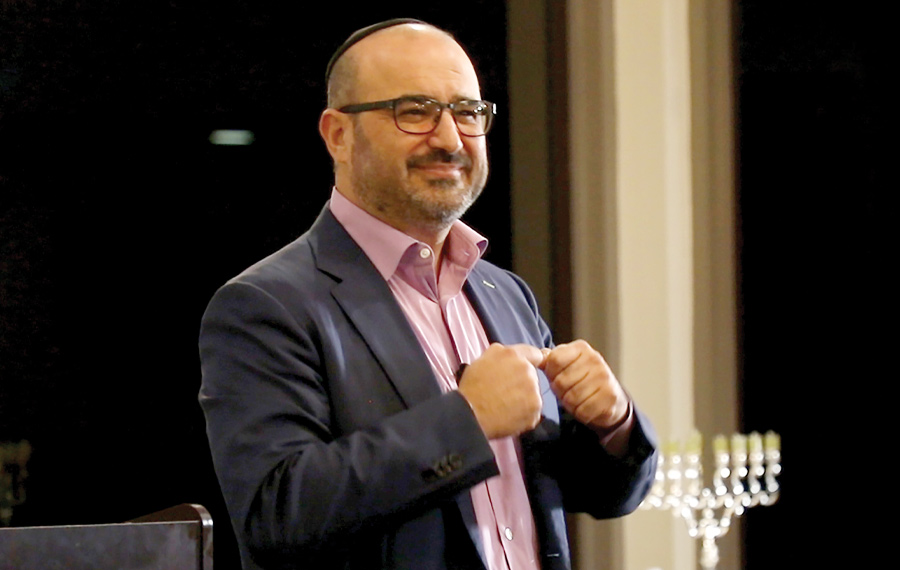
As the sun gracefully set on the Santa Monica Mountains on the last night of Hanukkah, Eliyahu Jian, a spiritual adviser and rabbi, lit the last of the menorah’s candles, closed his eyes and recited the traditional blessings. Behind him, visible through a window, sprinklers cascaded on the Calabasas Country Club’s golf course. 

“We want to send out as much positive energy into Ventura County and the surrounding communities as we possibly can,” he said in a thick Israeli accent. “With this, we give those affected [by the fires and the Borderline Grill shooting], the light to turn misfortune into fortune, chaos into order and tears into laughter.” 

A hearty “Amen!” rang out from the nearly 30 people gathered inside the club’s restaurant. Their eyes were closed, as instructed. 

“Now open your eyes with a big smile on your lips,” Jian said. They did. “Now, please have something sweet to eat.” 

Guests sidled up to a table with trays of pastries, water bottles, free astrology-themed T-shirts, bags of goodies for kids and copies of “The Snail With No Shell,” a Jian-penned children’s book. 

The event, held for those affected by the November wildfires and the Borderline shooting, was part of Vital Transformation, Jian’s nonprofit that produces podcasts, teaches Torah and Kabbalah classes, and hosts services and spiritual lectures. Jian, who is also a motivational speaker who travels the world for professional engagements, delivered a PowerPoint-aided lecture on the power of positivity and how life’s challenges build strength, unity and character. 

“The kabbalists 2,000 years ago explained that the soul is divided into three levels: your action, your speech and your mind,” Jian said. “If you’re able to learn how to control those three things, your life around you will start changing. If you believe that you can make your life better, you’re right. Whatever you believe you can do, well, you’re absolutely right.” 

Jian’s wife, Debbie, filmed the talk on her phone and live-streamed it on social media for those who couldn’t attend the event. Throughout, Jian included talmudic references and encouraged audience participation, even leading a guided meditation. Afterward, he engaged with guests one-on-one and extended an open invitation for Shabbat dinner at his Pico-Robertson home that doubles as Vital Transformation’s headquarters. 

“Just give us notice so we have enough food,” he said. 

Jordan Schaul, 45, a zoologist who has traveled the world working with animals, recently settled in Marina del Rey and came at the urging of a friend to start getting involved with the local Jewish community and to show solidarity for friends affected by the wildfires. 

“I got so much from this,” Schaul told the Journal. “When [Jian] talked about taking time to be silly, spending time with kids, I thought that was profound because it’s so uplifting without any context needed. I always felt that Judaism was so focused on ritual, but this was the first time I realized there’s a spiritual component I’ve overlooked my whole life.” 

“We want to send out as much positive energy into Ventura to give [people] the light to turn misfortune into fortune, chaos into order and tears into laughter.” 

— Rabbi Eliyahu Jian

David Levy, 19, who lives in Calabasas, came with his mother after a long shift at his retail job. During the height of the wildfires, Levy and his family were evacuated from their home twice, ultimately spending two short stints at a Hollywood hotel. 

“Most of Calabasas was evacuated at some point, probably all of Calabasas was affected in some way,” Levy told the Journal. “While [Jian] spoke, I was thinking about all the people I know who were affected. It’s nice to bring some spirituality into the mix and reflect on everything.” 

One of Jian’s Vital Transformation students, Michelle Alfi, 35, a West Hollywood resident, told the Journal she, too, has many friends and colleagues that had to evacuate. She also has connections to victims of the Borderline Bar and Grill shooting in Thousand Oaks. 

“I wanted to be a part of something so beautiful here tonight and help prop up the community that has gone through something so devastating,” she said. “Finding the beauty in pain is the only way to create more beauty around us. One example that [Jian] spoke about is how the community has come together with so many amazing volunteers and first-responders doing their part. If you can take that spirit and adopt it into your own life, well, that’s what creates change and makes the world a better place.”

‘Vital Transformation’ Brings Healing in Ventura County Read More »

Cleveland Clinic Fires Doctor for Anti-Semitic Tweets

The Cleveland Clinic fired a resident after her anti-Semitic tweets were exposed by the Canary Mission watchdog group.

Canary Mission compiled tweets from the former resident, 27-year-old Lara Kollab, that read, “ill [sic] purposely give all the yahood [Jews] the wrong meds,” said that Haifa “full of Jewish dogs” and called the Holocaust “exaggerated.” Kollab has also tweeted praise Popular Front for the Liberation of Palestine (PFLP) terrorist Ghassan Kanafani and Palestinian Islamic Jihad terrorist Khader Adnan and has defended Hamas.

The Cleveland Clinic posted a statement on their website on Sunday that they were “recently made aware of” Kollab’s comments.

“This individual was employed as a supervised resident at our hospital from July to September 2018,” the statement read. “She is no longer working at Cleveland Clinic. In no way do these beliefs reflect those of our organization. We fully embrace diversity, inclusion and a culture of safety and respect across our entire health system.”

Touro College, Kollab’s alma matter, also weighed in:

In a statement sent to the Journal via email, Canary Mission called on Kollab to “apologize and explain what led her to hold such bigoted opinions and tweet such frankly scary things.”

“Anti-Semitism is on the rise,” the watchdog wrote. “We see it on the far right, far left and among anti-Israel activists. Canary Mission will continue to focus on the dangers to the Jewish community.”

They added, “Anti-Israel activists are trying to pull the wool over our eyes. They claim that that there is a distinction between anti-Semitism and anti-Zionism. Like many, Dr. Kollab’s hateful language morphed as she progressed through college. We note that from 2013-2017 Dr. Kollab turned her focus to ‘Zionists,’ ‘Israel’ and to showing support for terrorism. With 44% of the world’s Jews living in Israel, the distinction between anti-Semitism and anti-Zionism is starting to wear thin.”

According to NBC News, Kollab received her medical training certificate in July; the state medical board said in a statement that the certificate is only active if Kollab is taking part in a medical program.

“Malicious acts and attitudes toward any population go against the Medical Practices Act and are denounced by the board,” the board said.

Simon Wiesenthal Center Founder and Dean Rabbi Marvin Hier and Associate Dean Rabbi Abraham Cooper called on the medical board to revoke the certificate altogether.

“While the Cleveland Clinic did the right thing, this person remains a menace to the community-at-large and has made a mockery of the Hippocratic Oath through her hatred,” Hier and Cooper said. “To protect the public, her Medical License should be revoked.”

Kollab’s social media accounts have all been deactivated.

This article has been updated.

Cleveland Clinic Fires Doctor for Anti-Semitic Tweets Read More »