fbpx

September 19, 2017

How to Jew: Rosh Hashanah

Wednesday, September 20 (evening) to Friday, September 22

BACKGROUND

Rosh Hashanah, which means “head of the year,” is the Jewish New Year. According to tradition, it is the day God created Adam and Eve, and it occurs at the beginning of the Jewish month of Tishrei. The holiday represents the beginning of the Days of Awe, or the 10 Days of Repentance, which end with Yom Kippur. It is taught that Rosh Hashanah has an influence over our whole year, as it is when God decides our fates for the coming year.

TRADITIONS

A central practice of Rosh Hashanah is the sounding of the shofar, or ram’s horn, which we are required to hear during prayer services. Its blast acts as a call for repentance.

A custom called tashlich, which comes from the word “to cast,” typically is performed on Rosh Hashanah at a body of water. It often involves tossing crumbs into the water, representing our sins from the past year. Prayers and appropriate verses are recited.

Special greetings for the holiday include, “L’shanah tovah tikatevu v’tichatemu” (May you be inscribed and sealed [in the Book of Life] for a good year) and “G’mar chatimah tovah” (A good final sealing [in the Book of Life]).

SPECIAL FOODS

A number of symbolic foods are consumed during the festive holiday meals. The most well known probably are apples and honey, which represent wishes for a sweet new year. Pomegranates are eaten because, according to rabbinic tradition, they have 613 seeds, corresponding to the number of commandments in the Torah. Round challahs symbolize the cyclical nature of the years. Some Ashkenazi Jews place a fish head on the holiday table — replaced by a cow tongue by some Sephardic Jews — in the hope that God will make us “the head, not the tail” in the coming year.

Sources: Chabad.org, My Jewish Learning, The Spruce

How to Jew: Rosh Hashanah Read More »

The binding of Charlottesville

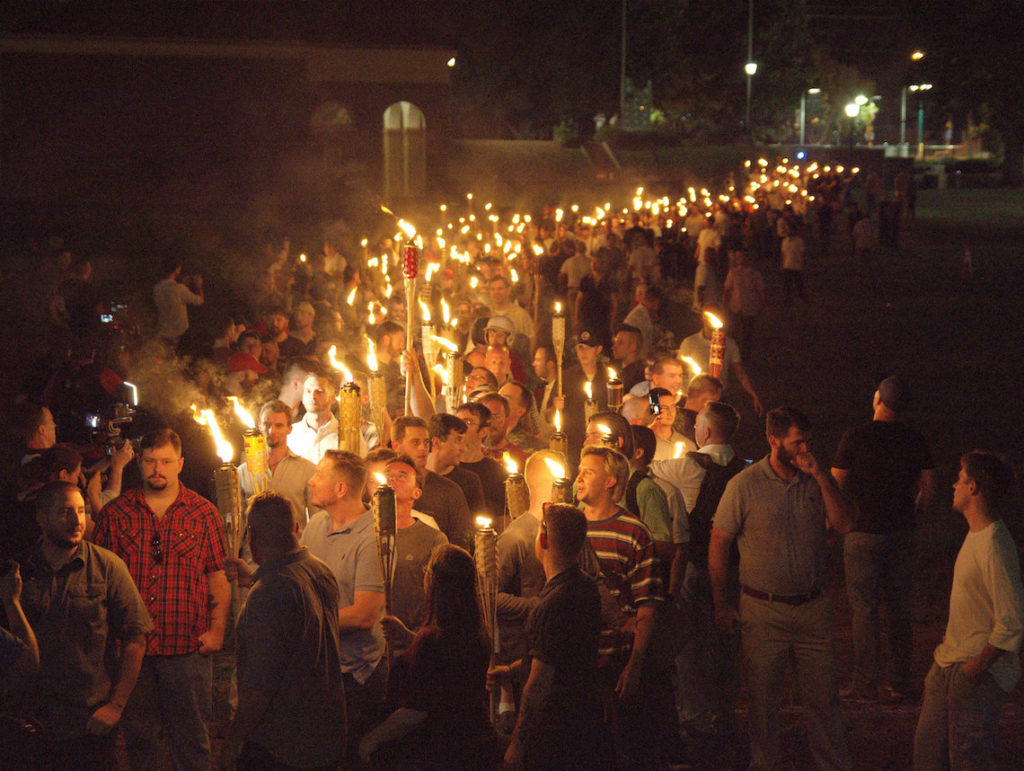
As this Rosh Hashanah neared, I wondered if even a shofar blast could clear away the Charlottesville chant of “Jews won’t replace us” still echoing in my brain. A good, long tekiyah can clear the mind, but this year it seemed the shofar’s piercing sound would not be enough to shatter the growing concerns about anti-Semitism that were keeping me from a more hopeful New Year.

Not that living around people scornful of Jews was anything new. I grew up in the 1960s in Orange County, which had a rock-ribbed chapter of the far-right John Birch Society; The Orange County Register and its editorializing against public schools; and my neighbors and fellow students who told me of their disdain for Jews. What happened in Virginia felt like a return to a place I thought I had left behind.

Still thinking “shofar” as a remedy, I turned to the Rosh Hashanah Torah reading in which a ram’s horn figures prominently: the Akeida, The Binding of Isaac. I hoped that within this dramatic and central story of faith and sacrifice I could find a way not to sacrifice my sense of well-being to the recent emergence of American Sieg Heil-ers.

Reading the parshah did not ease my angst. As you may recall, God puts Abraham to a test by telling him to sacrifice his son Isaac. Abraham and Isaac travel to Mount Moriah, where Isaac is bound and laid on an altar. Abraham, raising a knife, is about to sacrifice his son when a messenger from God stops him. Abraham then sees a ram caught in a thicket by its horns and sacrifices it instead.

I usually have considered the Bible story to have little connection to my everyday life, but now I read it as a cautionary tale. After absorbing weeks of swastikas and arms raised in Nazi salutes, I realized that this year The Binding of Isaac was less about Abraham’s faith being tested and more about my own vulnerability: my being bound to the fear of “it can’t happen here” happening here.

Caught up in my Bible reading, there I was: on a mount, bound up by hate words tightly tying me to a stereotypical image of a Jew. In that scene, a knife of anti-Semitism was hanging over me. Who was wielding it? Not Abraham, more like a guy in khakis and a white polo shirt. Who was being tested? Our “both sides” president, and an array of people who think Jews are too pushy, powerful and in their way. Would an angel’s voice keep the blade from descending? With no unequivocal voice coming from Pennsylvania Avenue, that would depend on public opinion.

Though an Anti-Defamation League (ADL) survey released in April said “the vast majority” of Americans held respectful opinions of their Jewish neighbors, an October 2016 survey revealed the blade was inching downward — that 25 percent of the general population felt “Jews still talk too much about what happened to them in the Holocaust”; 30 percent agreed that “Jews were responsible for the death of Christ”; and 14 percent said that a list of “anti-Semitic propensities — including such statements as “Jews don’t care what happens to anyone but their own kind” and “Jews have a lot of irritating faults” — was “probably true.”

Not at all reassured by these unnerving numbers, I wondered if Jews could reduce them. Though not to be confused with a voice from heaven, the ADL suggests that to free ourselves from hate we learn to recognize its symbols, report hate crimes and “engage in respectful dialogue to build understanding among people with different views.” The ADL also stresses, in the aftermath of acts of hate, how important it is to discuss them with young people.

In the weeks since the tiki torches of Charlottesville, friends and family, even tablemates at Shabbat lunch, have intensely discussed politics and anti-Semitism. Charlottesville has energized us. It’s as if what is called in Yiddish our pintele yid, the Jewish spark at the center of our identities, has been fanned to burn hotter.

Before, many of us didn’t even think or worry about those who might be marching up the mountain, or we didn’t realize that for some of our neighbors and, yes, leaders, Charlottesville was a test. But now in the light of that glow we see it.

In the Akeida, Isaac, not comprehending what is about to transpire, asks his father “where is the sheep for the burnt offering.” Many of us, in a new light of comprehension, now are breaking the bonds of silence, asking our own questions, talking to each other and our neighbors and leaders about anti-Semitism.

It is the sound of that conversation, as clear and sustained as any shofar blast, that we need to hear as we enter the New Year.

The binding of Charlottesville Read More »

Why Trump’s U.N. speech thrilled Netanyahu — for the moment, anyway

The number of times President Donald Trump mentioned Iran or its derivatives in his U.N. speech?

Twelve, and each time to emphasize its threat.

The number of times he mentioned the Palestinians or derivatives? That would be zero.

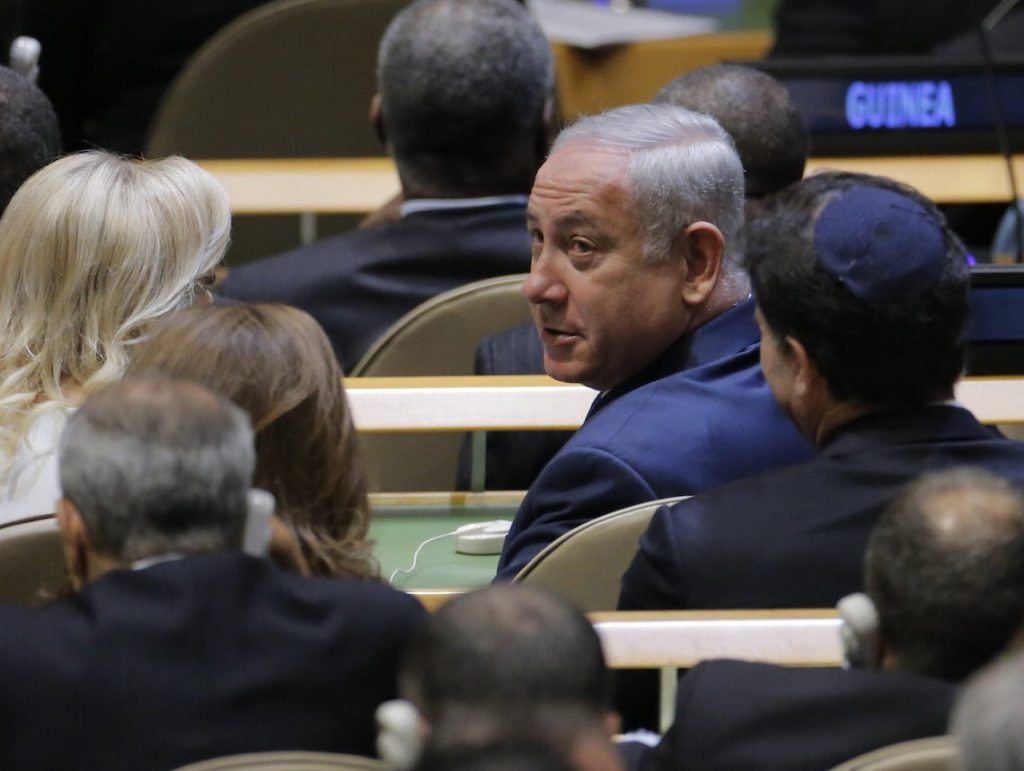
Israeli Prime Minister Benjamin Netanyahu, paying Trump the rare leader-to-leader gesture of attending his speech and applauding throughout, was clearly pleased.

“In over 30 years in my experience with the U.N., I never heard a bolder or more courageous speech,” Netanyahu tweeted immediately after the 40-minute address on Tuesday. “President Trump spoke the truth about the great dangers facing our world and issued a powerful call to confront them in order to ensure the future of humanity.”

Short term, Trump delivered big time on the Netanyahu wish list: He came closer to pledging to kill the Iran nuclear deal reviled by the Israeli leader and did not even mention peace with the Palestinians, which Netanyahu does not believe has traction at this point.

But wait, there’s more. Trump mentioned the word “sovereign” and its derivatives 21 times on Tuesday, the first day of this year’s General Assembly in New York.

Long term, Netanyahu and Israel may not be as enthused by Trump’s dream of a world in which nations make a priority of “sovereign” interests — or as the president put it, repeating a campaign phrase that unsettled many U.S. Jews, “America First.”

Trump’s overarching theme was a retreat from the robust interventionist role that to varying degrees has characterized U.S. foreign policy since the presidency of Franklin Roosevelt. Indeed, that undergirded the U.S.-led effort following World War II and its devastation to establish the United Nations.

“Our success depends on a coalition of strong and independent nations that embrace their sovereignty to promote security, prosperity and peace for themselves and for the world,” Trump said. “We do not expect diverse countries to share the same cultures, traditions or even systems of government.”

What that means practically is not clear, much like the rest of Trump’s foreign policy nine months into his presidency. But Israel’s security establishment has been wary of an American retreat from world affairs, especially when it comes to its war-torn neighbor Syria and the alliance between Syria’s Assad regime and Iran.

Trump’s emphasis on Syria — the thrust of much of his speech — was the routing of the Islamist terrorist threat embodied there by the Islamic State. Iran and its Lebanese proxy Hezbollah share that goal.

Secondarily, Trump said he would intervene when what he called the “criminal” Assad regime uses chemical weapons.

What Trump did not say — and what the Netanyahu government had demanded — was whether he would seek the removal from Syria of Iran and Hezbollah, which launched a war against Israel in 2006 and appears to be building a missile arsenal ahead of another war. (Trump did twice attack Hezbollah as a terrorist organization that threatens Israel.)

More broadly, Israeli Cabinet ministers — especially the defense minister, Avigdor Liberman — repeatedly expressed the concern that the Obama administration diminished the U.S. profile in the Middle East. Israel has long considered a robust U.S. profile in the region as key to its security.

On the Iran deal, Netanyahu could only be pleased at what he heard.

“We cannot abide by an agreement if it provides cover for an eventual nuclear program,” Trump said of the 2015 agreement, which trades sanctions relief for rollbacks in Iran’s nuclear program. Again calling the deal “one of the worst” he had ever encountered, the president said it was “an embarrassment to the United States and I don’t think you’ve heard the last of it, believe me.”

“I couldn’t agree more,” Netanyahu said from the same podium several hours later.

He lavished plenty of praise on Trump in his speech. Referring to Trump’s visit earlier this year to the Western Wall, Neyanyahu said, “When the president touched those ancient stones, he touched our hearts forever.”

Netanyahu also said “we will act to prevent Iran” from establishing a permanent base in Syria, developing weapons to be used against Israel from Lebanon and Syria, and establishing a terrorist front against Israel on the Lebanon border.

The Israeli, who had a long meeting with Trump in the days before the General Assembly launched, suggested that his message was congruent with Trump’s.

“Today I will say things that the rulers of Iran and the people of Iran will remember always,” he said in Hebrew in a social media post two hours ahead of his speech. “I think they will also remember what President Trump says.”

Why Trump’s U.N. speech thrilled Netanyahu — for the moment, anyway Read More »

How to do Kapparot With Money

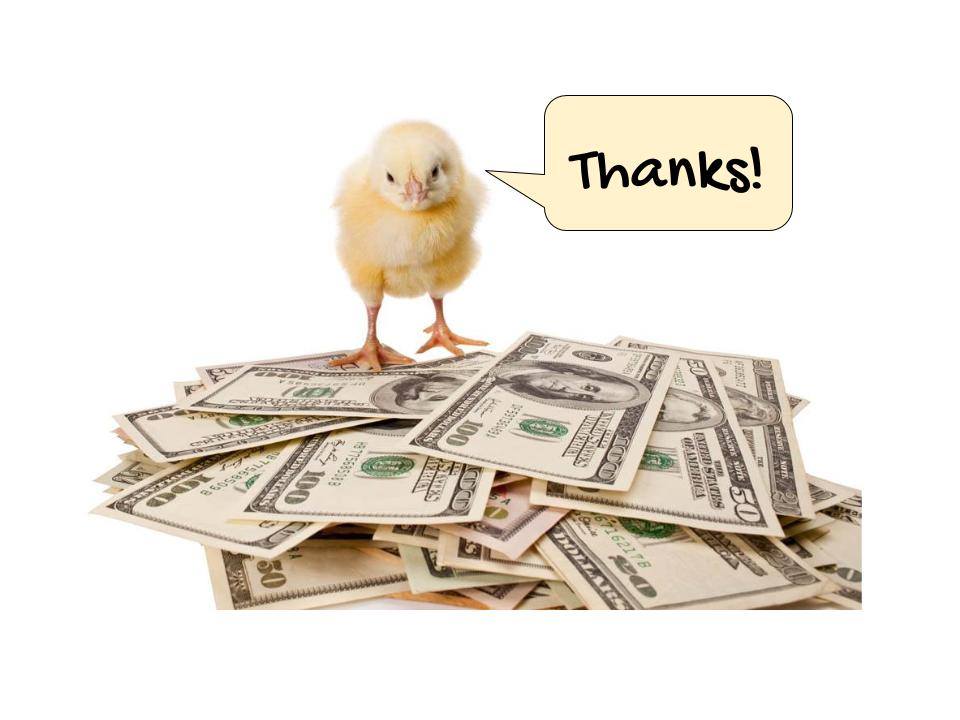
It’s easy to do the ancient Kapparot ritual in the comfort of your own home. The ritual is performed between Rosh Hashanah and Yom Kippur. All you need is some cash and the ritual worksheet below which is adapted from the Machzor.

Before Yom Kippur, gather those who want to do the ritual — your children, your self, your spouse, and anyone else who is interested — and have enough cash per person to make it a significant donation. I recommend that you use the same amount that is spent on a chicken, usually $18 or more. After performing Kapparot, the money is given to tzedakah, ideally to help feed people in need in your community.

Below is a sheet you can print out and use at home.

Wishing you a sweet and healthy New Year!

DOWNLOAD YOUR KAPPAROT WITH MONEY GUIDE

How to do Kapparot With Money Read More »

High Holy Days alert: Be prepared to look out the windows

This is the time of year when Jews begin preparing for the High Holy Days. Part of that preparation inevitably involves picturing oneself in services, head buried in the prayer book. This year, however, perhaps we should prepare for a different posture.

The prophet Daniel, Scripture tells us, prayed in the upstairs room of his home. Why upstairs?  Because that’s where the windows were, showing him the world outside, facing Jerusalem. For Daniel, real prayer calls attention to the real world, the happenings outside the sanctuary of one’s comfort zone: in the sobering suffering of the public square.    

The diversity of the Jewish community is a wondrous feature of our people; it’s amazing that we can be so different yet cling to the same Torah. No two synagogues are alike, just as each community sings with its own voice and animates our age-old duty to pursue justice in its own way.

However, despite this astonishingly variegated nature of communities, every single sanctuary in our tradition has at least one commonality: They all, thanks to Daniel, have windows. They all, by Jewish law, forbid a prayer setup that is, in essence, “soundproof” from the noise outside of the thick walls of our buildings.  

The realities of our world today demand Daniel’s prayer posture, gazing out the window, as our liturgy urges us to make teshuvah, to “turn” to our core obligations, as a people in Covenant with God.  

This year, we look out the windows of our sanctuaries and confront our world. We look out the windows to see a world torn by suffering and hatred. We look out the windows to acknowledge pernicious public policies that propagate bigotry, oppression and racial and ethnic supremacy upon the most vulnerable among us —­ the proverbial “ foreigner, widow and orphan.” This year, we look out the windows to see the world as it really is, rather than the alternate realities prevaricated by corrupt leaders who, we pray, may yet find their pathways to moral rehabilitation.

This year, recognizing that, in the words of the late Abraham Joshua Heschel, “the hour calls for moral grandeur and spiritual audacity,” we look out the window, with our eyes open, our ears attuned and our hearts willing to be broken. And with our hearts broken, may we allow the letters of Torah to enter through the cracks and provide meaning and strength for what in the year 5778 surely will be a fierce, urgent and critical fight for the values of truth, justice and peace.

As we approach this High Holy Days season, while we practice the inherently introspective tradition of cheshbon ha-nefesh, “taking account of our souls,” be prepared to look out the windows.


Rabbi Matthew Soffer is the senior associate rabbi at Temple Israel of Boston, is on the board of the Jewish Alliance for Law and Social Action and is a member of the advisory council of the Pluralism Project at Harvard University. Rabbi Joel Thal Simonds is the founding executive director of the Jewish Center for Justice and is the rabbi of the synagogue for the Hebrew Union College-Jewish Institute of Religion in Los Angeles. 

High Holy Days alert: Be prepared to look out the windows Read More »

Daily Kickoff: Trump talks peace, Bibi focused on Iran | Meet Obama’s go-to speechwriter for kishke speeches | Dicey future for jarred gefilte fish

Have our people email your people. Tell your friends to sign up for the Daily Kickoff here!

OUT TODAY — “Thanks, Obama. My Hopey, Changey White House Years” by former White House speechwriter David Litt: In advance of the book’s publication, we conducted an iMessage interview with David late last night. This interview has been edited and condensed for clarity.

JI: In the book, you write “if something kishke-related came up (at the White House), I was the go-to guy.” How did you become that guy?

Litt: In 2011, President Obama delivered a speech at the Union of Reform Judaism’s annual meeting. I had this moment where I was like “As a kid, I did eight years of Hebrew school and never knew why. This is why!” After that speech if something was going to be delivered to the American Jewish community, I generally handled it.

JI: How was teaching Hebrew to the President?

Litt: It was great, except for the hard ‘CH’ sounds. Those didn’t go so well. People could be pretty hard on him if he didn’t get a “Chag Sameach” right, but I write in the book about how he gave it plenty of tries. And it’s not like he grew up with that sound. As we all know, it’s a tough one!

JI: In 2012, you were in the storm path of one Harvey Weinstein. How did that happen? 

Litt: Maybe it’s best to let people read the whole story in the book!

JI: You mention your great-grandparents from Eastern Europe several times in the book. If they were still with us, what do you think they would be most surprised to read?

Litt: Honestly, I think they’d be stunned that I ended up in the White House just a few generations after they arrived here with almost nothing, in many cases not even speaking English. That’s such a typical American story, but we shouldn’t lose sight of how remarkable that typical-ness is. And I like to think they’d understand that in it’s own way, the fact that I got serve under America’s first black president is part of that story too. This is a country that at its best is always expanding its definition of what’s possible, and my family got to be part of that.

JI: Not to spoil the ending to a chapter about the legendary Correspondents’ Dinner speeches, but what did you have to tell the President after he asked what happened to using a photoshopped picture he liked of him and Bibi Netanyahu in 2013?

Litt: “I’m sorry, Mr. President, we just couldn’t use that picture. You kind of looked like Hitler in it.” Like you said, it’s a long story. $18.29 for the hardcover. Available now [Amazon]

“Ivanka Trump talks Hillary’s book on ‘Dr. Oz’” by Maggie Coughlan: “The first daughter sat down with Dr. Oz for an interview about her life in Washington, D.C., but surprised the audience when she commented on Hillary Clinton‘s newly released book… Ivanka said she’d be curious to know what Hillary, 69, would do when she disagreed with husband Bill while he was president. During the interview, Ivanka, 35, also revealed that she suffered from postpartum depression following the birth of her first child, Arabella… “The highlight of the show was when Ivanka joked about taking over her father’s Twitter account.”” [PageSix]

TODAY AT 10:30 AM: President Trump delivers his much-anticipated address at the 72nd United Nations General Assembly. Israeli Prime Minister Netanyahu will attend the President’s speech. Netanyahu is expected to speak around 1:00 PM. Trump will be in the UN building, meeting with the UN Secretary-General, during Bibi’s speech. [Livestream]

“Egypt’s Sisi meets Israeli PM at UN for first public talks” by Emmanuel Parisse: “Egyptian President Abdel Fattah al-Sisi met Israeli premier Benjamin Netanyahu publicly for the first time in New York to discuss Middle East peace… Sisi emphasized the importance of “resuming negotiations between the Israeli and Palestinian sides to reach a comprehensive solution,” the [Egyptian] presidency said. The two leaders discussed “ways to resume the peace process and establish a Palestinian state,” it said.” [Yahoo; Haaretz

BIBI MEETS TRUMP: Trump met with Netanyahu for over an hour yesterday at the Lotte New York Palace Hotel. Ahead of the meeting, Trump that there’s a “good chance” for Middle East peace. “It’d be a fantastic achievement. We are giving it an absolute go.” Netanyahu said, “I want to say that under your leadership the alliance between America and Israel has never been stronger, never been deeper… “I want to say, that under President Trump, America’s position towards Israel and the U.N. has been unequivocal. It’s been strong.” [Video]

HOW IT PLAYED: “Trump at U.N. Talks Up, but Does Not Press, Mideast Peace” by Mark Landler: “While Mr. Trump has clung to the hope for peace… he has put much more time into cementing alliances with the Sunni Muslim kingdoms of the Persian Gulf, as a way of confronting Iran… “Middle East peace is desirable because it’s the mother of all diplomatic deals,” said Robert M. Danin, a senior fellow… at the Council on Foreign Relations. “But the conflict that’s taking place in the Gulf is harming U.S. interests in a more immediate sense.” … The allure of a history-making peace accord is still strong, as Mr. Trump’s remarks with Mr. Netanyahu illustrated. While the Israeli leader kept his focus on “the terrible nuclear deal with Iran,” Mr. Trump spoke expansively about a peace agreement as though it was a genuine possibility, somewhat to the Israelis’ surprise.” [NYTimes]

KAFE KNESSET — by Tal Shalev and JPost’s Lahav Harkov: Netanyahu said that he “shares the desire to reach peace with the Palestinians, but I insist on those vital interests – the goal is peace, security, security and peace. There will be no peace if we cannot anchor the security of the State of Israel.” Despite the fact that the peace process was the only topic mentioned by the President during the photo op, Israeli and US officials told Kafe Knesset that the issue took second place during the meeting, which was mostly dedicated to Bibi’s favorite topic – Iran. Read today’s entire Kafe Knesset here [JewishInsider]

“Mea Culpa: I Said Trump and Bibi Would Blow Up” by Aaron David Miller: “A year or so ago in this space… I predicted that it would be only a matter of time before U.S. President Donald Trump and… Netanyahu would be annoying the hell out of one another… Even I’m a little stunned by how the relationship has blossomed seemingly without serious disruption and complication… Trump may be unpredictable on many issues, but when it comes to the U.S.-Israeli relationship he’s been preternaturally and consistently pro-Netanyahu.” [FP]

BRIEFING: “The President and Prime Minister Netanyahu had a very good meeting,” State Department Director of Policy Planning Brian Hook told reporters at a briefing yesterday. The President reaffirmed America’s unshakable bond with the Jewish state.” The two leaders, according to Hook, discussed “at length” countering Iran’s malign influence in the region, not allowing the “Lebanization” of Syria, and the Middle East peace process.

Hook told JI’s Jacob Kornbluh that the peace process didn’t take up much time in the meeting: “I didn’t keep a stopwatch, in terms of just how long everybody discussed each subject. As I said, they spent a lot of time talking about Iran and about Syria — Middle East peace. I would say it was an equitable distribution of topics. I think each was given the time necessary needed to kind of give it full justice. So, it was a very good discussion. But these discussions are so regular, it wasn’t a lot of time that had elapsed because the trip that Jared and his team recently made was only a few weeks ago. We’re in regular discussions with the Israelis.”

Hook on the two-state solution: “What the President has been talking about in the context of Middle East peace is trying to avoid bumper stickers and slogans around this. He does not want to impose a solution. And what he’s really trying to do is work as a facilitator to find a solution that both sides can accept. Ambassador [David] Friedman has talked about it in terms of a win-win for both the Israelis and the Palestinians. He does want to take a new approach.”

‘Ridiculous’ if Trump doesn’t back two-state solution: Palestinian official: “It would be utterly ridiculous if Mr Trump doesn’t eventually say that,” Nabil Shaath, a senior Abbas adviser, told journalists in Ramallah when asked about the two-state solution. “What the hell are we negotiating? We are negotiating a diplomatic accord between Abu Mazen and Mr Netanyahu where they can meet each other? No.” [YahooNews] • More Palestinians Seek Abbas Resignation; Skeptical of Trump [AP]

WHAT NETANYAHU WANTS TO TALK ABOUT — Netanyahu at a briefing for Israeli reporters: “The American establishment has changed its approach toward Iran. We’re in agreement with the Americans that this agreement is terrible. There’s a clear American interest, which was conveyed to me explicitly, about the desire to fix the problems in the agreement… I said in the past that the biggest problem I see isn’t if Iran violates the agreement, but if it upholds it… The president’s starting point regarding Iran is identical to ours. That wasn’t the case in the previous administration. Like us, this president sees Iran as the root of the Middle East’s problems.” [Haaretz

ON THE HILL — JI’s Aaron Magid asked Senators yesterday what they’d advise the administration to do on October 15th, the next certification deadline for the Iran deal.

Sen. Orrin Hatch (R-UT): “I would support the administration on decertifying Iran from adherence to nuclear deal. He (the President) can lead on that particular issue, which is fine with me.”

Sen. Rand Paul (R-KY): “I think as they (Iran) are adhering to the nuclear agreement, we should stay in the agreement and not change it. All of the reports have said so. The Trump administration has certified that they (Iran) have been.”

HAPPENING TODAY — United Against Nuclear Iran (UANI) will host its second annual Iran Summit at the Roosevelt Hotel in New York. Speakers include New Jersey Governor Chris Christie, General (Ret) David Petraeus, HRH Prince Turki bin Faisal Al Saud, Joe Lieberman, John Bolton, Dennis Ross, former Governors Jeb Bush and Bill Richardson; Reps. Ileana Ros-Lehtinen and Ron DeSantis, former Congressman Steve Israel, former Senator Mark Kirk, and former Attorney General of Canada Dr. Irwin Cotler.

HEARD YESTERDAY — Mideast envoy Jason Greenblatt called on the Palestinian Authority to reassert control over Gaza in an address before donor nations to the Palestinians. “The time has come to stop monitoring the situation in Gaza and start changing the situation in Gaza,” Greenblatt said, according to a transcript released by the White House. The New York attorney slammed Hamas for its abusive treatment of Palestinian people since its 2007 coup over Gaza. “For too long, Hamas has exploited the people of Gaza as hostages and shields, bullying them into submission. Hamas rules by the fist, instead of by improving the lives of the people it purports to govern,” he added.

While the Trump administration is now supporting the Taylor Force Act, which would cut off all US economic aid to the PA for terror payments, Greenblatt urged donor countries to help the PA during its current economic struggles. “The PA is still dependent on international donors and is unable to afford important services which Israel is willing to provide – so I encourage all of us to work with the parties, in a coordinated manner, to reduce fiscal losses and ensure that the Palestinian Authority collects the taxes it is owed,” he explained.

“The Hubris of Hezbollah: How the militant group will fumble into the next Middle Eastern war” by Andrew Exum: “Israel knows it cannot intercept each and every shipment of arms. Sometimes the weather is too poor, or the intelligence too fuzzy, to act. And now Hezbollah is reportedly developing indigenous arms-making capabilities that will render cross-border shipments of advanced weaponry less necessary. So, for nearly two years now, Israeli military and intelligence officials have been warning every American official who comes through Tel Aviv and Jerusalem that the next war is coming. Israel has methodically prepared its allies—and most especially the Americans— for a very, very ugly war on the horizon… Hezbollah has grossly underestimated Israel, a mistake that will prove costly. Hundreds and perhaps thousands of Israelis could die in another conflict, but Israel isn’t going anywhere. This is existential for them. It will be the Lebanese who suffer immeasurably more.”[TheAtlantic]

“Putin Seeks Syria Deal That Both Iran and Israel Can Swallow” by Anshel Pfeffer: “According to well-placed sources in Moscow, Putin is planning to propose a formula to Netanyahu whereby no foreign country will be allowed to turn Syria into a platform for attacking neighboring states. This won’t go as far as Netanyahu’s insistence that Iran be prevented from establishing a permanent presence in Syria. If enforced, though, it would prevent them from establishing air and missile bases there. Netanyahu is unlikely to accept such a formula in public, but he is unlikely to have much of a choice.” [Haaretz] • U.S. Establishes Permanent Military Base in Israel [RealClearDefense]

** Good Tuesday Morning! Enjoying the Daily Kickoff? Please share us with your friends & tell them to sign up at [JI]. Have a tip, scoop, or op-ed? We’d love to hear from you. Anything from hard news and punditry to the lighter stuff, including event coverage, job transitions, or even special birthdays, is much appreciated. Email Editor@JewishInsider.com **

BUSINESS BRIEFS: Kushner Cos. Acquires New Jersey Apartment Complex for $190 Million [Bloomberg] Rubenstein Partners Sells 1000 Washington Street in Boston [BusinessInsider]  As ‘Diller Island’ Sinks, Whitney Plans Major Artwork on Hudson [NYTimes]

Exhibit Allows Virtual ‘Interviews’ With Holocaust Survivors: “An exhibit at the Museum of Jewish Heritage in New York City called “New Dimensions in Testimony” uses hours of recorded high-definition video and language-recognition technology to create just that kind of “interview” with Eva Schloss, Anne Frank’s stepsister, and fellow survivor Pinchas Gutter. “What we’ve found is that it personalizes that history,” says concept designer Heather Smith. “You connect with that history in a different way than you would just seeing a movie or reading a textbook or hearing a lecture.” The project is a collaboration between the Steven Spielberg-founded Shoah Foundation, which has recorded nearly 52,000 interviews with Nazi-era survivors, and the Institute for Creative Technologies, both at the University of Southern California.” [AP]

“When Life Asks for Everything” by David Brooks: “Most religions and moral systems have aimed for self-quieting and, figuring that the great human problem is selfishness. But around the middle of the 20th century, Abraham Maslow, Carl Rogers and others aimed to liberate and enlarge the self… Rabbi Wolfe Kelman’s life was fraught with every insecurity when he marched with Dr. King in Selma, but, he reported: “We felt connected, in song, to the transcendental, the ineffable. We felt triumph and celebration… That was a warming, transcendental spiritual experience. Meaning and purpose and mission were beyond exact words.”” [NYTimes]

“TV tonight: Seinfeld stand-up, Conan goes to Israel” by Kelly Lawler: Jerry Before Seinfeld Netflix: Jerry’s back. The comedian is debuting an intimate stand-up special on Netflix, the future home of his Comedians in Cars Getting Coffee series. The nostalgic special was filmed at The Comic Strip, the New York club that helped launched his career, and mixes new and archival material and even childhood videos… Conan Without Borders: Israel – TBS, 10 ET/PT: Conan O’Brien is on the move, again. The host of TBS’s Conan is taking his seventh international trip in the past two years, this time to Israel, where he visits Tel Aviv, Jerusalem and other sites. The trip follows earlier sojourns to Mexico, South Korea and Cuba.” [USAToday; NYT

DESSERT: “Treif No More at Franklin Barbecue: Aaron Franklin goes kosher for the day” by Daniel Vaughn: “Last week, under the burned out shell of Franklin’s now-fireless pit room, this barbecue brain trust gathered to cook a trio of kosher briskets, the likes of which had never been attempted at Franklin. The idea was hatched during a brisket competition in Brooklyn. Franklin and I were judges, and agreed with the five others on the panel to crown Sruli “Izzy” Eidelman the Brisket King of New York. His duo of smoked brisket and pastrami, both of them kosher, wowed the judges. He celebrated with his friend and fellow kosher barbecue cook, Ari White, who took 2016’s title. Eidelman felt especially proud that judges from Texas had crowned his barbecue.” [TexasMonthly]

WSJ A1: “‘I Still Have Nightmares.’ The Dicey Future of Jarred Gefilte Fish” by Lucette Lagnado: “Traditional jar fans haven’t gone away by any means, but times and tastes have changed. In an artisanal food world, Manischewitz is struggling to make its shelf-stable product hook a new, more-finicky generation of eaters. Among its more popular innovations are gluten-free gefilte fish and a “Premium Gold” version. A new secret variation is yet to come. The emphatic response from Jewish foodies? Don’t bother. “I ate gefilte fish from the jar as a child,” says Chanie Apfelbaum, a gourmet cook and kosher blogger from Brooklyn. “I still have nightmares.”” [WSJ]

SPOTTED: Mrs. Sara Netanyahu at Reserve Cut, a kosher steakhouse in NYC’s Financial District, last night. [Pic]

BIRTHDAYS: Entrepreneur and philanthropist, co-founder with his brothers of a large industrial parts and electronic component distribution firm, Morton Mandel turns 96… Actor, writer and Dean Emeritus of the Drama School at Pace University, James Lipton turns 91… Professor of Jewish history and literature at Yeshiva University, he is the only son of Rabbi Joseph B. Soloveitchik, Haym Soloveitchik turns 80… Member of the New Hampshire House of Representatives since 2016, he was a professor of health management and policy at the University of New Hampshire, Jeffrey Colman Sallowayturns 76 (h/t Jeff Wice)… Professor at Yeshiva University’s Cardozo School of Law and director of the Innocence Project, he became famous as a member of O.J. Simpson’s defense team called the “Dream Team,” Barry Scheck turns 68… Senior Fellow at the Gatestone Institute, after a 28 year Pentagon career as a Middle East expert, Harold Rhode turns 68… Reporter for the Voice of America, following a long career as the Washington correspondent for the Times-Picayune of New Orleans, Bruce Alpert turns 67… Stockton, California-based physician, he is Board certified in both sleep medicine and pulmonary medicine, he practices at The Pacific Sleep Disorders Center, Ronald Kass M.D. turns 65…

Reporter for The Wall Street Journal, she was born to a Jewish family in Cairo, Egypt, and wrote a prize-winning book about her childhood, Lucette Lagnado turns 61… Attorney at the Boston-based law firm of Weston Patrick, Mark A. Chapleau turns 57… Bow tie-clad field reporter for “Major League Baseball on Fox” since 2005, sportswriter and reporter Ken Rosenthal turns 55… Executive Director of the Jewish Community Relations Council of Greater Washington since 2001, Ronald Halber turns 49… Author of four popular business books, former small business columnist for The Wall Street Journal, Mike Michalowicz turns 47… Founder and CEO of MassChallenge (a startup accelerator), John Harthorne turns 44… Director of external relations at the DC-based bipartisan think tank, the Center for New American Security, Neal Urwitz turns 34 (h/t Playbook)…

Gratuity not included. We love receiving news tips but we also gladly accept tax deductible tips. 100% of your donation will go directly towards improving Jewish Insider. Thanks! [PayPal]

Daily Kickoff: Trump talks peace, Bibi focused on Iran | Meet Obama’s go-to speechwriter for kishke speeches | Dicey future for jarred gefilte fish Read More »

Moroccan-inspired tzimmes with saffron, white wine and chicken

I didn’t grow up with tzimmes, so the idea of stewed, mushy vegetables with dried fruit has never much appealed to me. I say “idea” because I am pretty sure I have never actually tasted tzimmes. The dish always seemed too sweet to be appealing, even if sweet foods are traditionally enjoyed for the New Year.

But recently, while thinking of new ways to reinvent a few classic Rosh Hashanah dishes, I began thinking about tzimmes. And perhaps with a couple of very liberal (and namely savory) changes, who’s to say it couldn’t become something newer, grander and much more enticing for a palate like mine?

My experimentation has produced a colorful, show-stopping and nontraditional chicken dish.

Wonderfully savory chicken now complements the sweet tzimmes of yore, which I have updated by swapping fresh, juicy plums and apricots for their dry, pruney counterparts, adding sweetly swirled candy cane beets (you can also use red or golden beets); switching out regular carrots for vivid, tricolored ones; and tossing in a handful of golden raisins to be plumped up with aromatic pan juices. Alongside the requisite onion, aromatic rosemary and heady cloves of garlic, the striking fruit-and-vegetable mixture roasts in a cinnamon, ras el hanout (a Moroccan spice blend) and spiked date honey sauce.

Once the fruits and vegetables have softened a bit, they are topped by the chicken and doused in a saffron-infused white wine mixture, which saturates the entire dish as its components roast together in happy, fragrant harmony.

Now we have a delicious dish with tender fruits and vegetables, bronzed chicken and a saffron-and-white-wine-flavored gravy that puddles at the bottom of the pan and would be splendid spooned over fluffy couscous. Serve this holiday-worthy chicken with even more wine and with shreds of fresh green parsley, then watch as even the most vehement tzimmes haters come slowly, then speedily around.

Ingredients:
For the fruits and vegetables:
2 bunches small colored candy cane beets, tops removed, scrubbed and sliced
1 bunch colorful young carrots, scrubbed and thicker ones sliced in half
4 apricots, halved, some quartered
4 big purple plums, halved and some sliced
1/2 cup golden raisins
10 cloves garlic, peeled
1 large onion, peeled and sliced into thick rings
3 sprigs fresh rosemary
chopped parsley, for serving

Some of the fruits and vegetables that go in a newfangled tzimmes dish.


For the chicken, sauce and saffron white wine marinade:
4 chicken bottoms, cleaned
2 teaspoons fine sea salt
2 sprigs fresh rosemary
1/4 teaspoon saffron threads
1/4 cup water
3/4 cups good white wine
3 tablespoons date honey (silan)
1/4 cup olive oil
1/4 teaspoon freshly ground black pepper
3 cardamom pods, lightly crushed
1 teaspoon ground cinnamon
1/2 teaspoon ground cumin
2 pinches cayenne pepper
1/4 teaspoon ras el hanout

Directions:
1. Preheat the oven to 425 F. Rub the chicken bottoms with the sea salt and the 2 sprigs of fresh rosemary.

2. Toast the saffron threads in a small pan over low-medium heat for about 3-5 minutes until they are slightly toasty and fragrant. Remove the pan from the heat, add the 1/4 cup of water and let it sit and turn yellow as the saffron infuses its flavor into the water.

3. Combine the cooled saffron water, of which you should have 1/4 cup, with the white wine. Mix and set aside until needed.

4. Make the marinade: Whisk the date honey, oil, black pepper, cinnamon, cumin, cayenne and ras el hanout in a large bowl.

5. Add the chicken pieces, carrots, onion, cardamom pods, garlic, apricots, plums, carrots, beets, golden raisins and rosemary to the large bowl and toss to combine.

6. Remove the chicken and set aside in a clean, baking paper-lined pan until needed. Spread the fruits and vegetables on a baking paper-lined rimmed baking sheet.

7. Pour half of the saffron/white wine mixture on the chicken and half on the vegetables. Cover the vegetables tightly with foil. Roast 15 minutes, then remove from oven. Remove and discard the cardamom.

8.  Remove foil, lower the heat to 400 F. and top the vegetables with the chicken and the rest of the saffron/white wine mix.

9. Continue to roast until the beets and carrots are tender, the chicken is golden brown and the whole mixture smells divine, around 40 minutes to 1 hour. (If the fruits and vegetables get too dark, you can remove the sheet tray from the oven, place the chicken in another pan and return that pan to the oven until the chicken is nice and golden, leaving out the vegetables.)

10. When the chicken and vegetables are done, transfer chicken mixture to serving platter. Pour pan juices over. Top with shredded parsley before serving.

Chaya Rappoport is the blogger, baker and picture taker behind retrolillies.wordpress.com. Currently a pastry sous chef at a Brooklyn bakery, she’s been blogging since 2012 and her work has been featured on The Feed Feed, Delish.com, Food and Wine and Conde Nast Traveler.


The Nosher food blog offers a dazzling array of new and classic Jewish recipes and food news, from Europe to Yemen, from challah to shakshuka and beyond. Check it out at www.TheNosher.com.

Moroccan-inspired tzimmes with saffron, white wine and chicken Read More »

Letters to the Editor: Hurricane Harvey, Trump bashing and David Myers

Amid a Disaster, a Sense of Community

I was a member of Congregation Beth Yeshurun while I lived in Houston (“A Tale of Two Synagogues in Harvey’s Wake,” Sept. 8). My sons attended the day school and observed their bar mitzvahs in the large sanctuary. I was in the synagogue a week before the flooding. It’s sad to see what has happened to all the congregations and to the homes of my friends. At moments like this, we know what it really means to belong to a community, and it strengthens us.

Rosalyn Borg via jewishjournal.com


Deciding How to Live an Ethical Life

Ethical behavior does not require the uninvited visits of hurricanes Harvey and Irma (“May Harvey Inspire Out Better Angels,” Sept. 8). It requires you to decide to live an ethical life and to practice daily the skills necessary to reach that goal. The Harvey and Irma events are just theater.

Jerry Daniels, Marina del Rey


Torah Is Timeless Guide to Moral Decisions

The world changing is nothing new (“Technology and the Age of Broken Tablets,” Sept. 8). From movable type to editing the human genome, self-driving cars and artificial intelligence, mankind has been challenged with moral decisions.

Throughout time, mankind has needed guidance as to what are the correct moral decisions.

This is the reason we have the Torah. It is a moral compass for all times.

We are the ones who need to be adopted and adapted to this new world.

The Torah is perfect, just as it is.

Leigh Greenberg, Los Angeles


Bashing President Trump Gets Old

Columnists Rob Eshman and Marty Kaplan lose credibility by their constant screeds about President Donald Trump.

Eshman’s dislike for the president (“I am not saying he is like Hitler, but … ”) approaches an obsession. His comment on what the president said about Deferred Action for Childhood Arrivals (DACA) is misleading (“Replacement Theology,” Sept. 8). Any objective view would acknowledge that the president asked Congress to pass legislation legalizing the so-called “Dreamers” status and not leave them in legal limbo caused by an earlier nonbinding — and unconstitutional — executive order.

Marty Kaplan makes no attempt at analysis of anything the president does or says. Instead he resorts to unending name-calling (“corrupt, deranged, deceitful, ignorant,” etc.)

If Eshman and Kaplan are trying to prove to their readers the correctness of their positions, they fail. If their purpose is only to vent their emotions, then they are not persuasive to anyone not already in the choir.

Mitchell W. Egers, Studio City

So, Rob Eshman: What do you say to the 800,000-plus future Americans who have filed papers for years, paid their fees and are waiting to come to the United States the legal  way?
As an American, I was one of those unfortunates. I married in Israel and thought my husband would automatically be able to return with me to New York. Well, I was so wrong. We had reams of papers to file that had to be translated into English, dollars to pay for translations, and we had to support ourselves, not knowing how long the process would take. It was hard to get a job as no one would hire either of us, as we were considered temporary workers. Some of the questions were insulting, such as, “Were you ever a male prostitute?” “Did you ever belong to the Communist Party?” etc.

And this was asked of a professional engineer and Holocaust survivor. We did it the proper way, and it took the better part of a year. Now why should anyone go through that process when you can just come here and forget about the proper channels? No, the “Dreamers” have no one to blame but their undocumented parents who used them for their own self-interests. I am sick and tired of this whole stupid mess. Not my problem. Try pulling this as an American in Mexico. You would wind up in jail.

Glenda Urmacher via email


David Myers and His New Job

Thanks for explaining this tempest (apparently beyond a teapot) (“Myers Gains Support After ‘Scurrilous’ Article,” Sept. 15). David Myers is a great new leader of the Center for Jewish History. Sorry he has to waste any time on this nonsense.

Elise Bernhardt via email

As another Jewish Studies major and commencement speaker for UCLA’s Jewish Studies Class of 1979, let’s look back at those professors. Amos Funkenstein made clear that the philosophy behind Gush Emunim in placing land as the key ingredient to the messianic age was no less dangerous than Shabbatai Zvi. Arnold Band was also not a supporter of the expanding settlements and favored reconciliation. In teaching about Nobel Prize winner Shmuel Yosef Agnon, he spoke about the fact that a common theme in Agnon’s stories was the fear of leaving one’s home and finding it occupied, a reflection on the plight of Arabs in 1948.

Or consider Janet Hadda or Deborah Lipstadt. In short, the professors who laid the foundation for the Jewish Studies program at UCLA all would be cast by [Myers’ detractors] as traitors and self-hating Jews.

You think it is mere coincidence that 500 leading Jewish academicians all side with Myers? That these professors are less informed than you? You are entitled to disagree with Myers or any of these folks. They may all be wrong. But you are seeking to deny them a seat at the Jewish table because they believe that Israel’s positions on a range of issues are not acceptable, even if they deeply believe in the concept of a Jewish state.

The moral inconsistency here runs deep. The right did not hold its tongue when Israeli Prime Minister Yitzhak Rabin signed the Oslo agreement, not in Israel and not in the United States. They felt he was wrong. But they did more than that. They created an atmosphere where they enabled his assassination. Heck, today more than 50 percent of Israeli Jews believe that Rabin was actually involved in planning his own assassination, which was supposed to fail in order to silence his critics. And they accuse us of hijacking the Jewish narrative?

Stephen Feingold, Stamford, Conn.


The Never-Ending Immigrant Issue

I understand and have empathy for the arguments made in this story (“Israeli and Undocumented,” Sept. 15). I am certainly not against giving these Israelis some type of legal status. However, being in the country illegally because their parents overstayed their visa/green card status is problematic. Yes, it was their parents’ fault not theirs. So if we allow the children to stay and give them status, what do we do with their parents, who clearly violated immigration law? How can we reward this law-breaking by the parents? They clearly broke immigration law knowingly and there needs to be some type of consequences for the parents.

It seems very apparent to me that once the new DACA law is passed and put into law, the liberals are going to say we have to keep their parents and extended families in the country. After all, how can you break up a family? It goes on and on and on. When does it end?

Steven Richman via jewishjournal.com


Berman Is Gone, but Not Forgotten

We’ll cherish every episode of “Curb Your Enthusiam” — classic comedy at its finest (“Larry David Revives ‘Curb,’ Finds Confederate Jewish Roots,” Arts and Entertainment Fall Preview). We’ll miss Shelly Berman as Larry’s father. What a legend we have lost.

Jeffrey Diamond via jewishjournal.com


Robert Wexler to Leave
AJU Next Year

Rabbi Wexler is a mensch (“AJU’s Wexler Will Step Down in 2018,” Sept. 15). May you enjoy a long, fulfilling, and enjoyable retirement.

Bobby Meth via jewishjournal.com


Doing Justice to Reb Mimi

That was a beautiful story that captures the essence of this unique woman, whom I also met (“In L.A., Reb Mimi Found Herself, Her Soul Family and a Way Home,” Sept. 8). She needs to come to Australia!

Corinne Markov via jewishjournal.com

Letters to the Editor: Hurricane Harvey, Trump bashing and David Myers Read More »

Allegations of cow tongue price fixing troubles Persian Jews

A local rabbi is using his Facebook page to urge the Jewish community to boycott several local kosher supermarkets, alleging they and their suppliers are involved in a “scheme of price fixing” over the cost of kosher fish and meat, including cow tongue.

In a Sept. 14 post, Rabbi Netanel Louie, founder and director of Hebrew Discovery Center in Woodland Hills, said the recent price of kosher cow tongue “has exceeded a ridiculous $20 per pound in certain stores.” Louie also called for Los Angeles rabbis and local Jews to “boycott buying meat from all kosher markets in L.A. until prices drop.”

Most Iranian Jews consume cow tongue as a Rosh Hashanah siman, or sign to be “at the head and not the tail,” according to a passage in Deuteronomy.

Asked if he has verifiable evidence of price fixing, Louie said he knows people who can confirm it but declined to identify them.

Louie did not mention specific stores, but at least two are selling tongue at $19.99 per pound, citing low supply. At Elat Market on Pico Boulevard, a representative of the meat department, who asked not to be identified, said although he understood customer frustration, his distributors “don’t always have the supply. And when they do have it, they usually give it to clients who purchase more of it during the course of the year.”

Cow tongue has sold at lower prices at other times of the year.

https://www.facebook.com/HebrewDiscoveryCenter/posts/10154673612401831

Glatt Mart, also on Pico, claims to have lowered the costs of beef and chicken to make products more affordable during the Jewish High Holy Days. Elat Market says it has done the same.

Representatives from both stores offered to make their recent invoices of tongue purchases from suppliers available to the public to demonstrate that they have not engaged in price fixing.

Meir Davidpour, a partner at Glatt Mart, called Louie’s allegations “false” and said they could be challenged “in a legal manner.”

Glatt Mart co-partner Aaron Nourollah said the United States Department of Agriculture (USDA) has cut imports from what they claim to be “any inside parts of the animal, such as tongue, liver, and brain,” particularly from Uruguay and Costa Rica. One of Glatt Mart’s primary meat suppliers, a company that asked not to be identified, also claimed that there is a “major shortage” of cow tongue available this year.

USDA import-export representatives could not be reached for comment.

Drew Alyeshmerni Leach, 32, a resident of San Pedro who runs an educational nonprofit, said she drove three hours round-trip last week to the Pico-Robertson area to purchase Glatt kosher cow tongue for Rosh Hashanah. An Iranian married to an Ashkenazi Jew, she said she enjoys sharing Persian-Jewish customs with her husband and his family.

“When I took the tongue off the shelf, my heart sunk — the tongues were priced at $40 to $50 [whole] or even more! Performing a mitzvah shouldn’t have to be a luxury,” she said. Instead of tongue, Alyeshmerni Leach bought a package of turkey necks for $6.

“We are hosting our very first Rosh Hashanah as a married couple and I’m sad that because of the high price, I won’t be able to continue this Persian tradition with my husband as we build our new home together,” she said.

Eman Esmailzadeh, a 35-year-old entrepreneur from Westwood, said he has decided to adopt the Ashkenazi custom of displaying a fish head at his family’s Rosh Hashanah table this year.

“To my dismay, there are many that take Rabbi Louie’s claims of price fixing as another reason to bash kashrut altogether. The fact is that if you truly want to be kosher, you could keep kosher without ever buying a pound of meat,” he said. ​

Louie and representatives from Elat Market and Glatt Mart are expressing concern that the controversy will deter many Jews from adhering to kosher meat standards.

“When I took the tongue off the shelf, my heart sunk — the tongues were priced at $40 to $50 [whole] or even more! Performing a mitzvah shouldn’t have to be a luxury.”

“Such shameful actions over greed for money are examples of what perpetuate the community to wrongly criticize Judaism and in some cases even stop eating kosher,” Louie said on Facebook, adding in an interview, “It has to be very clear to the community that in no shape or form does boycotting kosher meat mean that they are encouraged or allowed to purchase nonkosher meat. All it means is do not eat meat for a short amount of time till the industry feels the pain and regulates itself.”

At Glatt Mart, Nourollah says that rather than high prices, accusations of corruption such as those by Louie are deterrents that turn people away from kosher practice.

Louie, who says he has received “99.99 percent positive feedback” for his call to boycott, is open to speaking with both markets and distributors. He would, however, like the supermarkets and distributors to agree “to an open audit of their books.”

He also is passionate about reminding Iranian Jews that enjoying cow tongue on Rosh Hashanah is only a custom and not a formal halachah, or Jewish law.

“I must inform the community that there is no halachic obligation, neither from the Torah or the Rabbis, to eat cow tongue on Rosh Hashanah,” according to his Facebook statement. Louie has encouraged Iranian Jews to display fish heads, instead. “If you can’t afford it [tongue], don’t buy it.”

Sam Yebri, a 36-year-old attorney from Westwood and board member of Builders of Jewish Education and the Jewish Community Foundation of Los Angeles, also has joined the boycott.

“To me, the issue is not about allegations of price fixing, price gouging or supply-and-demand economics, and it certainly goes beyond cow’s tongue,” Yebri said. “I am hopeful that this debate reflects a tipping point for the Jewish community. The crisis of affordability of Jewish life is real and is as serious a threat to the future of American Jewry as any our people face, anti-Semitism and assimilation included.”

Allegations of cow tongue price fixing troubles Persian Jews Read More »

15 tracks to top your High Holy Days playlist

For centuries, the blast of the shofar has jolted generations of Jews into the proper frame of mind for the introspection needed to pursue teshuvah, or repentance, during the Days of Awe.

But that doesn’t have to be the only way to get into the spirit of the Jewish New Year and the Day of Atonement. For a more modern musical approach, try listening to a little Justin Bieber or Nirvana. Because while “Sorry Seems to Be the Hardest Word” — as Elton John sang in 1976 — it’s still the best place to start.

Here are some other songs and lyrics to get you going.

“This Is the New Year” (2014)
A Great Big World
“Another year you made a promise
Another chance to turn it all around
And do not save this for tomorrow
Embrace the past and you can live for now”

“Sorry” (2015)
Justin Bieber
“I just need one more shot at forgiveness
I know you know that I made those mistakes maybe once or twice
By once or twice I mean maybe a couple a hundred times”

“Please Forgive Me” (2010)
Bryan Adams
“Please forgive me
I know not what I do”

“Sorry, Blame It on Me” (2006)
Akon
“As life goes on, I’m starting to learn more and more about responsibility
I realize everything I do is affecting the people around me
So I want to take this time out to apologize for things I have done
And things that have not occurred yet”

“The New Year” (2003)
Death Cab for Cutie
“So this is the new year
And I have no resolutions
For self-assigned penance
For problems with easy solutions”

“The Apologist” (1998)
R.E.M.
“When I feel regret
I get down on my knees and pray
I’m sorry, so sorry”

“All Apologies” (1993)
Nirvana
“What else should I be?
All apologies”

“Man in the Mirror” (1987)
Michael Jackson
“I’m starting with the man in the mirror
I’m asking him to change his ways
And no message could have been any clearer
If you wanna make the world a better place
Take a look at yourself, and then make a change”

“Let’s Start the New Year Right” (1942)
Bing Crosby
“Let’s watch the old year die
With a fond goodbye
And our hopes as high
As a kite”

And, of course, Leonard Cohen’s riff on the Unetanah Tokef prayer from the High Holy Days liturgy:

“Who by Fire” (1974)
Leonard Cohen
“And who by fire, who by water,
Who in the sunshine, who in the nighttime
Who by high ordeal, who by common trial
Who in your merry, merry month of May
Who by very slow decay
And who shall I say is calling?”

Others:

“Sorry” (2005) by Madonna

“Oops! … I Did It Again” (2000) by Britney Spears

“New Year’s Day” (1983) by U2

“Hard to Say I’m Sorry” (1982) by Chicago

“(Just Like) Starting Over” (1980) by John Lennon

15 tracks to top your High Holy Days playlist Read More »