fbpx

September 19, 2017

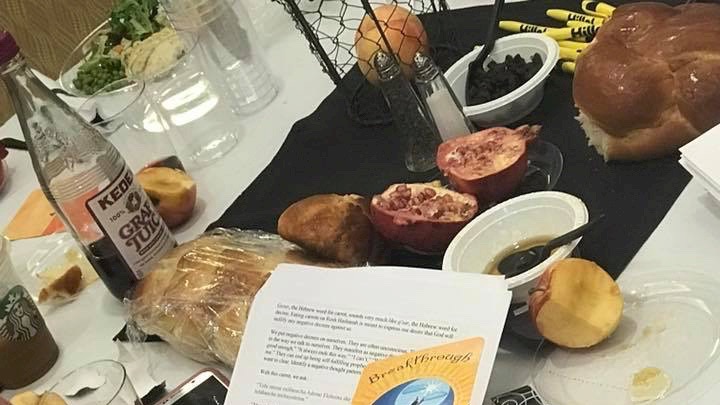
A Rosh Hashanah Seder

A Rosh Hashanah Seder

By Emily Stern


Creation


What would you feel if I told you that, in the Jewish tradition, you were being created anew in this very moment?

Well, in every moment, but Rosh Hashanah is the beginning of the year. This is an opportunity to dwell in the space of renewal. The tradition teaches, there is a cosmic re-writing of your story for the coming year in your bones, sinews, muscles, mind, heart, and being.

So, at this meal celebrating Rosh Hashanah, we have the chance to take part in this powerful time, and also bring awareness to the act of creation. Each moment is a microcosm of who we are becoming. We recognize the food we eat as symbols for our prayerful intentions. They are listed here along with exercises. We bless each other and ourselves, celebrating our moments of gratitude. We bring presence and positivity into our hearts, and can get very clear about the truest, most authentic version of ourselves that, we pray, will find expression and aliveness in the coming year. We act as conscious co-creators with The Creator.

A poem from The Radiance Sutras:

The roar of joy that set the worlds into motion

Is reverberating in your body

And the space between all bodies.

Beloved, listen.


Find that exuberant vibration

Rising new in every moment,

Humming in your secret places,

Resounding through the channels of delight.

Know you are flooded by it always.


Float with the sound.

Melt with it into divine silence.

The sacred power of space will carry you

Into the dancing radiant emptiness

That is the source of all.

The ocean of sound is inviting you

Into its spacious embrace,

Calling you home.


  • The Radiance Sutras


Into The Garden: Apples and Honey

The most archetypal foods of this high holiday season are apples and honey.

We look to the roundness of the apple to represent the cycle of the year. We look at the fruitfulness and prosperity the apple represents, and welcome that these blessings be made sweeter by dipping them in honey.

What else does the apple evoke in you? Here is an exercise to help you uncover some associations:


Close your eyes. Take 3 deep breaths. In through the nose, out through the mouth.

Feel your body and any blocks you have in it. Imagine how you have brought the blocks hiding inside you and feel them like a heavy armor.

Imagine you are walking with this heavy burden along a wall.

Behind it is a garden. You reach the closed gates of the garden and try to look at the garden.

See how you stand still in front of the gate and you undo the armor piece by piece, saying in your mind loudly the name of one of your difficulties and throwing each piece of armor behind you.

Open the gate, if it has not opened by itself.

Enter the garden. When walking in the garden, see yourself at a tree.  Bend down to it or stretch up to take an apple from the tree.. See your hands and feel you mouth, and holding it in your hands, take a bite of this clear, nourishing, and purifying apple.

Look at yourself. How is your hair? How are you dressed? How do you feel?

As the apple grows and grows, it becomes too big to hold. You place it on the ground and allow it to grow more, larger and larger still. You notice it is now so big that you can walk inside it. What is it made of? What does it look like now? What colors? What shapes? Does it still look like an apple or something else?

Once you are inside your apple, feel honey coming like light into you. Feel it coming down through your whole body dissolving all toxins, discomfort, and peeling away layers of yourself.  Send anything that does not belong out down into the ground. Allow the honey to bring you closer to the apple as you dissolve and breathe with the apple’s core. As you are returning to the Origin, what do you see, feel, sense or know?

 Breathe out one time slowly.

Open your eyes.

Share your experience in the present tense.

  •  The Encyclopedia of Mental Imagery & Emily Stern


Honey represents sweetness and we wish each other a sweet new year.

Pick up a slice of apple, dip it in honey, and say:


Baruch atah Adonai, Eloheinu melech ha-olam, borei p’ri ha-eitz.

We praise You, Eternal God, Source of blessing, Creator of the fruit of the tree.

Then add:

Y’hi ratzon milfanecha, Adonai Eloheinu v’Elohei
avoteinu v’imoteinu, shetchadesh aleinu shanah tovah um’tukah.

May it be Your will, Source of All, that this be a good and sweet year for us.


Eat the apple dipped in honey.


Challah


Bread dipped in honey

Baruch Atah Adonai, Eloheinu Melech haolam,
Hamotzi lechem min haaretz.

“Blessed are you, Eternal One, Who brings forth bread from the earth.”


Grape Juice in Gratitude: An Exercise in Mindfulness


“Gratitude is the wine for the soul. Go on. Get drunk.

  • Rumi, Sufi Poet


Making blessings are about concretizing a moment of gratitude for what we have.

Lift the cup(s) of wine/grape juice and say:

Baruch atah Adonai, Eloheinu melech ha-olam, borei p’ri hagafen.

We thank You, Eternal God, Sovereign of the Universe, who creates the fruit of the vine.


Before taking a drink,

begin exploring, using as many of your senses as possible.

First, look at the grape juice. Notice its texture. Notice the way it sits and takes the shape of the cup. Notice its color.

Before you drink, explore with your sense of smell. What do you notice?

Take your first sip. Notice the actual sensory experience of tasting. You might want to close your eyes for a moment to focus on the sensations on your tongue, the way it feels in your mouth.

Notice the sensations of swallowing, if the intensity of its flavor changes

being aware of the simple sensations of tasting

Just pay attention, moment by moment. Presence breeds gratitude. 


Releasing Thought Patterns: Carrots

Gezer, the Hebrew word for carrot, sounds very much like g’zar, the Hebrew word for decree. Eating carrots on Rosh Hashanah is meant to express our desire that God will tear up any negative decrees against us.

We can put negative decrees on ourselves. They are often unconscious. They come from within in the way we talk to ourselves. They manifest as negative thought patterns like, “I’m not good enough,” “It always ends this way,” “I can’t,” “Why me?” “These people won’t like me.” It’s a tangled energy inside that we want to clear. Identify a negative thought pattern or belief that you carry around.

With this carrot, we ask:

“Yehi ratzon milfanecha Adonai Eloheinu she yeekorah g’zar dee’neinu ve yeekaroo lefahnecha zechuyoteinu.”

“May it be Your will, Source of the Universe, that our harsh decrees are torn up and our merits are proclaimed before You.”

As you bite the carrot, imagine this pattern being torn up.

Divine Qualities: Pomegranate

The rimon, or pomegranate, is special for many reasons. If we have not yet eaten it this season, can make a special blessing celebrating the particular moment of newness. Let this blessing be for the new experiences to come, especially in the way we embrace the aliveness and freshness of each and every moment.

Baruch atah Adonai, Eloheinu Melech haolam,

shehecheyanu, v’kiy’manu, v’higianu laz’man hazeh.

Our praise to You, Source of Blessing, Sovereign of all:

for giving us life, sustaining us, and enabling us to reach this season.


There are other links between pomegranates and the Jewish New Year. Some have counted the seeds in a pomegranate and they are said to always come to around 613, which is the number of commandments, or particular physical actions to connect with God. Just as pomegranates are full of seeds, we hope we’ll be similarly full of good actions and positive growth in the coming year.

In Judaism, all the letters in the aleph-bet are assigned numbers. The Hebrew word for honey, D’vash, has the same numerical value as the word Mussar, which speaks to mindfulness. A whole movement of study and practice is called Mussar. It’s about transforming yourself and your qualities, strengthening the virtuous qualities. Like honey, change of self can be a slow process, but it can also be sweet.

“Yehi Ratzon Mil’fa’necha, Adonai Eloheinu She nirbeh zechuyot ke rimon.”

“May if be your will, Source of All, that our merits increase like the seeds of a pomegranate.”

At your seat, each of you has a card from Denise Linn’s Soul Coaching Oracle Card Deck with a quality on it to think about for this meal. Some examples are joy, action, healing, adventure, love. etc. Think about how this quality fits into your life, what this means to you, and how it makes you feel. How has this quality been demonstrated to you? How have you demonstrated it?

Now consider if this attribute were totally incorporated into your being. How would you be different?


Honoring What’s In Your Life: Raisins

We are going to “raise up” what is important in our lives. Give something a shout out, something you’d like to honor and raise it up into light.


Wishes: Lettuce/Let Us

This is our opportunity to make wishes for our future. “Let Us” on Lettuce. What are you calling into your life? What would you like more of?

Like God said, “Let there be light! And scripture teaches, “there was light,” we say, “Let us . . .” “Let us have a healthy year!” “Let us have Peace.” “Let us have more life.” etc.


Remove Enemies: A Metta Practice

The Hebrew word for beets is selek.  In Aramaic, one of the languages of the Talmud (texts of the oral tradition), silka referred to a leafy green vegetable. This is similar to the word for “remove,” expressing a wish that our enemies will be removed.

The blessing we say is:

“Yehi ratzon milfanecha Adonai Eloheinu she yeekartu soneinu.”

“May it be your will, Source of Creation, that our enemies or anything blocking us from our truest natures, be removed.

A Buddhist practice to remove obstacles and hatred in your path is called metta. Metta means Loving-kindness in the Pali language. Metta is unconditional, inclusive love. It does not depend on whether one “deserves” it or not; it is not restricted to friends and family. The process is first one of softening and breaking down barriers that we feel inwardly toward ourselves, and then those that we feel toward others.

 Take a very comfortable posture. Begin to focus around your chest area, your “heart center”. Breathe in and out from that area, as if you are breathing from the heart center. Anchor your mindfulness only on the sensations at your heart center.

Breathing in and out from the heart center, begin by generating this kind feeling toward yourself. Feel any areas of mental blockage or numbness, self-judgment, self-hatred. Then drop beneath that to the place where we care for ourselves, where we want strength and health and safety for ourselves.

Continuing to breathe in and think these phrases.

May I be safe and protected.

May I be happy.

May I be healthy and strong.

May I be able to live in this world happily, peacefully, joyfully, with ease.

Next, move to a person toward whom it takes no effort to feel respect and reverence, someone who immediately elicits the feeling of care. The first person is usually someone we consider a mentor, a benefactor, an elder. It might be a parent, grandparent, sibling, pet, child, or teacher. Repeat the phrases for this person:

May you be safe and protected.

May you be happy.

May you be healthy and strong.

May you live in this world happily, peacefully, joyfully, with ease.

Now move to a neutral person, someone for whom you feel neither strong like nor dislike. As you repeat the phrases, allow yourself to feel tenderness, loving care for their welfare.

Now move to someone you have difficulty with–hostile feelings, resentments. Repeat the phrases for this person. If you have difficulty doing this, you can say before the phrases, “To the best of my ability I wish that you be….” If you begin to feel ill will toward this person, return to the person it was easy for you to feel this towards and let the loving kindness arise again. Then return to this person. Let the phrases spread through your whole body, mind, and heart.

After the difficult person, radiate loving kindness out to all beings. The traditional phrases are these:


May all beings be safe, happy, healthy, live joyously

May all living beings be safe, happy, healthy, live joyously

May all breathing beings be safe, happy, healthy, live joyously

May all individuals be safe, happy, healthy, live joyously

May all beings in existence be safe, happy, healthy, live joyously


                                                –    Steven Smith, The Insight Meditation Society

As I read this poem, stay in touch with the ember of warm, tender loving-kindness at the center of your being, and begin to visualize a felt sense of all living beings.


Love all Creation

The whole and every grain of sand in it.

Love every leaf

And every ray of light.

Love the plants.

Love the animals.

Love everything.

If you love everything

You will perceive the Divine Mystery

In all things.

Once you perceive it

You will comprehend it better every day.

And you will come, at last,

To love the whole world

With an all-embracing love.


  • Dostoyevsky, Brothers Karamazov


Blessing Each Other: Beans

Rubia, which may refer to several different types of small beans, reminds us of the word yirbu, “to increase,” or “rov” which means most or many. These foods symbolize the hope for a fruitful year filled with merit.

The blessing before eating is:

“Yehi ratzon milfanecha Adonai Eloheinu Sheh’yirbu ze’chu-yo-taynu.”

“May it be your will, Eternal God, that our merits increase.”

We can begin spreading our blessings right now. Take your attribute card from Denise Linn’s Soul Coaching Oracle Deck from earlier and turn to someone next to you. As if it is your super power, form a blessing or wish with your card for your neighbor. You do not have to use your card. it is only meant as inspiration.

**At the last seder I ran, everyone decided to go around and make a blessing for the whole room inspired by the theme on their card!


Debrief: The Meal

Fish heads are usually eaten at a Rosh Hashanah meal. One reason fish is eaten is because it is an ancient symbol of fertility and abundance. This is a blessing for creativity in the coming year, for the easy birth of new ideas, projects, and aspects of yourself. I hope we can live in the awareness of the power and potential to create as we explored at this Rosh Hashanah seder.

The yehi ratzon blessing for fish is:

“Yehi ratzon milfanecha Adonai Eloheinu She nifre ve nirbe ke dagim.”

“May it be your will, Creator of the world, that we be fruitful and multiply like fish.”


May everyone have a healthy and happy new year!


What was something interesting that you learned?

What surprised you?

What do you think you are going to remember?


A Rosh Hashanah Seder Read More »
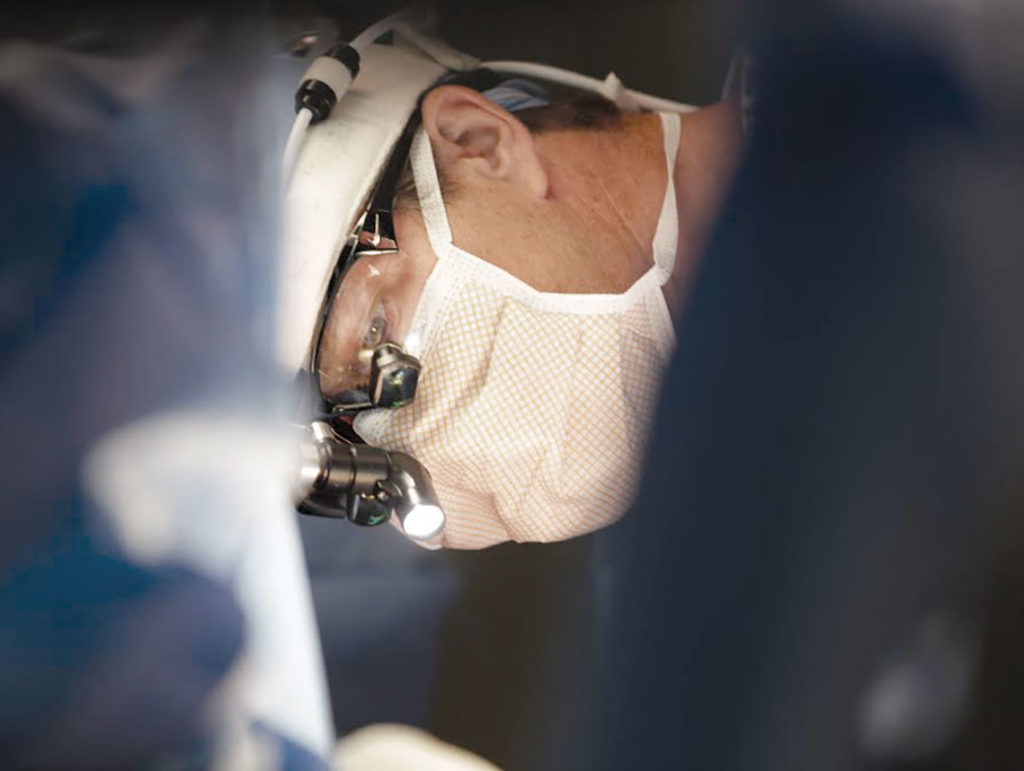
Dr. Evan Zahn at Cedars-Sinai continues to innovate for infants with heart defects

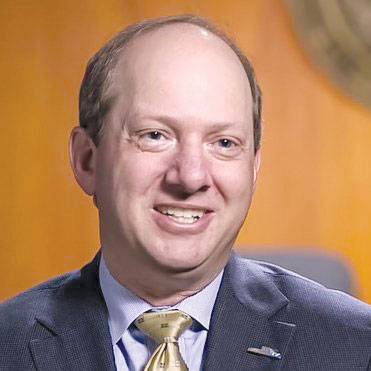
The large desk inside Dr. Evan Zahn’s Cedars-Sinai Medical Center office overlooking Beverly Boulevard has a 3-D printed model of a human chest, revealing veins, arteries and, of course, a human heart — the primary focus of his work for more than 30 years.

“It’s a model of an actual patient,” he said.

Zahn, 57, showed how a small metal device could be inserted into the heart through a catheter that would unsheathe once inside, replace a faulty pulmonary valve and improve blood flow.

“It can last 10 or 15 years, and maybe we just put in another valve then, kind of like a Russian [nesting] doll,” he said. “We can save many patients open-heart surgery.”

One patient he helped save was Jimmy Kimmel’s infant son, Billy, whose heart defect was first diagnosed at Cedars-Sinai. In an emotional monologue on his late-night show in May, Kimmel thanked Zahn by name and used the episode to argue for making the same high-quality medical care available for all Americans.

A native of Long Island, N.Y., Zahn has been the director of pediatric cardiology at Cedars-Sinai’s Heart Institute since 2012. He’s one of the world’s pre-eminent experts at treating structural heart problems with minimally invasive procedures, particularly in children.

During a nearly 20-year stint as chief of cardiology at Miami Children’s Hospital in Florida before coming to Cedars-Sinai, Zahn rose to prominence, performing the world’s first nonsurgical tricuspid valve replacement via catheter on a 9-year-old boy.

Five years ago, it seemed like the right time for Zahn to take on a new professional challenge offered by Cedars-Sinai. He, his wife and four children moved from Miami to Pacific Palisades, where they’ve become members at Kehillat Israel, a Reconstructionist temple. He’s an avid runner and cyclist.

“I love it here,” he said. “When people ask me about the traffic in Los Angeles, I say there’s a reason so many people want to live here.”

Zahn was lured to Cedars-Sinai to head up a new Congenital Heart Disease Program and develop more minimally invasive treatments.

“Cedars is a household name, a widely respected place for treating heart disease,” he said. “There’s tremendous support here for doing new, creative and innovative things. I don’t think there’s a place anywhere that rivals this institution for that.”

One of the main attractions for Zahn in coming to Cedars-Sinai was the prospect of forming a congenital heart disease program in an adult medical center. Children’s hospitals, by nature of their charters, can’t treat patients over the age of 18. In many cases, Zahn had patients born with heart defects requiring lifelong medical attention and complex procedures age out of his care.

“I was having to send my patients away, and I hated it, but not half as much as they hated it,” he said. “So, one of the things that really drew me here was being able to take care of patients who need a lifetime of care at one institution with one singular team, from fetal diagnosis until old age.”

Cheryl Davis, 48, a lighting artist at Walt Disney Animation Studios in Burbank, is one of Zahn’s adult patients. She was diagnosed with a severe pulmonary valve regurgitation, or leaky valve, as a 9-year-old. Leaks in the pulmonary valve allow blood to flow back into the heart chamber before it gets to the lungs for oxygen.

Davis had open-heart surgery as a child to correct it but still had complications throughout adulthood, including a murmur and fatigue. After consulting numerous cardiologists, she was referred to Zahn. In late August, he performed a valve replacement on Davis, just as he demonstrated on the model in his office. She was back at work a few weeks later.

“I’m still taking things a little slow, but I don’t feel my murmur and my heart feels normal for the first time in my life,” she said. “[Zahn] has been amazing. On top everything, he’s just a really nice man and one of the most humble people I’ve ever met.”

Still, Zahn’s primary focus at Cedars-Sinai has been treating newborns, particularly premature babies, with structural heart problems. He estimated that as many as 15,000 premature babies are born each year with life-threatening congenital heart defects. These are babies born up to four months early that sometimes weigh as little as 1 pound and fit in a cupped adult hand. Zahn said doctors currently have two main treatment options, which work less than half the time and have significant side effects or complications linked to severe outcomes like blindness, deafness and mental disability.

At Cedars-Sinai, Zahn has made great strides in this area, dedicating time to research and development with colleagues and outside biomedical engineers. So far, he has treated 40 premature babies using a catheter to insert a small metal clamp that plugs harmful blood flow to a baby’s lungs, which causes disease in lungs, bowels and the brain.

“For premature babies, no one does that,” he said. “No one has gone into their hearts via catheterization.”

Zahn said he has a 90 percent success rate so far. No one has died, and babies he treated three years ago now look like other kids their age. In the remaining 10 percent of cases, he said additional conventional surgery was required. 

“There have been other people who have done other work in other countries, and some of that was very useful, but ultimately, I think the solution came from here,” he said.

Zahn almost feels guilty about how much personal satisfaction he gets out of saving lives.

“It’s almost a selfish thing that I do,” he said. “I get so much joy out of knowing that a baby, who without immediate medical care won’t survive, will be fine because I’ve seen their course so many times. Now that I’ve done this for nearly three decades, I’ve seen these babies grow up to play T-ball, play high school sports, get married and have kids. It’s remarkably gratifying.”

Cedars-Sinai is working with an industry partner to develop a clamp device uniquely designed for premature babies with heart problems and to get federal approval for it. The device, Zahn said, will be a self-expanding plug, fashioned to fit inside a catheter and made out of a metal called nitinol, or nickel titanium. The device used in the initial 40 cases was designed for other purposes.

Zahn, who recently spoke to a colleague in Japan whose hospital just treated its first premature baby, said he is confident that his efforts at Cedars-Sinai will have wide-reaching impact.

“We think we can make a big difference around the world with this,” he said. “It’s a very in-need population, and there’s not a lot made in general for premature babies. They don’t vote. They don’t get the attention they need. We think this is going to be a game changer.”

Dr. Evan Zahn at Cedars-Sinai continues to innovate for infants with heart defects Read More »

Nonprofits benefit from Jewish Community Foundation’s new grant program

The Jewish Community Foundation of Los Angeles has launched the Next Stage grant program, providing nearly $1 million in awards to four local Jewish nonprofits — Creative Community for Peace, Friendship Circle of Los Angeles, Silverlake Independent Jewish Community Center (JCC) and ETTA, an organization that helps people with intellectual and developmental disabilities.

Three of the recipients were awarded a $250,000 grant and Silverlake Independent JCC received $200,000, given out over the next two years. All four organizations had previously received the Foundation’s Cutting Edge grants.

The pilot program continues grants of more than $17 million awarded by the Foundation since 2006 to help nearly 100 programs and organizations.

“One of the biggest challenges that even the most innovative and best-run nonprofits confront is the path to achieving sustainability,” Elana Wien, vice president of the Foundation’s Center for Designed Philanthropy, said. “Next Stage Grants was piloted to provide the assistive ‘tools’ — in the form of grant monies, but also professional coaching and other consultative resources — to better enable their success. The success of these nonprofits represents, in turn, a boon to the whole of our local Jewish community, now and in the future.”

A unique aspect of the selection process for these grants, Wien said, is that leaders from each grantee got a chance to discuss with the Foundation their potential involvement with the pilot program.

The Friendship Circle of Los Angeles helps about 120 children with special needs and their families through 20 programs with a volunteer network of more than 500 teens.

“We are thrilled to have the Foundation’s confidence and support to streamline and strengthen our organization, which will ultimately help the children with special needs, families and volunteers who depend on our vital services,” said Gail Rollman, Friendship Circle’s development director.

ETTA is planning to use the grant to expand its programs.

“The demand for programs to help adults with special needs is continually rising,” ETTA Executive Director Michael Held said. “This funding will contribute greatly to helping ETTA fulfill its mission of inclusion and independence for the clients we serve.”

The Creative Community for Peace provides support to artists so they can resist pressure from boycott groups in response to scheduled performances in Israel. The organization uses its broad network to educate artists who are touring in Israel and to mobilize a grass-roots social media response to Boycott, Divestment, Sanctions movement protests.

The Silverlake JCC hosts an early childhood center, a Jewish learning center and community-led classes and programs, including East Side Jews and Culture Lab.

According to Wien, the Next Stage program is among the first by any Jewish community foundation in the United States offering “capacity-building support” of this scale to sustain nonprofits’ operations, growth and long-term viability. 

Nonprofits benefit from Jewish Community Foundation’s new grant program Read More »

Persian-language bookstore Ketab Corp. closes but maintains its mission

“Reading books is a human right,” Bijan Khalili said on Public Radio International’s “The World” last month. Then, a few weeks later, he closed the doors to his Persian-language bookstore, Ketab Corp., after 36 years in Westwood.

For thousands of Iranian-Americans in Southern California, Ketab — “Book” in Persian — represented a community institution as a physical space on Westwood Boulevard where they could reconnect with their homeland. (It continues to sell books, movies and music online and by phone to local customers and Iranians around the world.)

Like so many brick-and-mortar operations, Ketab fell victim to the explosive growth of internet book sales and the logistical challenges of high rent and overhead and operating on a busy street with limited parking.

For the Iranian-American community in Los Angeles, the closing of the storefront was a major loss — one that took some history with it. Khalili, an Iranian-Jewish Kurd, said he hung the first Persian-script vertical sign on any business in America when he opened the store in 1981, and offered the first Iranian Yellow Pages ever published outside of Iran, which is still circulated and contains 2,500 listings.

Among the most notable areas of the bookstore was a shelf labeled “Books Prohibited in Iran.”

As a college student at National University of Iran in Tehran immediately before Iran’s Islamic Revolution, Khalili delivered passionate public addresses against the Ayatollah Khomeini and encouraged students to vote against regime change that led to the creation of the Islamic Republic of Iran in 1979. In 1980 he was imprisoned, and like thousands of others, he feared he would be executed without a trial.

Khalili still does not know why he was released after 11 days. When the Iran-Iraq War began that September, he traveled by bus to Istanbul, then by plane to Zurich, where, with the help of Swiss Jews, he received a humanitarian parole visa from the American consulate.

Khalili opened Ketab roughly one month after he arrived in the United States. He brought 10 beloved books, including “1984” and “Les Misérables,” which became the first books he kept at Ketab.

The store featured books and films in Persian on a variety of topics, from controversial biographies to explanatory works on Judaism and Islam, as well as books in English about Iran. Its patrons were mostly Iranian exiles eager for a taste of Persian culture.

Ketab was often the site of debate, evening poetry readings and locals reading their own works.

“Offering prohibited books was one of the duties of Ketab,” Khalili said. “Since the freedom of choosing and buying and reading of books was respected in Ketab bookstore, I believe there was no difference that the owner was a Jew or not a Jew. More importantly, I always carried books that were pro-Islam and against Islam, and at the same time books that were pro-Jewish and against the Jewish faith, and the same with Christian and Baha’i books.”

Customers varied by faith and included many Iranian Muslims who often purchased books about Zionism and Israel, Khalili said. Ketab also published calendars, on which Khalili made sure to include all prominent holy dates related to both Shiite and Sunni Muslims, and to Jews, Christians, Baha’is and “nonbelievers,” he said.

Ketab came to promote inclusivity of Iranian identity for exiles young and old, yet fewer young people visited the store in recent years, due to their inability to read Persian or their lack of interest in the language.

Rachel Sumekh, a 25-year-old Iranian-American Jew who was born in Los Angeles, said she first entered Ketab after completing a Persian-language class at UCLA in 2012. Her mother escaped Iran by camel in 1983, and her father arrived in Oklahoma for college in 1970.

It was at Ketab that Sumekh purchased her first Persian beginner’s book, a famous children’s tale titled “The Little Black Fish,” which promotes allegorical political themes of exploration and venturing into uncharted waters. The book held “prime real estate” on her bookshelf, she said.

“I wanted to pick up a proper book to keep my reading strong, and it was easier to peruse a physical bookstore in a foreign language than it is on Amazon,” Sumekh said.

While the storefront has closed, Ketab remains a prominent Persian-language publisher who bypasses regime censors, offering Iranians worldwide information on critical topics ranging from gender equality to the Holocaust. The latter is considered a particularly taboo topic by Iran’s Ministry of Culture and Islamic Guidance.

Ketab Corp. will continue to sell both Persian and English books online and by phone. It also will continue as a publishing source for books, as well as the Iranian Yellow Pages, which is available in a pocket edition, and the local Iranshahr newspaper.

“My hope is to send electronically all or most of the banned books into Iran,” Khalili said.

His efforts have produced unexpected results. According to the report on Public Radio International, some of those books already have made it into Iran’s National Library. 

Persian-language bookstore Ketab Corp. closes but maintains its mission Read More »

Hamas and Fatah try again to move toward Palestinian unity

The long-awaited reconciliation between Palestinian factions Hamas and Fatah has taken a new turn with the announcement by Hamas on Sept. 17 that it would dissolve its administrative committee — the body that effectively serves as the governors of the Gaza Strip since Hamas took control from Fatah and the Palestinian Authority in 2007.

The Islamist group apparently has agreed to take the action and to abide by other conditions that Fatah set forth for implementing a reconciliation agreement. Several of the conditions have been signed in recent years but none has been implemented. The new initiative, brokered by Egypt, includes an invitation for Palestinian Authority (PA) Prime Minister Rami Hamdallah to oversee a unity government for the Gaza Strip immediately.

The Hamas declaration was released one day after the PA’s delegation reached Egypt after meetings last week between a visiting Hamas delegation and the head of the Egyptian Intelligence Agency, Khaled Fawzi.

Hamas’ promising press release is something Palestinians have been waiting for since the signing of the first reconciliation agreement in Egypt in 2011. The statement also mentioned that new elections will soon be held in Gaza, and that Hamas is willing to accept Egypt’s invitation to meet with the PA under Cairo’s aegis. Hamas said all of these decisions were made with the desire to establish a unified Palestinian government that includes all political parties that were signatories to the 2011 agreement.

Wassel Abu Yousef, a member of the Palestinian Liberation Organization (PLO) Executive Committee, cautioned that while the Hamas press release is important, it must be followed by action — specifically, practical steps to implementation, unlike after previous attempts at reconciliation.

“The Palestinian Authority needs to go to Gaza to assess the current governmental infrastructure and prepare for the elections to come,” he said. Abu Yousef also warned that follow-up was critical to end the division, and he expressed appreciation for Egypt’s role in initiating and providing the venue for the political reconciliation.

“The Palestinian Authority needs to go to Gaza to assess the current governmental infrastructure and prepare for the elections to come.”

In recent months, Hamas has sought to improve its relationship with Egypt in several ways, including issuing a new charter that removed its association with the Muslim Brotherhood — Egyptian President Abdel Fattah al-Sisi’s nemesis. The Muslim Brotherhood’s relationship with Hamas had been the catalyst for the Sisi government to eschew Hamas and refuse its pleas for assistance. Hamas needs Egypt to allow passage of goods and people through the Rafah crossing, the only crossing point not controlled by Israel. It also needs Sisi’s help in obtaining goodwill gestures from Israel, such as medical treatment for Gazans.

Having been teased several times since 2011, Palestinians-at-large were not optimistic that the latest developments would spell unity.

Abdel Rahman Haj Ibrahim, head of the political science department at the West Bank’s Birzeit University, pointed out that the Palestinian government has not made an official statement despite the PA sending a delegation to Egypt.

“Nothing is solid or official,” he said. “Hamas and Fatah have two different political agendas, they have no mutual points, and there will be no reconciliation without the two parties finding mutual grounds.”

He cautioned, “No one knows what is going to happen. Remember, more than once has there been talk of reconciliations but there were no results on the ground.”

A former member of the Popular Front for the Liberation of Palestine, a rival group to both Fatah and Hamas, explained under the condition of anonymity that the Palestinian people have no faith in either of the two factions involved in the talks.

“For the last 15 years, we have needed a unified government to fight settlements and the occupation, to support prisoners during the strike. … We needed one unified official political Palestinian entity, but they failed to put aside their differences.”

He agreed, however, that the Palestinian reconciliation is a necessary step that needs to be taken in order to reunify the Palestinian people.

“The bad situation in Gaza is a result of Fatah and Hamas and their respective governments, which resulted in corruption and disingenuousness,” he said. “They need to work on regaining the trust of their people.”

Hamas and Fatah try again to move toward Palestinian unity Read More »

Jews join Bahrain officials to promote religious tolerance

Even for Los Angeles, where spectaculars often are met with a stifled yawn, a recent international tribal gathering in a Beverly Wilshire Hotel ballroom was an eye-opener.

There were delegations of Buddhists in saffron robes, Sikhs in turbans, Muslims with keffiyehs and hijabs, Jews with kippahs and Christians in business suits.

Some 400 members of these diverse groups came together on Sept. 13, at the invitation of the Simon Wiesenthal Center, for a noble objective. The aim was to sign and support a declaration denouncing religious hatred and violence in all their forms; to support full freedom of religious choice and government protection of minorities; and to ensure that religious faith “serves as a blessing to all mankind and as the foundation of peace in the world.”

Given the past and present behavior of mankind, it doesn’t take a skeptic to view this and similar declarations as pie-in-the-sky illusions.

What was different in this instance was that the declaration was promulgated and drafted by the ruler of a country where such ideas have been in effect for centuries. That country is Bahrain, a small island nation in the Persian Gulf. Bahrain has some 1.4 million inhabitants, and a breakdown of its religious faiths indicates that 70 percent are Muslims, 14.5 percent are Christians, 10 percent are Hindus and 2.5 percent are Buddhists. The percentage of Jews is listed in different surveys as a fraction of 1 percent, but the actual number is even smaller, ranging between 36  and 40 residents.

Large parts of the Jewish population left the country following riots in 1947 and 1967, but Jewish, Muslim and British sources agree that the riots were triggered by pro-Palestinian outsiders and that resident Arabs went out of their way to protect their Jewish neighbors.

But with the ascendancy of King Hamad bin Isa Al Khalifa to the throne in 2002, domestic and foreign observers have seen an almost utopian state of relations among Bahrain’s religious groups. The monarch has enshrined religious tolerance in the country’s laws and by personal example. For instance, since 2015, he has celebrated Chanukah with both Jews and Muslims in attendance.

During the dinner in Beverly Hills, Sami Abdulla, a Bahrain government minister responsible for housing projects, was asked whether there were any problems in what sounded like paradise on earth. He responded that the main fear of his countrymen was that the surrounding region’s many problems and hostilities would at some point spill over into their nation.

Marvin Hier and Abraham Cooper, the two Orthodox rabbis whose unorthodox projects and initiatives as leaders of the Simon Wiesenthal Center often vex more conventional Jewish organizations, visited Manama, Bahrain’s capital, by invitation in early 2017. A walk through the city, Cooper said, was enlightening. There was a church, with a huge cross, next to a Hindu temple; and 100 yards away was an impressive mosque. A small synagogue, the only one in the Persian Gulf region, still stands in an older part of the city.

Hier and Cooper met with Hamad and discussed the ruler’s plan to establish a Museum of Religious Tolerance in the capital city by the end of this year.

Bahrain does not have diplomatic relations with the State of Israel. However, Cooper noted, during the audience with the king, the latter denounced the Arab boycott of Israel and said his subjects were free to visit the Jewish state.

Another point of discussion at the Beverly Hills event was a universal statement on religious tolerance written by the king and celebrated as the Kingdom of Bahrain Declaration.

The document’s key points emphasized freedom of religious choice, religious rights and responsibilities, and “faith illuminating the path to peace.”

The evening’s guests included officials from such predominantly Muslim nations as Kuwait, Egypt, Malaysia, United Arab Emirates and Azerbaijan. Like all others present, the Arab officials stood in respect as the colorful Bahrain National Orchestra, conducted by Field Marshal Mubarak Najem, played “Hatikvah,” preceded by the Bahraini and United States national anthems, sung by Sumaya Meer and Cantor Arik Wolheim.

The main speaker was Shaikh Nasser bin Hamad Al Khalifa, son of the king, who led the Bahraini delegation, toured the Wiesenthal Center’s Museum of Tolerance and met with Jewish students.

As the evening’s climax, a group of distinguished guests on the dais signed the Bahrain Declaration, among them the speakers; visiting Arab officials; clergymen of various faiths; the evening’s master of ceremonies, television personality Mary Hart; UCLA professor Judea Pearl; and Betsy Bennett Mathieson, president of This Is Bahrain. The government-supported  booster  organization presented each guest with a lapel pin featuring symbols of the country’s seven religions, with a Jewish menorah adjoining a Christian cross and a Muslim crescent.

At the conclusion of the ceremony, a reporter asked Cooper whether the evening’s upbeat tone and hopeful notes were warranted in light of the Mideast’s seemingly endless conflicts.

Cooper responded that Bahrain, like Israel, “lives in a tough neighborhood. But if there is to be any hope for the future, it will have to be realized by voices of religious moderation.”

Jews join Bahrain officials to promote religious tolerance Read More »

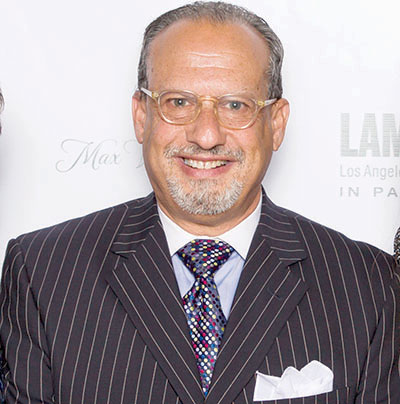
Schoenberg parts With LAMOTH, citing problems with new management

E. Randol Schoenberg. Photo from Twitter

A week before Rosh Hashanah, philanthropist and world-renowned litigator E. Randol Schoenberg shocked the Los Angeles community when he announced on Facebook that he was withdrawing his support from the Los Angeles Museum of the Holocaust in Pan Pacific Park (LAMOTH), an institution he has supported since 1996 and which he helped transform into a leading Holocaust education destination.

In a Sept. 14 Facebook post, Schoenberg, a former president of the museum, signaled that his decision was the result of friction with the institution’s current leadership.

“I am sad to say I have decided I can no longer support the new management of Los Angeles Museum of the Holocaust and therefore cannot continue to be involved with or support the museum,” Schoenberg wrote. “Thank you to everyone who has supported the museum during the 21 years I have been there. I am very proud of what we accomplished together.”

Within minutes, dozens of comments piled up on Schoenberg’s Facebook page expressing shock and confusion over what had gone wrong at the institution where he once played such an integral role.

“The obvious question is why you made this decision,” one woman wrote. “Not lightly, I’m sure. And to announce this so publicly on Facebook adds extra weight to your words. … Please don’t drop this bombshell without explaining it. Not fair to your legion of fans or the museum.”

But Schoenberg provided no further explanation on social media.

In an interview with the Journal, Schoenberg denied that he simply is having a hard time allowing the new leadership to take charge and suggested something more dysfunctional than change is poisoning the atmosphere at one of the city’s most prized Jewish institutions.

“The last month has been very difficult for me,” Schoenberg said. “Change is always difficult. But that isn’t what this was about.”

Schoenberg declined to get into the details but indicated that the last year has been full of friction.

When reached for comment, LAMOTH President and CEO Paul Nussbaum said he was “personally saddened” by Schoenberg’s decision.

“Randy was the one who recruited me to come onto the board of directors, so there’s a personal loss to me,” said Nussbaum, a former banking and wealth management executive. “I had looked to Randy for institutional knowledge and support, counsel and advice early on.”

LAMOTH President Paul Nussbaum

Schoenberg’s decision to distance himself from the very leadership he helped install left many wondering how a relationship that began in mutual respect and trust had soured.

“Change is traumatic, and sometimes change is most traumatic for people who are founders or significant contributors to the development of an enterprise,” Nussbaum said.

By the time Shabbat arrived on Sept. 15, Schoenberg’s name had been scrubbed from the LAMOTH website’s list of honorary directors. Next, the museum issued a statement from the Goldrich Family Foundation — the museum’s other major benefactor — affirming support for the leadership that Schoenberg couldn’t tolerate.

“The Goldrich family and the Goldrich Family Foundation strongly support the current management team at the Museum and have been in active consultation with the management team as it has implemented changes over the last few years to support the Museum’s growth and continued vitality,” the statement said.

For years, Schoenberg and Jona Goldrich, a real estate developer and Holocaust survivor who died last year at 88, worked together as the most significant and passionate supporters of the museum. He also was one of the lead donors for the museum’s permanent building in Pan Pacific Park.

One of his daughters, Andrea Goldrich Cayton, now serves as LAMOTH vice president.   

Goldrich’s other daughter, Melinda Goldrich, who is a museum board member, wrote to the Journal, “Both my sister and I feel that the museum, through its current staff and supportive board members, has come a long way from its early days of inception. Though it is a young museum in its current form, its evolution is ongoing and as the primary donors to the operation, we couldn’t be more pleased to see these changes.”

Schoenberg first joined the LAMOTH board in 1996, nearly a decade before he won a landmark art-heist lawsuit that made him an international celebrity. With the case, Republic of Austria v. Altmann, Schoenberg restored a group of Gustav Klimt paintings stolen by the Nazis to their rightful Jewish owner, Maria Altmann.

The case was popularized by the 2015 film “Woman in Gold,” starring Helen Mirren as Altmann and Ryan Reynolds as Schoenberg. In 2005, the lawsuit reached the United States Supreme Court, and by early 2006 Austria agreed to remove the paintings from the country’s museums and turn them over to Altmann.

After the five Klimt paintings were recovered and sold at auction for an estimated $327 million, Schoenberg, who reportedly received 40 percent of the proceeds, became a wealthy man. In addition to the leadership role he assumed in December 2005 as president of LAMOTH, which was founded by a group of Holocaust survivors in 1961, he also was in a position to help fund the expansion and operation of the museum.

During the decade he served as LAMOTH president, Schoenberg led a $20 million capital campaign to expand the museum into an eco-friendly, state-of-the-art building in Pan Pacific Park. It opened its doors in 2010, at a ceremony attended by city officials and Jewish community leaders.

In addition to fundraising, Schoenberg was meticulous in overseeing the new building’s details, including designing its permanent exhibitions, curating its award-winning audio guides and dreaming up the centerpiece exhibition, “Tree of Testimony,” a data-visualization art project featuring 52,000 survivor testimonies.

Since 2006, Schoenberg, who is guarantor for the museum’s line of credit, has contributed about $7.7 million to the museum, he said.

But last summer a reshuffling of museum leadership led to some unexpected changes, triggering a turbulent series of events.

In August 2016, the museum’s then-executive director, Samara Hutman, whom Schoenberg supported, began an abrupt and unexplained leave of absence. As word quietly spread among the L.A. Jewish community, many were surprised that a woman who had served the museum for three years and was credited with improving its programming and raising its public profile disappeared from her desk.

Around that same time, Nussbaum, who previously had served as board treasurer, took over as president and former president Beth Kean assumed the position of executive director.

Three months passed before a formal announcement was made on the museum’s website, explaining that Hutman was leaving the museum and returning to the Remember Us organization, a Holocaust engagement program for teens.   

When reached by phone, Hutman declined to comment on the reasons for her departure. So did Schoenberg. Nussbaum also declined to comment, citing pending litigation.

Once Nussbaum and Kean took over the management of LAMOTH, they initiated changes that affected the operation of the organization and its staff. Schoenberg played a periodic role, stepping in on an as-needed basis — sometimes by request and sometimes through personal initiative. Eventually, conflict arose about the way museum business was handled.

In interviews, Schoenberg insisted he offered a helping hand for the health of the museum. Nussbaum defended the new ways.

“The museum is in incredible shape,” Nussbaum said. “It is thriving. We’re in the greatest fiscal health that this organization has ever been in, and our programs and our galleries are teaching tens of thousands per year about the Holocaust. This year, we’ll have 20 percent more visitors than we had the year before.”

He added, “That should put your questions in context.”

When asked if Schoenberg’s departure was related to a personality conflict, Nussbaum responded: “I’m not going to enter into that discussion.”

He also declined to be specific about how the loss of Schoenberg’s financial contributions would impact the museum.

“At this point, if you’re talking only about financial support, we are not facing the loss of a significant supporter on a yearly basis,” Nussbaum said. “This is about change. All it’s about is about change.”

Schoenberg rejected the notion that he was having a hard time letting go, explaining that he always had planned to step out of the way and hand the reins to a successor.

“This was a very tough decision for me to make,” he said. “Obviously, I’ve put a lot into the museum and I’m very proud of what we accomplished because it was a team effort. Unfortunately, many members of that team are no longer there.”

Asked what he’ll do next, Schoenberg said he is about to publish a book of correspondence between his grandfather, composer Arnold Schoenberg, and writer Thomas Mann. Titled, “The Doctor Faustus Dossier,” it reveals the dispute between Mann and Arnold Schoenberg after Mann used the composer as the model for the title character of his novel “Doctor Faustus” — a character who sells his soul to the devil.

Schoenberg also is devoted to the study of Jewish genealogy and continues to advocate for the restoration of Nazi-looted art to its lawful owners.

“I always keep busy,” he said. “I’m not gonna be twiddling my thumbs.”


Schoenberg parts With LAMOTH, citing problems with new management Read More »

The Akedah Dilemma

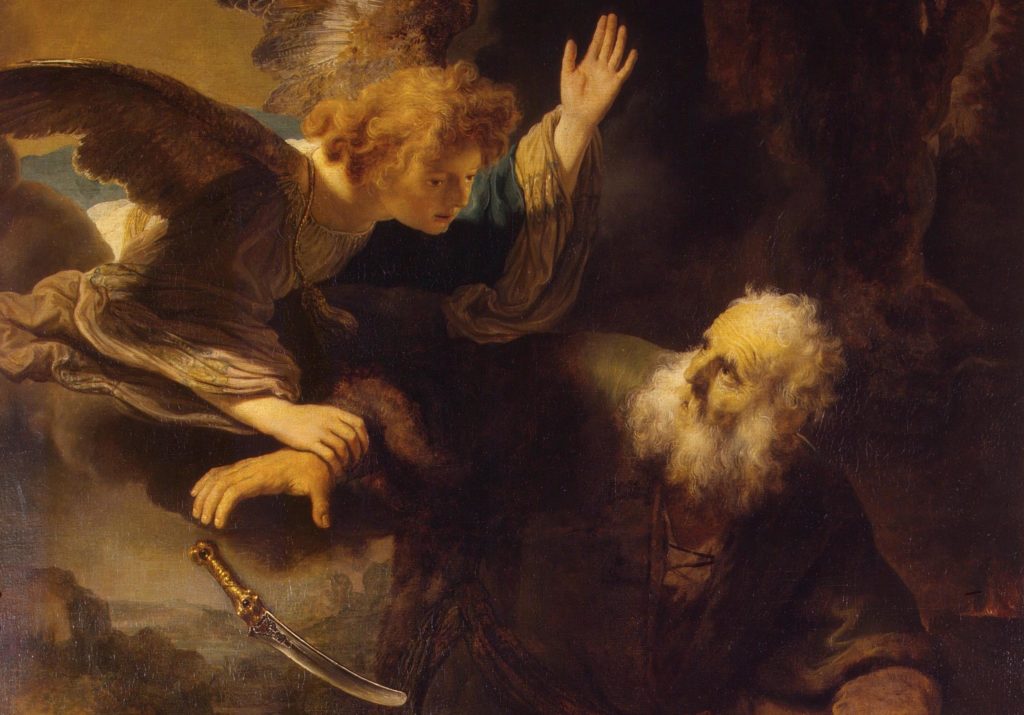
The binding of Isaac passage has posed a perennial problem for those affirming universal moral norms. Struggling with the dilemma of a God who commands Abraham to sacrifice his ‘chosen’ son has yielded a steady flow of creative interpretations. Herein my latest suggestion.

One way of presenting the Akedah challenge is to define the quandary that confronts Abraham as the choice between fulfilling the command to “Love the Lord your God” and the obligation to ‘Love Your Fellow as Yourself.” Which one has priority, the commitment to principle and law or the devotion to interpersonal love and relationship? Is the essential religious message that one must be prepared to sacrifice everything for the sake of the Divine or that we must do everything in our power to sustain our human relationships? Is obedience and submission always the appropriate religious stance or is resistance and disobediences sometimes the more holy/moral response?

Here again, as in the Sodom episode, Abraham emerges as our radical mentor. At the moment that he refrains from sacrificing Isaac he demonstrates that the perceived contradiction between the two Love commandments is only imagined and that, at the deepest level, the fulfillment of the Love of God is achieved through one’s acting to Love one’s fellow human being. Indeed, Abraham concluded that the God with whom he is covenanted would never desire that he sacrifice his beloved son nor demand the violation of any other universal moral precept.

And so, once again Abraham the iconoclast shatters the idol of religious absolutism in favor of the moderating virtues of compassion, mercy and love.This is the gift of a religion that proclaims loud and clear: “and you shall live by means of the commandments”(Leviticus 18:5), to which the rabbis append, “and not die because of them”(Yoma 85b).

To life, and to a year filled with health, love and peace.


Rabbi Chaim Seidler-Feller is Director Emeritus,UCLA Hillel


The Akedah Dilemma Read More »

Do it yourself: The state of the Jewish people at the beginning of a new year

Rosh Hashanah is not an easy holiday to celebrate. It is supposed to be the beginning of a new year — 5778, according to the Jewish calendar — but most Jews live by the Gregorian Calendar. It is a holiday of reflection, but Yom Kippur is the more powerful symbol of soul searching and introspection. Passover is more fitting for a large family gathering. Purim is more cheerful. Hanukkah is more publicly extravagant.

Rosh Hashanah is the day of the Shofar, but many Jews associate the Shofar with the end of Yom Kippur more than with Rosh Hashanah. It is the day of apple and honey. But really, how excited can such symbols, such treats, make you?

And it is long. Two days in a regular year. This year it is three, if you add the following Shabbat. Three days of what? Family? Children running around looking for things to do? Synagogue? Making one day a special day is difficult enough; a three-day holiday is a headache.

The Mishna counts four Rosh Hashanahs. Tu Bishvat begins the year for trees. Nisan, the month of Passover, begins the year of Jewish Kings. In Elul we find the more obscure beginning of the year for the tithing of cattle.

Our Rosh Hashanah is the beginning of the year for many things that we no longer worry about. For example: the new year for setting the Jubilee year, the new year for non-Jewish Kings, the new year for calculating the 10 percent tithe on produce.

None of this remains relevant to Rosh Hashanah, known as the holiday of ending and beginning. It no longer ends or begins a fiscal year, or a year of kingly reign. It no longer feels, naturally, instinctively, as a calendar turning point. School doesn’t begin; summer doesn’t end. Nothing happens in the real world. To make it a turning point we need to work — psychologically, spiritually — to make it so. The beginning of a culturally-manufactured mental year.

We do that with prayer. We do it with ceremony. We do it by collectively agreeing to consider this completely ordinary time as a special time. “We,” that is the Jews. So Rosh Hashanah is not just a personal mental new year, it is also a mental new year of a collective.

A collective can do useful things with a mental new year. It can decide that this is the time for reflection, not on world events or on financial achievements and failures, but on the state of the Jews. The think tank I work for, The Jewish People Policy Institute, marks a new year by the publication of its annual assessment on the state of the Jews. That is a good way to make it a collective new year.

What happened to the Jewish people this past year? Did they manage — did we manage — to make ourselves better, to better position ourselves for dealing with the challenges ahead?

JPPI’s annual assessment includes five “gauges” for trying to measure something that’s very tricky to measure accurately and convincingly: the state of the Jewish people. We look at geopolitics. We look at bonds between Jews. We look at identification and identity of Jews. We look at demographics and at material sources.

The gauges give a snapshot of advancement and deterioration. But in all fields, there are complications.

Demographics hardly change every year unless there is a catastrophe. There was none this past year. Identity is often connected to ideology: Tell me what a Jew needs to be — a conceptual preference — and I will tell you whether the Jews progressed or weakened.

Like questions of personal introspection — such as, are you happier with more financial success or with more peace of mind — questions determining one’s collective introspection depend on priorities. Some Jews see a collective advancement if more intermarried couples are married by rabbis. Some Jews see a collective decline if more intermarried couples are married by rabbis. That is to say: the collective reflection is still very much personal.

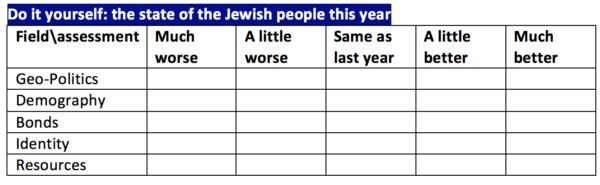
Try it. Try to assess the state of the Jewish people this year before you go and read how JPPI assessed it. And here is a tool to help you: JPPI’s earlier assessments, for 2014-2015 (in blue) and for 2015-2016 (in green). The letters mean: Thriving, Prospering, Maintaining, Troubled, Decline.

So, for example, last year JPPI assessed that the geopolitical situation improved from the Jewish world’s perspective (you can see the analysis here), and that the bonds between Jews remained unchanged. Because any assessment must begin with a baseline, these last two years can serve as your baseline as you answer the questions that follow the graph:

Last years assessment by JPPI

Now, let’s turn to this year:

Are the geopolitical circumstances better for the Jewish people today than they were a year and two years ago?

Are bonds between Jewish communities, and especially between Israel and Diaspora communities, stronger this year?

Do we have more or fewer resources than we used to have in previous years

Do you see a change for better or worse in the way Jews form their Jewish identity?

Did you see an improvement in the demographic circumstances of the Jewish people?

JPPI’s assessments for this Rosh Hashanah are here: geopolitics, bonds, identity, demography, resources. Are urge you to take a look at them.

And no matter how you assess the state of the Jewish people, the fact that we are assessing it as a group, as a tribe of interested participants, shows that Rosh Hashanah still has an important and relevant role in the 21st century.

Shanah Tovah.

Do it yourself: The state of the Jewish people at the beginning of a new year Read More »

haaretz

Episode 56 – Haaretz columnist throws right hooks at left-wingers

Anyone who’s visited Tel Aviv has walked down the famous, sometimes infamous, Allenby Street. It’s hard to miss this road that crosses Rothschild Blvd, runs by the entrance to the Carmel Market and leads to the Beach Promenade. Today, it’s a must see tourist attraction. But not so long ago, Allenby was still on the social fringes of Tel Aviv.

Gadi Taub’s best-selling novel “Allenby”, named after the street itself, sheds light on the gritty underground scene of Tel Aviv – from its shadier dance bars to its strip clubs and brothels. Taub’s book was later turned into a TV series for Channel 10.

But Gadi Taub’s resume does not end there. He received his PhD in American Studies from Rutgers University and is a senior lecturer at the Hebrew University of Jerusalem. He has written extensively for various new publications including Haaretz, Yedioth Aharonoth, Maariv and more. Taub also wrote the novel “The Witch from Number 3 Meltchet Street” which too was adapted for the screen.

Gadi Taub joins us today to talk about his life, his career and maybe a bit about his ideas.

Gadi’s books on Amazon

RSS Subscribe

Episode 56 – Haaretz columnist throws right hooks at left-wingers Read More »