You know the dreadful feeling when you buy something you’ve always wanted and then you find out you could have been smarter as there are far cheaper deals? Not snooping Motorcycle around for long enough can really leave a mark on your wallet, not to mention it can ruin the enjoyment and kill all the fun in the aftermath.
If you’re preparing to buy a motorcycle, don’t let this scenario happen to you. Buying a bike is the type of purchase that has to be well thought through and planned, so try restraining yourself from making any impulsive decisions. Be smarter than that: read on to find out how to get the best deal on a motorcycle.
Assess Your Wants and Needs
Before you start looking for shops and best deals, figure out what you are searching for. Are you an experienced biker who is looking for a stronger, better performing motorcycle or perhaps a beginner in the bike world purchasing his first ride? There are dozens of options on the market, so you need to narrow down your choice and understand what is it that you’re seeking for – a sports bike, cruiser, scooter, enduro, or customs. Consider the optimal weight and height of the motorcycle, type and size of the engine, riding position and the comfort of the seat, pricing range that you’re comfortable with, as well as the accompanying costs.
Once you have a vague idea of what you’d like, conduct further research to explore all your options. Not only will this help you get a fuller understanding of your own expectations (and how they resonate with reality), but it will also prevent the possibility of sale persons tricking you into buying something more expensive you don’t actually want.
Visit a Dealership
After you’ve reasoned with yourself what you want and need, look for the best dealership. You can find your dealer through websites such as CycleCrunch, that allow you to browse through the offer of new and used bikes in your area. Of course, nothing can replace seeing the bike in person, so once you’ve picked your dealership – it’s time to go and have a look at the offer live. Don’t be shy to ask the salesmen any questions you may have about a certain motorcycle model. Never assume anything or make a purchase if you still have some dilemmas. Treat the sales representative as the knowledge source. It could happen that you want to buy a bike with one idea in mind and left the dealership with a whole different one. Of course, you don’t want to get tricked by business, but let the trained employees help you with their expertise. Always take the bike for a test ride to see how it performs and how do you feel in the rider’s seat. If you’re not 100% sure of what you want, it’s better to sleep on it.
Understand the Costs
When deciding on the motorcycle you want, there are various costs you have to take in mind. In addition to the actual price you pay for the bike, you also pay the sales tax, dealer fees (these can go anywhere from $300 to $1000), title transfer, as well as for the riding gear. There are also maintenance costs and the money you’ll have to put out for gasoline. And don’t forget the insurance: according to The Balance, annual insurance coverage can go between $100 and over $3000, depending on a number of factors, including the type of the bike and the insured time period you choose. Spread the burden of payment by planning ahead, bargaining, and researching the price ranges in your area.
We all know it’s shockingly easy to fall for the beauty of two-wheelers and even spend life savings in a jiffy on them. But with just a little bit of effort and savvy thinking, you can get the best deal and buy the motorcycle of your dreams without crippling your budget.
In advance of the publication of “Thanks, Obama. My Hopey, Changey White House Years,” we conducted an iMessage interview with former White House speechwriter David Litt on Monday. This interview has been edited and condensed for clarity.
JI: In the book, you write “if something kishke-related came up (at the White House), I was the go-to guy.” How did you become that guy?
Litt: In 2011, President Obama delivered a speech at the Union of Reform Judaism’s annual meeting. I had this moment where I was like “As a kid, I did eight years of Hebrew school and never knew why. This is why!” After that speech if something was going to be delivered to the American Jewish community, I generally handled it.
JI: How was teaching Hebrew to the President?
Litt: It was great, except for the hard ‘CH’ sounds. Those didn’t go so well. People could be pretty hard on him if he didn’t get a “Chag Sameach” right, but I write in the book about how he gave it plenty of tries. And it’s not like he grew up with that sound. As we all know, it’s a tough one!
JI: In 2012, you were in the storm path of one Harvey Weinstein. How did that happen?
Litt: Maybe it’s best to let people read the whole story in the book!
JI: You mention your great-grandparents from Eastern Europe several times in the book. If they were still with us, what do you think they would be most surprised to read?
Litt: Honestly, I think they’d be stunned that I ended up in the White House just a few generations after they arrived here with almost nothing, in many cases not even speaking English. That’s such a typical American story, but we shouldn’t lose sight of how remarkable that typical-ness is. And I like to think they’d understand that in it’s own way, the fact that I got serve under America’s first black president is part of that story too. This is a country that at its best is always expanding its definition of what’s possible, and my family got to be part of that.
JI: Not to spoil the ending to a chapter about the legendary Correspondents’ Dinner speeches, but what did you have to tell the President after he asked what happened to using a photoshopped picture he liked of him and Bibi Netanyahu in 2013?
Litt: “I’m sorry, Mr. President, we just couldn’t use that picture. You kind of looked like Hitler in it.” Like you said, it’s a long story.
The book is available now on Amazon for $18.29 (hardcover)
We hear the word “high” a lot during the High Holy Days — and it’s not just because we live in pot-friendly California.
This time of year is supposed to elevate us, lift us up. It’s so integral to the mission of the holidays, and it’s embedded into the choreography of the service: The ark is opened and we rise; the shofar calls us to stand and wake up; the fast on Yom Kippur alters the chemistry of our brains. Prayer itself promises to bring us “higher and higher,” inching us closer to the profound mystery at the heart of the universe we call God.
Everything about this 10-day annual ritual titillates us with the promise of spiritual intoxication: If we take the holidays seriously enough — if we repent, return, forgive — Jewish tradition tells us we can change our lives; that everything we thought lost is still possible. Begin again, we’re told. It’s a new year.
But for so many of us, the task of getting high this year seems especially hard because this last year was so full of personal and global anguish. How do we reclaim a space for the spirit when life can be so profoundly dispiriting?
Most of the major events of 5777 have given us reason to worry, rage and fear. We lived through the most polarizing election in our lifetimes, followed by the installation of an equally polarizing administration. We learned about Russian subversion of our democratic process. We endured nuclear threats from North Korea and the rising threat of economic imperialism in China. We watched the Syrian civil war and genocide spread into its sixth tragic year. We divided ourselves over Israel, agonizing about the challenges it faces within and without. We witnessed terror in Europe.
And, most recently, we watched with utter helplessness as the wrath of nature devastated American cities and communities, and as DACA was rescinded, putting the futures of hundreds of thousands of young immigrants in limbo. All of this courtesy of the constant churn of the 24-hour news cycle that knows no Shabbat.
For these reasons and others, we feel drained. Can prayer and community have any impact on healing these wounds? And what if the very polarizing politics we wish to escape appear in our rabbi’s sermon?
For those of us who already are politically engaged, philanthropic and working with great devotion to fight injustice in this world, we hope the High Holy Days will pour some light onto the canvas of our aching souls.
Just before Rosh Hashanah, I asked Rabbi Mordecai Finley, the spiritual leader at Ohr Hatorah in Venice who teaches and counsels through the prism of psychology and philosophy, how we can move from a year of rage, grief or simply exhaustion to a period of spiritual elevation.
His answer was surprising — and kind of Buddhist.
“Every philosophical system that takes morality seriously detaches wisdom from emotions,” he said over warm apple pie at Sophos Café, the Italian-coffee hangout that serves as the lobby at his shul. (I had to put aside my extreme satisfaction with the pie to understand his point.)
But aren’t you angry about what you see happening in our country, or in the world, I asked?
“I don’t get that emotional [about it],” he said. “Anybody who is that upset [over politics], I’m wondering how efficacious their spiritual practice is to begin with. When people say to me, ‘It’s been the worst year ever,’ I say, ‘1862 was a bad year for our country [it was the Civil War and the Union was losing]. 1942 was a bad year for the world.’
“There are those who love divisiveness and get all emotional. It’s a choice you make. I’m among those who find [President Donald Trump] repugnant, but if I talk to somebody on the other side, I don’t bring that into the conversation. I say, let’s have rational conversation based on moral values. For people who say politics is personal, I think they like to be angry.”
Finley admitted that different people seek different things on the High Holy Days. Some people want and need to vent about politics.
“It can feel extremely satisfying when your leadership vents what you’re feeling,” Finley said. “But when people are venting, they don’t want to process. My congregation is populated by people who want an oasis during the High Holidays. I’ve asked, ‘Would you like me every week to rehash the new litany of Trump’s latest outrages?’ They say, ‘No, we get that from The New York Times.’ They’re after personal depth and transformation. They want leadership there.”
Finley believes that for most of us, the way to a better world is through higher consciousness, by cultivating what he calls “the higher self,” or the soul. And the best way to test and exert the functioning of our higher self is through interpersonal relationships.
“There’s a moral framework in which we live that for most people, the first place they experience it is interpersonally,” he said. “You’ve been hurt by others; they’ve been hurt by you. That’s the first thing we have to deal with.”
It’s a lot harder to take on the problems of the world if we’re suffering at home. So for those of us who are grieving, heartbroken, angry or stuck, the holidays are a time to examine and refine our most sacred relationships.
Simple acts of being kinder, more generous and more compassionate can make our broken world a little brighter and bring us higher — indeed, closer — to God.
Danielle Berrin is a senior writer and columnist at the Jewish Journal.
Israeli Prime Minister Benjamin Netanyahu said the Iran nuclear deal must be amended or canceled, but suggested that scrapping the deal may be preferable.
“Israel’s policy regarding the nuclear deal with Iran is very simple — change it or cancel it, fix it or nix it,” Netanyahu said Tuesday, addressing the launch of this year’s United Nations General Assembly in New York.
Netanyahu appeared to favor the cancel option, saying he “couldn’t agree more” with Donald Trump when the U.S. president said earlier from the same podium that the deal is an “embarrassment to the United States.”
The Israeli leader said canceling the deal would simply mean a return to massive sanctions as a means of pressure on Iran. The 2015 deal, negotiated by the Obama administration, traded sanctions relief for a rollback to Iran’s nuclear option.
Defenders of the deal say it would be near impossible to re-establish the international sanctions regime that brought Iran to the negotiating table.
Fixing the deal, Netanyahu said, would mean broadly expanding the number of sites available for impromptu visits by international nuclear inspectors, immediate penalties for any violations of the deal and ending the “sunset” clause — the restrictions on Iran that begin to lapse within the next decade.
Netanyahu said Iran’s rulers should be wary of their constant threats against Israel.
“Those who threaten us with annihilation put themselves in peril,” he said.
Netanyahu also said that Israel would not allow a permanent Iranian presence in Syria, where Iran is aligned with the Assad regime in suppressing a civil war that has raged for more than six years.
A benefit event for the Brent Shapiro Foundation at Green Acres mansion in Beverly Hills on Sept. 9 raised more than $1 million.
The gathering was hosted by Linell and Robert Shapiro,a defense lawyer, who established the foundation following their son Brent’s death at age 24 in 2005. Brent Shapiro was involved with alcohol and drugs since in his early teens. He went to rehab several times and was clean for 18 months before attending a party where he drank beer and took an accidental overdose of the drug Ecstasy.
His parents created the foundation to honor his life and promote prevention and awareness of chemical dependence. The foundation operates the Brent’s Club program that works in conjunction with the Boys & Girls Clubs of America. Brent’s Club serves more than 1,300 young people who are tested for drug use every year. None has failed a test so far. All graduates receive a college scholarship, and two of the graduates were honored during the event, receiving awards plus full scholarships.
“We started 12 years ago with 100 people in the club,” said Linell Shapiro, “and now we have expanded to six clubs and we are going to open two more in New York and Malibu. These kids appreciate what we are doing for them and it warms your heart to see them. Tonight is a celebration of Brent’s life. I’ve never known anybody who was so loved like he was. He is incredibly missed, and I know he is here with us tonight and loves the message of giving back.”
So far, 3,000 young people between the ages of 11 and 17 have participated in the program.
The event, hosted by Mario Lopez and Robert Shapiro, honored singer Demi Lavato, who has struggled with her own substance abuse. Also in attendance at the event were Priscilla Presley, Sugar Ray Leonard, AdrienneMaloof and Tracee Ellis Ross.
— Ayala Or-El, Contributing Writer
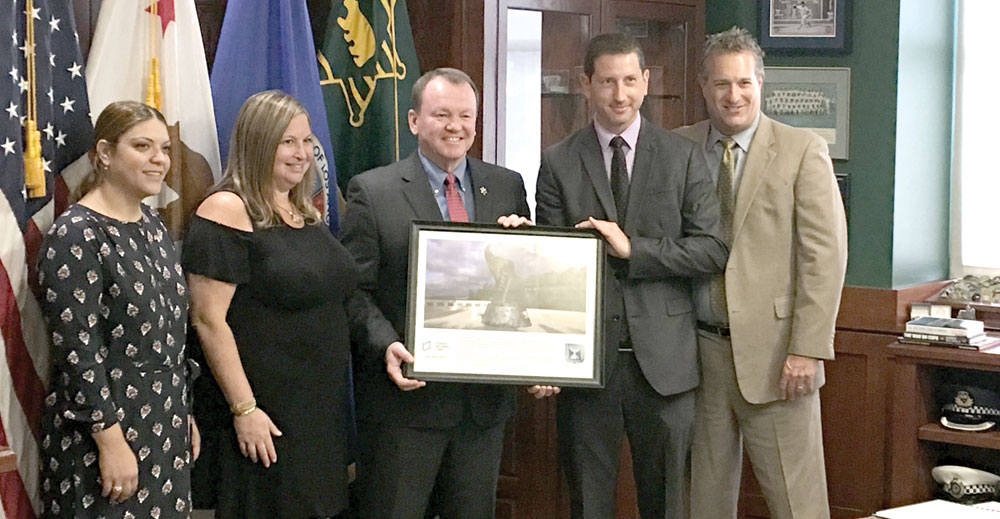
From left: Israeli Consul for Public Diplomacy and Culture Karin Eliyahu-Pery; Jewish National Fund (JNF) Board Member Gina Raphael; L.A. County Sheriff Jim McDonnell; Deputy Chief of Mission at the Consulate General of Israel in Los Angeles Eitan Weiss; and JNF Los Angeles Executive Director Lou Rosenberg commemorate the anniversary of the Sept. 11, 2001, terrorist attacks. Photo courtesy of Jewish National Fund
The Jewish National Fund (JNF) hosted events at fire and police stations around the United States to pay tribute to American first respondersand commemorate the events of Sept. 11, 2001.
JNF built the 9/11 Living Memorial in the foothills of Jerusalem in 2009, and it stands as the only memorial outside of the U.S. that lists the names of all of the victims of the terrorist attacks. Designed by Israeli artist Eliezer Weishoff, the memorial is a 30-foot-high bronze sculpture of the American flag that morphs into a memorial flame and includes a metal beam from one of the original World Trade Center towers.
The Consulate General of Israel in Los Angeles began delivering flowers to fire stations along with a postcard of the memorial on 9/11 three years ago and last year approached Daniel Friedman, JNF’s L.A. Israel advocacy and education department area director, about expanding the effort.
JNF created a plaque with a photo of the memorial in Israel and this year hosted events in L.A., Baltimore and New York.
“It was a huge honor to be part of a special ceremony to recognize our first responders. [It] shows the amazing bond between the United States and Israel, two countries that have shared values of peace and religious tolerance,” Lou Rosenberg, JNF’s Los Angeles executive director, said in an email.
“I think that so often our first responders are taken for granted. These brave people put their lives on the line every day for the betterment and safety of their communities. So to be able to express our gratitude to these police officers, fire fighters and sheriffs was truly an amazing experience,” Friedman said in the email.
JNF hosted four ceremonies, one in Beverly Hills and three others in L.A. On Sept. 8, Beverly Hills Mayor Lili Bosse, Fire Chief Greg Barton and Police Chief Sandra Spagnoli were presented with the plaque. On Sept. 11, JNF visited the Los Angeles County Sheriff’s office, LAPD headquarters and the West Los Angeles LAPD police station, where staff members were presented with the plaque in honor of their service.
Among those at the various events were L.A. County Sheriff Jim McDonnell, Los Angeles Police Department (LAPD) Chief Charlie Beck and Eitan Weiss, deputy chief of mission at the Consulate General of Israel in Los Angeles.
“Israel has always stood, and will always stand, with the United States of America, just as the United States has always stood with Israel,” Israeli Consul for Public Diplomacy Karin Eliyahu-Pery said in an email. “Like true friends and allies, we come together in celebration of good moments and also on occasions of terrible sadness, such as today.”
— Virginia Isaad, Contributing Writer
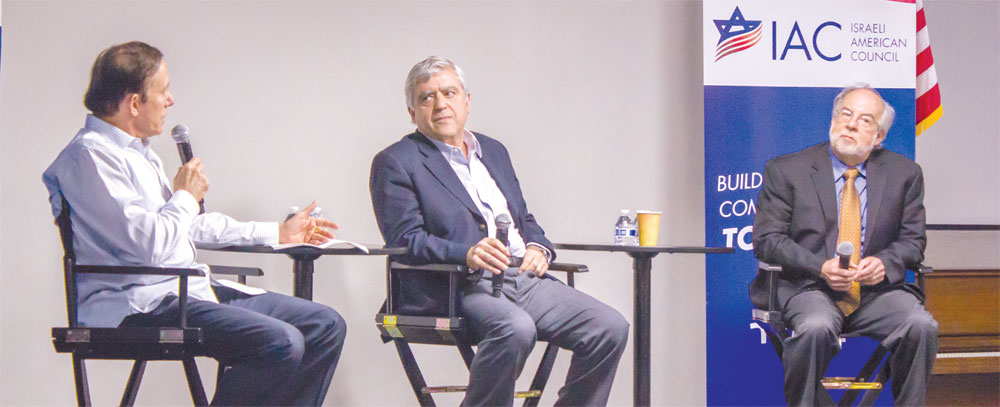
From left: Israeli American Council Chairman Adam Milstein; Jewish Journal President David Suissa and Valley Beth Shalom Rabbi Ed Feinstein. Photo courtesy of Israeli American Council
A panel discussion on Sept. 6 titled, “Israeliness: A Strategic Asset for the American Jewish Future?” featured Valley Beth Shalom Rabbi Ed Feinstein, Israeli American Council (IAC) Chairman Adam Milstein and Jewish Journal President David Suissa.
Approximately 80 people gathered at the IAC Shepher Community Center in Woodland Hills for the discussion, which also centered on the future of the Israeli-American community.
Feinstein expressed a fear that the next Israeli-American generation will have no ties to Israel and to Judaism.
“Here is my problem: In 20 years, whatever ‘Israeliness’ is will disappear,” he said. “They might eat falafel once in a while, might speak a little Hebrew, but that’s it. Israeliness is something that is based on memories that your children don’t have, so unless you do something about it, it will be Little Italy all over again.”
Milstein said the IAC was established by Israelis in part to keep the next generations of Israelis in America connected to their roots and to the essence and culture of Israel. He said membership in synagogues can be expensive and Israeli Americans who cannot afford the high cost have other options to feel connected to their Jewish heritage and maintain their connection to Israel.
“We see increasingly more Jewish Americans participate in our programs,” he said. “They love our Israeli culture and are delighted to discover many new ways to enhance their connection to Judaism and the State of Israel.”
— Ayala Or-El, Contributing Writer
Rabbi Noah Farkas
The American Jewish World Service (AJWS) has named two local rabbis, Noah Farkas of Valley Beth Shalom and Andrew Feig of Alice and Nahum Lainer School, as Global Justice Fellows for 2017-18.
They are among 14 rabbis selected from across the country by AJWS, which promotes human rights and combats poverty in developing nations.
The six-month fellowship will begin in October and include a weeklong trip to Guatemala in January, when the rabbis will meet with leaders in the fight against poverty and the advancement of human rights. They will continue their advocacy work during a trip to Washington, D.C., focusing on laws and policies promoting human rights.
“Rabbi Farkas has been supporting progressive values in the L.A. area for years, with his leadership with RiseUp LA and many other initiatives,” said Lilach Shafir, AJWS director of international education and Jewish engagement. “We are thrilled to have the opportunity to work with him again, at this intense level. Rabbi Andrew Feig is a community organizer and a leader in the interfaith field in L.A., and he brings a social justice perspective to bear on all of his work as a school rabbi in L.A.”
Rabbi Andrew Feig
In addition to his work with VBS, Farkas launched the Seminary Leadership Project, which has trained Jewish clergy to create social change through JOIN for Justice, and he is the founder of Netiya, an interfaith organization that works on food issues in Los Angeles.In 2015, Los Angeles County Supervisor Sheila Kuehl appointed Farkas to the Los Angeles Homelessness Services Authority, which oversees the regional strategy against homelessness.
Feig teaches in Hebrew Union College-Jewish Institute of Religion’s teacher preparation program, DeLeT, where he mentors student teachers both in and out of Alice and Nahum Lainer School, an L.A. Jewish day school. He previously worked at Milken Community Schools, where he was dean of students and a rabbinics teacher.
“I am very honored to be part of AJWS’ Global Justice Fellowship,” Feig said. “As school rabbi of Alice and Nahum Lainer School, my goal is to integrate the work of combining AJWS’ work with our school’s mission of developing students who recognize the dignity of every human being and have agency to stand against injustice.”
— Virginia Isaad, Contributing Writer
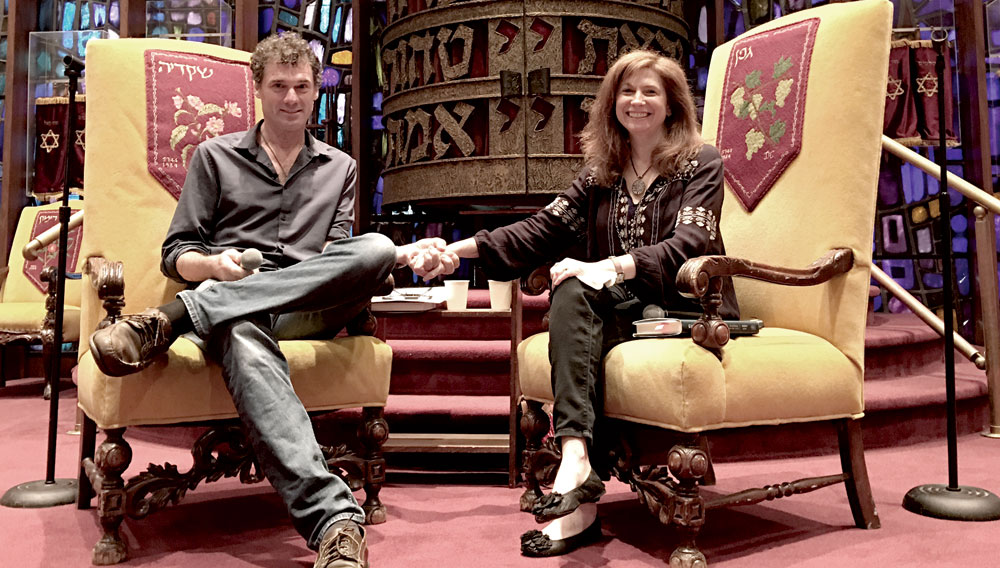
Rabbi Naomi Levy, leader of the spiritual community Nashuva, discusses her new book “Einstein and the Rabbi” with her husband, Jewish Journal Editor-in-Chief Rob Eshman. Photo courtesy of Bob Nankin
More than 300 people gathered on Sept. 10 at Temple Beth Am to hear Rabbi Naomi Levy, leader of Brentwood-based spiritual community Nashuva, discuss her latest book, “Einstein and the Rabbi: Searching for the Soul.”
The title of the book, Levy’s fourth, refers to a kind of mystery story that runs throughout the work after she found her way to an obscure letter whose author turned out to be Albert Einstein: “A human being … experiences himself … as something separate from the rest,” the great scientist wrote. “The striving to free oneself from this delusion is the one issue of true religion.” The letter inspired Levy to play the role of detective, eventually revealing a path to the soul.
The event was the first time Levy had ever been interviewed in public by her husband, Rob Eshman,the outgoing editor-in-chief and publisher of the Jewish Journal. Their conversation was filled with humor and soulful contemplation, including stories of Levy’s journey to writing the book and of the couple’s life together.
Eshman recounted that one of the messages of the book — that “the soul is tugging at us, telling us to grow, grow” — influenced his decision to step down from his role at the Journal.
“It’s your fault,” he told his wife.
“Don’t blame me,” she said.
Adding to the discussion of the soul, Levy and Eshman talked about the concept of soul mates. They recounted their first meeting nearly three decades ago, when Levy was a new rabbi at Mishkon Tephilo in Venice and Eshman was a freelance writer.
If there had been online dating, they likely would have been a “mismatch,” according to Levy. However, during their first date — tea at Rose Café in Venice — “I knew I was home,” Levy said.
After Eshman cooked her an elaborate homemade meal for the first time, she said, “I didn’t know I was home; I knew I was in the Garden of Eden and I’ve never left.”
— Julia Moss, Jewish Journal Staff
Moving & Shaking highlights events, honors and simchas. Got a tip? Email ryant@jewishjournal.com.
As the High Holy Days approach, it’s natural to start thinking about the biggies. Like, who am I? What am I doing with my life? And why is there even a world? God didn’t have to make one!
Rosh Hashanah, the Jewish New Year, may commonly be translated as “head of the year” but it also can mean “a new head.” What would we give for a new head, a fresh approach to navigating this fantastically mysterious treasure chest we inhabit. So in the holiday spirit, here is a short guide to achieving a “New Headedness.”
Let’s begin with a simple but profound truth — the mind believes, but the soul knows.
Let’s try to visualize the difference.
Imagine a submarine that is underwater, far from the clarity of dry land. How does the submarine see beyond itself? There is a periscope that reaches from the top of the submarine, out of the water, and from there the people on the submarine can see what is going on above the surface.
So it is with us. Our body is the submarine. We are surrounded by a world where God is hidden. In Hebrew, the word for “world” (olam) has the same root as the word for “hidden” (ne’elam). This is because God is hidden in this world.
Our soul is like the periscope. It transcends the hiddenness of this world and sees God. As a result, our soul doesn’t have to believe — it knows the existence of God with clarity and certainty.
The question is: How can the mind, which is steeped in the confusion of this world, achieve the same level of clarity as the soul and also come to know?
Here is a three-step approach based on Torah wisdom:
Step One — See
Look at how the Shema is written in the prayer book. Something deep is going on. The last Hebrew letter of the word shema (hear/understand)and the last Hebrew letter of the word echad (oneness) are written in a significantly larger font. Our rabbis teach that taken together, these two letters spell the Hebrew word for “witness” (ayd). If you reverse the two letters, it spells the Hebrew word for “know” (da) — as in, “Know before Whom you stand.”
In other words, if we witness the amazing ways in which God interacts with the world around us — eclipses, babies, ice cream, waterfalls, mind-blowing coincidences and the internet, to name a few — then we will come to “know” with certainty to whom the entirety of creation belongs.
Step Two — Do
When we accepted the Torah at Mount Sinai, we made an amazing declaration. We told God, “We will do and we will hear” — in Hebrew, Na’asay v’nishmah (Exodus 24:7). God marveled at this declaration and asked, “Who taught them the secret of the angels?”
What was so remarkable about our words? By saying, “We will do and we will hear,” the Jewish people committed to doing the mitzvahs before we even heard what they were. The Kotzker Rebbe writes that doing first and hearing the explanation later is akin to climbing a ladder. First we do the mitzvah. The holiness that ensues lifts us to a higher spiritual level, and from that increased place of clarity we are now able to hear the Torah in a deeper way. (Cool aside: The Hebrew words for “Sinai” and “ladder” share the same numerical value.)
This process repeats itself over and over. As we do more, we climb higher and achieve increasing degrees of spiritual clarity. In this way, we’re able to transform the mind’s belief in God into the soul’s knowledge of God.
Doing and seeing are key steps toward achieving a New Head, but I don’t think they’ll work without the third step.
Step Three — Love
The Prophet Hosea writes, “I will betroth you with belief and you will know God” (Hosea 2:22). The whole secret of turning belief into knowledge is in the opening words — “I will betroth you.” If our belief comes from a place of love, then we will know God.
Wow.
Love is the secret formula. Through love you become one. All else falls away. (Cool aside: “Love” and “one” share the same numerical equivalent in Hebrew).
Amazingly, in the Torah, the very first word after the Shema is v’ahavta (and you shall love). God is telling us that if you want to reveal His Oneness, then love Him with all of your heart, and with all of your soul, and with all of your me’odecha. This word is translated as might or money, but literally it means with all of your “very” (me’od).
What an unusual phrase. How do we serve God “with all our very”? The answer is by taking the fire of our hearts, the things we feel most strongly about in life, and using them to serve God.
The New Year is upon us. Our new heads are arriving!If we want the latest model — one where our minds have the same clarity as our souls — then see, do and, most importantly, love.
Shanah tovah.
DAVID SACKS is an Emmy Award-winning writer and producer. His weekly podcast, “Spiritual Tools for an Outrageous World,” is available at Torahonitunes.com.
It’s 1999, two days before Rosh Hashanah, and I can’t think of anything positive to look forward to in the coming year. Rabbi Shalom Leverton is coming to see me with some supplies to celebrate the holiday. I know that he’s going to try to lift my spirits. He’s going to tell me what a beautiful soul I have or something like that.
Although I am eager to get my hands on some of the food he will be bringing, I am not too eager to be around this upbeat man. His unbending optimism is contagious, and today I don’t feel like being happy.
At this point, I am 23 years old and I have been in prison for two years with eight years to go, serving a term for armed robbery. The rabbi is a member of the Aleph Institute, a program designed to reach Jews in prison and the military and help advocate for their religious rights. I am waiting for the officer to unlock my cell so I can go to the chapel and meet him.
Finally, 30 minutes past the appointed time, the officer comes and lets me out. He tells me that my “priest” is at the front gate, and they are waiting to hear from the administrator for approval on the items he brought. I am directed to go to the chapel and wait.
Walking the long corridors of the prison, I start to get angry, assuming they will not let him in. Or even worse, maybe they won’t let the food in. Maybe the chaplain forgot to submit the special request to the administrator, and it would be too late to do so at this point. Maybe the officers were giving the rabbi a hard time.
Assuming all of these things and feeling as though I have no recourse, my eyes begin to burn with tears that I fight back. This is not a place to let people see me cry.
Suddenly, the door swings open and Rabbi Leverton is standing there with the biggest smile a person could muster. As if I am the only person in the world, he shouts out my nickname as loudly as he can: “Moe!” I am so happy to see him that I forget my tears and decide to forgive him his cheerfulness. I see he’s empty-handed and I ask him if they denied the food. As I ask the question two guards step into the chapel, each carrying huge boxes. I should have known that nobody gives this rabbi a hard time. His very presence commands respect.
He brought me all of the traditional New Year foods along with a shofar, a holiday prayer book and a new Aleph calendar. Although I am wearing a happy face, he can tell that something is wrong. When he asks me about it, I let him know I’m feeling hopeless. I explain that I can’t even fathom what eight more years will bring.
The rabbi looks at me and starts to compare me to an onion. He’s saying something to the effect that I am like its layers and that each time rot sets in, a layer is peeled and a newer fresher one is underneath. While he’s saying this, all I can think is that onions stink.
The rabbi asks me if I know how to blow the shofar. I tell him that my father had taught me years ago. He hands it to me and I try to blow it. I don’t do very well. He takes it from me and proceeds to blow the most beautiful sounds I’ve ever heard. I could hold back no longer. Without warning, the tears that threatened to start earlier begin to stream down, staining my cheeks. I am reminded of walking with my father to shul to hear the shofar. It makes me realize how much I miss my family and they are missing me. My body is racked with sobs like a hysterical child.
After I collect myself, the rabbi explains to me that one of the sounds of the shofar, shevarim, represents the crying of the Jewish heart. He explains that we are crying for the missed opportunities of the past year, our misdeeds, repentance and, most importantly, the yearning to connect and grow. At the moment the shofar is blown, he says all the Jewish people are standing in front of our creator as one — no walls or barriers, and certainly no bars or barbed wire fences. My family and I will be together. I smile.
I begin feeling like a new person, cleansed of sorrow and grief, free of pain and the walls that surround me. I explain this by telling him how good it felt to cry. He then tells me that for now on, whenever I need to cry and can’t, due to my environment, I should just let the shofar do the crying for me. He tells me to just close my eyes and remember what it sounded like, and I will feel the same way I feel right now. He gives me a hug and leaves. As he walks, out I think how much I love that man for his words, his kindness and especially his optimism.
On Rosh Hashanah that year, alone in the chapel, I prayed for forgiveness. I prayed for my family and I prayed to be a better person and a better Jew. I was not miserable, but I did feel lonely. Until I blew that shofar. Or at least until I tried to. I am sure that it didn’t sound majestic or mystical, but to me, in my head, it sounded just the way the rabbi blew it two days earlier. Just like my father blew it for me so many years before.
I was not alone anymore. I was standing as one with my family, my friends, my people. I was connected, happy and free. It was at that point I knew that although there may be times that I would feel lonely, I would never be alone again.
The Israeli government said it would amend adoption law in the country to give same-sex couples equal rights.
The state made the announcement at a Sept. 17 Supreme Court hearing in response to a petition regarding adoption by same-sex and common-law couples filed by the Association of Israeli Gay Fathers, with the Israel Religious Action Center of the Reform movement, against the Social Affairs Ministry and the attorney general.
The state said it would introduce the new legislation by June 2018. The agreement comes less than a month after the Ministry of Welfare and Social Affairs reversed its opposition to allowing same-sex couples to adopt in the country. The government initially had told the court that given the “reality of Israeli society,” same-sex parents put an “additional burden” on their adopted children.
The agreement to introduce the new legislation led to the court dismissing the lawsuit, though the court reminded the two sides that if the legislation is not forthcoming, the petitioners could return to court.
“The court recognized the merits of the petition presented to them and decided to encourage a fundamental change in Israel’s adoption policy. From now on, same-sex families, who deserve the right to adopt like any other family, will have that right,” Riki Shapira Rosenberg, lead attorney for the Israel Religious Action Center, said in a statement. “We will continue to closely monitor the legislative processes following the petition to ensure that the government follows through on its commitment and soon.”
Although adoption by same-sex couples has been legal in Israel since 2008, in practice it has been nearly impossible. Because opposite-sex couples have been given priority, only three same-sex couples have adopted in Israel out of 550 applicants. More than 1,000 opposite-sex couples have adopted in the past nine years.
I believe from my experiences of being present in the moments of birth and in the moments of death that there lies a remarkable — and deeply holy — closeness in how we take our first breaths and how we take our last.
In this week’s Torah Portion, Parashat Ha’azinu, we once again are brought into the intimate details of Moses’ life. The Eternal says to him, “You shall die on the mountain that you are about to ascend, and shall be gathered to your kin” (Deuteronomy 32:50). With these words, God lays out for Moses what the final instants of his life will be like: They will be Moses’ alone, absent the people who accompanied every step of his life for decades. In the time between learning his fate and climbing a mountain in solitude for the last time, Moses is given the opportunity to prepare and to say goodbye to his life and to his community.
In his book, “A Year to Live: How to Live This Year as If It Were Your Last”Stephen Levine writes, “It’s never too late to complete our birth.”
Here is what we know about Moses’ birth: “A Levite woman … conceived and bore a son; and when she saw how beautiful he was, she hid him for three months. When she could hide him no longer, she got a wicker basket for him. … She put the child into it and placed it among the reeds by the bank of the Nile” (Exodus 2:1-3).
Moses came into the world clouded in secrecy and spent his first months in a quiet cocoon of isolation. It was only by keeping him in solitude that his family could ensure his safety. I am sure that those first months held a special sweetness for baby Moses and his mother, making it hard to imagine the shock for both when he was cast out alone into the world in a desperate move to save him.
He was discovered by Pharaoh’s daughter and the rest was history. From that point on, Moses lived a big life, soon to be cast in the role of Pharaoh’s daughter’s son, then as a champion of justice for his people, and finally as the leader of the Israelites. Moses’ life bore little resemblance to his birth.
But, how much of Moses’ end is linked to his beginning?
We read this week’s words of Torah during a sacred time for our people. As we engage in the days between Rosh Hashanah and Yom Kippur, our tradition invites us to contemplate our own potentialities for rebirth, as well as to practice elements of our death. At no other time of the year are we asked to strip ourselves so bare, and to relive and rehearse these bookend experiences of our own existence.
On Rosh Hashanah, each of us enters into a spiritual space that is ripe with infinite possibilities. For, it is on this day each year that we are invited not only to contemplate the birth of the world, but also to reflect on the possibilities for our own remaking.
As we move toward Yom Kippur, we are asked to call to mind Levine’s teaching: It is never too late to complete our birth. On Yom Kippur, we fast, abstain from worldly pleasures, and dress in white. These actions are meant to serve as a dress rehearsal for our death. The cycle of these holy days provides the opportunity to live out on a yearly cycle the ultimate rhythm of our lives — from birth to death, from rebirth to rebirth.
At the end of their lives, many people re-enter a stage of dependency similar to the one in which they began their lives. In our final moments, like our first, our world often shrinks — moving from the vivid, bold acts of living, into the small and very human acts of breathing and not. And during the Ten Days of Awe each year, we are invited to live out dimensions of this arc of life as a spiritual act.
This week, we witness Moses’ first steps toward encountering his final moments, for the completion of his birth. He was born in secrecy and he will die in secrecy — with no one knowing where his grave will be placed. He was born filled with wild potential and he will die with undimmed eyes and unabated vigor. He was born alone and will die alone.
Moses completed his birth in his death. And so, we too, in synchronized rhythm, are invited to act out birth and death this week. Like Moses, during these Days of Awe, we are invited to walk away from the noise of our lives and into quiet spaces of contemplation. To give up our own senses of control, and focus instead on the ultimate dependency of our lives, which are in the hands of the Eternal. And finally, to allow ourselves to be alone — with our thoughts, our aspirations, our desires for change, and our commitments to growth.
As we near the end of one Torah cycle and ready ourselves to begin reading it once again, so may we also embrace and celebrate our own potentialities for renewal.
RABBI JOCEE HUDSONis an associate rabbi at Temple Israel of Hollywood.
As congregants climb the stairs to reach High Holy Days services at UCLA Hillel, they will be surrounded by far more than empty walls.
Hard to miss will be a towering 11-foot-tall canvas, an oil painting depicting an ethereal, cupped pair of hands adorning the wall just outside the sanctuary.
“That’s exactly the idea,” said Zhenya Gershman, the Russian-born artist responsible for the work and its placement. Standing before the piece, titled “Lift,” she giddily descended a few steps then strode back up, arms open wide.
“They will be greeted by God’s hands,” she said.
“Lift,” along with 10 other larger-than-life pieces, make up her latest collection, aptly called “Days of Awe,” a reference to the 10-day period beginning with Rosh Hashanah and ending with Yom Kippur. “Days of Awe” will be on display through December at the Dortort Center for Creativity in the Arts at UCLA Hillel’s Hilgard Avenue home. It will be prominently featured in and around the third-floor sanctuary, which doubles as an art gallery, during the High Holy Days services led by the congregation’s rabbi, Aaron Lerner.
The works are mostly varied portraits of Gershman’s often-used model Mark Snyder — the back of his head, a magnified profile, or just his hands in “Lift.” They toy with neutral grays and Rembrandt-inspired plays of light that help bring out a water-like translucency. She also used ceramic tools normally meant for clay to carve into layers of paint. One of the effects is providing the skin with realism; even the fingerprints have distinctive raised lines. It’s a technique she discovered by accident.
“With art, you’re either on cloud nine or you want to die. There’s nothing in between,” she said. “I was having a bad day. It’s subconscious. I saw this tool and grabbed it and, in my agony, I just slashed. It removed the paint that was there and it revealed some of the layers underneath. It created this dimensionality and sculptural texture that I had never seen anywhere in other people’s art or in my art. I couldn’t stop. I was like a kid in a candy store.”
Gershman said she hopes the works inspire introspection within viewers.
“These paintings were made as an amplification of this meditative process. Theyare helping you, in my mind, and the way that I intended for them to be viewed, to facilitate you finding your humanity, your stability and your core,” she said.
Perla Karney, the Dortort Center’s artistic director, said holding ConservativeHigh Holy Days services with massive displays of artwork is certainly a first. She had the idea when she met Gershman at an art fair several months ago. She said she was moved by a striking portrait of a pensive Snyder.
“He looked otherworldly and was staring at me,” Karney said. “I took down [Gershman’s] contact information and, I suppose, the rest is history.”
Karney, who admitted to being a longtime fan, commissioned Gershman to put together a solo exhibition for the Dortort Center meant to coincide with the High Holy Days. Upon seeing the results, she said she and Lerner felt strongly that the collection would heighten the message of services, not detract from it.
“I find that Zhenya’s art conveys the human condition in a deeply spiritual, mystical way,” she said. “It is therefore so fitting to show her exhibit ‘Days of Awe’ during the High Holy Days at Hillel. Her art is a meditation on life and its profound mystery, something we can never fully understand but stand in awe of.”
Born in Moscow, the internationally renowned artist held her first solo exhibition in St. Petersburg at age 14 and was hailed as a prodigy in her native Soviet Union. Gershman, who now lives in Brentwood, immigrated to the United States as a teenager in 1991. She’s widely known for her portraiture work, which is housed in public and private collections around the world. The Grammy MusiCares Foundation selected Gershman to create portraits of Bruce Springsteen and Bob Dylan; her portrait of Sting is part of the permanent collection of the Arte Al Limite Museum in Santiago, Chile.
Gershman said that her latest solo exhibition is one of her most meaningful.
While growing up, Gershman and her family faced daunting anti-Semitism in the Soviet Union, unable to openly practice Judaism. She wore a Star of David necklace underneath her clothes but never learned much in the form of Jewish customs or traditions. Her inclusion in Lerner’s services, in a way, brings everything full circle.
“I’m very spiritual and I feel my Jewish roots that were forbidden deep within me. But services and prayers were always foreign to me,” she said. “That was cut down from the roots of my family. It’s very meaningful to now create a work that will participate in a ritual. It’s not a Bible illustration, and it’s not meant to be prayed to. But it is for raising spiritual awareness.”
Gershman has never attended High Holy Days services. This Rosh Hashanah at UCLA’s Hillel will be her first.
“For me to know that 500 people will be facing the ark framed by my artwork on either side, and everyone will be experiencing the Torah through my work, I can’t even describe how that makes me feel,” she said, becoming emotional. “For me, art is a way to communicate with people and, in this, their most intimate state of prayer and meditation, with my art used to heighten and communicate the experience — that’s paradise. I’ll probably be a ghost in the back just crying.”
The official “Days of Awe” opening is Oct. 26, and is free and open to the public. n