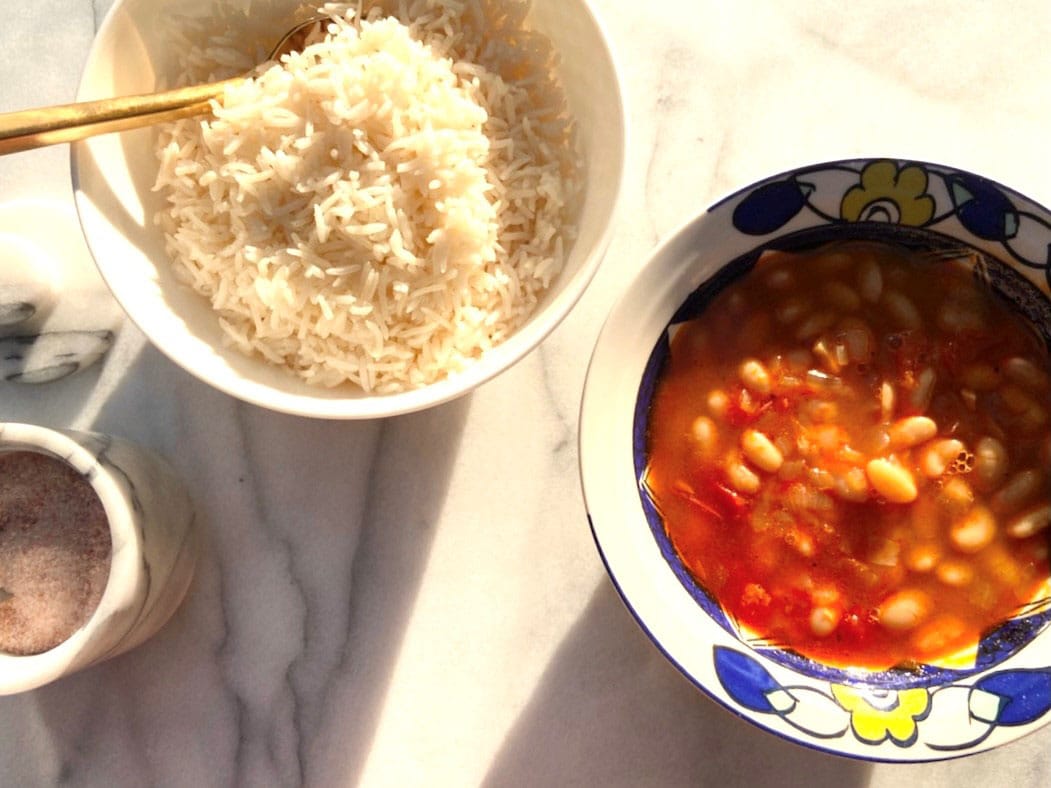
White beans cooked in a tomato broth and served over rice are the quintessential Sephardic comfort food. And they are the perfect food to cook for these crisp, cool, short Autumn days.
Domesticated in the New World, white beans soon became beloved staples in the Old World cuisines of the Mediterranean, North Africa and the Middle East. In the Ladino world this simple, hearty and nutritious dish is called “avas con arroz,” and “fassoulia” or “lubiyah” in the Arabic speaking countries of the Ottoman Empire.
Rachel’s Turn: My husband Neil’s great-grandparents emigrated to Palestine from Bulgaria in the late 1800’s and his grandfather attended the famed agricultural school “Mikveh Israel” near Holon. Established in 1870 as a youth village and boarding school, it was the first Jewish settlement outside of Jerusalem. He would reminisce on his younger days at the school and recount that he and the other boys subsisted on a daily diet of “avas con arroz” (beans with rice).
During the 60’s, when Neil was a young boy in the Crenshaw Village/Leimert Park neighborhood, the weekend barbecues featured shish kebab and “avas con arroz.” While the beans were always white northern beans made in a tomato sauce, the rice would either be Spanish style red rice or plain white rice and they had to be eaten together, with the beans spooned over the rice.
White beans have a delicate, nutty flavor and are wonderful additions to soups and stews, casseroles, chilis and cholents. They come in many different varieties, like Great Northern, cannellini and navy beans. They are interchangeable in recipes, all adding a creamy richness to any dish. These little white wonders are indispensable sources of protein, calcium and fiber. They are also a phenomenal source of many micronutrients including copper, iron, folate, magnesium and potassium. While the traditional Sephardic cook would add marrow bones to make a heartier broth, today’s cook can keep it tasty and vegan.
White beans have a delicate, nutty flavor and are wonderful additions to soups and stews, casseroles, chilis and cholents.
Rachel’s White Bean (Avas) Recipe
1 pound white beans, soaked overnight
1 large onion, diced
3 cloves garlic, chopped
1/4 cup extra virgin olive oil
1 1/2 tablespoons sweet red paprika
1 teaspoon cumin
2 tablespoons tomato paste
2 tablespoons Pareve chicken consommé
White pepper and salt, to taste
2 bay leaves
8 cups water
Sauté onion in olive oil over medium heat until onion becomes translucent. Add drained beans, garlic, spices, tomato paste and consommé. Stir for 5 minutes, then add bay leaves and water. Bring to a boil, cover tightly and reduce heat to low. Allow beans to simmer for 1 1/2 to 2 hours until beans are tender. Serve hot over rice.
Rachel Sheff and Sharon Gomperts have been friends since high school. They love cooking and sharing recipes. They have collaborated on Sephardic Educational Center projects and community cooking classes. Follow them on Instagram @sephardicspicegirls and on Facebook at Sephardic Spice SEC Food.