
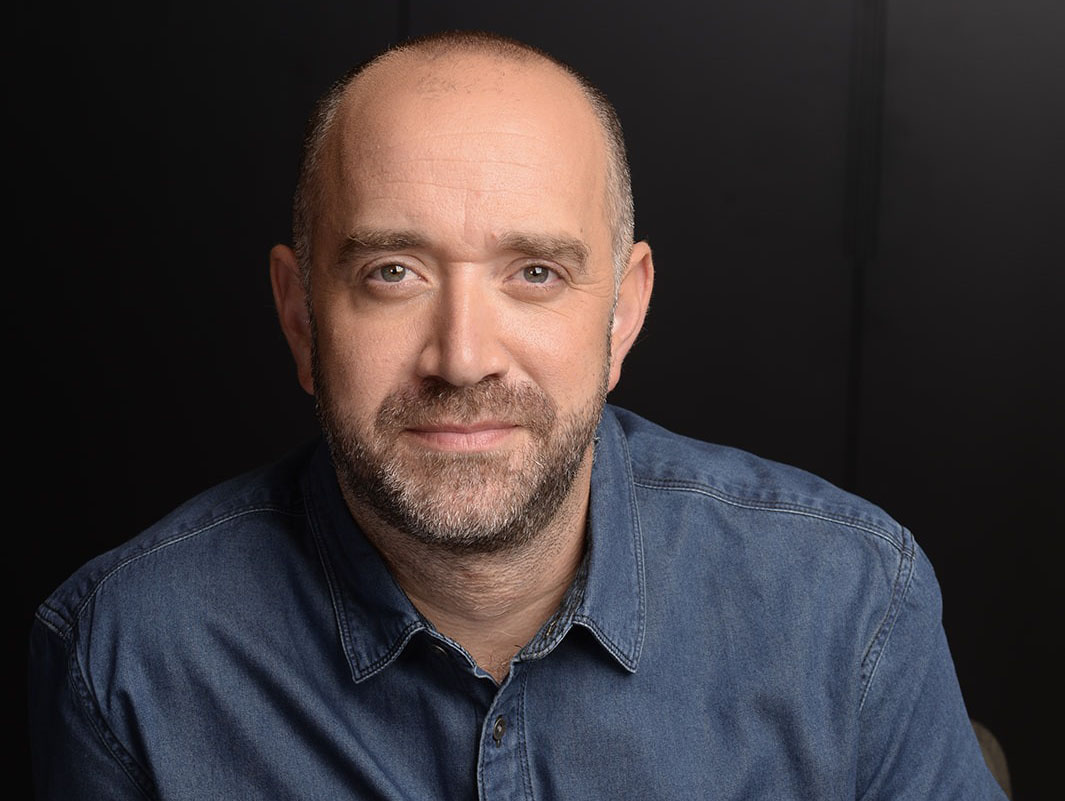
It is commonplace that the best comedy is essentially serious. Of course, clichés often have an underlying truth, so maybe that explains why Rob Tannenbaum, one half of the comedy-music duo, Good for the Jews, playing at the Knitting Factory on Dec. 14, is both a very funny guy, and nevertheless someone who discusses his work in surprisingly sober terms.
OK, he discusses it in sober terms some of the time. On the other hand, when asked about his Jewish upbringing in WASPy Fairfield County, Conn., the 32-year-old Tannenbaum replies with an ear-to-ear grin: “What Jewish upbringing? ‘Connecticut Jew’ is an oxymoron. I come from the land of the Izod yarmulke.”
Then he gets serious,
“I was a ‘bar mitzvah’ Jew,” Tannenbaum admits. “But I believe my personality and my sense of humor are deeply Jewish. In fact, I’m Jewish in every way except my religion. I guess ‘real’ Jews would call me a Christian.”
Probably not, although they might call him an apikoros (apostate). The simple fact is, like so many other secular Jews, Tannenbaum feels drawn to Jewish thought, Jewish ethics and Jewish cultural efforts, but not to synagogue.
“The things I love [about being Jewish] have to do with my friends and family,” he says.
But he is completely committed to the idea of Jewish identity, so much so that several years ago, while fronting a punk band — “of no great significance,” he adds with a rueful smile — he was so miffed by the omnipresence of that other December holiday that he wrote a song, “It’s Good to Be a Jew at Christmas.”
“It’s a protest song about identity and pride,” Tannenbaum says. “And that’s how it started.”
The song ended up on a compilation of Jewish comedy songs, “with a song by my hero, Mel Brooks,” he notes proudly.
“The turning point in my songwriting was going to see ‘The Producers’ on Broadway,” Tannenbaum says. “There I was in a theater full of tourists who were laughing at songs about the Holocaust and the Nazis. I felt liberated.”
Tannenbaum is probably better known as a rock critic, the music editor of the magazine, Blender, than as a singer-songwriter-humorist. Or you may remember him as one-half of What I Like About Jew, with former Rockapella frontman Sean Altman. That was the project that brought him some prominence in Jewish circles. It also brought some tsuris (trouble) when the pair split up.
“It wasn’t a happy breakup,” he admits. “Talking about what happened would turn this into a different story. Look, thousands of rock groups have broken up; that’s what happens.”
Both he and Altman have continued in the comedy and music vein. Each still performs some of the songs they wrote together.
Several of those songs, and the new ones Tannenbaum is writing on his own or with his new musical partner, David Fagin, may hit the occasional raw nerve, like the sex-obsessed bar mitzvah ballad, “Today I Am a Man”; the minihistory lesson, “They Tried to Kill Us (We Survived, Let’s Eat)”; or his new anthem, “Shiksas Are for Practice.”
“We don’t expect consensus,” he says. “Not everybody is going to find every song funny.”
But he tells a story about receiving some important validation from a friend, “the only child of two survivors of Auschwitz,” he says. “She came to one of our shows, and I have some material about the difficulties of being a German Jew. This is the person I know who has experienced the most suffering from anti-Semitism, and she found joy and hopefulness in those jokes. If she finds a joke about German Jews funny, that’s all the license I need.”
At the same time, though, he readily acknowledges that others may not be so relaxed.
“As a college-educated Reform Jew, I understand that some people may feel I’m not entitled to speak on some subjects,” Tannenbaum says. “The Jewish people are not monolithic, and I’ve had dialogues with people after our shows who have misgivings about the material.”
The one area about which there can be no argument, however, is the comfort level of his partnership with Fagin, who is also the lead singer, guitarist and songwriter for the Rosenbergs, a highly acclaimed power pop band.
“I met David at an event sponsored by Heeb,” Tannenbaum recalls. “He was performing, and I was emceeing. I’ve been a big fan of the Rosenbergs, so afterwards, I called him up and said, ‘Let’s start a band.’ I knew he was a great singer and musician, and the songs he wrote for the band were witty, but I didn’t know he was funny, too.”
Given that they’re in the middle of a 13-city tour over 17 days, he’d have to be funny.
But when you ask Tannenbaum if his forays into Jewish humor have affected his sense of Jewish identity, he gets serious again — serious and bit flummoxed.
“Yes, it has … but how?” he asks earnestly. “I went to shul for the High Holy Days this year for the first time in a long time. Was I looking for new material?
“Look, the stuff we’re doing brings me into pretty intensive contact with the Jewish community. It requires me to think about what it means to be a Jew. If you can accept the idea that someone can be a practicing Jew without being observant — well, I’ve spent a lot of time practicing my Judaism. And my sense of Judaism has developed. I guess I’m an Orthodox version of a secular Jew.”
Which may or may not be funny, but it’s certainly serious minded.
Good for the Jews will be playing the AlterKnit Lounge at the Knitting Factory Hollywood, 7021 Hollywood Blvd., Dec. 14, 7 and 10 p.m. For information, phone (323) 463-0204 or visit http://www.knittingfactory.com.















 More news and opinions than at a Shabbat dinner, right in your inbox.