Rabbi Elchonon Cohen of the Community Shul affectionately remembered the final time he walked his ailing, aging father-in-law to his brother-in-law’s Passaic, N.J. synagogue at the end of the Simchat Torah holiday. Eighty and in marginal health for decades, Harry Pascal, an economics professor, was trying to reach his son’s shul, which was some distance away. Exhausted, he needed to stop regularly. After several pauses, Prof. Pascal – called “Daddy” by Rabbi Cohen – puffed, “I can’t make it.” They detoured to a nearby minyan.
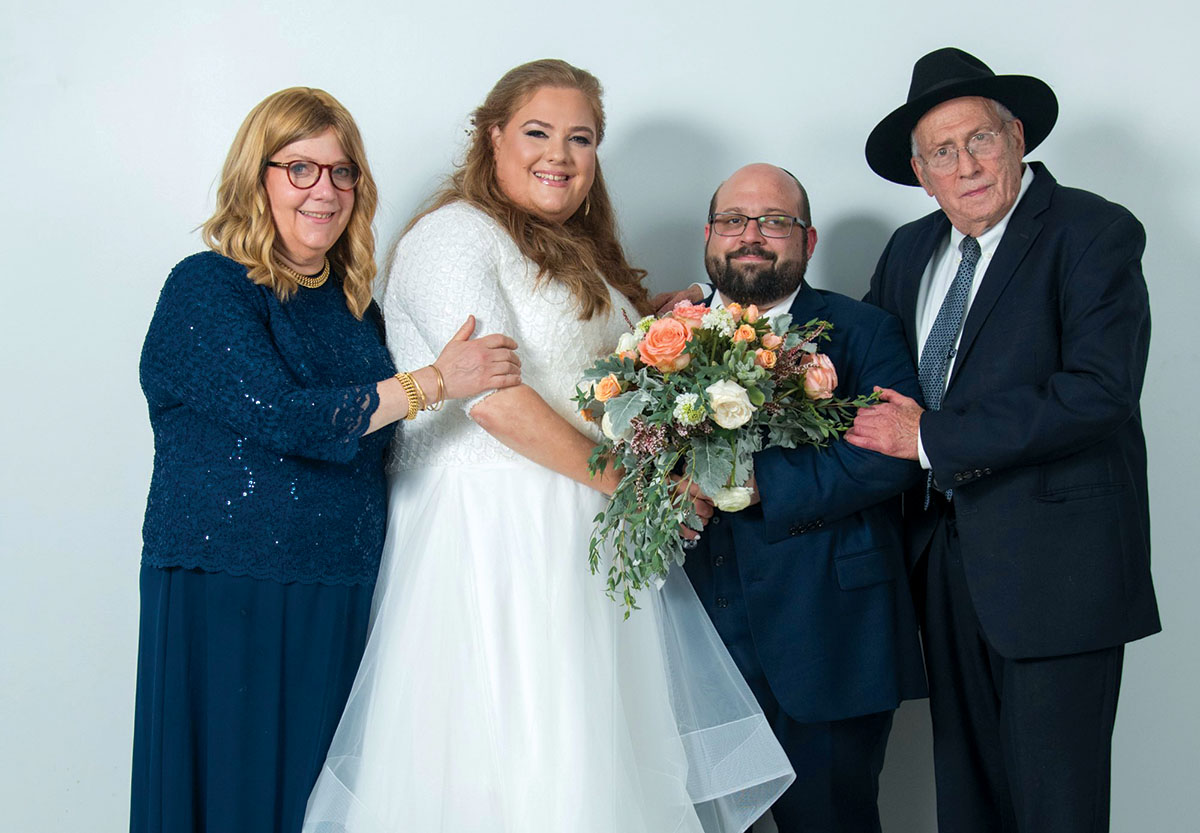
Five years ago, during the pandemic, the rabbi wed Miriam, Prof. Pascal’s last unmarried child. Looking back, he noted many similarities between father and daughter. “Miriam and her father shared a deep, intellectual search type of personality,” Rabbi Cohen said. “Both have this drilling deep tendency. When she gets into something, she goes very deeply into it. She has a fascination with serial killers. She has encyclopedic knowledge of different people and their stories.”
They also shared a sense of humor. And a love of the kitchen. “Neither of her parents had training in the culinary arts, nor did my wife. She picked it up on her own, another example of her digging deeply into a topic. He was very passionate about getting things just right in the kitchen. She is, too. Very much so.” Even as Prof. Pascal was nearing his final innings, “there was a feeling in the back of [Rebbetzin Cohen’s]mind that her father would rally.”
After marrying, the Cohens relocated to Lakewood, near her large family, and they stayed until last May. That was when The Community Shul, where he grew up and which his father, Rabbi Moshe, led for decades, invited him to return. In spite of the ongoing health drama, “there was a certain shock” when the call came. All were confident he would rally.
Over the last several weeks of Prof. Pascal’s life, the rabbi and rebbetzin had frequent discussions. Since he was an economics professor, Miriam Cohen would say, “With everything that is going on economically, I wish I could discuss this with Daddy. He could explain it to me.”
The rabbi reflected on a “fascinating idea” from the Talmud. “Normally it takes 12 months for the person who has passed to be forgotten. But with all the talk these days about tariffs, the memory of her father keeps coming up all the time.” “Daddy” had numerous idiosyncrasies. One frequently invoked phrase was “the pitter-patter of little feet.” He also hated misuse of the word “literally,” especially the frequency with which it is invoked. He would harp on it, his relatives recalled.
Not long ago, the Cohens made a post-fire visit to Malibu Pier. A bird was making funny noises. “My wife was kind of making bird noises back to it,” the rabbi reflected. “Jokingly, she said to the bird ‘I want to see if we speak the same dialect.’
This brought to mind the punch line of one of the professor’s jokes about the Japanese during World War II – “Oh, Yankee, you’re surprised I speak your language,” which he would say with an exaggerated Japanese accent. While she and the bird were talking, I said ‘Oh, Yankee, you’re surprised I speak your language!’”
“Unique” is a characterization that pops up frequently when Rabbi Cohen describes Daddy and daughter. “There was a unique relationship between my wife and her father because there was a very similar sense of humor, which is dry, intellectual,” he said. “They shared many unique interests. My father-in-law was a unique person. He had almost a doctorate in medieval French, and he picked things up from all sorts of places. He had a love of different cultures. He was passionately into the Japanese. He had jokes about ribbing the Japanese during World War II. “
He was especially impressed by Japan’s manufacturing and by the products they made — a passion father and daughter shared: “My wife, who cooks a lot, has a passion for kitchen knives. The Japanese produce beautiful, very high quality and sometimes expensive kitchen knives. After we married, my father-in-law bought for my wife a high-quality kitchen knife from Japan. Anything he delved into, he went in deeply (like my wife). He was emailing with the manufacturer different kinds of steels for the knives. He was a fascinating person.”
How the Cohens met is not in doubt, but the exact date is. Rabbi Cohen’s sister-in-law – one of many Miriams in both families – thought they were an ideal match. Both Miriams went to high school in Monsey. When Miriam’s daughter wanted to make a blueberry dish, she looked up the recipe on the rebbetzin’s blog. (She writes kosher cookbooks, too, as Miriam [Pasca] Cohen via ArtScroll.) It occurred to her that her friend would be an ideal match for her brother-in-law.
There is a difference of opinion when their first virtual date was; it took place on the evening of Jan. 31 in Los Angeles, after midnight on the East Coast, or Feb. 1. “Both of us had busy lives,” Rabbi Cohen said, “so we couldn’t travel to the other side of the country just to meet someone. It made more sense to start with a virtual encounter.”
There was, however, no disagreement over how the Cohens should respond to the Community Shul offer. “She pushed very hard for us to come here,” the rabbi said, even though they had lived in Lakewood for 10 years. “Miriam did social media marketing, working with mostly kosher food companies, and her cookbooks. We had been visiting regularly, and she kind of fell in love with the community. She liked me in the community. She felt I was actualizing my potential more here.”
Fast Takes with Rabbi Cohen
Jewish Journal: What is your next goal?
Rabbi Cohen: We have been here for a year, and there is a lot more I would like to accomplish.
JJ: Your favorite childhood memory?
RC: My father had gone to Las Vegas to officiate at a wedding. On the way home, in mid-winter, the Grapevine was closed by snow, and he was stuck in his car. When he got home, he still was wearing his winter coat, and his skin still felt cold. I ran and jumped into his arms.
JJ: Your favorite moment of the week?
RC: We try to set a Date Night each week and do something together, whether going out to dinner, cooking together (I enjoy cooking, too) at home or just sitting on the couch together.