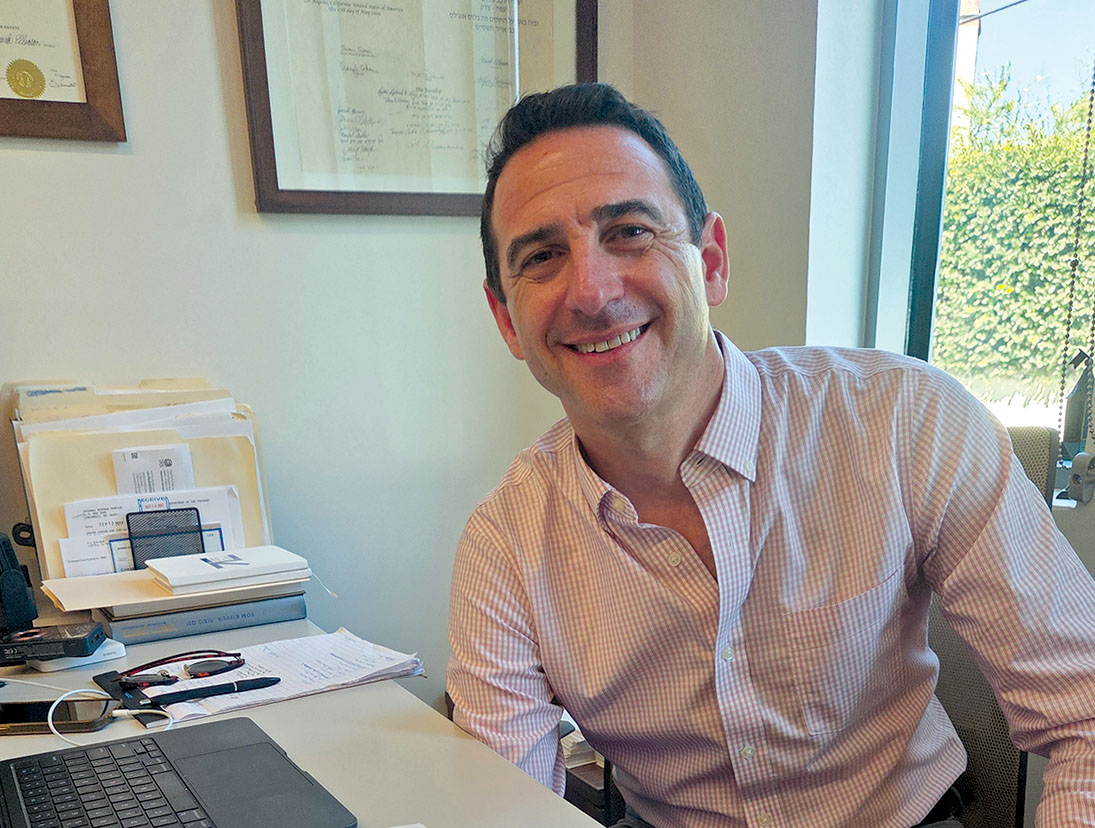
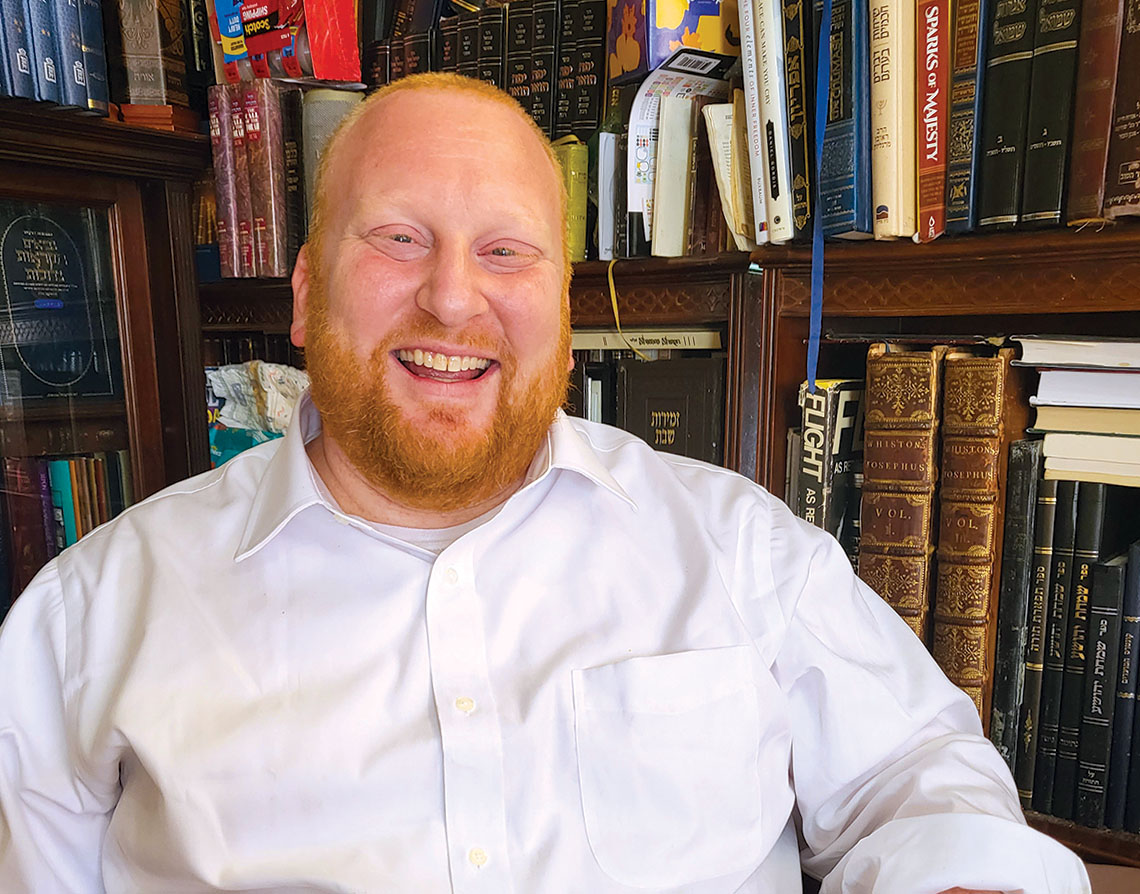
What sets Rabbi Elchanan Shoff apart from his colleagues and predecessors is his unquenchable desire to find out everything about everything. As a teacher for boys and girls at Valley Torah High School in Valley Village, Shoff has discovered a two-pronged approach that benefits both his students and himself.
“A lot of my job is teaching real material to boys and girls,” said the soft-spoken young rabbi, an LA native who grew up at Rabbi Daniel Lapin’s Shul on the Beach. This year, for example, he taught Tehillim (Psalms) to 10th grade girls. “I make sure I am not just recycling old material, but that I am getting into it myself,” Shoff said. “Much of what I prepare, I don’t wind up sharing with students if it is not at their study level. But it is a rich experience for me because I am trying to continue growing and learning on my own. What I am teaching, hopefully, is an overflow of that.”
The 40-year-old rabbi, a father of six who founded his own Orthodox shul (Beis Knesses) a decade ago in the Pico-Robertson neighborhood, takes an equally creative approach to his writing. He is the author of 10 religious books, some in Hebrew. “I am always sleuthing to find interesting Torah ideas from a tremendous variety of sources,” Rabbi Shoff said. How does he glean a fresh Torah-centric angle from ancient books that have been pored over by some of the brightest Jews ever born? Rabbi Shoff responded immediately: “I like to find things that are just not the average source, and then to research them all the way to the bottom,” he said. But how does he make it fresh? “I am not attempting to be incredibly original,” he said. “Rather, I want to uncover those books that were written and those interesting ideas. When I can link together something that was written in Izmir, Turkey, 250 years ago with something written a couple hundred years before in Poland, to see how all these things are connected, rich and exciting – that is very much my goal.” Those are the targets of his seforim (religious books) in Hebrew and English. “I want to show how rich, beautiful and varied the Torah is,” Rabbi Shoff said.
Trying to make each lesson sound as if it were freshly minted seems like a foolproof barrier against repetition or boredom. “I approach every class differently. I try to approach every student differently, tailoring it to him or her.” His finely tuned teaching philosophy makes boredom illegal. He believes — and tries to think about on an almost daily basis — that when he looks around the room, he thinks about students. “I think this child, even if displaying an obnoxious attitude sometimes, is someone’s whole life. In his or her family, if something goes wrong with that child, or were hurt or in danger, this would shake the foundations of their lives. This is a precious person who matters, is really special. I want my children’s teachers to think that way when they are teaching my children.”
Rabbi Shoff continued: “I really spend a lot of time seeing each student for who he or she is,” he said. “A quiet student, an outgoing student. I try to understand what is going on in their lives. I try to make sure they know that this is somebody who sees you and genuinely cares about you. For me, that orientation is the key for any success I have had with students.”
Where did he learn and master this intense and precise way of teaching? When he was 14 years old, Shoff went away, cross-country, to learn in a Queens, N.Y. yeshiva, Shaarei Torah, before transferring to Yeshiva Ateres Shmuel in Waterbury, Conn. when it opened two years later. “Meyer Yitzchok Fishman was my rebbe at the yeshiva in Waterbury,” Shoff said. “I learned with him almost daily for five years. To this day, I consider him my rabbi. He was the person who did this for me and my friends. He understood who we were. He was demanding but never judgmental, just accepted and loved us for who we were.”
Shoff said that while he has his own personality and methods, they are based on what he learned from Fishman and other educators. “You have to be passionate about what you are teaching,” he said. “You must have substance. Many teachers have those two elements. Without the human element, it is not a complete package. That is the hardest. Since students come from all different backgrounds, they present different challenges.
“That is the common denominator that motivates me most – being around the shul or any other area of Torah teaching. I want to know the name of every kid who comes into my shul. I want to know the people, to be connected to them and to their lives.” All growth, the rabbi maintains, is relationship-based.
Perhaps surprisingly, Shoff did not think he would be a rabbi. “Until I was in a community in the yeshiva world where being a rabbi is considered an enormously idealistic, valued job, it was not something I had considered,” Shoff said. “Though my parents were very observant, in the world I would have been from, becoming a rabbi in the more Modern Orthodox world is unusual.” The “really talented,” he said, go into finance or business or law or medicine. In the yeshiva universe, the best and brightest stay in learning, become rabbis.
Fast Takes with Rabbi Shoff
Jewish Journal: What is your favorite music?
Rabbi Shoff: I love the last 40 or 50 years of Jewish music – the Miami Boys Choir, Mordechai ben David, Avroham Fri
J.J.: Best book you ever read, outside of the Torah?
RS: The Rambam. The best book in English is “Go My Son” by Chaim Shapiro.
J.J.: Favorite Jewish food?
RS: My bubbe’s matzah balls.