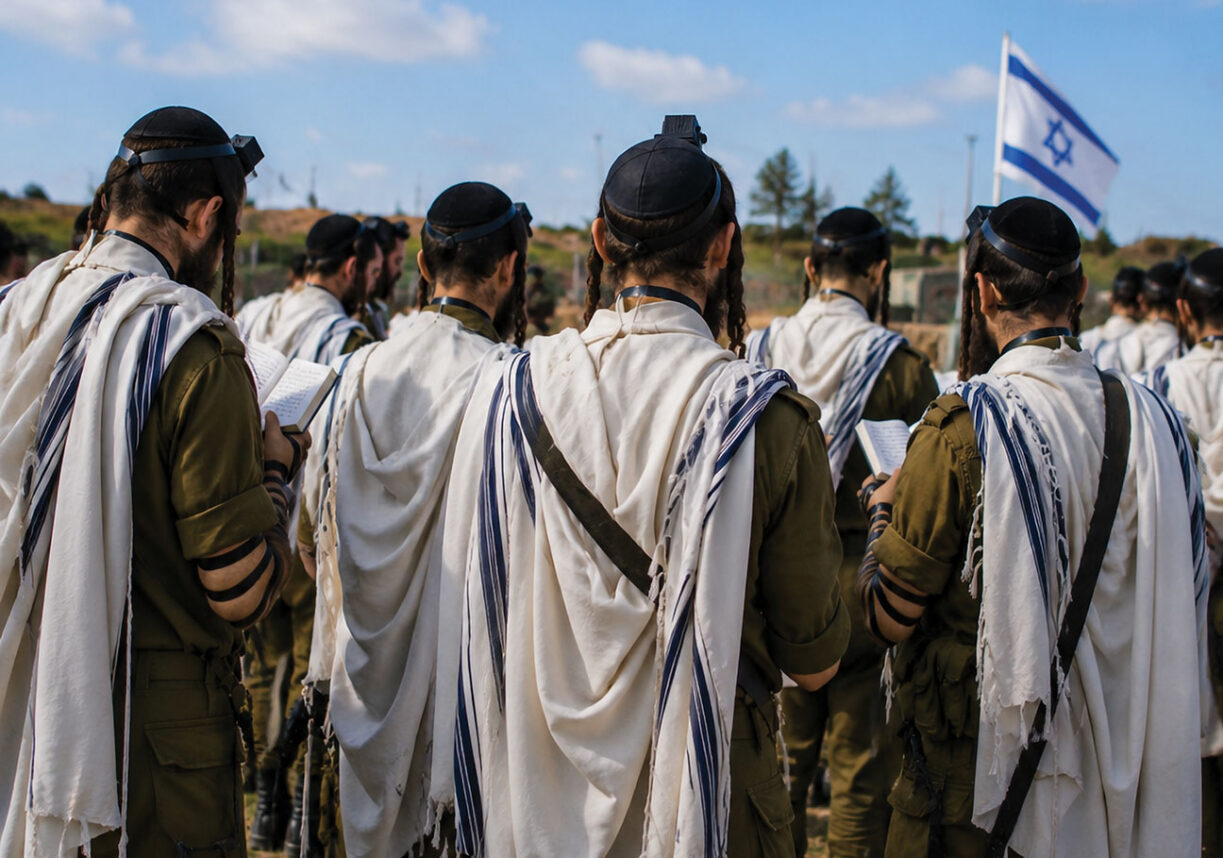
In between the prayers at the Pinto Shul in the Pico-Robertson area, people who only speak English might feel a little lost.
Not because congregants there don’t speak English — they do, except they are likely to break off into French every so often, leaving behind the hapless English speakers. Likewise, if you are expecting cholent or kugel or any of the other regular foods that you find at an English-speaking shul, you have gone to the wrong place. "Kiddush" at the Pinto Shul has a North African flair. Instead of cholent, they serve salmon cooked in red sauce with garbanzo beans, rice sticky with prunes and apricots and boutargue, a special Tunisian delicacy of dried waxed fish (which to the uninitiated palate tastes like shriveled goldfish).
The Pinto Shul is one of several congregations in Los Angeles that serves the French-speaking Jewish community. Unlike other ethnic Jewish communities in Los Angeles, such as the Persian community, the French-speaking community does not have a cohesive origin. French speaking Jews in Los Angeles are predominantly Sephardic, but they emigrated from a variety of places — Morocco, Tunisia, Algeria and France. Eager to escape the perceived and real hostility toward Jews in their countries of origin, and in some cases attracted by the greater personal freedoms that America offered, French-speaking Jews have been coming to Los Angeles for several decades now. They view Los Angeles as a good weather alternative to Montreal, where the French community is the largest outside Israel and France. In Los Angeles, despite their disparate origins, French-speaking Jews tend to stick together, united by the language and a shared cultural affinity.
In 1997, there were approximately 2,500 Jews of North African or French origin in Los Angeles, according to the Los Angeles Jewish Population Survey. Today, some estimate that the number has grown to 5,000.
Up until now, this community’s organized communal life has been relegated to the synagogue. Shuls like the Pinto Shul; Congregation Em Habanim and Adat Yeshurun in the Valley; the Baba Sale Shul in the Fairfax district; and the West Coast Torah Center in Beverly Hills have predominantly French-speaking congregations.
This Chanukah, however, marks the emergence of Club Lampadaire (The Lamp Club), a new French community group in Los Angeles, which aims to unite the French Jewish community with social, spiritual and cultural events.
"I think a lot of Jews living in France see California as an antidote to the stuffiness and formality of French society, and the pleasant weather reminds us of our childhood on the Mediterranean, and it appeals to our sense of nostalgia," said David Suissa, one of the founders of Club Lampadaire, who was born in Morocco. "But at the same time, the way the city is so spread out it does not encourage the fathering of the community which would otherwise happen naturally. So we have to compensate for that by creating this organization to make it easier for us to get together on a regular basis."
Club Lampadaire currently has a membership of 600 families, and has already raised $25,000 for its events from French Jews. Suissa said that Club Lampadaire was inspired by a conference given to French-speaking Jews in Los Angeles by Yechiya Benchetrit, one of the leading rabbis in France. "During this talk he brought up the word lampadaire, lamp, and suggested that Jews are like lamps and our mission in life is to light up the world," Suissa said. "So we decided to start an association which would bring together all the different synagogues and create a family of French Jews in Los Angeles. Our slogan is Alluman Le Foi et La Joir — light up faith and joy — and our first event will be to light up the first night of Chanukah. We want to seek out all the French Jews in Los Angeles, affiliated or nonaffiliated, and tell them that they have a home."
"I have a lot of American friends, but because of the wittiness of the French language, I feel more at ease on a cultural level with Jews who are French speaking," said Lolita Engleson, a psychologist, who was born in Lebanon but moved here from France while trying to market a documentary film she made about the Jews in Lebanon.
In Los Angeles, many French-speaking Jews find it difficult to get working visas or green cards, so they attempt to network in the community to find employment and sponsors that will allow them to do so. "They love it here," said Rafael Gabay, a French Moroccan who is president of the Baba Sale Shul. "If they can live here free without having a problem with a green card, then this place is a paradise."