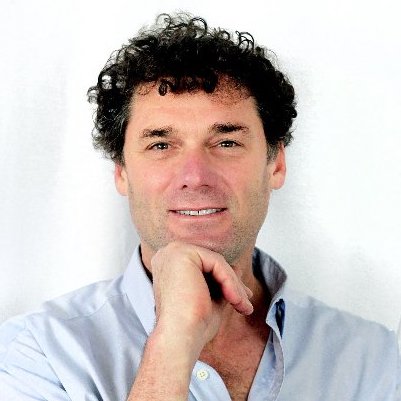
Some of the most moving and fearless reporting out of Iran this past week has flowed from the pen of New York Times columnist Roger Cohen. Cohen was with anti-Ahmadinejad protesters as riot police chased them with electric batons and tear gas into a small hiding place. He spoke with the music teacher who cradled the dying Neda, the 27-year-old woman shot dead by a Basiji sniper. He’s crunched the numbers to show just how clearly the mullahs have stolen the people’s votes. This isn’t just fine reporting. It’s teshuvah.
After all, this is the same Roger Cohen who traveled to Iran earlier this year and wrote two columns that tried to paint a more moderate view of Iran’s rulers.
“Perhaps I have a bias toward facts over words, but I say the reality of Iranian civility toward Jews tells us more about Iran — its sophistication and culture — than all the inflammatory rhetoric,” Cohen wrote from Esfahan on Feb. 22. “That may be because I’m a Jew and have seldom been treated with such consistent warmth as in Iran.” This column caused an uproar among the thousands of Iranian Jews who escaped the Islamic regime and settled in America, most of them here in Los Angeles.
In a March 1 columm, Cohen answered his critics: “Life is more difficult for [Jews] than for Muslims, but to suggest they inhabit a totalitarian hell is self-serving nonsense.” The angry letters that followed prompted Cohen to fly to Los Angeles and explain his point of view in a public forum at Sinai Temple, which has a large Iranian Jewish membership. In his defense, Cohen said that labeling Iran a totalitarian regime ready to destroy Israel and then the West’s infidels is a “grotesque caricature.”
Iran’s leadership is mainly pragmatic and primarily concerned with assuring its own survival, Cohen told the 1,200 or so critics gathered to hear him, adding that Iran is the most democratic state in the Middle East, outside Israel.
The Iranian Jews and Baha’is in the audience tried to get Cohen to see that Iran’s totalitarian regime had prevented people from speaking honestly to him.
But Cohen, according to his Sinai Temple host, Rabbi David Wolpe, could not be moved. “Of course, as the Iranian Jews pointedly said over and over again that night, the relevant experience is not Mr. Cohen’s two-week trip in the region,” Wolpe wrote later. “The deep experience is theirs, burned into their minds.”
And experience, it turns out, matters.
Three months, hundreds of wounded and dozens of dead bodies later, Roger Cohen got schooled. The undercurrents of freedom and tolerance, he found out, were as deceptive as fluffy towels at the Bates Motel. Cohen went back to Iran just before the election, as witness. And now, watching the façade of order unravel, teshuvah, the Hebrew word for atonement, is what he’s been doing.
He first made the gracious, honest and rare (for a pundit) gesture of admitting he was wrong.
“I’ve also argued that, although repressive, the Islamic Republic offers significant margins of freedom by regional standards,” Cohen wrote in a column published June 14, the day after the election. “I erred in underestimating the brutality and cynicism of a regime that understands the uses of ruthlessness.”
Then Cohen went on to throw his lot in with the protesters, documenting their courageous stand against the thugs, police and army of a vicious, medieval regime.
“Whatever happens now,” he wrote in his column of June 23, “all is changed in Iran. Opacity, a numbing force, has yielded to a transparency in which one side confronts another. The online youth of Iran will not be reconciled to a regime that touts global ‘justice’ while trampling it at home.”
There is a lesson here. Cohen is a smart man, yet he erred. He confused the humanity of the people with the humanity of the regime.
He assumed that somehow the mullahs were stretching toward freedom and that with a bit of massaging, they would actually relax.
The danger is that in our yearning for peace and rapprochement, or for oil and investment, our clear sense of right and wrong can become obscured. The men who control Iran are calcified, cruel and violent, and as opposed to freedom now as they were three months ago — only now it’s more obvious.
And by the way, the same goes for their neighbors in the region. How different do we really think Iran is from the other throwback regimes there — Egypt, Jordan, Saudi Arabia, Syria? Each has its own secret police, its own Potemkin elections, its own cells full of rotting journalists and jurors, its own “Supreme Leader” who may put on a courtly face on a visit to the Oval Office, but who is brutal to his own people and secretly despised by the lot of them.
Perhaps we should take a cue from Roger Cohen and make a greater effort to engage our enemies, but we should also learn from his mistakes that we can’t afford ever to fall prey to wishful thinking or the politics of greed.
“The fact that Saudi Arabian dictators are so strong is not only because of the price of oil,” Natan Sharansky, the former Soviet dissident and just-approved head of The Jewish Agency, once told me. “It’s simply because the United States of America, for all its presidents, the most left and the most right, were always supporting the dictators of Saudi Arabia and were never supporting dissidents. There is no shortcut.”
Dissidents or dictators — there should be no confusion, ever, whose side you’re on, whether you’re a president, or a columnist.