What do you do when you run out of money? When you’re about to be evicted from your home, or having trouble feeding your kids, or simply can’t afford the basic necessities of life? What happens, also, when you can’t afford certain things you consider crucial — like sending your children to a Jewish day school?
And what if you don’t want to go through the formal hoops of organized charity to fill out a bunch of forms to see if you qualify for help?
Over the past few weeks, I’ve met some people who have taken on these issues in distinct and refreshing ways.
The first is Shlomo Rechnitz, a 40-year-old Orthodox businessman who lives in the La Brea/Fairfax area. For the past seven years, Rechnitz and his family have followed this simple model for helping those in need: You ask, they give.
No forms to fill out, no matching grants, no performance metrics. Just a check.
The scene unfolds every Saturday night, and you’d think you were in a Polish village in the 18th century. A line of people extends outside the Rechnitz house and leads right to a dining room where Shlomo Rechnitz, dressed in a white shirt, sits at the head of a long table, waiting for people to come.
Each person in need sits next to him for a few minutes of conversation, receives a check, says thank you and then goes home. Some might bring “evidence” of their despondency — like an eviction letter from a landlord — but they hardly need it. Everyone walks out with a check.
He sees about 100 people on an average Saturday night, and they are diverse: religious, secular, old, young, Sephardic, Chassidic, mothers, fathers, businessmen down on their luck, young people out of work, etc.
Rechnitz allowed me to play observer one recent Saturday night, because he wants to encourage other wealthy people to pitch in. He feels there is too much suffering in our community, and too much money out there that is not being used to help those in need.
I know what you’re thinking: This is not the best way to give charity. Rechnitz should be helping people “learn how to fish” rather than just handing out the fish; he should be checking their qualifications to make sure they really need the money; and he should be monitoring where his money is going.
Yes, he should be doing all those things, but then he wouldn’t be Shlomo Rechnitz. Many of these people have nowhere else to go, and they need immediate relief. That’s why he makes it so simple.
Rechnitz gives to many causes, including the school where he serves as president (Toras Emes Academy), but it’s the Saturday night ritual that makes him stand out. Obviously, he doesn’t expect every wealthy Jew to give this way, but, especially in this rough economy, he’d love to see them give more than they’re currently giving.
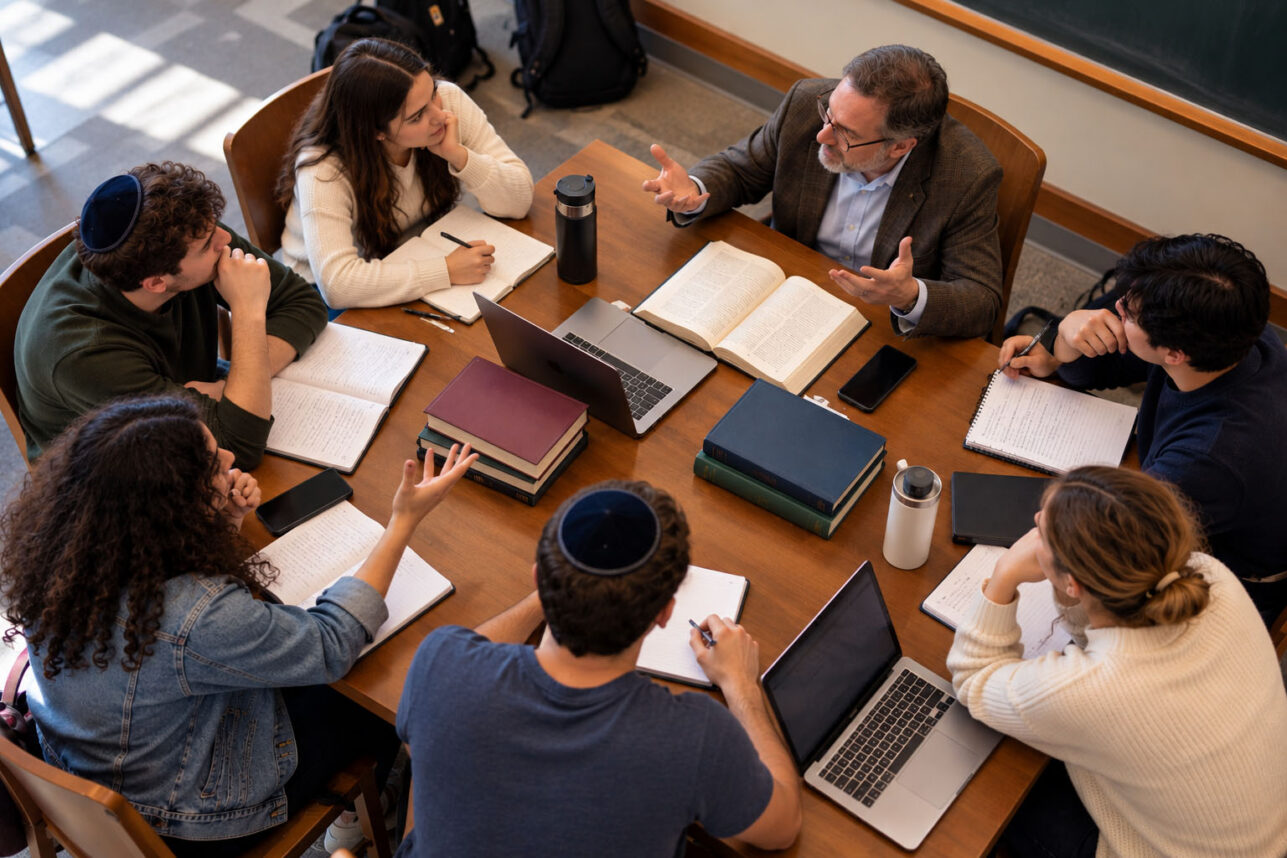
A week after witnessing the old-school approach of Rechnitz, I met three Jews who are fighting another community problem — the soaring costs of Jewish education — in a whole other way. Instead of offering financial aid, they have started a new school, Yeshiva High School, which reduces tuition costs dramatically through an innovative “blended learning” model of education.
The model combines online learning with traditional learning in a classroom setting, with a teacher/facilitator addressing the individual needs and pace of each student. It is a fully accredited college-prep program with national standards and a daily flow of data to monitor individual progress.
But here’s the upshot: Because the model is so cost-effective, instead of paying an annual tuition of $20,000 to $30,000, parents will pay $8,000 a year when the school opens next September.
The founders of the school, Rabbi Gabriel Elias and Rabbi Moises Benzaquen, and its director, longtime local educator Rebecca Coen, speak about the blended model as a “new paradigm” that will give them a sustainable model of Jewish education for years to come. Rabbi Benzaquen will lead the Jewish studies program, which will follow Orthodox tradition with an emphasis on Jewish values and interactive learning.
The new school has already created a buzz. I went to its open house last week — the school will be located at Congregation Mogen David on West Pico Boulevard — and the place was packed.
Will the school succeed? No one can say until we see results, but I can tell you this: There’s something very Jewish — and very brave — about trying all kinds of approaches in order to tackle chronic problems.
For those who need immediate relief, there is the refreshing hands-on approach of Rechnitz, who meets people face-to-face in his own dining room, feels their pain and never says no.
And for those desperate for a more affordable Jewish education, there is now an alternative school that uses new technology in a way our grandparents would never have dreamed possible.
Either way, this is what it means to be Jewish. We are restless, we feel others’ pain, we try to improve things any way we can, and we all want our kids to become the first Jewish Doctor-Mensch-President of the United States.
Whether we have money or not.