“>Occupy LA. A coalition of
is one of the more disturbing stories in the Torah. Two messengers of God come to Sodom to save Lot, Abraham’s nephew, from the destruction of the town, which they are to destroy themselves—or have some part in its destruction by God. What is the sin of the town that is so great that it merits the town’s obliteration? The opening of the story frames the sin of Sodom as xenophobia.
The two messengers come to Sodom and are greeted by Lot. He welcomes them and implores them to stay with him and enjoy his hospitality. This opening scene is reminiscent of Abraham’s welcoming of the messengers in the previous “>Judges 19.) Lot steadfastly refuses to hand over those who are under his roof. However, he immediately offers his daughters instead. Luckily for all involved the messengers are angels and they blind the townspeople and save Lot, his daughters and themselves from a violent death.
“>16:49) channels God as saying the following:
Only this was the sin of your sister Sodom: arrogance! She and her daughter had plenty of bread and untroubled tranquillity; yet she did not support the poor and the needy.
Sodom is described in “>chapter one) understands Sodom in the same manner when he derisively refers to the people of Israel as “chieftains of Sodom” and “folk of Gomorrah” because they do not “devote [themselves] to justice; aid the wronged, uphold the rights of the orphan; defend the cause of the widow.” Furthermore “Their rulers are rogues and cronies of thieves, every one avid for presents and greedy for gifts; they do not judge the case of the orphan, and the widow’s cause never reaches them.”
The Rabbis take this one step further. In the third century “>Parashah 49:10).
[God said:] “Even if I wanted to keep silent [about Sodom], the requirement of justice for a certain girl will not allow me to keep silent.” There was the case of two girls, who went down to draw water from the well. One said to her friend, “Why are you pale?” The other said, “All the food is gone from our house and we are ready to die.“ What did the other do? She filled the jug with flour and exchanged it for her own. Each took the one of the other. When the Sodomites found out about it, they took the girl (who had shared the food) and burned her. Said the Holy One of Blessing, “Even if I wanted to keep silent, the requirement of justice for a certain girl will not allow me to keep silent.”
God explains that God was forced to intervene in Sodom because things had gotten so out of hand that sharing one’s flour with a poor person was considered a capital offense. The sin of Sodom finally was that miserliness, private property, “What is mine is mine, and what is yours is yours,” was elevated to the level of a religious or moral virtue and those who abrogated it, those who shared with the poor, were deemed worthy of capital punishment.
The sukkah as a concrete object and as a metaphor is almost diametrically opposed to the kind of community represented by Sodom.
“>Leviticus 23) During the desert trek, Israel was completely dependent on God for sustenance, it was a time of absolute fragility. This is the first layer of the symbolism of the sukkah. The Rabbis take the sukkah one step further. In outlining the details of its construction the Mishnah opens with the following (“>as the law) a sukkah cannot be more than approximately thirty six and a half feet high. Everybody agrees that it must be at least three feet tall, have three sides and its roof must provide shade. In other words, the sukkah cannot be an overly imposing structure whose impermanence and fragility is not readily obvious; it must be habitable by an adult; it need not be enclosed nor can it be totally cut off from the elements.
In addition, a sukkah must be newly constructed each year. The intention being that the feeling of impermanence, displacement, vulnerability must also be fresh and not jaded.
When one moves into the sukkah, one moves into a structure which does not protect one from the human or natural environment. It is a structure all of whose boundaries are permeable, and therefore is welcoming to others, to strangers. It is a structure which is not secure and therefore assumes the righteousness of others—that other people do not necessarily want to do you harm. Interestingly enough, there is no blessing for building a sukkah, only a blessing for sitting in a sukkah. The assumption is that everybody will inhabit a sukkah, but that not everybody will buildtheir own sukkah and therefore sharing dwellings, opening one’s dwelling to others is built into the structure of the ritual.
Finally, as a celebration of this aspect of sukkot the mystical custom of welcoming ushphizin, ancestor-guests, into the sukkah every night developed. This has become one of the animating rituals in sukkot everywhere to this day.
If, then, we look upon our sukkot as a metaphor or a vision for a community, it is a community which is built upon generosity, hospitality and the sharing or resources.
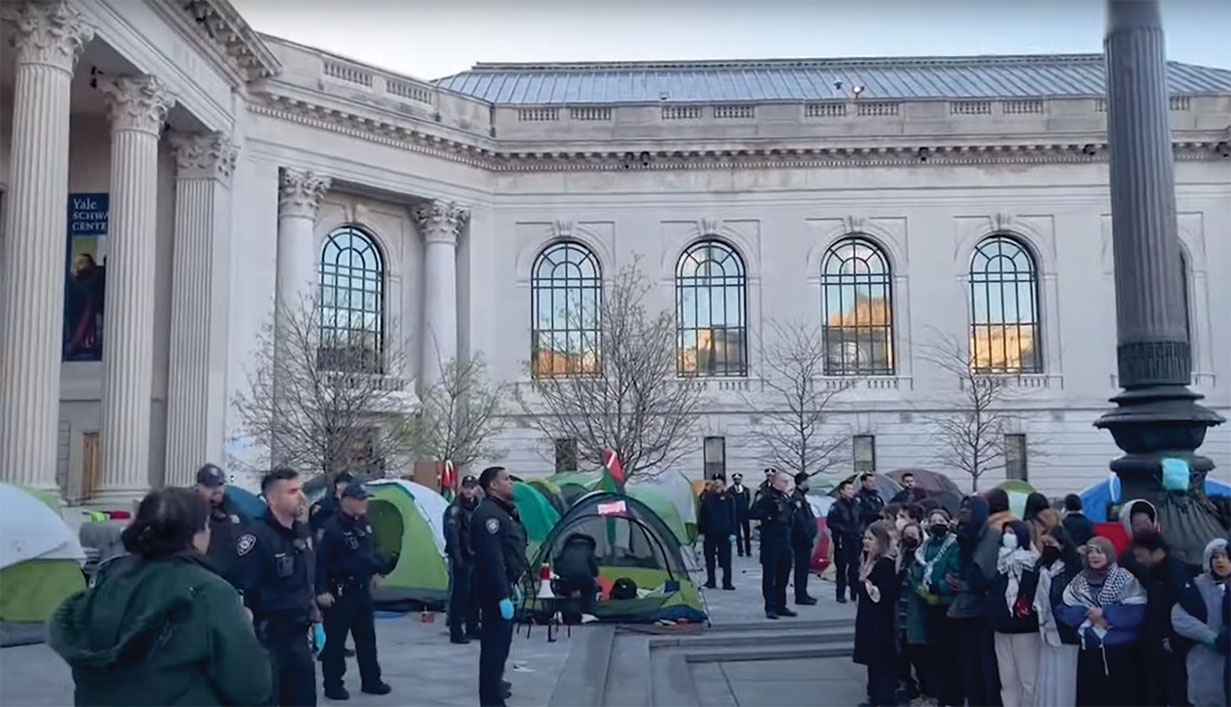
There is a tradition which can be traced to the “>Egypt or Tunisia), at the impunity of the financial markets, at the fact that working people were facing foreclosure while the bankers who hold their notes and almost brought the country to bankruptcy are not facing anything. However, the “platform” of the OLA community as far as I could tell was that we can have a different society, a society based on generosity and equitable distribution of resources. “Here,” they say, “we are doing it.”
_________
Photo credits: Jonathan Klein, Sarah Newman





















 More news and opinions than at a Shabbat dinner, right in your inbox.

