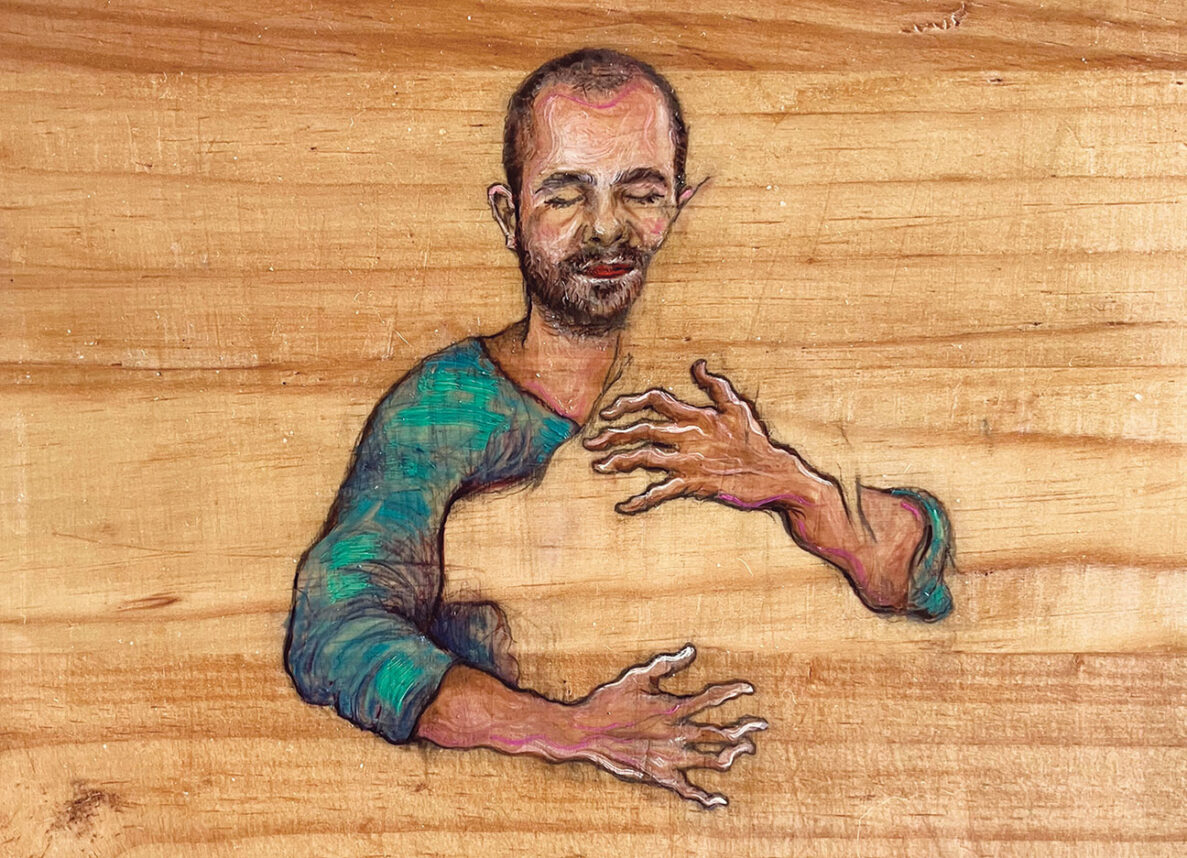
Thursday morning, Adam woke up, took his medication and vanished. Just like that. A drop of water in the desert at high noon. A 34-year-old man with a round face and the temperament of a boy in his late teens, wearing a black jacket and pajama bottoms. One minute he’s standing in the middle of his mother’s kitchen in Stevenson Ranch in the Santa Clarita Valley; the next minute he’s nowhere.
I write this kind of story in my novels, and people call it Magical Realism. I keep saying there’s no magic, just too much reality in these tales, that some people’s reality is just bigger, more crushing, maybe also more incomprehensible than others, and that it has nothing to do with what piece of history or part of the world they occupy.
They look for him throughout the house, up and down the streets of the affluent neighborhood with the clean, sunny streets and kids running around, at the bus stop a block away, in the park three blocks away. They call the police, talk to the neighbors. They search hospitals and the morgue, put up fliers everywhere. They know he had little, if any, money on him, no ID, cell phone or credit cards. He was out of shape and couldn’t have walked very far, had no friends or even acquaintances, hadn’t left the house for months before that Thursday, and, at any rate, who says he left the house that day, either? No one saw him go anywhere; they just know he was in the kitchen because that’s where he kept his meds, and that he took them because the little box that said Thursday was empty. There was no note, no sign of foul play, no conceivable reason for Adam to want to disappear.
That was two-and-a-half years ago, on Nov. 8, 2007. Since then, Adam Kellner’s family has exhausted every resource and chased every red herring, and, still, they know no more now than they did on that first day. His mother, Sherrill Britton, is associate vice president of university relations at Loyola Marymount University. She has a too-long commute to work and might have moved closer to LMU, but she can’t take a chance that Adam will come back to the house and find someone else living there. For months after his disappearance, she left the door unlocked at night, certain he would wander in while she slept. She kept a pair of shoes and a jacket in the trunk of her car, for when she found him during one of her searches on Skid Row. She hasn’t even thrown out the half-empty pack of cigarettes he left in the garage.
I knew Sherrill when she was executive director of PEN West. Among other things, she organized and managed human rights campaigns on behalf of writers who were condemned to death, or imprisoned, or just gone missing, because of their work. That was in places like China and Kenya and the Soviet Union. I wonder if she thinks about that now — now that she’s searching for her own missing son; if any of us ever believes that kind of thing can actually happen, until it does.
The difference between fact and fiction, between a great novel, say, and a well-written biography, is not the “what happened.” Whatever event we make up in fiction has already happened a thousand times in real life. The difference is the “why” — why did Adam Kellner suddenly become invisible? Why hasn’t anyone been able to find a trace of him? Why would he have left — if he did leave — and why hasn’t he made contact?
Adam took medication because he had been hearing voices since he was in his late teens. Before that, he was a good athlete and an outgoing, popular kid. Afterward, he withdrew into a quiet, peaceful, domestic life in which his only companions were the girls that only he could see. He liked the girls and they liked him; he was a happy schizophrenic, the kind that takes out the trash for his mother and offers to help his ailing stepfather up the stairs and has too much going on at home to ever want to step out.
I once wrote a novel about a boy who became invisible except to his mother and sister. He had been a rambunctious, adventurous kid until he lost his hearing and withdrew into his own, soundless orbit. Long after everyone else believed him dead, the Ghost Brother kept returning to his mother’s and sister’s homes, asking to be let in, waiting for them to make him manifest to the rest of the world, to point him out and say, “Look here, it’s my son, my brother, he’s come back from the land of the unseen, older and wiser, yes, and not entirely unscathed, but he’s real and in the flesh, he’s materialized because I’ve been telling his story everywhere I could, to anyone who’d listen, year after brutal, heart-breaking year, even after I knew I should give up hope, I sent the words, the pieces of his legend, into the abyss until one by one, those words came together, formed a sentence, then a page, and for once, life imitated art and the story became the person and walked back in through that same door I had left unlocked.”
Adam’s mother and older brother are counting on this — the power of words — to bring him back.
To read more about Adam, visit Help Us Find Adam Kellner on Facebook.
Gina Nahai is an author and a professor of creative writing at USC. Her latest novel is “Caspian Rain” (MacAdam Cage, 2007). Her column appears monthly in The Journal.