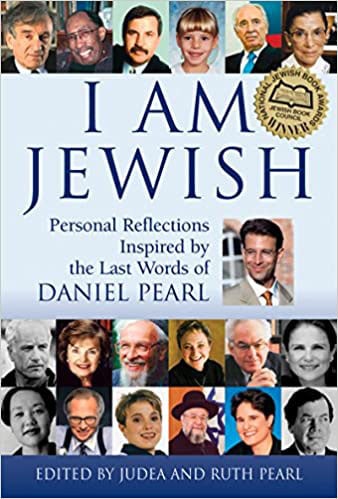
A.B. Yehoshua, one of Israel’s most revered authors, died on Tuesday last week at the age of 85. As a member of the 1948 generation, his struggles with the transformation and redefinition of Jewishness has gone through several intellectual stages, and is concisely described in the essay below, which he contributed to the book “I am Jewish, Personal Reflections Inspired by the Last Words of Daniel Pearl” ( Jewish Lights Publishing, 2003). His emphasis on a secular, choice-based national Judaism, in the spirit of Ruth’s “Your people is my people”, reflects the attitude of most Israelis, but has acquired new dimension in light of the appearance of psuedo-Jewish groups such as
“Jewish Voice for Peace” and other anti-national or anti-Zionist movements that American Jewry has spawned. “To be a Jew means to belong to a national group that can be left or joined.”
 We discover an astonishing fact in the classic Halachic definition. According to the Halachah, nothing is said about the Jew’s conduct, his thoughts, or basic principles of behavior. There is nothing indicating his homeland or language, or even the nature of his affiliation to a specific collective (such as maintaining solidarity with the Jewish people). A Jew is nothing more than a child of a Jewish mother, not even of a Jewish father. Is this biological fact really so compelling and binding? Not at all! Jews are not a race and never viewed themselves as such. They viewed themselves only as a people. According to the Halachic definition, a Jew, the son of a Jewish mother, who converts to Christianity ceases to be a Jew. That the Halachah enables someone not born of a Jewish mother to become a Jew also indicates that the Jews do not constitute a race.
To be a Jew means to belong to a national group that can be left or joined, just as any other national group is left or joined. Countless Jews have abandoned the Jewish people, and the struggle now and in all generations against assimilation indicates that it is possible to leave the Jewish people, that the individual is not compelled to retain
his membership in it.
We are now approaching the root of the matter. If we delve deep into the logic of the religious definition we see at its base another definition:
A Jew is someone who identifies as a Jew.
Someone born of a Jewish mother is no longer considered a Jew if, for example, he converts to Christianity or to Islam. It is of no importance where the Jew goes. What matters is his desire to leave. It must be understood that in the past, when everyone had a religious identification, Judaism ruled that passing to any other religion turns the Jew into a non-Jew. But today, when the individual is not obliged to maintain a religious identity, a person can leave the
Jewish people without having to pass through a religious corridor, even if according to the Halachah it seems that he must. The determining factor is not the technical step of formal religious conversion but his desire no longer to identify with the Jewish people. A Jewish atheist can become a non-Jewish atheist; the passage through another religion is a dispensable formality.
The same holds for joining the Jewish people. The determining factor is the act of identification, free will, and not the formal conversion, which may be altogether meaningless for the convert who, let us assume, is a confirmed atheist. These religious corridors (for entry and exit) may be good as a salve for the conscience of religious establishments, but they are irrelevant and meaningless for someone who wants to enter or leave, and does so as a freely chosen act.
The definition I am proposing, that a Jew is someone who identifies as a Jew, is not one I would want to be maintained always, but his definition has been the realistic, correct, and genuine definition until now. It is the base definition underlying the Halachic definition. The Halachic definition, born in the recesses of Jewish history, was suited to a world and situation in which religion was the decisive element of a person’s identity. The secular identity taking shape before our eyes in the world and in Israel (which always existed as a potential) exposes the deep and true definition at the foundation of the Halachic definition, that which declares that a Jew is someone who identifies as a Jew.
All the pseudo-Sartrean theories that would base Jewish self-identification on the existence of the Gentile (in the best circumstances) or the anti-Semite (in the worst circumstances), who forces the Jew to identify as such, are ridiculous. I don’t need the Gentile’s perception or the anti-Semite’s hostility to establish my Jewish identity. Even if there weren’t an anti-Semite in the world I would still want to identify as a Jew. How demeaning to present Jewish identity and belonging as a kind of trap from which there is no escape. Hundreds of thousands of Jews have left the Jewish people for good, as a matter of their own choosing, and have been lost forever among other peoples. To be a Jew is a matter of choice. This element of freedom in the act of Jewish identification has of late been obscured, but it is an element of tremendous importance, for it brings with it responsibility. If I identify as a matter of free choice I assume certain responsibilities. When young people repeatedly ask, as they have been doing with increasing frequency since the Yom Kippur War: Is it possible to cut one’s ties with the Jewish people? Is it possible to carry out a “disengagement of forces” with the Jewish people? Or, in the words of a soldier, is it possible to be just a person?—to all of these questions my answer is clear: It most definitely is possible. But if a person decides to identify as a Jew he assumes responsibility for his identification, since his decision was freely made. I do not ignore the social, cultural, and family influences a decision about identification, but these are not sufficient to determine the identification. It requires willed choice. The dimension of freedom, which always formed part of Jewish identification and which has recently been obscured by notions of Jewish “fate” and by the experience of the Holocaust, needs to be highlighted once again. The sense of freedom immediately lightens the sense of responsibility. A man is capable of mighty actions if he has a sense of freedom, while feeling coerced only depresses and incenses him.
The element of freedom in the act of identification is also what makes possible change and reinterpretation of Judaism. I do not dismiss those who think only of continuity, who want to keep alive the “ember” they imagine has been passed on to them. But no less legitimate is the desire of those who want to introduce change in Judaism, with which they identify as an act of free will.
Reprinted with permission from “I Am Jewish: Personal Reflections Inspired by the Last Words of Daniel Pearl.” Based on excerpts from AB Yehoshua’s book, Between Right and Right.


The Definition of the Jew: The Dimension of Freedom
Avraham B. Yehoshua
A.B. Yehoshua, one of Israel’s most revered authors, died on Tuesday last week at the age of 85. As a member of the 1948 generation, his struggles with the transformation and redefinition of Jewishness has gone through several intellectual stages, and is concisely described in the essay below, which he contributed to the book “I am Jewish, Personal Reflections Inspired by the Last Words of Daniel Pearl” ( Jewish Lights Publishing, 2003). His emphasis on a secular, choice-based national Judaism, in the spirit of Ruth’s “Your people is my people”, reflects the attitude of most Israelis, but has acquired new dimension in light of the appearance of psuedo-Jewish groups such as
“Jewish Voice for Peace” and other anti-national or anti-Zionist movements that American Jewry has spawned. “To be a Jew means to belong to a national group that can be left or joined.”
To be a Jew means to belong to a national group that can be left or joined, just as any other national group is left or joined. Countless Jews have abandoned the Jewish people, and the struggle now and in all generations against assimilation indicates that it is possible to leave the Jewish people, that the individual is not compelled to retain
his membership in it.
We are now approaching the root of the matter. If we delve deep into the logic of the religious definition we see at its base another definition:
A Jew is someone who identifies as a Jew.
Someone born of a Jewish mother is no longer considered a Jew if, for example, he converts to Christianity or to Islam. It is of no importance where the Jew goes. What matters is his desire to leave. It must be understood that in the past, when everyone had a religious identification, Judaism ruled that passing to any other religion turns the Jew into a non-Jew. But today, when the individual is not obliged to maintain a religious identity, a person can leave the
Jewish people without having to pass through a religious corridor, even if according to the Halachah it seems that he must. The determining factor is not the technical step of formal religious conversion but his desire no longer to identify with the Jewish people. A Jewish atheist can become a non-Jewish atheist; the passage through another religion is a dispensable formality.
The same holds for joining the Jewish people. The determining factor is the act of identification, free will, and not the formal conversion, which may be altogether meaningless for the convert who, let us assume, is a confirmed atheist. These religious corridors (for entry and exit) may be good as a salve for the conscience of religious establishments, but they are irrelevant and meaningless for someone who wants to enter or leave, and does so as a freely chosen act.
The definition I am proposing, that a Jew is someone who identifies as a Jew, is not one I would want to be maintained always, but his definition has been the realistic, correct, and genuine definition until now. It is the base definition underlying the Halachic definition. The Halachic definition, born in the recesses of Jewish history, was suited to a world and situation in which religion was the decisive element of a person’s identity. The secular identity taking shape before our eyes in the world and in Israel (which always existed as a potential) exposes the deep and true definition at the foundation of the Halachic definition, that which declares that a Jew is someone who identifies as a Jew.
All the pseudo-Sartrean theories that would base Jewish self-identification on the existence of the Gentile (in the best circumstances) or the anti-Semite (in the worst circumstances), who forces the Jew to identify as such, are ridiculous. I don’t need the Gentile’s perception or the anti-Semite’s hostility to establish my Jewish identity. Even if there weren’t an anti-Semite in the world I would still want to identify as a Jew. How demeaning to present Jewish identity and belonging as a kind of trap from which there is no escape. Hundreds of thousands of Jews have left the Jewish people for good, as a matter of their own choosing, and have been lost forever among other peoples. To be a Jew is a matter of choice. This element of freedom in the act of Jewish identification has of late been obscured, but it is an element of tremendous importance, for it brings with it responsibility. If I identify as a matter of free choice I assume certain responsibilities. When young people repeatedly ask, as they have been doing with increasing frequency since the Yom Kippur War: Is it possible to cut one’s ties with the Jewish people? Is it possible to carry out a “disengagement of forces” with the Jewish people? Or, in the words of a soldier, is it possible to be just a person?—to all of these questions my answer is clear: It most definitely is possible. But if a person decides to identify as a Jew he assumes responsibility for his identification, since his decision was freely made. I do not ignore the social, cultural, and family influences a decision about identification, but these are not sufficient to determine the identification. It requires willed choice. The dimension of freedom, which always formed part of Jewish identification and which has recently been obscured by notions of Jewish “fate” and by the experience of the Holocaust, needs to be highlighted once again. The sense of freedom immediately lightens the sense of responsibility. A man is capable of mighty actions if he has a sense of freedom, while feeling coerced only depresses and incenses him.
The element of freedom in the act of identification is also what makes possible change and reinterpretation of Judaism. I do not dismiss those who think only of continuity, who want to keep alive the “ember” they imagine has been passed on to them. But no less legitimate is the desire of those who want to introduce change in Judaism, with which they identify as an act of free will.
Reprinted with permission from “I Am Jewish: Personal Reflections Inspired by the Last Words of Daniel Pearl.” Based on excerpts from AB Yehoshua’s book, Between Right and Right.
Did you enjoy this article?
You'll love our roundtable.
Editor's Picks
Israel and the Internet Wars – A Professional Social Media Review
The Invisible Student: A Tale of Homelessness at UCLA and USC
What Ever Happened to the LA Times?
Who Are the Jews On Joe Biden’s Cabinet?
You’re Not a Bad Jewish Mom If Your Kid Wants Santa Claus to Come to Your House
No Labels: The Group Fighting for the Political Center
Latest Articles
Weinberg: The Secret German Life of a Jewish Last Name
The Anti-Zionist Agenda at the Heart of UC Ethnic Studies
The Beauty of the Slow and Steady
Ziegler School Welcomes Prominent Rabbi, O.C. Federation Names CEO, Pico-Robertson Cleanup
A Moment in Time: Beyond the Chuppah
A Bisl Torah ~ The Company You Keep
Because We Can
Print Issue: The View From Israel | October 23, 2026
Three years after Oct. 7, a country trying to heal is still waiting for a full accounting of what went wrong.
Rabbis of LA | Rabbi Taff’s Daughter Follows Her Father’s Footsteps
Second of two parts
‘The Nuremberg Women’: The Untold Stories of Eight Women Who Witnessed History
“These women were pivotal to both the process and the outcome of the trial. Yet they were marginalized on many occasions, literally reduced to footnotes.“
A Very Jewish Stew: Toscano Hamin
This Hamin Toscano recipe reminded us of a Tuscan wedding soup.
Table for Five: Lech Lecha
Shield Of Abraham
The View from Israel
Three years after Oct. 7, Israel is still waiting for a full accounting of what went wrong.
Albie Selznick’s Unlikely Connection to David Bowie Inspires New Solo Show
Selznick saw his idol David Bowie perform live when he was 15 and made up his mind that he wanted to create a show of his own and work with Bowie.
Is the New Facebook Film Equal to the Original?
“The Social Reckoning” isn’t about a power struggle, but shows that powerful companies are reluctant to change unless there is pain.
Larry David Is Spot-on in His Satire of the DSA
In his article about his proposals for the Democratic Socialists of America, he jokes that “The DSA has great respect for religious traditions.”
Remember and Be Grateful
Memory is the mother of gratitude. If we do not remember our past, it is difficult to improve our present or build a better future.
Michael Broukhim’s Journey to a Deeper Judaism
What began as a personal exploration of Judaism eventually became intertwined with Broukhim’s professional life.
Rosner’s Domain | No Surprise Is Also an Election Surprise
It’s worth paying attention to what is – or isn’t – happening to our “large” parties. They are quite small, or at least that’s how they appear in the polls even as Election Day draws near.
Lech Lecha: The Journey of Growth and the Process of Becoming
We need not know where every decision will lead before taking the first step. Sometimes acting upon our deepest convictions is itself the beginning of wisdom.
From Atop the Pulpit
New opportunities and challenges have always come and gone. But pulpit clergy with their years of training, education and perspective on life, generated from atop the pulpit, are especially well suited for whatever lies ahead.
Abraham’s Lessons in Leadership on the Eve of Israel’s Elections
Anyone who votes, or leads, would be wise to study the story of Abraham and David.
A Different Kind of Tower
The Tower of Babel reminds us how easily language can divide us. Our shared history reminds us of what becomes possible when we find ways to understand one another.
Paris on Fire, America on Edge and the Generation of the Flood
What is especially troubling to me is that at many of these protests in France you will find signs reading “Intifada Revolution” and “From the River to the Sea, Palestine Will Be Arab,” along with ubiquitous Palestinian flags, and Hamas flags too.
Torah Portion: Lech Lecha
In this parsha, we meet the first hire — employee #1 — of Jew, Inc. a new God-created enterprise that will change everything.
“What is Life Worth?”
Determine how much a man’s life – and death – are WORTH? The man who did this for the 9/11 families!
More news and opinions than at a Shabbat dinner, right in your inbox.