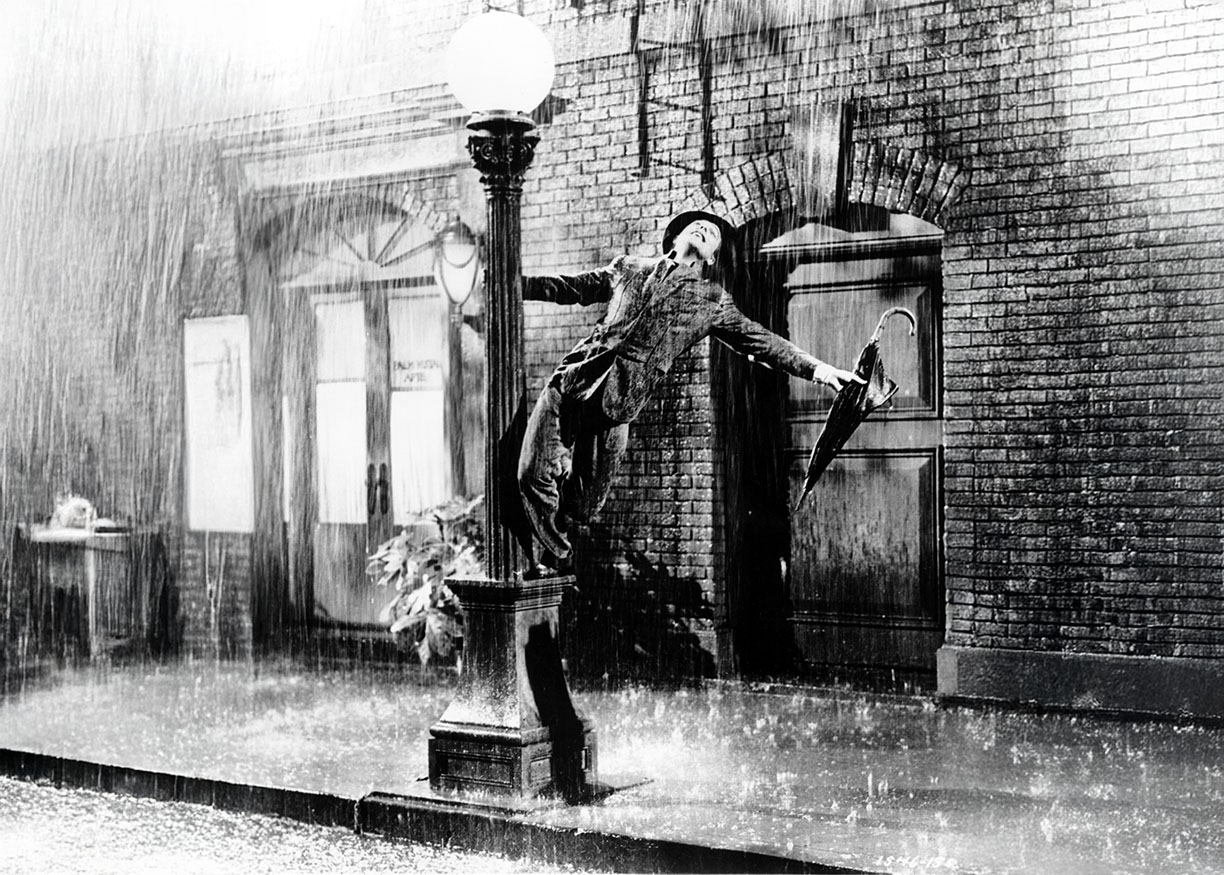
I didn’t expect to receive a lesson in dignity when my friend and I began watching “Singing in the Rain” the other night. Lately, we’ve been enjoying old movies for their innocence. We’re tired of hip, cool and snarky. Just give us honest entertainment, hold the sarcasm.
That’s what I was expecting—pure, honest entertainment, and I got plenty of it.
But I got a little more when the star of the film, Gene Kelly, uttered an unexpected word that stuck with me: Dignity.
Kelly was playing the role of Don Lockwood, a silent film star who opens the film at one of those glamorous Hollywood premieres from the early days of cinema. With an adoring crowd and press cameras facing him, an interviewer catches him off guard and asks about his upbringing.
The problem is that Lockwood wasn’t too proud of his humble roots as a hoofer, vaudeville performer and stuntman. So he improvises a whole other story as someone who was highly educated and studied at the finest arts and music academies.
He sets up this faux bio with: “I’ve had one motto that I’ve always lived by: Dignity. Always dignity. This was instilled by my mom and dad from the very beginning.”
Because Lockwood saw little “dignity” in the lowbrow vaudeville world his parents immersed him in, he couldn’t bear to reveal that past and felt he had to make up a new one. Lockwood connected dignity to his acts, assuming that compared to finer arts like ballet and classical music, his vaudeville acts had to be devoid of any dignity.
Ironically, his own film proved otherwise.
We can see in the film that those old vaudeville acts that embarrassed Lockwood were performed honestly and were full of life. It wasn’t Beethoven at Carnegie Hall, but it was a gutsy entertainer born on the wrong side of the tracks doing everything he could to make it in the big city.
Lockwood could have kept his same answer—dignity— without hiding his background. That’s because there is dignity in an honest struggle, even if it means performing in a seedy dance hall in a red light district.
Indeed, the whole film embodies a certain kind of dignity from the simple fact that the filmmakers have no other agenda than to provide the audience with good, honest entertainment.
Dignity comes not from our status in life or the education we receive but from our characters.
If we live our lives honestly and express that honesty in our art and professions, whether we’re a vaudeville performer, a classical musician, a filmmaker, an electrician or a columnist, that is dignity.
Shabbat shalom.