You don’t get to choose how people remember you, but you can learn something about yourself when you find out what stayed with them. For example, recently my old college roommate told my cousin — meeting her for the first time — that I was always cooking hot dogs back when we lived together. I’d never heard that before! It doesn’t seem idiosyncratic when you’re the one doing it, and of course at the time it was perfectly rational — hot dogs were the only kosher meat at the nearest grocery. Nevertheless.
More to the point: on my last Shabbat in Madison, Wisconsin, the Chabad rabbi, whose family had hosted me countless Friday nights over the two years I lived there, told me that he would always associate me with Sukkot. Rain or shine, I stopped by the Chabad Sukkah every day after work to nosh on oreos and guacamole (this is how I remember it) with Rabbi Mendel and his kids. Didn’t stay long — no more than 15 minutes — but always showed up to make Leshev BaSukkah.
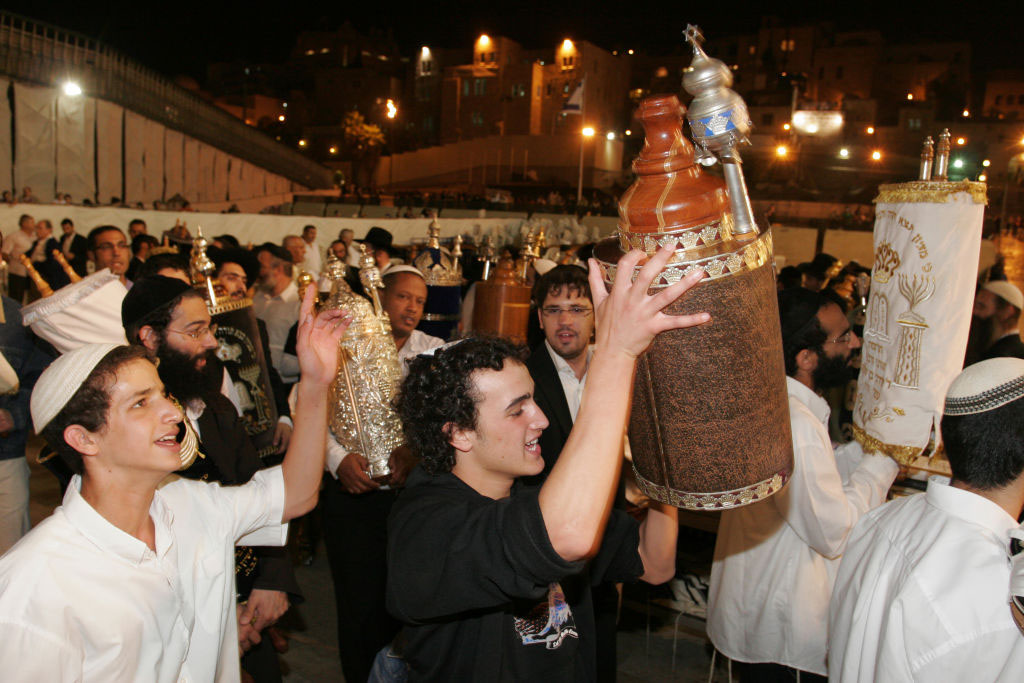
What is it with me and Sukkot? Let me count the ways. I love being outside, in the shade on a sunny day. (Even with the flies.) My parents’ sukkah is beautiful and big — it holds as many as twenty people in the gentle glow of its suspended lanterns — but more than that it is a monument to our family’s divinely embarrassing aesthetic idiosyncrasies, and I love that. I love the festival’s themes of hospitality, environmentalism, and shelter, core values of Judaism year-round that achieve ritual importance during this holiday, even taking on a mystical character. I love the Arba Minim and the bizarrely pagan-looking (and sounding) Hoshanos. (I love getting my steps in, in shul.) And I love — really, truly love — all the paper chains.
What I have come to appreciate about Sukkot most recently, though, is its pick-me-up timing following a period of anxiety, physical stress and strenuous introspection on the Jewish calendar. During the Ten Days of Repentance we endure a gauntlet designed to humble us, to remind us that we come from dust and to dust we shall return. The value of beginning each year by making ourselves feel small — viewing ourselves with respect to an infinitely expanding universe and an endlessly unraveling timeline — is enduring and unimpeachable. It’s also kind of bleak!
Comes Sukkot to puncture our fatalism. It hits all the right notes — warmth, rejuvenation, palm fronds with purpose — to clear out lingering High Holiday austerity. But the genius of Sukkot is not merely swooping in to turn frowns upside down or balancing the ledger of New Year’s vibes. Rather, Sukkot makes an epic counterpoint to Yom Kippur’s gloomy conception of transience by dialing it up to an extreme.
Indeed, the Festival of Booths is a monument to the ephemeral. In the span of a week, we build, inhabit, and dismantle intentionally flimsy structures. While the rest of the year our ritual objects are animal products dried out and preserved — the cowhide tefillin, the ram’s horn shofar, the klaf of a Torah scroll — Sukkot’s holy toys are necessarily perishable. The willow wilts, the Lulav frays and the Etrog loses its luster. Dust to dust, redux. How can we call this week, which doubles down on a theme of Judaism’s most solemn day, Z’man Simchateinu, the time of our elation?
Because the revelation of Sukkot is what happens while the tent is up. That we care about building our Sukkah up to code, mastering arcane architectural guidelines prescribed in the Talmud and its commentaries, should reflect our desire to build lives that are up to code — not in spite of our life’s time constraint, but because of it. We make hospitality a point of emphasis on this holiday — because we can involve and inspire and help others through our own search for meaning. There’s joy, plenty of it, in the hunt. Especially when we’re looking together.
A few weeks ago, I began writing this column for the Jewish Journal’s back page, setting into motion my own cycle of dust to dust. I scrape together an idea and figure out what to make of it as I write, I file, it comes out, and then it disappears, pretty much, forever. Almost no one will know of its existence before it meets its fate in a trash compactor. The Yom Kippur worldview is a healthy dose of humility: even readers who enjoyed the article have already forgotten the author.
As Sukkot begins, we tack more optimistically. Sukkot reminds us that life is everything but the dust, and that’s a precious lot. Yes, two things can be true: we enter and exit this world the same way, and each of us leaves a trace. We make impressions on people, more than we know, and we rarely learn what they are.
Louis Keene is writing and dwelling in Los Angeles. He’s on Twitter at @thislouis.