Steven Henkin is the rabbi of Congregation Agudath Achim in Savannah Georgia. A native of the Chicago suburbs, Rabbi Henkin received his B.A. in Jewish Studies, Religious Studies, and Psychology from the University of Minnesota before moving to Atlanta, where he earned his M.A. in Jewish Studies from Emory University and worked in the religious school at Ahavath Achim Synagogue. He later moved to Los Angeles to attend the Ziegler School of Rabbinic Studies, where he received his rabbinic ordination and M.A. in Rabbinic Studies in 2014.
Our discussion focuses on Sukkoth, and the commandment to be joyous.
Shmuel’s book, #IsraeliJudaism, Portrait of a Cultural Revolution, is now available in English. The Jewish Review of Books called it “important, accessible new study”. Haaretz called it “impressively broad survey”. Order it here: https://amzn.to/2lDntvh
A 23-year-old Arkansas man is facing five charges of criminal mischief after confessing to spray-painting swastikas in the city of Booneville, Ak., local ABC affiliate 4029 news reports.
The graffiti featured swastikas, “SS” lightning bolts, and the initials “D+R” in black spray-paint were found on multiple locations throughout Booneville on Sept. 26. Police believe the “D+R” initials refer to Mullen and his girlfriend, whose name has not been released. The “SS” is “a common white supremacist/neo-Nazi symbol derived from Schutzstaffel (SS) of Nazi Germany,” according to the Anti-Defamation League.
Authorities arrested Mullen on Oct. 4 after he was allegedly involved in a physical altercation with a man named Justin Jones. Jones, 33, was reportedly armed with a gun while Mullen had a metal baton. During the altercation, the gun went off and struck Mullen’s girlfriend in the chest. She is expected to survive her injuries.
Mullen later confessed to the vandalism and is currently being held in Logan County Jail.
“We want to make our town a better place to live and we want to clean our town up,” Lt. Benjamin Villarreal told 4029 News. “We don’t want those things happening around here and when something does happen like that, we’re going to take it serious (sic) and punish those the best we can.”
German Chancellor Angela Merkel told Israeli Prime Minister Benjamin Netanyahu in an Oct. 10 phone call that she will ramp up security for the Jewish community following the Oct. 9 shooting at a synagogue in Halle, Germany, the Times of Israel (TOI) reports.
Netanyahu’s office released a statement saying that Netanyahu told Merkel that “it was important to intensify efforts opposing the phenomenon [of anti-Semitism],” and Merkel responded “that she intends to step up security measures for the Jewish community.”
Germany’s Central Council of Jews President Josef Schuster told public radio station Deutschlandfunk the fact that there was only one private security guard protecting the synagogue was “scandalous.” The alleged gunman wasn’t able to enter the synagogue because the door to the synagogue remained locked despite the gunman shooting at it.
“This incident has changed the feeling of Jews in Germany,” Schuster said, adding that he is meeting with German President Frank-Walter Steinmeier and Interior Minister Horst Seehofer to discuss the matter.
The American Jewish Committee (AJC) is also urging the German government to increase security at Jewish institutions. AJC Berlin Ramin Institute Acting Director Remko Leemhius said in a statement, “The safety and the lives of Jews cannot depend on how thick the door is.” He added that the German government needs to “look at the loss and see there’s something they can do.”
Jeremy Borovitz, who was at the synagogue when the shooting happened, told Deutsche Welle that community members said, “It’s a holiday, it’s not so dangerous” when asked why there was a lack of security at the synagogue.
The alleged gunman shot and killed a woman outside the synagogue and a man at a nearby kebab shop on Oct. 9. He was arrested later in the day.
According to the German Interior Ministry, there was a 19.6% increase in an anti-Semitic incidents from 2017 to 2018.
You don’t get to choose how people remember you, but you can learn something about yourself when you find out what stayed with them. For example, recently my old college roommate told my cousin — meeting her for the first time — that I was always cooking hot dogs back when we lived together. I’d never heard that before! It doesn’t seem idiosyncratic when you’re the one doing it, and of course at the time it was perfectly rational — hot dogs were the only kosher meat at the nearest grocery. Nevertheless.
More to the point: on my last Shabbat in Madison, Wisconsin, the Chabad rabbi, whose family had hosted me countless Friday nights over the two years I lived there, told me that he would always associate me with Sukkot. Rain or shine, I stopped by the Chabad Sukkah every day after work to nosh on oreos and guacamole (this is how I remember it) with Rabbi Mendel and his kids. Didn’t stay long — no more than 15 minutes — but always showed up to make Leshev BaSukkah.
What is it with me and Sukkot? Let me count the ways. I love being outside, in the shade on a sunny day. (Even with the flies.) My parents’ sukkah is beautiful and big — it holds as many as twenty people in the gentle glow of its suspended lanterns — but more than that it is a monument to our family’s divinely embarrassing aesthetic idiosyncrasies, and I love that. I love the festival’s themes of hospitality, environmentalism, and shelter, core values of Judaism year-round that achieve ritual importance during this holiday, even taking on a mystical character. I love the Arba Minim and the bizarrely pagan-looking (and sounding) Hoshanos. (I love getting my steps in, in shul.) And I love — really, truly love — all the paper chains.
What I have come to appreciate about Sukkot most recently, though, is its pick-me-up timing following a period of anxiety, physical stress and strenuous introspection on the Jewish calendar. During the Ten Days of Repentance we endure a gauntlet designed to humble us, to remind us that we come from dust and to dust we shall return. The value of beginning each year by making ourselves feel small — viewing ourselves with respect to an infinitely expanding universe and an endlessly unraveling timeline — is enduring and unimpeachable. It’s also kind of bleak!
Comes Sukkot to puncture our fatalism. It hits all the right notes — warmth, rejuvenation, palm fronds with purpose — to clear out lingering High Holiday austerity. But the genius of Sukkot is not merely swooping in to turn frowns upside down or balancing the ledger of New Year’s vibes. Rather, Sukkot makes an epic counterpoint to Yom Kippur’s gloomy conception of transience by dialing it up to an extreme.
Indeed, the Festival of Booths is a monument to the ephemeral. In the span of a week, we build, inhabit, and dismantle intentionally flimsy structures. While the rest of the year our ritual objects are animal products dried out and preserved — the cowhide tefillin, the ram’s horn shofar, the klaf of a Torah scroll — Sukkot’s holy toys are necessarily perishable. The willow wilts, the Lulav frays and the Etrog loses its luster. Dust to dust, redux. How can we call this week, which doubles down on a theme of Judaism’s most solemn day, Z’man Simchateinu, the time of our elation?
Because the revelation of Sukkot is what happens while the tent is up. That we care about building our Sukkah up to code, mastering arcane architectural guidelines prescribed in the Talmud and its commentaries, should reflect our desire to build lives that are up to code — not in spite of our life’s time constraint, but because of it. We make hospitality a point of emphasis on this holiday — because we can involve and inspire and help others through our own search for meaning. There’s joy, plenty of it, in the hunt. Especially when we’re looking together.
A few weeks ago, I began writing this column for the Jewish Journal’s back page, setting into motion my own cycle of dust to dust. I scrape together an idea and figure out what to make of it as I write, I file, it comes out, and then it disappears, pretty much, forever. Almost no one will know of its existence before it meets its fate in a trash compactor. The Yom Kippur worldview is a healthy dose of humility: even readers who enjoyed the article have already forgotten the author.
As Sukkot begins, we tack more optimistically. Sukkot reminds us that life is everything but the dust, and that’s a precious lot. Yes, two things can be true: we enter and exit this world the same way, and each of us leaves a trace. We make impressions on people, more than we know, and we rarely learn what they are.
Louis Keene is writing and dwelling in Los Angeles. He’s on Twitter at @thislouis.
Samuel Mayerson, renowned for his role as prosecutor in the 1976 Patty Hearst trial, died Sept. 30, less than a week before his 97th birthday.
Mayerson was born Oct. 6, 1922, in Corpus Christi, Texas. His father was a merchant who eventually ran a mattress factory. Mayerson graduated from high school at the age of 15 and attended Corpus Christi Junior College. After graduating in 1941, he enlisted in the Army Air Corps. He served in North Africa and Italy, and after being discharged in 1945, settled in Los Angeles. He graduated from UCLA and earned his law degree at USC.
Mayerson joined the L.A. County District Attorney’s office in 1952 and was eventually named to lead the office’s felony crimes unit. It was in that capacity he tried Hearst, the granddaughter of multimillionaire media magnate William Randolph Hearst. The 20-year-old heiress was kidnapped by the urban guerilla group the Symbionese Liberation Army (SLA). Two months after her abduction, the group released an audiotape of Hearst claiming to have joined the SLA. She took part in the group’s robberies.
At the trial, Mayerson agreed to a plea bargain with Hearst. In return for pleading no contest to the charges of armed robbery and assault with a deadly weapon, she received a sentence of seven years’ probabtion. Mayerson said he accepted the deal because Hearst had been sentenced to seven years in a federal bank robbery case and had already been held in custody for a year and a half.
Mayerson was appointed to the Los Angeles Municipal Court in 1981 and served as a judge until 1994. He was back on the bench less than a year later under a state program that brought in retired judges to ease the backlog of Superior Court cases. He was known for being a fair and friendly judge but one who had little patience when attorneys were unprepared. Linda Deutsch, an Associated Press reporter, told The New York Times “he was very devoted to the law.”
Ruth, Mayerson’s wife of more than 60 years, died in 2016. Mayerson is survived by their children, Matthew (Leslie) Mayerson and Julie (Mark) Mayerson Brown, and four grandchildren: Mickey Brown, Madeline Mayerson Adler, Samuel Brown and Anna Mayerson.
“FAMILY & ME: SUKKOT!”
Grandparents, parents and young children gather in the Burton Sperber Jewish Community Library at American Jewish University for “Family & Me: Sukkot!” The event includes interactive story-time courtesy of PJ Library for ages 3 to 6. Meanwhile, Doda Mollie provides the music. Singing and crafts led by instructor Lisa Silverman round out the morning. 10-11:30 a.m. $25 pre-registration per family, $30 at the door. American Jewish University, 15600 Mulholland Drive, Los Angeles. (310) 440-1572. aju.edu.
SKIRBALL HARVEST FESTIVAL
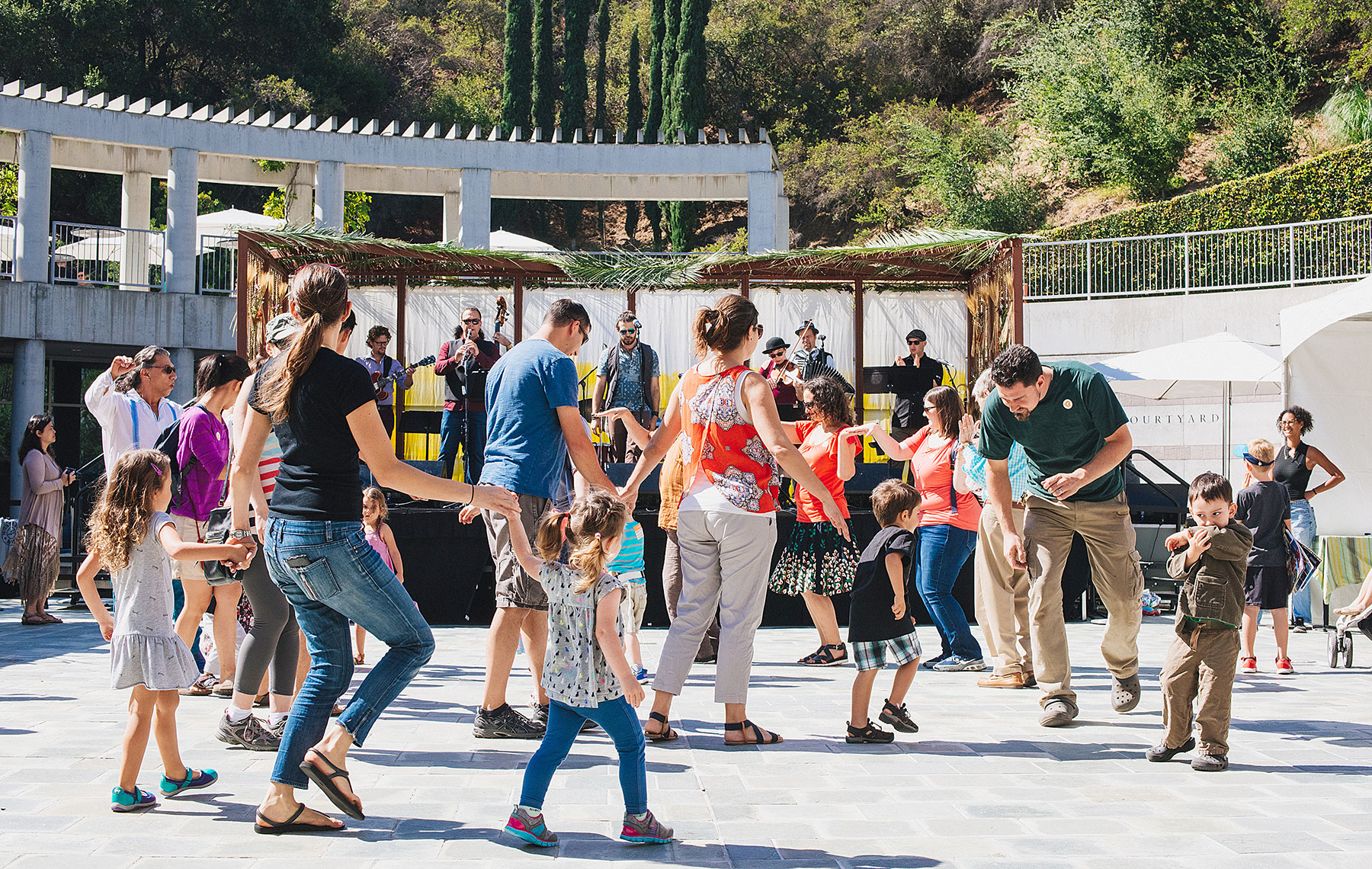
Bask in the glow of Sukkot during the Skirball Cultural Center’s Harvest Festival. The family-friendly event features a live musical performance by Mostly Kosher, a DJ set by Daddy Differently, Israeli folk dancing, spoken word and more. In the holiday spirit of welcoming guests to your home — and because Sukkot is a weeklong holiday — the Skirball invites community members to drop by every day to enjoy lunch and family time in its sukkah. 10 a.m. museum doors open. 11 a.m.-4 p.m. festival. $12 general museum admission. Skirball Cultural Center, 2701 N. Sepulveda Blvd. (310) 440-4500. skirball.org.
Skirball Harvest Festival
SUKKAH-BRATION BBQ
On the first night of Sukkot, join the LGBTQ-friendly Congregation Kol Ami. Bring your own favorite decorations, help brighten the sukkah before sharing a barbecue meal and shaking the lulav. 5-7 p.m. $18 for dinner per person. Kol Ami, 1200 N. La Brea Ave., West Hollywood. (323) 606-0996. kol-ami.org/event/sukkot2019.
SUKKOT UNDER THE SCHACH
Come early to help decorate Santa Monica congregation Kehillat Ma’arav’s sukkah while PJ Library entertains with stories for children. Dinner, chocolate and wine served. Everyone is welcome. 5 p.m. sukkah decorating. 5:30 p.m. dinner. Free. Kehillat Ma’arav, 1715 21st St., Santa Monica. (310) 829-0566. km-synagogue.org.
SUKKOT BBQ AND KARAOKE
Hollywood Temple Beth El celebrates Sukkot with karaoke and barbecue. The community’s master chef fires up the grill with fresh and tasty varieties of fish, chicken and your choice of veggie burgers or chicken burgers. 5-8:30 p.m.$14 members, $18 general, $10 students, $8 children 12 and younger. Hollywood Temple Beth El, 1317 N. Crescent Heights Blvd., West Hollywood.(323) 656-3150. htbel.org/sukkot-at-htbel.
SCHMALTZ KLEZMER BAND
Featuring one musician from Los Angeles, one from New York City and two from Eastern Europe, Schmaltz, a Klezmer band, performs at the Pacific Resident Theatre in Venice. Gathering from their far-flung origins, violinist Yvette Devereaux, Joellen Lapidus on accordion, Igor Kogan on upright bass and clarinetist Leo Chelyapov are seasoned musicians who have embraced the quaint sounds of Eastern European Jewish folk music. 7:30 p.m. $20. Pacific Resident Theatre, 705 Venice Blvd., Venice. (310) 822-8392. pacificresidenttheatre.com.
TUE OCT 15
“HOOKAH IN THE SUKKAH”
Young professionals in their 20s and 30s greet the holiday of Sukkot with the community-oriented evening, “Hookah in the Sukkah,” at Sephardic Temple. Enjoy wine, cheese and mixing and mingling over hookah, a water pipe for flavored tobacco popular in some Middle Eastern cultures. Membership not required. RSVP is encouraged. 8 p.m. Free. Sephardic Temple, 10500 Wilshire Blvd. (310) 475-7000. sephardictemple.org/shamayim.
“CARL LAEMMLE”
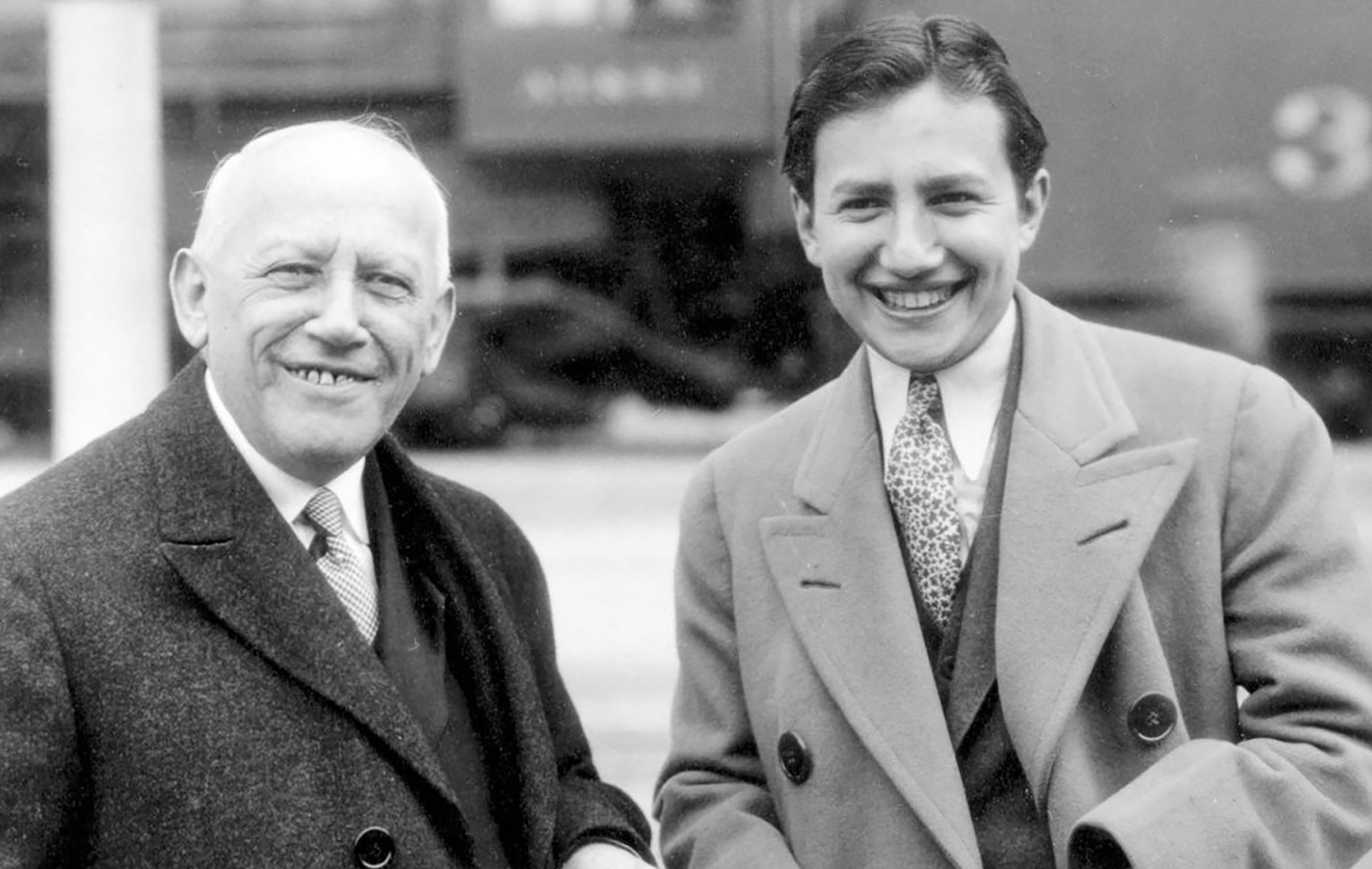
Feature-length documentary “Carl Laemmle” relates the extraordinary life of the German-Jewish immigrant who founded Universal Pictures, played a significant role in 400 films in early Hollywood and helped save more than 300 Jewish families from Nazi Germany. Walt Disney, Irving Thalberg, John Ford and William Wyler were hired or discovered early in their careers by Laemmle. Although he died 80 years ago, his name remains prominent because of the Laemmle theater chain. Wilshire Boulevard Temple, which Laemmle helped build, screens the documentary. A Q-and-A with his great-niece follows. 7:30 p.m. Free. Wilshire Boulevard Temple Irmas Campus, 11661 W. Olympic Blvd., Los Angeles. (213) 388-2401. wbtla.org.
“Carl Laemmle”
WED OCT 16
WOMEN, PEACE & SECURITY CHANNEL
Join the Israel Policy Forum (IPF) Atid at the launching of the Women, Peace & Security Channel, intended to advance women in Jewish communal affairs and Israeli-Palestinian peacebuilding. The evening includes a three-person panel featuring Journal columnist Tabby Refael, co-founder of 30 Years After; Shira Efron, special adviser on Israel for the Rand Corp.; and Adam Basciano, national director of IPF Atid. Rachel Wallace, chair of IPF Atid’s Women, Peace & Security, moderates. Desert, wine and networking follow. 7-9 p.m. Free. Miracle Mile address provided with RSVP. israelpolicyforum.org/atid/wps.
EMERGENCY RESPONSE SIMULATION
Tim Berke, who was confronted by an array of public health and disaster-response scenarios during the five years he lived in South Sudan, leads a unique interactive emergency response simulation at Cedars-Sinai. Participants experience the intensity of being an IsraAID first responder faced with a deluge of overwhelming challenges. A post-simulation analysis provides feedback and takeaways for participants. 6:30-8:30 p.m. $18. Cedars-Sinai Innovation Space, 8601 Beverly Blvd. israaid.org/israaid-humanitarian-professionals-network.
THU OCT 17
RICE AND GARCETTI Susan Rice, who served as President Barack Obama’s national security adviser and as U.S. ambassador to the United Nations, discusses her new memoir, “Tough Love: My Story of the Things Worth Fighting For,” with L.A. Mayor Eric Garcetti. Rice is a research fellow at the School of International Service at American University and a nonresident senior fellow at Harvard’s Kennedy School of Government. She also serves on the board of Netflix and the Kennedy Center for the Performing Arts. 8 p.m. $55 reserved section, includes book; $45 general admission, includes book; and $20. Museum of Tolerance, Peltz Theater, 9786 W. Pico Blvd. (310) 772-2505. livetalksla.org.
YOUNG PROFESSIONALS SUKKAH PARTY Young professionals in their 20s or 30s are invited to Nessah Synagogue’s Sukkah Party. Highlights include shawarma, Israeli cuisine and an open bar. 7 p.m.-midnight. $26 until Oct. 10. $36 afterward, $40 at the door. Nessah Synagogue, 142 S. Rexford Drive, Beverly Hills. (310) 273-2400. nessah.org.
NESHAMA CARLEBACH
Singer-songwriter Neshama Carlebach, one of the top-selling Jewish artists in the world, performs selections from her new album, “Believe.” Carlebach, who sings classic Hebrew songs, contemporary pop, jazz and gospel, is the daughter of the late and legendary Reb Shlomo Carlebach. At various points in the evening, Rabbi Bradley Shavit Artson, dean of American Jewish University’s Ziegler School of Rabbinic Studies, engages her with questions about her beliefs, inspiration, spirituality and her music. 7:30 p.m. From $25. American Jewish University, Gindi Auditorium, 15600 Mulholland Drive, Los Angeles. (310) 440-1572. aju.edu
RABBI ELLIOT DORFF
Rabbi Elliot Dorff, a professor of Jewish law at American Jewish University and a leader of the Masorti Conservative movement, discusses, “Jewish Law and Ethics: Do They Collide?” examining the differences between law and ethics, the nature of Jewish law and where it might clash with morality. An expert on the philosophy of religion, bioethics and Jewish law, Dorff appears courtesy of the Sinai Temple Men’s Club. 6:30-9 p.m. Dinner is free for Men’s Club members, $10 at the door for general. Sinai Temple, 10400 Wilshire Blvd. Contact rpolansky@sinaitemple.org or (310) 481-3228. sinaitemple.org.
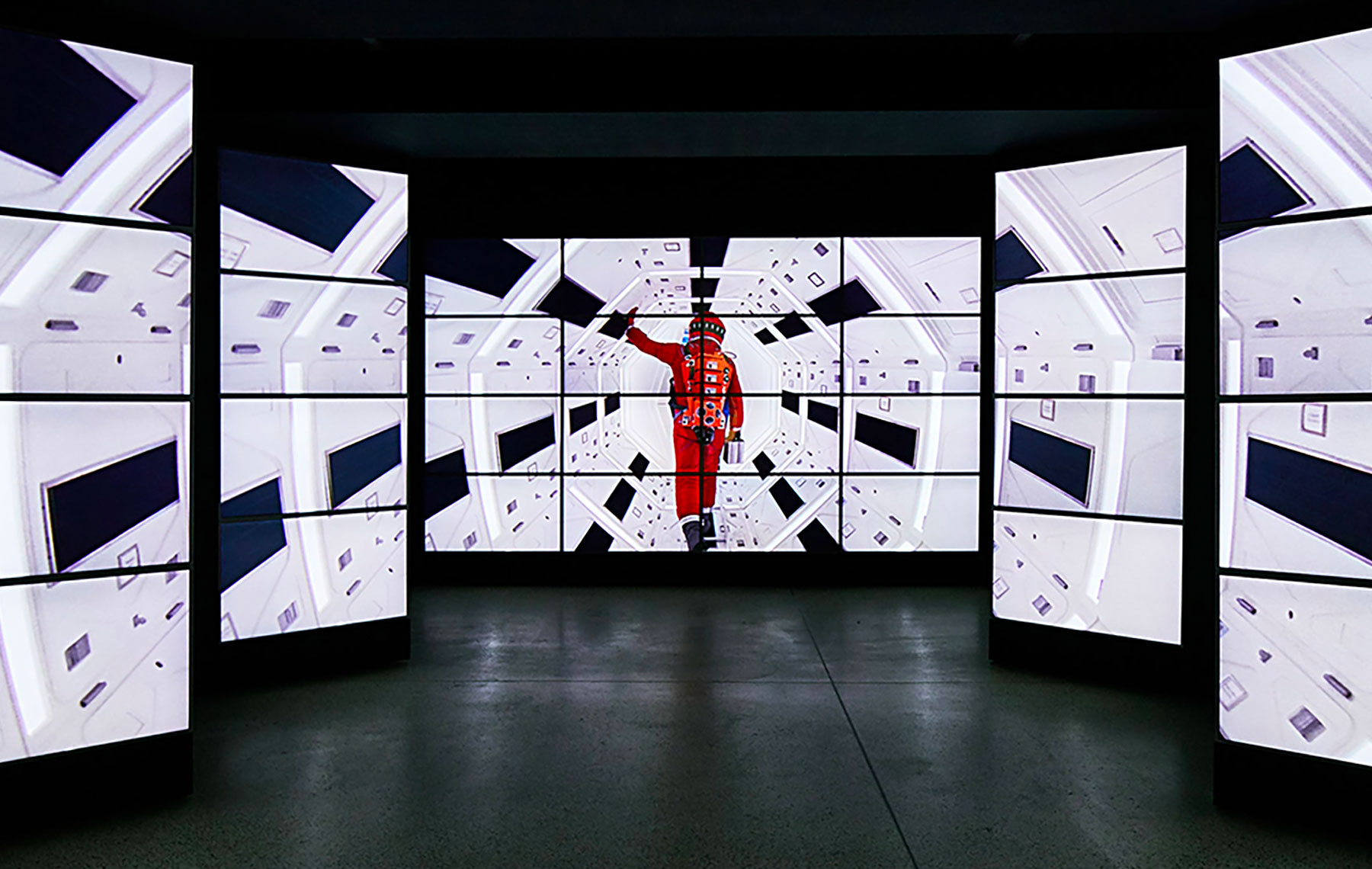
STANLEY KUBRICK EXHIBITION Most people know Stanley Kubrick as a filmmaker but this new exhibition, “Through a Different Lens: Stanley Kubrick Photographs,” reveals his photojournalist background. The late director of “2001: A Space Odyssey” and “A Clockwork Orange” sold his first work to Look magazine as a teenager in 1945, displaying an uncanny photographic sensibility that led him to scout human interest stories for Look. The new exhibition at the Skirball explores the formative phase in the iconic Jewish artist’s career. A special event, “Late Night! Stanley Kubrick,” will be held Oct. 25. Through March 8. Noon-5 p.m. Tuesday-Friday, 10 a.m.-5 p.m. Saturday-Sunday. $12 general, $9 seniors, students, children 12 and older, $7 children 2-12. Skirball Cultural Center, 2701 N. Sepulveda Blvd., Los Angeles. (310) 440-4500. skirball.org.
Stanley Kubrick Exhibition.
ZERO WASTE WORKSHOP IN SUKKAH
Concerned about plastic proliferation and its impact on global warming? Looking for ways to help shift the situation? In celebration of Sukkot, Temple Beth Israel of Highland Park holds a Zero Waste Workshop in the sukkah, led by Miles Lewis, an associate of the ocean plastics research organization 5 Gyres. Zero Waste refreshments and snacks served. 7 p.m. Free. Temple Beth Israel of Highland Park, 5711 Monte Vista St., Los Angeles. (323) 745-2474. RSVP at tbila.org.
SIX DIRECTIONS: SUKKOT MUSIC AND ARTS FESTIVAL. Come drink and dance in the Sukkah! East Side Jews is throwing a party as part of The In Between, a city-wide Sukkot festival powered by Nuroots. Shake the lulav and etrog in six directions to draw blessings from different corners of the Earth and redirect them back outward. This Sukkot festival-style party draws artists and creatives from different corners of L.A. Expect a night full of funky gallery strolling, live performances, tacos, drinks, and a legit dance party! For ages 21-and-over. 7:30-10:30 p.m. $15. The Courtyard at SIJCC, 1110 Bates Ave, Los Angeles. nuroots.org/theinbetween.
Have an event coming up? Send your information two weeks prior to the event to ryant@jewishjournal.com for consideration. For groups staging an event that requires an RSVP, please submit details about the event the week before the RSVP deadline.
Nicholas Meyer’s first bestselling novel, “The Seven-Per-Cent Solution,” concocted a fanciful case that brought together the fictional detective Sherlock Holmes and the real-life founder of psychoanalysis, Sigmund Freud.
Meyer’s fourth and latest outing in his Sherlock Holmes series is “The Adventure of the Peculiar Protocols” (Minotaur Books), which sets the most famous detective in literary history on a very real historical mystery: Who forged the notorious anti-Semitic screed known as the “Protocols of the Elders of Zion”?
Meyer is perhaps best known as a screenwriter and film director whose credits include three “Star Trek” movies, the time-bending romance “Time After Time” and my own favorite, “The Day After,” which imagines what would actually happen if an American city were the target of a nuclear missile.
All of Meyer’s Sherlock Holmes novels embrace the same narrative conceit that Arthur Conan Doyle himself first used. “For a good portion of my adult life I have been involved with and found myself editing missing, unknown, or unearthed manuscripts alleged to have been authored by Sherlock Holmes’s amanuensis, John H. Watson, M.D.,” Meyer writes by way of introduction. The notion that Holmes and Watson were flesh-and-blood human beings, which is known among Sherlockians as “the Game,” is alive and well.
Sherlock Holmes dismisses “Protocols” as self-evidently fraudulent and its contents as “arrant nonsense.” But he also discerns the deadly intent of the forgers, and author Nicholas Meyer deftly places the document into its historical context.
“The Adventure of the Peculiar Protocols” opens on Holmes’ 50th birthday in 1905. Meyer makes a sly reference to his own first novel when Holmes is made to observe that one of his birthday gifts, a novel by Tolstoy, was recommended by “our friend in Vienna.” Soon, however, Holmes and Watson are called on to inquire into the origin and intended use of a 20-page typescript that appears to be “the minutes of a secret meeting of a conclave of Jews who are plotting to take over the world,” as Watson describes it.
Here, of course, Meyer is repurposing a document that first entered history in the early 20th century and still afflicts us a century later because, then as now, “Protocols of the Elders of Zion” is a favorite tool of the most vicious and deadly anti-Semites, including the ones who have surfaced recently in America. The great detective quickly dismisses the document itself as self-evidently fraudulent and its contents as “arrant nonsense.” But he also discerns the deadly intent of the forgers, and Meyer deftly places “Protocols” into its historical context.
While Theodor Herzl was conducting open meetings of the World Zionist Congress, Meyer shows us, Jew-haters were still willing to believe in the existence of a secret conspiracy. He manages to shock us by quoting a speech that Winston Churchill actually delivered in Parliament. “From the days of Karl Marx here in London down to Emma Goldman in the United States, this worldwide conspiracy for the overthrow of civilization,” Churchill ranted, “has been steadily growing.”
Holmes proposes that the true purpose of the forged “Protocols” is “to prompt the elimination of a forceful figure in Jewish affairs” by putting Herzl “into the cross-hairs” of an assassin’s gunsight. The investigation quickly puts him in touch with other historical characters, including Chaim Weizmann (who is introduced to Holmes under his adopted English first name, Charles). Prefiguring the role in history that empowered Weizmann to lobby the British government for the Balfour Declaration, Weizmann casually discloses to Holmes that he is “working on an acetone-butanol-ethanol fermentation process” that can be used to manufacture a gunpowder substitute called cordite. It is Weizmann who confirms Holmes’ suspicion that Herzl may have died of something other than heart disease. “The Russians have the reputation of being the most accomplished poisoners since the Borgias,” Weizmann is made to say.
Meyer seeks to entertain his readers, and succeeds admirably in doing so, but he also serves a higher purpose. Watson, for example, finds his way to an essay by Mark Twain that purports to praise the Jewish people but employs a deeply anti-Semitic trope. “All things are mortal but the Jew; all other forces pass, but he remains. What is the secret of his immortality?” Watson cites Holmes for the proposition that “evidence which on the face of it points in one direction, viewed from a slightly altered perspective, may admit of precisely the opposite interpretation.” The point is that Twain’s depiction of the Jews actually prepares his readers to accept the slanders of “Protocols.”
“The scurrilous Protocols had already begun their insidious work, tunneling their way into my poor, addled brain,” Watson muses. “And if they could manage progress in mine, which was — to some degree — armed against them, what might they do to others, who were not?”
At certain moments, Meyer appears to turn his gaze from the turn of the 20the century to the here and now, as when Holmes engages in conversation with his brother, Mycroft, about the importance of the case he is attempting to solve. “This is not about the Jews; it is about truth. Which we are bound to seek and to value,” Holmes says. “These Protocols are almost certainly spurious news, but left unexposed, they will take root and grow in strength and credibility.” We cannot but think of the demonstrators in Charlottesville who chanted, “The Jews will not replace us.” And surely that’s what Meyer intends us to think.
What makes Meyer’s book such a pleasurable read is his ability to keep all the plates spinning at once. We follow Holmes and Watson into the twists and turns of their imaginary investigation, we are invited to pause now and then to read Meyer’s informative and often slyly humorous footnotes, and our eyes are pointed to the surprising facts of history that are embedded in the narrative. “The Adventure of the Peculiar Protocols” is a must-read for Sherlockians, to be sure, but it is also a treat for rest of us.
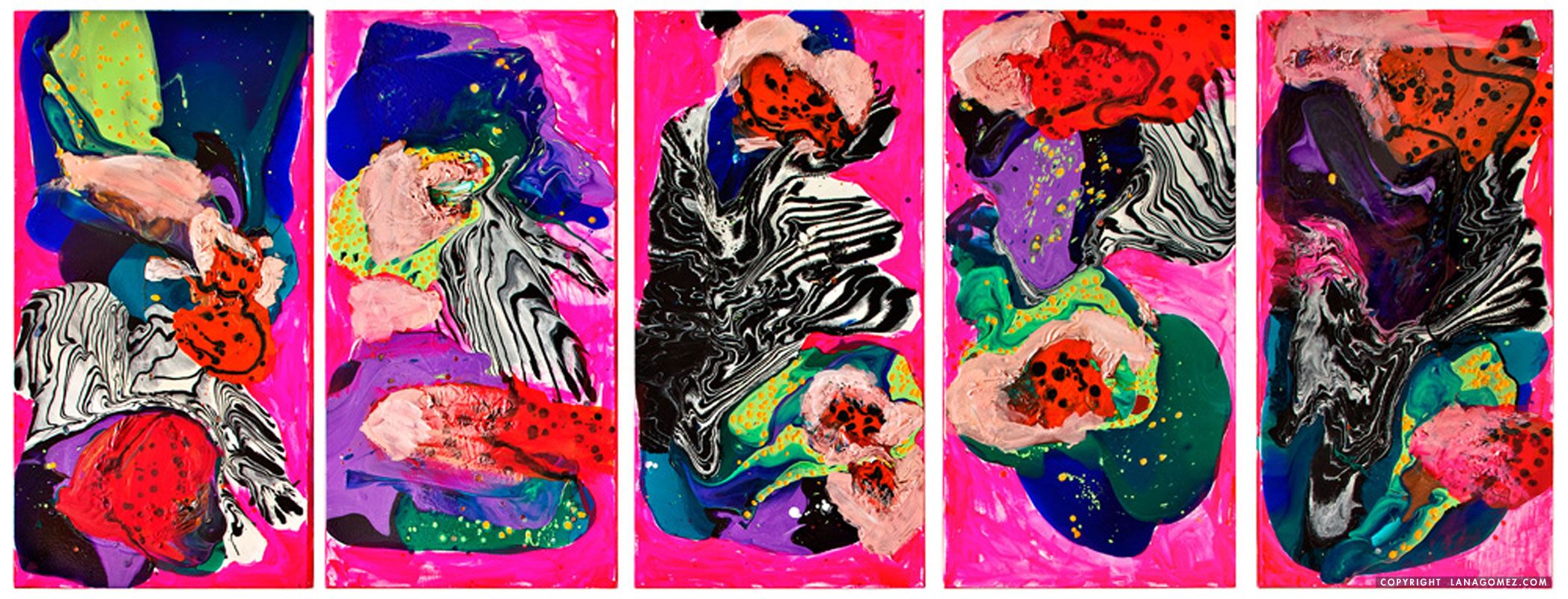
Los Angeles artist Lana Gomez’s artwork is literally larger than life. Whether it’s a large rug or a vast wall, give her a blank canvas and she will turn it into a masterpiece.
The 36-year-old has been perfecting her craft since childhood, when she threw paint on a canvas with her parents. Their encouragement gave her the confidence to pursue a career in art — something she initially thought couldn’t happen.
“It was so easy for me because it was so fun,” Gomez told the Journal. “Then in college, I had a professor who really let us study whichever style we wanted … I just started playing around and I got involved in watercolor and added in more materials and I kept wanting them to be bigger, bigger, bigger, bigger —it just felt so freeing.”
Gomez continued to create bigger, better artwork — including transforming entire walls in her dorm room and apartments — rethinking the rules of color, shape and texture.
“Ya Know Now Ya Know” Paintings by Lana Gomez.
“My parents encouraging me really helped me find my own voice,” Gomez said. “It was the first time I honed my craft. It opened up a whole new world for me and there is such a great creative world out there.”
More than a decade later, Gomez has studied and collaborated with interior designer Kelly Wearstler, painted a 10-foot Gibson guitar sculpture for GuitarTown on the Sunset Strip and sold one of her paintings to Greystone Mansion in Beverly Hills. The next project she’d like to tackle is creating a three-dimensional room with paint.
“[My art] creates a forum for people to talk. It’s not something you just randomly bring up in a conversation. It’s cool to have a talking point.” — Lana Gomez
Gomez’s pieces explore contrasting and complementary acrylic paint colors.
Each piece of art is her time capsule because, she said, “I don’t have a great memory. I sort of found when I finish a painting if I look at it and kind of think back, some thought of some random moment in my life comes out and I use it as a way to reflect and ask, ‘What is the feeling? What is the thought?’ Then I like to think of funny names for them too. Now I have all these paintings with names that could be the most random memory in my life or a random song or it could be a big moment in my life. It keeps [the memories] alive.”
Among the names of her pieces are: “All You Have to Do Is Dream,” “Different Worlds” and “What Makes You Tick?”
Gomez said she wants her artwork to spark a conversation between people who wouldn’t normally think about what makes people get out of bed in the morning. “It creates a forum for people to talk,” she said. “It’s not something you just randomly bring up in a conversation. It’s cool to have a talking point.”
One of her pieces is a neon fuchsia rectangular canvas with splashes of vibrant colors. Titled, “Purim” it was inspired by the Jewish holiday, which was one of her favorites to celebrate a child.
“As a kid, Purim was the most fun time because you’re dressing up and there’s the carnival and most children would have fun memories of it,” she said. “I think that painting is so colorful and over the top and reminded me of Purim.”
She said her connection to Judaism comes from the morals, lessons and family values that she incorporates in her day-to-day life and her artwork.
“Purim.” Lana Gomez
“As a kid, I wasn’t super excited to go to services,” she said. “But once I was a little bit older, I connected so much with what they were saying and I [realized] I knew more about my religion than I thought.”
Gomez, who is Sephardic, grew up in Memphis, Tenn., and Naples, Fla. She said although she lived in the heart of the Bible belt in Memphis, the Jewish community thrived. She also noted she is a descendant of the Gomez family who fled to America after the Spanish Inquisition. Their family ancestor Luis Gomez established the Gomez Mill House in 1714 in Newburgh, N.Y., and it remains one of the earliest known Jewish dwellings in North America and one of the oldest homes on the National Register of Historic Places.
Together, with her husband — comedian Sebastian Maniscalco — and their two children, 2 1/2-year-old Serafina and 3-month-old Caruso, Gomez said their artistic visions are a team effort, whether she’s styling posters or tour artwork for her husband or he is weighing in on designs for their West Hollywood home.
Gomez is also excited that her daughter has started dabbling in painting. “Stick with it,” a phrase from Wearstler, is one Gomez continues to use especially now that she is “collaborating” with her daughter.
“It’s so fun to paint with her,” Gomez said. “She loves it, too, and it really brings me back to just my love of color and materials. To see a kid play around and have them look at a painting and see what they would do it gives me ideas. I’ll be showing her like, ‘Here, pour it this way’ or ‘Use the brush this way’ and she doesn’t do it and then something cool happens. … I like to stay open and let anyone teach me whether it’s my 2-year-old, or Kelly Wearstler or Sebastian.”
To see more of Lana Gomez’s artwork visit her website.
A bullet-riddled execution wall at Auschwitz. A dissection table used at the Majdanek death camp. Tallitot and suitcases never claimed by their owners. Train tracks that transported millions of Jews to their deaths. This collection of black-and-white images, hauntingly beautiful and devoid of life, serve as a reminder of what was lost in the Holocaust. They’re on display through Oct. 26 in “Judy Glickman Lauder: Beyond the Shadows” at the Peter Fetterman Gallery in Santa Monica. An expanded exhibit featuring these and additional photographs from Lauder’s book “Beyond the Shadows: The Holocaust and the Danish Exception,” opens at the Los Angeles Museum of the Holocaust (LAMOTH) on Nov. 4.
Lauder has been photographing Holocaust-related subjects for more than 30 years. “My Jewish heritage is very important to me. I’ve always been interested in and photographed a lot of Jewish subject matter,” she told the Journal. Although she is not the daughter of survivors, Lauder said her grandparents lost members of their families who did not emigrate from Poland, Lithuania and Ukraine, including her grandmother’s twin sister.
When she had the opportunity to go to Auschwitz and Birkenau with a United Jewish Appeal group on the way to Israel in 1988, “I knew I had to come back,” she said. “It became a mission, a calling [to photograph] the camps, ghettos, cemeteries, train stations and places that used to be centers of Jewish life and are no longer.”
In 1993, she was asked to go to Denmark and photograph Danish survivors and rescuers for an exhibit to commemorate the exceptional story of a small country that went above and beyond to protect its 7,000 Jews.
Occupied in 1940, Denmark defied Hitler by refusing to turn over Jews for deportation. Three years later, Danes hid their Jewish neighbors and helped smuggle them to Sweden, where they remained for the duration of the war. Of the nearly 500 Jews who were captured and sent to Theresienstadt all but 50 survived. After liberation in 1945, the Danes who took care of Jewish homes and business in their owners’ absence welcomed the survivors back with flags waving.
“If you allow prejudice and stereotypes and hatred to go on it becomes atrocity. It has to be nipped.”
After spending so much time in places of misery and annihilation, going to Denmark and hearing the testimonies of survivors and rescuers “was such a breath of fresh air” Lauder said. “Hate is rising today, all over the place, including America, and we can’t afford to be bystanders. The Danish story is an incredible example that man can make a difference.”
In her book, testimonies from Holocaust scholars Michael Berenbaum and Judith S. Goldstein, recollections by Danish rescuers, Jewish survivors and a foreword by the late Elie Wiesel accompany Lauder’s photographs. She donates proceeds from its sales and photographic prints to LAMOTH and KAVOD Ensuring Dignity for Holocaust Survivors.
Raised in a non-observant Reform Jewish family in Piedmont, Calif., Lauder spent her teens in Los Angeles and attended UCLA. She served as a model for her father, a physician and amateur photographer, and spent hours learning in his darkroom. She got her first SLR camera in her 30s and has been using the medium to tell stories ever since.
“My passion is black and white,” she said. “You’re able to really see the subject matter, the light and the shadow, the gradations of light. Color is almost a distraction because we see in color. With black and white, you’re forced to look closer.” She used infrared film for some of her Holocaust images. “It captures more than the eye can see,” she explained. “It gives it a timelessness and a haunted feeling.”
The mother of four and grandmother of 16, Lauder shares homes in New York, Maine, Sarasota, Fla., and a Century City condo with her husband Leonard Lauder, the retired chairman of Estée Lauder Companies Inc. In 2015, they were married by two of her sons and a daughter-in-law, who are Reform rabbis. She’s a member of her sons’ synagogues and shuls near her homes, including Temple Isaiah. She became bat mitzvah in her 40s, and feels a strong connection to Judaism and Israel, where she has visited many times.
Previously married to shopping center developer Albert Glickman, she had known Lauder and his late wife, Evelyn, for 40 years, socializing on Aspen, Colo., vacations. When Glickman died in 2013, Leonard Lauder gave a eulogy for his friend and succeeded in getting a grove of trees dedicated in his honor on their favorite ski slope. When the widowed pair had lunch together for the first time by themselves, “It just developed from there. It was a love story,” Lauder said. “It was bashert.”
These days, Lauder travels often for speaking engagements at schools, collegesand synagogues. “It’s important to me because this happened and everybody was a bystander. If you allow prejudice and stereotypes and hatred to go on it becomes atrocity. It has to be nipped,” she said. “Human beings have the capacity for hatred, violence and greed but we also have the capability for goodness and making a difference.”
“Judy Glickman Lauder: Beyond the Shadows” is on view at the Peter Fetterman Gallery in Santa Monica through Oct. 26. “Judy Glickman Lauder: Beyond the Shadows: The Holocaust and the Danish Exception” runs Nov. 4-Jan. 5 at the Los Angeles Museum of the Holocaust.
Donn Delson was thousands of feet above the Earth when he aimed his camera and captured a majestically barren panorama along the Dead Sea in Israel. Somewhat paradoxically, he would later title the resulting image “Waterworld.”
Back on land, tens of thousands of miles away from where he collected that photo, the 70-year-old photographer gestured to the photo displayed at the Dortort Center for the Arts at UCLA Hillel, and said, “I’ll let you look at it for a moment and tell me why you think it’s called ‘Waterworld.’ ”
Upon my blank stare and a few babbled words about a disastrous Kevin Costner film from the 1990s, Delson put me out of my misery. “See the mouth and the eye of the bass?” he said. “See the puffer fish? See the mermaid’s tail?”
And indeed, amid the zigzags and lines, the cliffs and soil, the sea creatures emerge. “At one point, all this was under water. It was in the Dead Sea and the fish remained,” Delson said. “So even though it’s not blue or turquoise or aquamarine, it’s waterworld.”
There are more bits of visual playfulness within the 21 photographs of Delson’s “Holy Land” exhibition on display at the Hillel. Occasionally, the title card tells us exactly what we’re looking at, such as “Masada Sunrise.” In most instances, the title invites a shift in perspective. “Holy Land” takes us not just into, but literally over the Holy Land, offering views that most of us will never experience.
“What I enjoy is that multi-layer sense of perspective, the perspective of seeing something that one wouldn’t normally see which, maybe if we’re open to it, offers us a new insight.” — Donn Delson
Israel — indeed much of the world — looks very different from on high. Delson learned this in theory when, as a high school student in Cincinnati, he read T.H. White’s “The Once and Future King” and was intrigued by the portion of the story in which the wizard Merlin schools his young charge — the future King Arthur —by turning him into an eagle.
“Arthur could fly and get a sense of the oneness of the world,” Delson said. “That was a seminal moment for me.”
As a student and later as an adult, Delson enjoyed photography largely as a hobby while he pursued entrepreneurial ventures. Then, eight years ago, while on a trip to New Zealand, he took a helicopter to a glacier and began shooting out the window. Seeing that his passenger knew his way around a camera, the helicopter pilot offered to strap Delson into a harness and to remove the doors to give him an unobstructed view.
“That was it: a transformational moment for me,” Delson said. “It was another year or two before I actually started doing the aerial photography, but it has really become the focus of my work. What I enjoy is that multi-layer sense of perspective, the perspective of seeing something that one wouldn’t normally see which, maybe if we’re open to it, offers us a new insight.”
Delson’s family had attended the UCLA Hillel and they knew Executive Director Rabbi Aaron Lerner, who knew Delson’s family and his work. Lerner and Hillel Artistic Director Perla Karney said that Delson might come up with something for the fall exhibition at the Hillel’s Dotort Center for Creativity in the Arts.
“I don’t think either of them expected me to go to Israel and spend 35 hours on a helicopter taking pictures,” Delson said, “but I hope they were pleased with the results.”
Indeed, they were. The opening drew more than 150 people and generated several sales, a portion of which will go to Hillel.
“I thought that was pretty remarkable, that he made it kind of his mission to go and take photographs for our exhibit,” Karney said. “Donn is very detailed. He’s a visionary and he does things to perfection. He had something like seven sales on the opening night, which is unusual for Hillel. We’re not a gallery. But people really responded to these images, and they bought.”
Delson’s journey took him from the Golan to the Negev. He flew over Tel Aviv and the Sea of Galilee. Shooting with a Nikon 860 and a Canon 5Ds, Delson captured a bird’s-eye view of the Mar Saba Monastery and picked out a solitary kayaker breaking away from the shores of the Dead Sea for his “Odyssey.” Other images evoke jewel-like patterns (“Gemstones”) or fabric (“Crystal and Lace”). His shot of the cliffs that once housed the Dead Sea Scrolls appears from above to be a giant hand. Its title: “Hand Written.”
Delson knew he wanted a view of Masada at sunrise and another of Jerusalem’s Old City at dusk. But as is often the case when he goes airborne, he also was willing to be taken by surprise.
“A lot of it is serendipitous,” Delson said. “It’s my eye searching for patterns, for symmetry and for negative space. I’m searching for things that are colorful because a lot of the Earth is brown and green and gray. Finding things that are colorful and beautiful, things that appeal to me for what I’m looking for is a challenge.”
Delson contends that the work is not without its obstacles. Even with the doors off, shooting conditions from 5,000 feet include dealing with vibration and wind. From a helicopter, it’s so easy to quickly review your work and do reshoots.
Not that Delson is complaining. Quite the opposite. Sometimes he gets so caught up in the view that he almost forgets that he is working.
“In doing what I do, the reward I get personally is having that mystical magical moment,” he said. “When I was over Manhattan a few years ago, I flew over Times Square at dusk and it was so magical and so incredible that there was a period of probably a minute where I was actually just looking and not taking any pictures. And I remembered, ‘Oh yeah, the whole reason I was up here was to take pictures.’ You look out and you’re like, ‘Oh my gosh. What a gift to be able to have that experience and that opportunity.’ ”
“Holy Land” will be on display through Dec. 22 at the Dortort Center for Creativity in the Arts at UCLA Hillel, 574 Hilgard Ave., Los Angeles, (310) 208-3081, uclahillel.org.