We call this format a Timesaver Guide to Israel’s Coming Elections. This will be a usual feature on Rosner’s Domain until a new government is formed. We hope to make it short, factual, devoid of election hype.
Bottom line
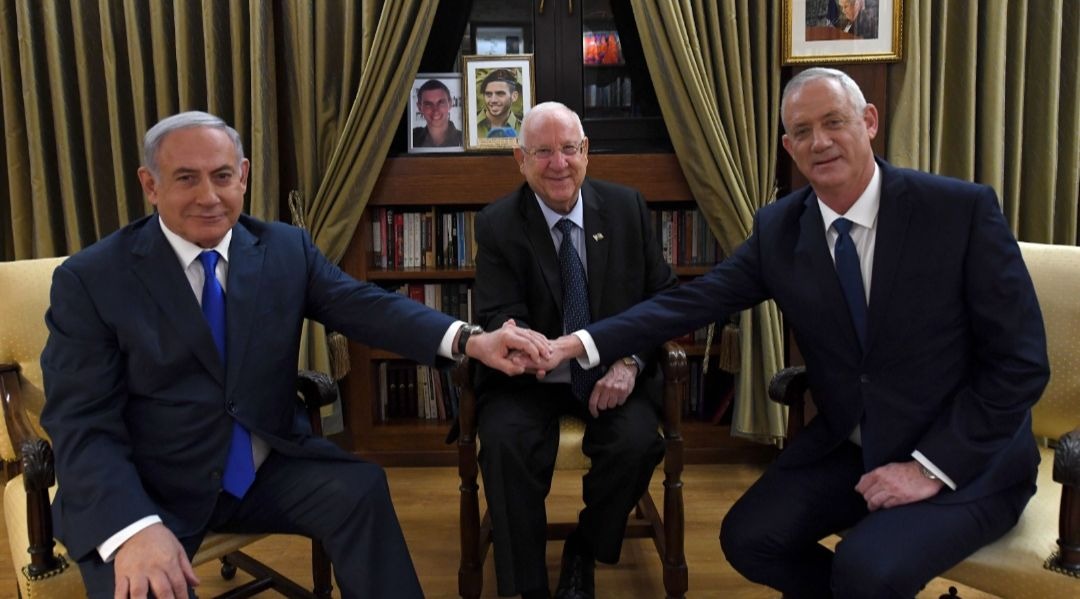
President Rivlin summons Netanyahu and Gantz to nudge them towards a unity government. It might take time before they come around to agree on something. Or not. (updates will be added when we have more information).
The News
Netanyahu: Israelis are not quite interested in politics right now. There is crisis. Prime Minister Netanyahu was counting on this crisis to help him form an emergency unity government. The terms were negotiable. It could be for three months, or six, or a year. One thing for sure: it would keep him as Prime Minister for the time being.
Gantz: Israel’s president Reuven Rivlin consulted with all parties. The result: 61 new Members of Knesset said they want Blue and White’s Benny Gantz to form the next government. These include the members of the following parties: B&W, Labor, Meretz, Israel Beiteinu and the Joint List.
Israel Beiteinu: Avigdor Lieberman, former Netanyahu ally, burned the last bridge and decided to go with Gantz. It is not clear how rightwing voters of Liberman will respond to such move in case of another election.
Joint List: All factions of the Arab party, including the radical Balad, recommended Gantz. This is remarkable for both them and for him. Remember, he is a general and the former IDF Chief of Staff. For a party of politicians who often call for international investigation against IDF “war criminals” recommending Gantz is no small thing. For the general, this is a huge political gambit. If there’s another election, the campaign against him is ready: He was going to form a coalition with the help of “terrorist supporters”.
Gantz’ Coalition: So why can’t Gantz just form a new government? Because of reservations within him own party. Blue and white leaders vowed prior to election day not to seat in a government supported by the Joint List. Some of them take this promise seriously and at least two MK’s (Hauzer and Hendel) refuse to support a minority coalition headed by Gantz. One member of the Labor-Meretz list (Orly Levy Abekasis) also said she would not support it. So currently he has 59 hands, not 61.
Unity: It seems as if all sides agree that unity is the proper remedy to a political deadlock in a time of crisis. The devil is in the details. Will Netanyahu be the PM, for how long, what roles will other politicians get, what parties will take part in the new government. There needs to be an agreement on all these things for a unity to be formed. But each and every one of them is thorny for various reasons.
Rivlin: On Sunday President Rivlin said that on Monday he will ask Gantz to form a government. with 61 recommendations, there was no other choice. But as Rivlin was making this early announcement he was also putting pressure on Netanyahu. The PM and Gantz were invited to see Rivlin on Sunday evening. He wanted Netanyahu to understand that if there’s no flexibility from him, Gantz will be moving forward.
Edelstein: In the meantime, to add complication, B&W asked for a Knesset vote to replace the Speaker, MK Edelstein (Likud). This is a move aimed at having control over the Knesset’s agenda, and possibly pass lows to limit Netanyahu’s ability to form a government before the end of his trial. For now, Edelstein refuses to let the Knesset convene (he can drag his feet, but not for very long).
The following table somewhat clarifies the numerical situation:

The Next Move
There are the basic options:
- Netanyahu and Gantz agree on unity. Time out for a while. Likely
- They cannot agree: Gantz attempts to form a coalition and succeeds. Unlikely.
- They cannot agree: Gantz attempts to form a coalition and fails. Netanyahu gets a chance and succeeds. Unlikely.
- They cannot agree: Netanyahu gets a chance and fails. Likely.
- Fourth election. Likely.
The bottom line here is clear: Unity, or a fourth election are the likelier outcomes.