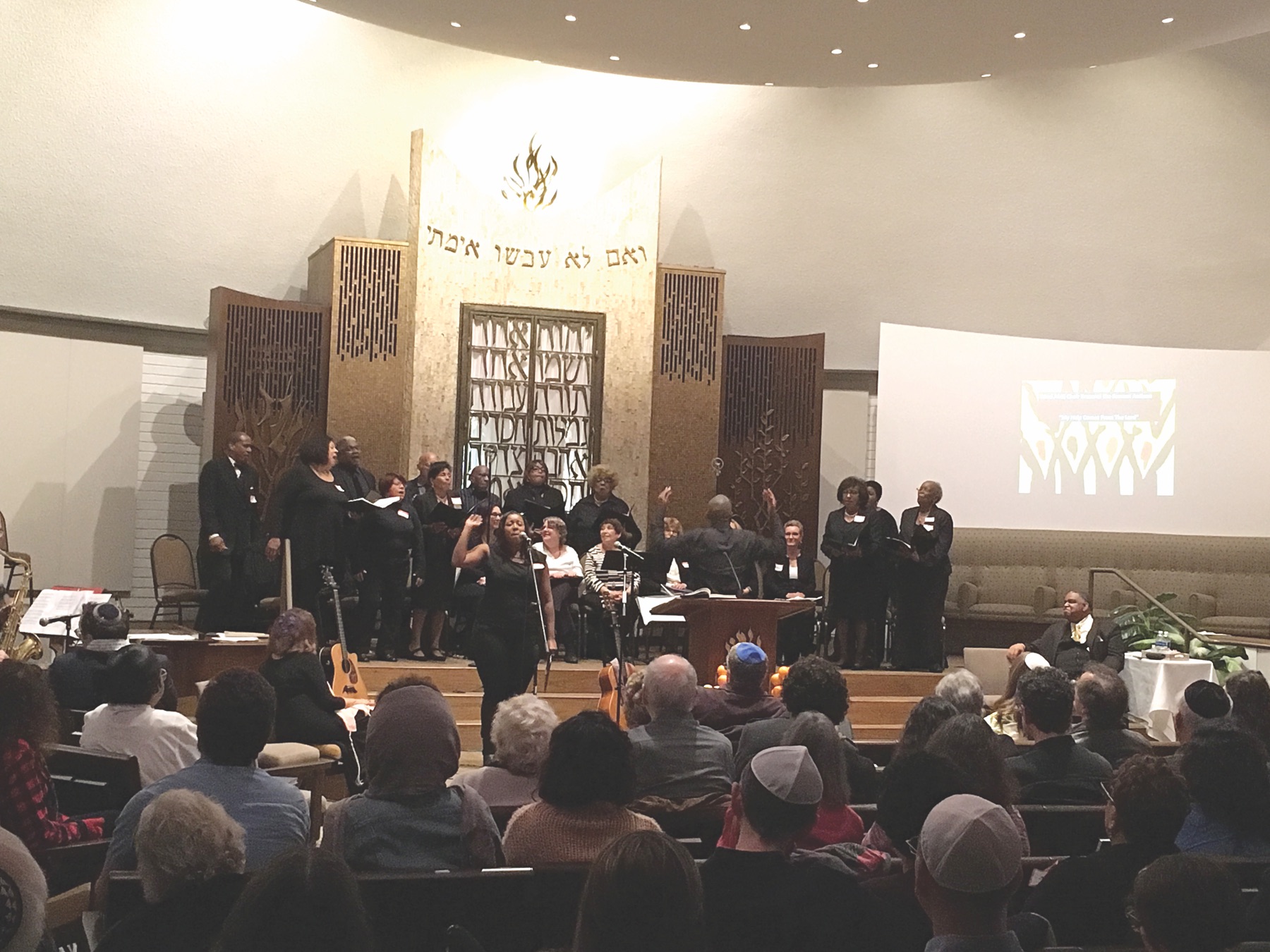
A Gospel Shabbat service at Temple Beth Hillel in Valley Village on Jan. 5 called to mind the alliance once forged between Jewish Americans and African- Americans from the early 1900s through the civil rights movement.
The service, which drew a full house and featured a band and choirs singing gospel music, was born out of the friendship between Beth Hillel’s Senior Rabbi Sarah Hronsky and Ward AME Church’s Rev. John Edward Cager. The two met in 2016 through the Los Angeles Council of Religious Leaders, an organization for which Cager is now president and Hronsky is vice president.
“For cross-congregational relationships to work, the leaders have to get along,” Cager said. “Her style of ministry and outlook match mine. … Where we walk together is, it is not enough just to have worship inside the walls of church, inside the walls of temple. You have to be willing to carry that ministry outside the walls, to be willing to affect the community on the outside.”
There is potential for Beth Hillel members to better understand white privilege.
The service was part of a series of social-justice-themed events in Beth Hillel’s inaugural “Justice January.”
“We do justice work all the time,” Hronsky said. “But I thought if I could put a strong label on it, then it brings it more to the forefront.”
Hronsky said she hopes the Gospel Shabbat service woull be just one of many exchanges between the two congregations.
“The more opportunities we have to build cultural understanding and relationships, the better it is for our community at large,” she said.
She is particularly keen on younger members of the congregations coming together. “When you influence kids, that carries forward for generations,” she said.
But Hronsky’s interest in developing the relationship is multifaceted. For example, she said, she sees the potential for Beth Hillel members to better understand white privilege and to assist Ward AME’s effort to house 150 homeless people on winter nights in its buildings in the University Park neighborhood west of downtown L.A.
“There are grand opportunities,” Hronsky said.
In addition to many of the regular Friday night service goers at Beth Hillel, the Gospel Shabbat attracted nonmembers of the temple and dozens of Ward AME parishioners.
Hronsky warmly welcomed the newcomers and tried to put them at ease by explaining that, while much of the service would be in Hebrew, most American Jews don’t speak it. The service then continued with multiple quotes from Martin Luther King Jr., in recognition of the 50th anniversary of the civil rights leader’s assassination.
After the Amidah and a few moments for silent prayer, Hronsky introduced Cager.
“Allow me to be me, Beth Hillel,” said Cager, who explained the tradition of call and response in his church. “Don’t be offended,” he said, “if some people want to preach with me.” Which they did, as Cager urged attendees to participate and offer affirmation.
As compelling and relatable as Hronksky and Cager were, ultimately it was the small moments — the breaking of challah together, the former strangers holding hands and, of course, the music — that marked the evening.
Beth Hillel’s choir, joined by a dozen choir members from Ward AME and the church’s organist, drummer, electric guitar player and saxophonist made for a rousing evening that drew rave reviews.
“It was fantastic,” said Stephen Feltman, 58, a Jewish Valley Village resident who does not belong to the temple. “We all might be different but we have so much in common.”