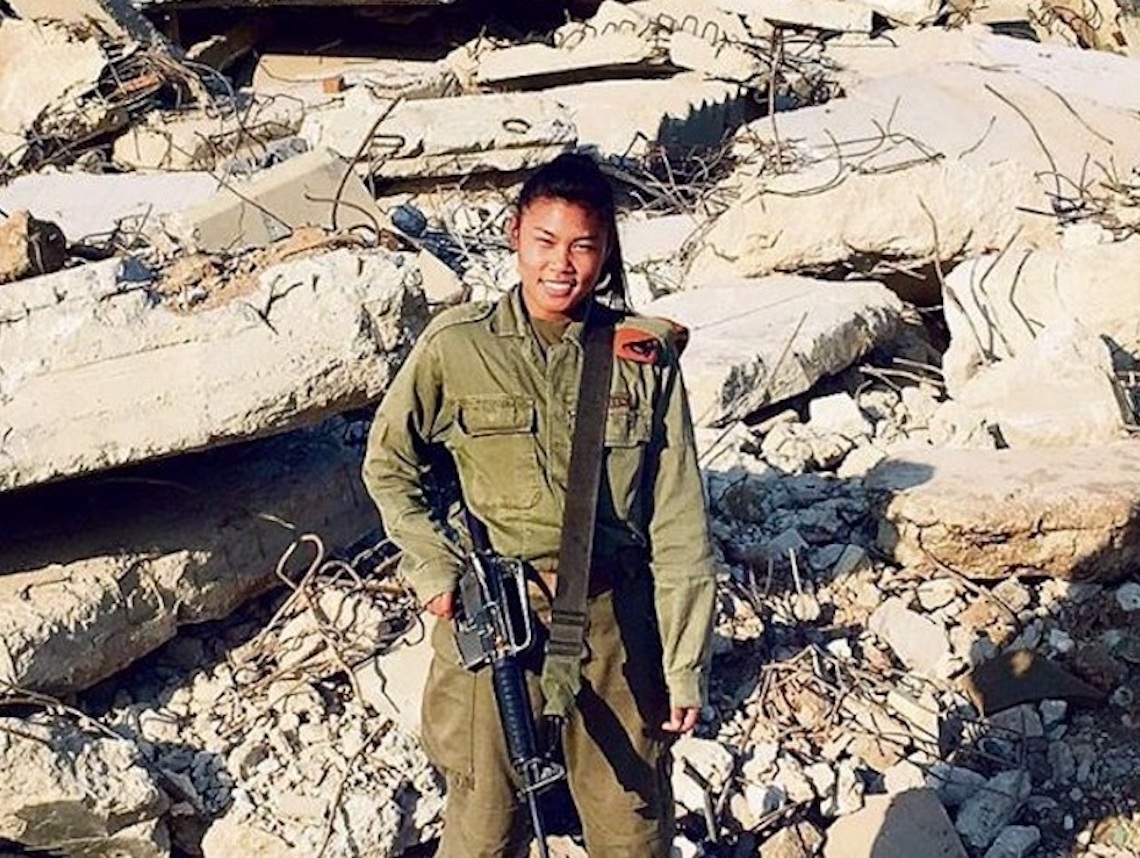
Staff. Sgt. Joana Chris Arpon isn’t Israeli, or even Jewish. Her service in the Israel Defense Forces is personal.
Arpon, 20, is the daughter of Filipino parents who came to Israel to find work. She said she enlisted as a combat soldier because an Israeli army team rescued her grandmother in the aftermath of the 2013 typhoon that devastated the Philippines.
“It was amazing to see the soldiers show up and help people. They saved my grandmother when her house was destroyed,” Arpon said. “I was like, “Whoa, that’s what I want to do.’”
On Tuesday, Israel’s 69th Independence Day, Arpon will be one of 120 soldiers recognized by Israel’s president for distinguished service. Later this year, Arpon and her mother will be granted Israeli citizenship thanks partly to her time in the army.
Born in Israel, Arpon always felt like part of the Jewish state. While many Filipinos live clustered in Israel’s big cities, her mother raised her and her older brother in the small town of Mishmar Hashiva, in central Israel. At their high school in nearby Rishon Lezion, they were the only Filipino students.
Arpon’s mother immigrated to Israel in 1988 to work as a nanny, and stayed to raise her children even after her husband left. The vast majority of the some 31,000 Filipinos who live in Israel are female caregivers.
As a rule, Filipinos are only allowed to live in Israel as temporary workers. But Arpon and her brother are among the hundreds of Filipino children the government has granted permanent residency, along with their immediate family members. After the children serve in the army, their families qualify for citizenship.
Arpon long knew she would follow in the footsteps of her brother, who served as a paramedic and is now a citizen. But it was only recently that she decided she wanted to be a combat soldier. Only about 7 percent of Israeli combat soldiers are women, though that number is growing despite opposition from some Orthodox Jews and others.
In November 2013, Typhoon Haiyan made landfall in the Philippines with record-breaking force. At least 6,300 people were killed, and tens of thousands lost their homes, including Arpon’s grandmother.
A few months later, Arpon flew with her family to the country to visit her grandmother in the hospital. Israel had sent soldiers and other emergency responders to help, and Arpon learned that its army’s Search and Rescue Unit had helped save her grandmother from her destroyed home.
“People said without the Israeli soldiers, they weren’t sure they would have survived,” Arpon said. “I realized that I wanted to be part of this unit, and definitely this country.”
When Arpon returned to Israel, she fought to enlist in the army as a non-citizen and was granted her preferred placement — in the Search and Rescue Unit. Over the past 2 1/2 years, she has served in bases across the country and responded to domestic disasters, including the wildfires that ravaged Israel in November and the Tel Aviv parking garage that collapsed in September, killing three.
Arpon said she did not know why she was being honored Tuesday from among “so many people with amazing stories.” But she said her mother and brother were proud of her, and would be on hand for the event. She said, too, that her grandmother, who died recently, likely would have approved of her plans for after she finishes her army service in November and becomes a citizen.
After the army, Arpon wants to study architecture — and design houses that will stand in any weather.
“I’m really glad I chose this type of service, where I was able to help the country that helped me,” Arpon said. “I see my future in Israel.”