fbpx

September 24, 2026

Kol Nidrei, Broken Eggs and a Beethoven Quartet in C Sharp Minor

Words can be broken just like eggs

when they have carelessly been dropped, and when they’re scrambled

they fall like dancers with weak legs.


Before words have been put to use they should be sampled

more for their taste than size,

and then allowed to stand en pointe and pirouette,

because unless they’re shameful lies

it’s possible to revise the shattered word-omelette,

making it as lovely as

six holy oranges and trees and lovely legs,

and summertime with Gershwin’s jazz,

which helps you to forget about your broken eggs.


Whereas no eggs can ever, once they have been broken,

be mended, promises we make

can be repaired when they’re respoken

as promises that we intend to keep


more  faithfully than that we declare on Kol Nidrei

sung with music of Beethoven’s quartet in C Sharp minor,

implying that we will not all promises obey,

but break some like the fast of Yom Kippur when we’re allowed to be a diner.


Rabbi David Wolpe wrote, in “Brokeness”(https://www.youtube.com/watch?v=Lh-ICsgyou8), that according to kabbalistically-inspired rabbis the universe was created by a process of “shvirat hakelim,” the breaking of the primary vessels for which God created it. This concept implies that life is not a process in which we must not seek to achieve a goal of perfection but a program for repairing what we have broken. He quoted one of my favorite poems, “Robert Browning’s “Andrea del Sarto,” in which the poet explains the rationale of the concept of “heaven”:

Ah, but a man’s reach should exceed his grasp,

Or what’s a heaven for?

My son Zachary pointed out that my poem explains why Rabbi Shimon ben Gamliel states in Avot 1:17:

All my days I grew up among the sages, and I have found nothing better for a healthy body than silence.

I learned about the link between the music of the slow movement in Beethoven’s Quartet in C Minor on 9/16/26, in a Torah in Motion discussion about the music of Kol Nidrei, given by Eric Freeman, head of the Belz School of Jewish Music at Yeshiva University.


Gershon Hepner is a poet who has written over 25,000 poems on subjects ranging from music to literature, politics to Torah. He grew up in England and moved to Los Angeles in 1976. Using his varied interests and experiences, he has authored dozens of papers in medical and academic journals, and authored “Legal Friction: Law, Narrative, and Identity Politics in Biblical Israel.” He can be reached at gershonhepner@gmail.com.

Kol Nidrei, Broken Eggs and a Beethoven Quartet in C Sharp Minor Read More »

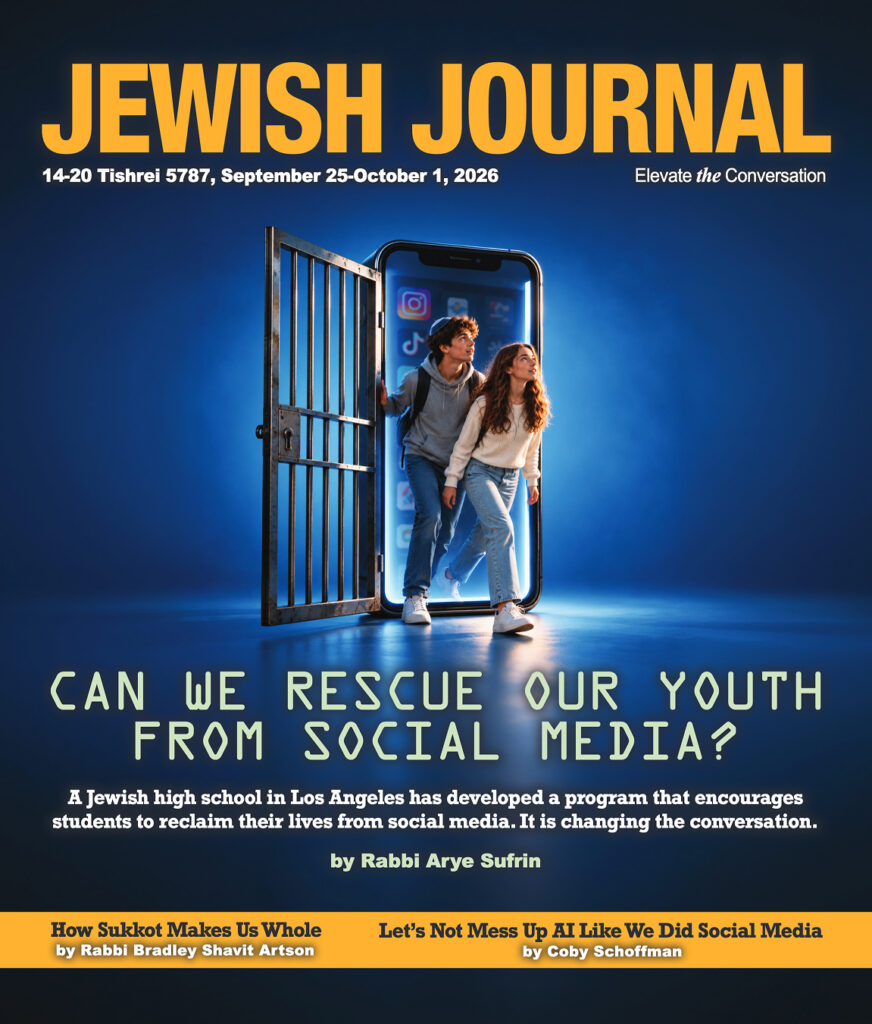
Print Issue: Can We Rescue Our Youth From Social Media? | September 25, 2026

CLICK HERE FOR FULLSCREEN VERSION

Print Issue: Can We Rescue Our Youth From Social Media? | September 25, 2026 Read More »

Before Oct. 7 and After: Arab Audiences Keep Watching ‘Fauda’

“Fauda” is No. 1 on Netflix in Lebanon again. The fifth season of the Israeli thriller hit Netflix on Sept. 8 and ranked No. 4 among the platform’s non-English television shows worldwide for the week of Sept. 7-13, with 2.1 million views and 15.9 million hours watched.

Season 5 is the first season of “Fauda” built around the Hamas-led Oct. 7, 2023 terror attacks on Israel. The season starts two years after the attack, when an unsanctioned revenge mission in Marseille pulls Doron Kavillio, played by co-creator Lior Raz, back into the field.

Arab audiences were watching “Fauda” years before Oct. 7. During Ramadan in 2020, when Season 3 hit Netflix, the Jewish People Policy Institute cited Netflix Top 10 lists showing “Fauda” at No. 1 in Lebanon, No. 3 in the United Arab Emirates and No. 6 in Jordan.

Netflix’s archive put Season 4 at No. 2 in the UAE and No. 6 in Morocco for the week of Jan. 23-29, 2023 — nine months before the Oct. 7 terror attacks.

Season 5 made the Top 10 in Jordan, Qatar, Bahrain, the UAE, Oman and Kuwait during its first week on Netflix. It ranked No. 4 in Jordan and Qatar, No. 5 in Bahrain and the UAE, No. 7 in Oman and No. 9 in Kuwait.

The Jewish populations in those countries are small. The World Jewish Congress said Lebanon had 29 Jews in 2020, Bahrain has about 50 and Morocco had about 2,100 in 2020. The Jewish Council of the Emirates estimates about 1,000 Jews live in the UAE, with the World Jewish Congress citing estimates ranging from 500 to 3,000. The U.S. State Department does not list an established Jewish community in Jordan, describes Jews in Qatar as one of several very small religious groups, says Oman has no remaining indigenous Jewish population and reported no known Jewish citizens in Kuwait.

“Fauda,” Arabic for “chaos,” premiered on Israel’s Yes network in 2015. Raz and journalist Avi Issacharoff created the Hebrew- and Arabic-language series around an Israeli undercover counterterrorism unit. Netflix began distributing it outside Israel in 2016. Season 1 brings Doron out of retirement after he learns that a Hamas commander he thought was dead is still alive. Season 2 moves into a revenge plot involving ISIS. Season 3 sends the story into Gaza. Season 4 expands through Jenin, Brussels and Lebanon. Season 5 deals with Oct. 7 and what came after it.

The writers were already working on Season 5 when the Oct. 7 attacks happened. They threw out the direction they had been pursuing and started over.

“We understood that a show that deals with reality in the Middle East, in Israel, cannot disconnect itself from the biggest event that happened here in the last, I would say, 75, 80 years. You cannot ignore that,” Issacharoff said in an interview published on Netflix.

Raz said the creators knew the audience extended far outside Israel.

“I hope that through seeing this show, [viewers] will understand how peace is important, and how we need to think differently and how war is ruining the universe. It’s ruining our region, it’s ruining our country, and their countries, for sure,” he said. “We know that people see this show all over the world — in the Arab world, in Israel — [and they’ll see] that the price of the war is hard, and we need to have hope to solve this situation.”

“I hope that through seeing this show, [viewers] will understand how peace is important, and how we need to think differently and how war is ruining the universe. It’s ruining our region, it’s ruining our country, and their countries, for sure.” – Lior Raz

Ahead of the Asian premiere of Season 4 at the 2022 International Film Festival of India, India’s Press Information Bureau said 90% of viewers of Seasons 1 through 3 came from outside Israel. India was also among the top 20 countries for Netflix viewing of Israeli content. Still, the World Jewish Congress estimated that about 4,800 Jews lived there in 2020. Pew Research Center estimated India had 213 million Muslims in 2020, the third-largest Muslim population in the world behind Indonesia and Pakistan.

Netflix called “Fauda” “one of the most popular Israeli series on Netflix” when Episode 1 of Season 4 had its Asian premiere at the 2022 International Film Festival of India in Goa on Nov. 27. Raz and Issacharoff also took part in a festival panel on global storytelling. India also got its own adaptation of “Fauda.” “Tanaav,” set in Kashmir, debuted on SonyLIV in November 2022. “Tanaav 2” later won the 2025 ContentAsia Award for Best TV Format Adaptation in the scripted category.

Season 5 arrived on Netflix one week before the sixth anniversary of the Abraham Accords. On Sept. 15, 2020, Israel, the United Arab Emirates and Bahrain signed agreements at the White House establishing diplomatic relations between Israel and the two Gulf states. The day before the signing, Omar Saif Ghobash, then the UAE’s assistant minister for cultural and public diplomacy and a member of the Emirati delegation in Washington, told The Times of Israel that “a lot of Emiratis are watching ‘Fauda’ and ‘Unorthodox’ on Netflix, so an image is building up.” He added that young Emiratis had told him they wanted to visit Tel Aviv and meet Israelis their own age.

Six years later, during the week before the Abraham Accords anniversary, Season 5 of “Fauda” was No. 5 on Netflix in the UAE.

Before Oct. 7 and After: Arab Audiences Keep Watching ‘Fauda’ Read More »

For These Israelis, Voting Is Worth a $10,000 Trip Home

On Oct. 25, David and Ella Harlev will fly to Israel to vote in the country’s national elections, scheduled for Oct. 27. Each paid $2,600 for a plane ticket, and they are planning to fly back to Los Angeles on Nov. 1. The Israeli couple, who have lived in L.A. for the past 32 years, are not alone. Tens of thousands of Israelis from around the world are planning to make the same trip to Israel to cast their ballots.

Israel is among the relatively small group of countries that do not allow ordinary citizens living abroad to vote in national elections from overseas. For many Israelis abroad, that means spending thousands of dollars, taking time off work and traveling across the ocean simply to cast a ballot.

Despite the fact that the Harlevs have no plans to return to live in Israel, one of their children has made Aliyah, and most of their family members still live there. “It’s important enough for us to make the effort and come vote,” Ella said. “We are at a crossroads in Israeli politics, and I believe this election could be one of the most important ever. Many of our friends are also planning to go to Israel, and most of them have no plans to move back.”

Rachel and Aharon live in San Diego and declined to give their last name. They purchased their plane tickets in July. “We’re going to vote for Bibi,” Aharon said. “It’s easy to blame Netanyahu for everything, but I don’t believe anyone else has what it takes to lead this country.” The couple has lived in the United States for 27 years and plans to return to Israel, where their children and grandchildren live. “We don’t know what will happen if someone else takes his place,” Aharon said. “That’s a scary thought.”

“We usually travel to Israel for Rosh Hashanah, but this year we decided to skip the High Holy Days and go just before the election,” said Riki Abraham, who lives in the Valley. “I’m traveling with my husband and our two children, who were born here but are also Israeli citizens. My son also served in the IDF.”

The trip will cost the Abraham family close to $10,000, but they believe it is worth the expense. “I think Bibi Netanyahu needs to go. I believe he has failed as a leader, and we need someone new,” Riki said. “I actually used to love him, but what happened on Oct. 7 [2023] and afterward made me realize that he is no longer the leader I once believed him to be.”

The Journal spoke with a dozen Israelis from California who are planning to travel to Israel for the election. Some immigrated to the United States after Oct. 7, while others have lived here for many years. About half said they are planning to move back to Israel one day. When asked whom they plan to vote for, most said they intend to vote for anyone but Benjamin Netanyahu, including some who identify as being on the right of the political map.

Sigal Lerner

Sigal Lerner, a travel agent in L.A., said she plans to vote for Gadi Eisenkot. “Regardless of what happened on Oct. 7, and how Netanyahu was as a prime minister, I don’t think it’s healthy to have the same leader for so many years. Israel needs to wake up and make a change.”

Lerner doesn’t ask her clients whom they plan to vote for, but she said she has heard from colleagues on the East Coast that many Orthodox Jews are organizing trips to Israel to vote for Netanyahu. “It’s really difficult to say how much influence voters from the United States are going to have because you have both sides of the political map who are going back to vote,” she said.

Jonathan Barsade, president of Aid Coalition, which began in the United States a month before Oct. 7, 2023, has been helping Israelis living outside of Israel through his “Fly & Vote” initiative.

Barsade, who was born in Australia, grew up in Israel and has lived in the United States for 35 years, said in a Zoom interview with The Journal that the initiative was created to provide Israelis with information and logistical assistance so they can return to Israel and vote.

“People have many questions, like, ‘Do we have the right to vote? Where can we vote? What do we need to bring with us?’” he said.

Jonathan Barsade

Barsade said many people who contact the organization are unsure whether they are still eligible to vote, mistakenly believe they are no longer registered or think they can cast their ballot at an Israeli consulate where they live. The organization provides information and helps with the logistics of getting to Israel, including finding flights and, when necessary, arranging charter flights. Voters are advised that they need only one of three valid documents: an ID card, a driver’s license or an Israeli passport.

Israelis, he said, stay connected to Israel even years after they have left the country.  He pointed to what happened immediately after Oct. 7, when thousands of Israelis living abroad boarded flights to Israel without a second thought. Many stayed for months to serve in the IDF. Others opened emergency operation centers, raised money and organized support for Israel.

“We live in a very different time than we did in the 1950s,” he said. “Back then, the attitude was that if you left Israel, you left. Today, people go abroad for a postdoc, for studies or for work and, even if they stay there for many years, they remain connected to Israel 24/7. They start their day by opening Israeli news sites and follow the news closely. They are very much involved, and there is no reason their voice should not be heard.”

Not everyone was happy about “Fly & Vote.”

In August, the Likud Party moved to challenge the initiative, threatening to appeal to the Central Elections Committee and take legal action against the organizations behind it. In a warning letter sent by Ilan Bombach, a legal advisor for Likud, the party argued that the initiative could violate election laws, including provisions prohibiting benefits to voters and attempts to influence their votes. The letter demanded that the organizations provide information and documents about the initiative and immediately halt activities that, according to the Likud, could affect the election process. Among the party’s claims were that the organizers maintained a database containing identifying information about voters and their voting intentions, arranged transportation for voters on Election Day outside the framework permitted by law and approached voters in an effort to persuade them not to vote for the Likud.

Barsade said that “Fly & Vote” has never asked voters whom they intend to support in the election. “We have no idea what they put in the ballot box.”

“I don’t know what their considerations were,” he said referring to the Likud Party. “It’s even more puzzling when you consider that the Likud and Benjamin Netanyahu tried to promote an initiative just a few years ago to allow citizens living abroad to vote. There has been a change in approach. The Likud is the only party that has expressed opposition.”

So far, 35,000 Israelis living abroad have registered through “Fly & Vote.” Barsade said he hopes the number will reach 50,000 before the election. The figure represents only those who have registered through the initiative – Israelis traveling to Israel independently to vote are not included.

When I asked Barsade why voting is so important to Israelis living abroad, he offered a phrase that, he said, captures the connection many still feel to Israel: “You can take Israelis out of Israel, but you can’t take Israel out of Israelis.” 

For These Israelis, Voting Is Worth a $10,000 Trip Home Read More »

A Harira Hug in the Sukkah

Last week, Rachel came over to film us both making Harira soup in my kitchen. She schlepped her beautiful white pot and most of the ingredients. I looked at her pot, telling her, “That quantity of ingredients will not fit in that pot!”

She really wanted to use her pot. So we warmed the oil, added the onions, grated the fresh turmeric and added the harissa paste and all the warm spices. Then we realized that the camera was not on. 

We quickly pivoted and used my green Le Crueset pot. That little slip-up meant we had two bases for the soup. 

Harira is a traditional, hearty, robust Moroccan tomato-based dish that is flavored with lentils, chickpeas, harissa and warm spices like fresh turmeric and ground cumin. 

This soup is nutritionally dense and low in fat. It is filled with fall harvest vegetables, like butternut squash, sweet potatoes and carrots, providing beta carotene. The garbanzos and red lentils are rich sources of protein, fiber, folate and minerals like iron and potassium.This soup is nutritionally dense and low in fat. It includes fresh herbs like flat leaf parsley and cilantro and a wonderful squeeze of fresh lemon juice at the end. 

Harira comes from the the Arabic word for silk which refers to the velvety smooth texture lent by the red lentils, which soften quickly and add a pleasing creaminess to the soup.

After we filmed the reel, I made another pot of Harira, but with a twist—I added a whole head of cauliflower. I served it as the first course for Friday night dinner and everyone (young nephews and nieces included) loved it. 

As the leaves turn orange and gold, the days grow shorter and the air blows a little cooler, make this amazing hearty and zesty soup part of your menu. 

—Sharon 

Sukkot has always been one of my favorite holidays. As the days grow shorter and the nights grow cooler, you can feel the change of season. There is something about sitting outside in the evening, surrounded by family, that makes Sukkot feel especially cozy.

Neil and I are the only people in my family who build a sukkah, so every year, my brothers and their kids come to join us. 

My parents always loved the holiday of Sukkot because it was always such a beautiful celebration in Morocco. In Los Angeles, they always lived in apartments, so they never had the space to build a sukkah. When Neil and I bought our first home, we built a pergola that could be used as the structure for our sukkah. And in every home we have lived in, we have made sure to have a permanent structure for a sukkah.

I love decorating with Moroccan-style fabrics and curtains and giving it that Moroccan touch. My parents loved sitting in our sukkah. I think it brought back a little bit of Morocco. 

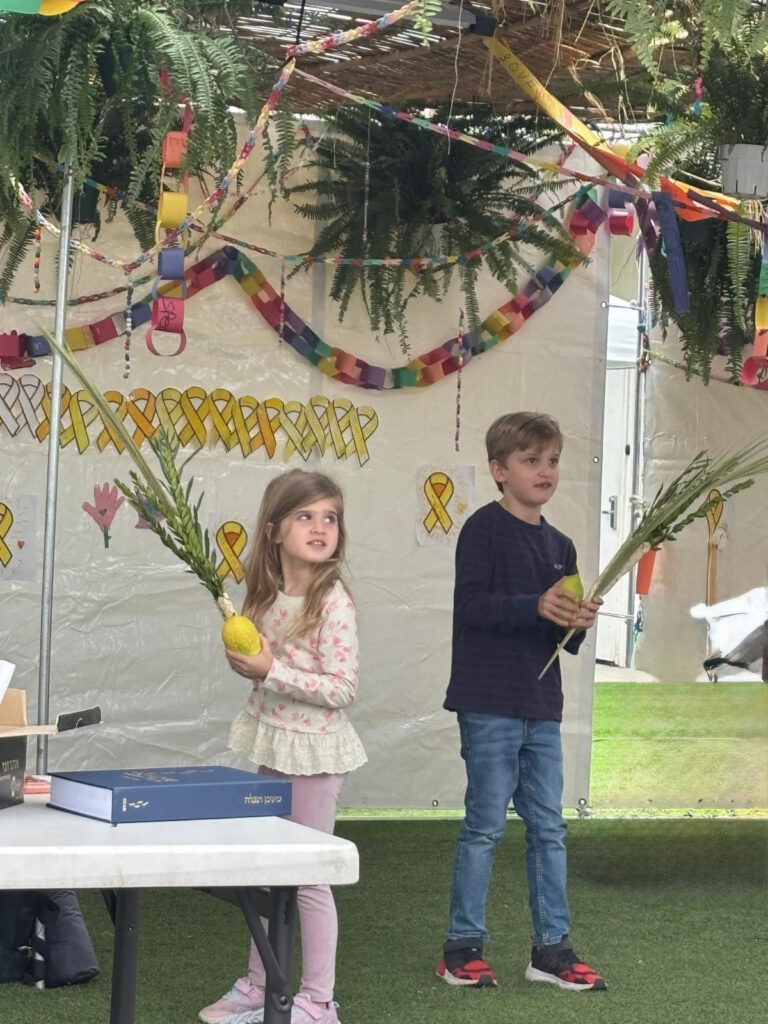
This year is especially exciting because my granddaughter started nursery school at Hillel Hebrew Academy, and she has been coming home with art projects. It has been a very long time since my children brought home art projects from school, and I am so excited to hang hers in our sukkah. I can’t wait to see her face when she sees her artwork hanging there.

And then there is the food.

For Sukkot, I always make a big pot of Moroccan harira. I love making soup for this holiday because even if the days are still warm, the cooler evenings make you start craving something warm and comforting.

I also make harira when we break the fast on Yom Kippur. I make it vegetarian because after a 24-hour fast, I find that eating meat can be a bit of a shock to my system. I want something lighter and easy to digest, but still full of vegetables and nutrition. A bowl of harira is exactly what I want after fasting all day.

For Sukkot, I make a heartier version. I add beef bones and cheek meat, which becomes so tender as it cooks in the soup. By the time it is ready, the harira is practically a complete meal. It is warm, nourishing and incredibly comforting.

This year, when my brothers and their kids come to sit in the sukkah, there will be a big pot of harira waiting for them. And hanging from the walls will be my granddaughter’s artwork. 

—Rachel

HARIRA MOROCCAN VEGETABLE SOUP (gluten free)

1/4 cup olive oil

1 large onion, diced

1 Tbsp fresh grated turmeric or 1 tsp ground turmeric

2 tsp ground cumin

1 tsp black pepper

2 tsp salt

1 tsp harissa (paste) or dried red chile flakes

4 celery stalks, sliced

1 large carrot, cut into coins

1 large sweet potato, cubed

4 cups butternut squash, cubed

1 large potato, cubed

2 large zucchini, cubed

1 bunch parsley, chopped

1 bunch cilantro, chopped

1 15oz can diced tomatoes

2 Tbsp tomato paste

8 cups vegetable, beef, or chicken stock

1 15oz can chickpeas, drained

1 cup red lentils, rinsed

1 lemon, juiced

Warm the oil in a large skillet over medium heat and sauté the sliced onions until they are golden.

Add the turmeric, cumin, harissa, salt and pepper and sauté until the onions are well coated.

Add the celery, carrots, butternut squash, sweet potato, and potato, stir and to combine.

Add the parsley, cilantro, tomatoes and tomato paste. Add the vegetable broth and stir well. Bring the soup to a boil to a boil, then add the lentils and canned garbanzos, cover and simmer for 1 hour.

Pour in the lemon juice and stir gently. Simmer the soup for about 5 minutes. Serve hot, topped with chopped cilantro and parsley.

If making this soup as a main course, you can serve with boiled egg noodles or white rice or cooked barley. Soup can be stored in an airtight container in the refrigerator for up to five days.

Sharon Gomperts and Rachel Emquies Sheff have been friends since high school. Their cooking and storytelling project has grown into a devoted following on Instagram @sephardicspicegirls and on Facebook at Sephardic Spice SEC Food. sephardicspicegirls.com/full-recipes.

A Harira Hug in the Sukkah Read More »

Table for Five: Sukkot

One verse, five voices. Edited by Nina Litvak and Salvador Litvak, the Accidental Talmudist

For a seven day period you shall live in booths. Every resident among the Israelites shall live in booths, in order that your [ensuing] generations should know that I had the children of Israel live in booths when I took them out of the land of Egypt. I am the Lord your God. 

– Leviticus 23:42-43


Rabbi Janet Madden, Ph.D.

Malibu Jewish Center and Synagogue

We decorate our sukkot for beauty and comfort; we roof them with branches, exposing ourselves to wind, rain, sun, stars. And, as our pasuk states, every ezrach, (citizen) of Israel must dwell in sukkot for seven days, the cyclic number of completion.

The shoresh of ezrach, zarach, means to “rise/ shine/spring up.” The ezrach, then, is one who rises, shining, springing up from the land like the trees whose branches and fruit we use to bless in every direction. Commanded to dwell for a week in sukkot, the ezrach reconnects to — somatically reenacts — leaving the land of constriction so as to be led home and rooted there.

Being an ezrach is not an individual experience. Sukkot 27b advises: “It is fitting for all of Israel to sit in one sukkah.” This image of mutuality within a single fragile structure reminds us that life itself is a shared liminal experience. In the sukkah, we sit, eat, study and sleep in the fragility of impermanence. We live as part of the natural world — not apart from it — generationally re-rooting in our history and land. 

Surely, this commanded experience of liminality is intended to teach us, in the words of Thích Nhat Hanh, the Vietnamese Buddhist monk and peace activist, “to respect and value every moment and all the precious things around us and inside of us.” Living for a week in shared liberatory joy, including our ancestral guests, shows us how to simplify and focus, how to live connective holy lives, springing up so that we can shine.


David Sacks

Happy Minyan of Los Angeles

The sukkah represents the vulnerability of life. After Rosh Hashanah and Yom Kippur, our faith in G-d is so high that we can dwell in this rickety little hut, and say, “I’m in Your Hands, G-d. And not only do I feel safe, I feel great!” The holy Ari teaches that the sukkah is a Divine hug! Sitting in the sukkah, we feel in the deepest way that our security doesn’t come from our bank account, or the four walls of our house, or our burglar alarm, but only from G-d. 

The sukkah, though, has its own surprising requirement. If the walls of a sukkah are made out of curtains, and the curtains are too billowy, meaning to say, if the wind can blow the curtains of the sukkah back and forth, believe it or not, the sukkah is not kosher. In other words, while the sukkah represents the impermanence of the world, you also need to have stability. 

That is the balance that the Torah asks us to walk through life with. This world is not an illusion. On the other hand, if we believe too much in the laws of nature, and not enough in the miraculous, then that’s not Torah, either.

 We need Divine balance. As Reb Shlomo taught, the hardest thing is to have your head in the clouds and your feet on the ground. The sukkah teaches us how to do both!


Michael Berenbaum

Distinguished Professor of Jewish Studies, American Jewish University

 What We Remember, What We Forget

Whenever I am invited to comment on one verse of the Torah for the Table for Five, I try to read it anew, to imagine that I have never read the verse before. In essence that it is what we must do for while the Torah does not change, we do. This year I was taken by the verse: “I had the children of Israel live in booths when I took them out of the land of Egypt.”

A historian might describe it much differently. “I had the children of Israel live in booths as they struggled for 40 years in the desert.” After all the booths were temporary, fragile, portable, quasi-protective, transportable, somewhat easy to assemble, somewhat easy to take down. In Halakhah, the Sukkah must offer greater shade than sunlight but must offer only partial protection from the elements.

Think of how Jeremiah remembered this history. We just chanted in the Zichronot: “Go proclaim to Jerusalem: Thus said GOD:

I accounted to your favor

The devotion of your youth,

Your love as a bride —

How you followed Me in the wilderness,

In a land not sown.  (Jeremiah 2:2)

Both God and the Jewish people want to remember the great moment – the Exodus, the exhilaration of the first breath of freedom and not the drudgery of the arduous journey to the Promised Land, standing at Sinai, not building the Golden Calf. As we retell our history, we too have a selective memory and too often, selective amnesia.


Rabbi Elchanan Shoff

Head of School – The New Yeshiva High School of LA

 Any “ezrach” or “resident” must dwell in a sukkah. The Torah calls us all “residents.” A person who feels permanent with a sense of belonging and identity can forget that we are all just visiting this earth. He can fail to stay humble, remembering that life’s a gift – precious and fragile. 

Judaism teaches that far more important than anything that this world has to offer is spiritual Truth. Abraham allows himself to be thrown into the fiery furnace rather than deny the One True God. Throughout the ages, Jewish people have sacrificed their lives with Shema on their lips – rather than give in to wicked people. Because this world is simply not all that important when compared to spirituality and a relationship with the infinite God. We love and cherish life – it is the most magnificent opportunity to connect with God and Truth and refine ourselves so that we can eternally enjoy our relationship with God in the world to come. It is a place where we can be kind, loving, loyal, and charitable. This world is a means to a very important end – and so extremely important. But the world isn’t worth much on its own. It’s temporary. Leave your home! Remember that the roof isn’t what really protects you – it is God. What is real and important is not our temporary homes – they are but means to find our way into the embrace of God.


Abe Mezrich

Author: “Words for a Dazzling Firmament”

You live in your country.

No: You live in a hut, a shack.

No: You live in the unshackling,

in your release

into nothing you own,

into all that is God’s.

Which is everything.

Table for Five: Sukkot Read More »

Can We Rescue Our Youth from Social Media?

When we launched Project Reclaim at YULA High School, we really did not know what to expect.

The idea was inspired by senior Talya Ferszt and it was ambitious: invite our students — completely voluntarily — to remove social media from their phones, install meaningful filtering and experiment with reclaiming something increasingly precious: their attention. Reclaim time. Reclaim focus. Reclaim relationships. Reclaim Torah. Ultimately, reclaim a little more control over their own lives.

From the beginning, we made a deliberate decision about how we would approach it: positive, guilt-free and without judgment.

We did not tell students that social media was evil. We did not shame students who chose not to participate. In fact, we celebrated students who seriously considered the challenge and decided they were not ready — yet. We wanted teenagers to think about their relationship with technology, perhaps for the first time, and to feel empowered to make a choice rather than lectured into one.

And yes, we offered some incredible prizes.

That was intentional. Social media companies spend billions of dollars designing products to capture and retain our attention. Their platforms offer likes, streaks, notifications and an endless stream of rewards to keep us coming back. We decided there was nothing wrong with using some positive motivation of our own to encourage teenagers to try something genuinely difficult. The prizes might get a student through the door. We hoped the experience would give them a reason to stay.

Still, we had no idea what would happen. Would 100 students sign up? Fifty? Twenty? Zero? Then something remarkable happened. Two hundred and twenty teenagers signed up for the first Project Reclaim challenge. But the number is no longer the story. The stories are.

Students began telling us about what they were doing with time they did not realize they had. Some took on additional chavruta learning. Others started small businesses or rediscovered hobbies. Students talked about sleeping better, being more present and having longer conversations.

And some comments surprised me more than almost any other: they told us they actually enjoyed being bored. Think about that.

For perhaps the first time in years, an empty moment did not immediately need to be filled. There was no scroll, video, notification or feed waiting to consume it. They could sit. Think. Talk. Create. Learn. Or simply be bored.

One father shared something else that has stayed with me. He thanked YULA because his children had started coming into his room late at night just to talk. Just to talk.

There was no special family program. No lecture about relationships. No new curriculum. We created an exciting challenge, and teenagers saw the value of trying. A phone was put away, space was created and something better filled that space.

That is when I realized that perhaps we had accomplished something bigger than moving the needle. Our students have changed the conversation. Students were talking about social media differently. Parents were talking about it. Teachers were talking about it. Teenagers who participated were talking with teenagers who did not. Instead of the conversation being only, “Which apps do you have?” it became, “What would your life look like without them?” Instead of assuming constant connectivity was simply an unavoidable part of being a teenager, students were asking whether there might be another way.

I don’t know where Project Reclaim will ultimately go. I don’t know how many students will complete every level (there are three levels). We intentionally designed the program so that trying itself matters. A student who makes it 30 days and then decides to return to social media has not failed. That student has learned something about himself or herself that most of us have never taken the time to discover.

But I know we have changed the conversation. And now that raises a much harder question:

What are we, the adults, going to do with it?

Schools can ban phones. We can require filters. We can block websites and establish policies. Those things matter tremendously, and schools should not be afraid to lead. But there is a ceiling to what schools can accomplish if families are not part of the journey.

Consider where society itself is heading. Meta and other technology companies increasingly face lawsuits, legislation and government efforts aimed at restricting or changing how social media platforms interact with minors. Courts and lawmakers are wrestling with questions about addictive design, age protections and what responsibility these enormously powerful companies have toward children.

If we are asking courts, governments and technology companies to create stronger boundaries for our children, what boundaries are we willing to create as parents? That is not an accusation. It is a question I ask myself too.

Parenting in this generation is extraordinarily difficult. None of us grew up with this. There is no playbook for raising children with devices that provide instant access to nearly every friend, video, news story, distraction and form of entertainment imaginable. We are figuring it out in real time.

But our children are watching us figure it out.

What do they see?

Do they see us checking our phones at dinner? Responding to an email while they are talking to us? Reaching for our devices every time there is a quiet moment? Do they hear us telling them that they spend too much time on their phones while ours is sitting face-up next to us?

This is not meant to make anyone feel guilty. Project Reclaim was guilt-free for our students, and this conversation needs to be guilt-free for adults too. Especially, when I embarrassingly struggle with the same.

It is an invitation to reflect.

Maybe we reclaim dinner. Maybe we create a phone-free hour each evening. Maybe we wait longer before giving our younger children smartphones or access to social media. Maybe groups of parents make decisions together so that no child feels like the only one without an app. Maybe we begin talking about these issues in elementary school, before we are trying to undo habits that have already become deeply ingrained.

Most importantly, maybe we stop viewing this exclusively as a children’s problem.

One of the most powerful lessons of Project Reclaim has been that culture can change when people are willing to change together. One teenager deleting social media can feel isolated. Two hundred and twenty teenagers doing it together feels entirely different.

Imagine what could happen if parents joined them.

One of the most powerful lessons of Project Reclaim has been that culture can change when people are willing to change together. One teenager deleting social media can feel isolated. Two hundred and twenty teenagers doing it together feels entirely different. Imagine what could happen if parents joined them.

This is not a movement against technology. Technology is extraordinary, valuable and here to stay. Nor is this about judging families who draw their lines differently.

It is about intentionality.

Who owns our attention? Who decides how we spend our time? Are we choosing when to engage with technology, or has technology slowly begun choosing for us?

For years, adults have been asking what social media is doing to our children.

Project Reclaim has made me wonder whether we have been asking only half the question.

Perhaps we also need to ask what it is doing to us.

Two hundred and twenty teenagers were willing to find out what life might feel like with a little less noise, a little less scrolling, and even a little more boredom.

They answered the challenge.

Now it is our turn to reclaim something too. 


Rabbi Arye Sufrin is Head of School at YULA.

Can We Rescue Our Youth from Social Media? Read More »