fbpx

August 11, 2026

Defend America — Save the Democratic Party, Defeat Abdul El-Sayed

Abdul el-Sayed eked out a narrow victory over Haley Stevens in Michigan’s Senate Democratic Primary (48.5% to 47.5%).

Haley Stevens, as a past and future politician, accepted the results and said that she would support El-Sayed. That acceptance response is the strict rule in party contests.

Senator Chuck Schumer (D-N.Y.), who supported Haley Stevens and raised money for her, said he would support el-Sayed. That is his primary obligation as Senate Minority Leader seeking to win a Democratic Senate majority.

Jewish voters have a different set of interests and should respond differently. To protect their interests and values, the top priority is to defeat El-Sayed in the general election – preferably by the largest margin possible.

Abdul El-Sayed is not just a candidate with different policy priorities whom one accepts after the fact. He could have presented as a critic of Israel. That is legitimate even when it is wrong. He made clear that he denies Israel’s right to exist. He does not recognize Israel’s legitimacy as a state because it is a Jewish state. He has no problem with eight countries that define themselves as Islamic or the additional 20 countries in which Islam is the official state religion – although there is outright discrimination against non-Muslims in most of them. To rephrase his views, only the  Jews are not entitled to have a state where they are the majority, exercising sovereignty. This denial unmasks him as an out-and-out antisemite. To confirm who he is, El-Sayed doubled down in his first post-primary interview on CNN alleging that Israel is a “bloodthirsty” state – a blatant evocation of the antisemitic trope that Jews take the blood of non-Jewish children and use them for their Satanic purposes.

El-Sayed also hates America – which with all its flaws is still the greatest democracy in the world. In private tapes he expressed identification with and sorrow at the death of Ayatollah Ali Khamenei – a dictatorial theocrat who fiercely hated America and called it “the Great Satan” (and Israel “the Little Satan”). He led his people in chants of “Death to America (and “Death to Israel”). Khamenei ordered the slaughter of 20-30,000 Iranians in one day for daring to protest against his abusive government.    

El-Sayed chose to campaign with Hasan Piker and endorsed his views. Piker says that America is the worst imperialist power in the world and that it “deserved” to be attacked on 9/11. He identified with Mao Zedong, the greatest mass murderer (in the name of Socialism and equality) of the 20th century. Piker says that Hamas’ terrorist regime is 1,000 times better than Israel. We Jews – as do most Americans – love America which has treated Jews with respect and equality more than any other country in the course of over 2,000 years of exile.

That El-Sayed does not share American values is also expressed in his policies embraced as a Democratic Socialist (although soft pedaled during his campaign) i.e.,to defund the police and to close the prisons.

It is crucial that El-Sayed be defeated so the Democratic Party will understand that being taken over by such extremists is the road to electoral oblivion. The party is tempted by antiestablishment forces to normalize anti-Americanism, antisemitism and anticapitalism but these policies would be disastrous for America. The American majority will reject such a Democratic Party. We can save the party from being taken over by voting against  an extremist like El-Sayed.

If there are 100,000 Jewish voters in Michigan, the goal should be to get 90,000 to vote for Rogers, the Republican candidate. Active fundraising and campaigning to defeat Sayed is also a great mitzvah. Admittedly for the 70% of Jewish voters who vote the Democratic Party religiously, it is no small request to vote for a Republican.But in Michigan this year, there is a rare opportunity to defend the country from  un-American policies and to save the Democratic Party for moderate, patriotic policies and for a foreign policy that aids democracies everywhere.


Rabbi Irving (Yitz) Greenberg is an important Jewish thinker and long time community activist who is Senior Scholar in Residence at Hadar Institute of New York and Jerusalem. The views expressed in this piece are personal and do not reflect those of any institutional affiliation.

Defend America — Save the Democratic Party, Defeat Abdul El-Sayed Read More »

The Iranian Intellectual Who Admired Israel

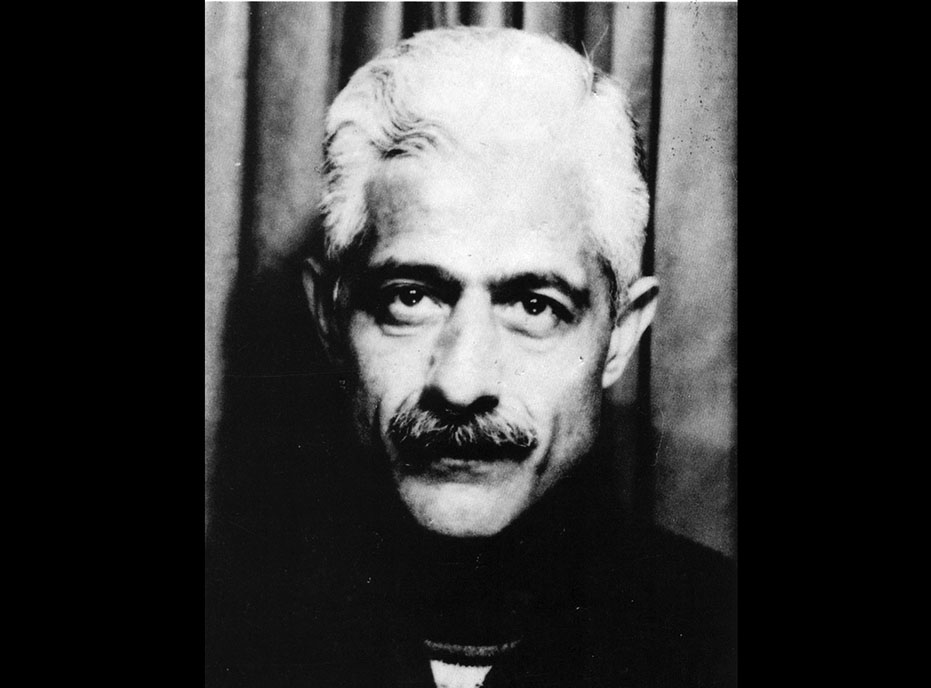
While no one can predict how the simmering conflict with Iran will end, it’s worth revisiting in the meantime a remarkable episode in the history of Israel’s relationship to the country. In February of 1963, the Iranian essayist, sociologist and anthropologist Jalal Al-e-Ahmad visited Israel and came away deeply impressed.

He described the Jewish state as a “true miracle” produced by the “clear-vision” of “guardians” such as David Ben-Gurion, whom Al-e-Ahmad perceived to be a cross between a politician and a prophet.

As William Eichler recently noted in the British journal History Today, Al-e-Ahmad’s fascination with Israel emerged from a particular moment in his country’s development. In the first half of the 20th century, Iran lurched from foreign interference to forced modernization. Reza Shah tried to build a strong, independent nation, only to be pushed aside by the British and Soviets during World War II. His son took over, but after Prime Minister Mohammad Mossadegh nationalized Iran’s oil, the CIA and MI6 helped engineer the 1953 coup that restored the shah’s power. A decade later, the shah’s “White Revolution” sought to rapidly modernize the country through land reform, women’s suffrage and economic development while keeping communism at bay.

Al-e-Ahmad came of age in the middle of this upheaval. Born in 1923 to the son of a village mullah, he became a teacher, literary critic and translator of Sartre and Camus. Politically, he followed a path familiar to many postwar intellectuals: first embracing the communist Tudeh Party, then breaking with it over its loyalty to Moscow, and ultimately supporting Mossadegh’s nationalist movement.

Al-e-Ahmad was best known in his day for his 1962 pamphlet “Gharbzadegi” (“Occidentosis”). It, in fiery prose, argued that the industrialized, capitalist West subjugated and exploited the East and infected it with cultural mores grown in foreign soil. “In our clothes, our houses, our food, our civilities,” Al-e-Ahmad wrote, Iran had become “estranged from itself.”

To avoid becoming ensnared in someone else’s modernity Iranians should reconnect with their own culture, he believed. For this, Israel was a model, having emerged reborn from its traditional roots into a flourishing faith-infused culture.

Tehran and Tel Aviv were friends in the 1960s, standing together against pan-Arab nationalism championed by figures like Egyptian President Gamal Abdel Nasser. To cultivate this cross-national friendship both governments regularly organized cultural exchanges. So Al-e-Ahmad and his wife, the novelist Simin Daneshvar, traveled to the Jewish state for two weeks (and in return, young Israeli diplomat Zvi Rafiah headed to Tehran). They toured Tel Aviv, Acre, Haifa and Nazareth, participated in an archaeological dig, and spent time at kibbutz Ayelet HaShachar. In Jerusalem, they paid their respects at Yad Vashem, where both were reduced to tears. Simin delivered two lectures at the Hebrew University and wrote in the kibbutz’s guest book, “As I see it, the kibbutz is the answer to the problem of all the countries, including our own.”

So it was that this Iranian intellectual expressed his admiration for the blend of religion, Hebrew culture and collectivism that he saw in Israel. “In the eyes of this Easterner, Israel, with all its faults and all the contradictions concealed in it, is a base of power, a first step, the herald of a future not too far off” for his own people, he predicted.

“Remarkable as it might seem given its subsequent trajectory,” Eichler writes, “Al-e-Ahmad saw in the Jewish state a model of how to be modern without mimicking the West, an example of decolonization done properly.” As Scott Abramson  quipped in Tablet magazine, to Al-e-Ahmad, “as far as East and West were concerned, in Israel the twain not only met, they mingled in harmony.”

The Iranian changed his tune following the Six Day War and Israel’s defeat of antagonistic Syrian, Egypt and Jordan. He lamented then what he perceived to be Israel’s imperialism while ranting antisemitic clichés about Jewish media control. It is this iteration of Al-e-Ahmad that adorns postage stamps across Iran and a highway in Tehran, and has a literary prize named in his honor. But the scholar’s earlier affinity for the Jewish state is worth revisiting and appreciating, reminding us in this moment of uncertainty that more positive possibilities could very well emerge between two nations, a friendship as existed decades ago, renewed.


Rabbi Dr. Stuart Halpern is Senior Adviser to the Provost of Yeshiva University and Deputy Director of Y.U.’s Straus Center for Torah and Western Thought. His books include the newly released “Jewish Roots of American Liberty,” “The Promise of Liberty: A Passover Haggada,” “Esther in America,” “Gleanings: Reflections on Ruth” and “Proclaim Liberty Throughout the Land: The Hebrew Bible in the United States.”

The Iranian Intellectual Who Admired Israel Read More »

What Do We Give Our Children?

I am a young father now, watching my own children grow up and I find myself asking what it is, exactly, that I hope to pass on.

The obvious answers present themselves readily enough: a Jewish identity, a connection to Israel, a respect for history, a loyalty to family, perhaps a handful of rituals sturdy enough to survive adolescence and indifference. These are worthy inheritances. But the older I get, the less convinced I am that any of them, by themselves, are sufficient.

Parenthood has a way of exposing the limits of instruction. Children do not necessarily inherit what we tell them to value. They inherit what they see us value. They notice which subjects animate us, which books remain open on the table, which questions we pursue after everyone else has moved on. Long before they understand our ideas, they absorb our habits of mind.

Lately, I have found myself paying closer attention to my own parents.

They are aging New York Jews, raised in Flatbush and Midwood, in neighborhoods shaped by the children of immigrants and survivors. Their conversations can move, with little warning, from Israeli politics to Impressionism, from a Yiddish expression to a Supreme Court decision, from the failures of a president to the origins of a family custom no one quite remembers correctly.

Disagreement is not an interruption to the conversation. It is the conversation.

Growing up, I assumed this was simply how families interacted. I did not understand that I was witnessing a particular kind of inheritance: a confidence that history matters, that ideas deserve scrutiny, that no subject is too settled to be reopened and no argument worth having should be abandoned merely because it has become uncomfortable.

My parents’ generation read widely and argued instinctively. They came of age in a culture that treated intellectual seriousness not as an affectation but as a responsibility. Whether they ultimately embraced or rejected the institutions that shaped them was almost beside the point. Those institutions had given them a disposition: question what you are told, learn enough to challenge it intelligently, and remain suspicious of anyone who claims that a difficult issue has an easy answer.

Their generation also witnessed Israel during one of the most extraordinary periods in Jewish history. They lived through the fear surrounding its early wars and the exhilaration that followed victories few believed possible. They watched a fragile state absorb refugees from across the world, revive an ancient language, build universities and cities and persuade a people emerging from catastrophe that Jewish sovereignty was not a temporary historical accident.

Their attachment to Israel was not constructed by a communications strategy. It was forged through history, danger, sacrifice and the sense that they were participants, however distant, in the unfolding of an improbable national story.

That generation is now in its 70s and 80s. As it fades, something deeper than nostalgia risks disappearing with it.

Long before Oct. 7, younger American Jews were becoming increasingly detached from both Israel and Jewish life. Fewer than half of Jews between the ages of 18 and 29 reported feeling emotionally attached to Israel, compared with roughly two-thirds of Jews over 65. Barely one-third said that being Jewish was very important in their lives. Even Holocaust remembrance, once the central pillar of postwar Jewish identity, has become less defining for younger Jews.

These numbers are often treated as evidence of ideological estrangement. Perhaps they point to something more basic. The greatest threat to Jewish continuity may not be disagreement, skepticism or even anger. It may be the growing conviction that the entire conversation is not worth entering.

Communities can withstand criticism. They can survive rebellion. What they struggle to survive is indifference.

Oct. 7 interrupted that indifference for many young Jews. Antisemitism forced thousands to confront an identity they had treated as incidental, private or largely inherited. Some have called this renewed engagement “the surge.” Synagogues filled. Jewish organizations saw new interest. Young people who had spent years avoiding conversations about Israel suddenly found themselves thrust into debates over its legitimacy, often before they had ever seriously grappled with the country’s history, complexities and contradictions.

But alarm is not the same as attachment, and attachment is not the same as intellectual engagement. A singular rally-around-the-flag moment produced by collective trauma cannot sustain a civilization. Identity rooted primarily in fear will eventually exhaust itself. If the only time young Jews are asked to care about Judaism is when Jews are threatened, we should not be surprised when they begin to associate Jewish life with dread, inconvenience or worse.

What, then, might endure after the urgency recedes, when the Oct. 7 Jews begin their disassociation once more?

I keep returning to my parents’ dinner table.

The inheritance I received there was not a fixed theology. It was not a political program. It was not even a particular understanding of Zionism. It was the habit of treating ideas as things to be tested rather than merely repeated.

That habit begins with reading seriously.

When I was a teenager, my parents gave me a subscription to The New York Times. I have paid for journalism ever since, not because I believe every article is correct, but because serious ideas require serious institutions: editors, fact-checkers, writers accountable for their claims and readers willing to distinguish reporting from rumor.

Today, nearly nine-in-10 Americans under 30 do not pay for their news. Information arrives constantly, but rarely with context. Expertise is treated as elitism, confidence is confused with knowledge and the algorithm rewards the opinion most likely to provoke an immediate, often hostile response. The result is not simply that young people know less. It is that many have lost the patience required to decide what is worth knowing.

Parents can begin to counter this in modest ways. They can put serious journalism in front of their children. They can discuss an article over dinner. They can model the humility of changing their minds when confronted with better evidence. Intellectual curiosity, like an accent, is often acquired simply by living among people who possess it.

Jewish philanthropy could encourage the same habit at scale. Subsidizing access to trusted journalism and serious intellectual publications for young adults is not a glamorous investment, but it may be a more durable one than endlessly lamenting that the next generation no longer reads or holding onto a phony vision of “free Day School for all.” Teaching people how to think requires giving them something worth thinking about.

It also requires a more honest relationship with Israel than many young Jews have been offered.

Some grew up believing that loving Israel meant defending every decision made by its government. Others concluded that disagreement with Israeli policy required distance from the country itself. Both positions substitute loyalty tests for thought.

Zionism was never intellectually tidy. David Ben-Gurion and Ze’ev Jabotinsky argued over borders, economics, military strategy and the nature of the state they hoped to create. Labor Zionists, Revisionists, religious nationalists and secular socialists did not arrive at Israel through consensus. The country was hammered into existence through arguments that were sometimes bitter because the questions were understood to matter.

If we want younger Jews to develop a serious relationship with Israel, we should trust them with that complexity. We should invite them to debate settlements, judicial reform, minority rights, the occupation, military service, religious power and the country’s extraordinary scientific and cultural achievements. We should not ask them to choose between affection and criticism. Mature patriotism requires both.

This has implications for philanthropy as well.

American Jewish giving has helped build Israeli hospitals, universities and cultural institutions, achievements worthy of enormous pride. But the health of a society depends on more than the institutions whose names can be carved into stone. It also depends on courts, journalists, civic educators, watchdog organizations and the less visible work of building trust between communities that increasingly struggle to imagine a shared future.

Israel today is engaged in an argument over what kind of country it will become: democratic and Jewish, religious and secular, secure and humane, unified enough to function but pluralistic enough to remain free. Investing in the institutions that allow that argument to continue peacefully is not a distraction from supporting Israel. It is one of the most meaningful ways to support it.

A strong Israel and a healthy Israeli democracy are not rival causes. They are the same cause.

There is, of course, nothing new about the Jewish reverence for argument. The Talmud preserved the disagreements between Beit Hillel and Beit Shammai not because both schools could be correct in practice, but because a rejected opinion could still contain wisdom. Minority views were recorded long after the legal question had been decided. The tradition understood that remembering why someone lost an argument could be almost as valuable as remembering who won it.

This was more than intellectual courtesy. It reflected a recognition that certainty is dangerous when it becomes too comfortable. A tradition that preserves only its conclusions eventually forgets how those conclusions were reached.

The question facing Jewish parents and institutions is therefore not simply how to make Jewish identity feel more urgent. Oct. 7 has already done that, at terrible cost. The harder question is how to make Jewish life feel intellectually alive once the emergency fades.

My greatest concern is not that my children will become less religious than earlier generations. I am not particularly religious myself. It is that they will inherit a world in which curiosity has been replaced by performance, argument by denunciation and knowledge by the endless recirculation of whatever claim happens to flatter one’s existing beliefs.

A civilization can survive theological disagreement. It has a harder time surviving intellectual laziness.

When I listen to my parents argue about history, literature, politics, Judaism and Israel, I now understand that they are doing more than exchanging opinions. They are demonstrating a way of belonging. They assume that the Jewish story is important enough to interrogate, that Israel is important enough to criticize and defend, and that disagreement is not evidence of communal failure but of communal vitality.

That may also be the answer to the question Jewish philanthropy has been circling for years: how to build a meaningful identity for a generation that is drifting, and how to keep the Jews awakened by Oct. 7 engaged after the shock subsides.

Israel trips, campus programs, research studies and advocacy campaigns all have their place. But they often attempt to solve the problem from the outside in. Curiosity cannot be installed through a single experience. It must be modeled by adults, cultivated by institutions and rewarded by a community secure enough to tolerate difficult conclusions.

Young Jews who watch American philanthropy invest in the actual health of Israeli democracy, including its free press, civic institutions, human rights organizations and efforts to strengthen social cohesion, may find that commitment more compelling than another campaign telling them what to believe. They may see that the Jewish future is not a finished product they are being asked to defend, but an unfinished argument they are being invited to join.

One day, my children will forget most of what I tell them. They will remember instead what they watched: whether their father read while drinking his morning coffee, whether he listened when he disagreed, whether he treated history as a source of inquiry rather than ammunition.

What my parents passed on to me was not a catechism but a disposition. They taught me, mostly without intending to, that ideas are meant to be examined, that traditions become stronger when they are questioned honestly and that loving Judaism or Israel does not require insulating either from criticism. It requires believing they are strong enough to withstand it.

That, more than any particular answer I could give my children, is the inheritance I hope to leave them: the conviction that the questions are worth keeping.


Coby Schoffman is a Los Angeles–based serial social entrepreneur and the founder of The Nation Foundation (TNF), which operates project zones across East Africa. Schoffman holds an MSc in Transnational Security from New York University and a BA in Counterterrorism and Conflict Resolution from Reichman University. The views expressed are his own and do not reflect those of any affiliated organization

What Do We Give Our Children? Read More »

A Father’s Endless Journey

My synagogue hosted the Israeli resident Avi Rosenfeld, father of IDF Sgt. Israel Natan Rosenfeld, who was killed in June 2025 when an explosive device detonated while he was trying to bring the hostages home. The courage it takes for this father to share his son’s story and relive that tragedy is beyond words. Natan’s sister’s boyfriend was also killed defending Kibbutz Sufa during the Oct. 7, 2023 attacks. More than enough for one family.

At the beginning of Avi’s talk, he said that when he cried, he was strong and knew he would get through it. At the end of his talk, someone raised a hand and shared that they had named their newborn son Natan after Avi’s Natan. Tears came quickly, and Avi gripped the podium rail to steady himself. We all waited and watched. As promised, Avi got through the moment. He said, “I heard others had also named their newborns Natan.” Then he added, “Where there was one Natan, now there are many.” What an amazing perspective.

When Avi opened the talk by telling us that if he started crying, he would be okay, he was teaching us a profound lesson from his own experience: if he can get through this tragedy, then perhaps we can get through whatever life may deal us. One can only hope.

I knew from our synagogue flyer to expect difficult moments, and there were more than a few. Still, I felt, as did the other people present, that it was essential to show up and let Avi know he was not alone. Like making a shiva call, we can’t bring the soul back, but we can listen and bear witness to who that soul was. If I truly believe we are all brothers – and I do – how could I not show up?

There are many events I can’t attend, but the ones I can, I do. What right do I have to not pay attention? If Avi had come and only two people had shown up instead of the 40 or so who did, I can only imagine his pain. A broken heart beats in real time; it cannot be put on hold. Life is lonely enough. Add a tragedy of this magnitude without friends, family and others willing to listen, and it’s a recipe for disaster.

According to the Torah, two of Aaron’s four sons, Nadab and Abihu, died suddenly after the inauguration of the Tabernacle. After their deaths, Moses spoke with Aaron.  The Torah then says simply: “And Aaron remained silent.”

Avi’s words touched all of us, yet there was somewhere in his heart a silent place that nobody except God and Avi knows about – a place only God and Avi can enter. We all have that same place. At certain times, there are no others, and there are no words.

Whenever I attend a talk, I make a point of approaching the speaker to thank them for coming. When I approached Avi before he began and introduced myself, I didn’t know he would say, “I was at a few of your shows in Israel.” He then sat down next to me, and we chatted and shared a few light laughs. We both agreed that laughter was important. Avi has a beautiful smile. I’m sure his son had the same.

By approaching Avi before his talk, I felt like I got to know him a little and learned something about him. Because we shared those moments, I was able to connect more deeply when he spoke. When he asked for questions, I asked, “Has anyone tried to stop you from speaking?” He said yes, but that he would never be stopped – that nothing could stop him – and that his daughter was even more adamant than he was.

When Avi finished speaking, I went up to thank him again. He told me that when I am in Israel, we should get together. Then he leaned in, touched my arms and gave me a hug and a kiss on the cheek. That is a hug and kiss I hope to never, ever forget. It was Avi’s gift to me for showing up. That kiss went to my silent place.


Mark Schiff is a comedian, actor and writer and hosts, along with Danny Lobell, the “We Think It’s Funny” podcast. His new book is “Why Not? Lessons on Comedy, Courage and Chutzpah.”

A Father’s Endless Journey Read More »

Between Governance and Political Rot

In the name of “governance,” Israel’s government is hollowing out the public service. The attempt to remove the commander of the IDF’s Central Command live on television marked a new low. But long before that, the government had been politicizing every position it could get its hands on.

The consequences are disastrous: chaos in the streets, near-catastrophes on Israel Railways, rising traffic fatalities, an unending wave of murders, a runaway cost of living and more. If the politicization of the public service – and the destruction of its professional ranks – continues, the damage to Israel, to its citizens’ quality of life, and ultimately to their lives may become irreversible.

One of the outgoing government’s signature slogans has been “governance.” Its underlying claim was that although right-wing governments are elected time and again, and although Benjamin Netanyahu – the right’s undisputed leader – has served almost continuously for 15 years, the left still rules through the “deep state”: faceless bureaucrats who supposedly run the country behind the scenes.

Government ministers and spokespeople preached that professionalism and suitability for office were beside the point. What mattered was ideological allegiance – and, above all, personal loyalty to the leader: the relevant minister, the prime minister or both.

The government advanced this agenda through an aggressive pincer movement.

The first arm consisted of bills and government decisions designed to turn every significant public position into a political appointment. Most conspicuous is the politicization of judicial appointments. The mechanism due to take effect with the next Knesset will give politicians unprecedented power to determine who becomes a judge in Israel.

But it does not end there. A series of government-backed bills would allow the government to appoint a broad range of senior officials in the civil service, the military and the police at will – and to dismiss them whenever a new government takes office. Other legislation has created mechanisms giving politicians control over regulation of the media and other sectors.

The second arm has been the ministers’ no-holds-barred campaign to politicize the ministries and agencies under their authority.

The competition is fierce, but several examples stand out. National Security Minister Itamar Ben-Gvir has acted as the police force’s de facto appointments chief. His interference in promotions – and his rewards for personal loyalty – has reached down to the lowest command ranks.

Transportation Minister Miri Regev has been no less determined. She turned the Ministry of Transport and Road Safety into a well-oiled patronage machine and drove out nearly all its professional civil servants. Communications Minister Shlomo Karhi followed suit, packing media oversight bodies with political appointees of his choosing.

And that is before we even address the patronage spree at state-owned companies. Another particularly egregious proposed appointment, blocked for the time being, would have installed Netanyahu’s personal attorney as state comptroller. The list goes on.

This is a catastrophe. Political appointments systematically damage the very core of the public service. They sever the connection between office and competence, replacing professional qualifications with party loyalty. They degrade decision-making in fields where incompetence costs money – and lives. They strip the public service of its institutional memory and drive away its best professionals.

They replace excellence with sycophancy and erode the balance between elected officials and professional experts. Worse still, they open the door to corruption, turn public office into an instrument of party patronage, and shatter public trust in state institutions.

For decades, Israel’s public service – while far from flawless – was guided by an ethos of public responsibility and politically impartial service. Politicization turns it into a party franchise run by apparatchiks whose principal qualification is loyalty to the party and the minister in charge.

If Israel continues down this path, the day may not be far off when even the Chief Justice of the Supreme Court is dismissed live on television for issuing a ruling the government dislikes.

Israel is better than that.


Dr. Shuki Friedman is director general of JPPI, the Jewish People Policy Institute, and a senior lecturer in law at the Peres Academic Center.

Between Governance and Political Rot Read More »

Senators, Shandas and Stoopers

Imagine a candidate for public office who is an outspoken member of the Ku Kux Klan, who preaches hatred of Blacks, who calls on America to penalize Black African countries economically, militarily and politically. Do you think Black politicians would endorse such a racist? Do you think they would welcome this person into a “big tent” coalition of “progressives?”

Of course not.

Black leaders would have the courage and self-respect to repudiate racism; they would refuse to endorse or coddle up to haters. They would make public statements calling on the American public to renounce racism of all kinds, not to allow racist poison into the American political system. Bravo Black leaders!

But now imagine a candidate for public office who is an outspoken antisemite who preaches hatred of Jews and the Jewish State of Israel, who calls on America to withhold all support of Israel – financial, political, military. Imagine this hateful candidate praising or condoning terrorism against Israelis/Jews. Do you think Jewish politicians would endorse such an antisemite? Do you think they would welcome this person into a “big tent” coalition of “progressives?”

We would think that Jewish leaders – like Black leaders – would stand up mightily against the haters. We would think that they would use every forum to call for a civil society that strenuously rejects racism, antisemitism, and bigotry of all kinds.

Shockingly, though, some Jewish politicians actually endorse and kiss up to blatant antisemites who openly despise Jews and the Jewish State. Isn’t it a “shanda” that a senator of Jewish ancestry is one of the most vocal critics of Israel and has sponsored legislation that would seriously endanger Israel’s security? Another Jewish senator is a “stooper” who bows down to antisemites for the sake of his party’s “big tent.” Such “leaders” not only betray the Jewish People, but they betray the very values upon which American democracy is based. Although they may pay lip service to the notion that “hatred has no place in America,” they condone, encourage and endorse hatred.

How wonderful it would be if instead of shandas and stoopers, we had courageous leaders who refused to be part of any “big tent” that included antisemites, racists and those who would slander and undermine the state of Israel. Wouldn’t it be heartening to have Jewish profiles in courage instead of defilers of courage?

When the Jews of the ancient Persian Empire were threatened with extinction, Mordecai sent a message to Esther, the Jewish Queen of Ahasuerus. He asked Esther to intervene on behalf of the Jews but Esther was reluctant. Mordecai told Esther: “Do not think in your heart that you will escape in the king’s house any more than all the other Jews. For if you remain silent at this time then relief and deliverance will arise for the Jews from elsewhere; but you and your father’s house will perish; and who knows whether you are in the royal estate for such a time as this?” (Esther 4:13-14).

Mordecai’s advice was relevant to Esther … and to Jewish leaders of all generations, including our own. When the Jewish People face peril, unflinching courage is required. Those in positions of power have the unique opportunity to defend the honor and safety of the Jewish People.  They must come to understand that antisemitism is also aimed at those Jews who act against the interests of the Jewish People and the Jewish State. If they remain silent at this time, deliverance will arise for the Jews from elsewhere. And the Jewish shandas and stoopers will go down in perfidy.

It doesn’t have to be this way. The shandas and stoopers might see the light and rise to their historic challenge.


Rabbi Marc D. Angel is Founder and Director of the Institute for Jewish Ideas and Ideals and Rabbi Emeritus of the historic Spanish and Portuguese Synagogue of New York City.

Senators, Shandas and Stoopers Read More »

The Power of One Sentence

Crossing the library on the way to a 9 a.m. meeting, I noticed one student quietly wrapping tefillin (phylacteries).

Most of the room had already emptied. Students were heading to class. He could easily have skipped davening (praying). No one would have known. Instead, he sat there alone, davening slowly and with obvious kavanah (concentration).

In truth, I almost walked past him.

Instead, I stopped, and quietly said, “I’m so inspired by your davening and kavanah, even when no one might have noticed if you hadn’t done it.”

That evening I received an email from his mother. She wrote that her family’s admiration for Ramaz had “gone to a new level.” More strikingly, she said that her son came home talking about how that brief interaction had made him feel “kind and seen” in a way he had never experienced before.

That interaction stayed with me. It eventually grew into a simple practice we now call One Sentence. But before I could explain it to others, I had to understand why that one sentence had mattered so much.

Only afterward did I learn what I hadn’t known that morning.

It was still my first year as Head of School. I was trying to learn hundreds of students’ names while navigating the endless stream of meetings and decisions that fill a school day. The night before, I learned, our varsity hockey team had played an away game. I try to attend as many home games as I can, but I rarely make it to away games, and at that point I hadn’t yet figured out a good way to learn what had happened at the games I missed. I had no idea the players had gotten home very late the night before.

I’ve thought about that interaction many times since. I don’t think what mattered was the compliment.

When Moshe prepares to leave this world, he asks Hashem to appoint the next leader of the Jewish people. He introduces that request with a remarkable phrase:

“May Hashem, the God of the spirits of all flesh, appoint a leader over the congregation.” (Bamidbar 27:16)

Why does Moshe call Hashem “the God of the spirits of all flesh”?

The great commentator Rashi (1040-1105 in France) explains that just as people’s faces differ, so do their minds and personalities. Therefore, the next leader must know how to relate to each individual according to that person’s unique spirit.

I’ve come to think that Rashi is describing not merely a quality of leadership, but a discipline of leadership.

The discipline of noticing.

Every person carries unique strengths, struggles, aspirations and ways of serving Hashem. The leader’s task is not simply to guide the community, but to discover the uniqueness of each person within it.

That is harder than it sounds.

The greatest obstacle is rarely a lack of caring. It’s distraction. The problem is not our hearts. It’s our attention. Most of us are hurrying toward the next meeting, the next responsibility, the next email, the next crisis.

Looking back, what stays with me about that morning is not only the sentence I spoke. It is how easily I could have missed the moment altogether. If I’m honest, I suspect I walk past more opportunities like that than I notice, not because I don’t care, but because I’m busy.

That realization led us at Ramaz to begin our simple practice of One Sentence. Each day, intentionally look for one authentic opportunity to recognize something uniquely admirable in a student, a colleague, a staff member or someone at home. Not the accomplishment everyone applauded, but the quiet act of integrity, perseverance, kindness, generosity, courage or Jewish commitment that might otherwise pass unnoticed.

Then give it words.

Soon after, I attended one of our junior varsity floor hockey games. One player caught my attention, not because of his stickhandling, but because he proudly wore his tzitzit (ritual fringes) outside his jersey throughout the game. Afterward, I emailed him a photograph with one sentence:

“Best uniform on the court; keep up the good work.”

A few days later another player stopped me on the sidelines of a game.

“The email you sent? He forwarded it to the whole team.”

Then he smiled.

“I’ve been keeping my tzitzit on ever since.”

The sentence had encouraged one student. It had quietly influenced another.

People notice what leaders celebrate, especially when the celebration is personal. A sentence that would fit everyone rarely changes anyone. The sentences that stay with us are the ones that could not have been written to somebody else.

“I noticed how patiently you helped that student.”

“I saw the integrity you showed when no one else was looking.”

“I admire the way you quietly include people who often get left out.”

Those words say: I noticed something about you that I could not have said about anyone else.

Maimonides hints at this when discussing the mitzvah of loving another Jew. After commanding us to love others as ourselves, he writes:

“It is a mitzvah for every person to love every fellow Jew as himself … Therefore, one should speak of that person’s virtues.”

(Mishneh Torah, Hilchot De’ot 6:3)

The word “therefore” is striking. Giving voice to another person’s virtues is not merely good manners. It is what naturally follows from truly seeing another person.

Over time, I’ve realized that One Sentence is actually a slightly misleading name.

The sentence is not the difficult part.

The noticing is.

One of our teachers shared an unexpected consequence of the practice. He wrote that he had begun intentionally looking for one sentence to say to students each day, “especially the students I find the most challenging.” Then he added something I hadn’t anticipated. He wasn’t only seeing a difference in the students. He was seeing a difference in himself. The discipline of looking for something uniquely admirable had begun changing the way he saw them.

Looking back, I realized that the practice had already begun changing people in different ways. The first student walked away feeling seen. His teammate quietly changed his own behavior. A teacher discovered that the discipline of noticing was changing him.

Perhaps the first person transformed by One Sentence is not the recipient.

It’s the observer.

One Sentence isn’t really a discipline of speaking. It’s a discipline of looking until you discover something true worth saying.

Once you begin practicing it, you discover opportunities everywhere: around the Shabbat table, in conversations with colleagues, in your own family, and in countless ordinary interactions that would once have passed unnoticed.

Tomorrow, someone in your life will quietly do something beautiful. It may be a student. It may be your spouse. It may be one of your children. It may be a colleague whose quiet faithfulness has become so consistent that everyone has stopped noticing it.

You will probably have somewhere else to be.

But what if, for just a moment, you paused long enough to recognize what is uniquely admirable about that person, and then gave it words? You may never know where those words will stop. They may encourage one person. They may quietly influence another. They may even change the way you see everyone around you.

The smallest sentences often leave the longest echoes.

Perhaps that is what Moshe meant when he prayed for a leader chosen by Elokei HaRuchot.

Not simply someone who could lead the people.

Someone who could recognize the unique spirit within each person.

And help them recognize it, too.


Dr. Noam Wasserman is Head of School of Yeshivat Ramaz/The Ramaz School in New York City.

The Power of One Sentence Read More »

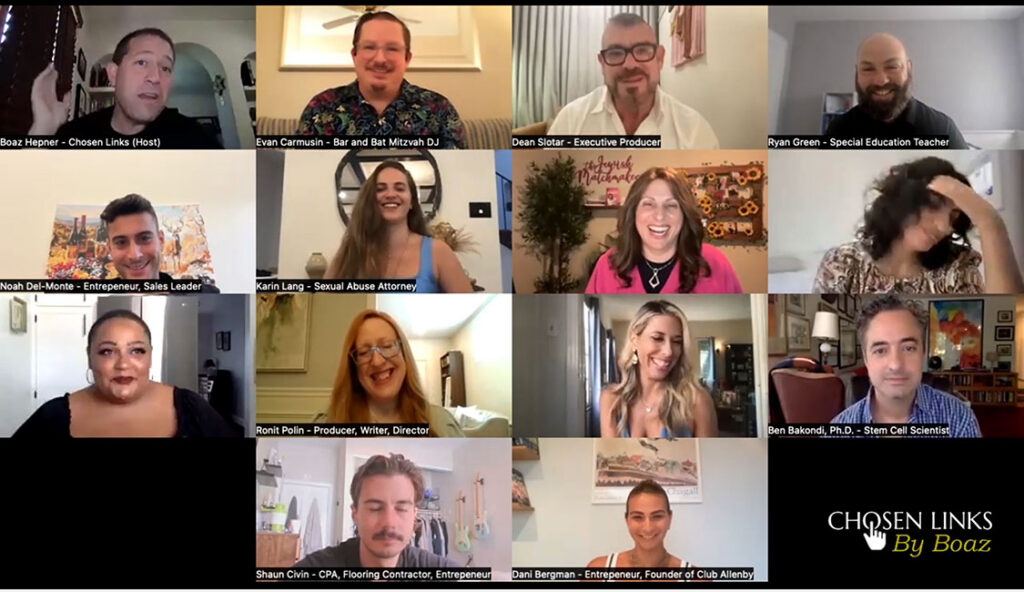
Chosen Links by Boaz – Ep 16 Jewish Matchmaking: The Reunion

Netflix might never give us a Season 2, but boy was it FUUUUUN getting to film this reunion with Aleeza Ben Shalom and most of the Jewish Matchmaking cast and crew!

In this special episode of Chosen Links by Boaz you’ll find out what happened since then, fun behind the scenes friendships, and 2 dramatic announcements – one cast member comes out publicly, and another tells us he’s about to buy an engagement ring! (Don’t worry, this was filmed months ago, so she already said yes!)

If it’s even half as fun to watch as it was to record, you’re in for a treat!

(EDITOR NOTE: This episode was filmed on 08/24/25)

Joining Boaz Hepner on the show:
Benjamin Bakondi – Stem Cell Scientist
Aleeza Ben Shalom – The Jewish Matchmaker, Coach, Author
Dani Bergman – Entrepeneur, Founder of Club Allenby
Evan Carmusin – Bar and Bat Mitzvah DJ
Shaun Civin – CPA, Flooring Contractor, Entrepeneur
Noah Del Monte – Entrepeneur, Sales Leader
Ryan Green – Special Education Teacher
Harmonie Krieger – TV Personality, Dating Coach, Matchmaker
Karin Lang – Sexual Abuse Attorney
Nakysha Osadchey – Information Technologies and Hospitality
Ronit Polin – Producer, Writer, Director
Pamela Rae Schuller – Comedian, Speaker, Disability Advocate
Cindy Seni – CEO Cindy Seni Consulting, Content Creator
Dean Slotar – Executive Producer

Here’s the direct link, please subscribe to the show directly on YouTube:

https://youtu.be/ijwnu6gaZq8

Chosen Links by Boaz – Ep 16 Jewish Matchmaking: The Reunion Read More »

Choosing Truth Over Tribe in Alyssa Rosenheck’s “White. Blonde. Jew.”

Recently I heard someone say that one of the biggest challenges of our time is being forced to choose between truth and tribe. It resonated me with on a deep level. I have identified as a liberal for most of my adult life because I care about equality of opportunity, individual rights, and racial justice. But over the past five to seven years the goal posts of what it means to be both liberal and progressive have moved farther left. And Jews especially have been left behind in the Democratic party’s migration to the fringes of the left.

The equation is simple: Unquestioning allegiance to the shifting policies of the left equals acceptance in a space that defines itself as having the moral high ground. On the other hand, deviating from the script, questioning the left’s delineation of all people into oppressor or oppressed categories, or calling out bad behavior in one’s own political group usually results in being shamed, rejected, or kicked out of the group. For many of us—especially Jews, for whom questioning and pushing back on ideas is a hallmark of our faith—it’s a litmus test that is impossible to pass, and we are forced to choose between pursuing the truth or keeping our place in our tribe.

Alyssa Rosenheck’s new book “White. Blonde. Jew. A Call to End Extremism, Speak Up, and Reclaim Center” grapples with this dilemma in a way that is both fierce and vulnerable while also offering readers opportunities not just for critical reflection but also dialogue and action. For many people who have felt paralyzed by the left’s increasing silencing of criticism within its own ranks, this book offers both relief and hope. It’s almost cliché to say it, but it has to be said: Rosenheck is brave for putting a book like this one out into the world. She chooses truth over tribe and in doing so paves the way for others to do the same.

But this kind of bravery has its costs. At the end of July Rosenheck made headlines when her book launch at Bell Bird Books in Nashville was cancelled after antizionist activists pressured the book store and engaged in online harassment. As Rosenheck said in her statement on Instagram, this kind of decision forces us to ask whether we are truly living in a society that values free speech. If an author can’t express marginally controversial views without being cancelled, then we have ceased to live in a society that can be called either free or liberal.

The irony, of course, is that the cancellation of Rosenheck’s book launch proves the point of her book. And there is no doubt that she will continue to advocate for the importance of maintaining a society that preserves and values free and open debate—especially one that does not prevent Jewish voices from participating in the marketplace of ideas.

Rosenheck didn’t begin her career as an outspoken advocate for these issues. She is a bestselling author and one of Architectural Digest’s Top 50 Interior and Architectural Photographers in the United States. Her first book, “The New Southern Style,” demonstrates how art has the power to humanize our differences.

“I built my career around light,” writes Rosenheck, “using it as a mirror to reflect our humanity, our goodness.” But as the world shifted, first as she became a casualty of the DEI obsession with oppression and then after the massacre of Oct. 7, so did her lens. She says that every image “tells a story” about the one who composes or creates it as well as the “truths they decide to expose or obscure.” Every shot shows us a “world view, a message woven into the frame.”

When she saw the image of 22-year-old victim Shani Louk lying face down in the back of a white pickup truck plastered across the media after Oct. 7, Rosenheck couldn’t help but think about the photographer behind the lens. Rosenheck wondered: “Why was he spared from the massacre? Why was he granted immunity from distributing photos of international acts of terror? If neutrality was his aim, why did he continue pressing the shutter instead of alerting the authorities?” The story this image tells when we consider the framing and who is behind the camera is dark. The fact that it was disseminated so widely without being questioned is even darker.

“To tell a story through the lens,” writes Rosenheck, “you must challenge perspective, exhaust every angle, and remain relentless until the truth of the frame emerges.” I would add that it’s intellectually dishonest to do less than this. We are responsible not only for bearing witness to the images of atrocity—to the event itself—but also for considering the ethics of how the images came to be. As a former scholar of Holocaust literature, I’ve seen countless archival images of the atrocities of that time. Some were taken by the Nazis themselves, who took pride in their meticulous record-keeping and documentation of the horrors they committed; others were taken by those who liberated the camps, which raises the question of how much was known about the details of the camps before liberators arrived to bear witness. Every image tells a story from different angles if we look closely and critically. And as Rosenheck examined images from Oct. 7 carefully, it became a turning point for her.

“To tell a story through the lens … you must challenge perspective, exhaust every angle, and remain relentless until the truth of the frame emerges.”

“And when the world shifted,” writes Rosenheck, “so did I.” By the time Oct. 7 rolled around, Rosenheck had already lost a major book deal because of book bans targeting Israeli publishers and Jewish authors. The DEI initiatives and obsessions with intersectionality of 2020 and beyond had ensured that Jewish writers were seen as problematic by many publishers and media outlets. But after Oct. 7, what was formerly seen as merely problematic was now seen as completely off-limits.

Rosenheck joins a long list of Jewish writers who have been blacklisted simply because they are Jewish. Even Jewish and Israel writers who are fiercely critical of Israel are not safe. Look no further than British-Israeli writer and translator Joanna Chen, whose March 2024 essay in Guernica was pulled after members of the magazine staff resigned in protest. The essay was incredibly empathetic to both Gazan and Israeli voices in the aftermath of the massacre in Israel and the ensuing war in Gaza, but the new “left” is not looking to bridge cultural divides or foster dialogue among disparate groups. Instead, it’s about forcing one rigid, ideological agenda onto mainstream society. Anyone who doesn’t follow along may find themselves harassed, shamed, and cancelled. But Rosenheck will not follow along.

“But being human means we do not look away,” writes Rosenheck. The world might feel like competing groups obsessed with power, but “we can persist with purpose.” We can connect, instead of divide. Above all, we can continue to tell stories.

“But being human means we do not look away.”

In a recent discussion with Bill Maher, comedian Whitney Cummings expressed some of her disappointment with the way the left has silenced different viewpoints. She said, “If I overlook your bad behavior, that’s just a cult.” I thought about this as I finished Rosenheck’s book this past weekend. This is not a book that looks away. Rosenheck chooses truth, over and over again, and by doing so she gives us hope, because the more people who choose truth, the greatest chance we all have of keeping our tribe, holding it accountable, and making it stronger than before.


Monica Osborne is a former professor of literature and Jewish studies. She is Editor at Large at The Jewish Journal and is author of “The Midrashic Impulse.” X @DrMonicaOsborne

Choosing Truth Over Tribe in Alyssa Rosenheck’s “White. Blonde. Jew.” Read More »