fbpx

July 1, 2026

Mel Brooks Turns 100, AFI Bumps ‘Blazing Saddles’ to Top of Comedy List

Mel Brooks turned 100 on June 28, and though he celebrated it with family at home in Beverly Hills, Hollywood celebrated him across social media.

Henry Winkler called Brooks, “My hero.” Amy Yasbeck, who appeared in “Robin Hood: Men in Tights” and “Dracula: Dead and Loving It,” said, “I think you’ve got 100 more in you.”

At home, Brooks’ son Max said his father was “in perfect health with a razor sharp mind, celebrating with friends and family. 100 years! Happy Birthday, Dad!” The photo showed Brooks at the center of a family photo with a birthday cake featuring the Brooklyn Bridge and three lit candles: 1-0-0. 

Actor Richard Kind said, “I don’t think he wants to share his birthday with the world, I think he likes to share his talent with the world.” Brooks has been doing that for more than eight decades. He is an EGOT winner — Emmy, Grammy, Oscar and Tony — a club he joined in 2001 after winning a Tony for “The Producers.”

Director Larry Karaszewski said Brooks has been his hero since he snuck into “Blazing Saddles” at “an inappropriately young age.”

“Happy 100th birthday to Mel Brooks — the funniest, kindest, smartest man in the history of the world,” Karaszewski said. “One of the great joys of my life has been becoming Mel’s friend.” Karaszewski also said, “We are all so lucky to have lived in the Mel Brooks century. Here’s to his next one thousand nine hundred years!”

The American Film Institute (AFI) also gave Brooks a birthday present more than a quarter-century in the making. On June 28, AFI moved “Blazing Saddles” from No. 6 to No. 1 on its “100 Years…100 Laughs” list, displacing “Some Like It Hot,” which had held the top spot since the list debuted in 2000. “Some Like It Hot” starred Marilyn Monroe, who was also born in June 1926.

AFI said the move was an “honorary reorganization” in honor of Brooks’ 100th birthday. Three Brooks films are in the list’s top 15: “Blazing Saddles,” “The Producers” at No. 11 and “Young Frankenstein” at No. 13.

Brooks was born Melvin Kaminsky in Brooklyn on June 28, 1926. Andy Griffith was born four weeks earlier and Calvin Coolidge was the U.S. President.

The centennial came after a Brooks-heavy first half of 2026. HBO’s two-part documentary “Mel Brooks: The 99 Year Old Man!” debuted in January. The film, directed by Judd Apatow and Michael Bonfiglio, follows Brooks from Brooklyn, World War II and the Borscht Belt to Sid Caesar, Carl Reiner, “The Producers,” “Blazing Saddles,” “Young Frankenstein,” “Spaceballs,” Broadway, Anne Bancroft and his family.

Apatow wrote on social media, “Happy Birthday King!!! We love you! Thank you for making Earth a happier place.”

In April at CinemaCon, Amazon MGM Studios announced that “Spaceballs: The New One” is set to be released April 23, 2027. The long-awaited sequel brings back Brooks, Rick Moranis (his first film in 30 years), Daphne Zuniga, George Wyner and Bill Pullman from the 1987 “Spaceballs,” and adds Josh Gad, Keke Palmer, Lewis Pullman and Anthony Carrigan. Josh Greenbaum is directing, with a screenplay by Gad, Dan Hernandez and Benji Samit.

And in May, the National Comedy Center in Jamestown, New York said it would become the home of Brooks’ career archives. The collection includes about 150,000 creative and production documents and more than 5,000 photographs, including material from his Army years.

The Journal saw Brooks’ timing up close in 2023, when Brooks appeared at the Los Angeles Jewish Film Festival opening night at the Saban Theatre in Beverly Hills for the world premiere of “Remembering Gene Wilder.” The night was about Wilder, Brooks’ friend and collaborator for more than 50 years. But when Brooks walked onstage in a red tie, white shirt and dark suit, the sold-out theater rose for Brooks too.

“It’s such a pleasure to be here,” Brooks told the crowd that night. “And at my age, it’s a pleasure to be anywhere.”

That line worked when Brooks was 96. It still works at 100.

In 2021, Brooks released his memoir, “All About Me!: My Remarkable Life in Show Business.” In the audiobook, read by Brooks, he took the listener from Brooklyn street corners to the Borscht Belt, from World War II to Sid Caesar’s writers’ room, from “The 2,000 Year Old Man” with Reiner to the films that made Brooks into Brooks.

Brooks has spent his career making large targets look small: Nazis, tyrants, bigots, Hollywood annoyances, studio logic, bad taste, good taste and, now, age.

“The best thing in the world was saying something funny and hearing an audience explode with laughter,” Brooks wrote in his memoir.

A century in, Brooks is still chasing that sound.

Mel Brooks Turns 100, AFI Bumps ‘Blazing Saddles’ to Top of Comedy List Read More »

The Limitations of a Housing Act and Two Practical Solutions

The 21st Century ROAD to Housing Act represents a bipartisan acknowledgment of the nation’s severe housing shortage, estimated at over 4 million units. By combining zoning reforms, planning grants, limits on institutional investors in single-family homes, updates to financing programs and incentives for denser development, the legislation aims to boost long-term supply. Passed recently with strong majorities, it is a positive step forward. Yet its changes resemble the Titanic attempting a wide turn – large, complex and slow to deliver meaningful relief at the community level.

Housing is an inelastic asset class. Moreover, new construction faces regulatory hurdles, labor shortages, material costs and lengthy permitting timelines. Material gains from added supply often take years, sometimes decades, to filter through markets and ease affordability pressures for average families. While the ROAD (Renewing Opportunity in the American Dream) Act addresses structural barriers, it offers limited immediate impact on existing inventory or targeted demand. Two straightforward policy adjustments could complement it by unlocking supply quickly and improving accessibility for essential workers.

Supply-Side Fix: Double the Capital Gains Exclusion on Primary Residences

Millions of long-time homeowners, particularly empty-nesters and retirees, are effectively locked in place by outdated tax rules. Under current law (Section 121), sellers of a primary residence can exclude up to $250,000 in capital gains for single filers or $500,000 for married couples filing jointly, provided they meet the two-out-of-five-year ownership and use tests. This threshold, set in 1997, has never been adjusted for inflation despite explosive home price appreciation — often exceeding 300% in many markets since then.

In high-cost areas like California, many homeowners face six-figure tax bills on gains above the cap. This “stay-put penalty” discourages downsizing, relocating for retirement or moving closer to family. Studies show capital gains taxes meaningfully reduce homeowner mobility; even modest increases in the tax burden can suppress sales rates. The result is reduced inventory of larger family homes, which could otherwise cascade through the market as sellers buy smaller properties.

Doubling the exclusion to $500,000 for singles and $1 million for joint filers would be a simple, immediate tax code tweak that could function as low-hanging fruit in the basket of possible supply solutions. Specifically, it would release substantial locked inventory without requiring new construction. Increased transactions would generate economic activity, additional property tax revenue from new owners and greater market fluidity — all at relatively low net fiscal cost when considering dynamic effects and eventual realization of gains. This targeted relief prioritizes middle-class homeowners who built equity over decades while directly addressing the supply crunch.

Demand-Side Fix: Expand VA-Style Loans to Community Heroes

Even with more supply, many essential workers cannot afford homes near their jobs. Teachers, nurses and social workers, the backbones of stable communities, often endure long commutes that contribute to burnout, high turnover and reduced service quality. Research links poor jobs-housing fit to longer commutes, especially in coastal metros, exacerbating staffing shortages in schools and healthcare.

The solution: Create the “T.E.A.C.H.” Homes Program (Teachers and Essential Accessible Community Heroes). This impactful, real-word acronym directly centers teachers while embracing broader community heroes (nurses, social workers, and similar vital roles). It evokes education, guidance, and uplift; core values these professionals embody. Yes, I came up with this acronym myself and yes, I welcome anyone with the connections and political capital to steal it immediately as long as it is acted upon with alacrity. Modeled on the successful VA loan framework, it would extend 0% down payment loans with government-backed guarantees and a low fixed 2% interest rate to qualified participants. Eligibility could require professional certification and a minimum service commitment in the area, with possible income or geographic targeting to high-need regions.

VA loans have proven effective at enabling homeownership with low default rates, building wealth for service members while stabilizing communities. Extending similar terms via T.E.A.C.H. would reduce recruitment and retention costs for public institutions, allow workers to live near the communities they serve and strengthen the “missing middle” of housing demand. It directly tackles accessibility without broad market distortion, pairing naturally with supply-side efforts.

These two fixes are complementary policy levers — one unlocking existing stock, the other enhancing demand from high-social-value workers. Unlike the broader, slower-moving provisions of the ROAD Act, they can be implemented swiftly through targeted legislation or amendments. They address both sides of the market equation efficiently, respecting housing’s inelastic nature while delivering faster, tangible results.

America’s housing crisis demands more than incremental turns. By doubling capital gains relief and launching the T.E.A.C.H. Homes Program, policymakers can inject immediate momentum into a market desperately needing it thus freeing inventory, empowering essential workers and teachers, and helping restore the dream of homeownership for the next generation. Congress should act on these commonsense reforms now.


Lisa Ansell is the Assoc. Director of the USC Casden Institute and Lecturer of Hebrew Language at Hebrew Union College-Jewish Institute of Religion Los Angeles.

The Limitations of a Housing Act and Two Practical Solutions Read More »

What Does the Rise of Democratic Socialists Mean for Jews and Democrats?

If someone called President Joe Biden a rapist, said “f— Kamala Harris” and there should be no borders for any country, and wiped their hands with the American flag, you’d likely send them to a therapist. Voters in the New York Democratic primary nominated that person for the congressional seat that covers parts of Manhattan and the Bronx in a narrow victory. Since her district is one of the most heavily Democratic in the nation, her primary win practically guarantees she will be elected to Congress.

Darializa Avila Chevalier also had zero political experience, as compared to fellow Dominican Adriano Espaillat, who’d been in Congress since 2017 and served as the chair of the Congressional Hispanic Caucus. Espaillat has spoken about his experience working against Trump and said he himself was an immigrant who overstayed his visa. On June 15, polls had Espaillat ahead by eight points, though he lost the primary.

What could Chevalier possibly have that Espaillat did not?

This was clear in the last debate between the two, in which Chevalier began by accusing Israel of genocide in her opening statement – and four more times within the first 15 minutes – criticizing her incumbent opponent for not speaking out about Israel and for accepting money from AIPAC. Asked by Espaillat why she celebrated the murder of Israelis by protesting against Israel on Oct. 8, 2023, she said it was because she knew of the Israeli military response that was coming, though Espaillat pointed out that not even current Mayor Zohran Mamdani went to that protest because it was known that there would be radicals there.

Dov Hikind was a longtime Democratic New York State Assemblyman, who since retiring from politics has spearheaded the group Americans Against Antisemitism. “I know Espaillat,” Hikind said. “He’s a nice guy. But he was wishy-washy when it came to Israel. I’m not surprised Chevalier won. Even Dan Goldman [a Jewish Democrat incumbent who was defeated by Jewish Mamdani pick Brad Lander in the 10th District primary] – these are people who put their finger in the air to see what they should say. The other side is confident while they say their crap and they are dangerous. … They have a problem with Israel; they hate Jews and are not embarrassed about it. We better wake up to this reality.”

Hikind said the DSA has shown that being anti-Israel, even if a candidate lacks experience, is enough to win. “Mainstream Democrats,” he said, are on “life support. But we should remember there are also problems in the Republican Party and questions about President Trump.”

Political consultant and public relations expert Hank Sheinkopf was one of the first to say that Mamdani had a great chance to win, when others thought his campaign was a pipe dream. While the other two candidates Mamdani endorsed, Brad Lander and Claire Valdez, had political experience, Chevalier held no previous elected office.

“It was a surprise she won,” Sheinkopf told The Journal. “We have to take a step back and look at the street game and how the campaign was well-organized.” But what about her debate performance, in which she looked robotic in the first portion? “She was extremely rehearsed,” Sheinkopf said. “She had made so many mistakes with social media; they didn’t want her to make any more errors.”

While she later did apologize for an expletive against Harris, when debate moderator Courtney Gross pressed if she regretted the comments about Biden, she would not answer,.

Long considered a fringe group, unable to take the reins of power, the DSA appeals to those who were infuriated that Trump could retake the White house, despite all his scandals. With no current way to oust Trump, DSA candidates blamed his return to the White House on mainstream Democrats, who they claim were too weak. They also believe the loss was largely due to Harris not saying Israel committed a genocide.

Could Mamdani and the three candidates he endorsed have won without Trump retaking the White House? “No,” Sheinkopf said.

While famed Democratic consultant James Carville distanced himself from Chevalier, Sheinkopf said the Democratic Socialists of America see the mainstream Democratic Party as “a dead animal with flies hovering over it.” While he expects that either outgoing California Governor Gavin Newsom or former Vice President Kamala Harris will ultimately be the Democratic nominee, Sheinkopf said both will have to push their policy to be far more anti-Israel than they otherwise would have based on the success of the DSA.

Professor Jeffrey Lax, a professor at CUNY Kingsborough Community College who appears on Fox News and Newsmax and has written op-eds for the New York Post and Washington Examiner, has warned about the DSA for years, speaking out against its hardcore antizionist agenda.

That a candidate like Chevalier could defeat an experienced politician like Espaillat — who stated that a main difference between him and Chevalier was that he believes there should be a two-state solution and Israel should exist, whereas Chevalier believes Israel should not exist — was glaring.

“When Mamdani won, I thought the main reason was that [former New York Governor Andrew] Cuomo was a flawed candidate,” Lax said. “Mamdani is only a symptom. People in New York want socialism over capitalism. They think they are going to get everything for free, and it makes you wonder if they’ve ever taken an economics course.”

Lax said he expects antizionism and antisemitism to rise to new levels.

Asked if these victories would help Maine’s Democratic Senate candidate Graham Platner, who had a Nazi tattoo for 18 years, he said he was unsure. “Maine is a strange place,” he said. “I think [Republican incumbent Susan] Collins will win.” He said “mainstream” Democrats failed to root out radical candidates pushing an anti-Israel agenda, or to criticize inflammatory rhetoric, fearing it could cost them their job, but it may be exactly what happened.

“I put a ton of the blame on New York Senator [Chuck] Schumer,” Lax said. “He wrote a book about antisemitism. Have you heard anything from him in the last few days? Nothing. He thinks staying quiet will keep in power, but the result will be he’s going to get thrown out.”

Some Jews looking for a positive sign point to the victory of Ritchie Torres, who is pro-Israel and did not call Israel’s war a genocide. His challenger, Michael Blake, thought turning against AIPAC would help him defeat Torres on the wave of anti-Israel sentiment. It didn’t work, as Torres won by a landslide.

Irina Tsukerman, a human rights and national security attorney and editor of The Washington Outsider, said the Chevalier victory is not a shock. “I am not surprised that she defeated Espaillat any more than I am surprised that Mamdani defeated Cuomo,” Tsukerman told The Journal.  “If you are going to be facing a rising populist with a huge support of an energized mayor, you’d better be sure you yourself have overwhelming support, which he did not, because like Cuomo, he is a problematic [figure]. Second, gentrification, as many have pointed out, and his base was far closer to the type of people who’d vote for an unabashed radical – college-educated middle- and upper-class whites rather than the lower class or working-class Blacks and Hispanics traditionally favoring Espaillat. Third, it was a mistake for him to give in to bait and to allow the conversation to turn to Israel and Jewish issues. He should have kept the race focused on constituent services and the concerns typically shared by his voters, rather than allow his opponent to hijack the race. This is how Ritchie Torres won in a comparable situation by 50 points and this is how Torres kept Mamdani out of getting involved. You make it about Israel, you are asking for trouble in the current political climate.”

What Does the Rise of Democratic Socialists Mean for Jews and Democrats? Read More »

Remembering Little Big Horn 150 Years Later as Historians, not Prosecutors or Priests

Last week, from June 25 to 27, marked the 150th anniversary of General George Custer’s disastrous defeat in a defining battle of American history in 1876. The silence around this commemoration resounded loudly. These days, it feels like every word about that moment is fraught. Too many think that history is about breast-beating or finger-pointing, while others reduce it to mindless cheerleading.  Both are wrong – and we all missed an important opportunity to learn more about the chaos of that moment, about America’s strengths and flaws and about history’s multi-dimensionality.

Today, for Americans and Jews, the Battle of Little Big Horn has relevance and resonance. Living in a society still shaped by Christian sensibilities, Americans tend to read history through the Early Christian doctrine of Original Sin. Many instinctively see America as defined by its two original sins – the enslavement of Africans and the brutalization of the natives. That wiring makes it easy to view the world through that oh-so-popular – and tedious – oppressed/oppressor lens. Such oversimplifications reduce the complex dynamics of the 1930s and 1940s, whereby the Arab world tried to annihilate the Jews, into saying, “Of course, Israel has an ‘original sin’ too … displacing the Palestinians.”

Especially as we approach America’s 250th – and we easily generate lists of “250 Reasons to Thank America” — Little Big Horn’s 150th should stretch us to approach history more maturely. Better to wield magnifying glasses, to peer closely and understand the event, instead of always, mindlessly, bringing down the hammer, without acknowledging that sensibilities develop, perspectives shift, and most human beings are neither angels nor devils but simply individuals, living history, trying to get by.

I grew up in simpler – and admittedly more callous – times. We learned that “the Indians” “massacred” General Custer and his troops. Custer to us was a hero, romantic, impulsive, brave – with flowing golden hair, a Civil War demi-god. I even had a General Custer action figure.

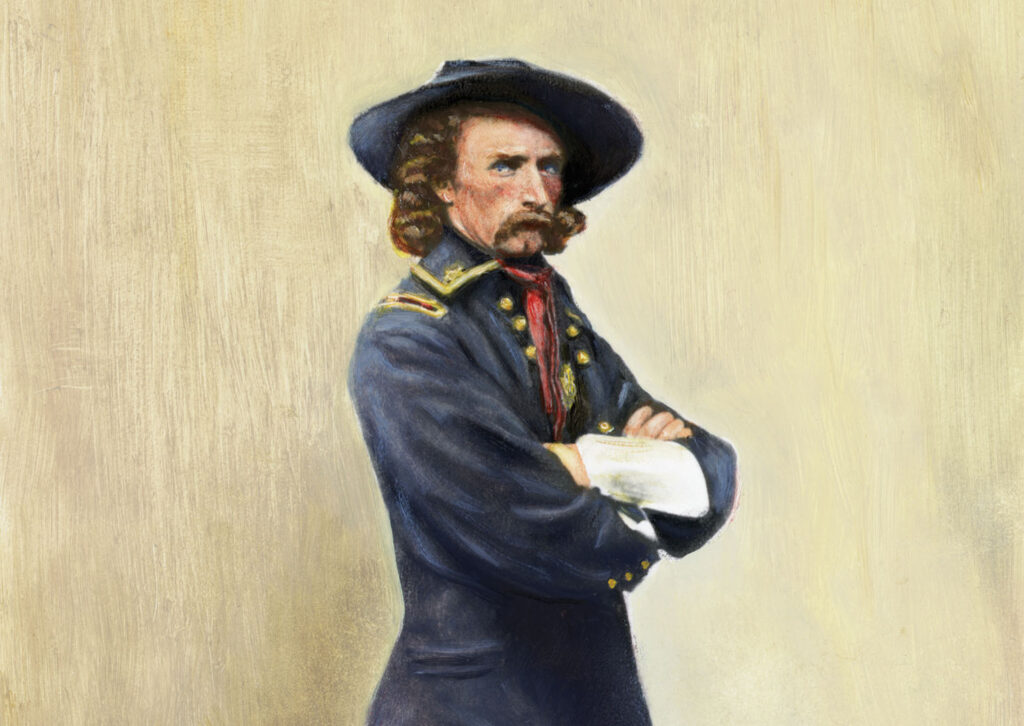
A Brigadier General by 23, George Armstrong Custer led the Michigan Brigade’s charge at Gettysburg, urging, “Come on you Wolverines!” He was the kind of guy who didn’t wait for the ever-cautious General George McClellan’s engineers to measure how deep the Chickahominy River was. Defying enemy fire, Custer charged into the water on horseback, hit midpoint, turned and yelled, “McClellan, that’s how deep it is, General!”

Today, honoring Custer’s contributions to freeing slaves and reuniting the Union in the 1860s doesn’t preclude struggling about how he and the American government hunted down Native Americans in the 1870s. There’s value in understanding what happened, and in assessing Custer as a leader.

Contrary to the legend his widow Elizabeth Bacon “Libby” Custer tended for 57 years until her death in 1933, most historians now view Custer’s catastrophe as self-inflicted. With his bigoted dismissal of his foes, and his egotistical quest for glory, he failed to take basic precautions.

For decades, such thoughts were heresy. Americans believed that Custer’s soldiers had fought courageously, rigorously, never breaking ranks.

By 1970, the myth was shattering. With America mired in Vietnam and rebels questioning America’s traditional, self-justifying, historical spin, Dee Brown published “Bury My Heart at Wounded Knee.” While detailing the broken treaties and brutal military campaigns Native Americans endured, Brown shifted perspectives,  writing about “Sitting Bull and the War for Black Hills.” Brown exposed Custer’s nickname, “Squaw Killer,” following his 1868 massacre killing women and children at Washita, a Cheyenne village. While resetting the moral dynamics, Brown framed Custer’s losing battle as a Native fight for self-defense, mounted courageously.

Thirteen years later, an August, 1983 wildfire consumed much of the thick brush that had grown in Little Bighorn National Monument, in southeastern Montana. Archaeologists led by Dr. Douglas Scott and Dr. Richard Fox started digging.

As Scott wrote in 2025 in the American Society of Arms Collectors Bulletin, the evidence confirmed much of the “Native American oral tradition” summarized in “Bury My Heart at Wounded Knee.” Using metal detectors, forensic technology and GPS mapping of each spent shell-casing found, researchers discovered “that Lakota and Cheyenne warriors used 47 different firearm types to completely outgun the U.S. 7th Cavalry.” The battle debris strewn far and wide suggests what Fox calls “tactical panic,” not a disciplined “Last Stand.” “Custer’s command,” Scott concluded, “was outnumbered, outgunned and simply outfought by the Lakota and Cheyenne warriors who were defending their way of life.”

Custer boasted: “There are not enough Indians in the world to defeat the 7th Cavalry.” Unaware of at least 1,800 Native warriors waiting in ambush, Custer weakened his own forces by dividing them into thirds.

Letters collected by the Shapell Manuscript Foundation also show that Custer’s soldiers – distanced from their command, overwhelmingly poor –  justifiably feared their enemy, as did many officers. On April 20, 1876, William Losee of Company F, 7th Cavalry, ended his letter to “Father and Mother,” admitting “my Eyes are dim with tears[.]  So good Bye all and a Kiss for all…”

On June 21st, Second Lieutenant William Van Wyck Reily, a 23-year-old officer, wrote to “My own darling Ma,” from the Yellowstone River in Montana, after two weeks of scouting the area. “We start tomorrow, and expect to have a fight inside of four days …” he wrote. “Much love to all. We have pretty hard times, but I will assure you that I am satisfied, and am not complaining. I may be able to go to the Centennial without asking, if so expect me in September some time, if I live through this campaign.”

Within days, Losee, Reily, and Custer were among the 268 soldiers, officers and civilians killed. Casualties included two of Custer’s younger brothers, his brother-in-law and his 18-year-old nephew. Most were stripped naked, scalped, with hands, fingers and legs slashed or dismembered. War clubs shattered heads and faces; arrows riddled most bodies.  The warriors’ ritualized killings infuriated Americans. That anger turned the Natives’ victory into an ultimate defeat, as America’s military flooded tribal areas and retaliated severely.

Historians are neither prosecutors nor defense attorneys. We’re analysts not priests, dedicated to explaining not moralizing. Custer’s battle today is a still-relevant warning to all armies against underestimating enemies. It highlights the tragic clash between Natives defending their homeland and soldiers equally convinced that their side was on the right side of history. And it shows how thorough research rather than partisan posturing can often bring us closer to the truth, in all its complexity and moral messiness.

For the author’s podcast on the Battle of the Little Bighorn, click here.


Gil Troy, an American presidential historian and Senior Fellow at the JPPI, the Global Thinktank of the Jewish People, is the host of The Human Side of History Podcast sponsored by the Shapell Manuscript Foundation. He is the author of 18 books, including his two latest: “250 Reasons to Thank America” with David Suissa – and, with the JJPI, “The Essential Guide to the U.S-Israel Partnership, the 250th Anniversary Edition.”

Remembering Little Big Horn 150 Years Later as Historians, not Prosecutors or Priests Read More »

Rosner’s Domain | Savior No More

Israelis are a politically capricious bunch, at least when it comes to foreign leaders. Had they changed their minds about their own government as quickly as they change their minds about foreign governments, we would be replacing our government every two months. Had they changed their opinions on their own leader as fast as they shifted their stance on Donald Trump, Benjamin Netanyahu would have been sitting at home long ago.

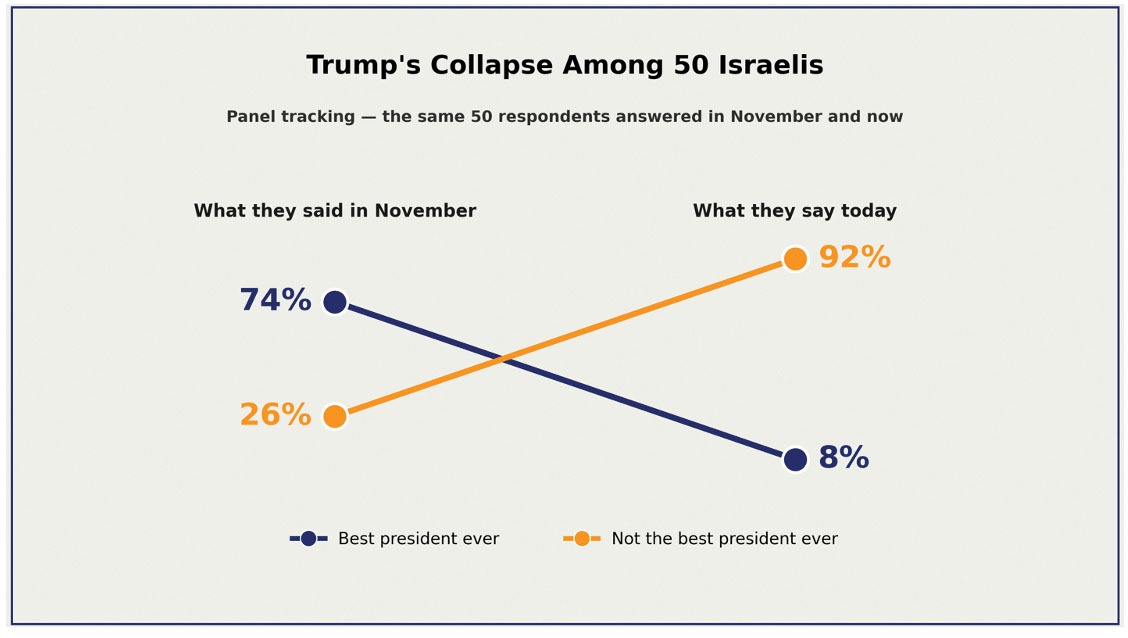
Here is a small story that illustrates the point: the story of 50 Israelis. We found them completely by accident, a welcome statistical occurence. They responded to a survey we conducted six months ago, which included a specific question about the American president. This week, when we ran a routine weekly poll, those same 50 individuals happened to land in the sample again and so, they answered the very same question.

Six months ago, the question was framed as follows: “During Donald Trump’s last visit to Israel, several figures, including the Prime Minister, stated that he is the friendliest president to Israel ever. Do you think this statement is …”

The options ranged from “very accurate” and “somewhat accurate” to “somewhat inaccurate” and “completely inaccurate.” Back then, a massive, decisive majority of the Israeli public agreed with the statement. Three out of four Israelis nodded in approval. Nearly 40% of them even chose the unequivocal “very accurate” option. There was no doubt among the public: history had culminated, the Messiah had arrived from Washington and there had never been a president like him.

But a few months passed, and reality, as is its habit in the Middle East, refused to remain intact. Since that poll, Trump managed to prove just how closely he can bring the two nations together — to the point of tight military coordination and a joint strike on a major regional enemy — while simultaneously proving just how far apart he can push them. It happened with dizzying speed: the president decideed to halt the war, compromise with Iran and berate Israel for not cheering his new path. Suddenly, it became clear that Trump’s friendship is a cold, conditional transaction.

Jews like to think of themselves as a people with a long historical memory. We remember the Exodus from Egypt, the destruction of the Temple and the Spanish Expulsion. But in the case of Donald Trump, Israelis proved just how short their political memory is – perhaps too short. When we asked this week in general terms whether Trump is a good or bad president for Israel, four out of ten Israelis (40%) explicitly defined him as a “bad” president. Only two out of ten (20%) still hold onto the “good” label. The rest? The rest are simply bewildered. They don’t know what to think.

Granted, there are still many Israelis who think he is better than most previous presidents, but this mostly betrays what they think of some of his predecessors (if even the current Trump is still deemed “the friendliest ever,” what does this say about a Biden Obama, Bush, Clinton, Reagan, Carter, Ford?).

By coincidence, or perhaps not, the Pew Research Center published a sweeping international survey last week tracking public confidence in Trump around the globe. On the surface, the review painted a highly flattering picture: Israel ranked as the country with the second-highest level of trust in Trump out of 36 nations surveyed. Only the Philippines surpassed us by a hair — 68% there express confidence in Trump, compared to 66% here.

However, anyone who digs deeper into the data realizes that the Pew report is already outdated for us. The data was gathered between February and May. We are already in early July. In the span of a single month, Israelis moved on. They discovered that the Trump of yesterday is not the Trump of today.

Yet, in truth, a deeper and more ironic reality has emerged: the Trump of yesterday is exactly, precisely, the Trump of today. His character hasn’t changed one bit. He remains the same volatile, adversarial, coarse, short-tempered, aggressive, utilitarian and cynical individual. The only difference is that yesterday, those traits — when directed at our enemies — aligned with our interests and amused us. Today, when they are directed at us, it simply suits us a bit less.

One can, of course, understand this sudden reversal. Politics is a game of cold realism: he turned on us, so we turn on him. An eye for an eye, a tweet for a tweet. But we can and should learn something unsettling about our national character from this. It exposes the deep psychological dependency we have developed on the American president, our obsessive need for his overt affection and, above all, our exaggerated, almost childish expectations of whoever occupies the Oval Office.

The greater the expectation, the sharper the disappointment. If we remembered a little better that Trump is not our president, but the president of another nation with its own interests, and if we internalized that there are certain personality traits that eventually always erupt — we wouldn’t have believed in him with such religious fervor before, and we wouldn’t be quite so sharply, bitterly and fearfully disappointed in him now. 

Something I wrote in Hebrew

As Gadi Eisenkot rises to become Netanyahu’s main election rival, here’s what Ultra-Orthodox groups blocked Israeli roads, protesting the detainment of draft dodgers. Here’s what I wrote:

The conclusion is quite simple. There are two ways to stop the Haredi road blockades: the short way and the long way. The short way is simply to give up — to give up on enlistment, on integration, on improvement, on confronting the issue. Just grant the Haredi community the autonomy it wants. The long way is not to give up, until they realize that this time a change is truly coming. And that is, of course, not very pleasant to write, and not very pleasant to hear. We all prefer easy solutions achieved through consensus. Except, such solutions are not always available.

A week’s numbers

Donald Trump once said he would get elected as Israel’s PM had he decided to run. Not anymore (see the lefthand side column).

A reader’s response

Jeff writes: “Wake up people, New York City is turning on the Jews.” Answer: There’s a whole range of gray areas between a Judeophile embrace and pogroms. Let’s attempt to clearly identify our current shade of gray. 


Shmuel Rosner is senior political editor. For more analysis of Israeli and international politics, visit Rosner’s Domain at jewishjournal.com/rosnersdomain.

Rosner’s Domain | Savior No More Read More »

Hineni: Choosing Torah

Torah isn’t just for professionals anymore. In fact, it never was. While many of us grew to adulthood with the sense that only rabbis (and maybe educators) studied Jewish texts, the reality is that quarantining the life blood of our existence, the very raison d’etre of Jewish identity to a small elite is a death knell. Torah was given to the entire people: men, women and children. And it belongs to Klal Yisrael, the entire people. Only if we all step up, only if we all say “Hineni, I am here” can this vibrant tool for human meaning, dignity and community hope to have a real future.

A remarkable revolution has hit the Jewish world: for the first time in its history, the Federations and secular organizations acknowledge that Jewish education must be one of the highest priorities of the entire Jewish community; every single one of us is now enlisted. If we think that being Jewish is of value, we all need to up our game.  Funding that used to go to “Jewish” hospitals and other institutions whose Jewishness consisted primarily in the ethnicity of its top staff (rather than any distinctive programming or services offered) now must share space with the explicitly Jewish concern of talmud torah (Jewish learning). Institutions have proliferated that offer opportunities for learning at every age, and the new technologies and social media are part of this grand revolution of Torah and spirit.

Why the shift?

Because every study of the demographics of the Jews of North America affirms the simple truth that without Torah there will be no Jews. Without a desire, for some, to serve God through mitzvot, to study and to implement the Torah in our daily lives, and for others, to deepen our identity and cultural link to those who have gone before us, there is simply not enough reason to put up with all the bother and separation that Jewish identity entails. Especially in an age of rising antisemitism, banding together and educating ourselves isn’t a luxury for the few. It is nothing less than resistance to the haters. This is a pivot and a willingness that cannot be transferred to others or displaced on a group; each of us is needed. Each of us is called.

Making ourselves available to growth in learning is no mere matter of partisanship — every Jewish religious denomination has been asserting this truth for at least a quarter of a century. And it is no retreat from universalism, simply a recognition that any universalism that requires (or produces) our destruction as a distinct people and culture is a false universalism, more akin to a cultural imperialism than a centering human diversity and expression.

While Jews have been known as the Chosen People from time immemorial, it is now essential that we become choosing people. When called, Abraham answered, “Hineni, Here I am!” In his pivotal moment, Moses responded as well, “Hineni, Here am I!” It is time we choose the Torah anew: for our own survival, for the survival of our mission of exemplifying righteousness in an often-wicked world. It is time we each and all become fully present, fully available. “Here we are!”

The idea of choosing to follow the Torah, while often associated with the Reform movement within Judaism, is rooted in ancient Judaism as well. Toward the end of the Book of Deuteronomy, for example, the Torah lists a series of blessings that will accrue to the Jew who follows God’s commands and a series of curses that will strike one who rebels against divine dictates.  The Torah records the words: “Cursed be the one who does not uphold the words of this teaching to do them, and all the people shall say, ‘Amen.’”

What is striking in this summation is the plain sense that the Jews can choose whether or not to follow God’s will. After all, one wouldn’t curse an automaton that malfunctions. If your television set’s remote control unit doesn’t do what you want it to you don’t curse it, you simply fix it. That God holds out blessings and curses to us implies that we do have a choice.  God doesn’t coerce observance. Instead, through teaching, example, and incentive, God hopes to persuade us to voluntarily make ourselves available, as we elevate our behavior to incorporate the holy and moral code of Jewish living.

Rashi takes that notion of choice one step further.  In commenting on this verse, Rashi says that “here [in these words] Moses included the entire Torah, and they [the people] accepted it upon themselves with a curse and with an oath.”  While there are certainly midrashim that view Israel’s acceptance of the Torah as forced upon them, Rashi is here identifying with the idea that the Jews of Moses’ generation freely chose to be bound by the Torah.

In a sense, choosing Judaism is still what links the contemporary Jewish people, regardless of our denominational affiliations.  An Orthodox Jew retains the individual liberty to choose to violate the words of the Torah and the traditions of Judaism yet is expected to choose to adhere to Jewish law in its totality as it is propounded by contemporary Orthodox sages.  So too a Conservative Jew is expected to choose to bind themself to a rich life of Jewish observance as the Conservative movement in Judaism understands that heritage.  And a Reform Jew is under a similar obligation — to freely choose to respond whenever they hear God’s commanding voice in a mitzvah. This same perspective links Reconstructionist and Renewal Jews as well. Where the denominations differ is in how they understand revelation, how they perceive Jewish law and its development and in who they think speaks authoritatively on behalf of Judaism, God, and their own spirituality. But all Jewish religious movements affirm the need to listen for God’s commands and to respond, as our ancestors did, with “Hineni,” Here I am.

To advance this unifying goal, American Jewish University has asked me to serve as the Goldstine Distinguished Scholar, and part of my happy responsibility is to launch opportunities for Torah study across the breadth of Los Angeles. Stay tuned for gatherings where we can explore, dive deep, debate and grow in Torah together.

Our ancestors willingly embraced the yoke of the Torah — with its need for self-discipline, diligence and study. Despite great hardship, they made themselves available and open. They said, “Hineni.” As a result of their commitment, we are here today, and the world is a richer and more compassionate place. We, today, are called to make a similar stand, to choose a life of Torah, study, and mitzvot. And our Hineni can also transform the tomorrows yet to be.

We are not robots, and God cannot make our choice for us. As the Torah says, “Hear O Israel! This day you become a people for Adonai your God. You shall listen to the voice of Adonai your God, doing God’s commandments and God’s statutes which I command you this day.”

As always, we each have the power to choose to listen, to learn, and to grow, or we can shut our ears to that still, small voice.

Are you listening? Are you willing? Are you here?

Rabbi Dr Bradley Shavit Artson, a Contributing Writer for the Jewish Journal, is the AJU Goldstine Distinguished Scholar while also serving as Vice President of American Jewish University in Los Angeles. He is currently completing a book, “Judaism Beyond Belief: Wisdom for People who Simply Want to Thrive.”

Hineni: Choosing Torah Read More »

The Agreement with Iran: This Lemon Is Sour, but Israel Can – and Must –Make Lemonade

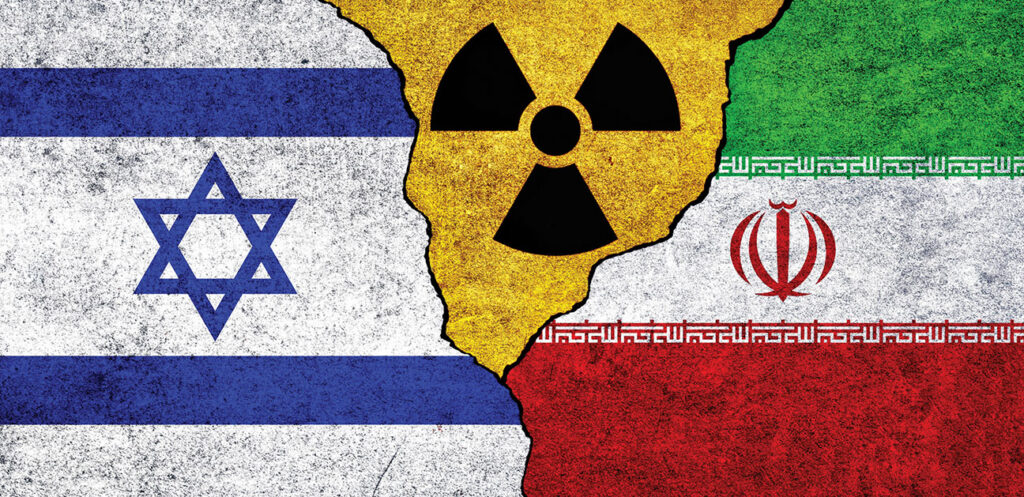
The emerging agreement between Iran and the United States has not yet been signed, but the chances are growing that the ceasefire already signed signals the end of the current confrontation between Washington and Tehran. In any event, it reflects the Trump administration’s deep desire to avoid a return to high-intensity fighting with Iran. And, as is often the case with partial or temporary agreements, what begins as provisional can gradually become permanent. For Israel, this is a bad agreement, but not a reason for paralysis. It is a warning that Israel must quickly define what can still be salvaged.

There is no easy way to say this: the emerging agreement is bad for Israel – potentially very bad. In the near term, billions of dollars are expected to flow to Iran, providing a significant injection of energy into the regime’s stability and its ability to sponsor terrorism across the Middle East. The broader strategic objective of weakening the regime and increasing pressure on its survivalis expected to suffer a serious blow, precisely at a moment when the regime’s stability is at a low point. Moreover, the agreement is likely to strengthen those in Iran who claim that the Islamic Republic has won – that it stood firm against “aggression,” demonstrated its regional standing, and managed to alter the status quo in the Strait of Hormuz in its favor.

On the nuclear front, it appears that the parties have agreed, for now, to defer the most urgent and serious issue: the fact that Iran still possesses a stockpile of roughly half a ton of uranium enriched to 60 percent. Removing that highly enriched uranium from Iranian soil, or diluting it, is a necessary condition for reducing this strategic threat. Now, the United States is expected to sign a ceasefire agreement without that condition being met, without clear inspection mechanisms or a credible military threat, and at a time when, on the other side, stands a regime whose motivation to acquire a nuclear bomb is at an all-time high – one of the central lessons it has drawn from the recent confrontations. It is also worth saying clearly: it would be dangerousto assume that Iran’s covert attempts to smuggle enriched uranium to a secret facility in the desert could be monitored hermetically.

On the missile issue, it appears that the United States has abandoned its demands entirely, leaving Israel and the countries of the region under a strategic threat that is expected to worsen in the coming years as long as the regime remains in place. Past experience shows that Iran’s force-buildup efforts cannot be dramatically constrained. It is reasonable to assume that Tehran will work energetically to reach its goal of 10,000 ballistic missiles within just a few years – with at least some of them potentially capable of reaching America, and certainly Europe.

The overall balance for Israel is negative. Based on Iran’s past behavior, there is every reason to believe that Tehran will channel the money it receives to Hezbollah long before it transfers it to its own citizens. The IDF’s impressive operational achievements in southern Lebanon will not translate into strategic gains without draining the Iranian swamp. That, unfortunately, has become a harder mission than it was only a few months ago, because of Iran’s growing confidence in its ability to restrict Israel’s use of force in Lebanon. As a result, Israel’s freedom of action in Lebanon is now more constrained than at any point since October 7, 2023.

The agreement is also expected to expose the fundamental gap between Israel and the United States on the Iranian question, in a way that will give momentum to Israel’s adversaries and critics. In many respects, Israel is perceived as being in a state of strategic weakness: heavily dependent on the Trump administration, while at the same time locked in a fundamental disagreement with it over the way forward on Iran.

And yet, there is still much that can be done. Israel should focus its efforts on the art of the possible, first and foremost, to ensure an effective and clear solution for the enriched uranium that remains in Iran, along with clear inspection mechanisms for that process. This should be Israel’s immediate diplomatic priority.

The agreement signed on June 26 between Israel and Lebanon is a step in the right direction, which demonstrates the existence of a zone of possible agreement (ZOPA) with Beirut. The window of opportunity to exploit Hezbollah’s strategic isolation remains open, as the organization faces growing domestic criticism and a hostile president in Syria. Israel and the United States can and should formulate a strategy designed to dry up both the Iranians and the money, the two things that keep Hezbollah alive in Lebanon. In parallel, Israel should press the United States to demand that the Lebanese state meet measurable targets for disarming Hezbollah and, if there is no alternative, preserve Israel’s ability to operate militarily throughout Lebanon if all other options fail.

The agreement also requires Israel to reorganize around the objectives the United States has deprioritized, foremost among them the future of the Iranian regime and the missile threat. A renewed strategy could include a coalition of regional states, many of which see eye to eye with Israel on the Iranian threat. Meanwhile, the IDF must carefully plan for the growing likelihood of direct rounds of fighting with Iran, so that, if they are forced upon Israel, they serve Israel’s broader strategic objectives.

The signing of the agreement would place Israel in a strategic reality worse than the one it faced before the last campaign. Yet Israel still has the ability to make lemonade from this sour lemon. If Israel can help ensure that the enriched uranium leaves Iran, and if it can use this moment to push Iran and its money out of Lebanon, then a damaging agreement can still be turned into a strategic opening. Israel’s position would improve significantly, as would its ability to confront the other challenges posed by the emerging agreement.

The Trump administration has rolled its dice. Israel now has to make its own move.


Or Horvitz is a senior fellow at JPPI. A former Lieutenant Colonel in Israeli Defense Intelligence (IDI) and served as Head of the Hezbollah and Lebanon Branch (2022–2024) and later as Senior Advisor to the Director of IDI (2024–2026), where he was centrally involved in post–October 7 transformation processes and Israel’s campaigns against Hezbollah and Iran.

The Agreement with Iran: This Lemon Is Sour, but Israel Can – and Must –Make Lemonade Read More »

Doubling Down on Who We Are

I knew Brad Lander when we were teenagers.

Not well. We weren’t close friends. But we moved in the same circles, NFTY conventions, the Reform Jewish youth movement that shaped so many of us who grew up in the Midwest. He was from St. Louis. I was from Omaha. Graduated our high schools the same year. We sang the same songs. Ani v’ata n’shaneh et ha-olam. “You and I will change the world!” We were pointed by the same tradition toward lives of meaning and repair.

This week, Lander, a Jewish politician who served as New York City Comptroller and has long been a prominent figure in progressive Democratic politics, won the Democratic primary for New York’s 10th Congressional District, running on a platform of explicit opposition to Israel, endorsed by a movement whose relationship to Jewish life I can only describe as hostile.

Upon hearing the news, I found myself feeling something I didn’t expect. Not anger. Grief.

I don’t think I’m alone in that. Many of you have your own version of this person — a college friend, a cousin, someone from your own youth group — shaped by the same Jewish formation, ending up somewhere you don’t recognize.

And then there is Darializa Avila Chevalier, who also won a primary in New York this week. She is not someone I know. She is not someone wrestling with the tradition from a different angle. The day after Hamas massacred 1,200 people in Israel, she was in Times Square at a rally where participants chanted “Resistance is justified,” made throat-slitting gestures and called out the number of Israelis confirmed dead. She has defended being there. In 2020 she reposted a tweet that said simply: “Israel doesn’t exist.” When asked at a debate whether she condemned the Hamas attack, she refused to answer.

I will not pretend that what swept New York this week is a policy disagreement about the Middle East. It is not.

For comfort, I turned to our Torah portion.

This Shabbat we read Chukat-Balak, a double parasha. Chukat is full of loss — Miriam dies, Aaron dies, Moses strikes a rock in grief and pays a steep price. A community in the wilderness, mourning, uncertain. We know something about that wilderness right now.

And then Balak.

Balak, king of Moab, watches the Israelites and grows afraid — not because they’ve threatened him, but because they are powerful and he doesn’t know what to do with that. So he hires the prophet Balaam to curse Israel, to make Jewish existence itself the problem.

Balaam opens his mouth. Blessings come out. He tries again, from a different hilltop. More blessings. A third time. He cannot utter a curse.

What comes out instead is a blessing:

Mah tovu ohalecha Ya’akov, mishkenotecha Yisrael.

How goodly are your tents, O Jacob — your dwelling places, O Israel! (Numbers 24:5)

An enemy hired to destroy us looks at the Israelite camp and sees homes. Community. People living with and for one another. Those words, first spoken by a man paid to erase us, to deny our identity, are the words tradition has us say every morning when we walk through the doors of our synagogues. The words meant to curse become our morning prayer.

The lesson of Balak is not that enemies can’t hurt us. The parasha ends with a plague. The danger is real.

What the story says is more precise: the attempt to define the Jewish people by our enemies’ worst fears about us is doomed to fail. Not because we are perfect but because there is something in this people, covenanted to justice, to memory, to one another, that is impossible to extinguish.

And while I have confidence that we will endure, not just survive but find the way to thrive, I am deeply troubled by the path my classmate Brad Lander took. The Judaism we learned in youth group and in our synagogues taught us two things simultaneously: that we should care deeply about the suffering of others, and that we have a particular responsibility to our own people. Those values are not in tension. They belong together.

I remember the banners outside our synagogues in those days, mine in Omaha, his in St. Louis: “Let My People Go. Free Soviet Jewry.” We were taught that concern for the legitimate national aspirations of the Palestinian people and unwavering commitment to Am Yisrael were not opposites.

But somewhere along the way, for too many who grew up proud and passionate Jews, Am Yisrael disappeared from the equation. That is the loss I’m grieving. Not a political disagreement but a severed inheritance.

Jewish communities across this country exist because Jews decided, generation after generation, to build something together. Tents, in the language of our Torah. Homes. Houses of worship. Schools for our children and for grown-ups as well. Places to bring our grief and our questions and our children and find that we are not alone.

That project is not contingent on who wins a primary in New York. It is not contingent on whether those who once sang with us still do. It has outlasted empires, inquisitions and movements far more powerful than this one.

The work, the ancient, urgent, irreplaceable work of Jewish community, is the answer. Not as retreat. Not as consolation. But as the most powerful response available to us.

So walk through the doors of a synagogue this Shabbat. Go with a friend or bring someone who hasn’t been in a while. Say the words of blessing with pride, with commitment, with conviction:

Mah tovu ohalecha Ya’akov.

How goodly are your tents, O Jacob, your dwelling places, O Israel!


Rabbi Yoshi Zweiback is the Senior Rabbi of Stephen Wise Temple in Los Angeles.

Doubling Down on Who We Are Read More »

I Chose Judaism

I was born of a Jewish mother and father. I lived in a Jewish neighborhood and went to a public high school that was 90% Jewish. I had a bar mitzvah. So, why would I say that I chose Judaism? Didn’t Judaism choose me?

My friends were secular and so was I. We had bar mitzvahs, memorized the haftorah and had a party, but had no real understanding of the purpose of the ceremony or its significance. We had a Passover seder, and those were lovely family gatherings, as long as they were over before the hockey finals were on TV.

Many of us knew Yiddish from parents and grandparents, loved Jewish jokes and Jewish cooking, were “challenging” students for our poor teachers and most attended some form of after-school Jewish lessons, which was called Hebrew School.  We were too tired for those lessons, learned little and came away without any real sense of what it meant to be Jewish.

So, what is Jewish? We would not have been able to answer that basic question. I don’t know what proportion of the Jewish population today could answer that question.

It was when I accepted a position at a university in a then-small town, Waterloo, that everything changed for me. Seeking Jewish fellowship, I attended the only synagogue in town. It was officially Orthodox, although hardly any congregants were Orthodox. The rabbi, like so many small-town rabbis of the day, accepted everyone and reached out warmly to each and every one.

When he learned that I was a professor of literature, he invited me to his class on Torah. “The Torah is full of fascinating and meaningful stories,” he said, “and we can explore them together.” And with that, my journey began. Rabbi Shraga Feivel Rosensweig, of blessed memory, opened vistas for me that I didn’t know existed. Eventually, after moving back to the city, where I commuted to my job in Waterloo, I read Jewish history, studied the prophets and undertook the complex task of wrestling with Talmud in a shiur (class setting) – what Rabbi Jonathan Sacks called an intergenerational discussion of Jewish thought.

I learned about our very long history, its glories as well as its agonies, from slavery in Egypt to freedom in the land of Israel. Jewish values and ideals inspired me, especially when I understood what that meant for all Western civilization. The contribution of the Jews to the world is not limited to modern medical, technical and scientific discoveries. It includes the cornerstone of ethics, values and morality of the Western world.

Learning about your history, religion and values gives you something that no money or other experience can provide – a sense of identity. “Who am I?” can be answered many ways, including “I am a Jew” – proud of our survival, our achievements and contributions, our dedication to our worldwide community and to the world at large.

If you take a deep dive into the complex world of Jewish life and history, it becomes glaringly obvious that the foundation of all of these ethical and moral values arise from a religious foundation. There is no escaping that conclusion. Judaism without religion is like a tree without its roots. Eventually, it will wither and die. It may last for a generation or two, but it simply cannot endure. Whether Orthodox, Conservative or Reform, the commitment to Judaism means accepting Jewish ritual or, more importantly, thinking and studying in order to do so.

Pointing out the foundational importance of religion and religious practice in a profoundly secular age is a hard sell. But that is where fellowship exists, where community is developed, where charitable activities are undertaken, where the opportunity to explore texts takes place. In a period when people feel alienated, lacking identity, questioning the meaning of life, religious community is comforting, positive and deeply satisfying. Prayer services are the core of a myriad of Jewish life experiences and events.

We depend on business, government and institutions to provide support for society, but those have been proven to be inadequate. Civil society was always a major factor in social cohesion, emotional and financial support, a sense of purpose. Civil society included the churches and synagogues and all that they did to create local identity on a person-to-person basis. That is missing today.

So, my journey has been a long one, filled with discovery and understanding, that gave me a sense of myself, where I came from, and a future that I can only imagine. Quoting Rabbi Sacks again, I have come to understand that I am a letter in the scroll, a part of the Torah, its meaningful past and great future, an eternal gift that offers meaning and identity.

So, yes, I was born Jewish, but I chose Judaism in the sense that I came to understand what Judaism represents, how it gives meaning and purpose to my life and how important it is for the world.

From lighting the candles on Shabbat eve to lighting the havdalah candle at the end of Shabbat, there is illumination of the mind, the body and the soul. The lighting is a ritual and a sign, a statement, a commitment to one’s self, one’s family and to the world. May that light be kindled forever as a connection to the divine and ultimately to all people who wish to live in harmony with themselves and others.


Dr. Paul Socken is Distinguished Professor Emeritus and founder of the Jewish Studies Program at the University of Waterloo.

I Chose Judaism Read More »

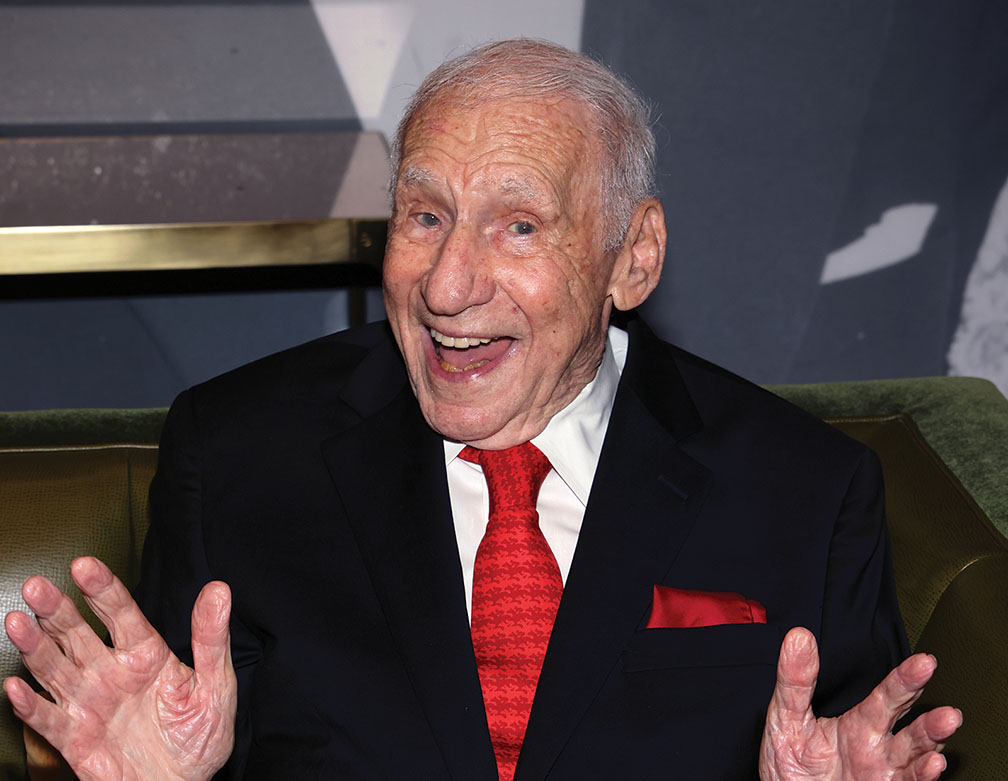
Did Netanyahu Undermine Israel’s Most Valuable Asset?

For the first three decades of Israel’s existence, the principle was so widely understood it rarely needed stating. But when it was stated, in moments of stress or when someone broke ranks, the words were unambiguous.

In 1972, Yitzhak Rabin, then serving as Israel’s ambassador to the United States, was summoned before the Conference of Presidents of Major American Jewish Organizations. Reports had surfaced that he’d made remarks favorable to one side in the Nixon-McGovern race. Rabin denied it and used the occasion to articulate what he called a “long-standing practice”: Israel would remain nonpartisan in U.S. presidential elections and would not intervene in the internal politics of other countries.

Note that phrase. This was 1972. Israel was 24 years old. The rule was already old.

Eight years later, Prime Minister Menachem Begin, the right-wing Likud founder who deeply loathed Jimmy Carter, reiterated the same principle at a foreign press luncheon. His own defense minister, Ezer Weizman, had publicly endorsed Carter’s reelection. Begin didn’t attack Weizman directly. He simply reasserted: the Israeli government would not interfere in the democratic election process of the United States.

Begin had every reason to abandon the principle. He believed Carter intended, in a second term, to impose a Palestinian state on Israel through arm-twisting and collusion with Egypt’s Anwar Sadat. And yet he stayed silent, issued warm congratulations to the incoming Reagan and kept Israeli interests scrupulously separate from American partisan politics.

From the other side of the spectrum, Shimon Peres put it plainly in a 2016 Times of Israel interview: “We shouldn’t take sides in internal American issues. We have to appreciate that the U.S. friendship with Israel is bipartisan, so we cannot show an involvement in American politics, just as Americans are careful not to show involvement in Israeli politics.” When asked about Netanyahu’s drift, Peres was equally direct: “The right thing was to have the bipartisan support. Anything that endangers it is a mistake.”

Right and left, Labor and Likud — the rule was the same. It was not a courtesy; it was the strategic foundation of Israeli-American relations.

Benjamin Netanyahu blew it up.

Netanyahu’s partisan turn was calculated and incremental. According to Obama’s deputy national security adviser Ben Rhodes, “whenever Netanyahu felt Obama was pressuring him, he would go to Republicans in Congress who would then issue statements blasting Obama and create multi-week political headaches for the White House.” Rhodes’ verdict: Netanyahu was “duplicitous, self-interested and relentlessly meddled in American politics to undermine President Obama, and frankly was indistinguishable from a Republican political operative in his tactics.”

The defining breach came in March 2015. Without notifying the Obama White House (which learned of the visit from news reports) Netanyahu accepted an invitation from Republican Speaker John Boehner to address a joint session of Congress, two weeks before Israeli elections, explicitly to sabotage Obama’s Iran nuclear negotiations. Rahm Emanuel, Obama’s first chief of staff and a lifelong pro-Israel Democrat, later described the damage with precision: “The seeds to where Israel is today weren’t planted three years ago, they were planted a decade ago. What the prime minister was doing was setting a course where Israel would become a partisan issue in American politics.”

The provocations continued. In March 2024, Netanyahu appeared via video at a closed Senate Republican caucus lunch and attacked Democratic Senate Majority Leader Chuck Schumer, the highest-ranking Jewish elected official in American history, calling Schumer’s call for Israeli elections “wholly inappropriate and outrageous.” When Schumer declined his request to address Senate Democrats the same day, the tableau was complete: an Israeli prime minister using the Republican caucus as a stage to attack the Democratic leadership, a first in the history of the alliance.

In June 2024, Netanyahu posted a video on X accusing the Biden administration of “withholding weapons and ammunition,” a charge the Pentagon denied with bewilderment. High-level security talks were canceled in the aftermath. In July 2024, he addressed a joint session of Congress at the height of a presidential campaign, in an event Democrats widely read as an in-kind contribution to Trump. Dozens boycotted.

The Israeli-American relationship, carefully tended as a bipartisan asset for 75 years, had been conscripted into the American culture war.

To understand why even the most loyal pro-Israel Democrats have finally said “enough”, one must reckon with what they actually did for Israel, and how Netanyahu repaid them.

The dominant narrative cast Barack Obama as an adversary of Israel. Netanyahu promoted it relentlessly.

But over eight years, the United States provided Israel with more than $23.5 billion in foreign military financing, making Israel the leading recipient of U.S. military assistance every year of Obama’s presidency. The administration invested over $3 billion in missile defense, including more than $1.3 billion for Iron Dome. Then in September 2016, after the 2015 congressional speech and years of public contempt, Obama signed a Memorandum of Understanding committing $38 billion in military assistance over 10 years: the single largest military aid pledge to any nation in American history. The White House described it plainly: “No other American administration in history has done more for Israel’s security.”

Netanyahu called it “historic” at the signing. He had spent his presidency using Congress to humiliate Obama before a global audience. Conservative Jewish groups made no effort to credit the administration that had just written Israel the largest check in American history. The narrative of Obama as Israel’s enemy continued unabated.

Joe Biden’s commitment to Israel was not political calculation. He described himself as a “non-Jewish Zionist” and told audiences his support “began at my father’s dinner table.”

After Oct. 7, 2023, the worst massacre of Jews since the Holocaust, Biden flew to Israel. No sitting American president had ever traveled to Israel during one of its wars. He embraced Netanyahu on the tarmac, sat with the war cabinet, and told the Israeli people: “You are not alone.” He deployed two carrier task force groups to the Eastern Mediterranean, dispatched a nuclear-armed submarine and orchestrated two coordinated multinational responses to Iranian ballistic missile attacks on Israel. By the time he left office, the United States had provided $20 billion in military assistance since Oct. 7 alone. Former U.S. Ambassador to Israel Tom Nides summarized it plainly: “Biden’s support for Israel has been rock solid, and he did it at enormous political cost.” Biden’s Middle East coordinator Brett McGurk described the ledger at the close: “Biden left office with a ceasefire in Gaza, a ceasefire in Lebanon with Hezbollah defeated, Iran in its weakest position since 1979 after two failed missile attacks. His commitment to Israel’s security was unwavering throughout the crisis.”

In January 2026, at a press conference marking the return of the last Israeli hostage, Netanyahu, unprompted, declared that IDF soldiers had fallen in Gaza because “at a certain point, we simply didn’t have enough ammunition, and people fell, heroes fell. Part of the loss of ammunition was also a result of the embargo.” He noted the situation improved only “with the entry of President Trump’s administration.” He did not name Biden. He didn’t need to.

What he called an “embargo” was a single paused shipment of 2,000-pound bombs, over civilian casualty concerns in densely populated Rafah, during an otherwise uninterrupted $20 billion flow of wartime assistance. NSC spokesman John Kirby called Netanyahu’s claim “perplexing, to say the least.” Biden’s envoy Amos Hochstein was blunter: “Netanyahu is both not telling the truth and ungrateful to a president that literally saved Israel at its most vulnerable moment.”

The party that signed the largest military aid package in history, deployed carrier groups and a nuclear submarine and sent its president to physically stand in Tel Aviv: that party was told, at the moment of Israel’s military success, that it had cost Israeli soldiers their lives.

The consequences are arriving at a level few anticipated.

In a Senate vote this spring, 40 of 47 Senate Democrats voted to block weapons sales to Israel, up from 24 in 2025 and 19 in 2024. J Street, the left-leaning pro-Israel organization that had long supported Iron Dome funding, announced it would no longer back the annual military aid package at all. Its president Jeremy Ben-Ami declared: “The era of a blank check for Israel is over.”

The most telling voice is Rahm Emanuel. He is not a progressive; he is the man who as Obama’s chief of staff personally directed more than $1.3 billion into Iron Dome. He is a proud Jew, a hawkish centrist, and a likely 2028 presidential candidate. Netanyahu once called him a “self-hating Jew.” On Bill Maher’s show this year, Emanuel was unequivocal: “The days of taxpayers subsidizing Israel militarily — that’s over. No more financial aid.” When asked about Iron Dome, he made no exception: “You’re going to pay full price. You don’t have special status.”

These are not people who hate Israel. They are people who concluded, after years of watching Netanyahu treat Democratic presidents as adversaries and Jewish Democrats as enemies, that the relationship as currently structured no longer serves American, Israeli or Jewish interests.

Netanyahu’s gamble was premised on a simple calculation: locking in Republican support was worth alienating Democrats. That bet now looks far less certain, for reasons entirely separate from his partisan tactics.

The Iran war has strained the Trump-Netanyahu relationship in ways Netanyahu did not foresee. Trump, who ran as the president who would end foreign wars, has found this one harder to exit than to enter. He has publicly told Netanyahu Israel is “PROHIBITED” from bombing Lebanon. The Israeli press dubbed the parade of senior American officials dispatched to Jerusalem “BibiSitters,” sent not to coordinate but to constrain. Former Prime Minister Ehud Olmert observed: “Netanyahu thought he was the friendliest of all people to Trump, and it appears that he’s not.”

The events of mid-June 2026 only reinforced the pattern. When the Trump administration finalized a 14-point memorandum of understanding with Iran — extending the ceasefire, reopening the Strait of Hormuz and setting the stage for permanent nuclear talks — Netanyahu’s government was, by its own officials’ admission, not shown the actual draft text before Trump said he’d given Israel a copy. Netanyahu’s office tried to characterize the relationship as still aligned, but Trump’s own remarks told a different story: he publicly called Netanyahu “f—ing crazy” over the continued strikes in Lebanon, told reporters he was “perturbed” with him, and warned him directly to “stop this.” Within days Trump pivoted to calling Netanyahu a “great partner” and a “warrior prime minister” — a reversal so abrupt that it reads less like a steady alliance and more like a patron managing a subordinate.

Trump went further than criticism: he demanded that Israel fall in line with the MOU’s terms, leaning on the fact that his administration, in its current alignment, is functionally Israel’s only remaining great-power friend. That kind of leverage did not rise in a vacuum. It is only available to this American president because Netanyahu spent decades destroying Israel’s bipartisan support that used to give Israel options. Had he preserved Democratic goodwill alongside Republican support, the administration’s pressure would have been mitigated. Netanyahu’s single party approach has enabled Trump to make demands on Israel that no single ally should be able to make alone.

Regardless of Trump, Republican public opinion is fracturing along generational lines no partisan alignment can override. The April 2026 Pew poll found 57% of Republicans under 50 now view Israel unfavorably, up from 35% in 2022. The forces driving that shift include “America First” isolationism, war fatigue and right-wing media figures whose anti-Israel commentary is, in some cases, inseparable from documented antisemitism. Tucker Carlson promoted “great replacement” theory for years, repeatedly cast Jewish philanthropist George Soros as a shadowy puppet master and platformed Holocaust revisionist Darryl Cooper, who was condemned in a joint statement by all 24 Jewish Democratic House members as a “Nazi apologist and Holocaust denier.” Candace Owens, whom the ADL describes as “one of the most influential promoters of antisemitism and antizionism in the world,” has promoted blood libel tropes, Holocaust minimization, and a 19th-century antisemitic tract on her podcast. These are not good-faith foreign policy critics. They are antisemites who have found, in the current environment, an opening to mainstream hatred that was previously more confined to the fringes. The collapse of bipartisan consensus, which once gave Israel the buffer to weather anti-Israel sentiment wherever it arose, has left no safety net as the Republican coalition fractures as well.

The Pew data captures the wreckage: Sixty percent of Americans now view Israel unfavorably. Fifty-six percent of Jewish Americans have little or no confidence in Netanyahu. The only demographic remaining solidly behind him is White evangelical Protestants over 50, a shrinking base that is not a substitute for the durable, cross-partisan coalition that Rabin, Begin and Peres understood to be Israel’s most precious strategic asset.

A final note on the international picture: anti-Israel bias at the U.N. and in certain European capitals is real and longstanding: one need only recall the U.N. General Assembly’s 1975 resolution equating Zionism with racism, a resolution so indefensible the U.N. itself revoked it in 1991. Israel’s traditional strategy was never to win those arguments but to build relationships strong enough to withstand them. Netanyahu has applied his same partisan logic to Europe, cultivating alliances with authoritarian populists, most prominently Hungary’s Viktor Orbán, whom he welcomed as “a true friend of Israel” even as Orbán was running antisemitic billboard campaigns against George Soros and awarding state honors to writers known for antisemitic views while straining ties with Israel’s most historically committed European ally.

Germany, whose Staatsräson (the principle that Israel’s security is a matter of German national interest rooted in Holocaust responsibility) has been one of the great moral commitments of postwar European democracy, has seen favorable views of Israel drop 10 points since 2021, to 36%, according to Bertelsmann Stiftung polling. Germany imposed a partial arms embargo in 2025 and its new chancellor has delivered sharp public rebukes of Israeli conduct. Netanyahu responded by invoking the Holocaust against the German government, an approach that Israeli defense industry sources privately described as ensuring Israel would “isolate itself from the world.”

Begin understood something Netanyahu does not: that a small state dependent on American military and diplomatic support cannot afford to make permanent enemies of half the American political system. The “long-standing practice” articulated by Rabin in 1972, enforced by Begin in 1980 and defended by Peres in 2016 was not a courtesy, but a survival strategy.

Netanyahu discarded it. He replaced a durable consensus with a partisan alliance always one election cycle from collapse, and it is now collapsing. He destroyed the Democratic relationship that produced the $38 billion Obama package and Biden’s wartime embrace. He alienated Jewish Democrats, then pro-Israel moderates, then hawkish centrists. He bet on Republicans whose own coalition is now fracturing. And he did it all while telling the world that the president who stood on the Tel Aviv tarmac and said “you are not alone” had cost Israeli soldiers their lives.

The bill is being delivered from the Senate floor, from Bill Maher’s stage, from a war-weary American public that now views Israel unfavorably by a 23-point margin.

Rabin called it a long-standing practice. Begin honored it even when he loathed the president he was protecting. Peres defended it with the clarity of a man watching it erode in real time.

Netanyahu called it a weakness. It was Israel’s most valuable asset. History is rendering its verdict.


Michael S. Rosenblum is a Los Angeles business attorney, a graduate of Wharton and UCLA Law with a background in political science, and a former trustee of the Washington Institute for Near East Policy.

Did Netanyahu Undermine Israel’s Most Valuable Asset? Read More »