fbpx

March 20, 2025

Rebuild & Renew: Pop-Up Boutique Provides Relief for Fire Victims

While the Eaton and Pacific Palisades fires may seem like old news to some, for many residents of these communities, the struggle is far from over and will likely continue for years to come. With this in mind, Courtney Mizel and her friend Erin Feniger-Maggio were inspired to open a pop-up boutique in Santa Monica.
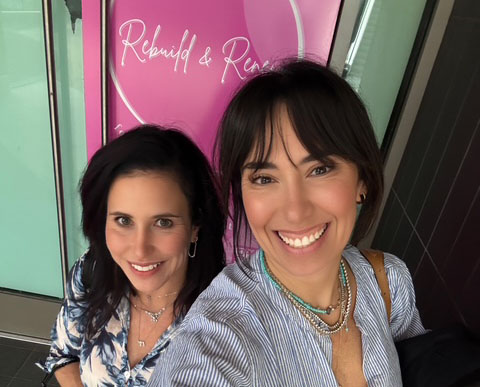
Courtney Mizel and Erin Feniger-Maggio

The two Jewish friends are no strangers to philanthropy and giving back to the community, so it was a no-brainer for both of them to open the boutique and invite those affected by the fires to come and pick up clothes and some essentials.

Feniger-Maggio, whose parents lost their Montana home to a wildfire in 2020, understood firsthand the devastation of losing both a home and a lifetime of memories. When the fire hit Pacific Palisades on Jan. 7, she got on the phone with Mizel and tried to figure out how they can help.

The two quickly came up with an idea to have a place for the victims to come and get new clothes. They wanted to offer them a real shopping experience just like in any boutique and not have them go through pile of clothes in some donation hub in the hope to finding something that fits. The store is open by appointment-only to ensure the privacy of the shoppers.

“We started as a pop-up in my living room and an owner of a boutique I know asked me if I knew where she could donate eight bags of new clothing. Later that night, a friend came over and we got some clothing racks and set it up,” said Mizel.

Mizel, who serves on the board of six different charities and is involved with the Cayton Children’s Museum in Santa Monica Place mall, asked the mall if they could provide a space for the boutique.

“Within 30 minutes, they showed us five spaces and told us we could pick one — that’s how it started. I wrote about it on Facebook and was connected with a woman who was interested in doing the same thing. She delivered 13 or 14 racks of brand-new clothing, still wrapped and that’s how we started.”

In no time, the 2,500-square-foot “Rebuild and Renew” boutique was filled with clothes, including denim pieces that Feniger Maggio, a fashion designer, provided. The store quickly took shape and before long, they were open for business— the business of giving back to the community.

Speaking with The Journal, Mizel recalled how after Oct. 7, she felt a strong urge to take action and help those who had lost everything in the terror attack. This time, when a different kind of tragedy struck her own town, she seized the opportunity to assist. She started by opening her home to a few people who evacuated their Palisades home.

“I feel blessed to be able to help people in a hands-on way. I couldn’t necessarily respond the way I wanted to in October 2023, so this is gratifying on a deep level. “Rebuild & Renew” became our chance to make a tangible difference in the lives of people facing loss and uncertainty, offering them dignity and a sense of hope when they need it most.”

“I feel blessed to be able to help people in a hands-on way … Rebuild & Renew became our chance to make a tangible difference in the lives of people facing loss and uncertainty, offering them dignity and a sense of hope when they need it most.” – Courtney Mizel

Two high school graduates from Milken Community School were hired, along with two additional workers, to welcome customers, who are invited to pick 10 items each week. New inventory arrives regularly through donations from clothing companies and charities.

“We are serving over 100 families every week,” said Mizel. “We are developing relationships with them. One of the things we said from the start is that it’s not only about providing a retail experience, but also a place to talk—if they want to talk. We let them take the lead.”

At first, most of the shoppers were victims of the Palisades fires; not only people who had lost their homes but also those who needed to evacuate as a result of the fires.

Many of them are struggling with insurance issues — or the lack of insurance — after their policies were canceled just months or even weeks before the fires erupted. The uncertainty of the future weighs heavily on them and the boutique offers a sense of normalcy — an opportunity to pick out new clothes, enjoy a moment of respite and perhaps open up to people who genuinely care. Some who have managed to get back on their feet even return to donate items themselves.

“We, as Jews, come from the perspective of tikkun olam — it’s our responsibility to help others,” said Mizel. “I walk around with my hostage tag and my Chai necklace and it’s important for me to subtly show that we are here to help, that we know it’s our calling.”

The store is scheduled to remain open until the end of April.

For more information, visit rebuildrenew.org

Rebuild & Renew: Pop-Up Boutique Provides Relief for Fire Victims Read More »

Sovereignty Is Surely Not Doomed

Is sovereignty an oriflamme that’s doomed,
as personal relationships increasingly
become encroached by those who are assumed
to be intrusive, and invade increasingly,
and is it doomed for national entities,
which now are answerable increasingly to sup-
ranational bodies? Doing as we please
will be perhaps just for the birds who’ll always poop
wherever they desire, sovereignty
of skies as yet unchallenged by the poop police.
Birds will be the only creatures who can flee
the oriflamme of sovereignty, and we must cease
deluding ourselves that we have control
of personal and national relationships.
We’re all controlled by outsiders, our only role
will be to pay to sovereignty mere service of the lip.

Sovereignty is now challenged by both Trump and Putin,
just as I was opposed once by James Polk,
distressingly denouncing what they’re both disputin’,
great principles long favored by free folk,
but is supported by the post-October war
for Jewish sovereignty, mamlakhtiyut
the Hebrew word for what we must restore,
this Jewish,  sadly often fatal, fruit.


In “Israel’s Second War of Independence,” mosaic-magazine.com, 3/1725, Michael Oren writes:
In this, our second war of independence, we have the opportunity—and beyond that, the duty—to ensure Israeli and Jewish unity. Our leaders have the opportunity to exhibit and personify the kind of behavior urged by Ben-Gurion in his most exalted (if untranslatable) coinage: mamlakhtiyut: i.e., acting in a respectable, responsible, and statesmanlike manner. Perhaps that would even be a more fitting name than the war of revival, or Iron Swords (the IDF’s formal name for its current military operations): milhemet ha- mamlakhtiyut, the war for attaining true sovereignty.
Thus, along with winning the war on the battlefield, we must triumph also in the war for Israel’s soul. Even though the extraordinary solidarity we experienced at the beginning of the war is today once again in danger of unraveling, there is reason to believe we will avoid the bloody internecine hatred of the kind once openly unleashed when, at the height of the Arab invasion of 1948, one Israeli armed force deliberately sank a ship (the Altalena) bearing the fighters of another.

Above all, we have every reason to be optimistic about the generation that has fought and continues to fight this war: the 360,000 reservists who, proportionally speaking, made up the equivalent of 20 million Americans—four million more than served in all of World War II.
They, the members of this generation, are tempered, steeled, anything but fragile, and intensely patriotic. They are the greatest such generation we have known since 1948. They are the Levi Eshkols and Golda Meirs, the Yitzhak Rabins and the Moshe Dayans of the future. They have been, and they remain, united, transcending all of the usual Israeli divisions—politics, religion, ethnicity—to live and to fight as a single force and with singular purpose. They are unparalleled in their resilience, their camaraderie, their quiet moral confidence, and their courage.

This generation will lead our country in rebuilding, reviving, and breathing new life into the Zionist project. This is the war for restoring our dignity, our identity, our independence, and for reaffirming and embracing our responsibility. This is the war after which, each time we rise to sing our national anthem anywhere and everywhere in the strong, sovereign, responsible Jewish state of Israel, we can stress, without modification, elision, or irony, the final phrases that say exactly who we are: “a free people, in our own land, in the land of Zion, in Jerusalem.”

In “The Painting That Explains Trump’s Foreign Policy,” WSJ, 3/15/25, Josh Dawsey, Vera Bergen and Alexander Ward point out that President Trump’s challenge of Danish sovereignty of Greenland, and that of Canada, echoes the way that President James Polk annexed Texas, California, Arizona, New Mexico, Nevada, Utah, and parts of Colorado and Wyoming. Polk’s conduct is so admired by President Donald Trump that he asked Speaker Mike Johnson for a portrait of James Polk that was hanging in the US Capitol in exchange for a one of Thomas Jefferson in the White House.


Gershon Hepner is a poet who has written over 25,000 poems on subjects ranging from music to literature, politics to Torah. He grew up in England and moved to Los Angeles in 1976. Using his varied interests and experiences, he has authored dozens of papers in medical and academic journals, and authored “Legal Friction: Law, Narrative, and Identity Politics in Biblical Israel.” He can be reached at gershonhepner@gmail.com.

Sovereignty Is Surely Not Doomed Read More »

A Bisl Torah~Restraint is a Mitzvah, Too

After the incident of the golden calf, the children of Israel are anxious to reconcile with God. Their immediate inclination is to help build the Mishkan, the Tabernacle with as many beautiful items as possible. The Torah explains that each person’s heart was moved to give and give they did.

At one point, the artisans instructed with leading the building grew overwhelmed. Moses had to tell the people to stop bringing gifts! It was just too much. The Alshich, a 16th century Biblical commentator, reminds us, “When so commanded, refraining from doing a mitzvah is no less a mitzvah than doing a mitzvah.” In other words, sometimes less is more.

The Torah asks us to approach mitzvot with a certain sensitivity with the task at hand. When visiting the sick, often visiting for 15 minutes is more impactful than staying for 45. When offering comfort to mourners, a silent hug is more appropriate than sharing one’s own experience. Considerate restraint may lead to a mitzvah filled with deeper meaning and sanctity.

While hiddur mitzvah is interpreted as beautifying a commanded act with a sense of abundance, as usual, the Torah asks us to think harder about the ways we engage with each other. And when we choose to act with restraint, sensitivity, compassion, and understanding, it is God that comes closer and closer.

Shabbat Shalom


Rabbi Nicole Guzik is senior rabbi at Sinai Temple. She can be reached at her Facebook page at Rabbi Nicole Guzik or on Instagram @rabbiguzik. For more writings, visit Rabbi Guzik’s blog section from Sinai Temple’s website.

A Bisl Torah~Restraint is a Mitzvah, Too Read More »

I Have Questions – A poem for Parsha Vayakhel

He made the sacrificial Altar out of acacia wood. ~ Exodus 38:1

I’ve read the complete accounting of
the making of the tabernacle
and I have questions.

It says he made dozens of times
but is suspect as to exactly who
he was when the hes came along.

Where did he get all the things
to make the things? Slaves bolted
out of Egypt with all the

purple linen they could carry?
Could they have had time to
let the dough rise if they weren’t

so busy grabbing precious fabrics?
They were using a lot of acacia wood.
Was this history’s first deforestation?

Was this the world’s first tabernacle?
I bet I could look that up. Okay, I looked it up.
It was not the world’s first tabernacle.

That’s actually all the questions I have.
If you have questions you’d like me to
pass along in a future poem

please send them. But It may be another
seven years before I get back to this text.
If I live that long. I hope to, of course.

By then you may have built your own tabernacle.
All the instructions are there for you.
If you have enough acacia wood,

you can do anything.


Rick Lupert, a poet, songleader and graphic designer, is the author of 28 books including “God Wrestler: A Poem for Every Torah Portion.” Visit him at www.JewishPoetry.net

I Have Questions – A poem for Parsha Vayakhel Read More »

A Moment in Time: “Judaism: Sturdy Roots are Important – So is Ongoing Care”

Dear all,

A few days ago, a huge tree fell completely over in our neighborhood. (Luckily no person or structure was damaged). Unfortunately, neglect of ongoing maintenance – accompanied by strong winds – were too much for the sturdy roots.

I saw this and thought deeply about Judaism. We are proud of our history. We speak with reverence about the journeys of the generations gone by. We honor the trailblazers who enabled us to live freely. We openly share that our grandfather was a kosher butcher or that our grandmother ensured the family all sat at the Shabbat table.

These study roots are incredible, and we honor them.

So what are we doing today to ensure the ongoing health of the trees that grew from those roots? Are we maintaining our foundation so that strong forces don’t uproot us?

It doesn’t take much. But it does take intention.

It takes a moment in time to light Shabbat candles.

It takes a moment in time to offer a prayer thanking God for each new day.

It takes a moment in time to put money in a tzeddakah jar.

It takes a moment in time to add a Jewish song to our playlist.

It takes a moment in time to search for a Jewish podcast.

It takes a moment in time to donate to a Jewish organization.

It takes a moment in time to vote in the World Zionist Elections.

It takes a moment in time to be Jewish for the sake of tomorrow.

How do you keep the tree reaching proudly toward the heavens?

With love and Shalom,

Rabbi Zach Shapiro

A Moment in Time: “Judaism: Sturdy Roots are Important – So is Ongoing Care” Read More »

Wikipedia Editors Place Moratorium on Controversial Sentence in Zionism Article

Wikipedia editors decided to place a one-year moratorium barring anyone from editing or discussing the controversial sentence in the lead of the Zionism Wikipedia page: “Zionists wanted to create a Jewish state in Palestine with as much land, as many Jews, and as few Palestinian Arabs as possible.”

Middle East historian Asaf Romirowsky, who heads Scholars for Peace in the Middle East and the Association for Study in the Middle East and North Africa, has previously told me that this sentence in the Wikipedia page is “false” because “there are [an] abundance of diplomatic correspondents of looking to find ways for coexistence and the fact of the matter is that all those Arabs who stayed in the land and became the Arab Israelis … they became naturalized citizens because of that earlier desire for coexistence between the population of the land.” My previous reporting highlighted how the sentence resulted from anti-Israel editors primarily citing anti-Zionist historians and appearing to take a passage from one of renowned Israeli historian Benny Morris’ books out of context.

The moratorium was implemented on Feb. 21; a recent report from the Anti-Defamation League (ADL) cited the moratorium as an example of Wikipedia’s anti-Israel bias. The moratorium came about after the editor “Bob drobbs” started a discussion on the Zionism talk page on Jan. 27 suggesting alternative phrasings to the sentence to make it more neutral. Bob drobbs was immediately met with opposition from anti-Israel editors who noted that a Request for Comment (RfC) — a formal discussion in which a closer (an uninvolved Wikipedian in good standing) renders a verdict on the discussion based on numbers and strength of the arguments as they pertain to site policy — had been closed on Jan. 4 finding that the sentence, as written, adhered to Wikipedia’s neutral point of view (NPOV) policy and should remain in the article. These editors argued that while Wikipedia policy acknowledges that consensus can change, it was too soon to launch a new discussion on the matter and is thus considered “disruptive.” Bob drobbs contended that the previous RfC left wiggle room for improvements to the sentence to be discussed, while anti-Israel editors claimed that Bob drobbs’ suggestions would have broken the consensus derived from the previous RfC.

Others pointed out that the previous RfC had been dominated by two anti-Israel editors who have since been topic-banned, but the editors in favor of keeping the sentence argued that even without those two editors (and one pro-Israel editor since topic banned), the numbers would have come out in favor of not changing the sentence. These editors also argued that bringing up the fact that those editors were topic banned would be “gravedancing,” Wikipedia argot that is defined as “insults/accusations/other behavior directed at editors who are now blocked or banned,” or “behaving as though a consensus is no longer valid simply because a blocked or banned editor contributed to it” or “nominating articles for deletion based solely on a blocked/banned/retired editor being the one who started them or contributed to them.” The essay defining gravedancing explains that “the work of a blocked, banned or retired editor should be treated respectfully as it may still have some value.”

Two days after drobbs initiated the discussion, “Lf8u2” launched an RfC on if editors supported a moratorium lasting three months, six months or 12 months; no moratorium at all was also an option. “While consensus can change over time, there is no indication that it has shifted to such an extent in such a short time,” Lf8u2 wrote. “Regurgitating the same discussion in hopes of a different outcome is both disruptive and a waste of time. I also notice that this particular change has been discussed extensively outside of wiki.”

On Feb. 21, “Chetsford,” an administrator, concluded that there was consensus in favor of a 12-month moratorium, as 19 editors supported “a moratorium of some length” while only four were opposed. “All discussion about editing, removing, or replacing (the sentence) should end immediately and not be resurfaced until February 21, 2026,” Chetsford wrote. “The existence of a moratorium should be clearly recorded on the Talk page in such a way that innocent transgressors can be notified on such occasions when the topic is accidentally reopened.”

Chetsford added that discussion on the sentence could resume earlier if there are at least two reliable sources published on Feb. 22 or after that provide new information on the matter, though Chetsford qualified that their view here is “non-binding.” An editor explained to me that this means that “something substantively new needs to happen, as measured by two sources … I guess it could just be the publication of a new study or paper.”

One editor who grew disillusioned with Wikipedia after making thousands of edits told me that they had never heard of a moratorium being implemented before, and that doing so goes against Wikipedia policy stating that consensus can change. Regarding the part of Chetsford’s close stating that discussion could resume earlier if two recent sources provided new information, the editor called this “extra stupid, even for Wikipedia. What ‘new information’ is going to come to light? We’re talking about stuff that happened 100 years ago. This sentence is already an exemplar of an NPOV violation. You don’t need ‘new information.’ All you need is to open any history book not written by [anti-Israel historians] Ilan Pappe or Rashid Khalidi.” This editor also called the gravedancing argument “bulls—.” “There are editors who spend half their time pointing out and removing stuff from socks and other banned editors,” the editor said. “I would have removed it and said that whoever wants to take responsibility for it should put it back in the article.”

(The moratorium) isextra stupid, even for Wikipedia. What ‘new information’ is going to come to light? We’re talking about stuff that happened 100 years ago. This sentence is already an exemplar of an NPOV violation. You don’t need ‘new information.’ All you need is to open any history book not written by [anti-Israel historians]. – former Wikipedia editor

Another editor told me that “moratoria are not unheard of, but are slightly drastic/unusual and undoubtedly according to the admins, they are a justifiably drastic measure to deal with ‘extreme’ disruption in the topic area.” This editor believes that the moratorium here is “heavy-handed and unnecessary. I think, largely, discussion is the purpose of talk pages and repeated relitigations are not inherently disruptive.” Regarding the gravedancing argument, the editor contended that “I would not call it gravedancing, and that is not really an argument, more like a social norm. I also do not think it makes the old RfC moot. I think there can be a new discussion. But their topic ban is not a reason why and not helpful to bring up.”

Administrator Tamzin Hadasa Kelly told me that moratoria are “rare” and are “not a well-defined concept on Wikipedia,” though she pointed out that the moratorium could be overturned by the community. “You can think of this sort of like how, in a parliamentary system where constitutional law is passed by the same majorities as regular statutes, a parliament forbidding itself from something is more normative than binding,” Kelly said. “The same is true here:  What a talk page self-imposing a moratorium means is less ‘there’s some hard-and-fast policy against discussing this’ and more ‘if you try to discuss this, expect it to be shut down much more aggressively than usual.’  So in theory at least, if a page’s contributors agreed to a six-month moratorium, but then two months later everyone suddenly realized they did want to talk about it, they could overturn themselves and just have another discussion.  The community could also overturn a local consensus for a moratorium.  I can’t recall ever seeing either of those things happen, though.”

Given how skewed the numbers were in favor of the moratorium, don’t expect the “as few as Palestinian Arabs as possible” sentence to change anytime soon.

Wikipedia Editors Place Moratorium on Controversial Sentence in Zionism Article Read More »

Student Group at UMich Hosts Van Jones and Hussain Abdul-Hussain for Talk on Middle East Peace

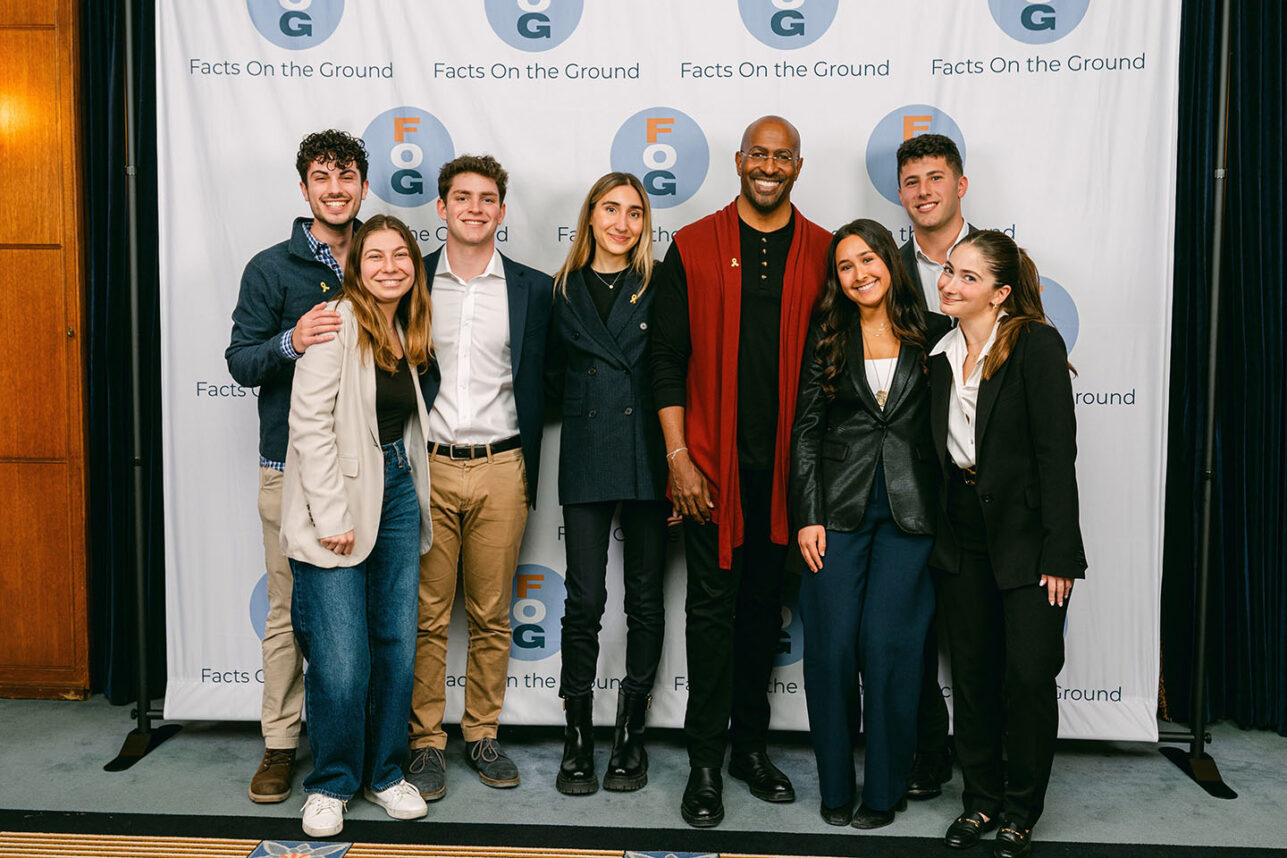
On March 17, a student group called Facts on the Ground at the University of Michigan (FOG) hosted a talk with CNN host Van Jones and Hussain Abdul-Hussain, senior research fellow at the Foundation for Defense of Democracies (FDD). The two discussed the topic of the night, “Policy for Peace in the Middle East” inside the school’s Rackham Auditorium, where students listened intently.

Jones, seated next to Abdul-Hussain on the stage, talked about how when he was younger, he was a leftist activist. Now, because of his experience, he understands what is happening on the left.

“I was woke before ya’ll had alarm clocks,” he told the audience. “I was on the left side of Pluto… any kind of -ist you could be, if it was against the system, I was that. I was a Black nationalist, and an anarchist and a Marxist and any other -ist I could find.”

Jones, who has publicly called for the release of the hostages and wore a yellow ribbon pin in support of them, continued, “It’s really wrong for [activists] to say if you believe in Black liberation, you should therefore support what Hamas did.”

Abdul-Hussain, a former reporter and managing editor at The Daily Star in Lebanon who reported from conflict zones, also touched on the left-wing activism on college campuses and around the world.

“It looks funny to people like us who grew up in that part of the world [when] you’re carrying an LGBTQ (flag) for Hamas,” he said. “Are you crazy? I have no idea how [this activism] passes in this country without being checked.”

While Abdul-Hussain grew up believing one thing about Israel, he saw the truth about the country in 2000, when Israel withdrew from Lebanon during the South Lebanon conflict. From Lebanon, he looked through a flimsy fence separating his country from Israel.

“I thought, ‘These are regular people,’” he said. “This made me curious. I spent the coming 10 to 15 years learning about Israeli society. I became fluent in Hebrew. I started listening to Hebrew debates. I wanted to understand what they were saying in their native language because somehow in the Arab world, you never get this debate. The only books about Israel you get if you grow up in Lebanon or Syria or Iraq are by [Noam] Chomsky or [Norman] Finkelstein or ‘Mein Kampf.’ You never get anything that’s close to reality.”

As an expert on Middle East relations – in particular relations with Iran and Israel, Abdul-Hussain discussed the fact that regional stability must depend on diplomacy and economic cooperation. Jones talked about Black and Jewish unity at the event, and at a roundtable prior to it, he brought together Black and Jewish students. They touched on coalition building and collaboration between the two communities.

No protestors were at the event; the campus has been a hotbed of antisemitic activity in the wake of October 7. There were flyers distributed shortly after that day that said, “Zionists f*** off,” someone crossed out a Star of David with red paint, a student leader posted on Instagram that they wanted to “utter death to every single individual who supports the Zionist state” and anti-Israel protestors dubbed themselves the “Student Intifada” and set up encampments.

Senior Sam Heller, who is director of finance at FOG, said that while antisemitism on campus was bad last year, “this year has been entirely different. The administration has been far more supportive, and pro-Hamas protests have significantly diminished. These experiences shaped me into the leader I am today. I am unapologetically Jewish and proudly pro-Israel. Unlike last year, it’s now rare to encounter students who loudly and aggressively push back against me for expressing that.”

Mia Curwin, a senior at UMich as well as the executive director at FOG at her school, said she helped create the group to “clear the fog” of misinformation she saw on campus.

“We focus on educational initiatives that promote diverse, productive and fact-based dialogue on the Middle East,” she said. “As students, educators and members of this community, we have a responsibility to engage in conversations that lead forward, but those discussions must be rooted in truth.”

Heller and Curwin believe the “Policy for Peace in the Middle East” talk, achieved its goal, which was, “to provide students with a fact-based opportunity to better understand the ongoing war in the Middle East while allowing them to form their own perspectives on the region’s dynamics,” Heller said. “By fostering discussions that acknowledge Israel’s right to self-determination and its role in regional stability, we hope to shift the conversation toward cooperation, progress and a more accurate understanding of the Middle East.”

At the end of the over 90-minute discussion, Jones left the audience with an inspirational message.

“To the young people who are here: It’s not such a bad thing to face a big challenge,” he said. “It’s not such a bad thing to have to straighten your back up and reach in your shirt and pull your star out and know someone may not like that. Breakdowns become breakthroughs when you use them right.”

“You have a strong people, a beautiful people, a generous and resourceful people.” – Van Jones

He continued, “Your parents, grandparents and great-grandparents, all the way back, had to deal with people who were hateful, ignorant, mean-spirited and wrong. Thank God they didn’t back down. Because you have had to stand up to hateful people for generations, you’ve created something beautiful on this earth. You have a strong people, a beautiful people, a generous and resourceful people. No pressure, no diamonds. So now it’s your turn. That’s all. That’s all.”

Student Group at UMich Hosts Van Jones and Hussain Abdul-Hussain for Talk on Middle East Peace Read More »

Print Issue: Wikipedia for Palestine | March 21, 2025

CLICK HERE FOR FULLSCREEN VERSION

Print Issue: Wikipedia for Palestine | March 21, 2025 Read More »

“You Want to Enjoy the Mundane” ft. Ami Kozak

This week we’re bringing you an exciting episode beginning with the launch of Libby’s new creative consulting business. Libby celebrates one month of working independently and shares about her journey of embracing new opportunities and attending events like the ADL conference and TikTok gatherings. She details a bit about what her new creative consulting company offers like unique packages for creators and brands, including behind-the-scenes event filming and social media strategies. Switching gears, Marla gives a major relationship update and discusses the importance of open communication and maintaining a strong connection amidst a busy life. 

They then welcome their guest, comedian Ami Kozak! (Note this episode was recorded a few months ago so some comments are slightly outdated). They continue with an exploration of Jewish identity, comedy, and music. Ami reflect on the challenges and joys of navigating a modern Orthodox Jewish upbringing, working in both music and comedy, and the power of social media. They dive into Ami’s controversial debate with Candace Owens as well as the surprising antisemitism that broke out after October 7th. The conversation also touches on societal pressures in dating, the dynamics of “schmuck culture,” and the importance of authenticity in relationships. 

“You Want to Enjoy the Mundane” ft. Ami Kozak Read More »

Rabbis of LA | Joel Nickerson, WBT’s New Rabbi, Wants to Hit the Ground Running

Perhaps it was accidental that Joel Nickerson was selected as the new senior rabbi of Wilshire Boulevard Temple (WBT) on Oct. 6, 2023, the day, he noted, before the world changed forever.

“A new level of access was open. I was empowered to ask questions that wouldn’t have been appropriate for me to ask previously. Even though I had been at Wilshire since 2019, for the first time every door was open for me to peek in, to understand the inner workings of every aspect of the institution.

“As a clergy member, I had collaborated with a lot of people and gone to board meetings. Now a new level of access was open. I also was empowered to ask questions that wouldn’t have been appropriate for me to ask previously.”

A year and a half after the Oakland native was announced as the retiring Rabbi Steve Leder’s successor, Nickerson was formally installed this month at Wilshire in the presence of his wife Julia and their three school-age daughters.

Being the rabbinic leader of the first, the most storied and most sprawling synagogue in Los Angeles, his promotion sparked questions he needed answered: How do we go through the budgeting process? How do we think about the projects we have underway? What are ways we are measuring success? What are the challenge areas? What’s going on in staffing and management on the HR side?

“There are advantages with having been here,”  Nickerson said, “such as knowing the people, the culture, being able to delve into things before I officially started. I also wanted to take advantage of that runway to start building deeper connections with congregants whom I didn’t know as well.”

Like a proud father, Rabbi Nickerson glows when he speaks of WBT’s “complexity,” its multiple campuses, multiple business units within, the camps, the Karsh Center, social service center, religious schools and day schools. “There’s a complexity to the organization, which is what I love about it,” the rabbi said. “This makes it very different than being a synagogue with one location that focuses on the traditional elements of a synagogue.”

Nickerson loves that WBT has expanded beyond what typically is expected of a synagogue, to span “the ideal elements of a Jewish community under one umbrella. Wilshire is in every corner of members’ lives.”

He believes WBT targets the essential values Jews are looking for in their lives. “You have education,” he says, “both in a traditional manner, but also experiential education with our camps. We have the concept of tikkun olam and our responsibility to the greater world with our social service center.”

WBT has all the pieces that make it special to be a part of the synagogue because “people can walk through a variety of doors. They can zoom in and out, choose one door, and if it is not right for them, they can choose another.”

While Nickerson graduated from Emory University in Georgia before he had decided on a career, he had a strong Jewish identity growing up in the Bay Area with a single mother. “When I was 12, my house burnt down in the Oakland fire, right before my bar mitzvah,” he said. “For me, the Jewish community was an essential part of rebuilding my life. It was important for my mother and me to have the support of the rabbi, Steve Chester, who officiated at my bar mitzvah, to have a built-in community that would support us.”

In the wake of January’s destructive Palisades and Altadena fires, Nickerson said “I have my own connection to empathize and know about how long recovery is going to be.”

In the wake of January’s destructive Palisades and Altadena fires, Nickerson said “I have my own connection to empathize and know about how long recovery is going to be.”

Given the proximity of WBT’s Resnick Family Campus on Sunset to the Palisades fires, 50 WBT families lost their homes and another 30 have been displaced. 

Nickerson calculates that besides Kehillat Israel in the Palisades and the Pasadena Jewish Center, the WBT community probably has been affected the most.

Nickerson reflected on his path to the rabbinate “I remember going to Israel in high school on a Federation trip from the Bay Area,” he said. “It helped me understand the breadth of the Jewish world. It connected me to the land and to the people.” His experiences with his peers in Israel were “transformative.”

But looking back, he guessed his path to the bimah probably began at Emory University. “I was a neuro-science major. I went there primarily so I could work at the Centers for Disease Control in the labs. I was fascinated by human nature from a science perspective.”

An Introduction to Judaism class he took with the renowned historian and diplomat Deborah Lipstadt started him on the path to a religious career.  He is quick to note that he would have laughed at the notion of becoming a rabbi then. “But it launched me into the intellectual, spiritual, historical connection to Judaism.”

After Emory, he pondered grad school for psychology. Instead, he chose Hillel at Stanford. “Through that job, I got to come to LA, to BCI (Brandeis Camp Institute),” Rabbi Nickerson said. “Not only did I meet my wife there, we studied [Rabbi Abraham Joshua] Heschel together. I also was exposed to this utopian Jewish experience, Jews from around the world, learning with excellent scholars, exploring Judaism through the arts, working the land in the morning, celebrating Shabbat in a beautiful way.” That, he said, “piqued my psyche. I said ‘I want to work for the Jews.’” 

He was 23 when he became youth director at Temple Judea, Tarzana, under Rabbi Don Goor, and taught religious school, which led him to Hebrew Union College. “There’s so much beauty and complexity to this work,” he said.

Fast Takes with Rabbi Nickerson   

Jewish Journal: What is your favorite book?

Rabbi Nickerson: To honor my wife and our time together, “The Sabbath” by Heschel. My connection with Julia reading that and how it opened my mind.

JJ: Your favorite family vacation?

JN: The Russian River in Sonoma County. My family has had a small cabin on the river for 120 years. Every winter break, my children, my wife and I go there for a week.

JJ: Your favorite moment at home?

JN: Sitting at the dinner table with my wife and my kids. 

Rabbis of LA | Joel Nickerson, WBT’s New Rabbi, Wants to Hit the Ground Running Read More »