fbpx

January 17, 2025

Never Alone

For over 15 months, Hamas has subjected the hostages to brutal physical, sexual, and psychological torment. Dr. Itai Pessach, a doctor at Sheba Hospital who cared for the hostages released last November, recounted that “there have been some episodes where Hamas separated two family members, and then put them back together, then separated them, then put them back together.” Much of this was deliberately planned. The terrorists were constantly telling the hostages: “Nobody cares about you. You are here alone. You hear the bombs falling? They don’t care about you.” Isolation was used as a psychological weapon.

This technique isn’t new. The Nazis, among their many methods of psychological torment, would separate family members to heighten their sense of loneliness.  The KGB would tell refuseniks that their friends had turned on them and the world was ignoring them. A lonely prisoner is easily broken.

To suffer in isolation is unbearable. It can eat away at one’s self-image; the feeling that you are being singled out for an unusual torment makes you feel rejected and unworthy. The Jewish proverb “the suffering of many is half a consolation” recognizes this reality. When you suffer alone, your suffering transforms from a psychological challenge into an existential crisis. You feel cursed, the one person that God has abandoned.

Much like the biblical Job’s friends, who blame him for his own suffering, some religious thinkers see defeat as evidence of unworthiness. The Church Fathers argued that exile was proof that the Jews were rejected by God. John Calvin’s theology suggests that worldly success is proof that one is among the divine elect, while failure means that one is rejected by God.

Judaism takes a very different view. The Torah says that God “executes the judgment of widow and orphans.” The Talmud goes much further, and says “the Divine Presence is above the head of the sick person”; God sits at the bedside of someone ill, and the Talmud says we should act as though we are in a synagogue when we visit. God doesn’t reject the weak and broken; He stands with them.

God reveals himself to Moses in a burning thornbush. This baffles the Midrash, which asks the obvious question: Couldn’t God reveal himself to Moses in something more majestic? The spot of the burning bush is where the Jews will receive the Torah, Mount Sinai; and, as Ibn Ezra explains, Mount Sinai gets its name from the thornbushes (sneh) that cover its surface. And that intensifies the question; the grand divine revelation of the Ten Commandments is given against the backdrop of lowly thornbushes.

The Midrashim offer multiple answers to this question. One answer is that yes, God could have spoken to Moses from the heavens, “but He humbled Himself and spoke to Moses from within the bush.”  This is the God who will redeem the slaves. Unlike the Egyptian Gods, the Jewish God can descend to those who, like the thornbush, are on the lowest rungs of society.

Another Midrash which is quoted by Rashi focuses on the thorns in the thornbush. It explains that even though it is (metaphorically) painful for God to inhabit the prickly thornbush, yet God does so anyway, because God shares in the slaves’ pain. The Midrash finds support for this idea in the verse (Psalm 91:15) “I am with him in distress.” God feels the pain of those who need redemption.

This dramatic idea becomes a foundation of Jewish philosophy. In the times of the Talmud, fast days would be declared during a severe drought. The people would go to pray in the street, and bring the Ark with the Torah scrolls with them. And, inspired by this verse in Psalms, they would place ashes on top of the ark, to indicate that God too was grieving with the community. The Talmud relates that “Rabbi Zeira said: At first when I saw the Sages place burnt ashes upon the ark, my entire body trembled.” It is shocking to imagine the Almighty suffering alongside man; but this is the Jewish view.

During the Holocaust, this idea gave support and comfort to many religious Jews. Rabbi Kalonymus Kalman Shapira, was the Rebbe of Piaseczno; after the Nazis invaded, he was sent to the Warsaw Ghetto.  A widower when the war began, he lost during the German invasion his only son, his daughter-in law, his mother, and his sister-in-law. Even so, he redoubled his efforts to care for his followers and did so until he was murdered by the Nazis. His sermons from the Warsaw Ghetto were hidden and recovered after the war, and printed under the title Aish Kodesh, “The Holy Fire.”

Rabbi Kalonymus Kalman uses this idea to offer hope amidst the horrors of the Holocaust. In one sermon given on July 11, 1942, he tells his followers:

And how can we slightly lift ourselves, at least a little, from the terrible old and new reports that shatter our bones and melt our hearts? By knowing that we are not alone in our suffering, but He, blessed be He, so to speak, suffers with us. “I am with him in distress.”

Rabbi Kalonymus Kalman is enduring unbearable suffering himself. Even so, he gives comfort to others, and finds comfort himself, in God’s presence. And he teaches his students that one is never alone, because God is always at their side; and the same God who appeared to Moses in the thornbush knows our pain and suffering too.

Rabbi Kalonymus Kalman is making a powerful declaration of faith. It is exceptional because many others during the Holocaust drew the opposite conclusion; they looked everywhere for God, and only saw an ugly void filled with darkness. But faith speaks its own language; and the words “I am with him in distress” inspired those who, like Rabbi Kalonymus Kalman, held tight to their beliefs no matter what.

I am frankly unsure if I have within me this type of heroic faith. But generations of Jews certainly did. They endured, lonely and abused, certain that God was crying alongside them. Rabbi Aharon Lichtenstein once related that “a woman asked my neighbor Leib Rochman, a Holocaust survivor, “Where was God during the Holocaust?” He replied, “He was with us.”

One is never alone, even in the most difficult of times. God is with you.

But for those like me with less than extraordinary faith, there is another lesson to be learned; we must seek to emulate God. If He descends to the thornbush to share in the pain of our brothers and sisters, we must do the same. “I am with them in distress” is our responsibility too. We must make sure they are never alone.

This weekend, the first set of hostages is due to be released by Hamas. It is a time of mixed emotions in Israel. There are fierce debates over whether the deal should be done, and whether this will cause greater suffering in the future. There is also the disappointment of those hoping for their relative’s release, only to find that they have to continue to wait. And in the background is the tragedy of the 1,200 people murdered on October 7th, and the over 400 young soldiers who have died in battle since then.

Yet there is joy for those who are released, no matter how small the group. Each human is an entire world, like Adam in the Garden of Eden; each child is a potential redeemer, like baby Moses. And if our hearts are with those who are in distress, they are also with those who rejoice.

In the next few days, there will be those who cry in pain, and others who will laugh in joy. And we will be with them, with all of them.

Just as God always is.


Rabbi Chaim Steinmetz is the Senior Rabbi of Congregation Kehilath Jeshurun in New York.

Never Alone Read More »

A Bisl Torah — The Tzadikim

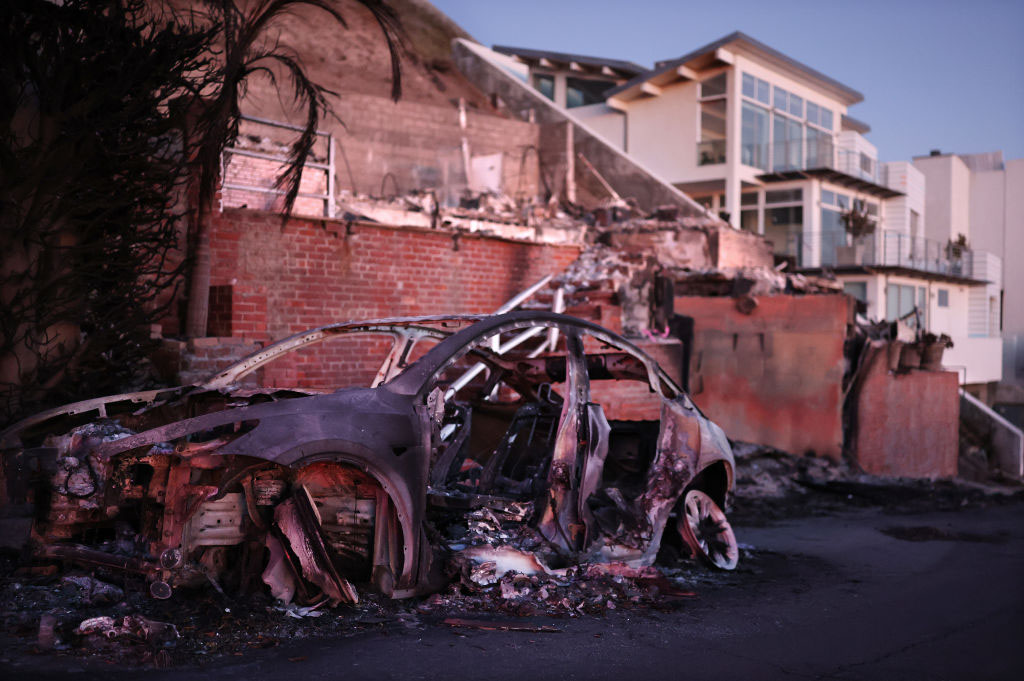
I have a feeling that Angelenos have met more tzadikim, more righteous people, this week than perhaps, ever before. Maimonides, the great Jewish philosopher, teaches that any human being can strive to be as righteous as Moses. We have within each one of us the capacity to be wise, merciful, and generous. It isn’t a matter of finding the righteous. It is a matter of choosing to be righteous.

This week, we celebrated our daughter’s bat mitzvah and had a tremendous amount of fresh, leftover, untouched food. We immediately thought the fire stations would be the best place to offer the meals. We went to three different stations, a YMCA, and an evacuation area. The people that greeted us came with smiles, gratitude, and love. They laughed with tears in their eyes, pointing to the piles of food and clothing around them, turning our food away because so many righteous souls had already offered so much. The innate goodness of this city feels unmeasurable.

The firefighters explained they were substitutes coming in from other cities outside of evacuation zones to help our resident firefighters reach the fires in the Palisades and Altadena. I asked these replacement firefighters when they last slept or had seen their own families. One kindly answered, “When our friends come home here, then we’ll go home, too.” As we say, they are a mensch.

And even though my Jewish mother genes were in full gear, the firefighters would not accept the food. One could see the donations piled around the station. As we started to walk away, one firefighter called out to me. “Wait! I have something for you!” I was hoping he’d at least take one tray but instead, I saw him holding a sweet bouquet of flowers. He said that someone had given him the flowers, but he wouldn’t be able to take them home to enjoy them. It would be a gift for him to know I would give the flowers a place on my dining room table.

And here they are: A testament to the righteousness of this city; the people that do not wake up declaring themselves heroes but who make split second decisions to rise to the occasion and allow love define who they are.

Through this tragedy of loss and destruction, the righteous have come forward. Los Angeles, the city of angels, human angels. As it says in Psalms, “May the righteous flourish in his time, and peace abound until the moon is no more.”

Let our goodness and kindness know no bounds.

Amen.


Rabbi Nicole Guzik is senior rabbi at Sinai Temple. She can be reached at her Facebook page at Rabbi Nicole Guzik or on Instagram @rabbiguzik. For more writings, visit Rabbi Guzik’s blog section from Sinai Temple’s website.

A Bisl Torah — The Tzadikim Read More »

Trump and Bibi: An Awkward First Dance

President Donald Trump wanted his Ronald Reagan moment. Just as Reagan saw 52 American hostages released from Iran on his Inauguration Day in 1981, Trump wanted hostages released from Gaza before his inauguration on Monday.

But in his zeal to get a big deal to mark his big day, our new president may have bought himself a ticking time bomb.

First, having to pay for hostages by freeing scores of prisoners can hardly be called a good deal. If releasing more than 1,900 Palestinian criminals in return for 33 Israeli hostages, as part of the first phase, is Trump’s definition of a victory, I suspect Hamas can’t wait for more such defeats.

Second, the deal is not really a deal; it’s more of a tease. It’s built on quicksand. Trump assumes the ceasefire will end the war and bring back all the hostages, but does he even realize the “deal” is a fragile three-stage process that leaves the key issues unresolved?  

After the first stage, most hostages (including several Americans) will remain in Hamas hands, at the mercy of further negotiations. The parties will then be trapped by opposite goals: Hamas wants to survive as a military force, while Israel wants to eliminate it. For many Israelis still traumatized by Oct. 7, finishing off Hamas is an existential imperative.

Hamas, meanwhile, has no intention of destroying itself. As Shmuel Rosner writes this week, “[Hamas] will never go through with a deal designed to bring about its own destruction.”

Trump was so intoxicated with his Inauguration deadline, he overlooked those complications and pressured Netanyahu to swallow a poisoned deal. This has created an awkward dance between the two allies. Trump has endorsed a process that ends a war Bibi and most Israelis do not want to end.

Had Trump not imposed his artificial deadline of Jan. 20, he might actually have delivered a good deal. After all, who says Israel must give up hundreds of murderers in return for innocent hostages who have been brutalized for 15 months?

All Trump needed was to wait until he got to the White House. As the most powerful man in the world, he could have applied maximum pressure on Hamas to “release all the hostages … or else.” He could simultaneously have pressured key Hamas allies like Qatar, Iran and Turkey, not to mention encouraged military pressure from Israel.

Force is the only language terrorists understand. In this case, we’re also dealing with terrorists whose very charter calls for the genocide of Jews.

In return for the release of all the hostages, Trump should have offered only one thing to Hamas leaders under military assault from Israel: personal survival. I’m sure they wouldn’t mind safe passage to a luxury hotel in Qatar, especially if the alternative is sure death.

All that said, we can’t underestimate the incredible joy we all felt last Sunday when hostages Romi Gonen, Emily Damari and Doron Steinbrecher returned home after 15 months of Hamas hell. This is what has made this war so heart-wrenching. We could never separate military victory from the rescue of hostages, one of the highest values in Judaism. In a sense, as Michael Oren has argued, both goals were irreconcilable.

Hamas, of course, knows all this. They know Israel’s dilemmas. That’s why they will never give up the remaining hostages unless they absolutely have to. 

Now they’re seeing how far they can exploit that leverage. As they prepare to welcome in jubilation the hundreds of criminals and murderers liberated from Israeli jails, Hamas will surely claim victory, at least in this first round.

They should remember, however, that as much as Trump loves making deals, he also loves Israel — and he hates getting ripped off.

Trump and Bibi: An Awkward First Dance Read More »

Recriminations – Thoughts on Torah Portion Shemot 2025 (slightly rewritten from previous versions)

Recriminations

Thoughts on Torah Portion Shemot 2025 (slightly rewritten from previous versions)

© Rabbi Mordecai Finley


Our names give us a stable reference for others, but we, the persons behind the names, know that we live lives of ever-changing senses of self. Our hopes and aspirations, our sorrows and our failures, our losing the way and our finding the road all shift the shape of our inner lives. You might for years tell the story of your life one way, and then the story wears out. You might discover that your story contains facts, but little truth. We have to retell our story. Maybe something happened. Maybe life happened.


Several chapters of our stories will begin with the words, “I was not prepared for what happened next.” The turn of events might create loss, sorrow or confusion. The turn of events might open a door to new love, or to an old love, become new. The turn of events might produce wonder, deepened purpose and resilience.


We are never fully prepared for the turns in the roads that are taking us away from that from which we are running, or from the roads that take us toward that for which we are searching. Sometimes things arrive on the road that have been searching for us.


Take Moses, for example. We are told in our Torah portion (in one long sentence) that Moses grew up, went out to his brethren, saw their suffering, and saw an Egyptian man (ish Mitzri) striking a Hebrew man (ish Ivri) of his (newly found) brethren. Moses looked around, and seeing no one, beat an Egyptian man to death and buried him in the sand.


We are not told that Moses investigated the matter, to find out what might have caused the Egyptian man to strike a Hebrew man. Maybe the Hebrew man hit the Egyptian man first. We typically assume that the Egyptian was a taskmaster, but the text does not say that. Maybe he was just some Egyptian guy. Moses went out to see his brethren and killed someone instead.


We can look long and hard at the story, and at the Midrashic depths of the story, to explain away the manslaughter. The facts as presented in the Torah, however, are sparse and rather horrifying.


When he killed that Egyptian man and buried that body, Moses buried a former self. He was no longer, internally, an Egyptian. He had changed sides. Whatever the killing was about, it was partly because the man was an Egyptian. Moses killed off his Egyptian self.  Moses had killed someone, someone who maybe did not deserve to die. Moses had done something, it seems, from a newly discovered inner identity, but a terrible deed nonetheless. Moses went out to see his brethren, and ended up destroying his old identity.


We have all buried former selves, especially the former self that thought it knew who we were, what we would do, and how things would turn out. Sometimes that new reality can hit us upside the head like a brick. Maybe even a brick of our own making. Maybe we even had to find the straw to make that brick.


When Moses went out to meet and greet his people, he couldn’t have imagined he’d return home with blood on his hands.


He went out the day after the murder, to return to the scene of the crime. He took with him, apparently, with of his old sense of self as a ruler. Adopted son of Pharaoh. New person, new people, but the same status.


When he went out the second day, Moses saw two Hebrew men beating each other. I wonder if this gave Moses pause. Maybe there was a gang of Hebrew ruffians about, ruffians who liked to fight, and one of them had attacked the Egyptian the day before. We, like Moses, don’t know what happened before the Egyptian man was beating the Israelite. The Torah averts her eyes when we start to ask.


In any case, Moses soon began to lord over the Hebews. He said to the wicked one, “Why would you strike your fellow?” The Hebrew man, characteristically, it turns out, answered a question with a question. “Who made you a dignitary, a ruler and judge over us? Are you going to murder me like you murdered the Egyptian?” Impudent ruffian. Moses became fearful and said to himself, “Apparently, the matter is known.”


Moses had buried the perhaps innocent Egyptian man’s body, but that did not cover up the deed. It seems that the man whom Moses had saved from the Egyptian had told everyone about the incident, including where the body was buried. We now see the man whom Moses had saved in a new light. Maybe the Hebrew man whom Moses had saved was not only an impudent ruffian, but also a gossip. Maybe the Egyptian man whom Moses had beaten to death was beating the Hebrew man for good reason, impudent, ruffian gossiper that he was. In the olden days, some people deserved a beating now and then. Maybe the Egyptian man of yesterday was no worse than the wicked Hebrew man of today who was beating his fellow Hebrew. Moses didn’t kill him.


Pharaoh finds out and seeks to kill Moses. Perhaps the Pharaoh had read a bit of the not-yet-in existence Bible, “Whosoever shall spill the blood of man, by man shall his blood be spilled.” Moses heads for the hills (of Midian).


Earlier that week, the biggest decision in Moses’ life might have been whether to order the tilapia or the mullet at the Nile Bar and Grill. Now he had to decide which road to take to evade an Egyptian posse. One rash, thoughtless act, and everything was changed forever. I can’t imagine even Moses being prepared for that. His name was still Moses, but he wasn’t the former Moses anymore.


How does he tell himself his story while hightailing it out of Egypt, or for the next 40 years, for that matter? How often does he go over those two days, over and over again, asking himself: “Who was I that I could do that? What was I before I did that? Did I know that I was the kind of man who could do such a thing?” He did the crime and now he would have plenty of unstructured time to think about it.


(I wonder if when Moses heard, “Thou Shalt Not Kill,” he thought, “oops.”)


Look in your past. Most of our offenses are petty, but some are egregious. Did you know how petty you could be, or how destructive you could be, the day before the deed? How do you account for your offenses? We all know this: you can’t bury the wayward self for long. The matter is known. The wayward self shakes off the dirt, or sand, and reappears.


We all have roads before us, the roads of denial or the roads of transformation. Bury the wayward self, or meet it on the road and work things through.


Subsequent events tell us that Moses took the road of transformation.


All of this is recorded in the yet-to-be-written “Journal of Moses’ Recriminations and Rebirth.”


Recriminations – Thoughts on Torah Portion Shemot 2025 (slightly rewritten from previous versions) Read More »

Anti-Israel Activists Compare LA Fires to Gaza

Anti-Israel activists on social media and elsewhere have compared the ongoing fires Los Angeles to the ongoing war in the Gaza Strip, with some going as far as blaming Israel for the fires.

The most notable figure to compare the Los Angeles fires to Gaza was Francesca Albanese, the United Nations Special Rapporteur on the Occupied Palestinian Territories. “On our small planet, all injustices are connected,” Albanese posted on X in response to an op-ed, “From Gaza to California: the flames that connect us all,” that was published on Mondoweiss, an anti-Zionist website.

The op-ed stated that “for 15 months, I’ve witnessed Gaza’s land, and people, burn through screens and headlines, and now as I watch the skies over an American city fill with smoke, the distances between these catastrophes collapse into a single, searing truth: these flames speak the same language of destruction – colonialism.” It goes onto state that “each bomb that falls on Gaza sends ripples through our collective future, its impact felt in rising seas, warming temperatures, and yes, in the fires that now threaten California’s hills.” It added: “The bitter irony doesn’t escape me: LA Mayor cut $17.6 million to its fire departments while California sent $610 million to Israel through taxpayers. The Wonderful Company, controlling nearly 60% of California’s water through the Resnick family, pumps millions into supporting the very territorial expansion that has turned Gaza’s landscape into an environmental catastrophe. That already, in 2025, Biden is trying to push for an additional 8 billion in military ‘aid’ to fund a Genocide while thousands of U.S. citizens from Ashville, NC to Los Angeles are suffocating under the climate crisis. We are funding the flames that will eventually reach our own doorsteps.”

The Jewish Chronicle quoted multiple X users rebuking Albanese’s X post, accusing her of blaming Israel for and connecting it to the fires.

The Anti-Defamation League’s (ADL) Center on Extremism released a report on Jan. 14 titled titled “Los Angeles Wildfires Trigger Conspiracy Theories and Hate” mentioned that the Resnick family has been subjected false rumors accusing “them of ‘controlling’ the water in California, suggesting they contributed to water shortages that have made it harder to contain the fires,” though the ADL report did not mention Albanese nor the Mondoweiss op-ed. The Wonderful Company released a statement on Jan. 12 stating that “there is zero truth that any individual or company, much less ours, owns or controls most of the water in California. It’s also not true we have anything to do with water supplied to Los Angeles. Water intended for municipal use is not taken for agricultural purposes or food production.” The company added that “we use less than 1% of the state’s water” and that “we own a 57% stake in the Kern Water Bank, not the state of California’s water resources.”

The ADL report also included a section on how “anti-Zionist influencers and groups are blaming Israel as a key catalyst for the wildfires.” It referred to far-right and anti-Zionist influencer Jackson Hinkle’s suggesting on X “that U.S. funding for both Israel and Ukraine has taken away from the Los Angeles Fire Department’s ability to combat the fires; his post has garnered over 26K likes.” It added that “similar narratives followed the aftermath of Hurricane Helene and Hurricane Milton in 2024, when false claims suggested that FEMA had insufficient funds for hurricane relief due to U.S. aid towards Israel. Anti-Zionist groups including Code Pink and certain chapters of Jewish Voice for Peace (JVP) attempted to draw explicit connections between Israel’s war in Gaza and the Los Angeles wildfires. On Instagram, these groups suggested that Israel’s military actions are a form of ecocide, meaning that Israel’s actions in Gaza are contributing disproportionately to global warming or that aid to Israel means the U.S. government doesn’t have adequate funds to fight the fires and climate change generally.” The ADL acknowledged that war contributes to climate change, but contended that “singling out Israel speaks to an agenda of demonizing and scapegoating Israel — rather than highlighting the actual climate crisis.”

Palestinian Media Watch noted that Fatah, the ruling party in the West Bank, published a cartoon on their official website stating that the Los Angeles fires are divine punishment for Donald Trump threatening to “open the gates of hell on the Middle East” if Hamas didn’t release the hostages by the time he returns to office.

Author Saul Sadka shared a screenshot on X of “Palestinian celebrations” of the fires; Ido Halbany, who educates people about Judaism and life in Israel, similarly shared screenshots of “pro-Palestinian comments” that are “enjoying every moment” of the fires.

Journalist Eve Barlow described the remarks blaming Israel for the fires — whether it was “payback” for the war in Gaza or that fire department funding was sent to Israel — as being “the fire libel.” In a Jan. 14 piece on her Substack, Barlow specifically pointed to a passage from the Mondoweiss op-ed shared by Albanese (though Barlow does not mention Albanese in her piece) as well as a post on X from comedian and writer Sammy Obeid stating “Biden just approved an $8 billion package to fight the fire in California … Oh wait that was for Israel to fight hospitals, sorry” as examples.

“All these champagne socialists do all day is parrot Hamas lies from the comfort of their first class air lounges, while discrediting themselves forevermore, because only the teeniest amount of fact-checking will show anyone with any modicum of integrity or care for reality that the purpose of Israel’s war in Gaza has not been ‘to fight hospitals,’ but to fight Hamas, who hide in hospitals, which — for the 1 millionth time — is a humanitarian crime in breach of international law,” Barlow wrote. “But also — what does Israel have to do with wild fires in Los Angeles? I’ll tell you what. Two Israeli NGOs have sent assistance to the fires.” Jewish Insider Senior Congressional Correspondent Marc Rod posted on X on Jan. 16 that “Israeli firefighters are arriving in LA today to assist with the wildfire response.”

“Nobody in Los Angeles has energy for these attention-seekers,” wrote Barlow. “The people on social media who have said nothing about the fires other than to make them about Gaza, the Palestinians, and Jewish billionaires see themselves in Palestinian propaganda because they too identify with making themselves the victims of everything that happens at all times. When someone they faintly knew dies, it’s about them. When someone they once met in a bar has a public scandal going on, it’s about them. When pandas are becoming extinct in China, it’s about them because of something that happened with a panda once in their childhood. Everything that ever happens in the world to anyone else is actually happening to them. They make themselves the center of every single story conceivable with the end goal of getting their own spotlight and attention, just like their Palestinian heroes.”

Barlow continued: “Let this show you who these people are. They’re narcissistic liars and they are suffering from a psychotic, hateful, mental derangement that no amount of re-education can resolve, because THEY DO NOT WANT TO LISTEN TO THE FACTS.”

Anti-Israel Activists Compare LA Fires to Gaza Read More »