fbpx

November 25, 2024

Thanksgiving Leftovers to Shabbat Dinner

One of the best things about Thanksgiving are the leftovers. Simply give them a makeover for the perfect Shabbat meal. 

For instance, your traditional Thanksgiving cranberry sauce can become the star of Shabbat. “Cranberry sauce makes a delightful dressing for salmon or chicken, bringing a festive twist to your meal,” Aderet Dana Hoch, registered dietitian nutritionist and owner of Dining With Nature, told The Journal. “This recipe highlights the joy of cooking homemade, while celebrating the versatility of a seasonal plant like cranberries.”

“Cranberry sauce makes a delightful dressing for salmon or chicken, bringing a festive twist to your meal.” – Aderet Dana Hoch

She added, “Pairing cranberries with a nutritious protein like salmon or chicken makes this dish both delicious and balanced; a perfect combination for any table.”

Homemade Cranberry Sauce

½ cup fresh orange juice
½ cup honey or maple syrup
½ cup water
3–4 cups cranberries (fresh or frozen)
A sprinkle of orange zest (for added brightness; optional)

Combine orange juice, honey or maple syrup and water in a medium saucepan. Bring the mixture to a boil, then add the cranberries and optional zest. Once it’s bubbling again, reduce the heat and let it simmer for 5–10 minutes. Stir occasionally until the sauce thickens to your liking. If you prefer a jam-like consistency, cook it a little longer.

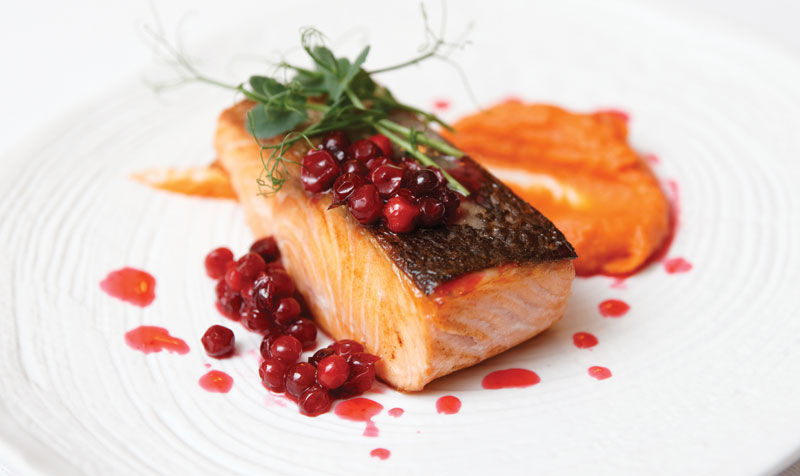
Cranberry-Glazed Salmon with Vegetables

Rinse your salmon filet under cool water and pat it dry with paper towels. Use a fork to poke small holes across the surface of the salmon. This helps the flavors infuse while cooking.

Sprinkle salmon generously with salt and pepper. Then, spread a layer of cranberry sauce over the top of the filet. Use as much as you like; more for a bold flavor, less for a subtle touch.

Place the salmon on a lined sheet pan and surround it with halved Brussels sprouts and sliced onions. Toss the veggies with olive oil, salt and pepper to complement the salmon.

Roast in a preheated oven at 400°F (200°C) for 20–25 minutes, or until the salmon flakes easily with a fork and the veggies are tender and caramelized.


For a hearty and healthy recipe that repurposes leftovers, try Dawn Lerman’s turkey cholent. “This high-protein recipe features the antioxidant benefits of turkey, lentils, sweet potatoes, turmeric and garlic,” board-certified nutritionist Lerman, author of “My Fat Dad: A Memoir of Food, Love and Family, With Recipes.” told The Journal. “This recipe is customizable and very forgiving, so feel free to personalize.”

“A bissel of this and a bissel of that” Turkey and Sweet Potatoes Cholent

24 ounces turkey meat  (thighs, legs and wings), shredded
2 onions, diced
3 heads of garlic, peeled
2 tsp turmeric powder
6 pieces of celery
2 raw carrots
1 cup of cooked or raw sweet potatoes, diced
1 cup of red lentils, rinsed
3 cups water
4 cups of chicken broth
1/3 cup extra virgin olive oil
Salt and pepper, to taste
Place all ingredients in a crockpot and mix well.

Cover the pot and cook on medium heat to high heat, which is 300° to 350°F on a crock pot. Simmer for one hour, until all the flavors meld together and the lentils are soft.

Then keep on low after sundown for lunch the following day.


Chef Olivia Ostrow believes Hachis Parmentier, which is also known as the poor French people’s shepherd’s pie, is the perfect way to use Thanksgiving leftovers.

“It’s made by chopping up leftover turkey, mixing it in a bowl with gravy and laying it at the bottom of an oven dish,” Ostrow, owner of Ostrow Brasserie, told the Journal. “Top it with mashed potatoes and leftover bread smashed into crumbs, stick it in the oven for 15 minutes and enjoy a perfect dinner.” 

Since the preparation is quick and easy, it’s the best meal to serve for Shabbat.

“It’s just what you want after all the hard work preparing for Thanksgiving,” she said. 
Zoryana Ivchenko/Getty Images

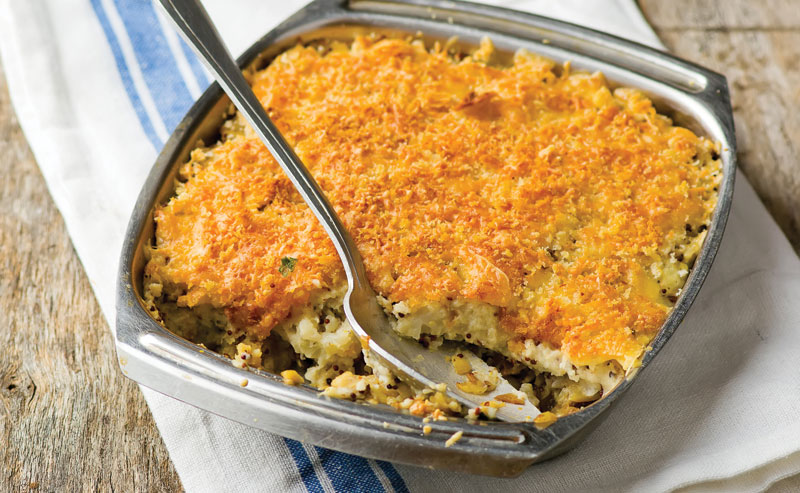
Turkey Hachis Parmentier

Serving Size: 4

1 Tbsp olive oil
1 large yellow onion, halved and very thinly sliced
3 cups cooked turkey, shredded
1/2 cup turkey gravy
 sea salt and freshly ground black pepper
1/4 tsp ground bay leaf
2 cups mashed potatoes, leftover, seasoned with salt and pepper
1 cup of bread crumbs 

1. Put the oil in a medium-sized, heavy saucepan over medium heat. Add the onions and cook until browned. You can add a little sugar to caramelize it; just a pinch!

2. Preheat the oven to 425°F.

3. When the onions are cooked, transfer them to a medium-sized baking dish, and spread them evenly across the bottom. Top with the shredded turkey and gravy.

4. Spread the mashed potatoes over the turkey in an even layer.

5. Top it evenly with the bread crumbs, and bake in the center of the oven until the potatoes are slightly golden, about 30 minutes. Remove from the oven and serve.

Thanksgiving Leftovers to Shabbat Dinner Read More »
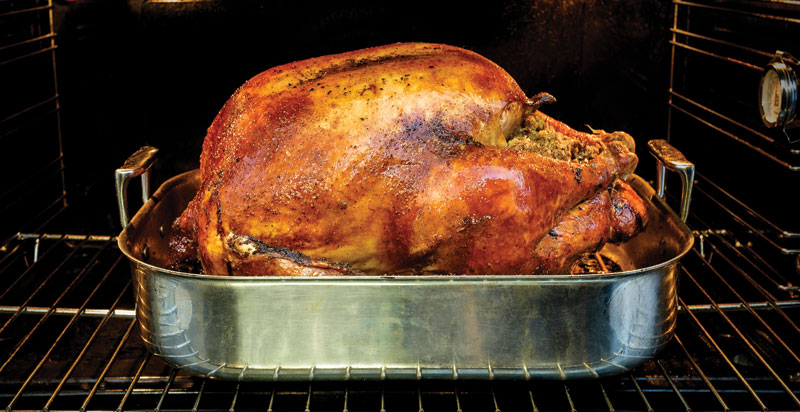
Let’s Talk Turkey: How to Make a Moist, Delicious Bird for Thanksgiving

A perfect, moist turkey for the centerpiece of your holiday table does not need to be an impossible dream. There are simple things you can do that will make all the difference. 

Chef Elizabeth Mehditach said the secret to juicy, tender, flavorful and evenly cooked turkey starts with spatchcocking. “Spatchcocking is an abbreviation of ‘dispatch the cock,’ simply meaning to remove the backbone of any bird – turkey, chicken, Cornish game hen, etc., then splaying it flat,” Mehditach, founder of Liza Michelle Lifestyle, told The Journal. “You’ll need some muscle to crack the breast bone flat too, when prepping for roasting.” 

She added, “White meat stays just as tender and juicy as the dark meat; plus, carving is easier.” 

Here are her other tips:

1. Marinate your turkey in an adobo brine or some sort of marinade for several hours prior to cooking. The acidity in any brine or marinade helps tenderize the meat and adds loads of flavor. Tip: Double the amount of marinade or adobo noted in the recipe for basting during cooking time; you don’t want to run out.

2. Add fat under the breast skin along with red wine/extra marinade. Kosher friends can use margarine or any of the vegan spreads out on the market now. This is all about adding moisture and flavor to the white meat as well as the rest of the bird.

3. Make sure you season the inside cavity of the bird really well. Adding aromatics, like cut up quarters of lemon, onion quarters, thyme, sage or rosemary, is a nice touch as well. (Make sure you remove any gizzards, the neck etc. from the cavity first!) You can add the innards of the bird to the roasting pan with your other vegetables (i.e., carrots, onions, celery, garlic cloves) and aromatics and marinade — it will make a richer base for your gravy. Discard after roasting.

While cooking: 

1. Most recipes recommend starting at a higher temperature; then, after 30 to 45 minutes, turning the temp down. Be sure to follow this important step.

Most recipes recommend starting at a higher temperature; then, after 30 to 45 minutes, turning the temp down. Be sure to follow this important step.

2. Next, cover the breast area or, if spatchcocked, the whole area with foil. This will keep the steam in and the bird moist, while preventing the skin from burning.

– Baste your bird every 30 to 40 minutes. Check the roasting pan for liquid, if it’s drying out, add more water, stock etc.


“Dry brine with kosher salt and black pepper at least 24 hours before cooking,” Lindsey Baruch, CEO and founder of Lindsey Eats, told The Journal. “It adds flavor and keeps the bird moist.” 

If your kosher turkey has been pre-salted, Baruch suggested placing the turkey on a large sheet tray in the fridge, uncovered for at least 24 hours, or up to 2 days ahead. 

“This allows all the moisture to get taken out and results in a crispy bird when roasting,” she said.

Baruch also recommended:

1. Use a large roasting rack, or large baking sheet. That way, you have the ability to baste throughout the cooking time all around the bird.

2. Layer vegetables, like carrots, fennels, red onion and garlic, around or under the bird, so the turkey dripping falls on them. These can then be used as a side dish.

Layer vegetables, like carrots, fennel, red onion and garlic, around or under the bird, so the turkey dripping falls on them. These can then be used as a side dish. 

3. Save any leftover turkey schmaltz to make turkey matzah ball soup the next day!


Tabby Refael, a weekly columnist for The Journal, and her family enjoy a “Persian-style” Thanksgiving each year.

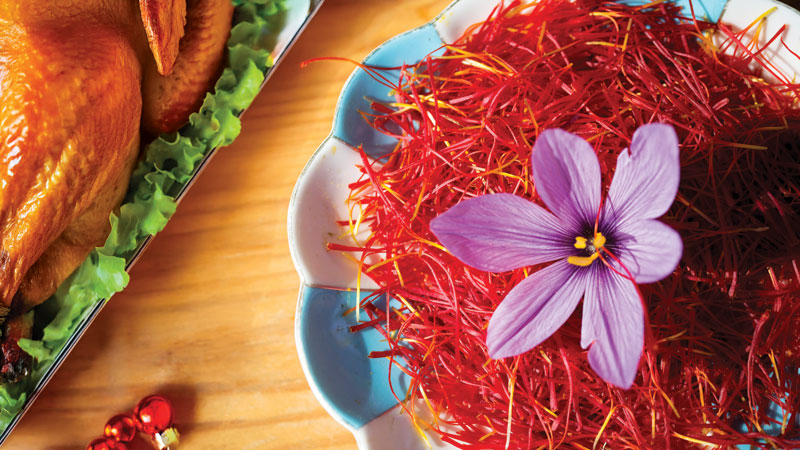
“As an Iranian Jew, I have a natural aversion to pale-looking poultry, because I only grew up with radioactively yellow chicken or turkey, covered in turmeric or saffron,” Refael told the Journal. “I like to dissolve about a teaspoon of saffron in some boiling water, cover it in a small glass bowl for about an hour and then pour it under the skin of the turkey, as well as on top.”

If you don’t own a turkey baster, she explained, throughout the cooking process, take a small ladle or a spoon and continuously spoon over some of the liquid. 

“This really helps keep the flesh tender and the skin very crispy,” she said. 

Here are some more of Refael’s turkey tips:

1. My go-to for any moist poultry is fresh onion. I cut one large onion into rings, which I place under the bird, whether it’s a whole roast chicken or turkey. Then, I cut a second, large onion into rings or half rings and cover the top of the turkey or chicken with it as well. 

2. Rub under the skin with parve butter, like margarine. Don’t melt it and pour it in. Depending on the size of the bird, take maybe four or five individual teaspoons of solid margarine and place it under the skin in various areas, particularly the breast, because the breast dries out the most. 

3. Stuff the inside of the bird with an orange, a lemon and garlic. Cut an orange cut in half, squeeze the juice of the orange over the bird and then put the remaining part of the orange inside. Use the same technique with a lemon, too. Then put in one head of washed, unpeeled garlic. If it doesn’t fit, use half a head, half an orange and half a lemon.

Let’s Talk Turkey: How to Make a Moist, Delicious Bird for Thanksgiving Read More »

Saffron and Football: How Sephardi and Mizrahi Jews Celebrate Thanksgiving

“Why is it so big?” my mother demanded to know while poking a defrosted turkey in a way that must have surely constituted fowl fat-shaming. 

“Remember I told you they make everything bigger in America?” my father reminded her. 

“Like that Oldsmobile?” groaned my mother, pointing toward the garage behind our two-bedroom apartment. Maman had an aversion to our brown Oldsmobile, primarily because the first and last time she attempted to sit behind its wheel and back the car out of that tight garage, she dented nearly every neighbor’s car and almost mowed down a poinsettia shrub that was home to a family of tired opossums. The look on those opossums’ faces when my five-foot mother nearly ran them over in that giant Oldsmobile is something I will never forget. For some reason, they packed up their bags and their tails and never came back to the outdoor garage of that apartment complex on Gale Drive. 

It was Thanksgiving 1992 and after having arrived in this country three years prior, our family finally wanted to pay homage to American traditions. Perhaps we had seen one too many ads for stuffing on TV, but Thanksgiving looked glorious, and we wanted in.

“It looks pretty empty in there,” observed my father as he peered into the open cavity of the turkey. And then, half- jokingly, Baba wondered, “Can you put something inside so it doesn’t look so immodest?”

“In there?” asked Maman. “Maybe I can push some too-deh-lee [Persian rice stuffing] inside. But why is this turkey so big?!”

My mother rubbed the skin of that turkey with so much saffron and turmeric that it looked downright radioactive. In the end, the turkey was placed on the table with a full view of the stuffing inside: ground Persian kabob mixed with onions and more turmeric. I’ll always remember that first Thanksgiving, when we remembered our love for this country as we sat with my cousins on our faux Persian rug, stuffed our faces, and watched “The Simpsons,” back when it still aired on Thursday nights. 

Instead of candied yams, we had Persian rice. Instead of green bean casserole, we had more Persian rice. We weren’t averse to traditional Thanksgiving staples; we simply didn’t know how to make them, and this was the pre-internet age. We managed to buy a frozen pumpkin pie, but no one thought to defrost it hours in advance. By the time everyone asked about dessert, my father gave my mother that frozen hunk of pie to place behind her aching back as she sat down and wondered why she had spent seven hours cooking for a Thursday meal, when she would need to spend another seven hours preparing for Shabbat the following day. 

Growing up, I always wondered whether Americans only reserved one day to be thankful for this amazing country. As protected refugees, every day felt like Thanksgiving for me and my family.

Growing up, I always wondered whether Americans only reserved one day to be thankful for this amazing country. As protected refugees, every day felt like Thanksgiving for me and my family. 

And it’s also important to note that as Jews, every week (Shabbat) felt like a Thanksgiving convention of family, food that brought one joy, and a certain sense of wonder that was rooted in our utter gratitude to have escaped from post-revolutionary Iran. As it turns out, when preparing a Thanksgiving meal, gratitude is the best seasoning of all. 

Tannaz Sassooni is a Los Angeles-based food writer who focuses on Iranian Jewish cuisine. Like me, she was born in Tehran and had similar early Thanksgiving experiences. “In our early years in the United States, my mom and my aunts did make turkey for Thanksgiving, but it came in the form of a big pot of haleem, a breakfast porridge with shredded turkey and wheat,” she told me. “We had no context for the holiday, but as new immigrants in an unfamiliar country, opportunities to gather with family were our respite, and the grownups tried their best to create some normalcy.”

That’s it. Some normalcy. As Iranian refugees and immigrants, we knew we looked different than most Americans, ate different foods and had wildly different customs. But one night of the year (perhaps two, if you count the Fourth of July), we had access to that “Americana” aspect of life here that helped us feel like normal Americans.  

“Over time,” Sassooni continued, “our Thanksgivings evolved: a neighbor introduced us to candied yams with marshmallows, which we still don’t really understand. Cousins married Americans, who brought with them their grandma’s apple pie, or ‘exotic American’ dishes like stuffing and cranberry sauce. These days, we get creative: Our turkey is finally whole, but it’s fragrant with saffron and strewn with quince and dried fruit. And yes, there’s stuffing, but there’s also tahchin, topped not with barberries, but cranberries. A true American Thanksgiving.”

When I asked Journal editor David Suissa and Rabbi Daniel Bouskila, Director of the Sephardic Educational Center, about their Thanksgivings, I expected memories that were similar to mine and Sassooni’s. Suissa and Bouskila are two of the proudest Sephardic Moroccan-Americans I know. But their responses surprised me in the best way possible:  “We actually went out of our way to add nothing of our own,” said Suissa. “We wanted the authentic American experience — turkey, stuffing, sweet potatoes, the works — even watching football. It’s America’s day. Doing it the American way was our way of saying thank you to this great country.”

Bouskila recalled, “I am a first generation American who grew up in a French-speaking Sephardic home. To borrow from the Passover Haggadah – Why was Thanksgiving different from all other holiday nights in our home? Because on all other nights – particularly Shabbat and Jewish holidays – our tables were Moroccan-Algerian culinary feasts, but on Thanksgiving night, our table was adorned with classic American Thanksgiving foods. Couscous and matbucha stepped aside for stuffing and sweet potatoes. On that night, our menu was proudly American, and eating the traditional Thanksgiving foods reflected our deep gratitude and love for America.”

I love that. 

Over the years, my family has convened around many Thanksgiving tables. The most difficult Thanksgiving I recall occurred in 2008, amid news of the widespread Mumbai attacks that also killed Chabad Rabbi Gavriel Holtzberg, his pregnant wife, Rivka, and six others. It was hard to chit-chat or even swallow our food that night amid news of four days of carnage in India. 

Last Thanksgiving, we were in a state of post-Oct. 7 shock and sorrow. I know this Thanksgiving will also be less sweet, as rockets continue to rain down on Israel, a five-front war continues, and we remember Chabad Rabbi Zvi Kogan, age 28, who was kidnapped last Thursday by terrorists in the United Arab Emirates and murdered. I believe all Jewish families should partake in a moment of silence before their lovely meals begin this Thanksgiving. 

However you celebrate this special day, the meaning remains the same: Amid the pain and confusion of reality, gratitude always leaves us feeling happier, healthier and more open-eyed to the wonder in our lives. And in case we coast through Thanksgiving mindlessly, Shabbat is always just one day away. 

Happy Thanksgiving.


Tabby Refael is an award-winning writer, speaker and weekly columnist for The Jewish Journal of Greater Los Angeles. Follow her on X and Instagram @TabbyRefael.

Saffron and Football: How Sephardi and Mizrahi Jews Celebrate Thanksgiving Read More »

Thanksgiving and John Adams’ Affinity for Athletics

Those tuning into the traditional slate of NFL games this Thanksgiving might not realize they are making the Founding Fathers proud, but sports and America have been connected since the country’s earliest days. 

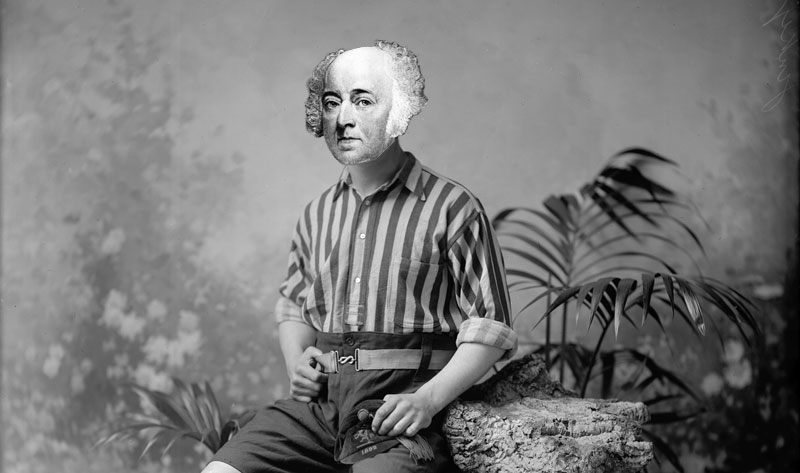
As Jack Campbell notes in a recent article in the Journal of the American Revolution, John Adams, America’s first vice president and second president, had a lifelong affinity for athletics. The stout Adams is often characterized as sternly formal, so it might come as a surprise he had decades-long devotion to sports. In a letter to fellow Founder Dr. Benjamin Rush, Adams writes of how when he was younger he was avidly “making and sailing Boats, in Swimming Skaiting, flying Kites and shooting in marbles, Ninepins, Bat and Ball, Footbal &c &c.” He even admits in his autobiography “My Enthusiasm for Sports and Inattention to Books, allarmed my Father” and reminisces how in his mind’s eye he “can revive the scenes, Diversions, sports of [my] Childhood, Youth.”

While nowadays, war metaphors are often used in sports (“blitzing the quarterback,” “the tiring pitcher doesn’t have many bullets left”), Adams’ writings often went in the other direction — bringing athletic analogies into his reflections on military actions. In an Aug. 28, 1782 letter to Virginia’s Attorney General Edmund Jenings during the Revolutionary War, Adams saw fealty for the cause as a bouncing ball to be kept in play. “The Courier de L’Europe Says, an Acknowledgement of American Independance is a breach of the Neutrality,” Adams wrote. “Let Us keep up this Ball and Set all the litterary Sportsmen in Europe to play with it —  it can do no harm and may do great good.”

While on a trip to France in 1778, Adams marveled that “Sunday in this Country is devoted to Amusements and Diversions. There are more Games, Plays, and Sports of every Kind on this day, than on any other, in the Week.”

Decades later, in a June 27, 1811 letter to the “Boston Patriot” newspaper after he had left office, his analogies to athletics continued. “For my own part,” he observed, based on his experience in the White House, “I thought America had been long enough involved in the wars of Europe. She had been a foot-ball between contending nations from the beginning, and it was easy to foresee that France and England both would endeavor to involve us in their future wars. I thought it our interest and duty to avoid it as much as possible, and to be completely independent, and to have nothing to do, but in commerce, with either of them.”

When Adams’ son John Quincy Adams, who would become America’s sixth president, once left his own son (John Adams II) and his brother George Washington Adams in grandfather John’s care for the day, the eldest Adams remarked  “George … is a dutiful Son, for he is deeply engaged in Platonick Greek” while “John is at present devoted to his Sports, in shooting and Fishing he thinks he has a licence in the Vacation.” Both grandsons, he concluded, are “good Lads and will come to something, If you do not allow them two much Money.”

No wonder then that when America had declared its independence, Adams foresaw sports as being an essential element of the celebration. Gratitude for liberty, he wrote in a letter to his beloved wife Abigail, “ought to be solemnized with Pomp and Parade, with Shews, Games, Sports, Guns, Bells, Bonfires and Illuminations from one End of this Continent to the other from this Time forward forever more.”

As we turn on the latest football action this weekend, or throw together a pick-up game of our own, let’s take a moment in between huddles to express our gratitude to those like John Adams who ensured our country is so often celebrated through sports.

So as we turn on the latest football action this weekend, or throw together a pick-up game of our own, let’s take a moment in between huddles to express our gratitude to those like John Adams who ensured our country is so often celebrated through sports.


Rabbi Dr. Stuart Halpern is Senior Adviser to the Provost of Yeshiva University and Deputy Director of Y.U.’s Straus Center for Torah and Western Thought. His books include “The Promise of Liberty: A Passover Haggada,” which examines the Exodus story’s impact on the United States, “Esther in America,” “Gleanings: Reflections on Ruth” and “Proclaim Liberty Throughout the Land: The Hebrew Bible in the United States.”

Thanksgiving and John Adams’ Affinity for Athletics Read More »

A Scapegoat For All Occasions

The sad truth is that anything I say today will alienate people I care about. I’m a proud Zionist, but going into this election, it was made crystal clear from countless posts that if Trump won, it would be the “fault of the Jews and Israel,” and if Kamala won, it would be, you guessed it, “the fault of the Jews and Israel.”

We “Chosen People” are the knee-jerk response in countless conspiracy theories and are said to control the media, Hollywood, and yes, even elections. You hate Trump? Haven’t you heard? Jews and their evil AIPAC helped elect him. Their dual loyalty makes them one-issue voters, and Trump will help Israel commit genocide. Oh, you hate Kamala? Haven’t you heard? Most Jews still voted Blue. They are so disloyal and ungrateful to the only friends they have (Republicans), and they are why Trump might lose! (Ironically, while people on the right and left throw stones at each other over differences in Israel/Gaza policy, those who hate us see no difference between the two parties, with each being labeled pro-genocide in their warped minds.)

Ironically, while people on the right and left throw stones at each other over differences in Israel/Gaza policy, those who hate us see no difference between the two parties, with each being labeled pro-genocide in their warped minds.

All roads in the brain of the conspiracy theorist lead back to us. Remember that little thing called COVID? We were blamed by both the anti-vax movement on the right for being profiteers behind the evil vaccines, and vilified by extremists on the left who said we created the virus. As much as I would love to make my mother proud and be all of the things all of the time, even my narcissism has its limits.

I’m no political strategist nor analyst, but I think Kamala made a huge error by not picking Shapiro as her VP and throwing away Pennsylvania and who knows what else in the process. Yes, it meant losing Pennsylvania, arguably the most important battleground state, but that’s not the only reason.

In spite of what social media and college campuses scream at us, it’s partly an optical illusion. Most of the country, for the most part, is not hateful towards Jews. Europe might be, and Amsterdam seems to be, but thankfully the United States is still overwhelmingly welcoming to me and my tribe. Oh, it’s getting much worse each year — per the FBI and ADL, the numbers are definitely trending in the wrong direction. But if you throw a dart at a random American, they are far more likely to embrace you as a Jew, and even offer empathy toward Israel, rather than question your horns or loyalty.

We all knew there were two picks that the Democrats were considering for VP. The watered-down version was that one was the extremely popular governor of Pennsylvania, who would lock up that most important of states. And the other was milk toast, not offering any real gains in any states. Oh, and the one that gained Pennsylvania was Jewish. When Josh Shapiro was passed over for Walz, countless Jews and our allies got nervous. Why turn away the surefire victory of the most important state unless it was just to appease the haters of Israel and Jews around the country? I’m not claiming to know the machinations and strategy of the Democrats; there may have been other reasons entirely. But I can speak to how it was perceived. And for many, our Spidey senses were tingling.

How much of a difference a pick of Shapiro would have made we will never know; I can assume it would have at least been a closer race. But for the conspiracy theorists, fingers were once again pointing at the Jews. Harris lost the election because of Israel. Jews funded Trump. Jews avenged Shapiro. Jews, Jews, Jews. For a people who make up just 0.2% of the world’s population, we sure are on people’s minds more than I’d like.


Boaz Hepner works as a Registered Nurse in Saint John’s Health Center. He moonlights as a columnist, where his focuses are on health and Israel, including his Chosen Links section of the Journal.

A Scapegoat For All Occasions Read More »

A Mitzvah in Memory of Rabbi Zvi Kogan

This week, Chabad Rabbi Zvi Kogan, of blessed memory, who was serving the Jewish community in Abu Dhabi, UAE was ruthlessly murdered. The entire Jewish community is in mourning. Like everyone else, I am heartbroken. I wanted to share comforting words in honor of him and his short but incredibly meaningful life.  

Chabad changed the trajectory of my life 14 years ago. I don’t know where I’d be without them. 

The year was 2010, and I had just graduated from college and moved to New York City. I was a wreck: anxious, depressed and having existential crises every few minutes. I was an atheist and had no God to turn to.

I had also started dating Daniel, a Jewish man who had gone “off the derech,” away from Jewish observance, for 11 years following bad experiences, including getting kicked out of his yeshiva for no good reason.

He had recently gone back to Chabad after a Chabad rabbi stopped him on the street and encouraged him to come to Friday night dinner. He loved it there.

One Friday, we were both broke and didn’t know where we’d get dinner. Daniel said, “Let’s go to Chabad.” I had no idea what that meant, but I went along with it.

That night, the rabbi greeted both of us with a warm smile. His wife cooked delicious food. There were so many different kinds of Jews around the table.

While the rabbi wore a black hat, everyone else was diverse — hipsters, businessmen, old and young people. I loved the community feel and how everyone came together. 

When the rabbi got up to share words of Torah, I felt a warmth in my chest. I thought, “This is God.”

I told Daniel I wanted to come back every week. We started going to the Chabad house for meals and events and to his parents’ home for Shabbat.

I started believing in God again and decided to convert to Judaism, choosing an Orthodox conversion, since I clicked with it the most. Daniel came back to Judaism on his own terms and also became observant again.

After I converted and Daniel and I got married, we traveled and went to Chabads everywhere: the Netherlands, Spain, Hawaii, Florida, Arizona, Aruba … so many places. We were always greeted with warmth and love.

Thank God, we have three Jewish children. Three Jewish neshamas were created because of Chabad.

Though I am not a “Chabadnik,” Chabad always has a special place in my heart. The shluchim pour their hearts and souls into their work, and it isn’t easy.

They are often away from family, away from other Jews, and are living to serve their people. I admire them so much. They are the most incredible people you’ll ever meet.

Whenever I feel like judging my fellow Jew, I think, “What would the Rebbe do?” And I hold my judgment and try to look favorably upon them instead, just like he would.

With the tragic murder of Rabbi Zvi Kogan, absolute hate eradicated absolute love. Why do bad things happen to good people? Why, God, did this happen?

Humans have free will, and they sometimes do horrible things. But I believe that love, in the end, conquers hate.

In Rabbi Zvi’s memory, I encourage you to do mitzvot. Go to a Chabad for Shabbat dinner this week. Check in on your local shluchim to see if they are OK. Take on one mitzvah you haven’t done before. Jewish women: Light candles this Friday night. Jewish men: Wrap tefillin. Go to a community gathering. Visit a senior who is lonely. Donate to a good cause. Spread love in this world, which needs it so much right now.

We can fix the world with our good deeds. We can usher in Moshiach so that nothing like this happens again.

My heart is broken. The Jewish people’s collective heart is broken. But it can be mended.

My heart is broken. The Jewish people’s collective heart is broken. But it can be mended.

Baruch Dayan Emet Rabbi Zvi Kogan. You will not be forgotten. The Jewish people will continue your legacy, spreading love and light in your honor. 

Love you all.


Kylie Ora Lobell is an award-winning writer and Community Editor of the Jewish Journal. You can find Kylie on X @KylieOraLobell or Instagram @KylieOraWriter.

A Mitzvah in Memory of Rabbi Zvi Kogan Read More »

ICC Kangaroo Court in Session

As if legal systems, and international bodies like the United Nations, needed any assistance in further damaging the public’s perception of their hypocrisy, the International Criminal Court (ICC) has sullied the name of the rule of law even more. 

It’s really time for the United States to withdraw its funding to kangaroo courts like the International Court of Justice. The names of these are laughable misnomers (‘justice”?), not unlike the Human Rights Council of the U.N., which occasionally features humanitarians like Iran and Syria as members in good standing.

The United States Senate should expedite passage of the Illegitimate Court Counteraction Act. It already has bipartisan congressional support. Under this measure, ICC officials, and their outside experts, who abuse their authority by prosecuting leaders from the U.S. and its democratic allies, would be unwelcome in America. 

George Clooney’s wife, Amal, for instance, would kindly be asked to leave. More about that later.

Last week, Israeli Prime Minister Benjamin Netanyahu, America’s ally, learned that the ICC had issued a warrant for his arrest. Yes, the prime minister of Israel, and his former defense minister, Yoav Gallant, are now international outlaws. If this legal farce can happen to them, it will most certainly happen to an American leader sometime very soon.

What judicial wisdom was revealed by the anti-Western, antisemitic haters from The Hague? Netanyahu and Gallant are being charged with starvation as a method of warfare; crimes against humanity; and “intentionally directing an attack against the civilian population” of Gaza.

Each of these charges stem from Israel’s retaliation against Hamas for the Oct. 7 massacre.

Demonstrating the ICC’s balancing of the scales of justice, one of Hamas’ former military leaders has also been charged, but, unfortunately, he is already dead. 

It doesn’t matter. What matters is that the court is drawing a moral equivalence between terrorists who behead Israeli babies, gang rape scores of Israeli teenagers, and murder, mutilate and torch 1,200 Israelis, and the undeniably just war Israel is waging in self-defense. Israeli leaders are being prosecuted for casualties of war in Gaza; the actions of Hamas, which includes causing these casualties by placing them in harm’s way as human shields … well, that’s just Arabs having fun.

This is the first time in the court’s existence, dating back to 2002 with the Rome Statute, signed by 125 nations — the United States and Israel, for obvious reasons, are not signatories — that a leader of a democratic nation has been charged. 

Democratic governance is important, because the ICC was supposed to prosecute leaders from nations that did not have functioning independent legal systems of their own. Israel most certainly does, and several investigations of its wartime conduct are already underway, directed by Israeli legal experts who are not known to cut the Jewish state any breaks.

Because Israel never signed onto the Rome Statute, the ICC has no jurisdiction or enforcement powers over Netanyahu and Gallant, anyway. In its nearly 25 years of holding court, the ICC doesn’t have much to show for itself. Take Omar al-Bashir, the former head of state in Sudan responsible for the genocide in Darfur. He has been at large since 2009, and it took six years for the I.C.C. to even obtain an enforceable arrest warrant.

 Of course, as a matter of law and procedure, this case is wholly deficient. Factually, it is groundless. Starvation as warfare requires a proving of intent that Netanyahu is fighting a war specifically to starve Gazans, and that he is “willfully impeding relief.” But Israel is fighting terrorists who steal the food that Israel is allowing into the enclave. Under international law, and siege warfare, given that this aid is ultimately feeding terrorists, Israel isn’t obligated to allow any humanitarian assistance at all — and yet it has been doing so since the war began.

The factual claim of starvation itself is in dispute. Over the summer, an agency of the U.N., the Integrated Food Security Classification System, determined that starvation in Gaza has simply not materialized, despite alarms sounding to the contrary. The ICC knows there is no actual evidence that a single Gazan has died of starvation as a result of Israel’s border policies. And there is even less evidence that Israel is fighting this war to intentionally inflict starvation on the Palestinian people.

The same specific intent requirement applies to crimes against humanity. Even dishonest brokers assessing the war in Gaza realize that Hamas started it. Israel is targeting terrorists, not civilians. Casualties of war are not victims of genocide, and the collateral damage in Gaza would be considerably less if civilians were not being used as human shields, and other civilians, of the true believer variety, wouldn’t so agreeably volunteer for human-shield duty.

How could the ICC get this so wrong? Aside from antisemitism, which is a default conclusion for many questions involving Jews, the ICC recruited four legal consultants to evaluate the case before proceeding with arrest warrants. The one thing they all shared in common: years of prejudging Israel of war crimes. The selection of the experts made the prosecution a forgone conclusion.

One is on record supporting BDS against Israel. Another falsely accused Israel of shutting off Gaza’s water supply. Israel controls less than 10% of Gaza’s water, and it has no legal obligation to hydrate Hamas. Another “expert” needs to reread the Law of War Manual, because it is not illegal to impose a siege on a civilian population when they are embedded within a terrorist fighting force. He had also already declared that Israel was committing war crimes before he took on the ICC assignment.

And the last expert, Amal Clooney, has her own long history demonizing the Jewish state.

The ICC’s Code of Conduct states that the prosecutor’s office should not “negatively affect confidence in [its] independence,” and should “refrain from expressing an opinion” that could taint its impartiality.

So much for that.

This case sets a dangerous precedent. Urban warfare against terrorists where collateral damage is a natural occurrence is being characterized as crimes against humanity. Donald Trump could easily have been charged following the Battle of Mosul, which eliminated ISIS, but resulted in thousands of civilian deaths.

For those dissatisfied that Trump largely escaped all those prosecutions against him in the United States, the ICC has just given you something new to root for.


Thane Rosenbaum is a novelist, essayist, law professor and Distinguished University Professor at Touro University, where he directs the Forum on Life, Culture & Society. He is the legal analyst for CBS News Radio. His most recent book is titled “Saving Free Speech … From Itself,” and his forthcoming book is titled, “Beyond Proportionality: Is Israel Fighting a Just War in Gaza?”

ICC Kangaroo Court in Session Read More »