fbpx

November 14, 2024

Kosher Asian Fusion Comes to LA

On Oct. 1, I needed a break from the reality of antisemitism. That day, Iran had launched 200 ballistic missiles against Israel (again), Hamas gunmen had killed seven innocent people in a vicious terror attack in Jaffa, and I was compulsively refreshing news sites and growing irreversibly anxious.

I needed an escape, so I drove through the smog, traffic and hustle and bustle of Pico Boulevard in West Los Angeles until I arrived at my “secret garden.” It, too, was located on Pico, but one would never know what was waiting inside a kosher restaurant named Bowls N’ Bunz. 

At first glance, the restaurant appears like any other Asian fusion joint in L.A., though the city’s latest kosher Asian fusion establishment is worthy of recognition (it holds O-K Glatt kosher certification). But if one keeps walking inside, that secret garden in the back of the restaurant, replete with greenery and dozens of enchanting Moroccan lanterns that glitter above at nightfall, is a reminder that even in the often-predictable landscape of Pico-Robertson kosher restaurants, there is always more than meets the eye. 

That day, the sun was shining as I helplessly read the news and watched videos of my former homeland attacking my eternal homeland. But somehow, surrounded by that small oasis on Pico Boulevard (and Asian staples like orange chicken and vegetable Lo Mein which, for me, constitute the best of comfort foods), I felt I had given myself the gift of something every Jewish person has needed this year: A break. 

Owners Ellie and Moshe Edison opened Bowls N’ Bunz several months ago, renaming and rebranding their former restaurant at the same location, Kosher Madness, which served everything from Persian kabobs to pastrami fries. The couple amicably parted ways from their former business partner and set out “to create the kind of kosher food we really don’t have here in L.A.,” Moshe told me. He wanted to move beyond “fast-casual” options and instead, offer “fine dining and the experience of quality.” But there was only one challenge: “I choose my passion,” said Moshe, who spent years training as a chef. “My passion is Asian fusion.”

The Edisons are the first to admit their unique challenge: Asian fusion is not often synonymous with fine dining, particularly when it comes to kosher options. That’s where the reality of Moshe’s health considerations informed part of the menu for Bowls N’ Bunz: At age 21, he was diagnosed with Crohn’s, a disease that can cause abdominal pain, inflammation and other difficult symptoms. 

How, then, does Moshe eat the succulent foods that he and his chefs prepare for customers, including chicken teriyaki and Korean beef bulgogi (a fan favorite), without triggering a Crohn’s flare-up? Despite a range of deep-fried options, whenever possible, the restaurant takes it easy on the oil and sugar; chef Moshe and his team instead prefer boiling meats and vegetables. “I realized that we Jews don’t really know how to make things al dente, or without sugar and oil,” Ellie told me. “But al dente is our aim.” A quick glimpse into the kitchen revealed a welcome sight: There were no “hot pots” (big pots of various foods simmering in oil until ready to be served); every dish is made to order. 

Moshe’s insistence on fewer and better quality ingredients probably explains why he politely left our interview early, insisting that he “had to go shopping.” Every two days, he visits local Asian markets and hand-picks vegetables that are boiled, sauteed, chopped and diced at Bowls N’ Bunz.

Moshe’s insistence on fewer and better quality ingredients probably explains why he politely left our interview early, insisting that he “had to go shopping.” 

Though I am often helpless in refusing the restaurant’s take on orange chicken (it tastes even better than the Panda Express version, which I enjoyed heartily before committing to kosher dietary laws as an adult), it is the crispy garlic green beans to which I always return. In a menu filled with various sandwiches, Korean and Chinese steak plates and what the Edisons call the city’s first kosher ramen, authentically made with ginger broth, vegetables and a hard-boiled egg, those savory green beans constitute a meal of their own, despite being an option on the appetizer menu. 

The Edisons’ story is one of grit, starting over and resilience: Ellie came to the United States as a child refugee from Iran at age six; Moshe immigrated here with his Iranian family from Israel when he was a one-year-old. They met in Los Angeles, where they married and are raising three daughters. In 2016, the family relocated to Las Vegas to open Ace of Steaks, serving prime kosher steaks and Persian food. Though the couple always shares kind words about their time in Nevada, I suspect that Vegas may not have been ready for five-star kosher steaks and kabobs (Moshe makes an excellent beef koobideh). For various reasons, including the fact that they missed their close-knit Iranian-American family, the Edisons moved back to Los Angeles in 2019.

Moshe tried other business ventures. “One day, he called me and said, ‘I found it. I found home,’” recalled Ellie, who learned that her husband had already given the owner of the space that became Bowls N’ Bunz an offer and received the key. “Moshe said, ‘Ellie, Hashem didn’t put any blocks in my way. He opened my path and it was just handed to me,’” Ellie remembered. 

Over the years, Moshe, who is the ultimate foodie, has acquired a gentle gripe over kosher food in this city: “Kosher restaurants in L.A. feel like they don’t need to give the customer the “Wow” factor,” he lamented. “They know you don’t have a choice, so they don’t have to impress you. In New York or Miami, there are so many kosher options that they have to up their game.” 

Moshe is also “tired of the small portions of meat” at local restaurants, which he patronizes not only because he loves food, but because he understands the importance of supporting kosher establishments. Still, his chefs must comply with his policy that meat dishes can’t be overfilled with vegetables to save a few pennies. “I want customers to have more meat,” declared Moshe (Jewish mothers rejoice). 

I couldn’t help but ask the Edisons if L.A. Jewry is ready for a different kind of restaurant, one that serves Korean barbecue, including galbi (short ribs), and ramen that doesn’t come in a plastic wrapper with a spice pack and a disposable fork. It often seems that every other kosher restaurant that opens in L.A. serves pizza or falafel. “Sometimes, you feel like pizza and falafel,” Ellie gently reminded me. “But it comes down to taste buds. Sometimes, you feel like spoiling yourself.”

Like the time last month, when Israel was under fire and I wandered into that secret garden, a space that is filled with both open air and privacy, at lunchtime. Isn’t it amazing how the best spaces in Los Angeles are the ones that enable you to feel as though you are no longer in L.A.?

In the coming months, Bowls N’ Bunz hopes to host comedy nights and offer customers a chance to grill Korean barbeque right at the table. The space currently accommodates gatherings for up to 100 people and thankfully, their catering menu still features Moshe’s famous kabobs. The venture is a dream come true for Moshe, whose great-great-grandfather earned a modest living by selling lentils back in Iran (in Persian, lentils are called “Adass,” and the family’s long-standing last name was “Adassian” before they changed it to “Edison” upon arrival in the U.S.).

In the coming months, Bowls N’ Bunz hopes to host comedy nights and offer customers a chance to grill Korean barbeque right at the table. 

Last year, Ellie prayed to G-d for “a chance to give people good food” and to enjoy a close-knit relationship with a team of devoted staff. The hours are long and there are always lessons to be learned, but for now, she, too, enters that secret garden and relaxes with her thoughts long after the last customer has been served, and that last lantern dims gently to signal the end of another bustling day on Pico Boulevard.


Tabby Refael is an award-winning writer, speaker and weekly columnist for The Jewish Journal of Greater Los Angeles. Follow her on X and Instagram @TabbyRefael

Kosher Asian Fusion Comes to LA Read More »
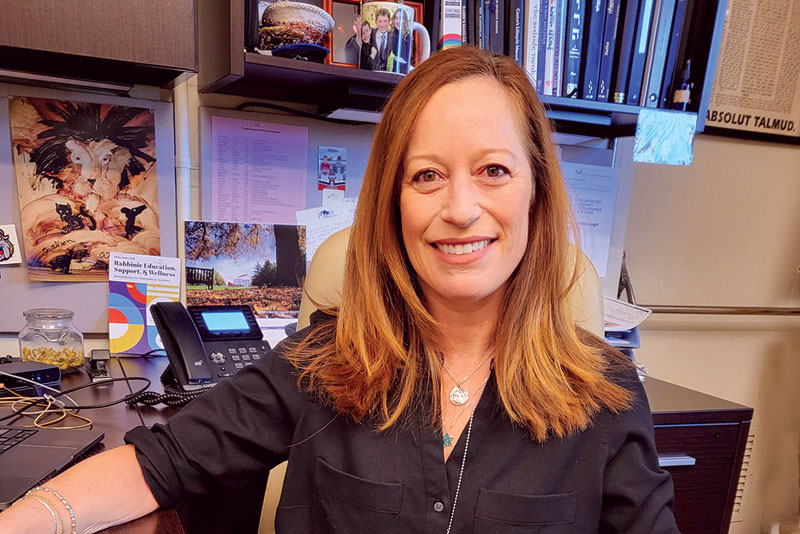
Rabbis of L.A.: How Alison Wissot Became Rabbi-Cantor Wissot

Her title might read “Rabbi Cantor,” but Temple Judea’s Alison Wissot knows that’s backwards. Singing, and becoming a cantor came first, thanks to the legendary Cantor Nathan Lam.

“I grew up at Stephen Wise Temple when it was ‘Stephen S. Wise.’  Rabbi Isaiah Zeldin was my rabbi, and then Rabbi Eli Herscher. They were giants. It was a magnificent experience growing up there. I felt very connected there to my Jewish identity. I didn’t love Religious School. But I loved singing Jewish music.”

Even when she was “really little,” Wissot was already a performer, a kid acting in musicals. Dance was her first love, followed by singing. She joined a ballet company When she was about 13, she began voice lessons. “I had sung with Cantor Lam in various opportunities. Lam formed a student group that sang at Wise’s Friday night services, Wissot joined and, “as time went on,” she said, “it became a deep part of who I was.”

By the time she was a 10th grader at Westlake School for girls, her classmates were talking careers, but “there really weren’t women cantors. I did not envision myself doing this. But as I grew older, that world became more open to me.”

But she still yearned for the stage. She fulfilled those desires as a young adult, appearing on stage in both New York and London. “While I felt happy during that time, and I loved the work, I was not fulfilled,” she said. And she was homesick. “I was missing my family,” so she returned to Los Angeles. 

Back home, one Shabbat morning, Cantor Linda Kates was leading the services at Stephen Wise. “All of those moments came together,” she said. “The beauty of the Jewish music, the feeling of purpose, the feeling of community – and also hearing a woman’s voice, someone to whom I could relate. I was a little older. I had done some of the things I wanted to do. It clicked.”

Forty-eight hours later, she knew what she had to do. “I had a Monday morning voice lesson with Cantor Lam,” she said. “I went into his office and said ‘Sit down, there is something I have to tell you.’ He said ‘You sit down. There is something I have to tell you.’ He said ‘There’s an Israel trip leaving in about 10 days. A spot just opened. I want you to take it.’

“I said, ‘That’s great, because I am going to be a cantor!’” This was about 1996. 

“I think most of us in this business have a moment where time stops and it all comes together,” she said. After the Israel trip, she enrolled at Hebrew Union College (HUC), New York. “I was the weirdo who took extra classes — all I could fit in. I just wanted to learn. It should not have been a shock to anyone when I went to rabbinical school.”

She can trace her decision to become a rabbi to a single date: 9/11. Returning to Stephen Wise as a cantor in the summer of 2001, “I had barely gotten my feet wet as a professional when 9/11 happened.” From conversations with the clergy team, she “realized on that day that to be a part of the Jewish discourse, to be able to contribute my thoughts and opinions, I needed to have the authenticity of being a rabbi.”

Convinced before 9/11 that “I knew a lot about what was going on in the world with radical Islam,” the cantor said “nobody was interested because my training was as a cantor.” She realized she could spend the next 15 years “waiting for people to find my own authenticity, or I could go back and study more and get my rabbinical degree and be a part of the conversation.”

Two years later, she left Wise to become a fulltime rabbinical student at HUC Los Angeles. “I landed here [at Temple Judea] because the cantor before me was leaving. They needed someone to fill in.”

Michael Wissot, then running for the California Assembly, came to Wise for Shabbat as part of his campaign. “I noticed him from the bimah,” she said. “But I was too chicken to introduce myself. My parents had met him at another event, and they introduced me.”

The same day they met, she told her parents he was “The One.” He agreed.

After 22 years, Wissot said her job still looks different every year. “I love that because I never get bored,” she said. “One thing I love about this place is that you can take risks — a firm enough place to stand by its values but flexible in responding to the needs of the community.”

She calls the staff at Judea an “amazing team; we like each other, we disagree about a lot, and we talk about important things.” The rabbi-cantor would counsel a newcomer, “You need to be able to tolerate but empathize with opinions different from yourself. That is the only way we get to a sense of truth. None of us has The Truth.” Wissot always operated with the idea of “prepare yourself and the opportunity will come,” which she said means “study, learn, grow, continue to take voice lessons until you are going to stop singing, continue to put things into the well and suddenly there are opportunities to use those things. That is what my parents taught me. It’s what makes life fulfilling. Be in conversation with people with whom you disagree. Work on your own character. See the beauty life has to offer.”

“That is what my parents taught me. It’s what makes life fulfilling. Be in conversation with people with whom you disagree. Work on your own character. See the beauty life has to offer.”

Fast Takes with Rabbi-Cantor Wissot

Jewish Journal: Do you have any unmet goals?

Rabbi-Cantor Wissot: An infinite number. My goal this year: I want people to understand they need to show up (at services). Watching online is wonderful, but you need to be in the room for others.

J.J.: The single happiest moment of your life?

CW: I am lucky to have many. Meeting my husband and knowing instantaneously. I knew. He knew. The births of my three children. Moments in their lives. My wedding. I have been blessed with so many extraordinary moments. If I am open to it, there will be more.

J.J.  Best book you have read?

CW: “The Choice” by the Holocaust survivor Edith Eger.

Rabbis of L.A.: How Alison Wissot Became Rabbi-Cantor Wissot Read More »

Predicting Trump’s Policies

Trump is Israel’s best friend.
Trump is an isolationist.
Trump is a dangerous bully.
Trump is a peacemaker.
Trump is unpredictable.

Trump is a Rorschach test. For now, that is what he is. All of the above are somewhat true, none of the above reveals much about his future policies in the Middle East. He is going to be in Netanyahu’s pocket – worries a European diplomat. He isn’t going to be in Netanyahu’s pocket – predicts a hopeful Netanyahu opponent. What people read into Trump’s intentions is their own fears and their own wishes. What people read into Trump’s intentions is based only on partial information.

Example: “Trump Won’t Move U.S. Embassy in Israel to Jerusalem.” That’s a WSJ headline from 2017. But Trump did move the embassy. Example: “Peace in the Middle East? Why Trump, Clinton Are Unlikely to Help.” That’s from NBC, in 2016. And yet, Trump did help. In fact, he is the only U.S. President since Bill Clinton (peace between Israel and Jordan) who was able to complete a peace deal worthy of its name. 

Now take all the above listed truisms and turn them on their head. Israel’s best friend? I don’t think so. Trump doesn’t seem like the emotional type – he doesn’t seem to have attachment to any country, or ideology. An isolationist? So why the Abraham Accords, why the sanctions on Iran, why the involvement in the attempt to tame North Korea? A dangerous bully? Trump – as he repeatedly remarked during his campaign – did not rush to launch wars. A peacemaker? More a dealmaker. Unpredictable? In fact, his main unpredictability stems from the fact that people were astonished to see him act in ways that were in line with his campaign promises. He said he’d move the embassy, and he did. The surprise is only because many presidents before him made similar promises without feeling the need to do what they vowed to do.

On this last point, I’d start any attempt to assess Trump’s future policies by taking his declared intentions seriously. When he says he wants the war in Gaza and Lebanon to stop – he means it. Of course, stopping the war isn’t as easy as declaring your intention. The war has two sides and both must accept certain terms for it to stop. This means that Trump is going to have to make at least two important decisions as he strives to stop the war. One: he needs to decide what is in his view a reasonable framework that could become the exit strategy from the war. Two: following this decision, he’d need to put pressure on the belligerent parties to accept the framework, and such pressure could be applied in two possible fashions. On Israel – to accept Trump’s framework. Or on Israel’s enemies – to accept Trump’s framework. The challenge for Israel is clear: It is easier for the U.S. to put pressure on its ally Israel than it is to put pressure on its enemies. Israelis pushed back against some of the proposals put forward by the Biden administration because of their belief that Biden and his emissaries are trying to push Israel around – because it’s easier to do – rather than pushing Israel’s enemies, as the situation requires. 

Lebanon is going to be a clear test of Trump’s intentions. What Israel wants in Lebanon is a diplomatic settlement. The government wants it, the IDF preaches for it, and the public will support it – if, and only if, the security arrangements could guarantee the safety of Israel’s northern communities. What does this mean? That’s quite simple: Implement U.N. Security Council Resolution 1701. That is to say: in 2006 the resolution was passed and accepted but it was never truly realized. The resolution has clauses demanding the disarmament of all nonstate actors in Lebanon. It has clauses insisting that only the Lebanese army and UNIFIL can operate in the area between the Israel border and the Litani River. Neither thing happened. The Resolution was good. The implementation was bad. 

This time around, what Israel wants is to make sure that implementation would be guaranteed. It wants to clarify, in writing, that a failure to implement the agreement is going to prompt legitimate Israeli actions. Trump can make such arrangement work by vowing to let Israel act if the implementation in 2025 is an agreement is a repeat of the implementation in 2006. Trump can make this arrangement work by pressuring actors such as France to publicly declare that they also accept the idea of serious implementation – or else. Trump can make such an arrangement work. 

And he can do all this by being Trump Israel’s best friend, an isolationist, a dangerous bully, a peacemaker. By being unpredictable. That is – by keeping his word.

Something I wrote in Hebrew

Last week, when Defense Minister Gallant was fired by the PM, I wrote the following paragraph:

Everything Netanyahu does is within the law. Netanyahu behaves with cold cynicism, with calculated cruelty and promiscuously – but the dismissal of the Minister of Defense is within his authority. This is what makes it very difficult for those who oppose him. If they want to maintain the formal framework of what citizens are allowed and forbidden to do, they don’t have many tools. If they decide to go beyond this framework, beyond closing a street for a day or two, they will be accused of disrupting the war effort. 

A week’s numbers

When the public doesn’t trust the government, that’s the sad result (a Ch.12 News survey).

A reader’s response

Naomi Brown writes: I can’t understand why Israelis were so pleased when Trump won. My response: Please see my column from last week (you can easily find it on JJ’s website). 

Predicting Trump’s Policies Read More »

I Voted for Kamala. Here’s Why We’re in Trouble.

It’s Nov. 6, the day after the election. 

10:28 am: I receive an email from MoveOn.org, where I was once a donor before they became so blatantly anti-Israel. “MoveOn resisted Trump’s agenda at every turn during his first presidency and we are prepared to do it again.” 

1:07 pm: I receive an email from my very liberal synagogue’s rabbi, whose opinions and sentiments I don’t always agree with. “Join us tonight as we gather to grieve, sing, pray and process this moment.” (A political shiva?)

I think: Maybe, just maybe, they’ve got this all wrong. 

I listened to Kamala’s impressive concession speech. I wish all her speeches had been that passionate and forthright. But when she advocated that we keep fighting against the opposition, maybe she too was wrong. 

I voted for her, although without much passion. It would be more accurate to say I was voting against Trump, who I passionately didn’t support. My sentiments against him were stronger than my doubts about her. But now that he’s won, what course should we Democrats take? Certainly not the course we’ve been on.

Now that he’s won, what course should we Democrats take? Certainly not the course we’ve been on.  

Not the course of “resistance again.” Not the course of “grieving.” We’ve done all that before, and it has yielded very little for a better America, or a better Democratic Party. To follow this failed course, and stay within the boxes we drew last year, four years ago, 10 years ago— ramping them up, strengthening them— is foolhardy. The proof is all around us. 

What do we do? 

For starters, get out of our echo chambers that make us feel so good, justified and connected to our political peers. Dare to leave our comfort zones. Think in ways we never would consider before. Creatively. Strategically. Challenge our liberal leaders and influencers to think differently. Stop demonizing those who don’t agree with us. Stop thinking they are all crazy. Find some respect for them. Ask ourselves a million hard questions. 

Among them: How do we partner with this new administration? How do we collaborate with those with whom we don’t agree? How do we work across the aisle for the good of this country? How do we extend a hand to people, delirious in victory, who have no intention right now of partnering with the other side? 

This is why I smell trouble.

Because so far, I’m seeing a lot more finger-pointing than self-reflection. Instead of asking, “What’s wrong with us?” my Democratic peers seem to be asking, “What’s wrong with America?”

Instead of asking why our policies were so unpopular, my Democratic peers are hiding behind the “it’s happening all around the world” excuse.

Instead of asking why the other side managed to build such a large, multi-ethnic coalition, some of my Democratic peers are accusing Black and Latino male voters who voted for Trump of being anti-women. 

Last week, Los Angeles Times columnist LZ Granderson blamed Kamala’s loss on the voting patterns of white women. Rather than blaming strategies and policies, everyone seems to be blaming everyone. It’s a circular firing squad par excellence.

But shifting the blame won’t cut it. Our starting point must be to listen to those who didn’t vote for us.

I learned this in the advertising business. When we created campaigns, they were not only targeted at current buyers, justifying and strengthening their decision to continue buying the client’s product. We also needed to raise our antenna toward the buyers who were loyal to the competition. We needed to get out and meet them, hear them, catch their non-verbal signals, hear what was between the lines or even not being said. We needed to understand them, finding ways to create a relationship with them. 

Now we the Democrats are not listening, or meeting. We are dismissing. We’re not interested in creating relationships with them. And they are not interested in creating relationships with us.  But that shouldn’t stop us. We need to find partners on the other side, willing to work with us and break this down. 

There is an extraordinary irony here. Liberals, especially in the Jewish world, are the ones right now talking ceasefire, peace, dialogue. Why are the ones who so strongly believe in this approach for Israel and its enemies, not also taking this approach between American Democrats and Republicans? Why are they fighting so hard against one another in this country, ginning up a political and culture war, rather than leading the way to find compromise, commonality and collaboration between all of us?

There is an extraordinary irony here. Liberals, especially in the Jewish world, are the ones right now talking ceasefire, peace, dialogue. Why are the ones who so strongly believe in this approach for Israel and its enemies, not also taking this approach between American Democrats and Republicans? 

“But,” many people will cry, “the other side has no intention of compromise.” No one says this is going to be easy. Do we give up and crawl back into our comfort zones?

I have a very close friend, Dr. Ernie Katz, a well-known psychologist in Los Angeles. A son of Holocaust survivors. A Modern Orthodox guy. We’ve been friends since college. He signed the ketuba at my wedding 50 years ago. He voted for Trump. From his life experience, he has his reasons. Most of my Chabad friends voted for Trump. They have their reasons. Most of my Persian-Jewish friends voted for Trump. Their families had to flee a threatening antisemitic regime. They have their reasons. One of my sons-in-law, Camilo, a Nicaraguan Jew, voted for Trump. He grew up in a revolution. He has his reasons. The guy who built my deck — born in the U.S., the son of Salvadoran refugees who fled the Mara Salvatrucha gang — voted for Trump. He has his reasons. 

I have my reasons for why I voted the other way. We talk to one another.  None of these people are crazy, mean, or ill-intentioned human beings. They think differently than me about politics, about America, and about who best protects them, particularly those concerned about Jewish life here and in Israel. Should I be ending these relationships, because we have different opinions about an American election? 

I’m curious by nature. I find differences between people fascinating. As Kamala kept saying, we have more in common than what sets us apart.  She stated over and over that she loves this country and believes in America. Now all the pundits are asking what her new job might be. Maybe it should be the job of every losing presidential candidate, with an understanding and expectation that this is what they do next — help bring America together. Not that Trump would have ever considered doing this. But that spirit is one of the reasons why I did not vote for him.

I’m curious by nature. I find differences between people fascinating. As Kamala kept saying, we have more in common than what sets us apart.

Now, let’s swing this around to the Jewish world, where we have created so many divisions. We talk about the Jewish People, and yet we exclude so many of those people. We love each other. We hate one another. We feel for each other. We demonize each other. We are a tangle of nuances and complexities. Many people say we have always been divided like this and there is no chance for unity. Do we like it this way? Should we just leave it like it is? Or do we try to talk to one another, hear each other, work to understand? No one said it’s going to be easy. 

Wouldn’t that be the breakthrough? 

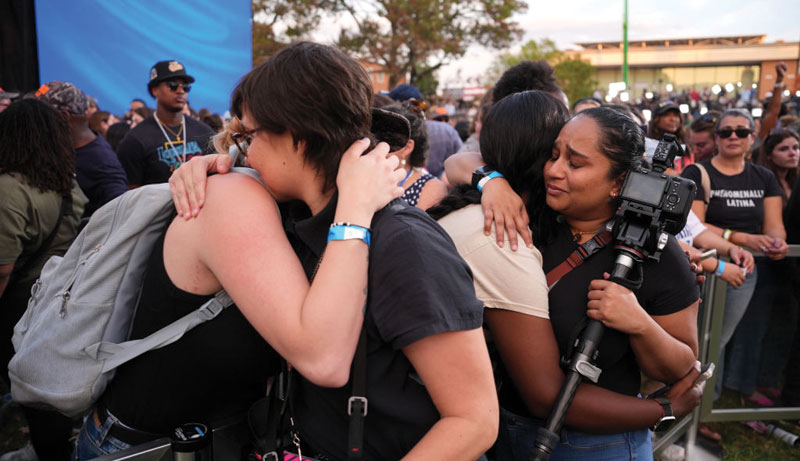
Supporters react after Democratic presidential nominee, U.S. Vice President Kamala Harris conceded the election during a speech at Howard University on Nov. 6, 2024 (Photo by Andrew Harnik/Getty Images)

And if we made that breakthrough between us, the Jews of this country, imagine the experience we could bring to America. We would learn so much about how to do this, that we could be sharing this knowledge all over the US, spreading it to communities and locales everywhere.  It would give us an important role in this society. We’d be fulfilling our role as a “light unto the nations.” Talk about performing Tikkun Olam. 

Isn’t this what we Jews should be doing, rather than “resisting the agenda,” rather than “grieving” and sitting political shiva?  No one died. Aren’t we the People who Moses instructed to “choose life”?


Gary Wexler was recently honored by the National Library of Israel with the creation of The Gary Wexler Archive, a 20-year history of Jewish life told through the advertising campaigns he created for Jewish organizations in the US, Canada and Israel. 

I Voted for Kamala. Here’s Why We’re in Trouble. Read More »

Table for Five: Vayera

One verse, five voices. Edited by Nina Litvak and Salvador Litvak, the Accidental Talmudist

Abraham hastened into the tent to Sarah, and said, “Quick, three seahs of choice flour! Knead and make cakes!”

– Gen. 18:6


Rabbi Lori Shapiro
Artistic Director, Open Temple

The greatest impact following this year’s presidential election will not be decided by whether or not our candidate wins. Rather, history will be made by how we respond as Americans once a final result is revealed. It is our behavior with one another that determines America’s future far more than anyone in the White House. 

Rambam and Rashi agree — Abraham requests an abundance of flour for the strangers and extracts its finest filament for his guests. He does not know who is visiting but acts upon his instinct for divine service. Abraham provides this fine flour despite his bodily discomfort, the heat of the day and his lack of familiarity. These factors are irrelevant. Neither is anyone’s political agenda, affiliation or the color of their skin. All that Abraham knows is that they show up, and it is upon him to serve.

What would a world like this look like today? What if we looked past political affiliation, sex and identity politics, and cared for the strangers in our midst? What if we open our “tents of being” (aka our hearts and souls) on all sides, and expedited a feast of curiosity and compassion with everyone we come into contact with?

There is nothing that we cannot surmount in this world when we work together. Perhaps the authentic stranger today is the one who believes this to be true. May Abraham’s wisdom speedily be served, and may all feast in a banquet of his nourishing message for peace, hope and redemption.  


Rabbi Benjamin Blech
Professor of Talmud, Yeshiva University

Hopefully America survived. 

The election is over. And we pray that after so many months of bitter enmity, hostility and hatred, our country will again rediscover the secret of Abraham.

What makes the Jews so special? Why are we the one nation that discovered the secret of historic survival? The Torah gives us the answer by way of the life of our first patriarch. Abraham taught us what it means to be a Jew. His very first act as a servant of God was to express loving care and concern for three passing strangers. 

Feed the hungry, clothe the naked, invite the stranger – acts of kindness and hospitality define us far more than all the protests and rallies and name-calling of those we continue mistakenly to define as moral examples of virtue. For many months now politicians spewed insults, cursed opponents, vilified all who disagreed with any of their self-centered views – and insisted that only they represented ethical virtue and divine character.

Abraham would have been profoundly ashamed.

But Judaism begins with the premise of human dignity, man “in the image of G-d.” It is time to remember that just before the message of unity and love made its voice heard by the first Jew, it was the world of violence — biblically identified as “Hamas” — that was responsible for almost universal destruction from a divinely ordained flood.


Rabbi Pinchas Winston
Thirtysix.org

The Talmud says: “Every action that Abraham performed himself for the angels, God performed Himself for Abraham’s descendants. Every action that Abraham performed through a messenger, God likewise performed for his descendants through a messenger” (Bava Metzia 86b). The Talmud likes to make statements as if they’re obvious when they are far from it. Firstly, why penalize Abraham’s descendants if he erred? I thought we only punish children for the sins of their fathers if the children continue committing the sins. Secondly, what did Abraham even do wrong? Was he supposed to do everything on his own? One of the reasons Abraham involved Yishmael in the mitzvah was to train him to perform good deeds for others. Surely, that had to count in his favor, not against him. Perhaps the Talmud is not criticizing Abraham for how he cared for the wayfarers, but simply pointing out a historical connection to what he did in his time and what happened later to his descendants in theirs. It may seem that what happens to us, the descendants of Abraham, is disconnected from the past, but there is a fundamental connection. Even F-16s racing across the Israeli skies on their way to do battle are connected to the lives of our forefathers. A tree can grow in unpredictable ways, but however it does and whatever it produces can be traced back to its roots. The same is true of the Jewish people in every generation.


Rabbi Michael Barclay
Spiritual Leader of Temple Ner Simcha (www.NerSimcha.org)

Hospitality to guests is a primary value in Judaism, and at its essence, hospitality is the theme of this entire portion. As we see in this reading, Abraham demonstrates hospitality to strangers with passion and alacrity. Even though he had just been circumcised immediately prior to this incident, he jumps up to be hospitable to these strangers. As a result, he and his wife are rewarded with a child, Isaac.

Shortly after this experience of being hospitable, Abraham sees the results of the opposite type of behavior. God, in this portion, destroys Sodom and Gomorrah. Although many people think this is because of the illicit sexual practices of Sodom, our Sages recognize that the destruction of these cities is because of their unwillingness to be hospitable to strangers. The people of Sodom were only interested in sexuality with strangers, not even with local virgins. Although Abraham is able to negotiate with God that if even 10 people can be found who are righteous in the city it would be saved, the Sodomites were committed to abusing strangers … and for this, they were destroyed.

The emphasis on hospitality is clear: Abraham and Sarah are rewarded with a child for this act of hospitality to strangers. Sodom and Gomorrah, on the other hand, are destroyed for their lack of hospitality. I knew a man at LMU who always set an extra place setting at his dinner table in case a guest came by. A beautiful practice based on this reading that we all can and should emulate. May we all take this lesson from the reading and choose in this coming year to be kinder, gentler and more welcoming to everyone who crosses our path. 


Yehudit Garmaise
Marriage and Family Therapy student, freelance writer, English and parsha teacher 

In this parsha, Sarah shares her holy secret of how to be both happy and gebentsht. Sifting what corresponds to 53 pounds of flour (more than 10x what we use to make hafrashich challah), Sarah expressed her considerable efforts toward separating herself from coarseness. While Hashem commanded Abraham to circumcise himself at age 99 to elevate him even further spiritually than he could ascend on his own, Sarah’s ascent to prophetess resulted from the personal refinement she achieved from sifting falseness and conflict away from her life. Just as Sarah would only use finest flour to bake for her guests, spiritually: she engaged only with emes.

Instead of feeling threatened, triggered, and sad from challenging situations and difficult people, we can learn from Sarah to detach from them, just as she leaves behind “coarse flour.” After disengaging from toxicity, we must continually choose to “knead” only the “fine flour,” which represents choosing the most holy and gentle ways in which to interact with others. 

Sarah’s efforts to knead her dough into three cakes for her angels was a positive and giving action she took to counter the sadness she felt as a result of her childlessness, Rav Shlomo Wolbe tells us. When we are giving, productive, and creative, we merit true simcha.

When the very guests for whom Sarah baked relayed the joyful message that within a year, she would bear a child, we learn that in return for our efforts for others, Hashem showers us with blessings.


Table for Five: Vayera Read More »

What Are Our ‘Magic Words’?

“There are no atheists in a foxhole.”

This famous aphorism, quoted by President Eisenhower in a broadcast in 1954, is very often used as a praise of religion, explaining how people embrace a Higher Power when in a state of extreme fear or despair. When there is nowhere else to turn, they raise their hands toward Heaven and beg for Divine aid.

Early in October, sirens blared across the entirety of Israel as Iran sent a barrage of over 180 ballistic missiles toward the civilian population. Fear and uncertainty gripped Jews globally. Those not living in Israel, who were not running toward bomb shelters, did what Jews do in times of distress and fear: They gathered by the dozens to recite Tehillim. En masse, they beseeched God to protect His people.

Although nearly 200 missiles, each longer than a school bus and capable of immense destruction, hurtled toward Israel, nearly all were intercepted, no Israeli deaths were reported, and only minimal damage occurred. Pentagon Press Secretary Air Force Maj. Gen. Pat Ryder explained in a security briefing that “you don’t launch that many missiles at a target without the intent of hitting something. Just like the last time, [Iran’s] intent [was] to cause destruction.”

Yet, in what can only be described as a miracle, the attack was a dud.

We all heard this incredible news, read the reports, gathered together, called out to God for mercy and salvation when the missiles were up, but when we witnessed the modern-day miracle that had just occurred, we didn’t do anything about it. We failed to acknowledge the miracle and thank Him when the missiles came down. We had called out to God when we were in distress with nowhere else to turn, yet we didn’t call out to Him when the danger had passed.

As Jews, whenever we are in distress, whether it be individually, communally, or globally, we gather to recite Psalms, to the extent that Tehillim has become synonymous with times of despair.

However, throughout the entire lengthy book of Tehillim, the majority of its 150 chapters are not begging God for salvation or safety, the majority are praises of God and extensive, beautiful expressions of gratitude.

As C.S. Lewis shares in his “Reflections on the Psalms,” “The most valuable thing the Psalms do for me is to express that same delight in God which made David dance … I find an experience fully God-centered, asking of God no gift more urgently than His presence, the gift of Himself, joyous to the highest degree, and unmistakably real.” (“Reflections on the Psalms,” Chapter V.)

God Himself highlights this important theme of gratitude in His very act of creation. “God said ‘Let there be light’ and there was light. And God saw that the light was good” (Genesis 1:3-4). God creates light and darkness and then immediately steps back to recognize and appreciate the result. In the literal sense, God does Hakarat Hatov, He recognizes the good and appreciates it.

We as Jews must always, and constantly, thank God. Whether in the mundane and common, such as eating, or the extraordinary and exciting, such as a wedding, we are commanded to express gratitude to God.

Psalms must not only be synonymous with despondency and anguish, it must be synonymous with joy and thanksgiving; we must always rejoice in the praising and thanking of God.

“Enter His gates with thanksgiving, His courts with praise; give thanks to Him, bless His name” (Psalms 100:4)

Of course we must thank and acknowledge God, as Nachmanides says: “for there is no other reason for creation” (Nachmanides, Exodus 13:16), but how are we expected to thank Him now, when we are in times of immense grief and pain? How can we continue to thank God when in the midst of a devastating war?

Following the events of Oct. 7, I co-ran a project called “Letters to The Nation” in which a friend and I would collect thousands of personal letters of support and comfort from Jews across the globe, and deliver the letters, in person, to grieving families. We delivered thousands of heartfelt letters from across six continents to dozens and dozens of families.

One such family was the Baker family from Ashdod.

The Baker family had immigrated to Israel from France not many years before. Only a few months after having arrived in Israel, the patriarch of the family died of cancer. Soon after, with the tears still wet on her face, a grieving wife lost her beloved youngest child. Naomi Baker, only 19 years old, was murdered at the Nova festival by Hamas terrorists on Oct. 7.

This mother had lost everything. She was in pain that cannot even begin to be understood. She was in the darkest of moments. Yet, she felt such gratitude to God. that her beloved daughter was not taken hostage and that her body was found whole.

It was a gratitude which I had never seen before. It was unfathomably sincere gratitude from a woman in unfathomable pain. But even in her darkest moment, when she had every right to be furious with God, she turned to Him in gratitude and praise.

It was a gratitude which I had never seen before. It was unfathomably sincere gratitude from a woman in unfathomable pain. But even in her darkest moment, when she had every right to be furious with God, she turned to Him in gratitude and praise.

That is gratitude. That is recognizing God. Especially in our hardest times, in the times when we turn to God for salvation, especially then we must thank Him and praise Him.

“Give thanks to God for He is good, for His kindness endures forever” (Psalms 136:1).

If we are able to recognize and thank God even in our times of pain, to call out to God when we need Him and sincerely express our gratitude when He saves us, to call out to Him when the rockets are up and rejoice and thank Him when they come down, then we will not be atheists in foxholes.

We will be righteous in the presence of God.


 Noam Schechter is a Straus Scholar at Yeshiva University.

What Are Our ‘Magic Words’? Read More »

The Holy City of Healdsburg

Our patriarch Jacob awoke in a place called Beth-El with an understanding that left him awestruck: “Surely God is in this place, and I didn’t know it.” 

When my father died this past May, my rabbi told me that while it would be optimal to say kaddish with a minyan of 10 Jewish men three times daily, it was especially important that I do so once a day.  Saying kaddish is easy when I’m home; my local Orthodox synagogue is close by, and I’ve also been able to recite the prayer daily at synagogues in major cities worldwide, when I travel for business. 

Recently, however, I had to attend an important business meeting in a small town called Healdsburg, in Sonoma County, California. The meeting schedule was packed with only a few short breaks. I looked online for a quick, traditional minyan in the area, but the closest Orthodox synagogue was 90 minutes away in San Francisco. I thought about trying to make a minyan among the colleagues I was traveling with but there were only three other Jewish men. I contacted an Orthodox rabbi who offered to try to pull a few guys together for me in Santa Rosa but that would have meant hours away from my meeting and it wasn’t clear we’d get 10 men. I ran a search for “Healdsburg Jewish” and saw there were Jews in town who owned a deli and a bagel store. What especially caught my eye, though, was an article from a few years ago about Healdsburg’s first Jewish mayor, a woman named Ariel Kelley, who now serves on the city council.

So I emailed Ariel out of the blue and explained my predicament.  On the Sunday before the presidential election (and her own reelection bid for the city council), Ariel began to text me about her search for 10 local Jewish men who were willing to make a minyan on Tuesday night in Healdsburg. As Sunday crossed into Monday and I flew out west, Ariel kept me posted: “I’ve got 4,” “I’ve got 7,” “I’ve got 10.” Ariel explained that her parents were Jews from Texas and New York, that she had grown up in Oregon, and had moved to California for law school.  Later, she became a nonprofit executive and married a Catholic man, moving to Healdsburg to raise their two children.

I told my three Jewish colleagues about the minyan that was coming together and they readily agreed to attend. I emailed the rabbi in Santa Rosa and he said he’d try to make it. I wanted to provide my impromptu congregation with the text of maariv, the evening prayer, in Hebrew with English translation, but I could not find a suitable link online.  During morning services on Tuesday at Adath Israel, an Orthodox synagogue in San Francisco, I saw on a bookshelf dozens of little prayerbooks containing the evening service in Hebrew and English.  After services, I told the rabbi about the minyan I was hoping would assemble that night in Healdsburg and asked if I could borrow the little prayerbooks. “Take them,” he said.

I alerted the head of our firm, who is not Jewish and leads one of the world’s major private companies, about the minyan. Despite the importance of our business meeting which included attendees from all over the world, he carved out 30 minutes on Tuesday night for the service. During one of our short breaks on Tuesday afternoon, I ran out to buy a bottle of scotch and some plastic shot glasses so our minyan could enjoy a l’chaim at the end of the prayers.

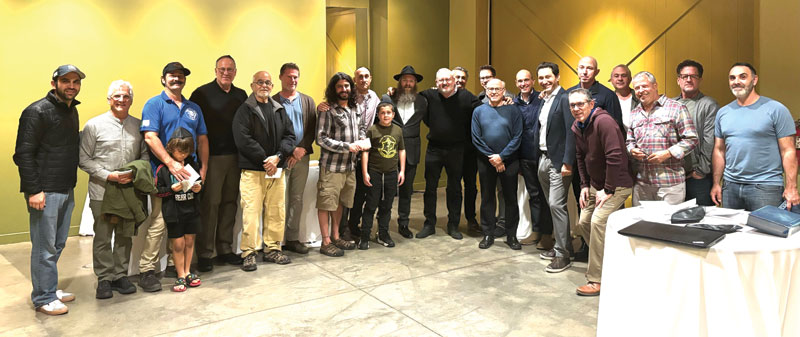
At 7 p.m. on Tuesday, Nov. 5, 2024, 18 Jewish men from Healdsburg met me at my hotel so that I could lead the evening service as a mourner and say kaddish for my father.  My three colleagues joined me as did the rabbi from Santa Rosa who brought his children as well as kippot for those men who wished to cover their heads. The head of my firm came too.

Before we began, one of the men asked if I could speak about my father so I told them a little bit about my dad. I explained that for me, kaddish is where the love goes when one can no longer hug one’s father and hold his hand.

Before we began, one of the men asked if I could speak about my father so I told them a little bit about my dad. I explained that for me, kaddish is where the love goes when one can no longer hug one’s father and hold his hand. 

We turned to face Jerusalem and prayed the evening service together. Then I, along with another mourner in the minyan, said kaddish, sounding out loud the longing and gratitude that Jewish mourners have recited in Aramaic from ancient times. “Blessed, praised, glorified, exalted, extolled and honored is the name of God beyond any blessing, hymn or praise that we could ever offer in this world.”  The minyan responded “Amen.”

We poured the scotch and raised our glasses to the memory of my father and then we relaxed and got to know each other a little better.  In our minyan there were doctors, retirees, businesspeople, consultants, the owner of the deli and the bagel store, office workers, the rabbi from Santa Rosa.

Five minutes remained before our firm meetings started again so I raced across the street to the Healdsburg Bar & Grill where Ariel Kelley’s reelection party was underway. What do you say to a complete stranger who does something transcendent for you? How do you greet someone you don’t know who will always be your friend? How do you thank someone who welcomes you without hesitation to a holy city so that you will know, without any doubt, that “God is in this place?”


Pierre Gentin lives in Westchester County, New York.

The Holy City of Healdsburg Read More »

American Friends of Beit Issie Shapiro Gala, Pressman Doc Screening, Oct. 7 Exhibit

American Friends of Beit Issie Shapiro, an organization dedicated to raising funds and awareness for the Israel-based Beit Issie Shapiro, held its West Coast gala at Sinai Temple on Oct. 30.

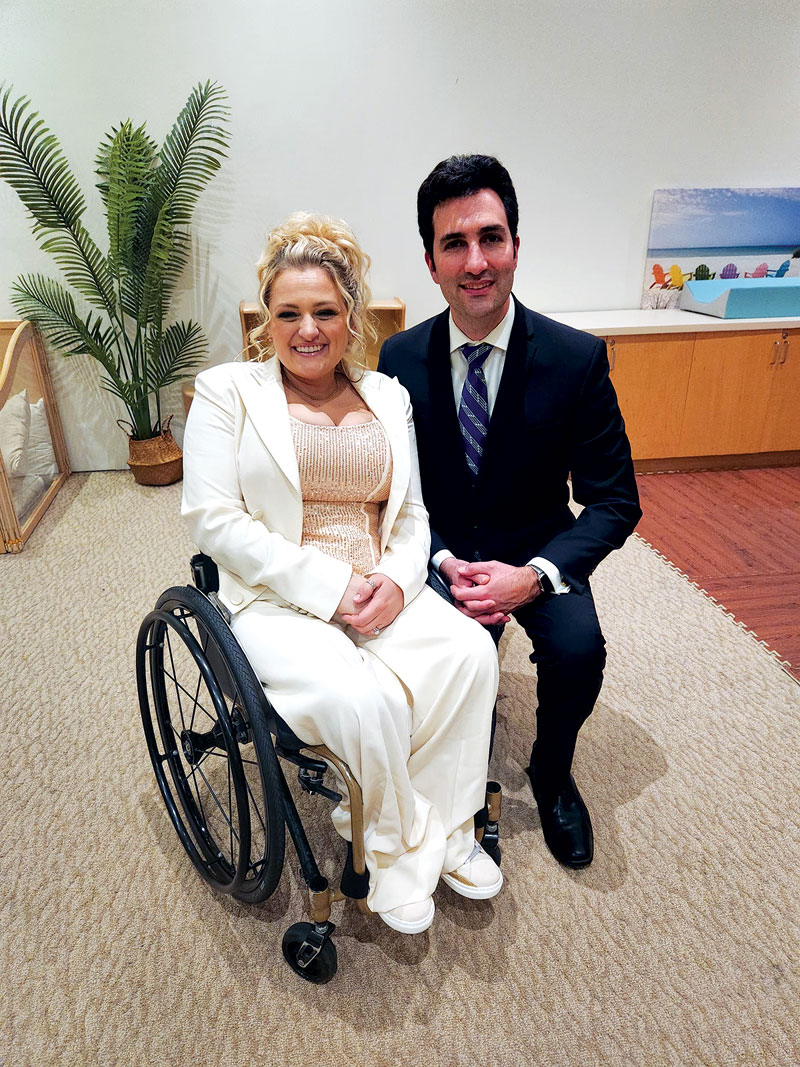
The sold-out event was hosted by Broadway star and Tony Award winner Ali Stroker. Among other accomplishments, Stoker has made history as the first actor in a wheelchair to appear on Broadway,

More than 300 community members attended the evening gathering, including Jewish Federation Los Angeles President and CEO Noah Farkas; Stephanie and Gilad Abrahami; Isaac Wiseman Cohanzad; Sinai Temple Co-Senior Rabbi Erez Sherman; Sinai Cantor Marcus Feldman; Beth Jacob Congregation Rabbi Kalman Topp; Jean and Jerry Friedman; Dr. Ellen and Harvey Knell; Benjamin Parnassi; Barak Raviv; and Jewish Journal Editor-in-Chief and Publisher David Suissa.

Additional attendees included Beit Issie CEO Ahmir Lerner and Soraya Nazarian, West Coast vice president of American Friends of Beit Issie Shapiro, along with evening honoree Jeffrey Zarabi. Also recognized were Michael and Natalie Zarabi.

Broadway star Ali Stoker and Sinai Temple Cantor Marcus Feldman turn out to support Beit Issie Shapiro, an Israel-based organization serving children and adults with disabilities. Photo by Orly Halevy

“The West Coast Gala offered a unique opportunity to connect, reflect, and renew our collective hope for a more inclusive world — something we urgently need now, especially in light of the challenges we have faced since Oct. 7,” Nazarian said. “Recent events have underscored the importance of unity and support for all individuals, particularly those with disabilities who often bear the brunt of societal challenges. Together, we can pave the way for systemic change and brighter futures for people with disabilities.”

Beit Issie Shapiro aims to develop cutting edge therapies serving children and adults with a wide range of disabilities. The organization — which impacts over 500,000 individuals annually worldwide through groundbreaking programs — is celebrating four decades of scaling impactful solutions that promote systemic change in the quality of life of people with disabilities in Israel and internationally.


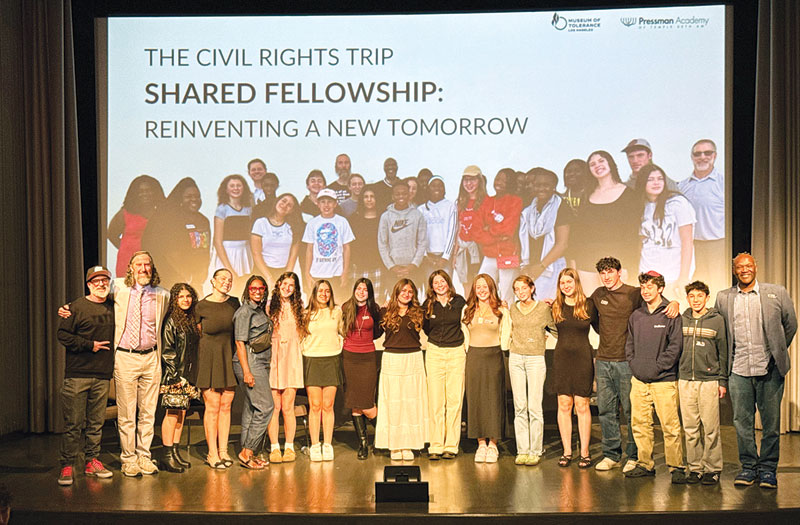
Students and leaders from Pressman Academy attend the screening of a film about their school’s bridge-building work with Selma, Alabama students. Courtesy of Pressman Academy

On Nov. 3, Pressman Academy, a day school at Conservative congregation Temple Beth Am, held a film screening of a documentary that demonstrated the power of African American and Jewish American students coming together for the sake of improving the world.

The film follows 13 eighth-grade Jewish students from Los Angeles as they began a relationship with African American students from Selma, Alabama by meeting regularly over Zoom. Their collaboration culminates with the Los Angeles students traveling on a class trip to Alabama. 

The bridge-building effort, made possible because of the leadership of Pressman Academy Rav Beit Sefer Chaim Tureff, is captured in the timely film. Filmmaker Kenny Stoff — whose son was one of the participants of the project at Pressman — helped put together the film.

Ultimately, the documentary explores the Civil Rights Movement in the U.S. and the bond between these two communities, forged by their attempts to break the chains of antisemitism and racism, the filmmakers said. 

The open-to-the-public screening was held at Museum of Tolerance and drew approximately 300 attendees, including Los Angeles City Councilmembers Heather Hutt and Katy Yaroslavsky. A panel discussion followed.

“It was an incredible screening,” Tureff said after the event, “The Civil Rights Trip: Reinventing a New Tomorrow.”


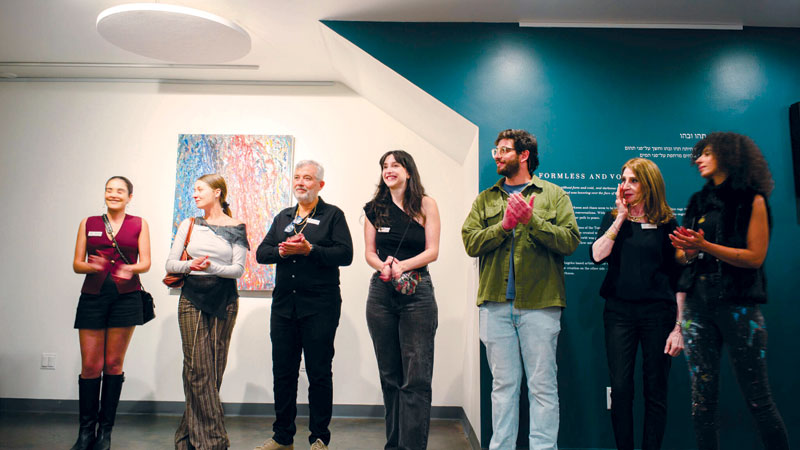
A recent art show at Upside Down gallery in Westwood grappled with themes connected to the Oct. 7 attack against Israel. The exhibition, titled “Formless and Void,” featured ten local Israeli, Jewish, and Christian artists. Opening night was Oct. 19. Courtesy of Emily Lunt

American Friends of Beit Issie Shapiro Gala, Pressman Doc Screening, Oct. 7 Exhibit Read More »