fbpx

October 29, 2024

Building a Pipeline of Hate

The permeation of anti-Zionism into Middle East Studies programs and academia at large is an old story, as is the BDS movement fostering a pipeline of hate on campus. George Washington University once accepted this problematic reality as a facet of its own campus culture. While pressure from advocacy groups and students like me over the last year has forced it to at least feign reversing course, recent events reveal that virtually nothing in GW’s thinking has changed.

Consider that recently, GW’s Elliott School hosted “Promises, Then the Storm: Memory, US Politics, and the Israel-Gaza War” that told the story of “Palestinian resistance and resilience” regarding the Oct. 7th massacre perpetuated by Hamas. It also facilitated a webinar with the authors of the Middle East Research and Information Project (MERIP), about the “deeper history and context of Lebanon’s history of resistance to Israeli violence and its entwined struggle with the Palestinian people.” Not only have each of the panelists slandered Israel as a genocidal state, but also MERIP has carried laudatory interviews with terrorist leaders and other activists in addition to encouraging readers to “comprehend the achievements” behind the 1972 Munich Massacre and declared that “all Israeli settlers are potential targets of the Palestinian resistance” in the aftermath of a 1974 Palestinian terror attack on an Israeli school.

Organized by the Institute for Middle East Studies (IMES), a partner of MERIP and a cynosure of anti-Israel dogma on campus, the events advertisements neither mention the tragedy Hamas inflicted on Israeli civilians last October, nor the role the Iranian Regime plays in destabilizing the Middle East with its proxy network of terror. This suggests a subtle but explicit endorsement of terrorism and a distortion of facts that the university, as of my writing, has failed to denounce and remedy.

This is exactly the kind of event GW pledged to keep off campus when it severed its relationship with IMES’ institutional partner, the Middle East Studies Association (MESA), last July. MESA is a pro-BDS academic association whose presence on campus has been linked to a rise of antisemitic incidents. IMES, whose symposiums on “decolonizing knowledge” and “producing knowledge for resistance practices” were already known for promoting radical and anti-Western ideologies. MESA, however, provided IMES its revolutionary steel, inciting verbal and physical abuse toward Jewish students in and out of the classroom.

In May 2023, the Brandeis Center for Human Rights Under Law sent a letter to former GW president Mark Wrighton, warning the University about the perils of the partnership with MESA. The letter described how MESA’s presence at GW was coinciding with an increase in antisemitic incidents, including Holocaust revisionism and denial in class, the appearance of swastikas, the desecration of mezuzot, and Jewish students being harassed and spat on for their Zionist beliefs.

A study by the AMCHA Initiative found that universities with faculty supporting the BDS movement are 3.6 times more likely to experience acts targeting Jewish and pro-Israel students with physical harm. The letter called on GW to terminate its partnership with MESA, arguing that it violated the university’s Academic Freedom Guidelines, contradicted GW’s anti-BDS policy, and could jeopardize its 501(c)(3) tax-exempt status as an educational institution.

Many GW community members deemed the university’s breach with MESA a step in the right direction. Over time, however, students and attendees of Middle East programming at the Elliott School began to question whether GW truly disaffiliated because BDS activity in the Elliott School and antisemitism on campus were only intensifying.

Indeed, IMES remains listed as an “Institutional Member” of MESA, rendering obvious the anti-Israel bent of IMES’s programming. Despite IMES not publicly endorsing a BDS resolution on their own website, the majority of its faculty including Professors Ilana Feldman and Shira Robinson support BDS and even signed onto a letter supporting last spring’s illegal pro-Palestinian encampment.

Former interim director of IMES Professor William Youmans, now a current lecturer at GW’s School of Media and Public Affairs, was one of the many GW and DMV faculty who attended the encampment. At the encampment, he stated “[students] enact what we teach in the classroom.” Another IMES professor dedicated class time to expressing support for the encampment and encouraged his pro-encampment students to stand alongside him and do the same in lieu of a final review session. No doubt, anti-Israel students feel legitimacy when advocating to guillotine administrators, pushing “Israeli Zionist pigs” off campus, and physically harassing Jewish families.

GW’s academic culture pertaining to the Middle East is no different than Columbia University, Northwestern University, and Harvard University—institutions facing some of the most serious concerns about antisemitism and under investigation by the Congressional Education and the Workforce and Ways and Means Committees—who are also listed as Institutional Members of MESA.

Once the foremost academic institution for its field, MESA’s 2022 official endorsement of BDS signaled its transformation into a political advocacy organization. Since then its overall popularity has declined. At the end of 2022, there were 43 institutional members; by the end of March 2023, only 31 remained. MESA’s advocacy page includes a section on “Campus Resources” with dozens of letters and statements written promoting ceasefire, negating anti-Zionism, and promoting illegal anti-Israel activity.

Last November, MESA sent a letter to Hebrew University defending Dr. Nadrea Shalhoub-Kevorkian, who was invited by GW’s infamous Dr. Lara Sheehi—a former professor responsible for harassing Israeli students in class—and stated that “Jews use money for nefarious purposes” among other antisemitic tropes. MESA also sent a letter to GW’s administration defending SJP under “academic freedom” after the group was suspended for violating school policies by projecting “Glory to our Martyrs” and “From the River to the Sea Palestine will be free” among other pro-Hamas slogans on Gelman Library.

Since Oct. 7th, the most tragic terrorist attack in Israel’s history, IMES has reeked of anti-Zionism and antisemitism. Not unlike last year, where IMES held two anti-Israel events shortly after Oct. 7th—a panel of several scholars with an anti-Israel bent and the screening of “Israelism”—IMES will hold two events related to Gaza without a single firm pro-Israel perspective. One event slated for October 15 features Dr. Annelle Sheline, who recently resigned from the State Department in protest to Biden’s Gaza Policy. The other, occurring on Oct. 23rd, explores the work of Arab and Arab-American poets and musicians to tell a story of “Palestinian resistance and resilience.” Unlike last year, however, IMES will not platform a single Israeli speaker—not even one Israeli critical of Israel’s policies—this October.

Since Oct. 7th, the most tragic terrorist attack in Israel’s history, IMES has reeked of anti-Zionism and antisemitism.

IMES faculty justifying and legitimizing Hamas’s Oct. 7 attacks as a “right of resistance” is no surprise. Before Oct. 7th, too, defamatory lies about Israel as an apartheid, settler colonial and genocidal entity with no contrasting views in talks like “The One State Reality: What is Israel/Palestine?” and “Between the Colonial and Authoritarian” were ever-present.

At several IMES events, when I asked questions about topics like Islamic terrorism, the antisemitic education system administered by the United Refugee & Works Agency, and the detriment of BDS to Israelis and Palestinians alike, GW faculty members and IMES panelists shut me down with claims of settler violence and parallels between the Israeli Declaration of Independence and the Hamas charter.

During an IMES-sponsored screening of the documentary “Israelism” last October (for which I received extra course credit for attending and writing about) the film director responded to my question by saying I was wrong because I “grew up blind to Palestinian suffering” due to being raised in an Israeli-Jewish-American home. Keffiyeh-garbed audience members applauded, cheering on the panelist as he sardonically responded to my questions.

The issue with IMES faculty and these events is not merely their anti-Israel stance but the complete lack of viewpoint diversity. During the Oct. 16th Panel Discussion on Developments in the Israel-Palestine Conflict, when panelists were encouraged to ask each other questions, nobody did, demonstrating that they more or less agreed. This undermines the intellectual rigor and stimulating contradictions that students come to college to explore, discuss, and challenge.

Indeed, this orchestrated absence of viewpoint diversity is crafted to distort and manipulate facts to fit an anti-Israel agenda, suppressing any informed and comprehensive education on Israel—whether this includes jihadi terrorism, Israeli internal society and politics, Jewish-Muslim relations in the MENA region, or antisemitism. IMES programming thus contributes to a “pipeline of hate,” inciting hostility toward Israel (and by extension, Jews in general), driving a misleading narrative that guides GW students destined to become future leaders and policymakers.

GW administrators’ failure to entirely remove MESA from the university’s Middle East studies program shows a continued tolerance for the promotion of terrorism as events celebrating “Palestinian resistance and resilience” persist—most cynically, this month, in the wake of the one-year anniversary of the massacres perpetrated on Oct. 7th.


Sabrina Soffer is a senior at George Washington University. 

Building a Pipeline of Hate Read More »
Noah’s Ark’s Under-Appreciated Passengers

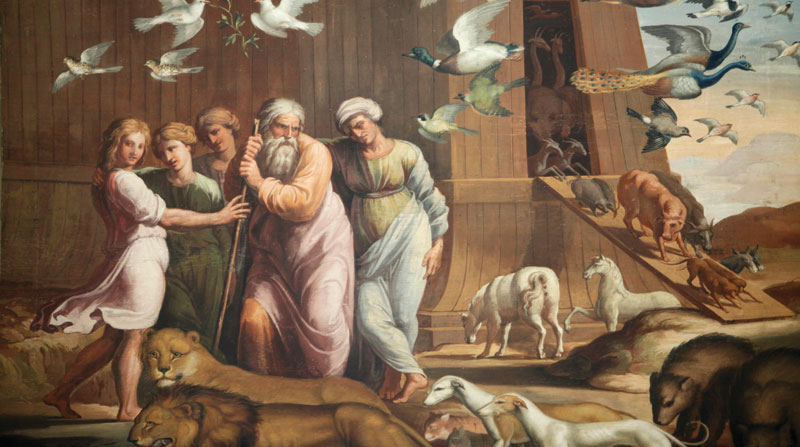
What about Noah’s wife? While the faithful hero of the flood story gets all the fame, often overlooked is his devoted spouse, there with their children amidst the floating zoo.

In the Bible, Noah’s wife is mentioned but not named. But a passing reference in Genesis 4:22 to a sister born to Tubal-Cain named Na’ama led the ancient rabbis to suggest that she was Noah’s spouse — the worthy wife of the architect of the ark. The medieval sage Nahmanides, punning off the Hebrew meaning of the name, “pleasant,” added that “her deeds were pleasant and pleasing. What they intended was that she was known in those generations for she was a righteous woman and gave birth to righteous ones.” Targum Yonatan adds that she innovated “elegies and songs” in humanity’s early years. The 16th century rabbi known as the Maharal of Prague wondered how she, in contrast to that later unnamed biblical wife, the spouse of Lot who ended up ensnared (or rather, en-salted) in the surrounding destruction of Sodom, survived God’s wrath. Must be, he affirms that Na’ama “was fitting and righteous and that her actions were pleasant.” 

Not all rabbinic opinions were in agreement that the Na’ama named in that verse was actually Noah’s spouse. Her music? Must have been for idol worship, they argued. Furthermore, she preserved the genealogical line of history’s first murderer, Cain. 

Perhaps she was so evil that she caused even angels to sin, suggested another interpreter. The Zohar viewed Na’ama as a demonic figure associated with the enigmatic “children of God” and the equally mysterious fallen angels, Nefilim, who appear in Genesis’ sixth chapter, the preamble to the flood story.

Others combined the belief in Na’ama’s sordid past with her later-in-life righteousness. The contemporary scholar Rabbi Ari Kahn notes, “Even after the great flood which purges the world of sin and restores purity and equilibrium, Na’ama carries the line of Cain into the world. Na’ama, the wife of Noach, survives; the line of Cain lives on.” 

 So, Kahn wonders, “Is Na’ama a demon-like temptress [luring people to worship idols], or a fitting spouse for the great tzaddik, the most righteous man of the generation?”

Kahn concludes that Na’ama was, in fact, a paradigm of repentance. As he puts it, “despite the violent, oppressive nature of the surrounding society, despite the extremely challenging family history, despite the genetic and genealogical challenges with which we are born, we are all capable of making choices for our own lives.”

There was, after all, plenty of time for Na’ama to have turned her life around. The devoted couple was quite ancient — and she was the older of the two. The chronology in Sefer HaYashar said when they wed, Na’ama was 580 years old. Her husband? A sprightly 498.

Speaking of comeback stories, there was another underappreciated passenger on the ark, according to rabbinic tradition. The Talmud in tractate Sanhedrin recounts a conversation between Shem, one of Noah’s sons, and Eliezer, Abraham’s beloved servant. Shem recounted about his family’s adventures with animals at sea: “With regard to the phoenix, my father found it lying in its compartment on the side of the ark. He said to the bird: Do you not want food? The bird said to him: I saw that you were busy, and I said I would not trouble you by requesting food. Noah said to the bird: May it be God’s will that you shall not die, and through that bird the verse was fulfilled, as it is stated: ‘And I said, I shall die in my nest, and I shall multiply my days as the phoenix’” (Job 29:18). As a reward for holding its hunger in check aboard the ark, the phoenix had been blessed by Noah.

Rashi, based on a midrash, comments on that verse in Job and adds an Edenic element. “This is a bird named ‘phoenix’ upon which the punishment of death was not decreed because it did not taste of the Tree of Knowledge, and at the end of 1,000 years, it renews itself and returns to its youth.” After Eve ate the forbidden fruit, she gave it to all of the animals to partake. Only the phoenix refused, earning itself eternal life.  

If the bird had gained immortality in Eve’s era, what was the point of Noah’s blessing? The second Rebbe of Chabad, Dovber Schneuri, offered that the original reward for the phoenix still involved dying and being reborn from an egg. So Noah blessed it that in the future it wouldn’t need to die at all.

The rabbinic elaborations of the ark’s underappreciated passengers offers, amidst the disagreements over details both mystical and minute, a reminder of the lesson that Noah himself well appreciated. Faith in second chances, the belief that we can change our lives for the better, can often serve as just the life-raft we need. 

The rabbinic elaborations of the ark’s underappreciated passengers offers, amidst the disagreements over details both mystical and minute, a reminder of the lesson that Noah himself well appreciated. Faith in second chances, the belief that we can change our lives for the better, can often serve as just the life-raft we need.


Rabbi Dr. Stuart Halpern is Senior Adviser to the Provost of Yeshiva University and Deputy Director of Y.U.’s Straus Center for Torah and Western Thought. His books include “The Promise of Liberty: A Passover Haggada,” which examines the Exodus story’s impact on the United States, “Esther in America,” “Gleanings: Reflections on Ruth” and “Proclaim Liberty Throughout the Land: The Hebrew Bible in the United States.”

Noah’s Ark’s Under-Appreciated Passengers Read More »

Election Guide: Key Races, Open Seats and Ballot Measures to Watch

U.S. SENATE (open)

Adam Schiff (D) vs. Steve Garvey (R)

Adam Schiff is in his 12th term representing Burbank in the U.S. House. As the lead Democrat on the House Intelligence Committee, he’s been in the national spotlight over the past eight years, particularly as the lead prosecutor in Trump’s first impeachment trial. Reflecting on his legislative work, he says he has “passed dozens of laws” to tackle prescription costs, job creation, earthquake early warning systems and protections for patients through the California Patients’ Bill of Rights. “Adam took on the biggest bullies — drug companies, polluters, and drug cartels — and won,” his campaign website touts. Schiff’s priorities include lowering housing costs, expanding access to health- and childcare, fighting climate change, and protecting abortion rights. On housing, Schiff says he’ll “take on big developers and foreign investors” to address the rising costs impacting Californians. He’s also vocal about reproductive rights, pushing to codify federal protections for abortion access after the Supreme Court’s decision in Dobbs v Jackson Women’s Health Organization. Schiff is an original sponsor of the Green New Deal and wants to fast-track the transition from fossil fuels to renewable energy.

Former Dodgers’ first baseman Steve Garvey comes to the U.S. Senate race as a political outsider running for public office for the first time. His priorities include addressing homelessness, immigration, public safety and rising costs. “Instead of an immigration system that rewards hard work, we have chaos on the Southern Border. Instead of safe neighborhoods, there’s violent crime,” Garvey said in his candidate statement. “Instead of affordability, Californians struggle to pay for rent, groceries, and gas. That’s not the California we love.”

Garvey is personally opposed to abortion but pledges to uphold California’s laws on reproductive rights, citing his commitment to respecting the will of voters. On environmental issues, he proposes a “balanced approach” that allows for a transition toward clean energy while keeping oil and gas industries viable. 

Schiff and Garvey will appear on the ballot twice: for the remaining months of the late Dianne Feinstein’s seat (currently held by interim U.S. Senator Laphonza Butler), and a new six-year term beginning in January. California has not elected a Republican senator since Pete Wilson’s reelection in 1988.

LOS ANGELES COUNTY DISTRICT ATTORNEY

George Gascón  vs. Nathan Hochman 

Incumbent George Gascón has spent the last four years taking a reform-oriented approach to criminal justice, aiming to reduce incarceration rates and address systemic inequities. Gascón has removed cash bail for most offenses, saying in 2021 that “there is no evidence that cash bail provides a sufficient incentive necessary for people to return to court.” Gascón also eliminated many sentencing enhancements. Eleven days after being sworn into office in 2020, he said, “Deputies in my office may file enhancements in cases involving the most vulnerable, such as cases involving children, the elderly, and hate-motivated crimes. All enhancements that do not fit these criteria will be dismissed at the soonest court date after victims are notified in accordance with Marsy’s Law.” Two recall attempts failed to secure enough signatures to remove him from office.

On the topic of antisemitic crimes, Gascón’s office told The Journal, “The District Attorney’s Office condemns all forms of hatred, including antisemitism and takes allegations of discrimination seriously. Any suggestion that the DA’s Office is sympathetic to organizations that promote hatred, discrimination, violence, or terrorism is unfounded. Our approach to prosecuting demonstrations and counterprotests is driven solely by the principles of law and justice, without any bias toward any group.”

Nathan Hochman, a former federal prosecutor and Assistant U.S. Attorney General, is proposing that Los Angeles return to “common-sense justice” and bringing crime rates down to the historic lows during the early days of Gascón’s predecessor, Jackie Lacey. Hochman supports reinstating certain sentencing enhancements for violent crimes, restoring partnerships with law enforcement, and enhancing accountability measures. 

On the topic of antisemitic crime, Hochman told The Journal, “My support for our Jewish community and my strong stance against extremism and hate has been clear and unequivocal — something that cannot be said about Gascón and his lack of leadership on this and too many other issues.”

LOS ANGELES CITY COUNCIL – DISTRICT 2 (open)

Adrin Nazarian vs. Jillian Burgos 

Adrin Nazarian, the former Assembly member for California’s 46th District, served as chief of staff to outgoing District 2 Councilmember Paul Krekorian and has spent a decade representing the San Fernando Valley. An Armenian-American born in Iran, Nazarian’s family fled political turmoil during the Iran-Iraq War and resettled in Los Angeles. He received his bachelor’s degree in Economics from UCLA. Nazarian’s legislative priorities include expanding affordable housing, tenant protections, senior services, and public transportation throughout the Valley. He is also concerned with increasing LAPD recruitment. 

Jillian Burgos, an Afro-Latina community advocate and optician, serves on the NoHo Neighborhood Council. Raised in Cleveland, Ohio, Burgos moved to Los Angeles to pursue a career in theater. She co-founded Dainty Dames Events, a theater company specializing in immersive experiences. Since joining the NoHo Neighborhood Council in 2021, Burgos has prioritized tenant rights, affordable housing, homelessness, food insecurity, and supporting youth-oriented programs.

District 2 comprises North Hollywood, Studio City, Sun Valley, Valley Glen, Valley Village, Van Nuys and Toluca Lake

U.S. HOUSE – CA 29TH DISTRICT (open)

Luz Rivas (D) vs. Benito “Benny” Bernal (R)

Luz Rivas, an engineer and current representative for the 43rd Assembly District in the Northeast San Fernando Valley, has served since 2018. Born and raised in Pacoima to immigrant parents from Mexico, she earned a bachelor’s degree in Electrical Engineering from MIT and a master’s in Education from Harvard. Before her political career, Rivas founded DIY Girls, a nonprofit organization aimed at encouraging young girls to pursue STEM fields. In the Assembly, Rivas has championed environmental justice, worker protections, climate education, and homelessness prevention. If elected, Rivas would be the first Latina to represent California’s 29th District in Congress, with plans to continue her focus on STEM education, environmental advocacy, and labor rights.

Benito “Benny” Bernal, a longtime Valley resident, was born in Los Angeles to a large family with roots in Michoácan, Mexico. Raised in Pacoima and Arleta, Bernal has worked for nearly three decades with the Los Angeles Unified School District, moving from a school bus driver to supervisor, and has served as vice president of SEIU Local 99. His platform includes increasing border security and supporting a national abortion ban with limited exceptions. 

The seat is currently held by Democratic U.S. Rep. Tony Cardenas, who is retiring after serving six terms. The 29th District includes parts of Mission Hills, North Hollywood, San Fernando and Toluca Lake.

U.S. HOUSE – CA 30TH DISTRICT (open)

Laura Friedman (D) vs. Alex Balekian (R)

Assembly member Laura Friedman has represented parts of Los Angeles and Glendale since 2016. Prior to holding elected office, she worked as a film and television producer. Friedman’s progressive record includes legislative efforts on environmental protection, housing, and traffic safety. Known for introducing bills on PFAS regulation, renter protections, and anti-speeding measures, Friedman has built a reputation as a champion of progressive causes. She has received endorsements from the California Democratic Party and several labor unions. If elected, Friedman said she will prioritize affordable housing, reproductive rights, and immigration reform.

Alex Balekian, a Glendale-born pulmonologist, is running on a platform focused on public safety, fiscal conservatism, and limiting government intervention. He originally entered the race as an independent before switching to the Republican Party. He calls himself a “Deukmejian Republican” — a reference to the two-term governor of California from 1983-1991. Balekian wants to counteract progressive policies, focusing on issues like crime, homelessness, education reform and lowering taxes, prioritizing public safety, and fixing the educational system. “Radical changes to curriculums are leaving parents and educators concerned about the quality and appropriateness of the content being taught,” Balekian says on his campaign website. 

California’s 30th U.S. House District includes Burbank, Hancock Park, Glendale, Park La Brea and West Hollywood and is currently represented by Adam Schiff. 

CA STATE SENATE DISTRICT 28

Lola Smallwood-Cuevas (D) vs. Cheryl Turner (D)

Lola Smallwood-Cuevas, the Democratic incumbent, is running fora second term. Raised by a single mother working various healthcare jobs, Smallwood-Cuevas has been a long-standing advocate for workers’ rights and economic equity. A graduate of CSU-Hayward, she began her career in journalism and unionized with the Newspaper Guild, then transitioned to political organizing with SEIU Local 1877. She later co-founded the L.A. Black Worker Center where she worked on job access and reducing employment discrimination for Black residents.

Cheryl Turner, a civil rights attorney and lifelong Los Angeles resident, is challenging Smallwood-Cuevas for the 28th Senate District seat. Turner earned both her B.A. and J.D. from USC and has managed her own law practice for over two decades, with a focus on civil rights, consumer rights, and regulatory compliance. Turner has served on the state Board of Vocational Nursing and Psychiatric Technicians and currently presides as president of the Apartment Association of Greater Los Angeles. Her campaign centers on affordable housing, civil rights advocacy, and clean air initiatives, leveraging her extensive background in law and public service.

The California Senate District 28 comprises of Ladera Heights, View Park, Arlington Heights, Arlington Park, Baldwin Hills, Carthay, Century City, Cheviot Hills, Crenshaw, Del Rey, Downtown, Hyde Park, Jefferson Park, Leimert Park, Mar Vista, Mid City, South Los Angeles, University Park, West Adams, and West Los Angeles.

CA STATE ASSEMBLY DISTRICT 44 (open)

Nick Schultz (D) vs. Tony Rodriguez (R)

Nick Schultz was elected to the Burbank City Council in 2020 and has served as the Mayor of Burbank since 2023. Previously, he served as a California Deputy Attorney General. His priorities include expanding housing affordability, implementing environmental protections, and strengthening gun safety regulations, criminal justice reform, universal healthcare, affordable housing, sustainable transit and clean energy.

Tony Rodriguez is a U.S. Army veteran, and construction manager based in Tujunga.  Rodriguez’ platform prioritizes parental rights in education, law enforcement support, and reducing small business taxes. His stance on education includes school choice and opposing what he considers “government overreach” in schools. On housing, he advocates for transparency in development costs and opposes renter protection measures he views as restrictive.

California Assembly District 44 comprises of Burbank, Glendale, La Crescenta-Montrose, North Hollywood, Sherman Oaks and Studio City. The district is currently represented by Laura Friedman.

BALLOT MEASURES

Proposition 33 – Rent Control Expansion

Proposition 33 seeks to repeal the Costa-Hawkins Rental Housing Act, which limits rent control on single-family homes and housing built after 1995. If passed, it would grant cities and counties the authority to expand rent control on newly rented properties and single-family homes, a shift in California’s housing policy landscape. Supporters argue that this will make housing more affordable, while opponents warn of decreased property values and potential reductions in local property tax revenue.

For more information on Proposition 33: https://voterguide.sos.ca.gov/propositions/33

Proposition 36 – Enhanced Crime Penalties

Proposition 36 introduces tougher penalties for theft and drug-related crimes, reversing some provisions of Proposition 47, which downgraded specific offenses to misdemeanors. This measure reclassifies certain repeat offenses as felonies, provides for drug treatment options and mandatory warnings for drug dealers. It is expected to increase state and local criminal justice costs due to anticipated higher incarceration rates, with critics arguing it could lead to over-incarceration and strain on the justice system.

For more information on Proposition 36:https://voterguide.sos.ca.gov/propositions/36/

Election Guide: Key Races, Open Seats and Ballot Measures to Watch Read More »

David Wiener Gets Honorary Doctorate, Sinai Akiba Academy Dedication, Museum Hire

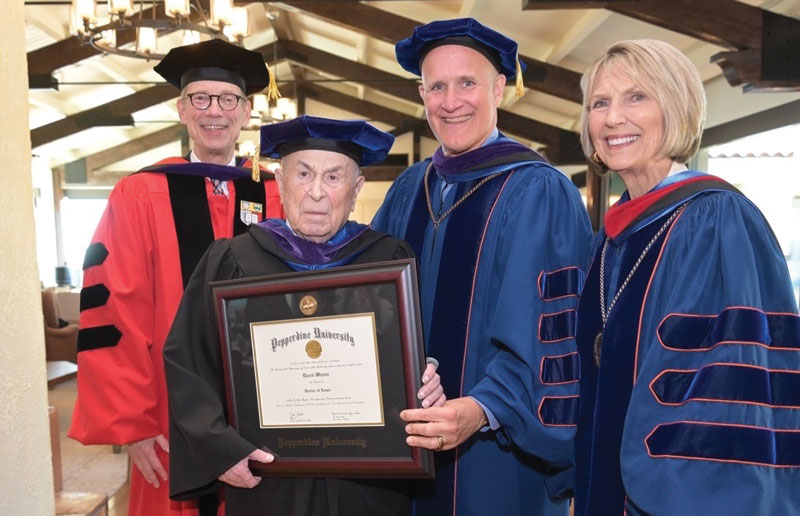
Holocaust survivor David Wiener received an honorary doctorate from the Pepperdine University Caruso School of Law, during a special ceremony held on Oct. 22 at Brock House in Malibu. 

Born in Lodz, Poland, Wiener survived the Holocaust, including internment at Auschwitz and several labor camps. He was the only member of his family to escape the Lodz ghetto at the age of 13. After the war, Wiener immigrated to the United States, building a successful career in real estate development in Los Angeles despite arriving with no money and limited English language skills. 

Today, Wiener is active in numerous philanthropic endeavors. He regularly speaks to underprivileged youth about the value of education and determination.  

Joining the 98-year-old Wiener at the ceremony were several of his family members, including his son, Michael, and his grandson, Shane. 


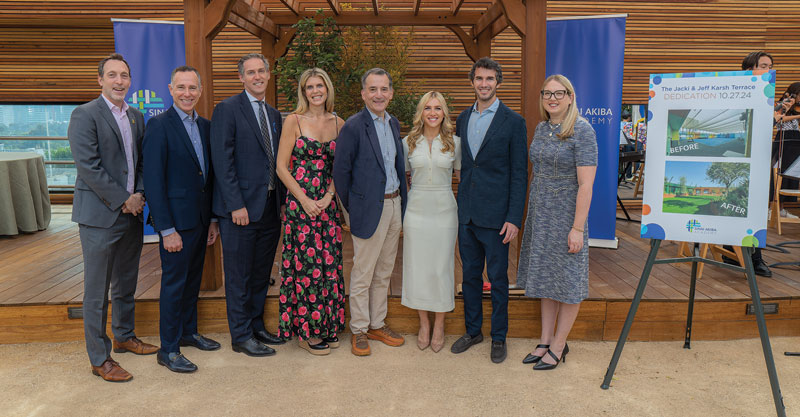
From left: Rabbi Avi Taff; Sinai Akiba Academy Board Chair Robert Galperson; Rabbi Erez Sherman; SAA Head of School Lauren Plant; Rabbi David Wolpe; Jacki and Jeff Karsh; and Rabbi Nicole Guzik attend a dedication ceremony for a new terrace rooftop at Sinai Akiba Academy. Courtesy of Sinai Akiba Academy

On Oct. 27, Sinai Akiba Academy held a dedication ceremony for the new Jacki and Jeff Karsh Terrace at its day school campus.

In a statement, the day school’s leadership said the brand new, fully renovated fifth-floor rooftop terrace was “the ultimate outdoor rooftop green space for students to engage and learn, and for the Sinai community to gather, connect and celebrate together.”

The space features a field, dining deck, walking path, pergola, fountain, fruit trees and gardens with native plants and herbs.

The project’s donors, Jacki and Jeff Karsh, are Sinai Akiba Academy parents with three children in the school. According to Sinai Akiba Academy, it was the vision of Sinai Akiba’s head of school, Lauren Plant — who always believed in the learning possibilities of an innovative green space —that inspired the Karsh family to contribute to the project.

“This project will enable whole child education and support the development of all dimensions of childhood,” Plant said. “It is designed for children to play and collaborate, utilize kinesthetic learning, develop social-emotional and mindfulness skills, connect to Judaism through outdoor services and holiday celebrations, and study native Israeli and California plants and trees. It is a one-of-a-kind learning and community space that will facilitate holistic community connections.”

The Sunday event featured a ribbon cutting and mezuzah hanging ceremony. Among the approximately 80 people in attendance were the Karsh family; Plant; Sinai Akiba Academy Board Chair Robert Galperson; School Rabbi Avi Taff; Sinai Temple Co-Senior Rabbis Erez Sherman and Nicole Guzik; and Rabbi David Wolpe, the Max Webb Rabbi emeritus of Sinai Temple.


Marla Eglash Abraham. Courtesy of Holocaust Museum LA

Holocaust Museum LA has appointed Marla Eglash Abraham chief advancement officer, according to an announcement by the museum’s CEO Beth Kean.

A veteran nonprofit advancement professional, Abraham most recently served as the United States Holocaust Memorial Museum’s western regional director for a 10-state region. Previously she was director of development at American Jewish Committee in Los Angeles and earlier served as senior vice president, responsible for endowment planning and strategic philanthropy at the Jewish Federation Los Angeles.

“Marla is a key element in our elevated efforts to meet not only the moment of addressing heightened antisemitism, hate and ignorance regarding the Holocaust but also planning for the museum’s future with its exciting ‘Building Truth’ expansion project that is under construction,” Kean said.

In a statement, Abraham expressed excitement about joining the organization.

“As the first institution of its kind in the country, Holocaust Museum LA is uniquely positioned to promote reflection and critical thinking through the lessons of the Holocaust,” she said.

David Wiener Gets Honorary Doctorate, Sinai Akiba Academy Dedication, Museum Hire Read More »

Down to the Wire

As we enter the final tension-filled days of an excruciatingly close election season, one overriding conclusion stands out above all others: Israel’s strongest opponents will decide our next president. 

I wrote last week that while we face renewed antisemitism from the most extreme fringes of both major political parties, the division among Democrats over the war between Israel and Iran’s proxies was poised to have a disproportionate impact on the outcome of the presidential campaign. 

But as we head into the race’s final days, it has become even more clear that the voting decisions of progressive critics of the Biden Administration’s support for Israel may represent the difference between victory and defeat for the vice president.

The voting decisions of progressive critics of the Biden Administration’s support for Israel may represent the difference between victory and defeat for the vice president.

Biden and Harris have been steadfast in their support of Israel throughout the current crisis, and they have suffered significant domestic political damage as a result of their support. The final margin will be determined by whether Harris or Trump is more successful at motivating their existing base of supporters. For Harris, these voters tend to be young people, non-white voters and other progressives. These are the same groups that have been the most critical of the Biden Administration’s approach to the Middle East and the most likely to exhibit sympathy for the Palestinians over the Israeli people. As we discussed last week, many of them will be tempted to vote for a third-party candidate or to avoid voting altogether, while a small number of these anti-Israel progressives will cross over and vote for Trump. 

The overriding question for these voters is whether their anger toward Biden and therefore Harris outweighs their revulsion for Trump. Just last weekend, we saw two high-profile and potentially influential bigots make the case on both sides of this critically important decision.

Last Sunday night, Trump’s campaign held a rally in New York’s Madison Square Garden, where he gave fairly standard and typically lengthy remarks. But the news coverage of the event was unintentionally hijacked by a racist comedian by the name of Tony Hinchcliffe, who delivered a hate-filled rant that targeted Latinos, Blacks, Jews and Palestinians in an extraordinarily ugly manner. A liberal voter who despises Biden’s support for Israel would have to think long and hard before taking an action (or inaction) that would increase the likelihood of Trump’s return to the White House after hearing Hinchcliffe’s screed.

But just one day earlier, another racist voice emerged on the national landscape to remind anti-Israel voters why they should not attempt to help Harris’ campaign. Nika Soon-Shiong, a Los Angeles activist whose billionaire father owns The Los Angeles Times, publicly took credit for The Times’ decision not to endorse a candidate for president this year. Patrick Soon-Shiong issued a statement that his daughter was not involved in his decision to refuse to allow his paper’s editorial board to endorse Harris. But Ms. Soon-Shiong contradicted her father, saying:

“Our family made the joint decision not to endorse a Presidential candidate. This was the first and only time I have been involved in the process,” she said in a statement to The New York Times, in which she also referred to “a country openly financing genocide” and an “ongoing war on children.”

It appears that Ms. Shoon Shiong herself believes that her opposition to the war drove her father’s decision to veto the Times endorsement, and that her efforts to prevent Harris from winning the White House will be to the benefit of the Palestinian people. For Harris supporters, this argument is a potentially dangerous one and could discourage many otherwise left-leaning voters from overlooking their differences with the Democratic nominee on Gaza. Trump’s backers, on the other hand, are almost certainly smirking as they watch progressives fight with each other to the GOP’s benefit.

Make no mistake, both Hinchcliff and the younger Soon-Shiong are both the worst kind of bigots. Both specialize in stoking outrage from the furthest extremes on opposite sides of the ideological spectrum. But the bigot whose voice disaffected Democrats hear last could shape the election’s final outcome.


Dan Schnur is the U.S. Politics Editor for the Jewish Journal. He teaches courses in politics, communications, and leadership at UC Berkeley, USC and Pepperdine. He hosts the monthly webinar “The Dan Schnur Political Report” for the Los Angeles World Affairs Council & Town Hall. Follow Dan’s work at www.danschnurpolitics.com.

Down to the Wire Read More »

The Satan Series (Part IV): Sinwar and Nasrallah Can’t Believe They’re in Hell

We interrupt the Kamala versus Donald Sweepstakes to bring you the fourth part of a satire I call “The Satan Series.”

October 16, 2024
15 Tishrei 5785
Tenth floor of hell

Satan (nervously walking back and forth and puffing on a cigarette): Where is he?! He should have been here almost 20 days ago!

Sergio (Satan’s dutiful assistant): I know, master. With all due respect, you have asked that question quite often. We’ve even received an official complaint from Tsar Nicholas on the ninth floor demanding, and I quote, “An end to this insufferable countdown that seeks to uselessly track the whereabouts of that Lebanese peasant.”

Satan: I’ll deal with Nick later. Maybe he’d like to count how many boiling-hot coals I can shove into his nostrils, and then file another formal complaint. 

Sergio: There, there, master. Nasrallah couldn’t have gone far. 

Satan: Then WHERE is he?! I need some more coffee. 

Satan puts out his cigarette and approaches the coffee machine. 

Satan: That’s just great. And now the Nespresso machine is out of capsules. Sergio! Where’s that Israeli-brand ground coffee — the red can? 

Sergio: (running toward Satan with his clipboard): He’s here! Oh, master, I’ve waited weeks to make this announcement. He’s finally here!

Former Hezbollah leader Hassan Nasrallah limps off the elevator on the 10th floor of hell. His hair immediately catches fire from the surrounding inferno. 

Satan: Where’s the water cooler?! Someone, throw some water on this wretch!

Carl (the 10th floor custodian): There’s been a department-wide ban on plastic bottles, master. We’ve all been drinking from the hose that G-d throws down every month from heaven. 

Satan: Who approved that ban on plastic — wait, let me guess: the progressives? Forget it! Just throw some ashes on him and bring him to me. 

Sergio and Carl cover Nasrallah in ashes, then hold him by his arms and bring him before Satan. 

Satan (addressing Nasrallah): Listen, you miserable toad, I’m having a terrible morning. You kept me waiting for three weeks and the Nespresso machine is out of those little gold capsules I like. I think I reserve the right to ask you to your insolent face: Where the hell have you been?

Nasrallah (half-smiling): I took a detour. 

Satan pulls Nasrallah’s glasses off his face and breaks both lenses with his fists. 

Satan: There’s no LensCrafters in hell, Hassan. I’m only going to ask you this one more time: What took you so long?

Nasrallah (trembling): I … I … I wasn’t at fault, I swear. I was tumbling down into the nether regions of damnation when, all of the sudden, I came to a stop and almost hovered mid-air.

Sergio (whispering): Like the world’s fattest hummingbird. 

Nasrallah: And then, I heard a voice shouting, “Wait! This one needs a more thorough background check. He’s being described by Western media as apparently having been generous, charismatic, and extremely beloved by children and the elderly.”

“Wait! This one needs a more thorough background check. He’s being described by Western media as apparently having been generous, charismatic, and extremely beloved by children and the elderly.”

Satan (listening while attempting to sip water from a plastic hose without spilling it all over his mouth and fangs): Those progressives will be the end of me, and that includes those editors on earth. Frankly, I’m not even sure I can survive another U.S. election next week. So then what happened?

Nasrallah: Then I heard another voice. It was surreal and angelic, almost too perfect to describe. “Ahmad?” I asked innocently. But it wasn’t Ahmad (he commanded our Radwan Force). Funny enough, it was the voice of G-d. And then I heard, “The headlines were false. Banish him!” And that’s how I ended up here. Mind if I have a sip of that hose? I’ve been in limbo for days. 

Satan: Silence! Water is only for administration, custodial staff, and me! 

Satan scans a wall of various torture devices that also includes a newspaper profile of him from the 1970s. 

Satan: Oh, I’ve been looking forward to this. Sergio, bring me “The Poker” and some Iranian uranium. I’ll take care of this entry personally. 

Sergio: Pardon me master, but isn’t he entitled to a trial?

Satan: You heard Ahmad! I mean G-d! He’s banished to hell and now I get to squeeze him into a thin dish and make some Nasra-Lasagna for everyone at the staff meeting!

Sergio: Oh, All-Knowing One, I hate to question you but — (Sergio’s iPhone 3 begins beeping wildly). 

Satan: What is it?

Sergio (looking down at his phone): No. No. NO! It can’t be. Not now. I can’t deal with this now!

Sergio begins walking compulsively back and forth and speaking nervously to himself. 

Satan: What happened?! The last time you reacted to something like this was when the Soviet hockey team accidentally arrived on the fourth floor back in 1980 (Satan stomps his feet on the floor and looks downward.) You hear that, Nicholas? Your lousy athletes couldn’t even beat a bunch of Americans at a place that was actually called Lake Placid!

Sergio: Oh, master. I don’t know how to tell you this, but Sinwar is on his way over. 

Satan: No!

Sergio: Yes! Apparently, he was pulled out of a chair and dragged down here before any Western newspapers could declare he was the patron saint of Palestinian grandmothers. 

Satan (whispering while looking upward): Thank you, G-d. Sergio, do we have an extra “Poker”? 

Nasrallah (squinting his eyes): Yahya, is that you? They broke my glasses and I can’t tell if it’s you or some mangled side of meat with arms and legs. 

Sinwar: Hassan? I can’t see that well either, on account of the fact that the Zionists first saved my brain and then took it back. 

Satan (watching in amusement): This is incredible. They’ve each been here longer than one minute and neither one of them has yet to ask about virgins. 

Sinwar (approaching Sergio): You don’t look like a beautiful virgin. 

Satan: Never mind. 

Sergio: We often don’t have such evil arrive on the same day, master. How shall we proceed? I went ahead and ordered a second “Poker” on Amazon, but you know how their delivery is so unreliable once their trucks reach the earth’s mantle. Also, I hate to bring this up again, but I really must insist on some kind of trial …

Satan (stroking his beard and watching as Nasrallah and Sinwar attempt to have a meaningful reunion in the fieriest depths of hell): You’ve given me an idea. It’s new, but I think it’ll work. Until that second “Poker” arrives, at least. Shh, just listen to them for a second. 

Nasrallah: What are you doing here, dear Yahya? There must have been some mistake!

Sinwar: What are you doing here, dear Hassan? Your presence here (and mine) contradicts everything I’ve ever believed. 

Satan: Sergio, bring these two brutes forward. 

Sergio prompts both terrorist masterminds to kneel before Satan. 

Satan: I am prepared to make a deal with you both: Each of you will be given an opportunity to prove before me why the other is more deserving of an eternity of suffering. If you can successfully prove that the other butcher committed more heinous crimes than you, you will receive a more lenient sentence. Now, who would like to go first?

Nasrallah and Sinwar exchange uncomfortable looks and remain silent for minutes on end. Then Sinwar breaks the silence. 

Sinwar (pointing at Nasrallah): He irreparably ruined Lebanon and ordered thousands of deaths!

Nasrallah (shouting toward Sinwar): He caused thousands of Palestinians and Israelis to die needlessly!

Sinwar: He was part of a group that killed almost 300 American Marines in 1983!

Nasrallah: Israel actually removed a tumor from his sick brain and saved his life, and he turned around and planned Oct. 7! The ingratitude!

Sinwar: He and his group fired on Druze children in a soccer field!

Nasrallah: He bought his wife a $32,000 Birkin bag while Palestinians around him were suffering from impoverishment at the hands of Hamas’ inept rule in Gaza!

Sinwar: That’s not fair! We both made fortunes off the suffering of those we claimed to represent! Also (whispering to Sergio), if my wife ends up here as well, can she bring that purse with her?

Sergio: No worldly objects that once belonged to you on Earth are allowed in hell!

Nasrallah (scoffing): Apparently, not even your eyeglasses. 

Satan: You’ve both made quite miserable cases. But I believe Mr. Sinwar deserves the harsher of the two judgments. Throw him into Room C and Nasrallah into Room D and label the doors so I can keep track of them until the punishments begin.

Sergio: I’ve already printed out the labels, master. 

Sergio affixes Sinwar’s label to the door of Room C. 

Satan: No, this has a typo. 

Sergio: I don’t see one, master. 

Satan: Right there. You see where it says “Sinwar”? Change it to “Sinwas.”


Tabby Refael is an award-winning writer, speaker and weekly columnist for The Jewish Journal of Greater Los Angeles. Follow her on X and Instagram @TabbyRefael.

The Satan Series (Part IV): Sinwar and Nasrallah Can’t Believe They’re in Hell Read More »

Why Is It So Weird for an Independent Paper Not to Pick Sides?

The mainstream media is in meltdown. Editors are resigning. Former editors are calling it a betrayal. Readers are canceling their subscriptions.

What are they losing their minds over?

Two major papers—The Los Angeles Times and The Washington Post—decided this year not to officially endorse one side in the presidential election. Actually, what specifically triggered the fury is that they refused to endorse the candidate of the Democrats– Kamala Harris.

In his announcement to the staff, Washington Post chief executive Will Lewis noted that this “was not a tacit endorsement of one candidate” or “a condemnation of another.” He referred to an editorial the paper published in 1960 that said it was “wiser for an independent newspaper in the nation’s capital” to avoid an endorsement.

That didn’t stop Marty Baron, the recent editor of The Post, from calling the decision “cowardice, with democracy as its casualty…disturbing spinelessness at an institution famed for courage.”

Los Angeles Times editorials editor Mariel Garza, who quit when the paper’s ownership chose not to endorse Harris, didn’t mince words, saying to PBS: “This is not a time in American history when anyone can remain silent or neutral.” Speaking to the Columbia Journalism Review, she added: “In dangerous times, honest people need to stand up.”

I consider myself an honest person, and given that this is indeed a dangerous time, I’d like to stand up.

The real danger is not in this or that endorsement but that so many Americans no longer trust the media. One would think an ideal way to regain that trust would be to remain neutral instead of endorsing a specific party. The fact that these endorsements have become standard practice in recent years is no reason to blindly continue them. In fact, they may well have contributed to the loss of trust in the first place.

But none of this holds any water with journalists and editors who can’t hide their contempt for Trump. “There is no question what the editorial board believes, that Donald Trump should not be president ever,” Garza told PBS.

One of my favorite writers, the witty Gail Collins of The New York Times, was equally adamant in her conversation with Bret Stephens: “I’m so desperate for Harris to win,” she admitted.

It’s not as if journalists and editors are not allowed to have political preferences. Papers like the Times and Washington Post and many others have published hundreds of op-eds and articles critical of Trump and favorable to Harris, and nobody has gotten in the way. The world knows where they stand, and it’s not on an elephant.

But this is still not enough; they want it all. They want the freedom to consistently and relentlessly bash one side and elevate the other for years and then make it absolutely official and ironclad that, in case you hadn’t noticed, this is the candidate we’re formally endorsing. Stop just short of that goal line and they throw a hissy fit.

How is this serious journalism?

The irony is that the man who’s made the most sense in all of this is the non-journalist of the bunch, Jeff Bezos, owner of The Post.

“In the annual public surveys about trust and reputation, journalists and the media have regularly fallen near the very bottom, often just above Congress,” Bezos wrote in an op-ed defending the decision. “But in this year’s Gallup poll, we have managed to fall below Congress. Our profession is now the least trusted of all. Something we are doing is clearly not working.”

What is not working is that too many journalists and editors are putting their personal politics ahead of their professional obligations. That’s always been true to a certain extent; it’s just that in recent years, it’s become so glaring as to become embarrassing, and the world has caught on.

Of course, maybe even journalists can’t help themselves. If they believe one candidate is a Hitler who must be stopped at all cost, they may have concluded this gives them the license to break all the rules– even the rules of trust.

Why Is It So Weird for an Independent Paper Not to Pick Sides? Read More »